







Abstract
Building on conflict expression theory, we develop and validate a measure of workgroup conflict expression tendencies (the “CET” measure). The CET is comprised of four dimensions—Argue, Debate, Subvert, and Disguise—defined by the directness and intensity of expressed opposition. Across six studies with diverse samples, the measure shows strong psychometric properties and convergent, discriminant, criterion, and incremental validity. Conflict expression tendencies relate appropriately to adjacent constructs, are distinct from conflict types (task, process, relationship) and management strategies, and explain incremental variance in trust, emotions, and information acquisition. We conclude with directions for future research on conflict expression in groups.
Introduction
The construct of workplace conflict has played a foundational role in our field’s theorizing about human interaction at work (Homans, 1950). Workplace conflict occurs within all types of social groups, including dyads, teams, and business units, when incompatible or opposing interests and goals cause people to advocate for different outcomes. Studies of workplace conflict reliably demonstrate that how groups tend to engage in conflicts importantly influences individuals’ experiences and outcomes with one another (De Dreu & Weingart, 2003; de Wit et al., 2012; Rahim, 1983). The two dominant approaches to studying conflict focus on the functions 1 of conflict type, that is, what a conflict is about—the degree of task, relationship, or process conflict (Jehn, 1995, 1997)—and conflict management strategies, that is, how conflicts are addressed—including avoiding, compromising, forcing, yielding, or problem solving (De Dreu et al., 2001; Rahim, 1983, 2002; van de Vliert & Euwema, 1994). Here, we focus on an alternative function of conflict, how conflict is expressed. The conflict expression theoretical framework specifies two underlying properties—oppositional intensity and directness—that combine to form conflict expressions (Weingart et al., 2015). Directness refers to “the degree to which the sender explicitly versus implicitly conveys his or her opposition” (Weingart et al., 2015, p. 237), and oppositional intensity refers to “the degree of strength, force, or energy with which the sender conveys opposition” (Weingart et al., 2015, p. 240). Conflict expression is a related, but distinct theoretical construct because conflicts of any type and that are managed with any strategy can be expressed with varying degrees of oppositional intensity and directness (Weingart et al., 2015). We argue and demonstrate that the conflict expression tendencies of a group have distinct effects on how members experience and respond to disagreements that are not captured by current methods of measuring conflict.
Despite the burgeoning influence of the conflict expression theoretical framework and recent empirical research that has manipulated conflict expressions along the dimensions of oppositional intensity and directness (Brykman & O’Neill, 2023; Todorova et al., 2022; Tsai, 2023), scholarship on the function of conflict expression has been hampered by the absence of a validated self-report measurement scale with which to study conflicts in situ. Validating a conflict expression measurement scale is challenging because a fundamental presumption of conflict expression theory is that although conflict occurs in shared social settings, senders and receivers express and interpret conflicts through their own lenses. This happens for a variety of reasons, including individuals’ distinct personality characteristics (Graziano et al., 1996), cultural conditioning (Ting-Toomey et al., 1991), conflict histories (Davies et al., 1999), and gender (Brody, 1997; Ragins & Winkel, 2011). A person’s role in the conflict can also influence how they perceive it, as they could be deeply embroiled in a conflict or merely an observer of conflict between others in the team (Park et al., 2020; Shah et al., 2021; Sinha et al., 2016). As a result, individuals often have divergent perceptions of the nature of conflicts that occur among them (Jehn, Rispens, et al., 2010; Jehn, Rupert, et al., 2010; Shah et al., 2021; Sinha et al., 2016). Yet, despite prior research acknowledging individual differences, workplace conflict is almost always conceptualized as a group-level phenomenon and measured using aggregated survey responses to capture shared characteristics of conflict within a group. Differences among people are treated as error variance rather than as a fundamental property of the construct. As a result, there have been few attempts to capture individuals’ perceptions of conflict tendencies in their groups (see Jehn & Chatman, 2000; Korsgaard et al., 2008; Krueger et al., 2022; Park et al., 2020 for discussions). We address this shortcoming by conceptualizing and developing a novel measure of workplace conflict that allows for differences among individual’s perceptions of conflict expression tendencies within their social group: the Conflict Expression Tendencies (CET) measure.
Rather than develop new constructs, our intent is to integrate and reconcile past research on how people communicate opposition, specifically during workgroup conflicts, under the coherent theoretical framework of conflict expression. Its underlying properties of oppositional intensity and directness allows us to “fit theories together” in order to “contribute to the integration, reconciliation, and parsimony at the level of programmatic theory” (Cronin et al., 2021, pp. 668–669) about workgroup conflict. The CET integrates research on a wide range of forms of oppositional communication in the workplace that have focused on specific phenomena independently and separately. By integrating subtle forms of opposition, such as social undermining (Duffy et al., 2002) and passive aggression (McIlduff & Coghlan, 2000), with more commonly studied workplace conflict constructs, the CET allows us to capture the full array of conflict expression tendencies within a social group, while examining the unique variance explained by each that is not associated with the other forms.
To construct this integration, we draw on prior research on how people express opposition. Based on the Weingart et al.’s (2015) theory, we identify four dimensions of individuals’ perceptions of how conflicts tend to be expressed in their shared social group that differ in terms of their combined properties of oppositional intensity and directness: Argue (high directness/high oppositional intensity), Debate (high directness/low oppositional intensity), Subvert (low directness/high oppositional intensity), and Disguise (low directness/low oppositional intensity). 2 Furthermore, in line with recent research demonstrating that conflicts frequently occur in dyads and subgroups within larger groups (Shah et al., 2021), we designed the CET to be flexible regarding the social group referent (e.g., dyad, team, work unit, department). Measuring these four dimensions of conflict expression tendencies within various referent social groups provides an integrated and parsimonious way to build better theory about how information is conveyed as a function of how conflict is expressed, and why some conflict expressions invoke more negative (or positive) reactions than others.
In sum, in this paper, we introduce and validate the CET measure that captures an individual’s perceptions of conflict expression tendencies in their social groups along four dimensions. In a series of six studies, we demonstrate its factor structure stability, content validity in terms of definitional correspondence and distinctiveness, convergent validity with related orbiting constructs, and discriminant validity with the alternative theoretical functions of conflict (Colquitt et al., 2019). We also test criterion and incremental validity of predictions regarding associations between CETs and critical individual cognitive, affective, and psychological states (Hunsley & Meyer, 2003; Podsakoff et al., 2016). We conclude by highlighting the theoretical and empirical gains the CET can offer to the study of workgroup conflict and discuss avenues the scale might open for future research. Accessible and anonymized Supplemental Materials are on OSF at https://doi.org/10.17605/OSF.IO/VGSZA.
Conflict Expression Tendencies
The two underlying properties of how conflict is expressed by a sender—directness and oppositional intensity—influence how an individual receiver perceives and reacts to a conflict message (Weingart et al., 2015). Directness refers to the degree to which opposition is explicitly conveyed by a sender—the extent to which the sender indicates that there is a problem, makes it clear what position they are taking, and expresses it directly to the other party involved (Tinsley & Brett, 2001). Low directness expressions include avoidant behavior and actions where the intent to harm is unclear. Oppositional intensity, the second underlying property of conflict expression, refers to the degree of strength, force, or energy with which opposition is conveyed by a sender (Weingart et al., 2015). High oppositional intensity conflict expressions include communicating an unyielding adherence to a position or attempting to overthrow or take from another person, for example, a fight or the use of subversive tactics. A low oppositional intensity conflict expression can involve taking a position while communicating flexibility and willingness to consider the other’s perspective. Importantly, oppositional intensity is not synonymous with communication or language intensity, which has been defined as “the quality of language which indicates the degree to which the speaker’s attitude toward a concept deviates from neutrality” (Bowers, 1963, p. 345; also see Bradac et al., 1979). As such, high oppositional intensity conflict expressions do not require the use of intense communication markers like shouting or negative emotions.
Whereas the original conflict expression theory focused on the microdynamics of conflict expression actions and reactions between individual senders and receivers, here we consider the impacts of conflict expression tendencies in social groups. Because the original theory recognized that people may perceive the same conflict expressions differently, we focus on individuals’ perceptions of conflict expression tendencies within their shared social workgroup.
Although directness and intensity can be described conceptually as ranging continously from low to high, the behavioral manifestations associated with these levels are not merely weaker or stronger versions of the same underlying expression. Instead, low versus high directness, along with low versus high oppositional intensity, involve qualitatively different and largely non-overlapping expressive forms of behavior rather than points along a single behavioral continuum. Because conflict expression theory recognizes that the two properties of directness and oppositional intensity occur in combination, our CET measurement approach is to treat each combination as a unique scale dimension that we capture independently.
The Four Dimensions of Conflict Expression Tendencies
Combining the properties of directness and oppositional intensity allows us to identify four dimensions of conflict expression that tend to occur within a focal social group and are perceived by individuals (see Figure 1): Argue, Debate, Subvert, and Disguise. These four dimensions of CET provide a parsimonious approach to capturing the myriad ways people express opposition with varying levels of oppositional intensity and directness that have been explored across a wide variety of literatures. 3 In order to allow us to directly compare the CET to its orbiting conflict constructs, we focus on team referents in this paper, which are most often the social contexts for other workplace conflict research. However, we expect that these four dimensions would effectively distinguish conflict expression tendencies in other social contexts, such as in dyadic relationships with specific individuals or in larger work units.
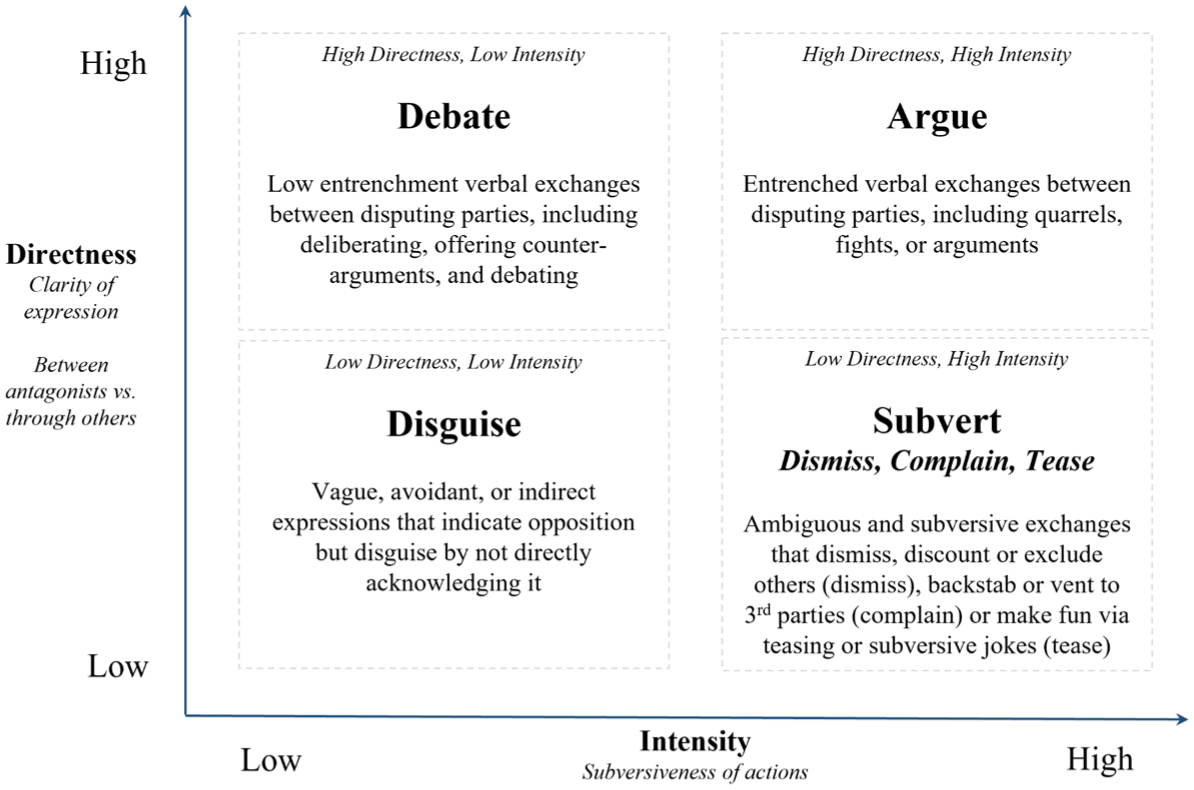
Theoretical summary of conflict expression tendencies dimensions.
Argue (High Directness/High Oppositional Intensity)
When conflicts are expressed with high directness and high oppositional intensity, they communicate unambiguous opposition, occur between conflicting parties (rather than with third parties), and are characterized by entrenched defense of a position (Weingart et al., 2015). Social groups that tend to engage in direct and oppositionally-intense conflict expressions exhibit arguments, attacks on the other’s positions, positional language, or unyielding defense of a point of view or desired outcome (e.g., Donohue, 2011; Pruitt, 1983; Pruitt & Rubin, 1986). This dimension captures direct and intense verbal confrontation behaviors, such as ultimatums, threats, angry responses, and an unwillingness to yield, that have been described in the negotiations and conflict style literatures (Fisher et al., 1991; Putnam & Wilson, 1982; Rahim, 1983; van de Vliert & Euwema, 1994).
Debate (High Directness/Low Oppositional Intensity)
Conflicts expressed with high directness and low oppositional intensity are characterized by oppositional statements that are not particularly entrenched or subversive and occur directly between the disagreeing parties (Weingart et al., 2015). Social groups that tend to express conflicts this way engage in debates where conflicting parties clearly state their opposition to one another while remaining open to integrating the ideas of the other into their thinking and responses. This type of back-and-forth interaction is direct because positions are articulated, clear in their meaning, and occur between the disputants rather than via third parties (Simons et al., 1999). They are also low in oppositional intensity because they reflect a perceived willingness to consider the other’s point of view (i.e., the parties are receptive: Minson & Chen, 2022; Tsai & Bendersky, 2016). The Debate dimension of the CET aligns with inquiry-based (versus advocacy) approaches to decision-making (Garvin & Roberto, 2001), problem-solving approaches to managing and resolving conflict (De Dreu et al., 2001; Pruitt & Rubin, 1986; Putnam & Wilson, 1982; van de Vliert & Euwema, 1994), and integrative negotiation strategies (Fisher et al., 1991; Pruitt & Lewis, 1975) in that they all are direct and low oppositional intensity conflict approaches. They differ in that debate specifically focuses on how opposition is expressed in workgroup conflicts rather than how groups make decisions or how conflict is resolved.
Subvert (Low Directness/High Oppositional Intensity)
There are many ways people can express opposition indirectly and with high intensity, including “ignoring or discounting another’s perspective, mean-spirited teasing, social undermining. . ., backstabbing, or mobilizing a blocking coalition” (see Weingart et al., 2015, p. 247; also see Duffy et al., 2002; Keltner et al., 2001; Malone & Hayes, 2012; Maynes & Podsakoff, 2014; Rawlings & Findlay, 2016). 4 Based on our review of the literature, it became clear that many related concepts have been studied independently, but little attention has been given to their shared properties of low directness and high oppositional intensity. In addition, related constructs often do not cleanly distinguish between direct and indirect behaviors. For example, the popular scale developed to measure “social undermining” includes some low directness, high oppositional intensity items, such as “. . .undermined your effort to be successful on the job,” and “. . .spread rumors about you,” but also some items that are very direct and oppositionally-intense, such as, “. . .belittled you or your ideas” and “. . .insulted you” (Duffy et al., 2002, p. 340). In contrast, the CET dimension, Subvert, is limited to indirect communication. Thus, although social undermining is clearly related, it spans the conflict expression property of directness more broadly than does Subvert.
Based on our literature review, we determined that the Subvert dimension was behaviorally more complex than the other three dimensions were. Thus, we theoretically and then empirically derived (and validated in Study 1 below) three subdimensions that reflect the variety of forms of subversion that commonly occur in interpersonal conflict: Dismiss: obstructive behavior that diverts critical resources or attention away from individuals to diminish their influence; Tease: hindering others through thinly veiled insults, making fun of others, or mean-spirited teasing; and Complain: backstabbing or venting behavior, in which an individual talks negatively about another person or their conflict behind their back. Each of these subdimensions of Subvert reflects a veiled attempt to undermine another person.
Disguise (Low Directness/Low Oppositional Intensity)
In contrast to the oppositionally intense nature of Subvert, the lower intensity of the indirect dimension, Disguise, includes equivocal behaviors that merely cue that there is opposition such that the meaning is ambiguous and the intent to harm is difficult to recognize (Weingart et al., 2015). Conflict expressions like passive aggression (expressions of covert and diffuse intent to harm; McIlduff & Coghlan, 2000), ostracism (being ignored, excluded, and/or rejected; Ferris et al., 2017; Williams, 2007) and incivility (acting with disregard for others; Andersson & Pearson, 1999) indirectly suggest that there is a problem but do not overtly threaten the receiver. These can manifest as saying one thing but meaning another, withholding information, or making vague statements that leave the commitment to a point of view or intended meaning open to interpretation (Holtgraves, 1997). These behaviors have been called “masking” or “channel inconsistency” in other research (Ekman et al., 1972; Ekman et al., 1987; Watzlawick et al., 1967). Conflict expressions of this type tend to convey vague opposition, but the content or reasons for the problem is disguised and requires inference to determine how to respond.
Conflict Expression Tendencies as an Alternative Theoretical Function of Workgroup Conflict
The CET offers a novel function, or underlying theoretical mechanism, through which workgroup conflict influences outcomes (Morgeson & Hoffman, 1999) that is distinguishable from conflict type (Jehn, 1995, 1997) and conflict management strategies (De Dreu et al., 2001; Rahim, 1983, 2002; van de Vliert & Euwema, 1994). While conflict type emphasizes the degree or frequency of conflict that arises and conflict management strategies focus on how groups typically resolve their conflicts, the CET captures individuals’ perceptions of how opposition tends to be expressed within a social group.
Conflict expression theory argues that any type of conflict can be expressed with any degree of oppositional intensity and directness, so they should be empirically distinguishable. Measures of conflict type typically capture the prevalence of three different types of conflict: task (disagreement over ideas and opinions pertaining to the group’s task), process (disagreement over logistics or methods of accomplishing tasks), and relationship (interpersonal incompatibility, typically including tension, annoyance, and animosity; see Jehn, 1995, 1997). While we expect measures of conflict type to be empirically distinct from conflict expression tendencies, they will not be perfectly so. Relationship conflict, being personal rather than task-focused, is most often characterized (and measured) as including negative emotions because it is ego-threatening, whereas task conflict has been characterized as more cognitive in nature and, by extension, less emotional (process conflict was conceptualized as somewhere in the middle). 5 Since emotionality is related to oppositional intensity (both for senders and receivers; Weingart et al., 2015), this implies that different conflict types may be expressed in systematically different ways. Therefore, conflict type and conflict expression tendencies may be related, but we expect them to be empirically distinct and will test their discriminant validity.
Measures of conflict management approaches are designed to capture how people attempt to resolve conflict (e.g., De Dreu et al., 2001; Janssen et al., 1999) as a function of two independent concerns: concern for own outcomes and concern for the counterpart’s outcomes (Pruitt & Rubin, 1986). Most research on conflict management approaches has focused on five strategies: yielding, compromising, forcing, problem-solving, and avoiding. Strategies that consider both one’s own and others’ outcomes, such as problem solving (optimizing both one’s own and others’ interests; also known as collaborating and integrating) and, to a lesser extent, compromising (which satisfices rather than optimizes both parties’ interests), tend to produce the most constructive, satisfying, and sustainable outcomes (DeChurch et al., 2013; De Dreu et al., 2000).
We argue that conflict expression tendencies and conflict management approaches are theoretically distinct such that the oppositional intensity and directness with which a group expresses their disagreement is functionally independent from the approach they might use to resolve their conflicts. To illustrate, a group that tends to argue when faced with conflict can use any of the conflict management approaches to resolve their disagreement. That said, it is possible that a given CET may correlate more highly with some conflict management approaches than others. We would expect groups that tend to argue when faced with conflict will be more likely to use forcing strategies to resolve conflict and groups that disguise their conflict expression may be more likely to avoid managing it because of the ambiguity associated with whether it exists. To that point, a few studies have examined the causal impact of conflict expression on conflict management strategies and collaboration behavior by manipulating the directness and oppositional intensity of conflict expressions using vignettes and instructions. Results show that, as expected, higher directness and lower oppositional intensity conflict expressions are associated with the most collaborative behaviors (Brykman & O’Neill, 2023; Todorova et al., 2022; Tsai, 2023). These studies have demonstrated that though one might impact the other, conflict expressions are empirically distinct from conflict management strategies.
Thus, we expect the CET to be distinct from conflict types and conflict management approaches due to differences in their theoretical functions. However, we also expect them to be moderately correlated in predictable ways based on the shared conflict setting that impacts all three functions. Importantly, we propose that individuals’ perceptions of the conflict expression tendencies within their social group will meaningfully impact downstream outcomes above-and-beyond those alternative functions of conflict because the theory suggests that conflicts of any type and managed using any strategy can be expressed with varying degrees of oppositional intensity and directness.
Conflict Expression Tendencies and Individual Psychological States
The criterion validity of the CET can be assessed by examining if an individual’s perceptions of their social group’s conflict expression tendencies are associated with their own emotions, cognitions, and social psychological states. These outcomes serve as appropriate criteria because they influence team members’ capabilities and willingness to work together toward a common goal (Barrett et al., 1981). Ample research shows that conflict advances individuals’ understanding of the problem while triggering emotions and influencing attitudes toward others involved because conflict communicates a potential threat implied by the disagreement (Cronin & Bezrukova, 2019; Halevy et al., 2012; Weingart et al., 2015). Thus, we examine the associations between the CET and three specific constructs from the conflict type literature that reflect individuals’ emotional, cognitive, and psychological states and have been shown to influence team performance and/or viability: positive and negative affect (Jehn et al., 2008; Rispens & Demerouti, 2016; Todorova et al., 2014), information exchange and acquisition/learning (De Dreu et al., 2008; Gibson & Vermeulen, 2003; Humphrey et al., 2017; Todorova et al., 2014), and interpersonal trust (De Jong & Elfring, 2010; Jones & George, 1998; Simons & Peterson, 2000). Studies generally find harmful relationships between each type of conflict and affect, information acquisition, and trust, with mixed effects of task conflict, particularly on information acquisition (see de Wit et al., 2012 for a meta-analytic review). The potential benefits of task conflict arise from promoting inquisitive problem-solving approaches in a depersonalized way that avoids ego and interpersonal threat (de Wit et al., 2012). By reframing the general findings of research on conflict types in terms of conflict expression theory, we posit that the less conflicts are experienced as interpersonally threatening (i.e., less oppositionally intense) and substantively ambiguous (i.e., more direct), the less disruptive they are (i.e., more information is exchanged, emotions are more positive and less negative, and trust is higher).
Conflict management research has also examined the impact of different approaches on emotions, cognitions, and social psychological states. Notably, Behfar et al. (2008) found that different conflict management strategies used to resolve team conflicts were associated with distinct patterns of team performance and member satisfaction. Teams that achieved high and increasing performance and member satisfaction utilized a mix of accommodating, problem solving, and compromising strategies that considered the interests of all parties in the conflict. Similarly, DeChurch et al. (2013) determined through a meta-analysis that “collectivistic,” other-oriented conflict management styles were positively associated with team performance and affective outcomes.
To evaluate the criterion and incremental validity of the CET in relation to the alternative functions of conflict, we develop predictions regarding the four CET dimensions on information acquisition, positive and negative affect, and trust based on how the property of directness conveys information and the property of oppositional intensity conveys threat. Furthermore, the original conflict expression theory paper (Weingart et al., 2015) posits that the effect of directness is moderated by oppositional intensity, such that directness is more positively associated with information acquisition when oppositional intensity is low than when it is high. That is, information conveyed in direct conflict expressions is more likely to result in information acquisition when expressed with low (versus high) oppositional intensity because receivers are more open to that information when not feeling threatened.
Associations With Argue
The conflict expression framework suggests that the Argue CET dimension will be associated with high levels of threat because the high level of oppositional intensity conveys a clear attempt to thwart another’s personal goals or denigrate their status. Higher levels of threat are typically associated with negative, higher activation emotions, such as anger and frustration (Friedman & Forster, 2010). Given that positive and negative emotions tend to be highly negatively correlated (Larsen et al., 2017), we also predict that people will experience lower levels of positive emotions in the face of threat associated with arguing. Furthermore, because the receiver perceives the sender as trying to harm the receiver’s interests, Argue should be negatively related to trust. Even though arguing involves direct communication, the high level of oppositional intensity dampens the potentially positive association with information acquisition. The negative, higher-activation affect states tend to encourage a win-lose orientation, repeating positions instead of compromising, and narrow information processing, which result in lower information acquisition (Elfenbein, 2007; Fisher et al., 1991). Thus, we predict that Argue CETs will be positively associated with negative affect and negatively associated with positive affect, trust, and information acquisition.
Associations With Debate
In contrast, individuals who perceive conflict expression tendencies characterized by higher directness but lower oppositional intensity (i.e., Debate CET dimension) experience these interactions as substantively clear but less threatening than arguments (Weingart et al., 2015). This dimension of conflict expression is likely to be associated with high levels of information acquisition (Cronin & Weingart, 2019; Tsai, 2023) because the low oppositional intensity promotes receptivity to the other party’s points-of-view (Minson & Chen, 2022; Tsai & Bendersky, 2016). In the context of less threat and the associated ability to focus more on the premise of an argument rather than the motives of the sender, trust may be higher, and debates will provoke positive affect such as interest and energy in the receiver as people become engaged in the conflict interaction and see the potential for progress toward resolution (Todorova et al., 2014). By extension, we expect that debate will decrease negative emotions. Thus, we predict that Debate CETs will be positively associated with positive affect, trust, and information acquisition and negatively associated with negative affect.
Associations With Subvert and Disguise
When conflict is communicated in more indirect ways, the ambiguity gives the sender the ability to “decommit,” to claim plausible deniability, or to create strategic ambiguity (Baron & Neuman, 1996; Binning & Wagner, 2002; Bush, 1983; Johnson, 1990). Within both of the low-directness CET dimensions—Subvert and Disguise—the receiver needs to expend energy on understanding the real meaning of a message, the motives of the sender, and the surrounding context of the expression, reducing the ease and likelihood of information acquisition (Krueger et al., 2022).
The predicted associations between Subvert and Disguise with affect and trust vary by oppositional intensity. Due to their high oppositional intensity and subversive nature, Subvert CETs should be associated with high levels of threat. The ambiguity and uncertain intent communicated with low directness in the context of high threat will likely reduce trust and increase negative affect by triggering negative attributions and defensive responses (Krueger et al., 2022). Moreover, the ambiguity and uncertainty in indirect conflict expressions are likely to reduce positive affect because uncertainty creates cognitive and emotional strain, which in turn reduces positive affect (Anderson et al., 2019). We predict that Subvert CETs will be negatively associated with positive affect, trust, and information acquisition, and positively related to negative affect.
The effects of Disguise CETs are harder to predict a priori due to little prior research to draw from. Following our logic, low directness should be negatively associated with information sharing. The low levels of oppositional intensity should not be experienced as threatening, but that does not mean Disguise CETs would promote stronger positive emotions or higher levels of trust due to the ambiguity and uncertainty from the indirectness of the expressions. Thus, we do not expect Disguise CETs to be significantly related to negative or positive emotions or trust.
In the remainder of this paper, we present a series of studies that validate the CET measure and demonstrate the theoretical and empirical gains the CET can offer in the study of workgroup conflict.
Study 1: Developing the Conflict Expression Tendencies (CET) Measure
The purpose of Study 1 was to develop items to measure individuals’ perceptions of conflict expression tendencies, assess their internal consistency and provide initial validation evidence for the theoretically derived factor structure of the CET (L. A. Clark & Watson, 1995). We first generated items that represent the theoretical dimensions described above and then validated them using a sample of working adults in the U.S. Consistent with best practices in scale development (DeVellis, 1991), we used separate samples to select the final items (Study 1a) and to confirm the theoretical dimensions (Study 1b). Results of power analyses using a point-biserial correlation model suggested a minimum sample size of 314 participants to detect an effect size of 0.20 with a power of 0.95. Accordingly, we targeted recruiting approximately 320 working adults for both Studies 1a and 1b. After excluding participants who failed the attention check, the final sample for Study 1 consisted of 641 adults who completed the survey (47.2% female, M = 31.36 years, SD = 9.72). We then randomly split the dataset into two subsets: 320 observations for selecting final items in Study 1a and 321 observations for testing the construct validity and reliability of the final scales via confirmatory factor analyses in Study 1b (Dahl et al., 2008).
Study 1a—Item Generation and Preliminary Item Selection
We designed the CET to be a reflective measure, such that each item serves as an observable manifestation of the underlying latent (sub)dimension (i.e., the conflict expression tendency) it represents (MacKenzie et al., 2011). Reflective indicators of latent constructs, especially in the form of synonyms, reflect the construct, share a common theme in that they are largely interchangeable and covary, and dropping an indicator does not change the conceptual domain of the construct (Weber, 2021). We generated four items for each proposed CET (sub)dimension by creating a list of reflective indicators for each of the conflict expression tendencies we aimed to capture. All items included the phrase, “when we have conflict” or “during conflict” to ensure respondents were focused on how conflicts are expressed rather than their communication tendencies in general. Our initial set of terms included: Argue (fight, clash, quarrel, and argue), Debate (debate, deliberate, present counter-arguments, and go back-and-forth), Disguise (ambiguous about our differences, vague when expressing our differences, indirect when expressing our concerns, or avoid saying what we really mean), and for each of the three theoretically derived subscales of Subvert (Dismiss: unwilling to consider, disregard, ignore, or discount one another’s perspectives; Tease: tease one another, make fun of one another, make one another the target of jokes, use a sarcastic tone with one another; Complain: go to others who share our concerns, complain about other people, talk behind each other’s back, and vent to other people). Our intention was to develop a valid formative scale for Subvert that included three reflective scales (Edwards, 2011).
To obtain a cross-section of employed adults who had experience working in teams, we recruited participants through Amazon Mechanical Turk, offering a payment of $1.50 for their participation, which was consistent with market rates at the time. To be eligible to participate, respondents needed to currently be working at least 20 hr per week with individuals outside their home. We implemented standard best practices to ensure the quality of the data, including attention checks and screening criteria. 6 Participants were asked to recall a group they had worked with in an organization within the past six months and rate how closely each survey item reflected their experiences.
We evaluated item quality using multiple complementary diagnostics recommended in scale development, including descriptive statistics (e.g., mean, variance, frequency of response options), item–total correlations, and exploratory factor analyses within each theoretically derived dimension or subdimension (DeVellis, 1991). We also examined each item’s residual variance estimates from the confirmatory factor models. For example, we aimed to identify items showing restricted variance or highly skewed response distributions, item–total correlations below approximately 0.30, factor loadings below 0.50, or elevated residual variances relative to other items within the same dimension. We also inspected residual correlations to identify potential redundancy, checking items with substantial residual correlations (e.g., |r| > .30). Across these indicators, all four items within each CET dimension demonstrated solid psychometric properties, with no evidence of invalidity. However, because our goal was to develop a theoretically grounded yet parsimonious scale, we selected three items that provided the best overall combination of conceptual coverage and statistical indicators of item quality for each dimension. 7 We present the final items, proposed factor structure, and inter-item reliabilities of the CET in Table 1. The complete 18-item CET is in Supplemental Appendix A.
Study 1a: Experienced Conflict Interactions Final Items and Item Descriptive Statistics.
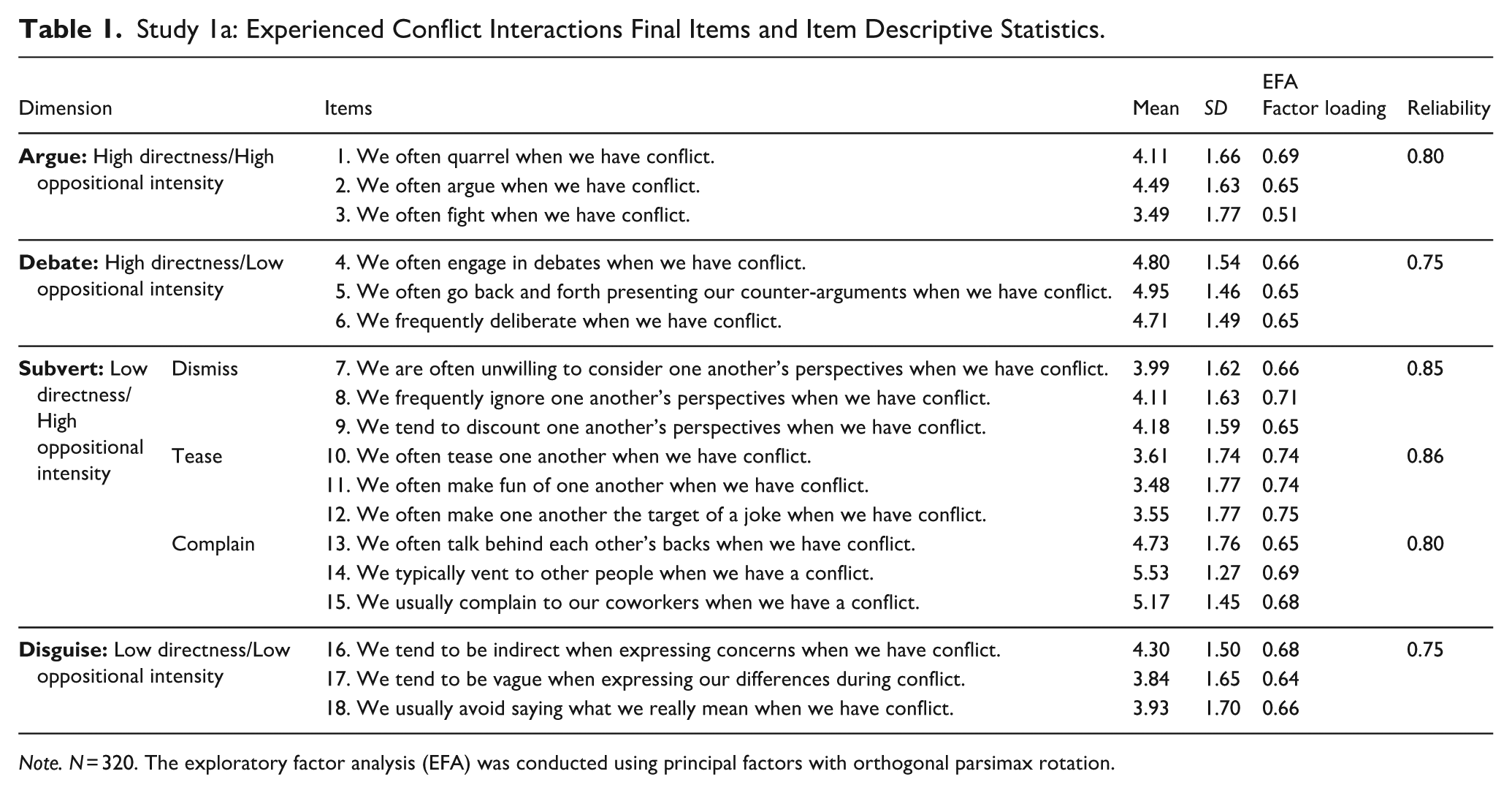
Note. N = 320. The exploratory factor analysis (EFA) was conducted using principal factors with orthogonal parsimax rotation.
Study 1b—Confirmatory Sample
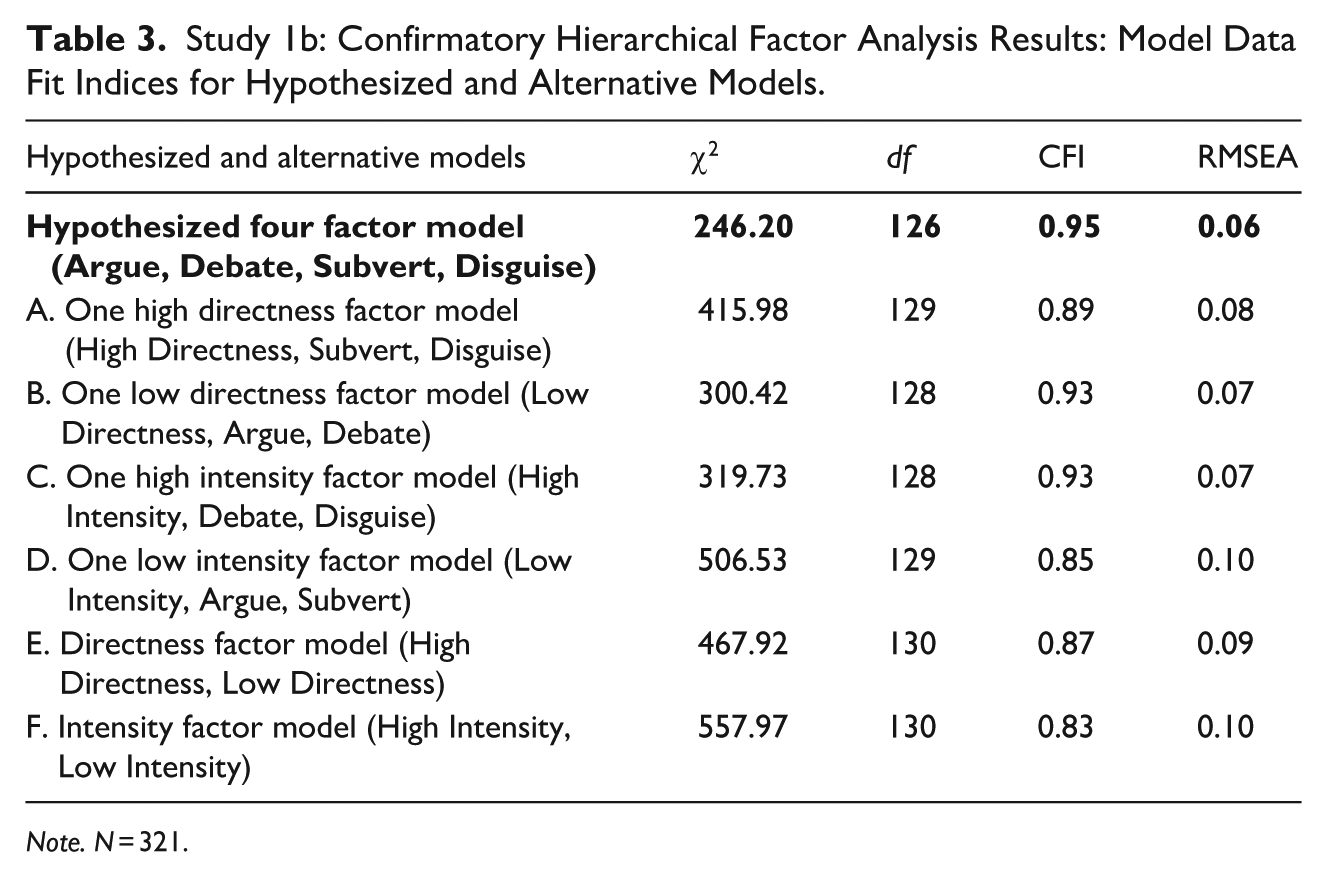
We used the other half of the sample (n = 321) to conduct confirmatory factor analyses (CFA) of our 18 final items (see Table 2 for descriptive statistics, reliabilities, and correlations of the CET scales). To assess the validity of our hypothesized factor structure, we conducted a hierarchical confirmatory factor analysis (CFA) of our proposed model, which specifies that the four factors—Argue, Debate, Subvert, and Disguise—are conceptually and empirically distinct (see Figure 2 for parameter estimates). The results provided strong support for this factor structure: χ2(126) = 246.20, CFI = 0.95, RMSEA = 0.06.
Study 1b: Descriptive Statistics, Scale Reliabilities, and Correlations.
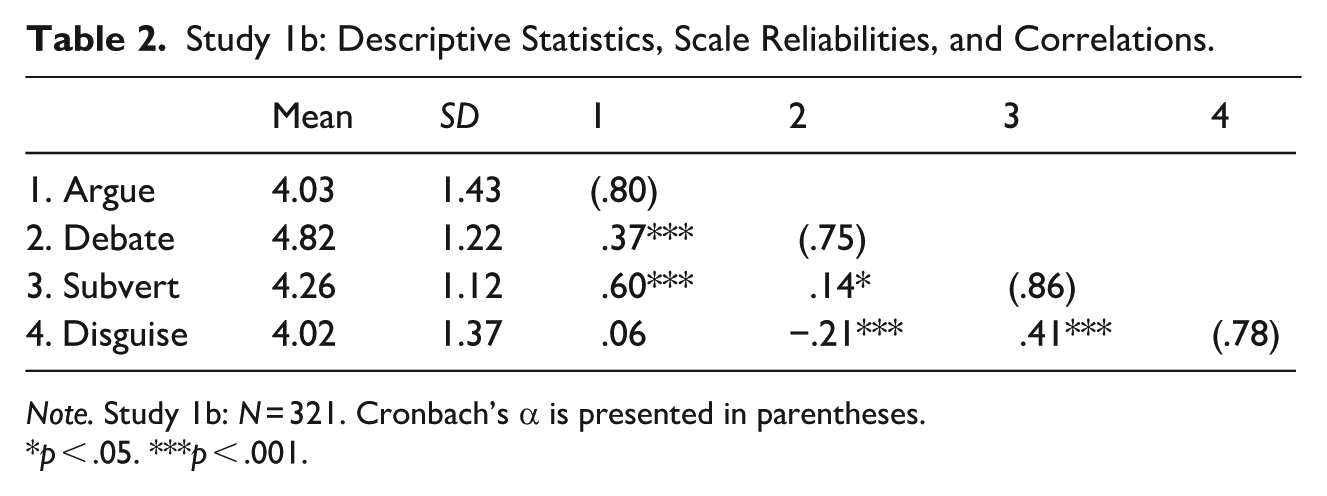
Note. Study 1b: N = 321. Cronbach’s α is presented in parentheses.
p < .05. ***p < .001.
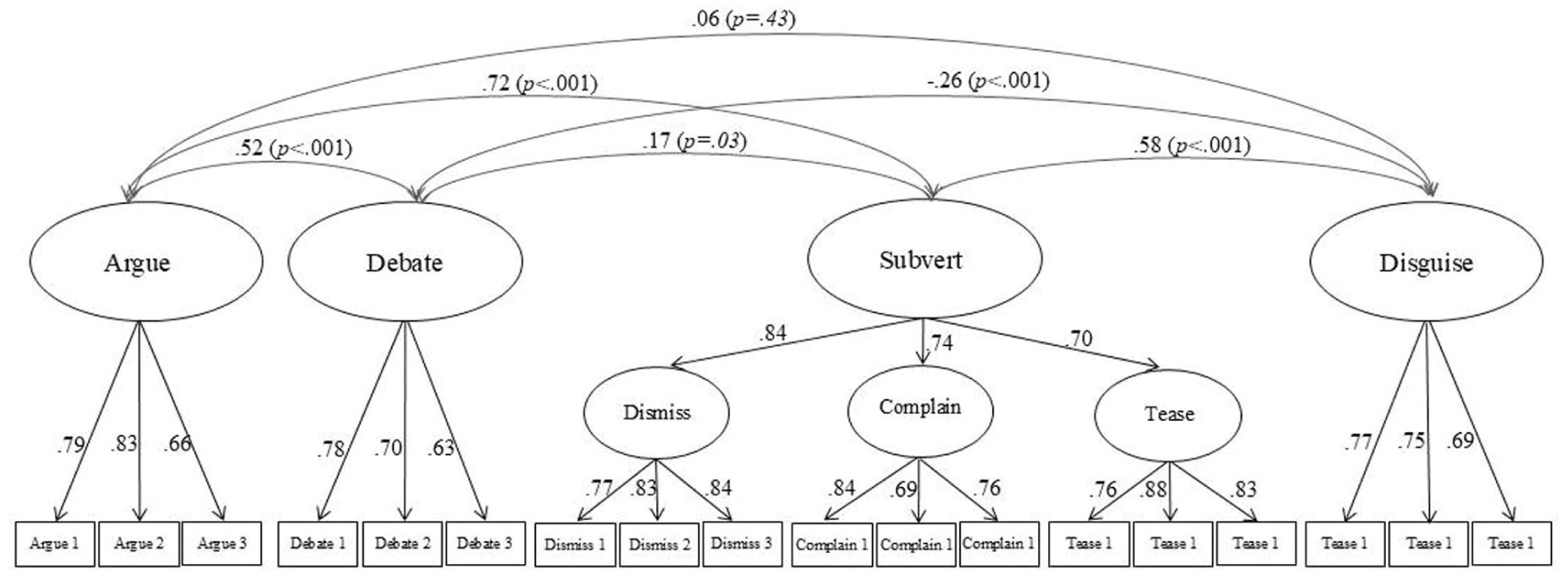
Study 1b: Estimates for CET hypothesized factor model.
Examining the correlations among the four hypothesized latent factors representing the four scales of the CET measure revealed that, as expected, the factors that shared a given property (oppositional intensity or directness) of expression were on average more highly correlated than the factors that did not. Using the hypothesized factor structure (which assumes directness and oppositional intensity jointly contribute to formulating the four dimensions) as the base model, we conducted model comparisons against six theoretically possible alternative models. The first four models in Table 3 (Models A–D) test whether pairs of CET factors that share high directness or oppositional intensity are better represented by a single factor reflecting that shared dimension. For example, Model A examines whether Argue and Debate can be collapsed into one factor representing high directness. The final two models test whether the overall distinction between high versus low directness (Model E) or high versus low oppositional intensity (Model F) best explains the CET structure. We used two fit indices (i.e., CFI and RMSEA) to assess the base model against these alternative models (see Table 3). Results showed that the base model with the hypothesized four factor structure outperformed all the alternative models.
Study 1b: Confirmatory Hierarchical Factor Analysis Results: Model Data Fit Indices for Hypothesized and Alternative Models.
Note. N = 321.
Discussion
The results of Study 1 provide the initial validation results for the four scales of the CET measure. It revealed that the 18-item CET has good psychometric properties, and the factor structure supports the four hypothesized CET dimensions derived from the two theoretical properties of directness and oppositional intensity. Although correlated, each of our four dimensions captures unique variance in item responses.
Study 2: Content Validity
The goal of Study 2 was to assess the content validity of the CET by determining if the scale items accurately represent their respective intended dimensions. To achieve this, we employed a method similar to that proposed by Hinkin and Tracey (1999) and preregistered the study protocol (https://aspredicted.org/9sn5-dxyp.pdf).
Method
We invited 20 Ph.D. students with expertise in Organizational Behavior to voluntarily participate in the study as part of their research training, rather than for financial compensation. Prior research has demonstrated that using student samples or other small panels of subject-matter experts is both appropriate and effective for evaluating the content validity of scales (e.g., M. A. Clark et al., 2020; Colquitt et al., 2019; Eby et al., 2008). In addition, relatively smaller sample sizes are generally acceptable at this stage of scale development because the primary focus is on evaluating the clarity, representativeness, and relevance of the items rather than on estimating stable parameter values (e.g., Haynes et al., 1995; Hinkin, 1998). We excluded three participants who either failed one of two practice items twice consecutively or self-reported that their responses were not of sufficient quality to be included in the research. The final sample for this study consisted of 17 individuals: 6 male (35.3%), 10 female (58.8%), and one participant who preferred not to disclose their gender. The mean age of participants was 29 years (SD = 5.56), and 11 participants (64.7%) reported that English was their first language.
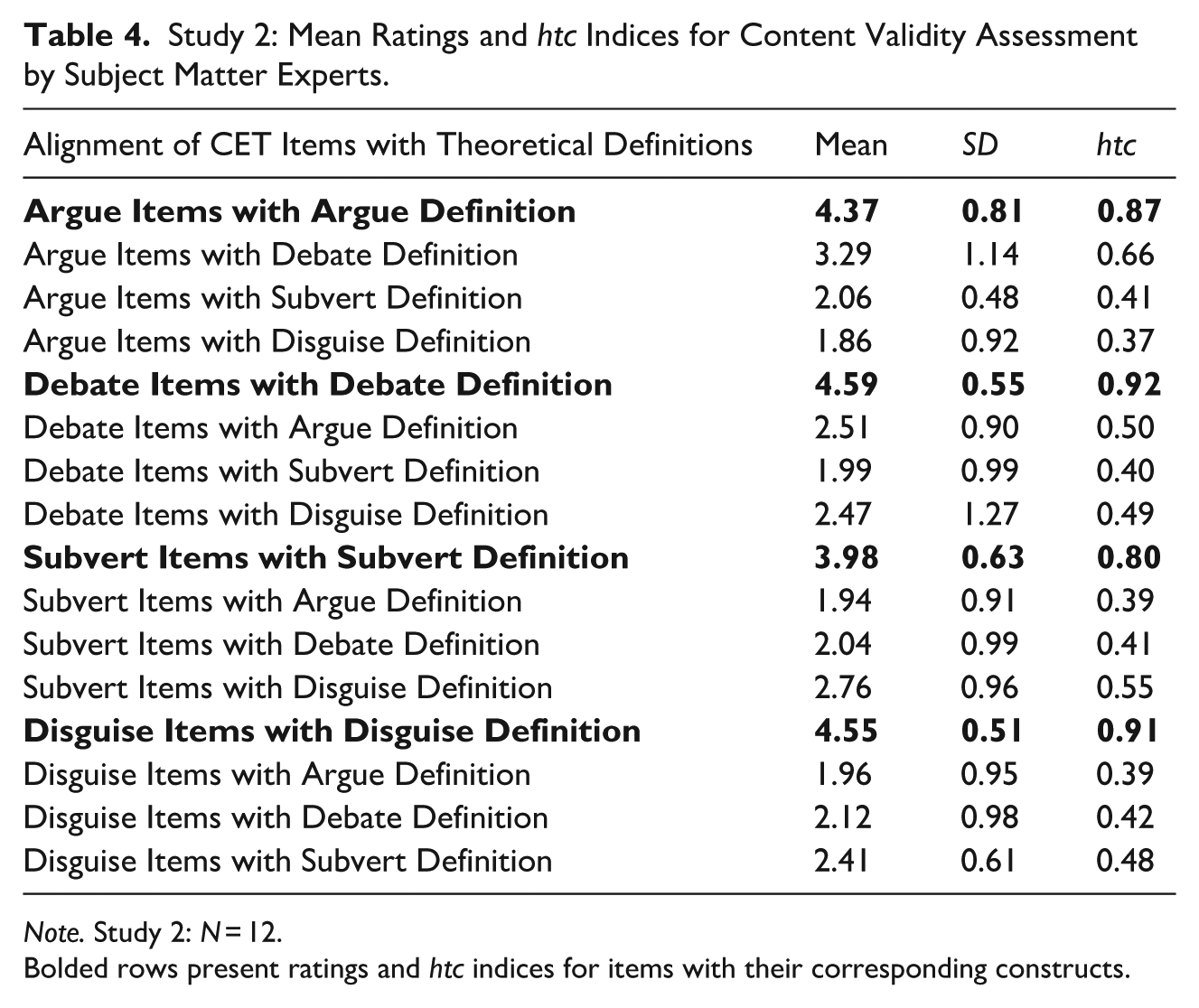
Participants were asked to evaluate the extent to which the CET items aligned with the definitions of their respective dimensions. Each CET item was evaluated across the four definition conditions of Argue, Debate, Subvert, and Disguise, presented in four separate blocks. Both the order of the blocks and the order of items within each block were randomized to minimize potential order effects. For each item, participants rated alignment using a five-point scale with the following response options: “1 = Item does an EXTREMELY BAD job of measuring the statement above,” “2 = Item does a BAD job of measuring statement above,” “3 = Item does an ADEQUATE job of measuring the statement above,” “4 = Item does a GOOD job of measuring the statement above,” and “5 = Item does an EXTREMELY GOOD job of measuring the statement above.” We analyzed the mean difference in ratings between items within the target dimension (e.g., Argue items in the Argue dimension condition) and items from other dimensions (i.e., Argue items in one of the Debate, Subvert, and Disguise dimensions). Following the recommendations of Colquitt and colleagues (2019), we also calculated the Hinkin Tracey Correspondence (htc) for each construct.
Data Analysis and Results
We present the mean ratings and htc indices for items both within their corresponding and non-corresponding constructs in Table 4. The results indicated that each of the four CET scales demonstrated good levels of content validity, with the Subvert scale being rated slightly lower than the others: Argue (M = 4.37, SD = 0.81, htc = 0.87); Debate (M = 4.59, SD = 0.55, htc = 0.92); Subvert (M = 3.98, SD = 0.63, htc = 0.80); Disguise (M = 4.55, SD = 0.51, htc = 0.91).
Study 2: Mean Ratings and htc Indices for Content Validity Assessment by Subject Matter Experts.
Note. Study 2: N = 12.
Bolded rows present ratings and htc indices for items with their corresponding constructs.
We conducted one-way repeated measures ANOVA analyses for each dimension to test if the mean rating for items in the corresponding dimension condition was higher than the mean ratings in non-corresponding dimension conditions. Results indicated significant mean differences across the four definition conditions (Argue: F = 34.59, p < .001; Debate: F = 39.22, p < .001; Subvert: F = 23.01, p < .001; Disguise: F = 52.57, p < .001). Planned contrasts revealed significant mean differences between the corresponding vs non-corresponding dimension conditions (e.g., for Argue items: Argue vs. Debate, Subvert, and Disguise) at p < .001 with all pairwise comparisons significant at p < .01.
Discussion
The goal of Study 2 was to demonstrate the content validity of the CET scale. Our results indicate that the items from the CET scale align well with their intended constructs. While the four scales of CET measure demonstrated appropriate levels of content validity overall, the items measuring the Subvert dimension exhibited the lowest levels. We suspect this occurred because the Subvert dimension is a formative scale that captures a broader range of conflict expression behaviors (as compared to the other dimensions) whose meaning is more open to interpretation given their indirect nature (i.e., dismissing, teasing, and complaining). This combination of breadth and indirectness may make it more challenging for participants to interpret these items consistently compared to other dimensions. Nonetheless, the mean ratings and corresponding htc index for the Subvert dimension provide evidence supporting its content validity.
Study 3: Nomological Network and Convergent Validity of CET
In Study 3, we examine the nomological network of the CET scales by mapping them onto orbiting constructs drawn from literature on interpersonal communication that are theoretically related with specific CET scales in terms of their directness and oppositional intensity. The goal is to examine predicted associations between CET factors and related constructs in the literature, in line with its proposed theoretical positioning with established research streams. We identified six constructs that closely align with the CET framework to serve as a meaningful set of comparison constructs for evaluating patterns of expected relationships.
Method
Participants were recruited via Prolific for $2.00, which was consistent with market rates at the time, and completed four CET scales followed by six comparison measures, presented in randomized order. We used current best practices for screening bot and low-quality responses. Participants who failed an attention check item that was embedded in the survey and participants who self-reported that their responses were not of sufficient quality were excluded. Based on a power analysis, we aimed for approximately 314 participants (effect size = 0.20, power = 0.95). We recruited 400 individuals, and the final analytic sample consisted of 328 respondents.
Measures
In addition to the CET scales, we measured the following orbiting constructs (each modified to reference the team). We present a complete list of survey items in Supplemental Appendix B.
Solution-orientation strategies from the Organizational Conflict Communication Instrument (Putnam & Wilson, 1982) represent a direct, low-intensity problem-solving style characterized by “direct confrontation, open discussion of alternatives, and acceptances of compromises” (p. 638; e.g., When there is conflict in our team, members tend to. . . “look for areas of agreement” and “compromise with the other person,” 7 items, α = .93). We expect it to align primarily with Debate, and to be somewhat correlated with Argue based on its partial alignment with high directness, and Disguise, based on its partial alignment with low intensity.
Control strategies (Putnam & Wilson, 1982) reflect highly direct and relatively high intensity strategies in which team members engage in “direct confrontation that leads to persistent argument and nonverbal forcing” (Putnam & Wilson, 1982, p. 638), (e.g., When there is conflict on your team, do you tend to. . . “assert your opinion strongly” and “speak loud and clearly when trying to get the other person to accept your position,” 6 items, α = .88). 8 We anticipated that Control Strategies should relate most strongly to Argue due to shared high directness and high intensity. We also expect it to be somewhat correlated with Debate because of the shared high directness, and some of the items in the Control Strategy scale could be interpreted as moderate intensity. Finally, it may also be somewhat correlated with Subvert to the extent that the scales are aligned in terms of intensity.
Destructive voice, teasing, and undermining, are all indirect and high-intensity communications that we expect to align with the CET Subvert scale. Destructive voice (Maynes & Podsakoff, 2014) measures expressions of criticism intended to harm, obstruct, or vent frustration regarding organizational practices (e.g., “often make insulting comments about work-related programs or initiatives,” 5 items, α = .96). We measured teasing with the “humour at work” scale (Rawlings & Findlay, 2016; e.g., Members of my team. . . “use humor to tease one another” and “like being teased,” 5 items, α = .89). Undermining (adapted from Duffy et al., 2002) consists of sustained behaviors that damage another’s effectiveness, reputation, or confidence (e.g., In the past month, how often have members of your team intentionally. . . “insulted you?” and “talked bad behind your back,” 12 items, α = .95). These three constructs correspond most closely with the Subvert and they may also be somewhat correlated with Argue based on their shared high intensity and Disguise, based on their shared indirectness.
Indirect production (Holtgraves, 1997) reflects indirect, low-intensity communication via hints and implications rather than explicit statements (e.g., On my team, . . . “there are many times when we prefer to express ourselves indirectly” and “My teammates’ remarks often have more than one meaning,” 9 items, α = .87). We expect it to relate primarily to Disguise, and secondarily to Subvert, based on shared indirectness, and Debate, based on shared low intensity.
Analysis and Results
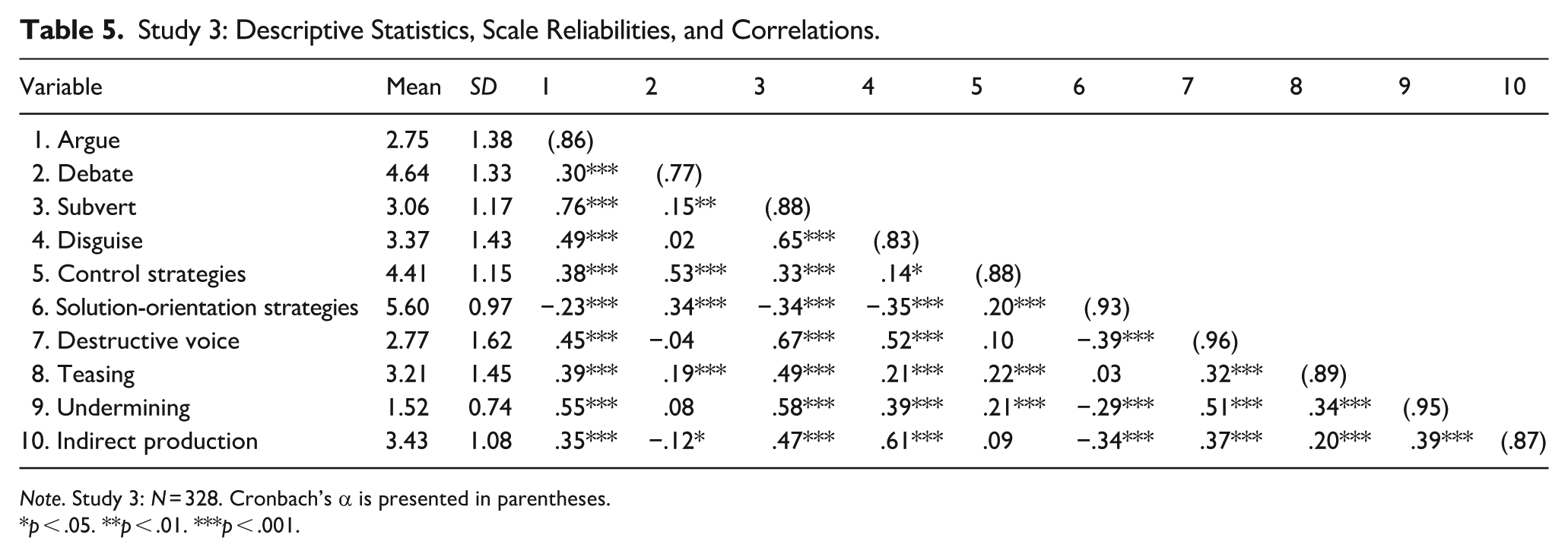
We conducted two complementary analyses to examine how each of the four CET scales relates to the six orbiting measures. First, we calculated bivariate correlations (Table 5). The variables were almost all significantly correlated with each other, generally in the predicted ways. Because the variables were intercorrelated, we also performed multidimensional scaling (MDS), which allowed us to visualize the relative spatial distances among constructs and gain greater insight into the pattern of their relative relationships. Across both approaches, we evaluated whether constructs that share similar levels of directness and/or oppositional intensity of each CET scales are more closely located to one another than are constructs that are less theoretically aligned.
Study 3: Descriptive Statistics, Scale Reliabilities, and Correlations.
Note. Study 3: N = 328. Cronbach’s α is presented in parentheses.
p < .05. **p < .01. ***p < .001.
Argue was positively associated with Control Strategies (r = .38, p < .001) as well as with other high-intensity constructs—Destructive Voice (r = .45, p < .001), Teasing (r = .39, p < .001), and Undermining (r = .55, p < .001). It was also unexpectedly positively correlated with Indirect Production (r = .35, p < .001). In the MDS output, however, Indirect Production is located further from Argue than the other variables (upper-left panel of Figure 3).
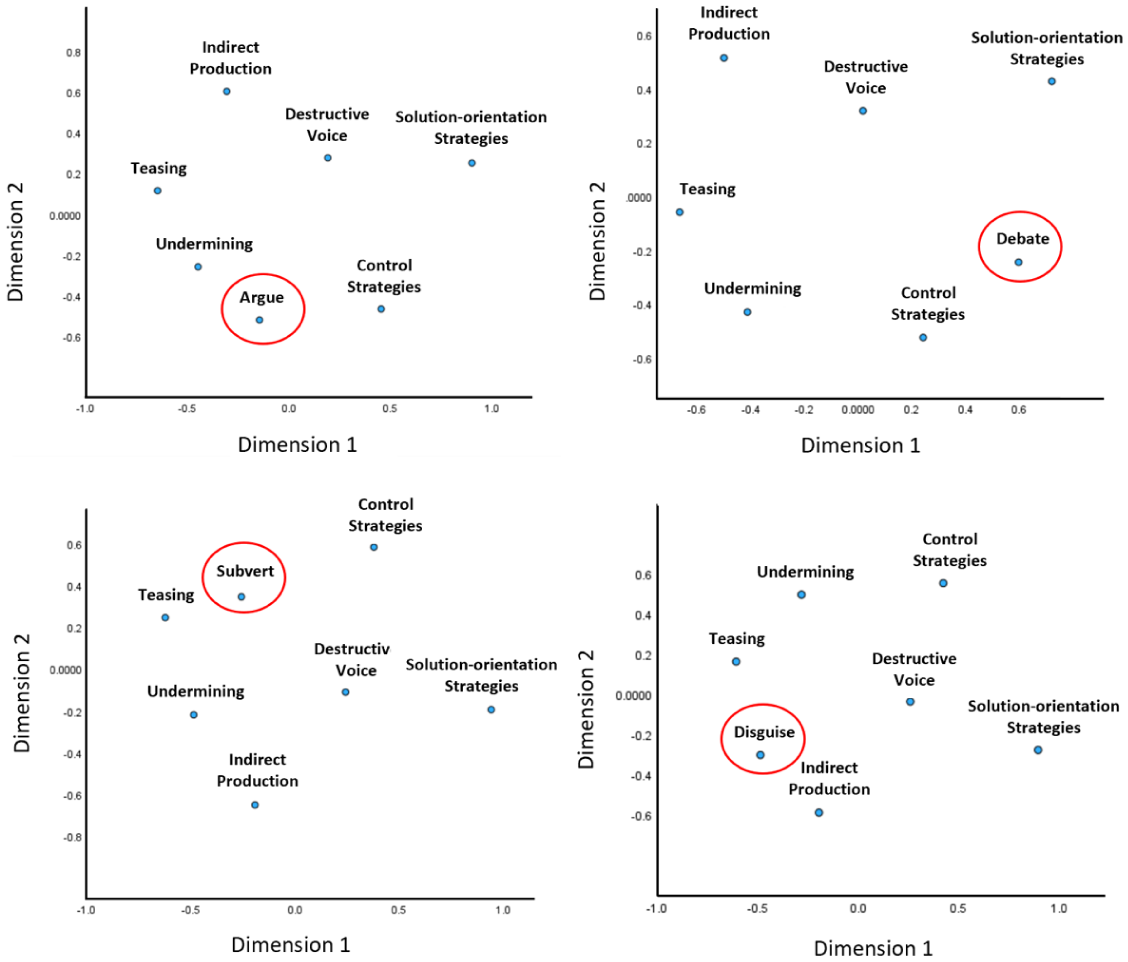
Study 3: Multidimensional scaling of CET constructs and their orbiting constructs.
Debate was positively correlated with both Solution-Orientation Strategies (r = .34, p < .001) and Control Strategies (r = .53, p < .001). It was also somewhat correlated with Teasing (r = .19, p < .001). The MDS configuration placed Debate nearer the Solution-Orientation and Control Strategies constructs (upper-right panel of Figure 3).
Subvert was strongly correlated with Destructive Voice (r = .67, p < .001), Teasing (r = .49, p < .001), and Undermining (r = .58, p < .001). It was also positively correlated with Control Strategies (r = .33, p < .001) and Indirect Production (r = .47, p < .001). In the MDS solution, Subvert clustered most closely with the Teasing, Undermining, Destructive Voice, and Control Strategies constructs (lower-left panel of Figure 3).
Finally, Disguise had a positive association with indirect production (r = .61, p < .001), Destructive Voice (r = .52, p < .001), Teasing (r = .21, p < .001), Undermining (r = .39, p < .001), and to a lesser extent with Control Strategies (r = .14, p = .01). The MDS analyses co-located Disguise and Indirect Production most closely (lower-right panel of Figure 3).
Discussion
Taken together, the correlation and MDS results provide consistent and interpretable evidence of convergent validity for the CET scales. Although we observed some unanticipated significant positive bivariate correlations, all four CET dimensions were positively associated with and located in the MDS space nearest to orbiting constructs that share theoretically similar levels of directness and/or intensity. This pattern supports the core premise of CET theory: that CETs meaningfully organize conflict communication along the intersecting dimensions of directness and oppositional intensity.
Importantly, this study also begins to map the broader nomological network surrounding CET. By positioning CET constructs alongside established measures, we were able to test if each CET dimension “sits” in the conceptual space where theory predicts it should using multi-dimensional scaling. For example, Argue clustered with other highly direct and intense forms of expression, such as Control Strategies, while Disguise situated itself near indirect, low-intensity constructs such as Indirect Production. By demonstrating that the CET constructs occupy coherent and theoretically meaningful positions in the nomological network, this study offers compelling support for the convergent validity of the CET scales.
Study 4: Conflict Contexts and the Structural Stability of the CET
In Study 4, we examine the stability of the CET factor structure across the contexts of task, process, and relationship conflict (Jehn, 1995, 1997). The preponderance of research on team conflict differentiates between these types of conflict and demonstrates how they influence team dynamics and outcomes (see DeChurch et al., 2013; De Dreu & Weingart, 2003; de Wit et al., 2012; Yuan et al., 2026, for meta-analytic examinations of task and relationship conflict). Thus, a fundamental question is whether the four CET dimensions can be differentiated in the same way across these conflict contexts. If not, then our theories of CET would need to reflect what the conflict is about, and the CET measure would have to be adjusted accordingly. Each conflict type provides a different interpersonal context for perceiving differences. For example, if relationship conflicts can only be differentiated in terms of directness but not oppositional intensity such that Argue and Debate collapse into one factor and Subvert and Disguise collapse on another, then our theory and measurement approach should reflect conflict type when considering how CET influences information acquisition, trust, and emotions. If there is equivalence across contexts, then we would not need to take conflict type into account. Thus, the goal of Study 4 was to determine whether the four CET dimensions are generalizable across specific conflict contexts.
Method
To investigate these questions, we conducted Study 4 to compare the CET item functioning across different conflict contexts. For each type of conflict, respondents were provided a contextually specific version of the CET prompt (focusing on either task, process, or relationship; see Supplemental Appendix A) before they were asked to recall a conflict at work and respond to the CET items. More specifically, participants were first provided with a definition of the conflict type they should focus on, along with examples of how it manifests. They then read four short descriptions of conflict (e.g., “Conflict about how much time to spend on a project.”) and were asked to select the correct example. If they answered incorrectly, they were shown the correct response before proceeding through the survey. Next, the definition was repeated and participants were asked to generate an example of this type of conflict from work. Finally, they were asked to keep their example in mind while responding to the CET items.
Based on a power analysis using a point-biserial correlation model, we aimed for approximately 314 participants for each of the three conflict contexts (effect size = 0.20, power = 0.95). In the end, 925 working adults were recruited from Amazon Mechanical Turk to participate in this study and were compensated $3.00, consistent with market rates at the time. The participants were 45.4% female and 31.72 years old on average (SD = 9.75). Because responding to the 18-item CET for each of the three types of conflict would create respondent fatigue, we randomly assigned each participant to respond to the CET for two of the three conflict types. The CET items were always presented in a randomized order. Of the 925 participants, 421 participants completed the CET for task conflict, 478 participants completed it for process conflict, and 480 participants completed it for relationship conflict.
Data Analysis and Results
We present the descriptive statistics, reliability, and correlations among the CET scales in Table 6, 9 which provide evidence that the four scales of the CET measure demonstrate good internal consistency (each with a Cronbach’s α > .75) across each of the three conflict contexts. We then examine whether the CET factor structure is invariant across task, process, and relationship conflict contexts.
Study 4: Descriptive Statistics, Reliabilities, and Correlations among CET Scales by Conflict Type.
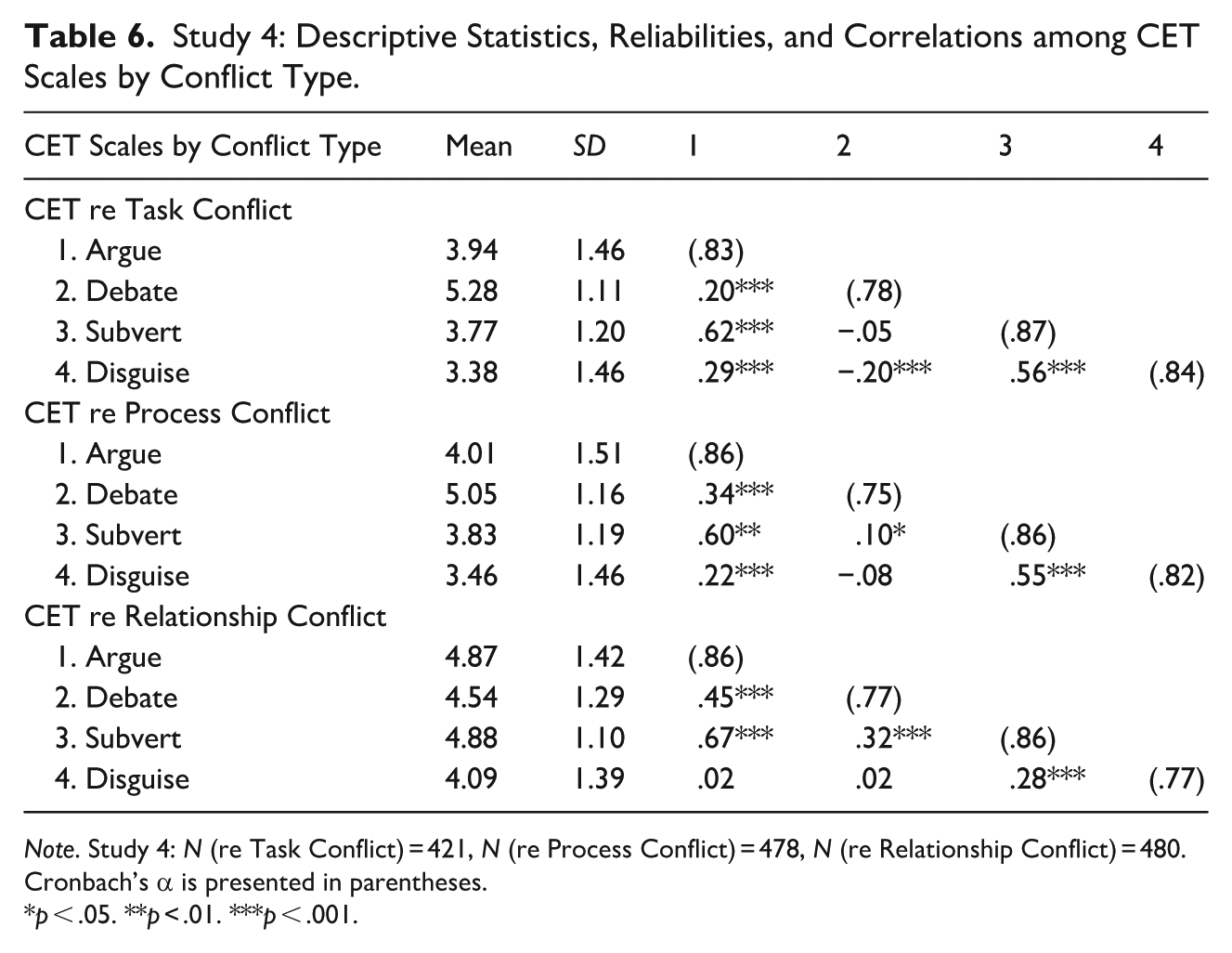
Note. Study 4: N (re Task Conflict) = 421, N (re Process Conflict) = 478, N (re Relationship Conflict) = 480. Cronbach’s α is presented in parentheses.
p < .05. **p < .01. ***p < .001.
We used Multiple Group Analysis (MGA) within a structural equation modeling framework to test (a) configural invariances, (b) metric (i.e., factor loading) invariances (Gregorich, 2006; Stark et al., 2006), and (c) uniqueness invariance (Chen, 2007; Manata et al., 2025). Configural invariance tests whether the proposed factor structure of the CET demonstrates good model data fit within each conflict context. Configural invariance is satisfied when the same factor structure is derived within each condition. Testing for metric invariance across the three conflict contexts enables us to determine if the measurement structure was influenced by the context of the conflict type a respondent was focused upon. If metric invariance does not hold, it would mean the CET factors are dissimilar across conflict types, such that there are differences in the relationship between latent factors and their items depending on which conflict context it is measured. Finally, we examined uniqueness (residual) invariance, which involves constraining the residual variances of the items to be equal across groups. Establishing uniqueness invariance provides evidence that the amount of measurement error associated with each item is comparable across conflict contexts. In other words, it suggests that the indicators demonstrate similar levels of reliability across task, process, and relationship conflict, further supporting the stability of the CET measure.
To assess configural invariance, we conducted separate model comparisons of different CET factor structures within each of the three conflict-type contexts. We also compared the same hypothesized and alternative models described in Study 1b to replicate these findings within each conflict context. The hypothesized four-factor structure provided a good fit to the data for each type of conflict (CET re: task conflict: χ2(126) = 230.73, CFI = 0.97, RMSEA = 0.04; CET re: process Conflict: χ2(126) = 309.41, CFI = 0.96, RMSEA = 0.06; CET re: relationship conflict: χ2(126) = 281.154, CFI = 0.96, RMSEA = 0.05) and was a better fit than each of the six alternative models within each of the three conflict contexts (see Section A of the Supplemental Materials). In other words, the factor structure of our CET model that was confirmed in Study 1 was also replicated in all three conflict contexts in Study 4, indicating that we are tapping into the same latent dimensions with or without reference to a specific conflict type. Thus, the configural invariance test was satisfied.
We next conducted metric invariance tests to examine whether the factor loadings were equivalent across the three conflict contexts by comparing two models: (a) a metric invariance model, in which the factor loadings were constrained to be equal across the two conflict contexts being compared, and (b) a baseline model, in which the loadings were freely estimated across groups (see Table 7). The comparison revealed that the metric invariance model provided a fit to the data that was comparable to the baseline model. Specifically, the model fit indices supported metric invariance across all pairwise comparisons (task vs. process conflict: χ2(266) = 557.70, CFI = 0.96, RMSEA = 0.04; task vs. relationship conflict: χ2(266) = 530.54, CFI = 0.97, RMSEA = 0.03; and process vs. relationship conflict: χ2(266) = 612.39, CFI = 0.96, RMSEA = 0.04). This indicates that the loadings associated with the CET factors did not significantly differ as a function of conflict-type context.
Study 4: Model Data Fit for Base Models and Measurement Invariance Models Among Task, Process, and Relationship Conflict Contexts.
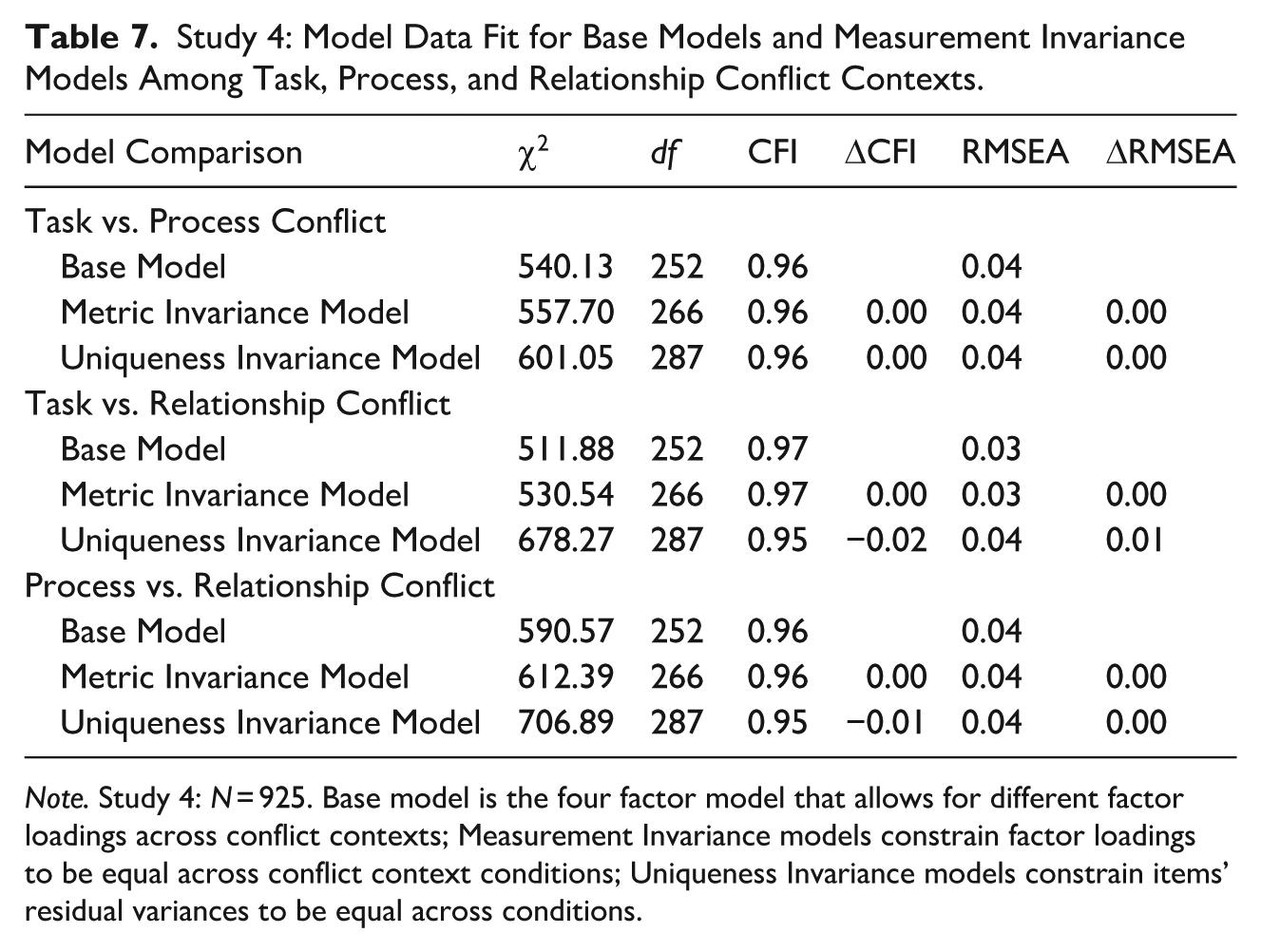
Note. Study 4: N = 925. Base model is the four factor model that allows for different factor loadings across conflict contexts; Measurement Invariance models constrain factor loadings to be equal across conflict context conditions; Uniqueness Invariance models constrain items’ residual variances to be equal across conditions.
We then conducted uniqueness (residual) invariance tests to examine whether the error variances of the items were equivalent across the three conflict contexts. As with the previous step, we compared (a) a uniqueness invariance model with residual variances constrained across groups, and (b) a metric invariance model with residual variances freely estimated. Across all pairwise comparisons, the uniqueness invariance model showed an adequate fit and did not substantially degrade model fit relative to the metric invariance model (task vs. process conflict, χ2(287) = 601.05, CFI = 0.96, RMSEA = 0.04; task vs. relationship conflict, χ2(287) = 678.27, CFI = 0.95, RMSEA = 0.04; and process vs. relationship conflict, χ2(287) = 706.89, CFI = 0.95, RMSEA = 0.04). 10 This provides further evidence that the items function similarly across conflict contexts, reflecting comparable levels of measurement error.
Discussion
The goal of Study 4 was to determine if the four CET dimensions were generalizable across different conflict contexts. The results demonstrated that the CET factor structure was stable across task, process, and relationship conflict contexts, as evidenced by configural, measurement, and uniqueness invariance. Configural invariance indicates that individuals conceptualize the CET dimensions similarly across conflict contexts, while metric invariance suggests that the relationships between latent factors and their indicators are equivalent across contexts. Uniqueness invariance further shows that the amount of measurement error associated with each item is consistent across conflict types. Together, these findings indicate that the psychometric properties of the CET are not significantly influenced by conflict context, supporting its use as a generalizable measure of conflict expression tendencies in unspecified, general conflict as well as in task, process, or relationship conflict situations.
Study 5: Construct Validity of the CET
In Study 5, we assess the construct validity of CET by examining its relationships with other functions of conflict to provide evidence for discriminant validity, and by testing its associations with individuals’ cognitive, affective, and psychological states to establish criterion and incremental validity. We tested the discriminant validity of the CET dimensions with conflict types and conflict management styles, expecting them to be distinct due to their unique functions. To test the discriminant validity of the CET in comparison to conflict types and conflict management approaches, we conducted a series of CFAs with model comparisons between the hypothesized factor model, which assumes that the CET factors are distinct from the conflict type factors and from the conflict management factors, and alternative models where one of the CET factors loads onto one of the conflict type or conflict management factors instead.
Next, we tested the concurrent criterion (Barrett et al., 1981) and incremental validity (Hunsley & Meyer, 2003) of the CET by examining outcomes related to individuals’ cognitive, affective, and psychological states. We tested if Argue, Subvert, and Disguise are negatively associated with individual information acquisition, positive affect, and trust, and positively associated with negative affect; if Debate is positively associated with individual information acquisition, positive and negative affect, and trust; and if the CET scales have predictive power for those DVs above and beyond the conflict types and management strategies variables.
Method
We pre-registered this study before collecting data (https://aspredicted.org/JKX_RYS). Participants were recruited via Prolific for $3.00, consistent with market rates. Based on a power analysis with the number of variables we planned to collect, 11 we aimed to recruit 900 eligible participants who were full-time employees and were working in a team at the time we administered the survey. Per our pre-registration, to ensure high-quality data, we excluded people who failed to pass either of two attention check items that we embedded in the survey, and those who took an unreasonably short amount of time to complete the survey (based on pilot testing, we excluded participants who took less than 5 min). The final sample comprised 796 individuals.
Participants completed the CET with the general prompt from Study 1 and then items assessing the individual outcomes of interest: information acquisition (Todorova et al., 2014), interpersonal trust (De Jong & Elfring, 2010), and positive and negative affect (Watson et al., 1988). Next, we measured conflict types (i.e., task, process, and relationship conflict) using scales developed by Jehn (1995, 1997) and conflict management strategies using an adaptation of the Dutch Test for Conflict Handling (DUTCH; De Dreu et al., 2001) that captured a person’s beliefs about the group’s tendency to use compromising, problem solving, avoiding, forcing, and yielding to manage conflict. 12 Although not pre-registered, we also confirmed that the reported results were robust to including controls for respondents’ sex, ethnicity, age, group size, meeting frequency, and meeting forum (e.g., in person, hybrid, remote). 13 We present a complete list of survey items in Supplemental Appendix B.
Analysis and Results
We report descriptive statistics and reliabilities of the CET, conflict type, and conflict management scales in Table 8. Before conducting the focal analyses, we conducted a comprehensive confirmatory factor analysis (CFA) including all constructs examined in the current study: the four CET factors, three conflict types, five conflict management strategies, and four criterion variables (trust, information sharing, positive affect, and negative affect). The measurement model demonstrated an acceptable fit to the data, χ2(2,801) = 6,628.75, CFI = 0.90, RMSEA = 0.04, supporting the distinctiveness of all first-order factors and reducing potential ambiguity in the interpretation of their intercorrelations. 14
Study 5: Descriptive Statistics, Reliabilities, and Correlations.
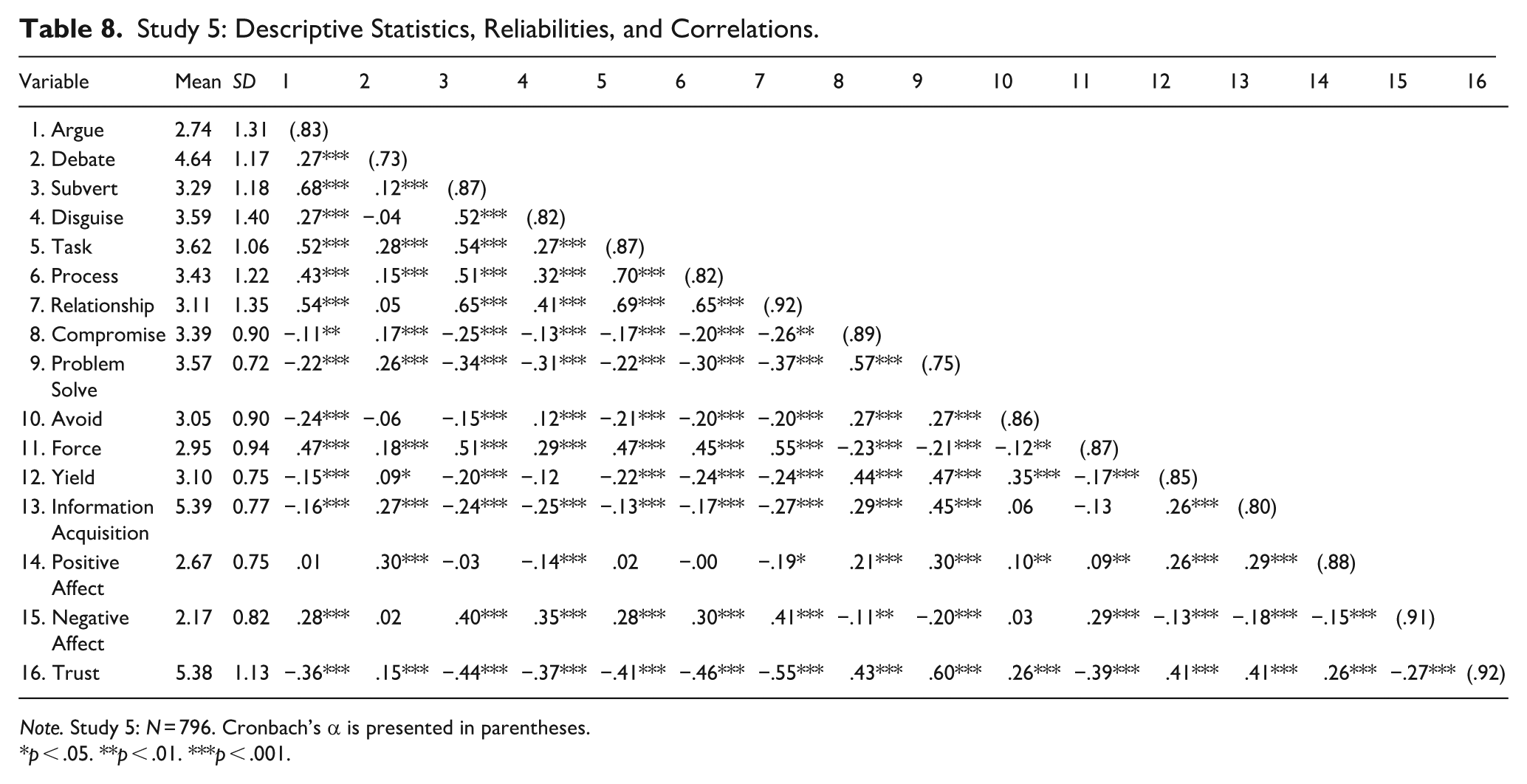
Note. Study 5: N = 796. Cronbach’s α is presented in parentheses.
p < .05. **p < .01. ***p < .001.
Discriminant Validity Analyses
To demonstrate discriminant validity, we conducted CFAs to assess if the CET dimensions exhibit empirical distinctiveness from conflict types and conflict management strategies. We conducted two sets of CFA analyses. In both models, we compared the hypothesized factor models with theoretically plausible alternative models based on two fit indices: RMSEA and CFI. 15
The first set of CFA model comparisons concerns the variance captured by the CET versus the three conflict type factors. We compared 12 alternative models to our hypothesized model (depicted in bold in the top half of Table 9). Each alternative model assumes that one of the CET factors is not distinguishable from one of the conflict type factors. The hypothesized seven-factor model (4 CET factors and 3 conflict type factors) produced the best model fit (χ2(209) = 472.12, CFI = 0.98, RMSEA = 0.04), confirming that the CET factors are distinguishable from the conflict type factors. These findings allow us to confidently distinguish between conflict expressions and conflict management types that are distinct but might be causally related (e.g., Argue and Force, Debate and Problem Solving, Subvert and Force, 16 and Disguise and Avoid).
Study 5: Model Data Fit for Hypothesized Models and Alternative Models.
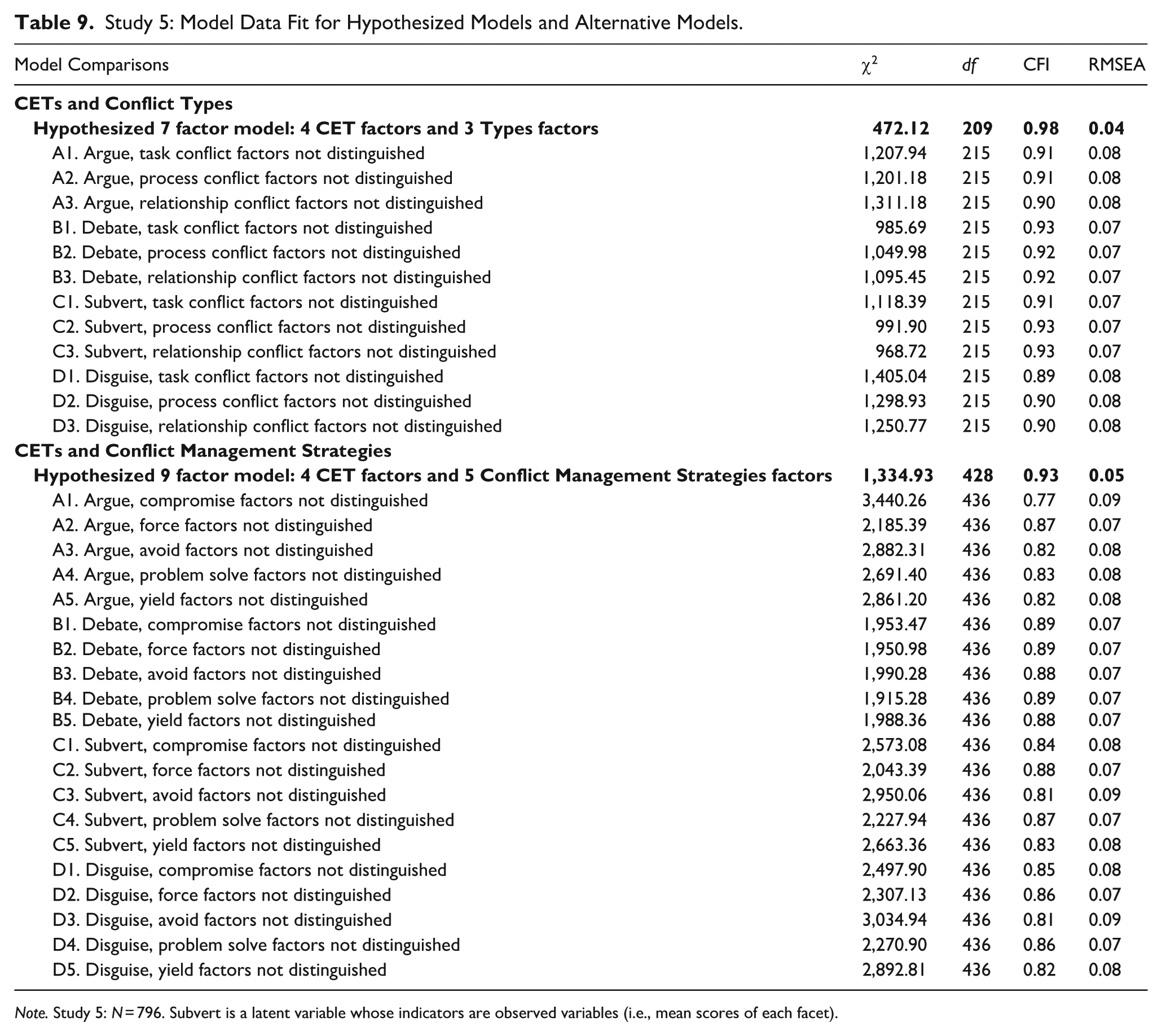
Note. Study 5: N = 796. Subvert is a latent variable whose indicators are observed variables (i.e., mean scores of each facet).
The second set of CFAs, presented in the bottom half of Table 9, concerns the variance captured by the CET factors and the conflict management factors. We compared the hypothesized nine-factor model (4 CET and 5 conflict management strategies) to all possible alternatives in which one of the CET factors is not distinguishable from one of the conflict management strategies factors. The model comparisons revealed that all the alternative models had inferior model fit statistics compared to the hypothesized model: χ2(428) = 1,334.93, CFI = 0.93, RMSEA = 0.05 (see Table 9). These results support our predictions that, whereas the conflict expression tendencies are correlated with types of conflict and conflict management approaches (as expected), the variance captured by the CET is distinct from that captured by the conflict management styles.
Criterion Validity Analyses
Next, we examined the associations between the CET scales and individual cognitive, affective, and psychological states to test the concurrent criterion validity of the measure. The results are mostly consistent with our predictions (see prior Table 8). We found that Argue was negatively correlated with information acquisition (r = −.16, p < .001) and trust (r = −.36, p < .001), while positively associated with negative affect (r = .28, p < .001). Debate was positively correlated with information acquisition (r = .27. p < .001), positive affect (r = .30, p < .001), and trust (r = .15, p < .001). Subvert was negatively associated with information acquisition (r = −.24, p < .001) and trust (r = −.44, p < .001), while positively correlated with negative affect (r = .40, p < .001). Disguise was negatively correlated with information acquisition (r = −.25, p < .001), positive affect (r = −.14, p < .001), and trust (r = −.37, p < .001), while positively associated with negative affect (r = .35, p < .001). We did not find support for our predictions that positive affect would be negatively associated with Argue and Subvert and that negative affect would be negatively correlated with Debate. 17
Incremental Validity Analyses
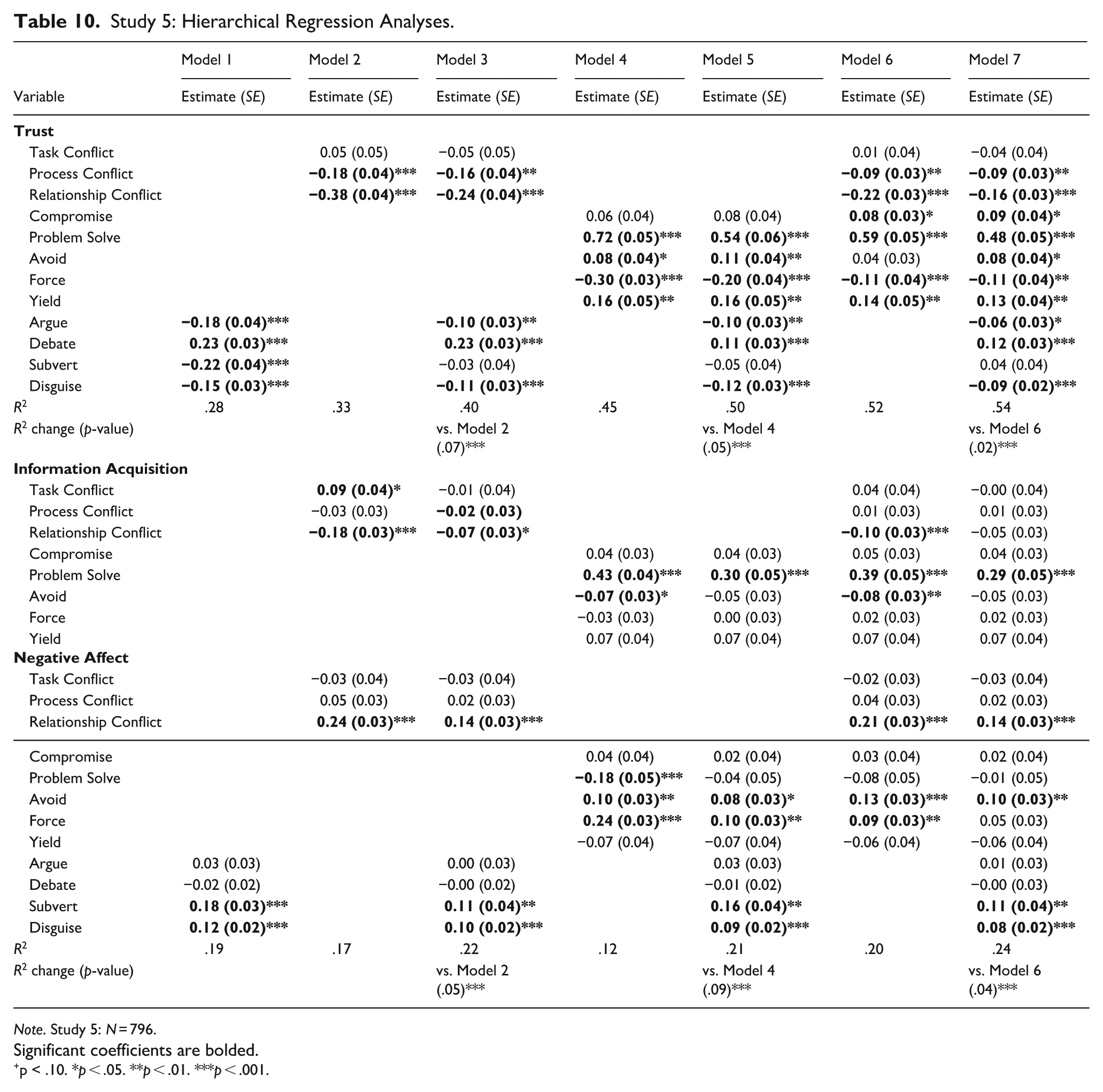
To examine incremental validity, we conducted a series of OLS regression analyses to determine if the CET explains variance in individual cognitive, affective, and psychological states over-and-above the alternative functions of conflict (see Table 10). In the first set of models (Model 1), we regressed each outcome variable on the four CET scales. We found that the coefficients for all four CET scales were statistically significant in the expected direction for trust and information acquisition. The CET scales deviated somewhat from our predictions of their association with affect: Only Debate and Disguise were significantly related to positive affect and only Subvert and Disguise were significantly associated with negative affect, all in the predicted directions.
Study 5: Hierarchical Regression Analyses.
Note. Study 5: N = 796.
Significant coefficients are bolded.
p < .10. * p < .05. **p < .01. ***p < .001.
We next conducted a series of hierarchical regressions to determine if the four CET variables explained significantly more variance in the outcomes than did the conflict types and conflict management styles variables (reported in Models 2–7 of Table 10). We compared the R2 of each model that included the CET variables to baseline models that included only the conflict types, only the conflict management styles, and both conflict types and conflict management styles, and found all R2 changes to be statistically significant (all p’s < .001). These results indicate that the CET scales do, indeed, explain significant incremental variance in all the outcomes beyond the measures of related conflict functions.
Discussion
The goals of Study 5 were to establish the construct validity of the CET compared to related constructs of alternative functions of conflict, conflict type and conflict management strategies. The results of the analyses support the functional distinctiveness of the CET from related constructs that capture conflict type and conflict management strategies. In addition, we found general support for the expected patterns of relationships between the CET dimensions and information acquisition, affect, and interpersonal trust. Although the direction of effects was consistent when we added the conflict type and conflict management approach variables into the equations, not all the CET coefficients remained significant across all models. This is not surprising given these three sets of variables were all moderately correlated with one another. Nonetheless, the inclusion of the CET coefficients explained significantly more incremental variance (i.e., change in R2) in each of the outcomes as compared to models with only conflict types and/or conflict management approaches.
In this study, we focused on the relationships between individuals’ perceptions of conflict expression tendencies, conflict types, and conflict management strategies, as well as their cognition, affect, and social psychological outcomes. Because conflict interactions often occur within groups and conflict types and conflict management strategies are typically treated as group-level, rather than individual-level constructs, in Study 6, we attempted to replicate the criterion and incremental validity of the CET for individuals in the context of intact groups.
Study 6: Replication of Criterion and Incremental Validity in Intact Groups
The final step in validating our measure, and the goal of Study 6, is to demonstrate the criterion validity of the four CET dimensions for the cognitive, affective, and social psychological outcomes of individuals working in intact groups. By examining individuals within highly diverse teams, we can investigate how unique conflict expression interaction experiences impact individual outcomes within the same group. We also replicated the incremental validity analyses relative to conflict types and conflict management strategies to examine the predictive power of the CET over and above group conflict constructs that are presumably shared by group members.
Method
Participants were full-time MBA students in an international business school who were assigned to five to six member teams. The teams were diverse in cultural and professional background and had been working together for five weeks on class exercises and team projects, making them an ideal setting for capturing a wide range of conflict expression tendencies in group settings. Because these teams had worked together for several weeks, they had established work norms and had ample opportunity to experience conflict. At the time of the data collection, teams were preparing to participate in a 24-hr, high stakes case competition that was required within their MBA program. Our questions were embedded in a survey that all students (345 individuals comprising 70 teams) were asked to complete as part of their educational experience. Students completed an informed consent form regarding sharing their responses with our research team. On average, four people responded from each group, 18 resulting in a sample of 282 individuals in 70 teams and a response rate of 81%. Participants completed the CET measure with the General prompt in a randomized order and responded to items measuring conflict types, conflict management approaches, information acquisition during conflict, positive and negative affect during conflict, and trust in the team. See Supplemental Appendix B for Study 6 survey items, which differed somewhat from those used in Study 5 due to the need to shorten the survey and clarify the wording of items for this context.
Analysis and Results
We display descriptive statistics, scale reliabilities, and correlations in Table 11. We conducted a series of hierarchical linear models (HLMs) to test the criterion validity of the CET, controlling for the nested structure of the individuals within groups. For the estimation, we used Restricted Maximum Likelihood Estimation. Across all HLMs we conducted, we entered the CETs as individual level predictors. In models where we controlled for conflict type and/or conflict management strategy variables, we entered those variables as group level predictors, as is consistent with their theoretical function, by adding group mean scores at the level 2 equation. We report the aggregation statistics for conflict type and conflict management strategies in Table 12. 19 The rwg statistics for the conflict type and conflict management scales were moderately strong for most scales, suggesting that group members’ responses were similar enough to one another to justify aggregation. The ICCs for conflict type were also adequate, however the conflict management strategies’ ICCs were relatively low (ICC(1) range: 0.02 to 0.11; ICC(2) range: 0.06 to 0.33), indicating low variation between teams. Given the theoretical function of conflict type and conflict management strategies are as group level constructs, the scale referents are to the group (“when my group has a conflict, we tend to. . .”), and the scales are typically aggregated to the group level for analyses in prior research, we included them in our primary analyses as averaged, group level constructs. However, we also ran a robustness check with those scales entered as individual level variables and the pattern of the results was unchanged (see Section C in the Supplemental Materials).
Study 6: Descriptive Statistics, Scale Reliabilities, and Correlations.
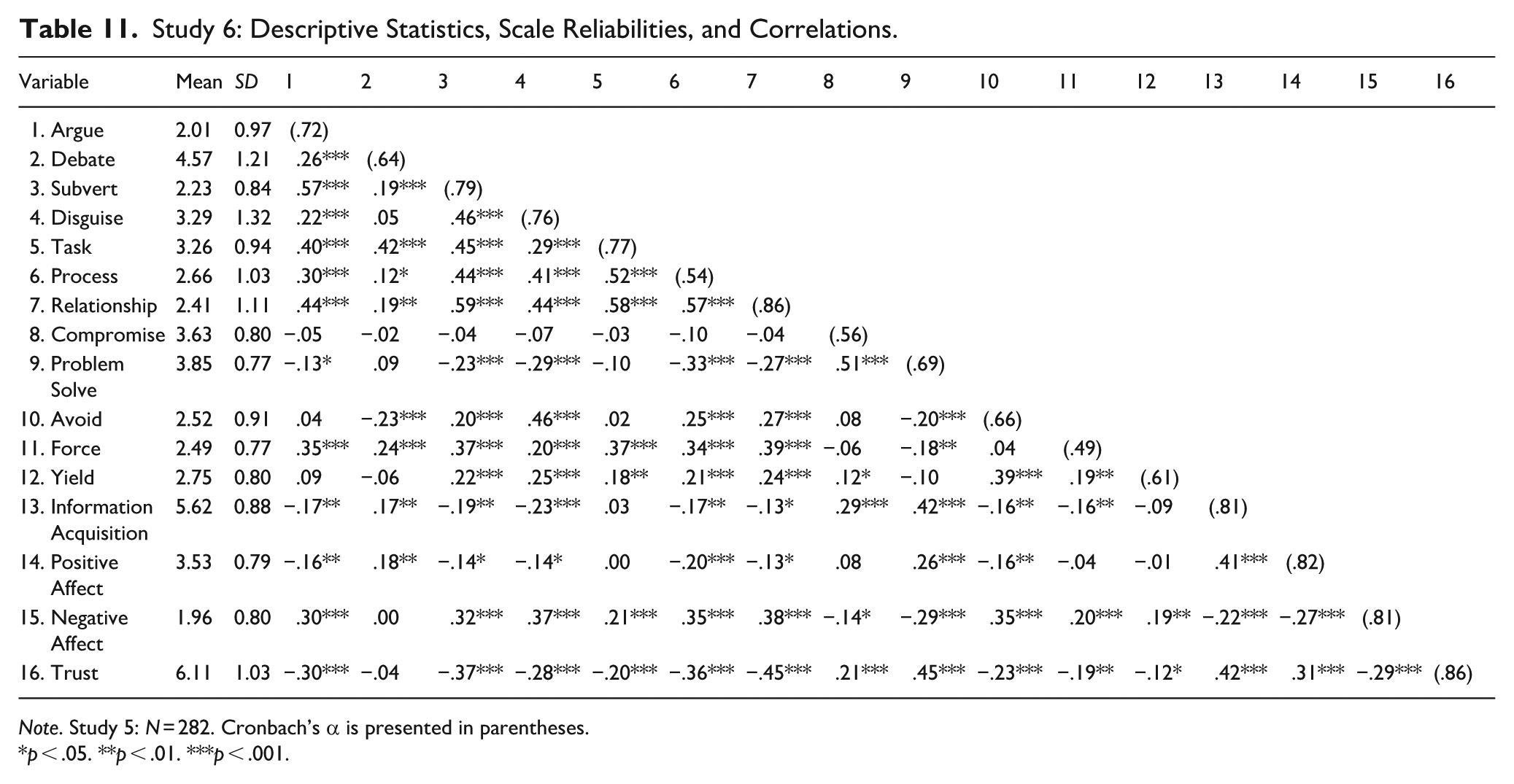
Note. Study 5: N = 282. Cronbach’s α is presented in parentheses.
p < .05. **p < .01. ***p < .001.
Study 6: Aggregation Statistics.
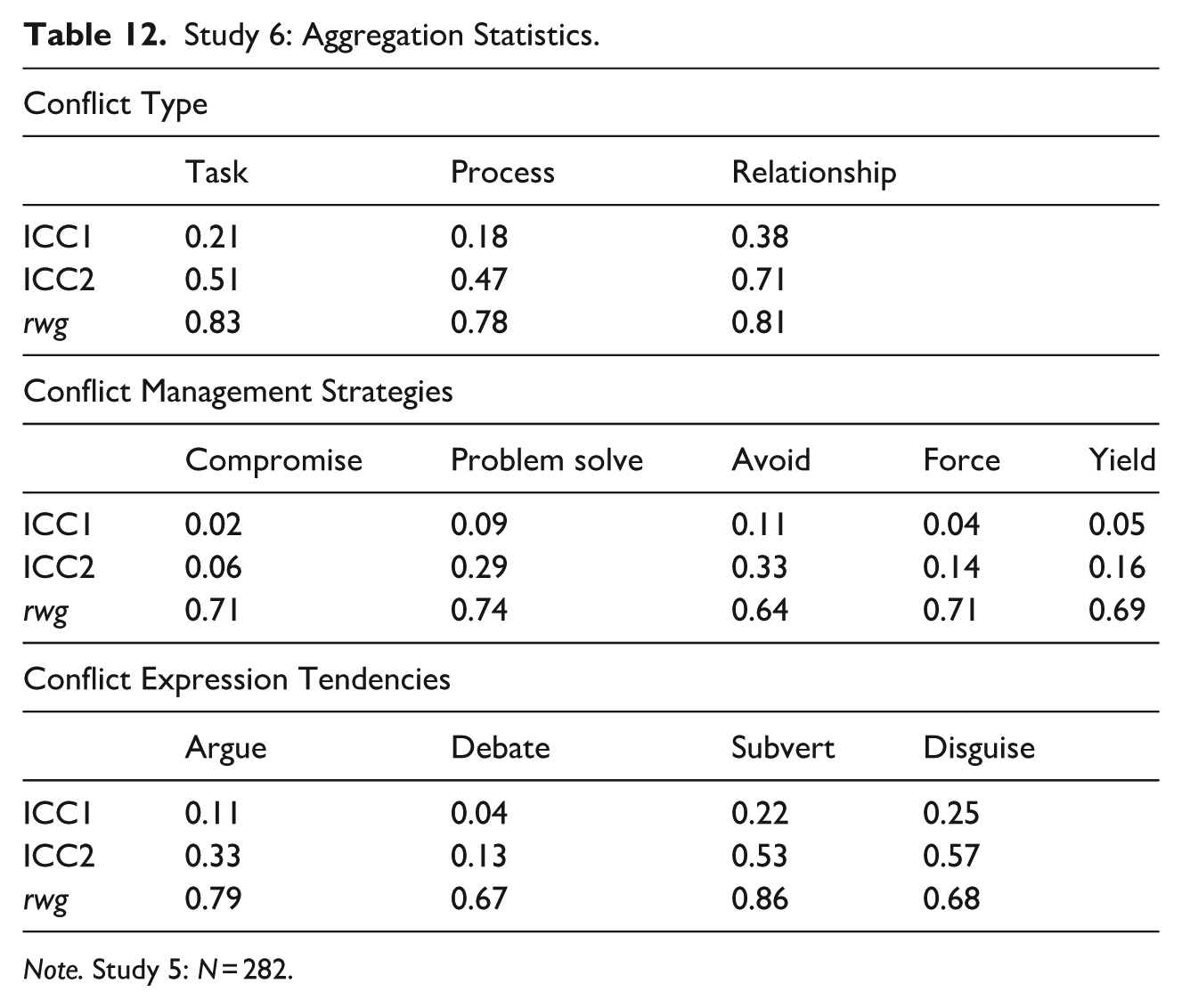
Note. Study 5: N = 282.
We also examined the agreement statistics for the CET on an exploratory basis to test the theoretical assumption that the CET captures an individual, rather than group level phenomena. We found that most of the aggregation statistics were below standard thresholds, but the two low directness dimensions, Subvert (ICC(1) = 0.22, ICC(2) = 0.53, rwg = 0.86) and Disguise (ICC(1) = 0.25, ICC(2) = 0.57, rwg = 0.68), were above the bar on at least some indices. Overall, these results support our conceptualization of perceived CETs as individual level constructs, so we include the individual-level CET scales in our analyses in line with the theoretical function of the constructs.
In the first set of analyses in which we regressed each dependent variable on the four CET scales at the individual level, we found results that are generally consistent with our predicted patterns and findings from Study 5 (see Table 13, Model 1). Results show that as participants experienced higher Argue CET, they also experienced less positive affect and trust, acquired less information, and experienced higher negative affect. In contrast, group members who experienced higher Debate CET acquired more information and experienced more positive affect. However, Debate was not significantly associated with negative affect or trust. Group members who experienced higher Disguise CET acquired less information and lower trust in their team, and they experienced more negative affect, but Disguise was not significantly associated with positive affect. In contrast, group members who reported higher Subvert CET also experienced less trust; but beyond that, Subvert did not influence team members’ affect or information acquisition.
Study 6: Hierarchical Linear Model (HLM) Analyses.
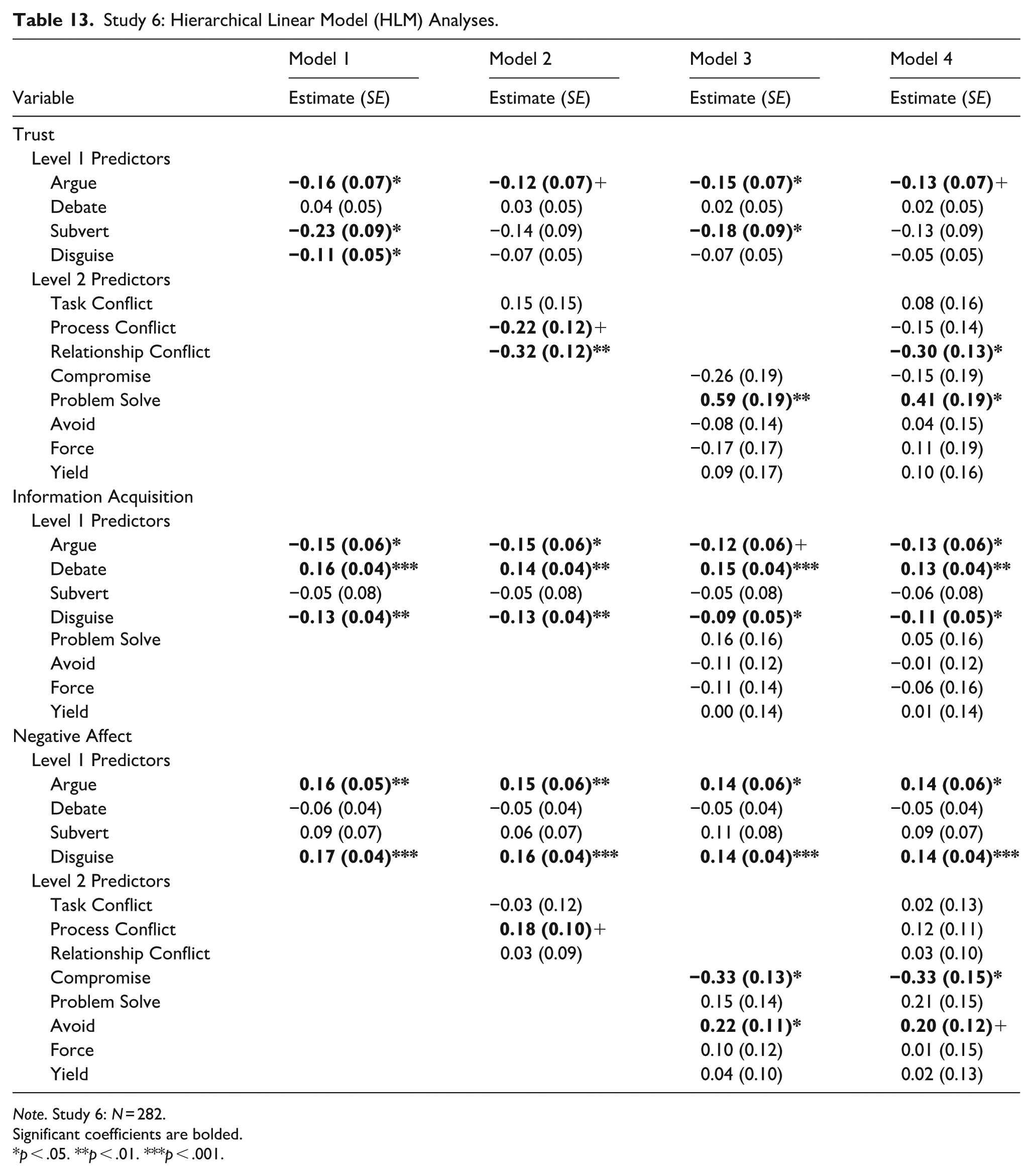
Note. Study 6: N = 282.
Significant coefficients are bolded.
p < .05. **p < .01. ***p < .001.
Including group-level conflict types and/or conflict management strategies controls did not change the pattern of relationships between the CETs and individual information acquisition, positive affect, and negative affect (see Table 13, Models 2–4). However, the negative relationships between the low directness conflict expression interactions—Subvert and Disguise—and trust weakened with the inclusion of conflict type and conflict management approaches in the equations. 20
Finally, we conducted likelihood ratio comparison tests of each pair of nested models 21 for the incremental validity analyses. Every test was statistically significant, with likelihood ratio χ2(4) values ranging from 13.07 (p = .01) to 39.66 (p < .001). These results indicate that the CET variables explained significantly more incremental variance in the outcomes than did just the conflict type variables, just the conflict management strategies, and both conflict type and conflict management strategies variables.
Discussion
In Study 6, we examined the criterion and incremental validity of CET in an intact group context. We found that group members’ perceptions of their group’s CETs were associated with important individual-level cognitive, affective, and social psychological outcomes, including information acquisition, positive affect, negative affect, and trust, in intact groups. Although the results largely mirrored those from Study 5, Subvert was only associated with trust in this setting. It is likely that Subvert’s significant relationships with the other individual outcomes (see the bivariate correlations in Table 11) were reduced to non-significance in the HLMs due to its moderate correlations with two of the three other CETs, Argue and Disguise. Debate was only associated with information acquisition and positive affect, but not with trust or (negatively) with negative affect. These differences from Study 5 suggest that the team context in which CETs occur may impact their effects on individual members’ outcomes.
Importantly, the CETs explained significant additional variance in information acquisition, affect, and trust over and above the measures of conflict types and conflict management strategies that are typically used to study conflict in groups. This indicates that individuals’ perceptions of CETs distinctly explain how conflict benefits or hinders team members’ psychological experience with working with others. This is an especially important consideration in culturally diverse settings represented by this sample.
There were some differences in these results and those from Study 5 that reflect the possibility that there are more opportunities to use indirect strategies in organizational teams than in student groups. In Study 5 there were effects of the indirect CETs on affect (i.e., Disguise was associated with lower levels of positive affect and Subvert was associated with higher levels of negative affect), whereas in our study of intact MBA teams in Study 6, only Argue was associated with lower levels of positive affect and higher levels of negative affect. Members of organizational teams interact inside and outside of full group meetings, whereas the student groups in our sample spend a large proportion of their work time interacting in their full group.
On a side note, the CET is predicated on the assumption that team members might not experience conflict in the same way and there does not need to be consensus about the nature of conflict expression interactions in a group for the construct to be valid. We were able to explore the levels of consensus using our sample of student groups in this study. 22 Results showed a moderate level of agreement within groups (as evidenced by rwg values averaging 0.75), which were lower than were the measures of conflict types (average rwg = 0.81) but higher than conflict management strategies (average rwg = 0.70). At the same time, the ICC’s for the CET were quite low, suggesting that variance in people’s experiences of conflict expression interactions was not occurring at the group level, as theorized. It is also noteworthy that several of the conflict type and conflict management strategy measures showed relatively low ICC(1) values, suggesting that these other conflict measures, especially conflict management strategies, might also be capturing individuals’ unique experiences, in addition to some shared reality among group members. 23 Using group averages as a measure of the “true” level of conflict in a group would mask that variation, so scholars may want to evaluate them as individual-level constructs like we do with the CET. Alternatively, future research seeking more precise estimates of group-level relationships should apply statistical corrections, because low ICC(1) values attenuate the reliability and predictive accuracy of aggregate variables (see Bliese, 1998).
General Discussion
In this paper we introduced a novel construct and validated a new self-report measure that captures individuals’ perceptions of conflict expression tendencies within specific social groups in laboratory studies and in-situ field settings: the CET. We demonstrated that the psychometric properties of the CET were strong and that the constructs are appropriately correlated with orbiting constructs and are differentiable from the alternative functions of conflict, including conflict types and conflict management strategies. We also showed that the CET exhibits strong criterion and incremental validity, predicting individuals’ cognitive, affective, and social psychological outcomes beyond existing conflict measures.
Our results regarding the impact of CET constructs on emotions, trust, and information acquisition were generally consistent with our theory—the use of Debate to express conflict improved information acquisition, affect, and trust, whereas the use of Subvert, Disguise, and Argue had myriad negative effects. However, three exceptions to our predictions occurred. First, higher levels of Debate were not associated with less negative affect in either criterion validity study. Debate only increased the experience of positive emotions, such that higher levels of debate made people feel more enthusiastic and energized during the conflict, but did not impact feelings of annoyance, tension, or anger. Second, higher levels of subverting did not decrease positive affect, although they did increase negative affect. Said differently, the experience of subverting did not result in people feeling less enthusiastic, but it did make them feel more tense or angry. Finally, we found that Disguise had similar negative effects as Subvert on individual outcomes—including information acquisition, affect, and trust—across both criterion validity studies. These results are somewhat consistent with prior findings that psychological and behavioral harms triggered by more subtle forms of workplace mistreatment that are characterized by a lack of social interaction (such as ostracism) are as harmful as more intense forms of mistreatment (e.g., abusive supervision, discrimination; Kim et al., 2023; O’Reilly et al., 2015).
These differences in the pattern of results that we found between our study of adults in the work teams (Study 5) and student teams (Study 6) point to the need to take the social group context and interaction patterns into account when developing predictions regarding which CET is likely to influence individual outcomes, especially in terms of team member affect. This is why we designed the CET to be flexible regarding the specific social group that is referenced in the question prompts. For example, the CET items could refer to each other individual in a team, like in Shah et al. (2021), to understand the role of perceived conflict expression tendencies in dyads that are nested within teams, and to consider how different conflict expression tendencies among those dyads impacts the overall team processes and outcomes. Or the items could refer to a larger work unit to understand conflict expression tendencies in larger social contexts. Because our main goal was to validate the CET relative to its orbiting conflict constructs, which are measured and analyzed at the group level, we leave it to future scholarship to confirm that the CET’s psychometric properties are robust to varying social group referents.
Theoretical Contributions
The CET framework and its validated measure offer several important theoretical contributions to conflict research, as well as to the broader literature on teams and communication. First, the CET contributes to workplace conflict research by offering an alternative framework that helps scholars understand individual-level mechanisms shaping personal outcomes within broader group-level conflict situations. By establishing the distinctiveness of CET from the two dominant approaches of conflict types (Jehn, 1995, 1997) and conflict management strategies (De Dreu et al., 2001; Rahim, 1983, 2002; van de Vliert & Euwema, 1994), scholars can now examine how these three constructs interrelate, offering a more comprehensive understanding of conflict dynamics within teams. For example, the CET framework could help clarify the positive and negative effects of task conflict (de Wit et al., 2012; Yuan et al., 2026), providing a more nuanced understanding of when and why task conflict either enhances or hinders team performance. Specifically, the CET framework can help answer how task conflicts unfold differently when expressed as debates versus as arguments. These variations, in turn, may shape how conflict content influences collective outcomes and how individuals select and employ conflict management strategies. Ultimately, the CET opens the door for more sophisticated theories of why information exchange varies across conflict episodes and why individuals choose competitive or collaborative approaches to conflict resolution.
Second, this paper contributes to research on conflict and teams by shifting attention away from the dominant consensus approach and toward the uniqueness of individual variance within team settings. The intra-group conflict literature has long been dominated by consensus composition models (Woehr et al., 2015), which assume that shared experiences among group members give rise to conflict as a team-level property (Kozlowski & Klein, 2000). The CET challenges this assumption by highlighting that individuals within the same team may perceive, experience, and respond to conflict differently (Jehn et al., 2006; Park et al., 2020; Shah et al., 2021; Sinha et al., 2016). A variety of factors, such as personality traits (Graziano et al., 1996), cultural background and conditioning (Ting-Toomey et al., 1991), conflict history (Davies et al., 1999), and gender differences (Brody, 1997; Ragins & Winkel, 2011) can influence how conflict is interpreted and experienced. The CET underscores the centrality of perception in conflict, as individuals express, interpret, and respond to opposition through verbal and nonverbal cues, behaviors, and underlying assumptions (Shannon & Weaver, 1949; Weingart et al., 2015). Given the multitude of reasons why individuals within the same social group might experience conflict differently, validating a scale that explicitly accounts for individuals’ perception represents a significant step forward in workgroup conflict and team research. This, in turn, paves the way for new theoretical insights into how individual and collective conflict perceptions interact to shape organizational behavior, team functioning, and interpersonal dynamics in the workplace.
Finally, the CET measure contributes to research on communication by integrating a myriad of forms of oppositional communication that have traditionally been examined in isolation rather than as interrelated components of a broader framework (i.e., as “unit theories”; Cronin et al., 2021). The CET advances programmatic theory by incorporating alternative forms of oppositional communication, such as social undermining (Duffy et al., 2002), passive aggression (McIlduff & Coghlan, 2000), and incivility (Andersson & Pearson, 1999). These forms of communication are often dismissed as peripheral or secondary to traditional conflict dynamics but, in reality, can play a crucial role in shaping interpersonal and organizational outcomes. Because they were each developed independently, there is some conceptual and construct overlap among them and other standard conflict measures. By integrating them into a programmatic framework, the CET allows scholars to investigate them in a coherent nomological network in relation to one another, as well as the conditions under which different conflict expression tendencies elicit varying degrees of negative or positive effects on important individuals and/or organizational outcomes, providing a more nuanced and complete understanding of interpersonal and organizational dynamics. Moreover, by measuring the four dimensions of conflict expression tendencies across various referent social groups, the CET can provide a structured yet flexible framework for examining how conflict manifests in different relational contexts (e.g., among coworkers, between supervisors and subordinates, or within peer networks) in the future. Ultimately, the CET measure can serve as a critical tool for refining theories of conflict communication by bridging gaps between previously fragmented research streams and offering a holistic perspective on how conflict is expressed, perceived, and managed across different social contexts. In doing so, it provides a foundation for future research that seeks to unpack the complex interplay between conflict expression tendencies, individual and group outcomes, and broader organizational processes.
Practical Implications
The CET can be a valuable diagnostic tool for understanding conflict expression tendencies within social groups, leading to more effective team management. Conflict expression tendency profiles of teams can be identified, generating discussions of more effective ways to communicate disagreements. As an example, one of the authors has used the measure in executive education programs to help participants consider the CETs in their work units. We typically find that participants report their teams use Debate the most and Argue the least, with the Subvert and Disguise in the middle. This leads to rich discussions of why and when their group tends to employ indirect strategies and why arguments are more infrequent when conflict occurs. The CET can also be used to design targeted interventions for teams or individuals. For example, high levels of Disguise tendencies may indicate a need for initiatives that promote trust and psychological safety so that members will feel safe clearly communicating their opposing positions and concerns. Engaging teams in discussions that identify the drivers of hidden conflict expressions and modeling constructive debate might help draw out the concerns that people have. Conversely, high levels of Argue tendencies may require strategies that help people regulate emotions, such as cooling-off periods or mediation sessions, to promote more constructive discussions.
The CET can also be used to detect asymmetric perceptions of conflict within a team, indicating misalignment in team norms and expectations. For instance, if some employees see conflict as managed through Debate while others see it as dominated by Argue, this disconnect can lead to misunderstandings and dissatisfaction. Differences could be examined in the context of hierarchical status, team composition, or cultural background. For example, if higher-status members perceive conflict as Debate and lower-status members see it as Argue, this may indicate a power imbalance. In culturally diverse environments, with people from high-context cultures (e.g., Japan, China) who rely on indirect communication, and others from low-context cultures (e.g., the US, Germany) who emphasize direct communication, the CET can provide culturally sensitive interpretations to help prevent misunderstandings.
Overall, the CET scale provides a nuanced approach to diagnosing and managing workgroup conflict, recognizing the diversity in how individuals experience and interpret opposition. This tool can be used to help leaders cultivate a more adaptive, responsive approach to conflict management, promoting constructive communication and healthier team dynamics.
Limitations and Future Directions
Our studies modeled the CET dimensions separately and demonstrated their criterion validity in relation to individual outcomes. Future research should build on this foundation by exploring questions that are beyond the scope of the current studies. Scholars could examine the subdimensions of Subvert (Dismiss, Tease, Complain) separately to determine their unique roles in conflict expression. While all three forms of subversion share the properties of being indirect with high oppositional intensity, they may be used differently, or under different conditions, to communicate opposition in the group. For example, teasing, by definition, sends mixed messages (playful provocation, see Keltner et al., 2001) that may help or hinder group dynamics depending on who is teasing whom, perceived intention, and group norms. Future research would also benefit from operationalizing the oppositionally-intense sub-construct of entrenchment (i.e., defending one’s position), in addition to the subversive behaviors we focused on here. While entrenchment goes hand-in-hand with dismissing others’ perspectives, it is a much more indirect means of expressing opposition.
Future research could also examine the interplay between the CET dimensions, recognizing that these four dimensions often occur simultaneously. For example, by employing a latent profile approach, researchers can identify combinations of CET dimensions that may have distinctive effects on individuals and groups. For example, individuals who perceive their groups as tending to express high levels of Argue and Subvert (i.e., high oppositional intensity conflict expression tendencies that vary in their directness) will likely differ in outcomes from those who experience high levels of Argue and Debate (i.e., highly direct conflict expressions that vary in oppositional intensity). Exploring these combinations could reveal unique conflict profiles that influence individual and group dynamics in different ways, offering deeper insights into the complex nature of conflict in organizational settings. Such work would provide a more comprehensive understanding of how conflict dimensions interact and shape behavioral outcomes, paving the way for targeted interventions that promote more effective conflict resolution strategies within teams and organizations.
Whereas the CET is designed to assess individuals’ subjective and personal perceptions of conflict expression tendencies, we have not examined the factors that may influence why and how individuals perceive conflict expressions differently. Future research should explore whether additional characteristics of conflict play a significant role in shaping individuals’ perceptions of conflict expression of their social groups.
Research could also examine how team members’ distinct experiences influence group level outcomes. To do this, future scholars must consider how individuals’ CETs accumulate to the group level to constitute a group emergent state. We advocate for treating the CET as a compilation of individual experiences (rather than assuming it is a consensus construct), which implies operationalizing group-level CETs in terms of different configurations rather than as a group mean (DeRue et al., 2010; Meyer et al., 1993). This would allow scholars to distinguish perceptions that are shared by group members from those that compile in different configurations. In other words, research is needed to determine how different combinations of CET across team members influence both individual and group outcomes without assuming consensus.
Also, tracking how CET perceptions change longitudinally could also provide a better understanding of what exacerbates or ameliorates negative conflict spirals and establish the direction of causality. Answering questions like these may give a more complete picture of the process dynamics that occur during conflict, and how conflict resolution might begin (Greer et al., 2008). This potential for greater understanding also has very practical implications for helping individuals to understand how to express conflict strategically. It is our hope that the validations of the CET measurement scale will be highly generative of future research.
Finally, future studies could enhance the external validity of CET findings by collecting data within real organizational settings and incorporating diverse data sources, rather than relying solely on self-reports. While our study benefited from a diverse participant pool, future research could improve external validity by gathering data from employees embedded in actual organizational environments. Examining intact groups in organizational settings would better allow researchers to distinguish conflict expression perceptions that are shared by the group from those that are unique to individuals. This approach would also allow researchers to observe CET’s impact in the context of work settings, where factors such as organizational culture, hierarchical structures, and job roles can influence conflict expressions in ways that are not fully captured by crowdsourced samples. By addressing this limitation, future research would be better positioned to validate and extend our findings, ensuring their broader applicability across various workplace contexts. Moreover, we encourage future studies to incorporate alternative data sources, such as observer reports of individual outcomes and team performance metrics, to further explore the downstream consequences of CETs. This would provide a more comprehensive understanding of how CETs influence both individual and group outcomes, offering a richer perspective on the practical implications of conflict dynamics in organizations. Additionally, utilizing multiple data sources could help mitigate potential biases inherent in self-report methods, offering a more holistic view of conflict expression and its effects on workplace functioning.
Conclusion
While the theory of conflict expression increasingly has attracted the attention of scholars and practitioners alike, research on conflict expression has been hampered by the lack of a self-report measure of conflict expression tendencies in social groups. We hope that the CET provides such a tool for the field, generating important insights into conflict experiences and outcomes for members of groups and teams.
Supplemental Material
sj-docx-1-sgr-10.1177_10464964261448469 – Supplemental material for Conflict Expression Tendencies in Workgroups: Measure Validation and a Test of Theory
Supplemental material, sj-docx-1-sgr-10.1177_10464964261448469 for Conflict Expression Tendencies in Workgroups: Measure Validation and a Test of Theory by Yeonjeong Kim, Laurie R. Weingart, Corinne Bendersky, Kristin Behfar, Gergana Todorova, Julia Bear, Karen Jehn and Ella Miron-Spektor in Small Group Research
Supplemental Material
sj-docx-2-sgr-10.1177_10464964261448469 – Supplemental material for Conflict Expression Tendencies in Workgroups: Measure Validation and a Test of Theory
Supplemental material, sj-docx-2-sgr-10.1177_10464964261448469 for Conflict Expression Tendencies in Workgroups: Measure Validation and a Test of Theory by Yeonjeong Kim, Laurie R. Weingart, Corinne Bendersky, Kristin Behfar, Gergana Todorova, Julia Bear, Karen Jehn and Ella Miron-Spektor in Small Group Research
Footnotes
Authors Note
The first three authors contributed equally to this research.
ORCID iDs

Ethical Considerations
This study received ethical approval from the UCLA IRB (approval #17-001773-AM-00002) on January 18, 2018.
Funding
The authors received no financial support for the research, authorship, and/or publication of this article.
Declaration of Conflicting Interests
The authors declared no potential conflicts of interest with respect to the research, authorship, and/or publication of this article.
Supplemental Material
Supplemental material for this article is available online.
Notes
Author Biographies
References
Supplementary Material
Please find the following supplemental material available below.
For Open Access articles published under a Creative Commons License, all supplemental material carries the same license as the article it is associated with.
For non-Open Access articles published, all supplemental material carries a non-exclusive license, and permission requests for re-use of supplemental material or any part of supplemental material shall be sent directly to the copyright owner as specified in the copyright notice associated with the article.
