







Abstract
Although team performance is crucial to organizational success, the role of social processes on the baseline and trajectory of team performance in newly formed teams remains largely unknown. Applying stress-as-offense-to-self theory, this study investigates how perceived team performance evolves over time and how individual- and team-level offenses or boosts to the self via appreciation, distributive justice, illegitimate tasks, and team meeting attitudes affect its initial level and subsequent development. Using longitudinal data from 49 student project teams, our findings support a positive performance trajectory and emphasize the importance of early perceived social dynamics on team performance throughout the collaboration process.
Keywords
Introduction
Teams are a central unit of work in contemporary organizations, and their effectiveness is widely recognized as a cornerstone of organizational success (DeChurch & Mesmer-Magnus, 2010; Morrissette & Kisamore, 2020). In recent decades, new forms of teamwork—such as fluid and agile teamwork (Peeters et al., 2022)—have gained prominence because teams nowadays must perform effectively in fast-paced and complex environments despite shifting membership compositions and rapidly changing conditions. These developments underscore the need to understand not only how well teams perform, but how team performance evolves over time and which factors shape its trajectory. Thus, recent scholarship has increasingly examined the temporal and dynamic nature of team performance over time and its optimization through organizational interventions or leadership (e.g., Ficapal-Cusí et al., 2021; Mathieu et al., 2017; Salas et al., 2025).
Theoretically, several perspectives suggest that team performance should show a positive developmental trend in newly formed teams. The team compilation model (Kozlowski et al., 1999) proposes that teams transition from loosely coordinated collections of individuals to more integrated and interdependent units capable of higher-level functioning. Similarly, the serial-order effect (Beaty & Silvia, 2012) suggests that repeated interaction of team members fosters cognitive integration, accelerates problem solving, and enhances collective efficiency through mechanisms such as spreading activation (Collins & Loftus, 1975). These perspectives converge on the expectation that active and effective collaboration within teams contributes to the progression of team performance. Recent studies support this assumption, showing that team performance tends to increase in newly formed teams over time (e.g., Lorinkova et al., 2013; Mathieu et al., 2015; Santos et al., 2015). In such newly formed teams, social dynamics are highlighted as an important driver of team performance, particularly in the early phases of collaboration (e.g., Kozlowski & Bell, 2012; Marks et al., 2001). For instance, longitudinal studies demonstrate that team cohesion (Tekleab et al., 2009), team climate (González-Romá et al., 2009), team communication (González-Romá & Hernández, 2014), and affective team trust (Webber, 2008) positively shape team performance over time.
However, despite sustained interest in how team performance develops, research to date has largely used designs and methods ill-equipped to capture its temporal dynamics. Many studies have examined social team variables and team performance either solely cross-sectionally or using incomplete panel designs without repeated measures (e.g., González-Romá & Hernández, 2014; Tekleab et al., 2009; Webber, 2008). This limitation precludes controlling for autoregressive effects, which are important for a trustworthy assessment of temporal dynamics. Consequently, prior research may have drawn incorrect conclusions concerning how social factors influence both the initial level and trajectory of team performance (Kozlowski, 2015). Notably, however, social processes are believed to play a crucial role both in the development of team performance over time and in establishing its initial baseline (e.g., Kozlowski et al., 1999; Marks et al., 2001), calling for research that addresses both.
To answer this question, we propose applying stress-as-offense-to-self (SOS) theory (Semmer et al., 2007, 2019), a theoretical perspective that has garnered considerable attention over the past two decades in explaining individual reactions and behavior, but which can be seamlessly extended to understand dynamics within social groups. Specifically, we argue that boosts and threats to individual self-esteem, as theorized within SOS theory, influence social processes not only at the individual level but also at the team level. This is because individuals inherently seek acknowledgment and respect from their team members. A perceived lack of appreciation or respect threatens individual self-esteem, potentially hindering the development of a shared social identity and mutual trust, which are essential for engaging in performance-oriented behavior (e.g., Guchait & Hamilton, 2013). Conversely, positive social messages—those that convey respect, competence, and appreciation—can foster psychological safety and collective efficacy (Edmondson, 1999), which are critical factors for effective teamwork. Accordingly, applying the principles of SOS theory offers a promising approach to understanding how team performance develops, particularly in newly formed teams where social processes emerge from the outset. Central to SOS theory are constructs such as appreciation, justice, and the concept of illegitimate tasks (unreasonable and unnecessary tasks), which help explain why individuals respond positively or negatively to social dynamics in a team context (Ding & Kuvaas, 2023; Semmer et al., 2019). Moreover, the lower the shared perceptions of attitudes at the team level (e.g., Stevens, 1994), the more they can be perceived as disrespectful and unappreciative.
To the best of our knowledge, these social processes have not yet been investigated at the team level in relation to team performance over time (e.g., C. Li et al., 2022; Semmer et al., 2025; Yu et al., 2022). The present study aims to examine the members’ perceived development of team performance in newly formed teams and assess the extent to which early perceptions of appreciation from colleagues, distributive justice, illegitimate tasks, and team meeting attitudes (TMA) predict the initial level and the development of team performance.
Doing so, this study contributes to team research in several important ways. First, by modeling team performance trajectories using a full longitudinal research design with four measurement waves, we respond to the call for multilevel team performance research and add to research on the team compilation model and serial-order effect (e.g., O’Neill & Salas, 2018). Second, this approach offers a framework for understanding how the interplay between individual-level perceptions and team-level dynamics shape performance trajectories. Conversely, early perceived success may also result in more positive social messages, as success contributes to the conviction of being effective as a team (e.g., Grebner et al., 2010). This belief can foster team members’ mutual trust in their abilities, so that tasks are distributed more fairly, for example. Thus, the effects of early perceived team performance on social processes are also considered and clearly add to our still inconclusive understanding of team processes. Third, from a practical perspective, this study offers insights for organizations, team leaders, and self-managing project teams on which social processes or early perceptions of success should be supported at the initial stages of collaboration. Moreover, this study provides recommendations regarding the potential value of deploying new project teams by examining whether their perceived performance improves over time.
Team Development and Team Performance
It is well known that the development of newly formed teams is a complex and non-static process that unfolds over time, with various phases and transitions in which team members integrate their skills and roles (e.g., Gersick, 1988, 1989; Tuckman, 1965). In contrast to permanent teams, which possess a shared history of collaboration and have already progressed through various developmental stages, newly formed project teams experience these distinct phases more dynamically as they begin from scratch and are typically time-limited (Cohen & Bailey, 1997; Hollenbeck et al., 2012). Moreover, members of permanent teams expect continued collaboration in the future, which encourages them to foster positive interpersonal interaction and relationships (e.g., Bradley et al., 2003; Saunders & Ahuja, 2006). Accordingly, the emphasis in permanent teams is usually on ensuring harmonious interaction and consistent performance. By contrast, newly formed project teams tend to focus more on task completion and the development of team performance, rather than maintaining interpersonal relationships (e.g., Bakker et al., 2013). Consequently, perceptions of team performance may vary significantly even over short periods of time.
In the early phases of collaboration, team members become familiar with the structure and nature of the team. In later phases, team members collaborate more intensively to improve their team performance (e.g., Kozlowski et al., 1999; Tuckman, 1965). The team compilation model (Kozlowski et al., 1999) provides a multilevel framework to understand this evolution of teamwork and team performance, emphasizing how newly formed teams progress from initial formation through phases of role negotiation, coordination, and performance refinement. The model distinguishes between four phases that can be relevant simultaneously and over time (Ito & Brotheridge, 2008): (1) team formation, during which team members begin to align around shared norms, goals, and interpersonal understanding; (2) task compilation, where team members acquire new skills and task knowledge; (3) role compilation, involving the development of collaboration routines and role clarity; and (4) team compilation, in which members should enable continuous improvement (Kozlowski & Bell, 2012; Kozlowski et al., 1999).
Building on the assumption of continuous improvement in the last phase, team performance develops over time and does not correspond to a static concept (Quigley et al., 2018). This assumption aligns with the serial-order effect, derived from spreading-activation theory (Collins & Loftus, 1975), which posits that initial ideas and solutions are often the most obvious and straightforward (Beaty & Silvia, 2012). As collaboration continues, more effective solutions are generated through feedback from others and a prosocial motivation to contribute to team success (e.g., Ahn et al., 2023). In line with this reasoning, a study by Mathieu et al. (2015) found a positive team performance trend for student management teams working on a simulation task over 10 weeks, with team performance declining in the first weeks and increasing in the last weeks. A positive time-related trend for team performance was also found in studies by Lorinkova et al. (2013) and Santos et al. (2015), in which teams were examined in computer and management simulation tasks, respectively. Following the assumptions of the team compilation model, the serial-order effect, and the reported positive temporal trends for team performance, we expect team performance to increase over time. 1
The Role of Boosts and Threats to the Self in Early Team Collaboration
According to the team compilation model (Kozlowski et al., 1999), a key factor in successful teamwork is the establishment of common ground and trust among team members, particularly when the outcome is individually significant. The early phases of teamwork are critical for shaping these dynamics, in which intensive social interactions lay the foundation for high team performance (e.g., Tuckman, 1965). In light of the fact that the team compilation model does not offer a precise theoretical perspective on these social processes, we propose using the basic tenets of SOS theory to better understand them. Emphasizing the social aspects of team formation, we focus on how team members treat each other directly and indirectly during these initial phases.
SOS theory (Semmer et al., 2019) theorizes individuals’ responses to perceived threats and affirmations to the self. Central to this theory is the idea that individuals have a fundamental need for acceptance and appreciation to maintain a positive view of themselves. When individuals feel disrespected or undervalued, this threat to the self leads to the experience of stress, which can lead to reduced engagement at work or even provoke withdrawal and counterproductive work behavior (Semmer et al., 2007, 2019). Research consistently shows that unfair treatment in organizations can provoke such reactions (e.g., Mercado et al., 2018; Zhou et al., 2018).
These dynamics are further supported by the “thin slice” literature, which suggests that early, brief observations of interpersonal behavior—so-called thin slices—can predict dynamic team processes (e.g., Goodwin & Sayette, 2023; Satterstrom et al., 2019). Thin slices are typically defined as short excerpts of verbal or nonverbal behavior that offer insight into underlying interpersonal dynamics (Ambady & Rosenthal, 1992; Curhan & Pentland, 2007). Accordingly, team members are able to reliably assess direct or indirect social processes within the team after just a short period of interaction (Murphy et al., 2015; Wang et al., 2021). In newly formed teams, these early thin slices of social interactions can be particularly influential, as they may shape the development of trust, norms, and collaboration from the very beginning (e.g., Quintane et al., 2013). For example, members of newly formed teams perceive more relationship conflict than those of permanent teams (Druskat & Kayes, 2000) and are prone to opportunistic behavior (Bakker et al., 2013), both of which can impair team performance over time. In contrast, social processes in permanent teams tend to be more stable due to socialization and adaptation (e.g., Quintane et al., 2013). In such teams, pre-existing trust can buffer the impact of interpersonal tensions, allowing conflicts to be addressed without compromising ongoing collaboration (e.g., Joshi & Roh, 2009).
Consequently, social processes are especially relevant during the formative stages of team development when members are highly sensitive to social cues regarding their status and esteem within the group (e.g., Kozlowski & Bell, 2012; Tuckman, 1965). These cues may be communicated explicitly, through overt discussions, or implicitly, through unfair processes and task distributions or exclusionary behaviors (Semmer et al., 2019). According to the stress as disrespect (SAD) path in SOS theory (Semmer et al., 2007), both direct and indirect messages of disrespect can cause stress, which should undermine trust and hinder team cohesion, ultimately affecting the development of team performance over time. Concerning the direct messages of disrespect, most of the SOS research has been conducted on the concept of appreciation, as being appreciated can enhance self-esteem (Semmer et al., 2019). In contrast, a lack of appreciation is likely perceived as disrespect. In terms of justice, illegitimate tasks, and TMA, these variables affect self-esteem more indirectly, for example through unfair treatment (e.g., Pfister, Jacobshagen, Kälin, Stocker, et al., 2020). While justice and illegitimate tasks are core variables in the SOS framework (Semmer et al., 2019), TMA have not yet been associated with the SAD path. In line with SOS theory, we argue that TMA can indirectly convey social messages relevant to the self if there is (no) perceived respectful treatment of attitudes within a team.
In addition, appreciation, justice, and illegitimate tasks as main variables of the SAD pathway have not yet been investigated at the team level, although they are particularly relevant in the team context. Implicitly, this team-level relevance has also been demonstrated by SOS theory itself, as interpersonal processes (e.g., distributive justice) are seen as social messages of (dis-)respect affecting social self-esteem (Semmer et al., 2019) and thus also team self-esteem (e.g., Lin et al., 2012), which in turn could influence team performance. In the following, we explain why the chosen SOS-relevant predictors should affect team performance over time.
Appreciation from Colleagues
Appreciation at work is a recognition of the person themselves and the person’s value, qualities, achievements, and work (Pfister, 2019; Pfister, Jacobshagen, Kälin, & Semmer, 2020). As a result, work-related appreciation can signal acceptance and acknowledgment as well as strengthen self-esteem (Pfister, Jacobshagen, Kälin, Stocker, et al., 2020). Given this positive effect on self-esteem, appreciation is seen as a resource in SOS theory (Semmer et al., 2019). Shared appreciation among team members, which is the focus in this study, is important alongside bilateral appreciation originating from supervisors or colleagues, which has been the focus in previous research (e.g., Stocker et al., 2019).
Following the theoretical view of appreciation as a resource, it has been found that appreciation has positive effects on well-being, job satisfaction, and life satisfaction (e.g., Pfister, 2019; Stocker et al., 2010). Stocker et al. (2014) argue that, in addition to satisfaction, appreciation is often expressed on the basis of performance. For example, people who feel appreciated show more work engagement and organizational citizenship behavior (Gauglitz, 2019). In line with SOS theory, appreciation boosts self-esteem, which in turn contributes to task and team performance (Lin et al., 2012). Accordingly, early perceived appreciation can influence the level of team performance at the very beginning. Furthermore, appreciation should boost the development of team performance, as appreciative teams show higher interest in communication and collaboration, which promotes greater cohesion and a stronger focus on team goals. Thus, these early social processes form the basis for further collaboration (Kozlowski et al., 1999). We therefore posit: 2
Distributive Justice
According to SOS theory, justice is one of the core concepts related to self-esteem, as being treated fairly contributes to basic need satisfaction, thereby boosting the self (Semmer et al., 2019). In terms of distributive justice, perceived respect depends on information people have gathered about whether tasks and associated outcomes (e.g., evaluations, rewards) are fairly distributed. As a result, individuals who contribute more compared to other people should also receive greater rewards (Sinclair, 2003). In teams, though, members often receive the same rewards, so equality among team members (e.g., comparable workloads) is increasingly important (Colquitt & Jackson, 2006; Deutsch, 1975; Martínez-Tur et al., 2020). To ensure that the contributions are distributed fairly, team members automatically monitor the others’ individual engagement (Scheel et al., 2019). Through this process, team members gain information about respectful treatment and feelings of acceptance, as theorized in SOS theory. Consequently, the early perception of distributive justice and the associated feelings of respect and acceptance can influence team processes and outcomes such as team performance (Colquitt et al., 2005).
Concerning the distributive justice-performance link, a meta-analysis by Whitman et al. (2012) supports a positive effect of distributive justice on team performance. This positive effect was also reported for the relationship between distributive justice and virtual team performance (Yu et al., 2022). Moreover, Sinclair (2003) observed that equality rules in teams enhance cooperation, which in turn results in better quality work, supporting the notion of SOS theory that respectful treatment is meaningful in the teamwork context. As these equality rules enhance quality work in teams, distributive justice can be expected to contribute to the development of performance in newly formed teams. However, the theoretical assumption that distributive justice influences the development of team performance in project teams has not yet been empirically tested. In relation to the team compilation model, distributive justice as a socialization process applies not only to ongoing but also to early collaboration, suggesting that it also influences the initial level of team performance (Kozlowski et al., 1999). Based on the mentioned findings, we posit the following for the effect of distributive justice on team performance:
Illegitimate Tasks
Illegitimate tasks are tasks that a person cannot legitimately be expected to perform (Semmer et al., 2010). These tasks can be perceived as unreasonable or unnecessary. Unreasonable tasks are those that are not part of the actual tasks assigned to the team member and cannot be expected to be completed by this team member but should be carried out by others in the team (Semmer et al., 2010). For example, taking over another team member’s work during their vacation or free time may be perceived as illegitimate if their absence occurs suddenly without prior agreement regarding task reassignment. Unnecessary tasks are those that are perceived as pointless, that could be done more efficiently, or that would not exist if other team members had done a better job in advance (Semmer et al., 2010, 2015).
According to SOS theory, illegitimate tasks pose a threat to the self as they convey the message to individuals that they are not respected and valued (Ding & Kuvaas, 2023; Semmer et al., 2019). This theoretical assumption is supported by the fact that illegitimate tasks contribute to counterproductive work behavior (Schulte-Braucks et al., 2019; Semmer et al., 2010; Zhou et al., 2018) and prevent high task performance (Ma & Peng, 2019), adaptive performance (P. Li et al., 2024), and experienced success (Semmer et al., 2025). We argue that a higher degree of illegitimate tasks in a team can be perceived as disrespect and injustice, leading to less motivation to be highly engaged in the team tasks, which negatively affects team performance. These early perceived negative feelings of disrespect may have significant implications for team performance, not only at the outset of collaboration but also in subsequent phases of teamwork. Such feelings can lead team members, particularly in the early stages of collaboration, to perceive themselves as not being fully integrated or valued within the team, potentially diminishing their level of engagement. Following this reasoning, which aligns with the SAD path and the individual-level findings, we expect negative effects of illegitimate tasks on team performance:
Team Meeting Attitudes
O’Neill and Allen (2012) developed the concept of team meeting attitudes (TMA), which refers to the attitudes of team members towards the perceived favorability of team meetings. These attitudes depend on team members’ preference to work and spend time in team meetings, as well as their (individual) experiences from previous meetings (O’Neill & Allen, 2012). For instance, positive TMA can be promoted by having a clear plan and agenda, starting meetings on time, and using time productively (Allen et al., 2012; Mroz et al., 2018). Conversely, high TMA may enhance well-planned and structured meetings, as people reporting high TMA perceive team meetings to be more effective (O’Neill & Allen, 2012). With regard to the SOS theory, shared attitudes towards team meetings may reinforce perceptions of respect, whereas greatly differing attitudes among team members can result in feelings of rejection and lack of cohesion. For example, it may be perceived as disrespectful when team members reject the importance of team meetings and do not attend them, potentially threatening team success. Such varying attitudes within a team can negatively influence both teamwork and the overall team atmosphere, particularly in newly formed teams, where, unlike in permanent teams, shared norms and attitudes have not yet developed. Thus, even at the beginning of collaboration, perceiving significant differences in TMA could detrimentally affect the initial level of team performance. Furthermore, these discrepancies may lead to dissatisfaction among team members, resulting in less cooperation over time, ultimately adversely affecting the development of team performance. As a result, those people sharing positive attitudes towards team meetings may also perceive higher team performance. Allen and Lehmann-Willenbrock (2023) highlighted the importance of examining the longitudinal effects between TMA and performance, but up to now, empirical evidence is lacking. Based on the tenets of SOS theory applied to TMA, we expect the following:
The Reverse Role of Early Perceived Team Performance
Considering the dynamic structures of teamwork, the relationships between team performance and the aforementioned four input variables may not be unidirectional, as suggested by the input-mediator-output-input (IMOI) model (Ilgen et al., 2005). Supporting this assumption, a lagged reverse effect of team performance on another interpersonal process, namely cohesion, has already been identified (Braun et al., 2020; Mathieu et al., 2015). In line with this finding, it has been demonstrated that early perceived success is important for ongoing teamwork, as it can soothe team conflicts (e.g., De Dreu & Weingart, 2003; De Wit et al., 2012) and increase team trust (e.g., De Jong et al., 2016). Teams achieving early success are also more likely to experience increased interpersonal liking among members, whereas low perceived performance may contribute to interpersonal conflict (Braun et al., 2020; Casey-Campbell & Martens, 2009).
Following this reasoning, team members in well-functioning teams may also develop greater confidence in the competencies of their team members. Thus, early perceived performance can facilitate a fair allocation of team tasks, enabling members to take on responsibilities that align with their areas of expertise. As a result, fewer illegitimate tasks may be assigned and greater expressions of appreciation may occur, driven by higher levels of team satisfaction and a shared belief in team effectiveness (e.g., Grebner et al., 2010). Moreover, if high team performance is perceived at the beginning of collaboration, team members may recognize that their own goals are achievable, so they tend to have positive attitudes towards teamwork. Hence, it seems that team performance can strengthen teamwork, making positive interpersonal behavior in teams more likely. Consequently, early perceptions of higher levels of team performance may promote the four input variables, as early team performance could lead to tasks being distributed fairly and team members being more appreciative and more willing to engage in team meetings. Based on these considerations, we expect: 3
Method
Sample and Procedure
Participants were recruited from student teams that collaborated in courses during the summer semester of 2024. Students received credit points for successfully completing the courses. Thus, team performance was of personal relevance for the participants, as the team results determined also the grade participants received for the course and thus influenced their academic success. As a further incentive, three vouchers worth €20 each were raffled off. Data collection began 1 week after the start of the semester and the second, third, and fourth measurement waves each followed 4 weeks apart. The data from all measurement waves could be matched as the participants were asked to create a personal identification code. All study variables and items were collected at each measurement wave and were presented in German. Participation was voluntary and the longitudinal study was preregistered at the Open Science Framework (OSF; https://doi.org/10.17605/OSF.IO/MRNW3). In addition, the study was approved by the local ethics committee (Approval Number 861).
For hypothesis testing, only data from participants in teams that took part at the first and at least one further wave were considered. In total, the sample consisted of 49 teams (kT1 = 49; kT2 = 47; kT3 = 48; kT4 = 46) with overall 241 student participants (nT1 = 224; nT2 = 206; nT3 = 183; nT4 = 178). The response rate across all measurement waves was 89.80% at the team level and 66.07% at the individual level. Age ranged from 19 to 44 years and mean age was 21.83 (SD = 2.96) at T1, 22.14 (SD = 3.38) at T2, 22.25 (SD = 3.45) at T3, and 22.35 (SD = 3.40) at T4. Across all measurement waves, about 80% were women (T1, 80.27%; T2, 78.64%; T3, 79.12%; T4, 78.53%). On average, around four students per team participated at each measurement wave: 4.57 (SD = 2.99) at T1, 4.38 (SD = 2.77) at T2, 3.81 (SD = 2.71) at T3, and 3.87 (SD = 2.41) at T4. Nearly 80% of the participants reported being Bachelor students who had a high school degree (A-levels). Additionally, more than half of all participants stated that they did not have any other meetings apart from the course meetings (T1, 72.07%; T2, 72.68%; T3, 60.99%; T4, 51.98%).
To assess potential selective dropout, an attrition analysis was conducted (Lugtig, 2014). Results did not show systematic differences between individuals, indicating that the data was not significantly biased by the number of measurement waves the participants took part in. 4 Consequently, it can be assumed that the dropouts are missing at random (MAR), if not missing completely at random (MCAR). Furthermore, across waves, the proportion of available data was about 90% at the team level and ranged from 67.2% to 92.3% at the individual level, depending on the specific analysis. Given these patterns, we decided to use the full, incomplete sample for hypothesis testing by performing full-information maximum likelihood estimation (FIML) as recommended for longitudinal analyses (T. Lee & Shi, 2021; Raykov, 2005).
Measures
Internal consistencies measured with McDonald’s omega at both the individual and team level according to Geldhof et al. (2014) were acceptable for all variables included in the statistical analyses (Table 1).
Means, Standard Deviations, Internal Consistencies, Agreement Within Teams (rwg), and Intraclass Correlation Coefficients (ICC) Among Study Variables.
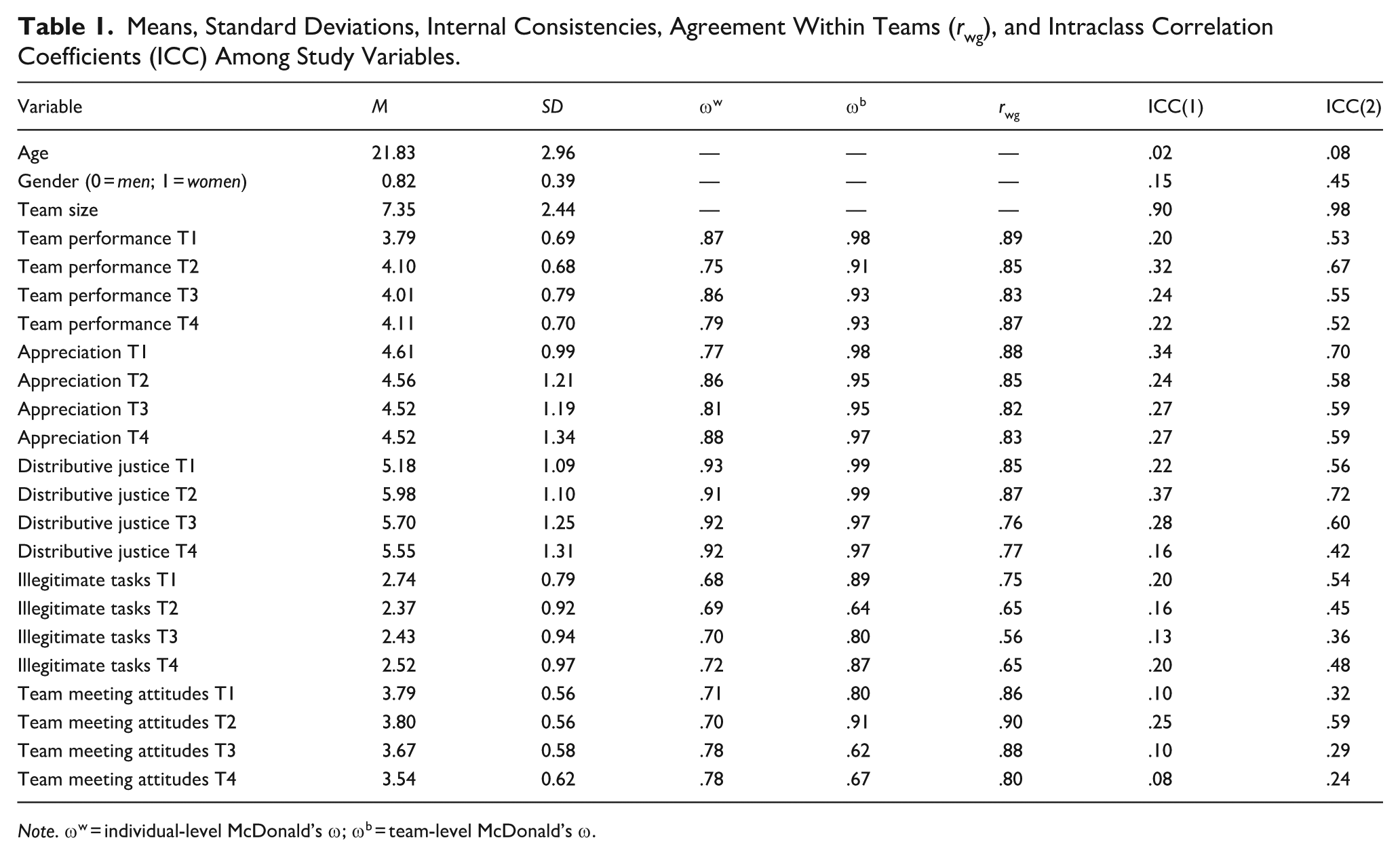
Note. ωw = individual-level McDonald’s ω; ωb = team-level McDonald’s ω.
Perceived Team Performance
Perceived team performance was measured with a three-item self-report scale by Aubé and Rousseau (2005). Responses were given on a 5-point scale (1 = not true at all, 5 = totally true). A sample item is: “This team is productive.” Although self-reported performance measures can be subject to certain biases, including halo and attribution biases (Podsakoff et al., 2003, 2024), three considerations guided our choice to rely on such self-reported measures.
First, evidence from multiple large-scale meta-analyses shows that the pattern and magnitude of relations between key team antecedents (e.g., cohesion, team processes, team cognition) and team performance are highly comparable whether performance is assessed by team members, supervisors, or objective metrics (e.g., DeChurch & Mesmer-Magnus, 2010; Hülsheger et al., 2009; LePine et al., 2008). Moderator tests revealed only moderately higher effect sizes that were attributed to common-source measurement (DeChurch & Mesmer-Magnus, 2010; LePine et al., 2008). Furthermore, members’ performance perceptions were shown to be substantially related to objective outcomes (e.g., Paulsen et al., 2016), underscoring their validity. Second, subjective ratings capture latent facets of team performance—such as coordination quality and adaptive learning—that are difficult for external raters to observe and rarely reflected in objective indicators (Pransky et al., 2006). Third, our full four-wave longitudinal design reduced the risk of inflated associations (Podsakoff et al., 2012, 2024), as it reduced respondents’ ability to reproduce earlier answers and allows genuine change to emerge.
Appreciation from Colleagues
Appreciation from colleagues was measured with five items taken from the appreciation scale developed by Jacobshagen et al. (2008, November 12–14). Responses were given on a 7-point scale (1 = not at all, 7 = very much). A sample item is: “My colleagues show how much they value my opinion by asking for my advice.”
Distributive Justice
Distributive justice was measured with three items of a five-item scale by Niehoff and Moorman (1993). The other two items were excluded as they relate to aspects that did not exist in the study context (level of pay, individual rewards). Moreover, the studied items were adapted to the team context using the referent-shift consensus approach (van Mierlo et al., 2009). The items were answered on a 7-point scale (1 = strongly disagree, 7 = strongly agree). A sample item is: “I consider my work load to be quite fair in this team.”
Illegitimate Tasks
Unreasonable and unnecessary illegitimate tasks were each measured with single-item measures of the Bern Illegitimate Task Scale (Semmer et al., 2015), as Matthews et al. (2022) found that these two items validly assess the overall construct. The items required responses on a 5-point scale (1 = never, 5 = frequently). The two items were: “I had to carry out tasks at work that were unnecessary, or could be done easier if things were better organized” and “I had to do unreasonable things at work that fell outside of my assigned responsibilities and should be done by someone else.”
Team Meeting Attitudes
TMA were measured using the eight-item Team Meeting Attitudes Scale (O’Neill & Allen, 2012). The items were answered on a 5-point scale (1 = strongly disagree, 5 = strongly agree). A sample item is: “Team members should make decisions without having meetings to discuss the issues.”
Control Variables
We included age, gender, and team size as potential control variables. With respect to age diversity, prior research suggests that greater age variation within teams may bring together members with complementary knowledge, skills, experiences, and abilities (e.g., Kunze et al., 2011; Y. Li et al., 2021). Such diversity is expected to encourage information processing, problem solving, and idea generation (Kearney et al., 2009; Y. Li et al., 2021; van Knippenberg et al., 2004). Consistent with this reasoning, empirical studies have shown that age diversity can affect team performance (Wegge et al., 2012; Wu & Konrad, 2023).
Gender diversity has been shown to influence task allocation and collaboration within teams (e.g., Bear & Woolley, 2011; Jackson, 1987). For example, Kearney et al. (2022) found that the performance of gender-diverse teams declined more compared to gender-homogeneous teams when perceived time pressure was high. However, the findings are inconclusive, and the direction of these effects remains unclear (Schneid et al., 2015). H. W. Lee et al. (2018) argue that this inconsistency may stem from differences in the composition of gender diversity within teams. Whereas a balanced distribution of genders may support more effective collaboration, gender-dominant teams may not exhibit the same benefits, as they are more likely to respond aggressively to status conflict (H. W. Lee et al., 2018). Thus, gender diversity appears to play a meaningful role in shaping teamwork.
Consistent with prior research, we also controlled for team size, as it can influence team member interactions (e.g., González-Romá & Hernández, 2014; Kirkman & Rosen, 1999). For instance, in larger teams, the negative phenomenon of social loafing may emerge (Karau & Wilhau, 2020), potentially resulting in lower performance and reduced willingness to collaborate with others, thereby also diminishing perceptions of appreciation and fairness in task allocation. Therefore, age, gender, and team size were included as covariates.
Statistical Analyses
Prior to hypothesis testing, preliminary analyses were conducted and descriptive statistics were calculated (Table 1). For the preliminary analyses, we determined the average intraclass correlation coefficients (ICC) of the studied variables based on the multilevel structure of team variables and tested for measurement invariance of perceived team performance across the four measurement waves. The ICC values that justify multilevel analyses are provided in Table 1 (Lance et al., 2006; Woehr et al., 2015). The levels of longitudinal measurement invariance were analyzed with nested multilevel confirmatory factor analysis using Mplus 8.8 (Muthén & Muthén, 1998–2017). Results showed that partial residual invariance applied to the data, as there was no residual invariance for the first item of team performance (“This team is productive”), but for all other items (Table 2). For the input variables, at least partial residual invariance was found. Altogether, this suggests that the study variables were measured consistently over time (see Table S1 of the Supplementary Material for the tests of measurement invariance). Consequently, the findings can be interpreted as reflecting changes in the studied variables rather than as measurement artifacts.
Goodness-of-Fit Indices for the Tests of Team Performance’s Measurement Invariance and for the Analyzed Multilevel Growth Curve Models.
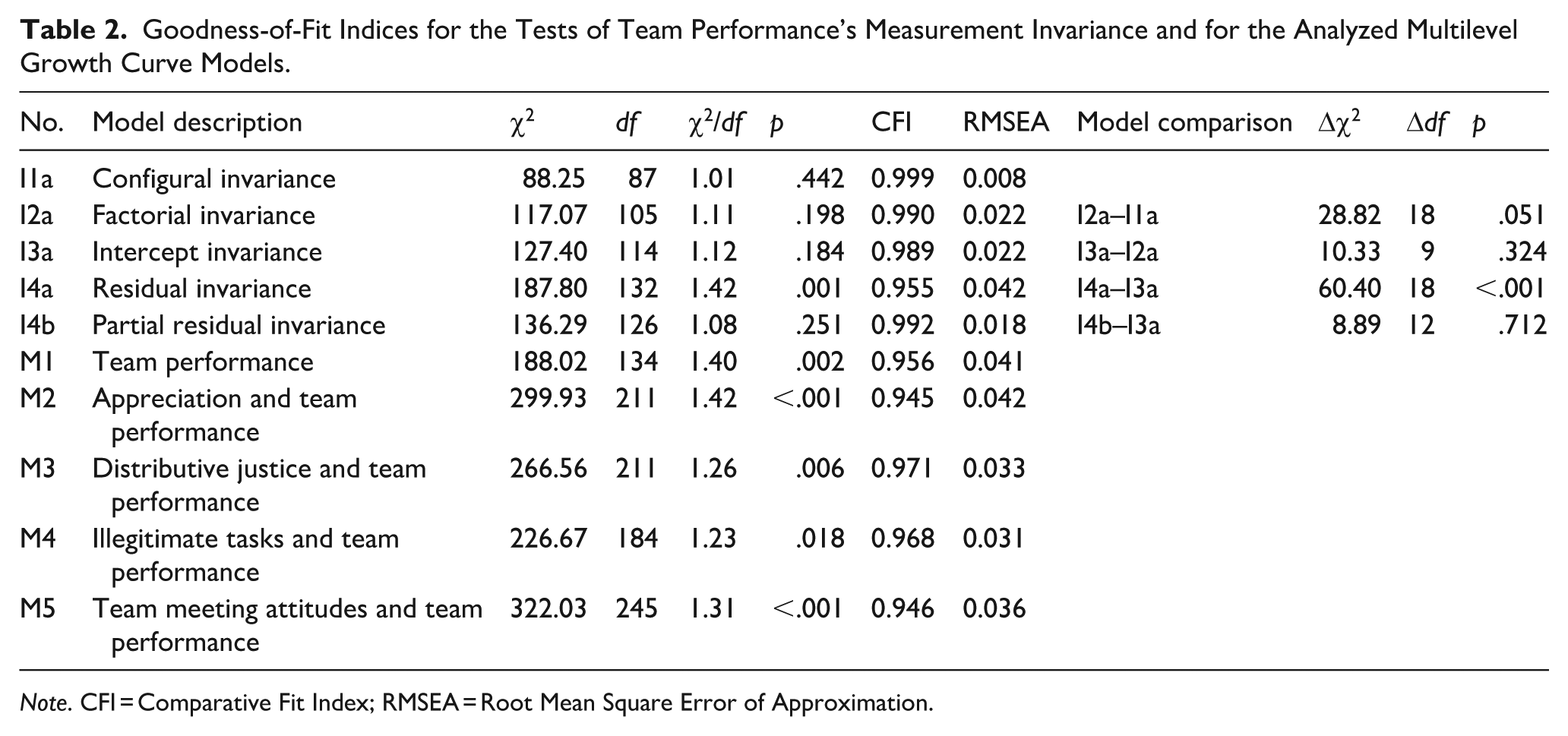
Note. CFI = Comparative Fit Index; RMSEA = Root Mean Square Error of Approximation.
Measurement models were specified with items as indicators. Because appreciation and TMA showed significant correlated residual variances, we subsequently formed item parcels for these two constructs to obtain more parsimonious and better-fitting measurement models (Little et al., 2013). To evaluate model fit, the chi-square goodness-of-fit test, the Comparative Fit Index (CFI), and the Root Mean Square Error of Approximation (RMSEA) were used. In accordance with the recommendations by Schermelleh-Engel et al. (2003), a chi-square value divided by the degrees of freedom (χ2/df) below 3, a CFI above .95, and a RMSEA below .05 indicate an acceptable fit.
To test the hypotheses, we performed second-order multilevel latent growth curve modeling (MLGCM) using the Mplus 8.8 software (Muthén & Muthén, 1998–2017) and the maximum likelihood estimator. Compared to first-order MLGCM, second-order MLGCM can take multiple indicators at each wave into account, which can increase power and growth curve reliability (von Oertzen et al., 2010). Moreover, this approach allows outcome variables at the between (i.e., team) level, orthogonally decomposes the between and within parts of all variables, and accounts for the unreliability of latent group means (Lüdtke et al., 2008; Preacher et al., 2011). In contrast to traditional multilevel modeling, this helps to reduce estimation bias (Preacher et al., 2011).
In a first step, we specified the unconditional MLGCM for perceived team performance (M1) and then added one input variable each as a latent construct in a single model, resulting in four distinct conditional models (M2–M5, see Table 2). Figure 1 schematically illustrates the analyzed multilevel conditional models, including the model specifications. At the individual level, the autocovariances between the items, or item parcels, across time were additionally accounted for. Furthermore, given that Mplus applies group-mean centering in multilevel models using latent decomposition, the intercept factors at each measurement wave were fixed to zero to ensure model identification. According to Hypothesis 6, we tested the effects of perceived team performance on the input variables over time in a second step following the IMOI model (Ilgen et al., 2005). As in the above-mentioned first step, we specified the MLGCM for each input variable and added the effect of perceived team performance on the intercept and slope factors (M6–M9, see Table S2 of the Supplementary Material). All effects were estimated at both the individual and team level. However, the hypotheses were tested and answered exclusively based on results at the team level. The dataset and analysis code used to test the hypotheses and additional analyses are available on the OSF (https://doi.org/10.17605/OSF.IO/JXB8Q).
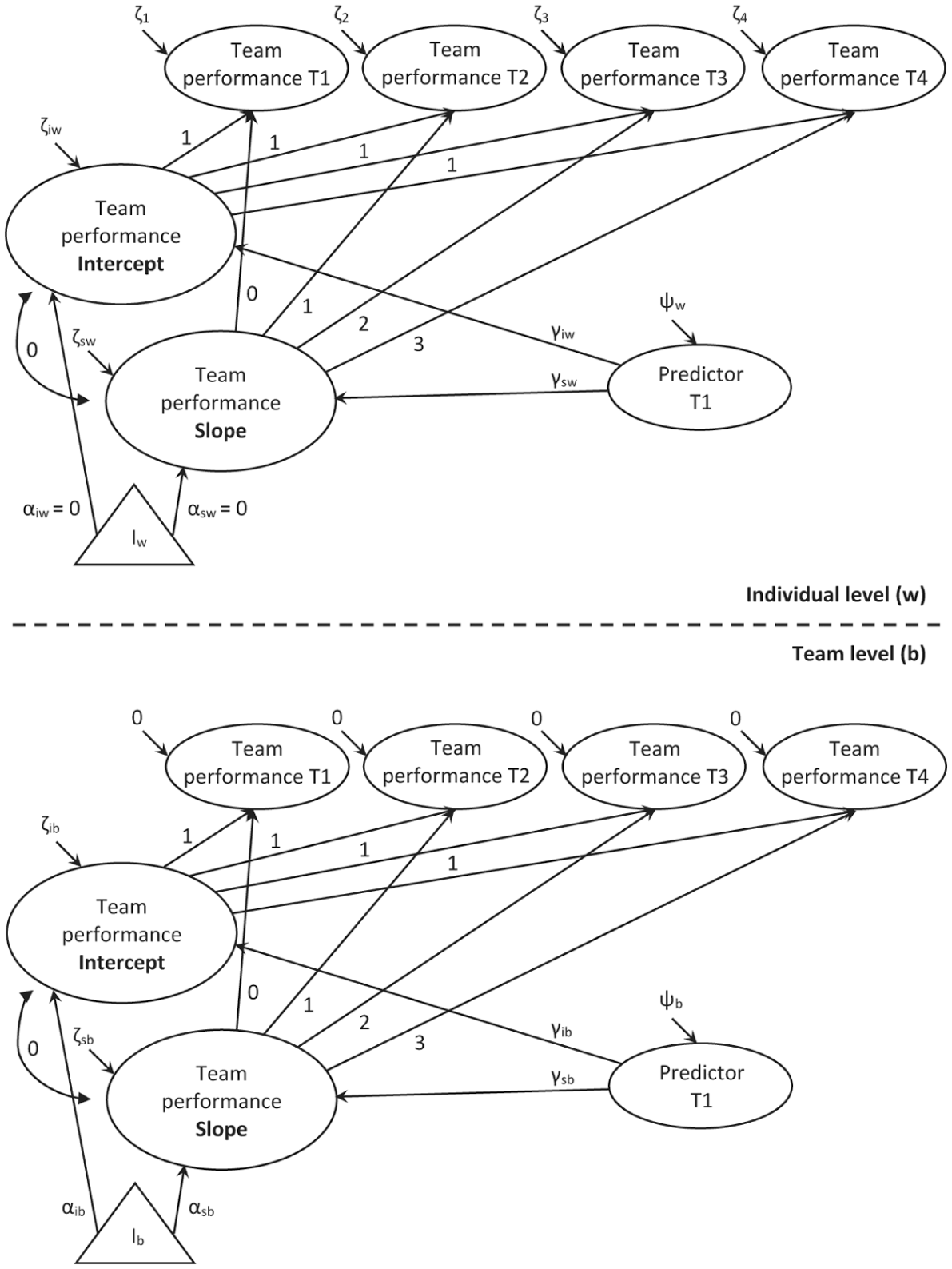
Schematic illustration of the analyzed second-order multilevel latent growth curve models of team performance.
In the additional analyses, we included the control variables. Age, gender, and team size were entered separately into the respective models to ensure computational feasibility (e.g., Saylors & Trafimow, 2021; Zyphur et al., 2023). Age and gender were modeled exclusively at the individual level (see Table S5 of the Supplementary Material for fit indices). The ICC values for age (ICC[1] = 0.02; ICC[2] = 0.08) did not justify consideration at the team level, and there was virtually no between-team variance in gender (team-level variance = 0.02).
Results
Means, standard deviations, internal consistencies, agreement within teams (rwg), and intraclass correlation coefficients (ICC) are provided in Table 1. Table 3 shows the intercorrelations of all study variables.
Intercorrelations Among Variables from All Measurement Waves.
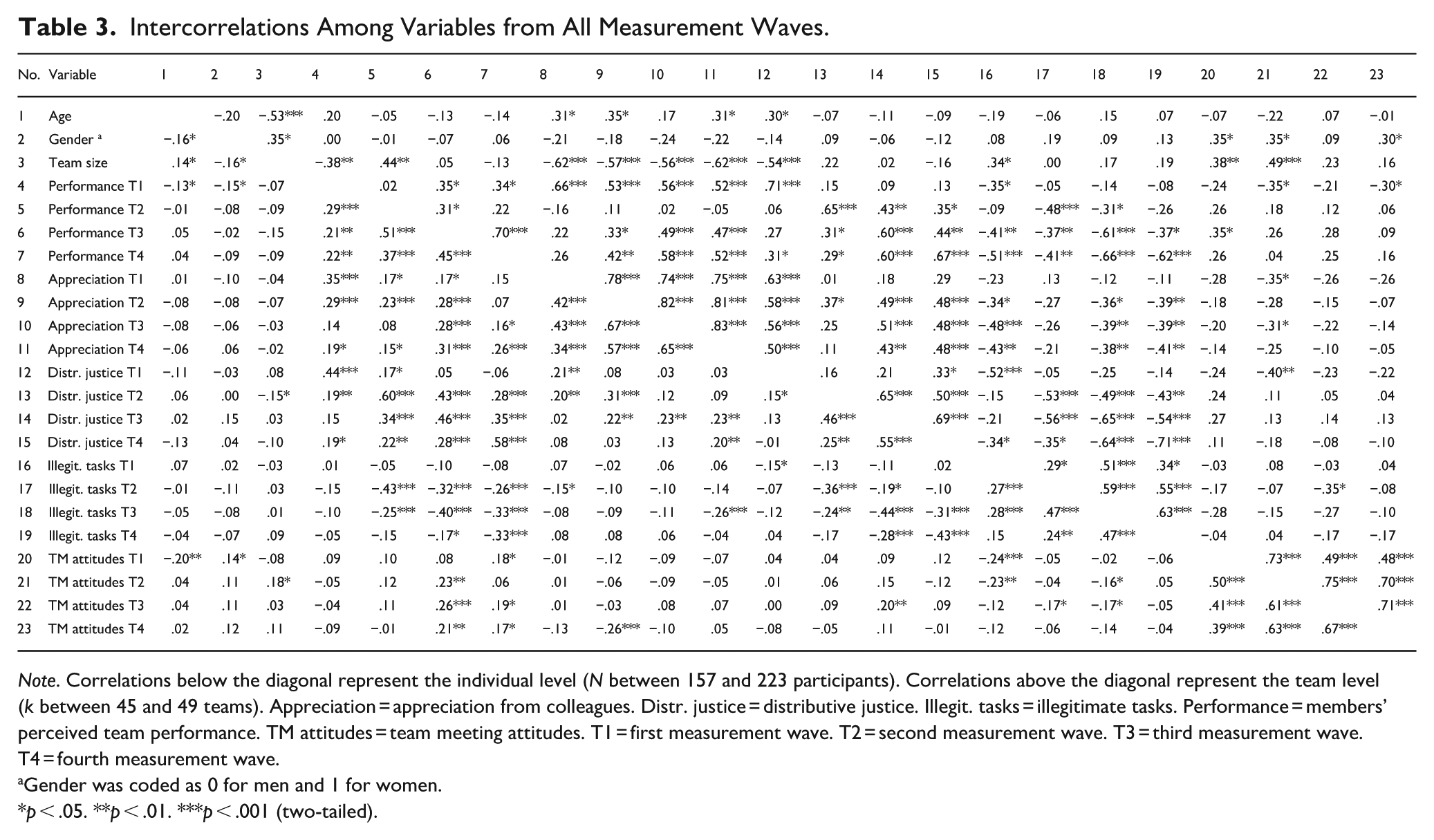
Note. Correlations below the diagonal represent the individual level (N between 157 and 223 participants). Correlations above the diagonal represent the team level (k between 45 and 49 teams). Appreciation = appreciation from colleagues. Distr. justice = distributive justice. Illegit. tasks = illegitimate tasks. Performance = members’ perceived team performance. TM attitudes = team meeting attitudes. T1 = first measurement wave. T2 = second measurement wave. T3 = third measurement wave. T4 = fourth measurement wave.
Gender was coded as 0 for men and 1 for women.
p < .05. **p < .01. ***p < .001 (two-tailed).
Multilevel Growth Curve of Team Performance
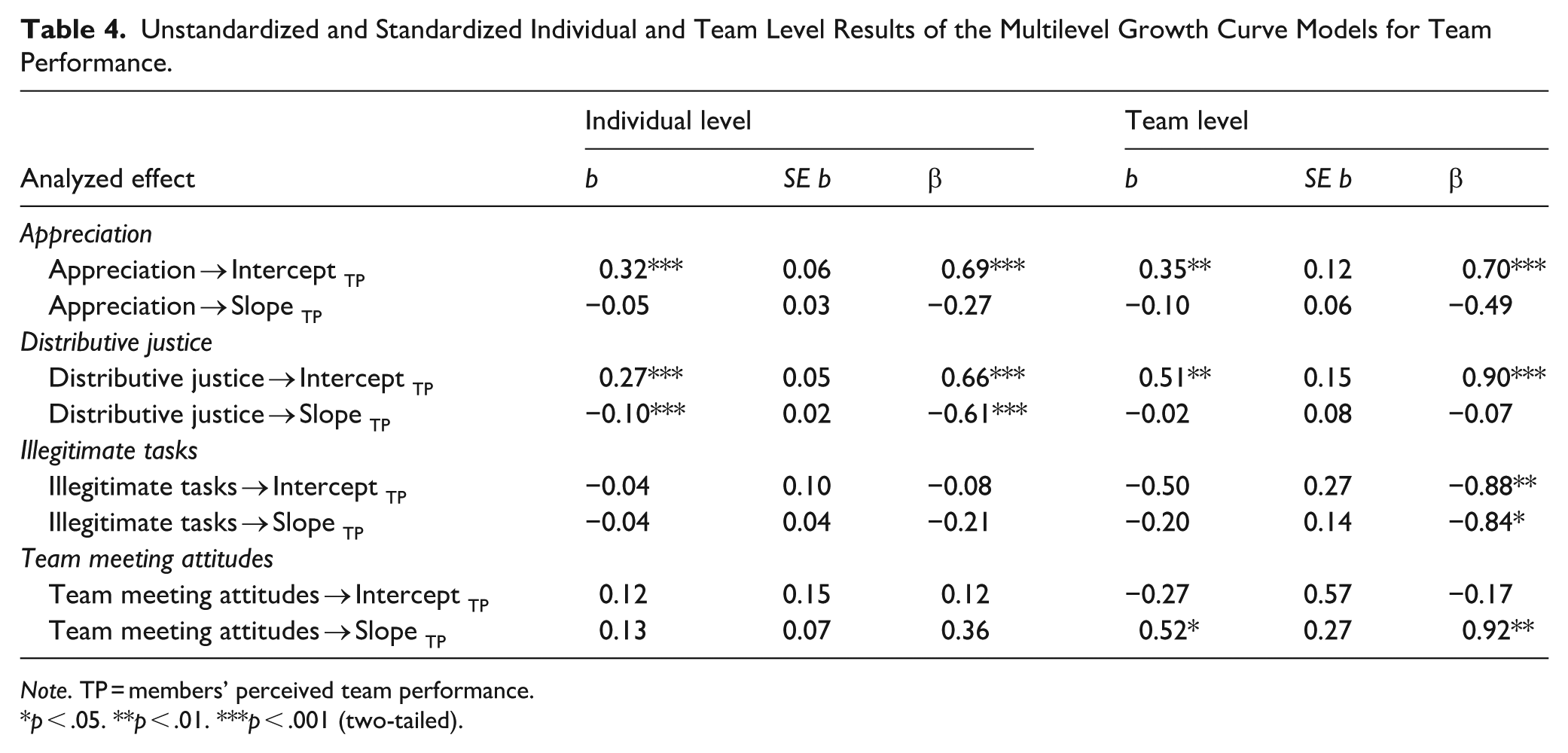
The unconditional MLGCM fit the data well (χ2[134] = 188.02, p = .002, CFI = 0.956, RMSEA = 0.041) and supports Hypothesis 1, as a positive linear trend at the team level over time was identified (b = 0.09, SE = 0.03, p < .01; β = 0.85, SE = 0.34, p < .01; Figure 2). Only at the individual and not at the team level, significant variances were found for the intercept (ψ = 0.10, SE = 0.03, p < .001) and slope factor (ψ = 0.01, SE = 0.01, p < .05), indicating that team members within a team differed in their perceived team performance at the baseline and its trajectory over time. Interestingly, variability in perceived team performance was considerably higher at T2 compared to the other measurement waves (see Figure 2). The results of the unstandardized and standardized 5 effects of the four predictors on team performance, which are described below, are displayed in Table 4.
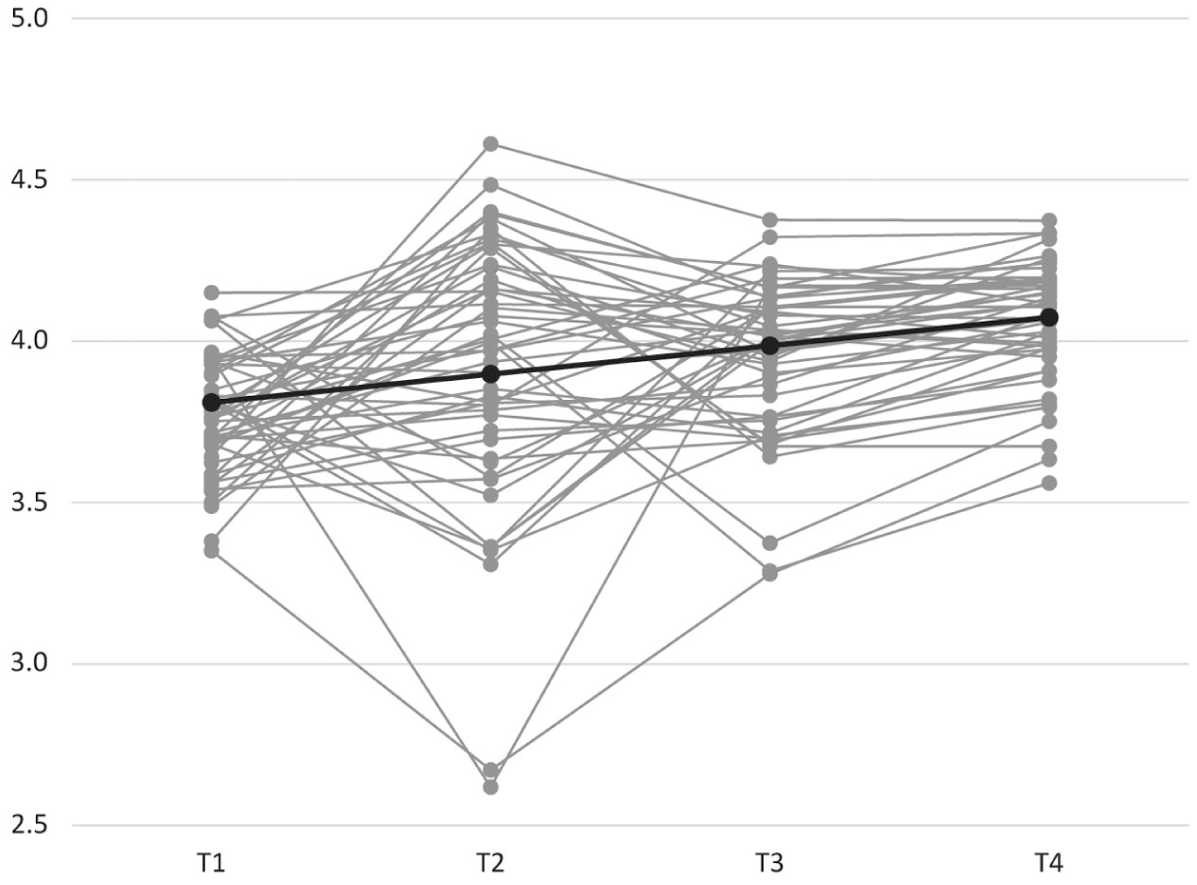
Team performance trajectories of the newly formed teams examined.
Unstandardized and Standardized Individual and Team Level Results of the Multilevel Growth Curve Models for Team Performance.
Note. TP = members’ perceived team performance.
p < .05. **p < .01. ***p < .001 (two-tailed).
Team-Level Effects of Early Perceived Social Processes on Team Performance
At the team level, we found that perceived appreciation from colleagues and distributive justice at T1 positively impacted the intercept factor of team performance (Table 4), supporting Hypotheses 2a and 3a. That is, teams that perceived, on average, higher appreciation and distributive justice at the beginning of collaboration reported higher initial levels of perceived performance. Concerning Hypothesis 4a, we observed a positive trend for the effect of illegitimate tasks on the intercept factor of team performance. The standardized regression coefficient was significant, whereas the corresponding unstandardized coefficient narrowly failed to reach the conventional significance threshold. In contrast, TMA were not significantly related to the initial level of team performance, not supporting Hypothesis 5a. Regarding the slope factor of team performance, Hypotheses 2b, 3b, and 4b were not supported, since neither a positive effect was found for appreciation from colleagues and distributive justice nor a negative effect for illegitimate tasks on the development of team performance (Table 4). However, the significant standardized effects of illegitimate tasks on both the intercept and slope factor of team performance were significant, as effect sizes were very large. Concerning TMA, significant effects were found on the slope factor of team performance, supporting Hypothesis 5b. Thus, the higher TMA were reported at the team level, the greater the increase in perceived team performance over time. Controlling for age, gender, and team size did not lead to different results regarding the effects of the input variables on the intercept and slope factor of perceived team performance (see Tables S6–S8 of the Supplementary Material). Considering this and given that the goodness-of-fit indices were superior for the models that did not include these control variables, the results presented in the main text are based on models without covariates.
Team-Level Effects of Early Perceived Team Performance on Social Processes
For Hypothesis 6, we analyzed whether initial perceived team performance influenced the baseline level and trajectory of the input variables (appreciation from colleagues, distributive justice, illegitimate tasks, TMA). The results of these effects are displayed in Table S3 of the Supplementary Material (for the standardized effects, see Table S4 of the Supplementary Material). We found that perceived team performance was important for the baseline level of appreciation from colleagues and distributive justice (appreciation: b = 1.20, SE = 0.43, p < .01; justice: b = 1.90, SE = 0.50, p < .001). In other words, teams experiencing higher performance at the outset of collaboration also reported higher initial levels of perceived appreciation and distributive justice. Regarding the reverse effects of team performance on the intercept and slope factors of the input variables, the results differed only in terms of the significance of the effect of team performance on the intercept factor of appreciation when controlling for team size (see Tables S9–S11 of the Supplementary Material).
Individual-Level Effects of Early Perceived Social Processes on Team Performance
At the individual level, we also found that initial team performance was positively influenced by appreciation from colleagues and distributive justice (Table 4). These findings suggest that team members perceiving higher appreciation and justice relative to the team average reported greater team performance at the onset of collaboration. Moreover, a negative effect of distributive justice on the development of perceived team performance was identified (Table 4), meaning that team members perceiving greater distributive justice than their team average at the beginning tended to report weaker increases of team performance over time compared to the team mean.
Individual-Level Effects of Early Perceived Team Performance on Social Processes
Within teams, positive effects of team performance on the initial level of appreciation from colleagues and distributive justice were also identified (appreciation: b = 0.74, SE = 0.11, p < .001; justice: b = 0.67, SE = 0.11, p < .001; Supplemental Table S3). These findings imply that team members who initially perceived higher team performance than the team average reported greater appreciation and justice. Furthermore, perceived team performance was negatively related to the slope factor of distributive justice (b = −0.20, SE = 0.07, p < .01; Supplemental Table S3), indicating that team members reporting higher initial team performance perceived a lower growth of distributive justice compared to the team mean.
Discussion
The present article aimed to clarify the development of members’ perceived team performance in newly formed teams. Guided by SOS theory, we followed a new lens on early team processes, positing that social messages that threaten or promote an individual’s self-concept shape the development of a positive team environment and ultimately affect team performance. We are among the first who examined how explicit and implicit social messages, as theorized within the SAD pathway of SOS theory, influence team performance at the beginning of collaboration and over time by employing a growth curve approach. By and large, results showed that team performance increases over the four measurement waves and that its trajectory was steeper for teams with more positive attitudes towards team meetings. Counter to expectations, the performance trajectory did not depend on appreciation, distributive justice, and illegitimate tasks.
In support of research highlighting the crucial role of the initial team phases, we found that appreciation from colleagues and distributive justice affected the initial level of team performance, in that teams with higher levels of appreciation and justice perceived higher team performance at the outset of collaboration. Regarding illegitimate tasks, the standardized coefficient aligned with our assumption of a negative effect on initial performance, although the unstandardized effect slightly missed the conventional threshold for significance. No significant effects were found for TMA on the initial performance level.
Perceived Team Performance Trajectory
Given the positive development of team performance over time, our finding corresponds well with previous research by Lorinkova et al. (2013) and Mathieu et al. (2015), who also reported a positive trend in newly formed simulation teams. The present study extends these results by demonstrating a similar pattern in student project teams working on real and authentic, rather than simulated, collaborative tasks. Positive team performance trajectories often arise when strong external drivers motivate members to produce high-quality outcomes, as was the case in the studies by Lorinkova et al. (2013) and Mathieu et al. (2015). In our sample, this external driver was the fact that most students were undergraduates and depended on good grades to gain admission to a master’s program. Thus, students were under high pressure, which may have resulted in a particularly high overall level of engagement in teamwork. Moreover, the positive development of perceived team performance can also be linked to the concept of interpersonal self-fulfilling prophecies. When newly formed teams begin their collaboration with high performance expectations, their behaviors may align with these beliefs, ultimately reinforcing and fulfilling them over time (Madon et al., 2011; Watson et al., 2021). Hence, the teams “can become the prophets of their own performance” (McNatt & Judge, 2004, p. 552).
Despite the average positive performance development, our results also showed significant intercept and slope variance at the individual level, indicating that there are substantial disagreements within the team variables. These varying perceptions are expectable in terms of team role theory, which states that team members perceive and behave differently (e.g., Belbin & Brown, 2022). At the team level, the studied teams did not differ greatly in their initially perceived team performance and their development over time. This might be explained by the considerable homogeneity of both the teams themselves and the tasks they were assigned. Participants were psychology students, who can be regarded as a social group with similar interests and a high degree of entitativity (Campbell, 1958; Lickel et al., 2000). The differences between the teams are thus averaged out at the team level, although the perceptions still differ at the individual level.
However, Figure 2 clearly revealed greater variability in team performance at T2, suggesting that differences between teams may also be influenced by the specific phase of teamwork. This may indicate that, following initial optimism during the forming phase, some teams experienced conflicts during subsequent phases (e.g., storming phase; Tuckman, 1965). These emerging conflicts could explain the increased variability at T2, which may decline as teams resolve tensions and move into more task-focused phases of teamwork.
The Role of Social Processes on the Initial Level and Development of Team Performance
Our results also revealed that early perceived appreciation from colleagues and distributive justice are meaningful predictors of the initial levels of members’ perceived team performance. It supports the assumption of the team compilation model that these socialization processes are particularly necessary at the beginning of teamwork so that shared norms of interpersonal interaction can develop (Kozlowski & Bell, 2012). Furthermore, it aligns with the “thin-slices” research, indicating that social messages can be perceived early on in collaboration (e.g., Murphy et al., 2015). As a result, it appears that these early shared perceptions of appreciation and justice in a team lay the foundation for team performance at the beginning of the collaboration. However, these early perceptions of appreciation and justice did not further influence the development of team performance, suggesting that these explicit and implicit social messages are less important for subsequent phases of team development, where the focus shifts to task-related processes and interactions (e.g., Bonebright, 2010; Kozlowski & Bell, 2012; Peralta et al., 2018). As argued by Guchait and Hamilton (2013) and He and Hu (2021), social processes may facilitate the development of shared mental models and enhance coordination and credibility, which in turn support team performance. Possibly for this reason, we also found no significant unstandardized effects of illegitimate tasks on team performance, as these and their detrimental effects may become more relevant and perceptible in permanent teams or later task-related phases of teamwork rather than at the beginning of the collaboration. This is consistent with findings suggesting that in temporary newly formed teams, perceived conflicts tend to be ignored in the course of collaboration and compromises are often reached early on (e.g., Bakker et al., 2013; Bradley et al., 2003).
With respect to the slope factor of team performance, our study showed that TMA contribute to the increase in team performance. This aligns with previous research indicating that positive attitudes toward team meetings are associated with team meeting effectiveness (O’Neill & Allen, 2012), and that effective meetings in turn promote greater team productivity (Kauffeld & Lehmann-Willenbrock, 2012). In contrast, TMA had no influence on the initial level of team performance at the start of collaboration. This may be due to teams initially focusing on socialization processes, with interdependent collaboration in meetings, such as solving task-related problems, emerging later (e.g., Kozlowski & Bell, 2012). Consequently, early positive perceptions of TMA may foster greater meeting effectiveness and enhanced team performance as collaboration progresses.
Conversely, and contrary to previous findings (e.g., Whitman et al., 2012), results revealed that team members reporting higher distributive justice compared to the team mean at the outset of teamwork perceived a lower increase of team performance relative to the team average. One possible explanation is that team members who perceive higher equality within the team may already report higher performance at the beginning of collaboration and this perception of team performance remains consistently high over time. In contrast, team members who experience a less equal distribution may initially perceive lower performance compared to the team mean, but their perceptions may align over time, resulting in higher perceived performance over the course of collaboration.
The Reverse Role of Team Performance on the Initial Level and Development of Social Processes
With respect to the analyzed reverse role of perceived performance on social processes, results showed positive effects of team performance on initial appreciation from colleagues and distributive justice at both the individual and team level. The perceived potential for high team performance early in the collaboration appears to encourage team members to engage more actively in social processes and exhibit positive interpersonal behaviors. At the team level, however, interpersonal appreciation seems to depend on team size, as larger teams tend to report lower levels of perceived appreciation, regardless of their initially perceived team performance. In addition, team members who initially perceived higher team performance compared to the team average reported lower levels of distributive justice over time relative to the team mean. Given this negative effect, it could be that a high perception of team performance at the beginning of the collaboration may also be due to the team members’ high aspirations for team performance. This high aspiration could mean that these team members contribute more to performance over time and therefore perceive less distributive justice, which corresponds to the concept of social compensation (e.g., Karau & Wilhau, 2020; Williams & Karau, 1991).
Theoretical Implications
The findings of the present study add to the serial-order effect and the team compilation model. Given the increase in perceived performance over time, it appears that as collaboration progresses, teams develop more original ideas and improved task-related solutions, supporting an extension of the serial-order effect to the team level (Beaty & Silvia, 2012). In line with the team compilation model, the assumption of the fourth phase is supported by the data, as continuous improvement was found (Kozlowski & Bell, 2012). Additionally, the results complement the first phase of the team compilation model, emphasizing the relevance of socialization processes at the beginning of collaboration (Kozlowski & Bell, 2012), as early perceptions of team performance depend on appreciation and distributive justice. The increased variability in team performance at T2 further supports the relevance of this formation phase, suggesting that early team interactions may lead to a reassessment of team performance as collaboration progresses. Consequently, we found support for the assumptions of the first and fourth phases of the team compilation model. For a holistic view, it will be necessary in future to examine all phases concurrently. The assumption that the different phases are relevant simultaneously and over time, as well as the influence of task-related processes on the development of team performance instead of exclusively focusing on socialization processes can then be tested (Ito & Brotheridge, 2008).
Moreover, this study complements SOS theory (Semmer et al., 2019) in that it is not only meaningful in understanding individual responses to offenses to the self but also for perceived team performance and team-level processes over time. By considering how interpersonal dynamics and perceptions of fairness influence team functioning, this research provides valuable insights into the broader applicability of SOS theory in team contexts, highlighting the ongoing impact of individual perceptions on collective outcomes. Our results extend the individual-level finding that a lack of appreciation and distributive justice can be perceived as a social message of disrespect to the team level. These results suggest that a shared perception of disrespect, stemming from social signals within the team, plays a critical role in team-level processes. This highlights the importance of addressing social processes from the very beginning of teamwork and fostering a respectful environment to support positive team outcomes. In line with SOS theory, shared social messages of (dis-)respect are likely to shape teams’ collective self-perceptions and, in turn, the formation of a shared social identity (Semmer et al., 2019).
Since we predominantly identified effects of social messages of team processes at the beginning of collaboration, future research is needed on whether social messages affect the development of team performance after team formation is completed successfully. In relation to the increased variability in team performance observed at T2, an extended observation period including additional measurement waves could clarify whether team conflicts emerge during specific phases of collaboration and shape performance perceptions.
Practical Implications
Given the positive effects of appreciation, distributive justice, and TMA on members’ perceived team performance, the current study provides the following implications for practice. Concerning the positive effect of appreciation on initial team performance, project team members could be trained in social skills such as appreciation before starting to work together (Pfister, Jacobshagen, Kälin, & Semmer, 2020). Such training should include that appreciative behavior can be expressed in different ways, for example by giving fair feedback, saying thanks, and listening attentively (e.g., Bies, 2015; Stocker et al., 2014; van Quaquebeke & Felps, 2018). Furthermore, team members should be made aware that these appreciative behaviors have a high impact and do not require much effort (Pfister, Jacobshagen, Kälin, & Semmer, 2020). In terms of distributive justice, it may be advisable for project teams to discuss what they consider to be a fair distribution and how this distribution should take place right at the start of the collaboration (Scheel et al., 2019). Such a clarification of a common sense of fair distribution and mutual expectations at the onset of teamwork can help to enhance task and goal clarity and thereby positively influence team performance (e.g., van der Hoek et al., 2018).
With regard to TMA, it can be helpful to select team members who value team meetings and to develop rules as a team about how and when team meetings should take place (O’Neill & Allen, 2012). This early establishment of shared norms may promote constructive communication patterns and help regulate expectations within the team (Handke et al., 2019). As a result, the joint development and agreement of a psychological team contract by the team members on how they want to work together—including agreements on appreciative behavior, distributive justice, and TMA—can contribute to task commitment and team performance (e.g., Rahman et al., 2017; Schreuder et al., 2020). By following these recommendations, it may be beneficial to deploy newly formed project teams under certain circumstances (e.g., temporary collaboration, evaluation of team performance), as their perceived performance can improve over time, potentially leading to innovative ideas and original task-related solutions.
Limitations and Future Research
By applying a four-wave longitudinal multilevel design, we provide evidence for the development of members’ perceived team performance and potential influential variables over time in newly formed teams. Nevertheless, our study has certain limitations that should be considered in future research. First, the data was collected at all four waves via self-report using online surveys, which might result in common method bias (Podsakoff et al., 2003). However, the temporal separation across four measurement waves should have minimized the influence of common method bias in this study (Podsakoff et al., 2024). Furthermore, the stable internal consistencies across waves and evidence for longitudinal measurement invariance underscore that perceived team performance was interpreted consistently by participants and that the items coherently represented a single latent construct over time. Consistent with expectations for objective indicators of performance (e.g., Breugst et al., 2012), the applied team performance scale was also positively associated with supportive behaviors among team members and team viability, and negatively with relationship conflict (Aubé & Rousseau, 2005; Guenter et al., 2016), further supporting construct validity. Moreover, expecting lecturers, who were not consistently in contact with the teams throughout the entire collaboration period, to provide reliable performance evaluations for several teams across all measurement waves would not have been practical nor reasonable. Nonetheless, the present study does not allow conclusions about whether the reported effects extend to objectively assessed or externally observed team performance, particularly since no external performance validity criteria are available for the measure used. Thus, future studies are needed that not only rely on self-reports, but on multiple methods that also consider generalizable objective measures of performance at the team level (Rosen & Dietz, 2017).
Second, characteristics of the sample compromise the generalizability of the study. As the data were collected from student teams, the sample represents a relatively homogeneous group likely to exhibit similar response patterns on psychometric scales (e.g., Handke et al., 2019). These teams worked together for one semester, so that the process of collaboration was limited to a few months. Additionally, most of the team members were strongly motivated and perceived their team performance as relatively high, possibly due to the crucial role of receiving good grades, which can be considered as an external incentive (e.g., Cerasoli et al., 2014). Consequently, the results of this study are only generalizable to teams that work together for a limited time and whose final performance is of high importance to each individual team member. We therefore recommend examining these dynamic structures outside the academic context and regarding different types of teams, for instance, cross-functional teams and teams that differ in tenure.
Third, concerning the limited sample size of 49 teams, the recommended target of at least 100 teams for multilevel models was not achieved in this study, although sample sizes of around 50 can still be considered acceptable (e.g., Maas & Hox, 2005). However, these recommendations do not specifically pertain to MLGCM. With respect to MLGCM, Diallo and Lu (2017) recommend that data from approximately 50 teams should be available. Thus, our sample of 49 teams is close to this guideline. Moreover, we conducted post hoc Monte Carlo simulation analyses in Mplus 8.8 using the results of the analyzed models as population and model parameters (following example 12.4 in the Mplus user’s guide; Muthén & Muthén, 1998–2017). The results indicated that, for the significant effects identified at the individual level, the power to detect significant effects with the present sample size was close to 1.00. The power to detect significant team-level effects of the input variables on the intercept factor of team performance ranged from .88 to .92, and the power for a significant effect of team meeting attitudes on the slope factor of team performance at the team level was .55.
Fourth, although we used a longitudinal design with four measurement waves, causal inferences could not be made, as real project teams were investigated and no potential third variables were controlled for (Finkel, 1995). Thus, future research should further investigate the effects of shared social messages on team performance using longitudinal field experiments so that possible effects of third variables on these relationships can be minimized (e.g., Zapf et al., 1996). Furthermore, our study does not allow for conclusions regarding the unique predictive value of individual social processes (e.g., appreciation) on team performance when controlling for others (e.g., distributive justice). Consequently, future research using larger samples should examine which social processes remain particularly influential when considered simultaneously within more complex statistical models.
Beyond these limitations and building on the present findings, future research should explore which types of team training interventions (e.g., cross-training, team coordination and adaptation training, guided team self-correction training; Salas et al., 2007) and training methods are most effective in fostering social processes such as appreciation and perceptions of distributive justice at the outset of collaboration. Given the positive effect of TMA on the development of perceived team performance, it should also be examined whether such attitudes influence team members’ behavior over time. To uncover the mechanisms involved, researchers should utilize both observational and self-report data to assess behavioral change. In addition, it would be valuable to investigate whether targeted interventions can change initial negative TMA to prevent permanent detrimental effects on team performance.
Supplemental Material
sj-docx-1-sgr-10.1177_10464964261450892 – Supplemental material for Dynamics of Performance in Newly Formed Teams: A Multilevel Latent Growth Approach
Supplemental material, sj-docx-1-sgr-10.1177_10464964261450892 for Dynamics of Performance in Newly Formed Teams: A Multilevel Latent Growth Approach by Maurits Dietrich and Marcel Kern in Small Group Research
Footnotes
Acknowledgements
We would like to thank Rüdiger Hossiep and his team for providing the survey platform and supporting data collection.

Funding
The authors received no financial support for the research, authorship, and/or publication of this article.
Declaration of Conflicting Interests
The authors declared no potential conflicts of interest with respect to the research, authorship, and/or publication of this article.
Supplemental Material
Supplemental material for this article is available online.
Notes
Author Biographies
References
Supplementary Material
Please find the following supplemental material available below.
For Open Access articles published under a Creative Commons License, all supplemental material carries the same license as the article it is associated with.
For non-Open Access articles published, all supplemental material carries a non-exclusive license, and permission requests for re-use of supplemental material or any part of supplemental material shall be sent directly to the copyright owner as specified in the copyright notice associated with the article.
