






Abstract
Sound decision making is critical for crews in isolated, confined, and extreme (ICE) environments, yet influencing factors are not well understood. Existing studies face challenges in generalizing due to variability in missions and crews, making data difficult to synthesize. Addressing this gap, we conducted semi-structured interviews with practitioners (N = 8) from diverse ICE teams. Using directed content analysis guided by models of naturalistic decision making, teaming, and literature-identified ICE stressors, we propose an integrative framework that maps elements of ICE team decision making and their interrelationships, including mission objectives, risks, team characteristics, and communication. Accordingly, we identify high-priority factors for empirical investigation.
Introduction
Sound decision making is critical for crews in isolated, confined, and extreme (ICE) environments, such as spaceflight, deep sea, and polar settings. Crews in ICE face isolation from their typical social network, confinement, and extreme, dangerous conditions (Golden et al., 2018). These settings are inherently high risk, where degraded decision making can result in loss of life or mission. These settings are known to pose unique cognitive, affective, and social challenges to people (Golden et al., 2018; Hockey & Sauer, 1996; Lieberman et al., 2005; Maruff et al., 2006; Nicolas et al., 2016; Palinkas & Suedfeld, 2008; Paulus et al., 2009; Pilcher et al., 2002; Roma & Bedwell, 2017; Struster, 2010); as such, factors driving decision making in ICE may differ from those in more typical, less constrained environments where experiments are typically conducted.
Despite these unique conditions and high consequences, the literature does not address decision making in ICE from a theoretical perspective. Naturalistic decision making (NDM) enables an understanding of decision making in real-world environments by providing a descriptive model for how people make decisions in constrained situations (Klein, 2008). In parallel, other research provides models of team processes (Cannon-Bowers et al., 1993; Hollenbeck et al., 1995; Ilgen et al., 2005). However, these theories have not yet been combined and employed to study teams in ICE, and it remains unclear how applicable these findings are to ICE contexts. The literature on ICE-associated stressors primarily aggregates data on the effects of ICE across expeditions, rather than their influence on decision making. Though these general frameworks provide a valuable starting point for investigating decision making in teams, it is critical to study teams in their unique and pervasive environments to ensure the validity of emergent constructs and inter-construct relationships. Only with improved theoretical framing can we tailor solutions to ICE practitioners to improve decision making and subsequent safety and mission outcomes.
In this research, we use qualitative interviews that jointly leverage these theoretical frameworks for the purpose of understanding the individual, interpersonal, and situational factors affecting team decision making in ICE environments. Because the aforementioned approaches each apply to teams in ICE in different ways (and none are fully comprehensive of decision making in ICE on their own), this effort combines them and grounds them in lived experiences. Directed content analysis was used to develop the interview protocol and guide systematic analysis of the interview data. We emphasize ecological validity by garnering lived experiences from practitioners who have lived and worked in ICE via a semi-structured, open-ended interview format. We improve on existing studies with very small sample sizes (typically studying one crew at a time) by interviewing individuals from eight different crews in diverse ICE contexts, recruited via maximum variation purposive sampling. Our results provide insights for a unique but important set of operational contexts and could enable the development of countermeasures aimed at preventing performance decrement in critical settings.
Decision Making in Individuals and Teams
The field of cognitive psychology has focused on developing models of how individuals make decisions. Wickens et al.’s (2016) information processing model of decision making begins with seeking cues from the environment. People selectively process cues with high perceived value (based on past experiences) and filter out others. Selected and perceived cues are used alongside information from long-term memory to iteratively inform one’s assessment of a situation. Following this cue-seeking and diagnosis towards formulating judgments (Mosier & Fischer, 2010c), the next stage involves decision making: executing actions from alternatives, which are thought to be judged on their perceived risks and benefits.
In addition to this general framework, researchers have developed descriptive models aimed at characterizing decision making in more specific contexts. NDM aims to understand how people make decisions in real-world settings that involve uncertainty, high stakes, limited time, ambiguous objectives, and instability (Hammond et al., 1987; Klein, 2008). Klein et al.’s Recognition-Primed Decision (RPD) model emphasizes the role of experience in how people make decisions. People can quickly match a situation to patterns they have learned through prototypical experiences, enabling fast decision making without comparison of options. In evaluating a course of action, people often imagine how it will play out, enabling them to modify it or pivot until finding an action that satisfices their needs (Klein, 2008; Klein et al., 1986). The RPD model has been informed by studies of military leaders, jurors, nuclear plant operators, and anesthesiologists (Klein, 2008).
We next consider teams, groups of individuals that are highly interdependent, share a common goal, and influence one another in their decision making (Hollenbeck et al., 1995). In complex scenarios, where decisions require strategic sophistication and learning, team-based decisions can provide substantial benefit over individual decisions. In complex decision environments, teams “coordinate faster, are more strategic, update their beliefs more quickly, have a steeper learning curve, and are better in predicting outcomes” (Kocher et al., 2020). However, influences of conformity and cohesion can lead to groupthink, where seeking unanimity overrides motivation to appraise alternative options, resulting in deteriorated mental efficiency, reality testing, and moral judgment (Janis, 1972).
To capture complex dimensions of teaming within a general framework, the modern IMOI (Input-Mediator-Output-Input) model conceptualizes teams as “complex, multilevel systems that function over time, tasks, and contexts” (Ilgen et al., 2005), built upon prior descriptions (Hackman, 1987; McGrath, 1964). Inputs may include individual-level factors (such as training), team-level factors (such as team size), and task-level factors (such as risk). Mediators may include team interactions (such as leadership) or emergent cognitive and affective states (such as team mental models and trust cohesion, respectively). Outputs may include both performance outcomes (like decision accuracy) and team outcomes (like cohesiveness; Ilgen et al., 2005; Reader, 2017). The IMOI framework concerns team formation, functioning, and existence in general and is not focused on decision making. Mathieu et al. (2017, 2019) proposed a new framework (the ABCDEF model), which recognizes team inputs, structural features, and mediating mechanisms as coevolving together to generate team effectiveness. The ABCDEF model retains the core components of the IMOI model and similarly acknowledges the cyclical, time-dependent nature of team interactions. It provides a more detailed categorization of team constructs and their intersections, making explicit the overlapping regions of IMOI. In contrast, the IMOI model maintains a process-oriented structure, making it well-suited to temporally ordered teaming interactions.
Mirroring the IMOI and ABCDEF models, effective team decision making has been found to be mediated by a number of social, behavioral, cognitive, and contextual factors (Reader, 2017). Some specific factors identified include team size, team composition, team cohesiveness, team autonomy, team member personalities, team member participation, team ability to adapt to changing circumstances, shared goals, group planning, communication norms, and the existence of hierarchies and distributed expertise (Reader, 2017). Research has concluded that teams with a history of working together outperform ad hoc teams, individual skills alone are insufficient without proper communication, building shared problem models before tasks improves performance, and high-status members strongly influence team performance (Orasanu & Salas, 1993). Conversely, the specific role of task-related and unrelated affect has been less examined, particularly within NDM (Mosier & Fischer, 2010a).
One model useful for representing information transfer between individual team members is the Shannon–Weaver model of communication (Schramm, 1954; Shannon, 1948). The model depicts an information transmitter, a receiver, and the channel over which the information is sent, capturing the information message, its encoding by the transmitter, its decoding by the receiver, and noise added to the message. Based on the Shannon–Weaver model, efforts to understand team decision making should capture the influence of information channels, noise, encoders, decoders, properties of transmitters, and properties of receivers, beyond the influence of just the messages themselves.
One emergent state central to team decision making is team cognition, defined by Mohammed et al. (2021) as “the knowledge-building processes and/or the emergent mental representations characterizing the degree of convergence of team-relevant knowledge content and structure.” Team-relevant knowledge encompasses a broad range of content, including objectives, strategies, interactions, and situational and temporal context. Team cognition has been linked to team effectiveness (Mohammed et al., 2021), with a meta-analysis indicating that it positively predicts team performance (DeChurch & Mesmer-Magnus, 2010). Importantly, the strength of this relationship depends on team and situational context. For example, Niler et al. (2021) found team cognition to be more strongly related to performance in teams characterized by social category heterogeneity, high external interdependence, low authority differentiation, and low temporal and geographic dispersion.
Within the broader domain of team cognition, constructs focused on emergent mental representations differ along a dimension of knowledge convergence (Mohammed et al., 2021). Team mental models emphasize convergence, capturing the degree to which members share team-relevant knowledge (Cannon-Bowers et al., 1993; Mohammed et al., 2021; Orasanu & Salas, 1993). Orasanu (1990) extended the concept of team mental models to explain functioning in novel situations, suggesting that teams develop shared situation models that include “shared understanding of the problem, goals, information cues, strategies, and member roles.” In contrast, transactive memory systems emphasize divergence, describing how knowledge is distributed across members and efficiently retrieved and integrated (Mohammed et al., 2021). These distinctions have important implications for capturing how teams store and share information under varying task and environmental conditions.
Other theoretical approaches highlight how team structures shape the use of shared and distributed knowledge. For instance, Hollenbeck et al.’s (1995) model of hierarchical teams with distributed expertise distinguishes between consensus-based and hierarchical team structures, emphasizing the role of hierarchy and expertise distribution in team decision making. Collectively, these perspectives demonstrate how structural and compositional factors shape emergent mediational states and their relationships with team outcomes, underscoring the importance of studying teams in their unique and pervasive environments.
Isolated, Confined, and Extreme Environments
One subset of contexts in which team decision making is critical is ICE environments. Individuals in ICE settings (such as spaceflight, deep sea, and polar settings) face isolation from their typical social network for an extended duration, confinement or limited mobility, and extreme, dangerous conditions (Golden et al., 2018). These stressors distinguish ICE environments from those typically studied in the decision making literature. In these inherently high-risk settings, degraded decision making can threaten safety and mission success. ICE environments are also often complex, involving interactions between people, the physical environment, and procedures, alongside tight coupling due to strict schedules (Roberto, 2002). As a result, small errors can trigger downstream problems, increasing sensitivity to lapses in judgment.
Adding to these challenges, ICE settings present unique decision making environments often characterized by limited information. Available information is constrained, depending on factors like satellite coverage, bandwidth limitations, and the availability of devices for accessing information. Information may also be delayed, as is the case for long-duration spaceflight missions and satellite-based communication in areas with poor coverage (Parisi et al., 2024). It may also be curated by external parties. For example, space agencies have had to determine how to deliver bad news (such as a family member’s death or a national security threat) to astronauts in space. Kanas et al. (2013) suggested that bad news from home “should probably be transmitted only after any near-term mission-critical operation has been completed.” In efforts to manage cognitive load, displays may be designed to reduce complexity, intentionally excluding candidate information streams (Sim et al., 2008). Without access to alternative information sources, people in ICE may be restricted to information from channels selected pre-mission and any additional information that their support structures choose to provide to them.
Despite shared characteristics, ICE settings can differ across important dimensions (Palinkas & Suedfeld, 2021). Polar settings present cold temperatures and altered light cycles, whereas astronauts in space habitats are subject to microgravity and radiation. ICE missions can range in duration (from weeks to years), degree of isolation, and environment severity. Long-duration space missions, for example, will impose communication delays between crews and Earth-based support systems, which have been shown to have detrimental effects on individual well-being, teamwork processes, and operational outcomes (Kintz et al., 2016). Additionally, crews spending long periods in ICE may see temporal changes in psychosocial states (Bechtel & Berning, 1991; Bell et al., 2019, 2025; Kanas et al., 2006, 2007; Steel, 2001; Struster, 2010). Depending on the specific context, additional stressors can include physical fatigue, low humidity at high altitudes, altitude-related cardiopulmonary effects, cold-related peripheral circulatory effects, hypothermia and frostbite, immunosuppression, and hormone dysregulation (Palinkas & Suedfeld, 2008, 2021). These conditions affect individuals (via altered emotions and decreased cognitive performance, for example) and team processes (via team cohesion and interpersonal relations, for example; Palinkas & Suedfeld, 2021).
Decision Making in ICE
ICE settings have been shown to affect cognition, affect, and social processes (Palinkas & Suedfeld, 2021), each of which influences decision making (Grossman et al., 2017).
Most studies support that cognitive performance deteriorates with ICE exposure. Lieberman et al. (2005) found vigilance, reaction time, attention, memory, and learning to be impaired with exposure to extreme environments (extended physical exertion in the heat). Maruff et al. (2006) saw decreased speed of psychomotor, attentional, and executive functions as a physically taxing desert expedition progressed. Hockey and Sauer’s (1996) study on the effects of isolation and confinement on cognition indicated loss of efficiency in mental resource use over time, increased processing effort needed to maintain performance, increased information-reference before decision making, and reduced decision making speed. Cognitive decrement has not been found in all studies (John Paul et al., 2010). Pilcher et al.’s (2002) meta-analysis found that cognitive performance does not deteriorate uniformly over time—instead, it is thought to decline until reaching a steady state, with potential to improve during prolonged exposure. Cognitive performance decrement is thought to be further mediated by other contextual factors, including task type, task duration, degree of task-related training, environment severity, and duration of ICE exposure, individual factors such as acclimatization, personal arousal, and motivation (Paulus et al., 2009), and adaptability to ICE (Bartone et al., 2018).
Affective responses to ICE can include positive and negative mood changes. Negative responses may include depression, anxiety, anger, fatigue, and irritability (Lieberman et al., 2005; Palinkas & Suedfeld, 2008; Paulus et al., 2009). Similar to cognitive outcomes, affective response depends on task type, the nature of the specific environment, and individual attributes (Paulus et al., 2009). Tortello et al.’s (2021) study of a team wintering over in Antarctica found social support to foster better adjustment to the environment, concluding that social interaction can facilitate emotional and cognitive strategies for managing harsh isolation conditions.
Social dynamics play an important role in mediating cognitive and affective outcomes in ICE. Social outcomes are themselves also affected by ICE exposure. In fact, interpersonal conflict and tension have been cited as the largest source of stress in polar expeditions (Palinkas & Suedfeld, 2008). Nicolas et al. (2016) found a significant continuous increase in social stress over a 12-month Antarctic mission. Factors affecting social interactions may include competition, exclusion, cliques, leadership styles, isolation from usual social networks, and differences in gender, age, occupation, and culture (Nicolas et al., 2016; Palinkas & Suedfeld, 2008). ICE environments often limit the degree of separation possible between work and leisure and provide little opportunity for privacy, which can exacerbate social conflict (Paulus et al., 2009). Tension and conflict can also occur between the team in ICE and externally located support organizations (Palinkas & Suedfeld, 2008), which may be worsened by communication delays between the groups (Kintz et al., 2016). These factors can further decrement cognition, affect, and team communication (Paulus et al., 2009), highlighting the need for continued research on their impacts, particularly on decision making.
Team-level decision making outcomes associated with ICE are less researched, partly due to the challenges of drawing causal conclusions from single-crew studies conducted in diverse contexts with varying objectives. Insights are often limited to case-specific observations. For example, a case study of the 1996 tragedy on Everest pointed to cognitive biases and team processes, thought to have been compounded by a lack of psychological safety, which prevented members from challenging prevailing views (Roberto, 2002). Structural characteristics of the team that may have prevented better psychological safety include status differences across members, leadership styles, and low familiarity among members (Roberto, 2002). This case underscores the importance of studying team factors in ICE contexts to better understand how decision failures emerge and how they might be prevented.
Gaps and Contributions
Despite the rich bodies of literature on both team decision making and ICE environments, there remains a gap in translating between the two domains. As a result, the influence of ICE settings on team decision processes is undercharacterized. It is also unclear which aspects of existing theories generalize to these environments. To begin addressing this gap, an integrative, empirically grounded framework that synthesizes insights across domains can help organize knowledge and guide future research. Building such a framework is an important step toward developing a more coherent understanding of team decision making in ICE environments, where outcomes carry substantial operational consequences.
Descriptive models of decision making have helped understand decision making processes in both controlled and real-world environments. NDM findings, often diverging from laboratory-based counterparts, highlight the importance of studying decision making in ecologically valid environments (Klein, 2008; Mosier & Fischer, 2010b). Other domains of research model team processes (such as the ABCDEF, IMOI, and I-P-O models; Ilgen et al., 2005; Mathieu et al., 2019; McGrath, 1964) and information transmission (such as the Shannon–Weaver model; Schramm, 1954; Shannon, 1948), all of which involve components relevant to team decision making. However, these theories have not yet been combined and employed to study teams in ICE environments. While the literature aggregates data on the effects of ICE within specific expeditions, factors influencing team decision making in particular are not well characterized. By drawing on these complementary approaches, we aim to present a well-balanced investigation and perspective on decision making in teams in ICE.
Accordingly, we identify factors likely to affect team decision making in ICE based on the current bodies of literature on decision making, team processes, and ICE-associated stressors. Specifically, we draw on existing research to select frameworks for use in analyzing qualitative data from interviews with ICE practitioners. To inform a useful interview code book, it was important that selected frameworks provided coverage of the anticipated mechanisms of interest but were scoped to promote analytic consistency in coding.
In ICE, we anticipate team-based decisions under incomplete information, mediated communication, and time pressure. Accordingly, we want to capture (1) how information is transmitted or degraded between team members and (2) how decisions are made under uncertainty and time pressure with limited cognitive resources. We sought theoretical frameworks to map onto these complementary mechanisms at different levels to enable separation of decision errors arising from cognitive processes from those arising from information transmission constraints, an important distinction in team-based, high-uncertainty environments.
The Shannon–Weaver model was selected to capture the role of information transmission in shaping team decision making in ICE settings. These environments often impose limitations on bandwidth, timing, and fidelity of communication, leading to potential information asymmetry and noise. By explicitly representing encoding, transmission, and noise, this choice allows communication processes to be analytically distinguished from decision processes. Drawing from the Shannon–Weaver model, communication-based factors include properties of message transmitters and receivers, channels over which messages are transmitted, noise added to messages, and the messages themselves (Shannon, 1948).
Wickens et al.’s (2016) model and NDM’s recognition-primed decision (RPD) model were selected to capture how decisions are made in ICE environments characterized by uncertainty, time pressure, and incomplete information. In these operational settings, decision makers are unlikely to compare explicit alternatives, but instead rely on pattern recognition, mental simulation, and iterative refinement. RPD is well-suited to multi-stage, context-rich decisions with ill-defined, evolving goals. Importantly, it reflects how real-world teams satisfice under cognitive and environmental constraints rather than optimize under idealized assumptions. Based on Wickens et al.’s (2016) model of decision making, information processing-based factors include constrained mental resources: information overload, motivation, and prior experience. NDM identifies factors including prior experience of team members, time pressure, risk, and conflicting information (Klein, 2008; Klein et al., 1986).
The IMOI model provides a conceptually clear, process-oriented structure that supports systematic and temporally grounded coding, where analytic consistency is essential. While the ABCDEF model provides valuable granularity for distinguishing between constructs, its scope of categorization is less suited to early-stage qualitative coding. The IMOI model still facilitates subsequent theoretical interpretation, as its derived codes can be readily mapped onto the ABCDEF model. The IMOI model suggests inputs to and mediators of decision making, including mission duration, organizational culture, organizational hierarchy, emotions, and attributes of individual team members (Ilgen et al., 2005).
Given ICE-associated stressors, situational factors include time pressure, characteristics of the physical environment, training, mission duration or ICE exposure, external pressure, risk, emotions, physical workload, mental workload, motivation, and attributes of individual team members.
Guided by empirical data, we integrate these descriptive models to examine team decision making in ICE environments, identifying candidate mechanisms that warrant further empirical investigation. We address gaps in ecological validity by garnering lived experiences from practitioners who have worked in ICE through semi-structured interviews. We improve on empirical studies with very small sample sizes (typically studying one crew at a time) by interviewing individuals from eight different crews in diverse ICE settings, recruited via maximum variation purposive sampling. We leverage the interviews and the literature to build an empirically informed, integrative framework and research agenda for team decision making in ICE. Improving our understanding of how teams make decisions in ICE provides valuable insights for a unique set of operational contexts where findings from studies in more normative settings may not generalize. Through this improved understanding, this effort could enable the development of countermeasures aimed at preventing performance decrement in high-risk ICE settings, where decision making can mean life or death.
Methods
We conducted semi-structured qualitative interviews and subsequent directed content analysis with individuals (N = 8) who have lived and worked in ICE. Existing models of decision making (NDM’s RPD), communication (the Shannon–Weaver model [Shannon, 1948]), and team dynamics (the IMOI model [Ilgen et al., 2005]), and ICE stressors identified in the literature guided the directed content analysis. Intercoder agreement across independent coders was calculated to assess the reliability of the coding scheme. This study was approved by the University of Colorado’s Institutional Review Board (IRB # 23-0579) and was exempt under Category 2. The study was also reviewed and approved by an Air Force Human Research Protection Official.
Interview Protocol
An interview protocol was designed to capture factors relevant to how teams make decisions in ICE. Specific questions were generated based on NDM’s RPD model, the Shannon–Weaver model, the IMOI model, and ICE stressors identified in the literature. The initial protocol was iterated on through two rounds of pilot testing. First, abbreviated pilot interviews were conducted with six PhD students (4F, 2M). Feedback from the abbreviated pilot interviews was used to improve the clarity of the questions. The updated protocol was used in end-to-end pilot testing with two participants (1M, 1F) who had ICE experience. These interviews were transcribed verbatim, cleaned, coded, and used in an initial pass of directed content analysis. The updated protocol was reviewed by the full research team. The protocol is available here: https://osf.io/axghr/?view_only=50ce843dd1f4487fabbd1edda825bb12
The interviews were structured into an event-oriented section and an interpretation-oriented section. The event-oriented section started by asking the participant to describe a time when they had to make a decision with limited information. A set of potential follow-up questions was prepared to ensure that the “who, what, and where” of the situation were described (Sandelowski, 2000). The follow-up questions were based on the guiding models and literature. For example, the Shannon–Weaver model motivated questions about the participants’ available sources of information, including their teammates, support structures, and other devices, information they had expected to be available that was not, and how they communicated with others. The RPD model motivated questions about the timeframe of the scenario, including the build-up and aftermath, perceived risks or threats, and how teams developed a solution. With an understanding of the situation, the interview proceeded with several interpretation-oriented questions. Guided by the IMOI model and ICE-associated stressors, participants were asked how past experiences, feelings and emotions, motivation, and personal attributes played a role in how the situation was handled. Finally, after the prepared questions, participants were asked if there was anything that they did not get the chance to bring up that they wanted to share.
Data Collection
Maximum variation sampling was used to capture a wide range of ICE experiences (Palinkas et al., 2015). Before the study, several ICE roles were identified to guide recruitment. These roles included astronaut, analog astronaut (a participant in a simulated space mission on Earth), alpine mountaineer, retired military operator, and polar researcher. We aimed to interview at least one person from each of these roles and to maintain gender parity to the best of our ability. Recruitment was seeded by identifying individuals in each role who then distributed recruitment materials to their own role-specific network. Participants with close connections to the researchers were not enrolled to minimize bias. Eight people (4M, 4F, aged 20–68) were interviewed. Participants’ self-reported races were either White, Asian, or more than one race. Participants included a Space Shuttle astronaut, an Everest mountaineer, a wildfire fighter, a scientist who wintered over in Antarctica, a Martian analog astronaut, a retired National Air Guard pilot, an Arctic ice researcher, and a remote airport director. Though the interviews concerned decision making in teams, due to the specialized nature of the recruited individuals it was not possible to interview multiple members of each team. The individuals thus acted as key informants of their teams, as has been done in prior studies investigating team processes through semi-structured interviews (Bogdanovic et al., 2015; Jalil et al., 2013; Wespi et al., 2023).
With participants’ informed consent, all interviews were conducted and recorded over video calls on Zoom. OpenAI’s Whisper model was run locally to generate transcripts from the audio recordings (Radford et al., 2023). A researcher reviewed each transcript while listening to its associated audio recording, correcting any mistakes in the generated text. Participants were asked to complete a demographic questionnaire on Qualtrics after the interview was complete.
Interview Coding
Prior to beginning data collection, we created an initial codebook using the Shannon–Weaver model, the IMOI model, characteristics of NDM, and ICE stressors identified in the literature. The codebook assigned codes to themes that we expected to occur frequently and provided operationalized definitions and reference quotes for each code. Conceptually similar themes were grouped into high-level categories. The initial codebook was reviewed by the full research team, and new codes were added based on the team’s suggestions. After the eight interviews were completed, data immersion provided an opportunity to improve the codebook before its application to the dataset. After reviewing and cleaning the interview transcripts, the codebook was revised to improve code coverage and code mutual independence. A list of themes from the interviews was recorded separately and cross-referenced with the codebook. Emergent themes were added to the codebook. Some similar codes were collapsed. The revised codebook, organized by the high-level code groupings, is represented in Figure 1.
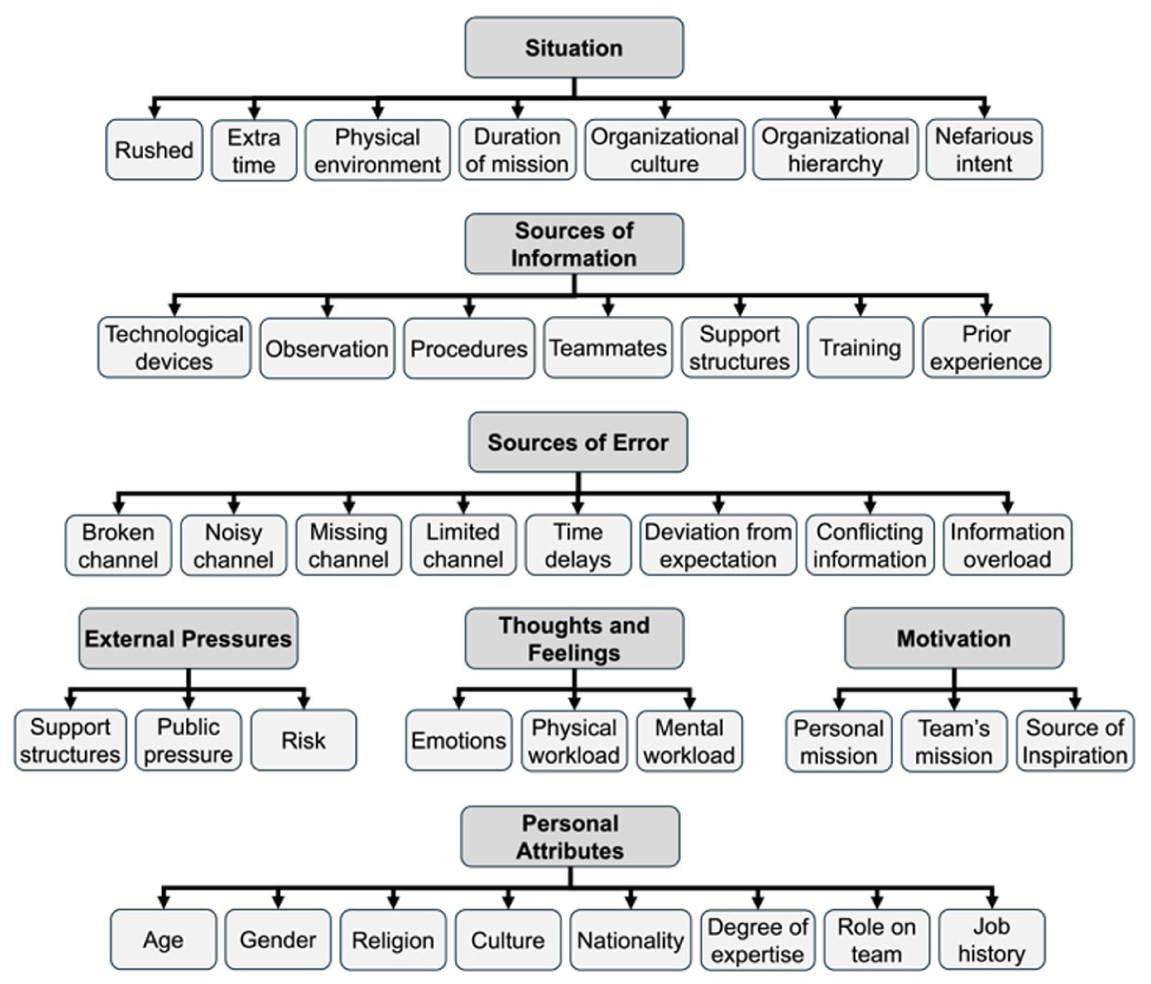
Tree diagram outlining the structure of the codebook and its included codes.
The cleaned interview transcripts were coded by applying codes to segments of the transcript that capture their associated themes. Segments could have zero or more than one code applied to them. MAXQDA 24.5.1 was used for interview coding and analysis. Two researchers (one PhD student and one postdoctoral researcher) independently coded a pilot interview using the codebook. The researchers discussed their results, ensuring shared understanding of codes and their operationalized definitions. Following this alignment, the two researchers independently coded two of the data interviews. Substantial intercoder agreement was achieved (
Determining Saturation
After eight interviews, the data were checked for saturation. Three criteria were satisfied, which indicated that adequate data were collected. First, interviews with the a priori set of ICE roles targeted for recruitment had been fulfilled. Second, the literature-identified factors of decision making in ICE had been captured. Third, all applied codes were used in at least two interviews; that is, no theme was unique to one interview, indicating a lack of additional data to be gained from new interviews.
Analysis of Coded Data
The frequencies of each code’s applications were summed across interviews, and the most frequently applied codes were identified. Additionally, the numbers of interviews each code was used in were counted to provide a measure of applicability to different ICE scenarios. MAXQDA’s Code Map was used to create a code map according to similarity based on the intersection of codes in a segment. Both the distances between codes and the edges between codes are based on how similarly the codes are applied in the data, with the edges enabling mapping of the multi-dimensional similarity matrix onto a 2D space. The edges indicate codes that intersect at least five times, where thicker edges indicate more coincidences. The codes are colored by data-driven clusters. The data-driven code map presents evidence for interesting relationships between codes.
Findings
Prominent Themes
Table 1 lists the ten most frequently applied codes across all eight interviews, their number of applications (frequency), and the number of interviews each code was applied in.
Frequencies of the 10 Most Applied Codes and the Number of Interviews They Were Applied To.
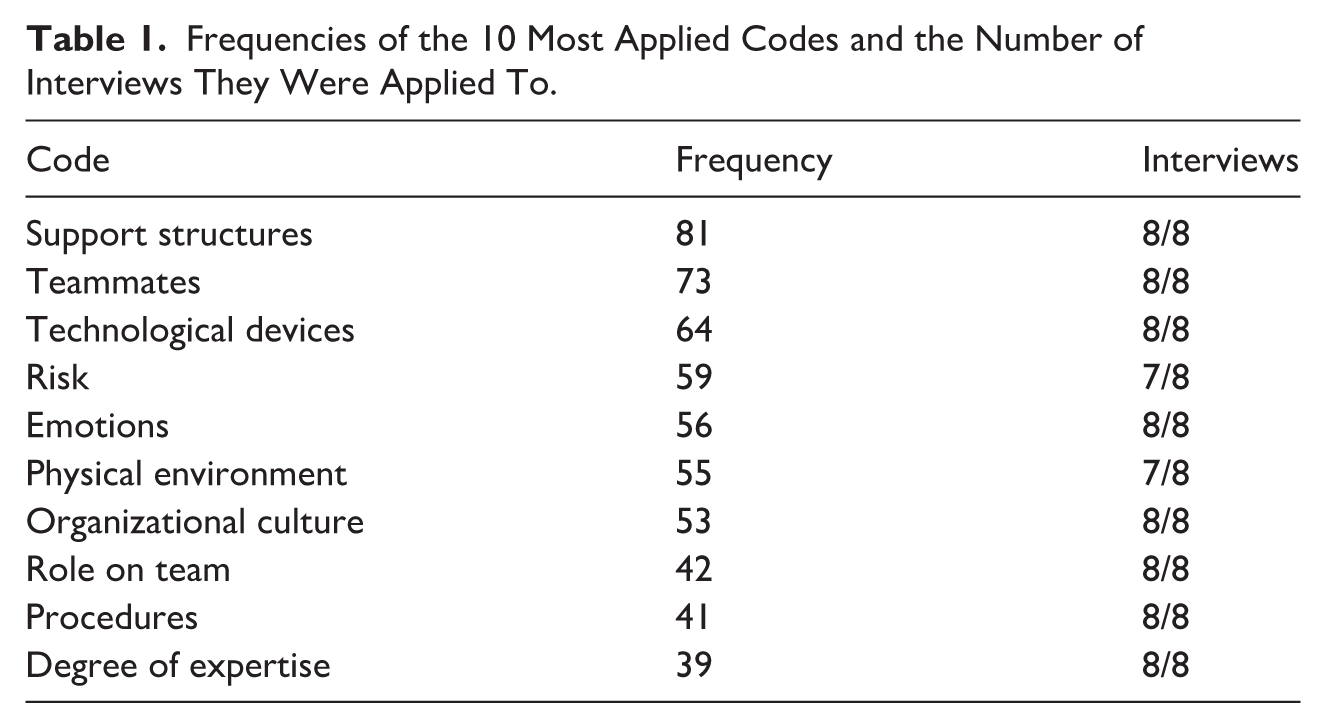
Support structures (as a source of information) was the most frequently applied code and was applied to all eight interviews. Though the studied teams were physically isolated, information from external sources (who had access to more channels of information than available in ICE) was important to their decision making. The Arctic ice researcher described how their expedition had “weather center people on site . . . they have access to the satellites and they just tell us, ‘. . . this is how we’re tracking this ice flow.’” The researcher did not have access to the satellite data nor the requisite experience to interpret the ice flows. After receiving reports of the conditions, they had limited time to select which site to visit. Their decision making relied on these sources due to the sources’ expertise, time pressure, and lack of additional channels of information.
Considering the criticality of externally sourced and synthesized information, there are implications for what information should be provided through external sources in ICE settings. For example, mountaineering crews that rely on infrequent weather reports to time their traverses can leverage estimates of uncertainty in the forecast to adapt their plans. Heavy reliance on remotely located groups also bears importance to the goals of space agencies which aim to extend crewed spaceflight to deep space, where communication blackouts and latency will make reliance on Earth-based support exceedingly difficult (Kintz et al., 2016). These teaming scenarios benefit from anticipating necessary information such that it can be transmitted before it is required by the crew in ICE. Additionally, capabilities previously accomplished by external support structures (such as ground control) will need to be transferred to onboard people or systems to improve self-reliance (Rollock & Klaus, 2022).
Given the extent of ICE crews’ reliance on information from external support structures, ensuring the strength of this information stream is critical. To this end, training was cited as a useful practice for developing positive ground-crew dynamics, with the Space Shuttle astronaut describing that “it’s a dance. It’s a sort of a ballet working with the ground. And you develop trust in them, and they develop trust in you, and you work together. And there’s a reason why you do so many simulations. And that’s to develop that confidence.” This experience aligns with Orasanu and Salas’ (1993) finding that experience working together improves teams’ coordination and performance. Several ICE studies cite tension between crews and external support groups (Palinkas & Suedfeld, 2021). Specifically, unreasonable and unclear demands on the crew in ICE have resulted in hostility and conflict and should be avoided (Palinkas & Suedfeld, 2021). Tensions between ICE teams and external support groups may be exacerbated by time delays (Palinkas & Suedfeld, 2008). Missions that rely on information from external groups may benefit from focused training on ground-crew teaming under realistic conditions (e.g., with the communication delay) to develop the confidence that facilitates positive teaming dynamics (Orasanu & Salas, 1993). This finding underscores the importance of understanding distributed team dynamics for fostering and maintaining an important line of information transfer.
Teammates (as a source of information) was the second most frequently applied code and was also applied to all eight interviews. Teammates, especially those with diverse expertise, were found to bring unique information to a situation. One participant relied on their teammate’s experience operating equipment, stating that “on the instrumentation side, [my teammate] was very familiar with how to operate the system. So, you know, I was definitely looking up to her for ‘how do we run this equipment?’” In ICE, where new team members cannot enter and leave easily, coverage of necessary expertise is essential. In the Space Shuttle, Everest, Antarctic, Martian analog, and the National Air Guard missions, there were no practical options for bringing in new members mid-mission if the crews had determined that expertise was lacking. Therefore, robustness to unanticipated failures via diversified personnel is important in complex environments like ICE settings. Bolstering this finding, heterogeneous teams with diverse skills and knowledge have been suggested to provide improved adaptation and robustness (Käosaar et al., 2022; Radwan & McComb, 2022), which could be advantageous in isolated, confined settings. Teammates also contributed new motivation towards solving problems. Another participant described feeling defeated after multiple approaches to completing a task did not work, but a teammate’s persistence led to their eventual breakthrough: “I was up late, and my [teammate] was up late doing whatever he was doing. And he says, ‘Hey . . . let’s think about some other ways to do this.’” People in ICE, isolated from their typical social networks, are affected by the emotional states of their crewmembers (Käosaar et al., 2022). For this reason, prioritizing positive team relations and emotion regulation skills could help both cohesion and task outcomes dependent on motivation. Finally, teammates, having shared experience in the environment and a shared understanding of the relevant situation, were found to provide confirmation and subsequent confidence in decisions. One participant said “I think support also helps, like having that person with [you] where you can chat a bit beforehand. You know, it does help provide a little sense of security around your decision making.” Tendencies for teammates to agree and consequently find such increased security in their decisions are likely facilitated by shared mental models and shared problem models (Cannon-Bowers et al., 1993; Orasanu, 1990; Orasanu & Salas, 1993). These shared mental models are especially important in complex scenarios like ICE settings where multiple failures may interact to result in a catastrophe (Roberto, 2002). A case study of the 1996 Everest tragedy (unrelated to the Everest expeditioner interviewed here) concluded that an interaction between the complexity of the system and a lack of psychological safety contributed to the incident (Roberto, 2002). One team member recognized potential danger associated with a decision that a Sherpa made to tow her on a rope, but later explained that “she didn’t unclip herself from the Sherpa out of respect for his authority” (Krakauer, 1998; Roberto, 2002). Too much desire for conformity can result in groupthink and deteriorated outcomes (Janis, 1972; Reader, 2017). Groupthink is more likely to occur during complex decisions with strong leadership, time pressure, and high stakes (Reader, 2017). ICE settings are prone to these predispositions: space agencies and military organizations maintain strong authority structures and all the participants interviewed described scenarios with high stakes under time pressure. To facilitate effective decision making, these teammate-centric findings indicate that ICE teams should maintain communication between team members, encourage collaboration on problem solving, and ensure psychological safety to elicit constructive dissent.
Other frequently coded information sources included technological devices and procedures. Some technological devices, such as radios, satellite phones, and email platforms were used to communicate with team members, external support structures, and other information providers (e.g., remote weather forecasters). When mapped to the Shannon–Weaver model, these devices are the channels between information transmitters and information receivers. Other technological devices, such as analog battery gauges, sun sensors, and flight planning apps, were used to obtain information in situ. These devices were essential in measuring parameters that were only accessible to the crew in ICE. Just as some ICE settings preclude the movement of people in and out of the environment, they can also preclude access to new equipment. Crews on the International Space Station can wait months between resupply missions, a duration that will only increase as crewed spaceflight missions travel farther from Earth. The Antarctic winter makes emergency resupply a non-option. For these reasons, technological devices that support decision making in ICE should be robust to their environments, and redundancy in both devices and information channels should be sought.
Procedures were found to have varied acceptance and influence on decision making in ICE. Some procedures were imposed on the crews by external parties and conflicted with their understanding of the circumstances. For example, when developing solutions for remote airports to operate during the COVID-19 pandemic, the remote airport director had to comply with “the requirement to have two-foot spacing between people. And, you know, you can’t just have people stretched across the airport tarmac as they’re getting off the plane.” As such, procedure misalignment with on-the-ground context caused variability in adherence. Compliance with rules also depends on the power that the imposing party possesses, where power may come from attributes such as position or expertise (Orasanu & Salas, 1993; Raven, 1992). In the wildfire fighter crew, authority levels were well-delineated. The wildfire fighter, a junior team member, described how “you can never take off your helmet while you’re fighting a fire. That was . . . a strict rule that was followed . . . there were some safety protocols that we sort of didn’t go by . . . But like if you took your helmet off around your crew leader when there was no higher management around, he’d be like, “you got to put that back on” and know you never question that.” In this scenario, enforcement by a higher-up ensured compliance by more junior members. Interestingly, the rule was strictly enforced even in the absence of higher management. Communicating the importance of procedures helps maintain compliance in ICE settings with intermittent supervision. The retired Air National Guard pilot emphasized the importance of understanding the intent of rules, explaining how “that’s an important part of being a decision maker, and specifically a pilot, is knowing the rules so that when you have to go outside the rules, you know why.” In contrast, sometimes crews developed additional procedures to aid their decision making. When planning a challenging landing sequence with their crew, the retired Air National Guard pilot established procedures to inform rapid decision making. They decided on turn-back points and milestones for their descent, thus minimizing the discussion and decision making necessary during the more critical phase of flight. This strategy aligns with Klein’s RPD model (Klein, 2008; Klein et al., 1986); based on their prior experience, the piloting crew identified patterns that they anticipated they could match observed cues to and prescribed responses to candidate scenarios. Applying an RPD-like strategy in this situation with time pressure and high stakes is congruent with the NDM paradigm (Klein, 2008).
The risk and physical environment codes capture factors that are specific to given situations but were influential to our participants’ decision making. Risk is known to alter judgments under uncertainty: people tend to avoid risk in sure-gain scenarios and seek risk in sure-loss scenarios (Kahneman & Tversky, 1979). Characteristics of the physical environment not only contribute to risk but can also impede access to information, contribute to confinement, and present additional psychological and physiological stressors (such as altered day/light cycles). On their simulated Mars mission, the analog astronaut crew had to complete an extravehicular activity from their habitat to a separate, internet-enabled building to communicate with their mission control. They were required to wear simulated spacesuits on these trips—an additional burden, especially in the hot summer weather where their mission took place. When faced with an important decision, the crew chose their action on their own, informing their mission control the next day instead of asking for their input. To maintain support from as many resources as possible, the effort required to access information should be minimized and independent of physical conditions outside of a crew’s control. Some settings permit the opportunity for adaptation to the environment, which may facilitate improved outcomes later. For example, the Everest mountaineer spent time at high-altitude locations before traveling to the Himalayas. After arriving, they completed rotations up the mountain, a series of climb and rest periods meant to help people acclimatize before starting their summit. The participant described how “each time . . . you feel a little bit better.” Where possible, ICE participants should spend time in representative environments before their mission to promote acclimatization and training. In some cases, such as mountaineering or polar expeditions, shorter training periods in the mission environment may be possible. In other cases, such as before spaceflight, training may be limited to analog settings such as pools (for practicing extravehicular activity), parabolic flights (which allow practicing maneuvering in weightlessness), or analog space habitats.
Several individual attributes were found to affect decision making, with an individual’s role on the team and their degree of expertise cited most frequently. In alignment with Raven’s bases of social power, people consider expertise and authority in their evaluation of information sources (Raven, 1992). The Everest mountaineer described how attributes of their guide influenced their trust in the guide’s judgments: “We were lucky, so our lead guide was also a Sherpa . . . This was his 23rd time summiting the mountain. And so, he . . . was an expert in vetting information sources, . . . You trust that source of information more than you would necessarily a Western climber who you’ve never interacted with.” In this quote, the mountaineer indicates increased trust in Sherpa people, a Tibetan ethnic group native to the mountain range, especially compared to Western climbers with whom they had not interacted before. The last clause indicates that such trust could be gained in non-native climbers, but points to a discrepancy in dispositional trust. The participant also mentioned the guide’s number of previous summits, highlighting the importance of his prior experience. In contrast, the wildfire fighter described a scenario where they and their teammate (both junior crew members) fixed a water pump. In hindsight, they thought the problem could have been resolved faster had more experienced team members been involved, saying “if they sent, instead of two crew members, they sent me and a crew boss . . . people with a little more experience could have got it going a little bit faster, saved some more time, saved stress for everyone.” In this scenario, since the two people working on the pump were beyond radio range of the rest of their crew they could not ask for support. This example further demonstrates the necessity of proper crew composition for ICE teams.
Finally, emotions was a frequently applied code and was applied to all eight interviews. Emotions are known to affect decision making by altering risk and benefit evaluations (Finucane et al., 2000), and ICE is known to present affective challenges (Golden et al., 2018; Palinkas & Suedfeld, 2021). Both positive and negative emotions were influential in the scenarios described by participants. Notable negative emotions were fatigue, loneliness, guilt, stress, and frustration. Several participants experienced fatigue. One recalled “sometimes you get really tired or dizzy, or, or I guess mentally you’re like ‘oh my God, I’ve been here for so long . . . I miss home. I want to go home.’ And that affects the way you work.” Another participant’s team member in ICE found out that their partner was pregnant soon before their mission, and “he wanted to get back and be with her.” There were delays in their return home, which “ate at him. And it was not comfortable and he was not feeling well, and I think he potentially disagreed with some of the decisions. And that was all based on, lack of a better word, loneliness, and his desire to get home to family,” demonstrating how feelings of missing others can be exacerbated by knowledge of important events. One consequence of the heavy work schedules often associated with ICE settings is the lack of opportunities to take a break from work. Even with opportunities, high-performing individuals may refrain from breaks. The scientist who wintered over in Antarctica described their experience: “throughout the year, you don’t really take much time off . . . even if you think like, you know, I’m going to take off half a day on a weekend, or I’m not feeling great today and I also have a low workload day, I’m going to just take the day off and bum around. Everyone else in the station is going to be working. And you sort of have that little pin in your head of guilt.” For crews comprising achievement-oriented individuals, it may be important to emphasize the expectation of downtime. During high-consequence situations, decision making was impeded by stress. When the wildfire fighter recalled struggling to get the water pump to work, they said “It’s the worst . . .you get so much adrenaline, you’re trying everything, you’re not thinking the way you normally do . . . you’re kind of in a totally different headspace.” Different people have different coping strategies. The remote airport manager “had to resort to [their] sarcastic side . . . just to deal with . . . the frustrations.” This person’s team had experience working together, which may have informed their perception of each other’s coping strategies and aided their cohesion. For new crews, training together can help team members learn to expect and work alongside each other’s unique coping strategies. On the positive side, breakthroughs in problem solving provided new excitement and motivation. The Shuttle astronaut described how “when we came up with the idea . . . and NASA approved it, we were super up, super excited, super happy. And like I said, I was 100% convinced we were going to [complete their objective] at that point. I just knew that was going to work.”
In summary, prevalent sources of information for decision making in ICE include support structures, teammates, technological devices, and procedures. Influential situational factors include perceived risk, characteristics of the physical environment, and organizational culture. Other relevant factors include emotions as well as the roles and expertise of crew members.
Relationships Between Themes
Given the complex nature of team dynamics in ICE and the decision making scenarios described, it would be valuable to understand relationships between factors of interest. Figure 2a presents a mapping of the codes, positioned by similarity in how they were applied to the data. Edges also indicate code similarity (with thicker edges indicating more co-occurrences), enabling the representation of a multidimensional similarity matrix in a 2D space.
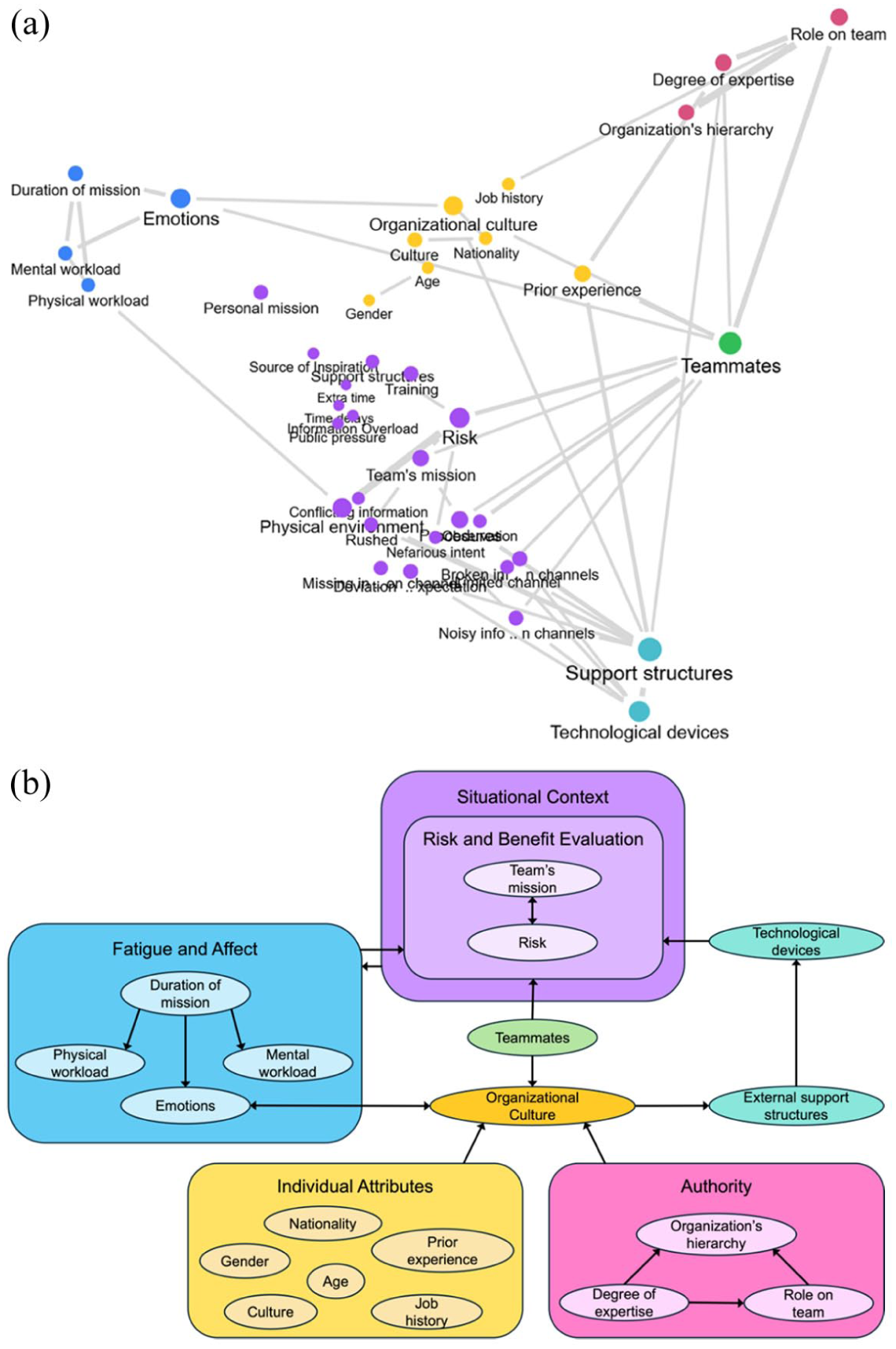
(a) Data-driven map of relations between codes and (b) proposed mapping of themes based on synthesis of the code relations map, interview quotes, and literature.
Risk is central to the map, with the team’s mission nearby. These codes’ proximity indicates that they were similarly applied to the interview data, co-occurring frequently. We posit that in ICE settings, an evaluation of risk against value to the team’s mission is central to decision making. Several interviewees described instances of making this trade when faced with a decision—one recalled that “in the end, [they] just said ‘you know what, I think, I think I’m going to make the determination that it’s safe enough and important enough.’” Surrounding the risk and team’s mission codes are other themes that provide situational context, grouped into the purple cluster. For example, codes in this cluster capture public pressure, pre-mission training, aspects of the physical environment, time delays, and conflicting, missing, or noisy information. Some of these codes, such as physical environment, training, time delays, and information availability, may directly inform one’s perception of a scenario’s risk. Public pressure, however, may influence what a team understands to be their mission and how important they perceive their mission to be (especially relative to some degree of risk). In summary, we conclude that decision making in ICE relies on a trade-off of perceived risk versus benefit to the team’s mission, which is evaluated in the context of the environment and situation at hand.
Prevalent codes capturing sources of information, such as support structures, teammates, and technological devices, feed into the purple risk-benefit trade-off cluster described above, as expected. Interestingly, there is a strong link (indicated by a thicker line and thus more coincidences) between the support structures and technological devices codes, both belonging to the teal cluster. In ICE, access to external support structures such as mission control, family at home, or a remote doctor is often mediated by technological devices. For this reason, the technological devices code was applied similarly to the support structures code in the interview data. If the technology (whether cellular signal, a satellite phone, or radio, for example) is disrupted, the information access that it provides is disrupted too. When the wildfire fighter was fixing the pump, they were too far to communicate with their crew boss over the radio, resulting in their team waiting without knowing why there was a delay in receiving water. When the Everest crew had to decide whether to depart each camp to climb to the next one, they had to base their decision on weather information from a forecaster in Belgium. The forecasts relied on remote observations, and delivery of the forecasts to the climbers relied on satellite phones. In these cases, the technological device becomes the channel in the Shannon–Weaver representation, enabling transmission of information from sender to receiver.
The blue cluster of codes at the top left of the map relates to fatigue and affect. The duration of the mission (an input within the IMOI framework and a structural feature within the ABCDEF framework) is linked to emotions, mental workload, and physical workload (mediating mechanisms within both the IMOI and ABCDEF frameworks), as expected. Both the literature and the interviewees describe longitudinal changes in affective states while in ICE. The scientist who wintered over in Antarctica described detrimental changes in their cognition and emotions over time. They found that “earlier in the season, you could have a challenging day, either physically or mentally, and then recover a lot faster . . . by the end of the season, it took me about a week to recover from that before I really felt that I was really back to my normal energy, my normal really blah [as compared to pre-mission] energy.” Their recovery to baseline had slowed and their baseline itself was poor compared to pre-mission. By the end of their mission, their lack of energy was even more apparent: “after like 14 months of this, you are exhausted. And at some point, maybe at about month 11 or so, I realized that my energy was strictly coming from what food and how much food I was consuming.” The wildfire fighter described how living with the same people for months at a time affected moods and interpersonal dynamics: “sometimes [my teammate] got a little bit moody, but obviously we’re with them every single day. . . So, we get kind of tired and annoyed of each other sometimes.” As shown on the code map, there is a link between emotions and organizational culture. We posit that this relation is bidirectional: team members’ emotional states affect the team culture, which in turn affects team members’ emotional states.
The yellow cluster contains codes that capture personal attributes, as well as organizational culture. The IMOI framework describes organizational culture as a mediator that emerges based on input variables such as team composition, which is reflected in the code map. The organizational culture code’s proximity to codes capturing individual attributes indicates co-occurrence of these themes in the data, or in other words, that participants described the traits of their teammates when describing their team’s culture. The genders, ages, nationalities, job backgrounds, and prior experience of individuals on a team will influence the dynamics between members and the team’s overall climate. Team members’ interdependence (a structural feature according to ABCDEF) further shapes this relationship. Congruent with its centrality in the interview-based code map, organizational culture maps to the center region of the ABCDEF framework: the overlap of compositional, structural, and mediating features. The remote airport director described how they tended to rely on phone calls more than emails, attributing the preference to their age. On another crew, gender imbalances affected confidence in the minority group (women), with one interviewee describing that “there were four of us women. And then there were maybe 20 men, you know, and that’s typically how it is . . . it’s not a lot of women out there. So, you feel kind of, you know, intimidated.” Nationality and culture also affected team culture and cohesion. One participant, from the United States, worked with a team of people from England, Australia, and New Zealand, and found that “the Australians and the New Zealanders are all like way more relaxed than Americans.” This culture “helped the team bond, because there just wasn’t that competition that might have been prevalent on a US-based team.” Given the mediational role of individual attributes on team culture, teams may select members strategically. Some research has identified attributes that predict performance and team outcomes in ICE (Kokun & Bakhmutova, 2021; Landon et al., 2017; Mittelstädt et al., 2016; Musson et al., 2004; Van Fossen et al., 2021).
The pink cluster in the upper right of the code map captures the influence of authority structures. Someone’s assigned role, degree of expertise, and position in a group’s hierarchy provide them with some degree of power, and consequently, some associated level of influence in a group’s decision (Raven, 1992; Reader, 2017). Literature-identified bases of social power include coercive and reward power (such as tangible rewards, physical threats, or personal rewards like approval), legitimacy (which comes from a structural relationship between people, such as a supervisor and a subordinate), expertise, reference (based on affiliations and belonging), and informational power (persuasion based on information or logical argument; Raven, 1992). The retired Air National Guard pilot explained how awareness of judgment from higher-ups could arise in decision making: “You’re going to make a decision, and then your commander is going to hear the decision. So having a reality check on what they are as a commander to you is certainly an important point of that.” Some organizations have more fluid hierarchies than others. The Arctic ice researcher described a dynamic authority in their team depending on who was more knowledgeable and depending on who had more at stake for a given decision. Sometimes, the power associated with an information source changed partway through a mission after an opportunity to observe the source’s accuracy. For example, the Everest mountaineer’s crew witnessed inaccuracies in their remote weather forecasts on more than one occasion, after which they started to question the forecasts’ validity. Here, the forecaster’s prescribed expertise basis of power decreased alongside a decrease in their overall influence on the team’s decisions. The astronaut, however, described a stricter hierarchy dictating decision making, where “the only time that the mission commander can do something different than what the flight director says is when the commander feels that the safety of the vehicle or the safety of the crew will be jeopardized by something that the ground is saying.” Mapping the authority cluster (pink) to the IMOI and ABCDEF frameworks, attributes that contribute to social power (such as prior experience or a leadership role) can be thought of as inputs (for IMOI) and as compositional features (for ABCDEF). The emergent social power affects the influence of individuals on the team, making it a mediator (for IMOI). On the more granular ABCDEF framework, the emergent social power better maps to the overlapping region D between compositional and structural features. Opportunities to assess the accuracy of information sources serve as outputs, which feed back into the team process cycle, where teams may update their reliance on that source in their next decision accordingly. Mapping this step to the ABCDEF model, this assessment of accuracy maps to potential team learning, which is centered in the framework. As with IMOI, this learning contributes to a team’s evolution over time, extending outward to affect the next interaction’s structural, compositional, and mediational features.
The positioning and edges between higher-level clusters point to interesting relationships between themes. The authority cluster’s (pink) closest neighbors are the individual attributes code, the organizational culture cluster (yellow), and the teammates code (green). As described by Raven’s bases of social power, an individual’s attributes, such as their job history and prior experience (notably the two yellow codes closest to the authority cluster [pink]), inform their social power (Raven, 1992). A group’s power structure can also influence its culture. In the Everest 1996 case study, for example, steep differences in power between the guide and clients are thought to have degraded psychological safety (Roberto, 2002). Both social power dynamics and organizational culture can affect information transfer between teammates. Raven (1992) describes how one’s social power affects their influence over others’ decision making. In the Everest incident, a lack of psychological safety prevented a client from raising a critical issue. These relationships can be used to understand the links between the authority (pink), organizational culture (yellow), and teammates (green) clusters. Of these three groups, only the teammates code (green) has a direct link to the decision making cluster (purple). Ultimately, teammates act as information sources that aid decision making. A teammate’s attributes and social power may drive how their input is perceived but are less directly informative to the decision itself. On the other hand, support structures and technological devices can both directly provide information towards a decision. These codes feed into the risk-benefit evaluation. Finally, the fatigue and affect cluster (blue) does not connect directly to the risk-benefit evaluation, but does connect to the physical environment code, which connects to risk. It is also linked to the team culture code; teammates’ emotions affect the team’s culture and vice versa.
The data-driven code map was used to formulate a mapping of themes, as shown in Figure 2b. Latent themes behind each cluster were inferred to capture the relationships as described previously, providing the purple, blue, yellow, and pink boxes. Here, decision making involves an evaluation of value to the team’s mission versus risk, which depends on the situation. The situational context also affects people’s fatigue and affective state, which in turn influences their decision making. Teammates provide each other with information, but reliance depends on the team’s culture. Specifically, this culture is affected by attributes of the individuals on the team and by perceived authority. External support structures provide valuable information, but their use is mediated by technological devices.
Discussion
Existing literature suggests that decision making is context dependent (Klein, 2008; Mosier & Fischer, 2010b; Reader, 2017). However, little work has applied existing frameworks of decision making and team processes to ICE contexts to evaluate their applicability. This study draws on multiple disparate frameworks to provide a synthesis and conceptual mapping of factors affecting team decision making in ICE, grounded in key-informant experiences. The identified factors and their mapping provide a research agenda for team decision making in ICE settings. More broadly, the integration of comprehensive theoretical frameworks into a directed content analysis for framework synthesis offers a methodological approach that can be applied to team research beyond ICE settings to better understand context-specific decision making.
Interviews with practitioners provided empirical evidence for the application of an RPD-like strategy when making decisions in ICE environments. In particular, people used prior experience to identify patterns (such as turnback points in an aircraft’s landing sequence) and generate candidate actions. Our findings on the importance of the situation on decision making were also in agreement with the NDM literature. We found that the risk-benefit trade-off central to the data-driven network of themes was surrounded by a set of situational factors ranging from characteristics of the environment to the presence of public pressure. It is evident that decision making behaviors must be studied within relevant environments with representative individuals.
Mapping of the interview codes to the Shannon–Weaver model highlights the importance of protecting channels that enable the transmission of important information, such as technological devices that permit communication with external support structures. Additionally, it is important to maintain relationships between decision makers and others that may act as information sources, such as their teammates or support structures. Even though these relationships may be strained in harsh ICE settings, mechanisms such as joint training before a mission can help protect them. Characteristics of other elements of the Shannon–Weaver model, the information source and the information receiver, were found to affect the degree to which information was relied on. The influence of different information sources on teams’ decision making depended on their perceived trustworthiness and social power. Decision maker tendencies to rely on certain information streams depended on their own individual attributes (such as age) and their emotional and affective state.
The interview results reveal that ICE team performance is likely to be strongly related to team cognition. Niler et al. (2021) found team cognition to be most strongly associated with performance for teams with social category heterogeneity, high external interdependence, low authority differentiation, and low temporal and geographic dispersion. ICE crews—by definition confined and isolated—face little to no temporal or geographic intra-team dispersion. As evidenced by the two most frequently applied codes across all the interviews, ICE teams also exhibit high external interdependence and benefit from member heterogeneity. Taken together, these characteristics reflect teaming conditions under which team cognition is expected to play a particularly influential role in performance. Accordingly, examining the formation of team cognition and the mechanisms through which it is shaped in ICE teams is critical for understanding and supporting their performance.
The interviews present factors of team decision making in ICE that warrant further study. Decision making reflects an inherent trade-off between risk and mission objectives and is influenced by situational context, fatigue and affect, authority structures, and individual attributes. Information is gained from the environment, teammates, and external support structures, with each channel mediated by factors such as organizational culture, social dynamics, and the technological systems that enable communication. Accordingly, candidate input variables include perceived risk, mission duration, individual attributes (specifically gender, age, culture, nationality, job history, and prior experience), fatigue, team roles, and hierarchical structure. Relevant mediational constructs include emotional state, mental and physical workload, emergent dynamics, and organizational culture.
Building on this framework, several testable implications can be formulated to guide future hypothesis-driven work in ICE contexts. (1) If technology-mediated communication with external support is degraded (e.g., due to increased latency, reduced bandwidth, intermittent loss), then decision quality will decline. This effect should be amplified in teams with high external interdependence but attenuated in teams with stronger team cognition, particularly when supported by prior joint training and stable membership. (2) As mission duration increases, teams will shift toward greater reliance on RPD strategies. This transition should be accelerated by pre-mission training and disrupted by crew turnover. (3) If fatigue increases, then decision makers will exhibit reduced decision quality. These effects should be attenuated when other team members can compensate, particularly in teams with stronger team cognition. (4) If authority differentiation is high, then decision quality will depend on the alignment between hierarchical position and expertise, such that outcomes will improve when higher-ranking members hold the most pertinent information but decline when lower-ranking members hold critical information. If authority differentiation is low, then decision quality will be more strongly associated with shared team cognition. Collectively, these propositions provide a set of tractable hypotheses and boundary conditions for examining how interacting individual, team, and contextual factors influence decision making in ICE environments.
Limitations and Future Work
There are several limitations to this study. First, although we reached code saturation, we have a relatively limited sample size of eight participants. Each participant has a unique experience in a different ICE environment, as it was our intent to maximize breadth in our sample. There are other candidate ICE environments from which we did not recruit participants and consequently may lack perspectives, such as submarines, desert sojourns, or sailing circumnavigation trips. Though we achieved several indicators of data saturation, future work should collect data from individuals with experience in other ICE settings to ensure the generalizability of results. Additionally, acting as key informants, each individual interviewed could only provide the experience of one person on their multi-person crew. Key informant interviews enabled access to diverse experiences but may have contributed to biases in answers that we cannot detect without perspectives from other team members. Furthermore, all interviews occurred after the fact, where participants recalled events from the past. Relying on participants’ memories provides a less accurate account than would be possible by observing teams in real time. This limitation motivates one of our suggested directions for future work: to study factors of team decision making in ICE in controlled settings. In this paper, we were restricted in the amount of detail we could provide about participants and their scenarios to preserve anonymity. Finally, code granularity may be limited for some analysis purposes; codes had to be general enough to facilitate drawing conclusions across interviews, but, as a result, some nuances were not captured. For example, all emotions were lumped as such despite differences in emotional states and effects (e.g., frustration versus excitement). To manage this loss of information, all coded segments were reread when analyzing the data for meaning and relationships between codes. This study provided insights into factors that affect decision making by teams in ICE, but it did not provide any quantification of these relationships. Future work should empirically evaluate the proposed relationships by systematically manipulating key factors identified in this framework (e.g., communication degradation, fatigue, authority differentiation, and mission duration) in controlled settings to estimate their effects. These efforts can then be extended to higher fidelity field settings to ensure ecological validity of findings.
Conclusions
We conducted semi-structured, qualitative interviews with ICE practitioners (N = 8) to identify factors of team decision making in ICE. Accounts of lived experiences across missions provided empirical data that fill gaps in the literature on how teams in ICE make decisions. Individuals were found to trade perceived risk against value to the team’s mission, where risk and mission objectives depend on their physical environment and situational context. Teammates and external support structures were relied upon for information, with access to support structures mediated by technological devices. Decision making was also influenced by affect, fatigue, and team culture, each of which related to the duration of ICE exposure. We mapped our findings to models in the literature, providing support for existing theories and identifying high-priority factors that, going forward, should be studied in both controlled environments and field settings.
Footnotes
Acknowledgements
We thank Matthew Bradford for their contribution to transcribing and coding the research data. We would like to thank members of the Cognitive Security Multidisciplinary University Research Initiative for their collaborations. We would also like to thank our participants for sharing their time and experiences with us.

Funding
The authors disclosed receipt of the following financial support for the research, authorship, and/or publication of this article: This work is supported by the Air Force Office of Scientific Research under Award FA9550-23-1-0453.
Declaration of Conflicting Interests
The authors declared no potential conflicts of interest with respect to the research, authorship, and/or publication of this article.