






Abstract
We conducted two experiments (166 triads) to examine when positive and negative moods shared among members help or hinder group creativity. We show that the effects of shared affect depend on whether groups adopt a global or local attentional focus immediately before the induction of mood. When groups initially adopted a global focus, subsequently inducing a positive mood increased group creativity relative to inducing a negative mood. In contrast, when groups initially adopted a local focus, subsequently inducing a positive mood decreased group creativity relative to inducing a negative mood. These effects were mediated by reductions in idea fixation during collaborative idea generation.
Introduction
Group creativity refers to the ability of groups to generate original and practical products (Paulus et al., 2012; Shin & Zhou, 2007). Because creative teamwork plays a key role in organizational innovation and social change (Paulus & Nijstad, 2019), scholars and practitioners have sought to identify antecedent variables that facilitate or hinder group creativity (George, 2007). In particular, the affective states of group members have received increasing attention as important determinants of group processes and performance, including their creativity (George & King, 2007). Yet, despite considerable research on affect in groups, our understanding of how it shapes collective creativity remains limited (Rösemeier et al., 2025). To advance our understanding of when and why affect in groups facilitates or constrains collective creativity, the present study examines the influence of shared affect among members on group creativity during an idea-generation task.
When engaging in creative tasks, group members are likely to experience affective states of varying valence and intensity (e.g., Larsen et al., 1987). Such affect may arise from intragroup, task-related factors (e.g., negative feedback) or from sources irrelevant to the task at hand, such as personal experiences outside the group (Barsade & Knight, 2015; Emich & Lu, 2021). Regardless of its origins, when members come together to collaborate, they bring these individual affective states into group interaction. Once interaction begins, affective expressions and transfer processes (e.g., emotional contagion, behavioral synchrony) allow members’ moods and emotions to influence one another, leading to convergence in their affective states over time (Kelly & Barsade, 2001; Park & Hinsz, 2015; Sy et al., 2005).
This convergence in members’ affective states has been conceptualized as a shared group-level affective experience—an affective state held in common by members of a group or team—and represents the most extensively studied form of group affect (Barsade & Gibson, 1998; Barsade & Knight, 2015; George, 1990). Following this bottom-up, compositional perspective, we treat shared affect as a group-level construct that reflects the aggregation of individual members’ affective states, as these states become aligned through interaction (see Hinsz & Bui, 2023, for an alternative conceptualization).
Shared affect in groups has been theorized to shape how members think, interact, and perform (George & King, 2007; To & Fisher, 2019; Yoon et al., 2022). However, although studies at the individual level have hinted at a relationship between affect and creativity (e.g., Baas et al., 2008; Davis, 2009; A. M. Isen et al., 1987), experimental research directly testing the causal relationship between group affect and group creativity is relatively scarce. Moreover, the existing body of experimental and non-experimental research on this relationship has yielded mixed patterns across contexts (Emich & Lu, 2021; To & Fisher, 2019). For example, some studies suggest that positive affect enhances group creativity under certain contexts (e.g., Grawitch, Munz, Elliott, et al., 2003; Grawitch, Munz, & Kramer, 2003; Pillay et al., 2020), while others indicate that it may impair it under different contexts (e.g., Tsai et al., 2012). Similarly, negative affect has been shown to enhance group creativity in some contexts (e.g., Jones & Kelly, 2009; Tu, 2009), but to reduce it in others (e.g., Klep et al., 2013; Leung et al., 2020). These mixed patterns suggest that the relationship between shared affect and group creativity is likely to be moderated by contextual factors. In this paper, we propose that one such factor is cognitive context, specifically the dominant attentional focus adopted by group members prior to the induction of an affective state.
In the sections below, we lay the theoretical foundation for our investigation by reviewing theories that propose a flexible relationship between affect and cognitive styles (Huntsinger et al., 2014; Petty & Briñol, 2015), particularly those emphasizing the signaling function of affect and its influence on the attentional focus individuals adopt within a given context. We first outline two contrasting forms of attentional focus and their distinct impact on creativity: global versus local focus. We then review two theoretical accounts explaining how affect influences creativity through its impact on attentional focus. Both assume a fixed relationship between affective valence (positive vs. negative) and attentional focus (global vs. local), such that positive affect consistently induces a broader, more global focus than negative affect. However, the mixed findings reviewed above raise questions about whether such a fixed relationship can fully account for observed outcomes. To clarify this issue, we next introduce a more nuanced theoretical perspective that proposes a flexible relationship between affect and attentional focus—one that depends not only on the signaling function of an aroused affective state, but also on the dominant attentional focus individuals hold immediately prior to the arousal of that affective state. Finally, we report two laboratory experiments testing this proposed flexible relationship between shared affect and attentional focus in a collaborative idea-generation context.
The Relationship Between Attentional Focus and Creativity
Creativity is essentially a mental activity, and prior research has identified various cognitive styles that shape creative performance, such as counterfactual thinking (e.g., Markman et al., 2007) and context-independent thinking (e.g., Choi & Yoon, 2018). Attentional focus has also been identified as an important cognitive mechanism influencing creativity (Förster & Dannenberg, 2010; Friedman et al., 2003; Huntsinger & Ray, 2016), although this work has been examined almost exclusively at the individual level. At any given moment, individuals are presumed to adopt either a global or a local attentional focus (Navon, 1977), referring to whether they “zoom out” to broadly perceive an object as a whole (global focus) or “zoom in” to narrowly attend to its specific details (local focus; Förster & Dannenberg, 2010). Individuals can readily shift between these two attentional styles, but the default tendency is global rather than local (Kimchi, 1992; Navon, 1977) because a local focus generally requires more mental effort (Clore et al., 2001).
Variations in the scope of perceptual attention are associated with variations in the scope of conceptual attention (Förster & Dannenberg, 2010; Friedman et al., 2003). Specifically, a global attentional focus promotes spreading activation among semantically distant concepts in memory, leading to the activation of broad, abstract, and superordinate ideas. By contrast, a local attentional focus activates concepts that are less abstract and semantically closer in memory. For instance, individuals with a local focus are more likely than those with a global focus to generate the concept “dog” in response to “cat,” as the two words are closely associated in semantic memory. In contrast, when considering either “dog” or “cat,” individuals with a global focus are more likely to produce a semantically more distant idea such as “restaurant” (Friedman et al., 2003).
Activating conceptually distant ideas often leads to novel or unconventional combinations and is positively associated with the generation of creative products (Choi & Yoon, 2018; Fredrickson, 1998; Mednick, 1962). Consequently, a global attentional focus is generally expected to facilitate greater creativity than a local attentional focus. Supporting this prediction, Friedman et al. (2003) found that individuals adopting a global focus performed better on several creativity tasks than those adopting a local focus (see also Förster & Dannenberg, 2010). Thus, when performing creative tasks, individuals appear to benefit from a global attentional focus, as it enables them to explore more distantly related ideas and integrate them in novel ways (see De Dreu et al., 2010, for a complementary perspective).
Affect, Attentional Focus, and Creativity
Initial evidence that affect influences creativity came from a study of individuals by A. M. Isen et al. (1987), who found that positive moods enhanced creativity relative to neutral or negative moods (see also Gasper, 2004). To explain this result, Isen and colleagues reasoned that putting people in a positive mood encourages them to explore broader, more superordinate categories, and enables them to integrate apparently disparate ideas in an unusual manner (A. Isen, 1999).
The essence of this explanation was adopted in two subsequent, more elaborate theoretical accounts, one emphasizing the beneficial impact of positive affect, and the other emphasizing the detrimental impact of negative affect. The broaden-and-build theory of positive emotions (Fredrickson, 1998, 2013) argues that positive affect fosters creativity by broadening the focus of conceptual attention, which in turn activates relatively inaccessible concepts in long-term memory and facilitates their novel combination. Affect-as-information theory (e.g., Clore et al., 2001; Schwarz & Clore, 1983, 2003), on the other hand, suggests that negative affect signals the existence of a problem (e.g., danger) in one’s environment, and prompts a narrower, more detail-oriented attentional focus that is intended to help identify the source of the problem. Taken together, these theories imply a relatively fixed relationship between affective valence and attentional focus: positive affect promotes a broader, global focus, whereas negative affect promotes a narrower, local focus. This pattern aligns with findings showing that a global focus promotes creativity more than a local focus (Friedman et al., 2003).
However, the previously cited research concerned with the impact of group members’ affect on their collective creativity does not uniformly support these theoretical ideas. In particular, some of those studies do find evidence that positive affect leads to greater creativity in groups, and negative affect leads to less creativity (e.g., Grawitch, Munz, & Kramer, 2003), whereas other studies find the opposite in certain conditions (e.g., Tsai et al., 2012; Tu, 2009). Moreover, some individual-level research suggests that positive affect may sometimes prompt a local (rather than global) attentional focus and detail-oriented processing, whereas negative affect may sometimes prompt a global (rather than local) attentional focus and broad, integrative processing (Huntsinger, 2012; see Huntsinger et al., 2014, for a comprehensive review). This pattern runs counter to the assumptions of both the broaden-and-build theory of positive emotions and the affect-as-information theory. It calls into question the idea that positive affect always promotes a global attentional focus whereas negative affect always promotes a local attentional focus. Instead, the relationship between affect and cognitive style may be more context-dependent—and therefore more flexible—than previously assumed. If so, the relationship between shared affect and group creativity may itself depend on the cognitive context in which the affective state is aroused.
A Flexible Relationship Between Affect and Cognition
Several theoretical models have been offered to account for the possibility of a flexible relationship between affect and cognitive style (e.g., global vs. local attentional focus). First, according to the affect-as-cognitive-feedback account (Huntsinger et al., 2014), positive and negative affect, rather than prompting any particular attentional focus, serve instead as feedback about the appropriateness of whatever attentional focus is currently dominant, and so signal whether that focus should be maintained or changed. Specifically, positive affect serves as a “go” signal that encourages the continued use of one’s currently dominant attentional focus, regardless of whether it is global or local. In contrast, negative affect serves as a “stop” signal that warns against the continued use of the currently dominant attentional focus and prompts instead a shift to the opposing attentional focus. Importantly, this framework distinguishes between the attentional focus that is dominant before mood induction and the attentional focus that emerges after mood induction. The former provides the cognitive context within which mood operates, whereas the latter reflects the attentional focus that results from mood’s signaling function. Thus, when a global attentional focus is initially dominant, subsequently inducing a positive mood is predicted to maintain that focus, whereas subsequently inducing a negative mood is predicted to prompt a shift to a narrower, more local attentional focus. Likewise, when a local attentional focus is initially dominant, subsequently inducing a positive mood is predicted to maintain that focus, whereas subsequently inducing a negative mood is predicted to prompt a shift to a broader, more global attentional focus.
To test these predictions, several studies (Huntsinger, 2012; Huntsinger et al., 2010) have primed individuals in ways that made either a global or local attentional focus temporarily dominant, and then subsequently induced their affective state. Results showed that when a global attentional focus was initially primed, participants who were subsequently put in a positive mood continued using that global attentional focus, whereas those who were put in a negative mood shifted to a local attentional focus. Similarly, when a local attentional focus was initially primed, individuals who were subsequently put in a positive mood maintained that local attentional focus, while those who were put in a negative mood shifted to a global attentional focus. In these studies, participants’ attentional focus after the mood induction was consistent with the predictions of the broaden-and-build and affect-as-information theories when a global attentional focus had been initially primed, but it ran counter to those theories when a local attentional focus had been primed instead. In contrast, the results aligned well with the affect-as-cognitive-feedback account, which posits a flexible relationship between affect and attentional focus regardless of whether the initially primed focus was global or local.
A similar set of ideas can be found in self-validation theory (Briñol et al., 2007; Petty & Briñol, 2015), which posits that affective states can either validate or invalidate people’s current thought processes. Such validation or invalidation, in turn, determines whether one’s dominant cognitive style is maintained or shifted. Specifically, positive affect is presumed to validate one’s cognitive style, and so should encourage its continued use, whereas negative affect is presumed to invalidate it, and so prompt a change. Thus, self-validation theory, like the affect-as-cognitive-feedback account, suggests that both positive and negative affect can bring about either a global or a local attentional focus, depending on the cognitive context in which the affective state is induced (Petty & Briñol, 2015; see also Martin et al., 1993).
Building on the theories of flexible affect–cognition relationships, if a global attentional focus tends to facilitate creativity whereas a local focus tends to constrain it, then both positive and negative affect should be capable of either enhancing or undermining creative performance. This flexible pattern is illustrated in Huntsinger and Ray’s (2016) experiments. In their studies, participants were first primed to adopt either a global or local attentional focus and were then induced to experience either a positive or negative mood before completing several creativity tasks. Results showed that when a global attentional focus was initially primed, subsequently inducing a positive mood (relative to a negative mood) enhanced performance on both an idea-generation task (Experiment 1) and creative problem-solving tasks (Experiment 2). However, when a local attentional focus was initially primed, this pattern reversed: individuals subsequently induced to experience a positive mood performed worse at these tasks than those induced to experience a negative mood.
Recent conceptual work has proposed that the flexible relationship between affect and cognition may also extend to interacting groups (Hinsz & Robinson, 2024, 2025). However, to the best of our knowledge, no empirical research has directly tested whether the effects of shared affect on group creativity depend on the dominant attentional focus held by group members prior to the mood induction. Indeed, it would appear that the affect-as-cognitive-feedback account has been tested with interacting groups in only one study, and that study examined the role of shared affect on group decision-making, not group creativity (Yoon et al., 2022). Consequently, it remains untested how inducing positive versus negative moods in group members influences their subsequent creativity as a function of the group’s dominant attentional focus prior to the mood induction.
Note that it would be premature to assume that affect always operates at the group level in the same way that it operates at the individual level. Working in groups differs from working alone in numerous ways. For example, in a group context, the impact of affective states is likely to be a function of not just its valence (i.e., whether it is positive or negative) but also of the extent to which that affect is shared among group members (e.g., Emich & Lu, 2021). Further, the mere fact of working in a group can change members’ affective experience over time (e.g., Delvaux et al., 2015; Park & Hinsz, 2015). Thus, it seems quite worthwhile to test empirically whether or not a flexible relationship between affect and cognition exists in groups, just as it appears to exist in individuals, and how this in turn influences group creativity. To address this need, the present study extends individual-level evidence (Huntsinger & Ray, 2016) to interacting groups and further examines group-level processes that may underlie the interaction effect between shared affect and attentional focus on group creativity.
Research Overview
We conducted two laboratory experiments using three-person interacting groups. According to the affect-as-cognitive-feedback account (Huntsinger et al., 2014), affective states signal whether one’s current attentional focus should be maintained or shifted. This framework therefore requires that attentional focus be established before an affective state is induced. Accordingly, we first primed participants to adopt either a global or a local attentional focus and then induced either a positive or a negative mood.
Consistent with prior research on shared affect and group creativity (e.g., Grawitch, Munz, Elliott, et al., 2003; Grawitch, Munz, & Kramer, 2003), we induced general positive and negative mood states rather than discrete emotions. Because our interest concerns how the affective states members bring into group interaction shape collective creativity, positive and negative mood states were induced at the individual level prior to group interaction. Once the inductions were complete, participants engaged in a collaborative idea-generation task in three-person groups. Although the experimental manipulations occurred at the individual level, research on team cognition and emotional contagion suggests that members’ cognitive and affective states tend to become aligned through interaction (Sy et al., 2005; Tindale & Kameda, 2000). Thus, all focal constructs of the present research are conceptualized and analyzed at the group level, and all effects are interpreted at the group level.
Following research on collaborative idea generation (e.g., Diehl & Stroebe, 1987; Paulus & Dzindolet, 1993), we assessed both quantitative and qualitative aspects of group creativity, including the number of non-redundant ideas generated by each group (fluency) and the novelty of the ideas produced (originality). In idea-generation tasks, producing more ideas often increases the likelihood of generating highly original ones, as a larger pool of ideas provides more opportunities for novel combinations (Osborn, 1963). Because a global focus broadens the scope of conceptual attention and facilitates the generation of diverse ideas relative to a local focus (Friedman et al., 2003), whether shared affect maintains or shifts this focus should influence not only how many ideas groups generate but also how original those ideas are. Across two experiments, we thus tested the following two hypotheses:
In Experiment 2, we further examined the group-level processes that may underlie the interaction between shared affect and attentional focus on group creativity. Prior research shows that idea fixation—the tendency to remain within the same conceptual category—limits the generation of original ideas by constraining the exploration of alternative perspectives (Choi et al., 2019; Kohn & Smith, 2011). Conversely, reductions in idea fixation (i.e., de-fixation) enable individuals to access more distant associations and thereby promote originality (Choi & Yoon, 2018; Choi et al., 2019; Lu et al., 2017). Thus, we reasoned that group creativity should be facilitated when members collectively reduce the tendency for ideas to become fixated during collaborative idea generation.
To capture this process behaviorally, we operationalized reductions in idea fixation as instances in which a new speaker generated an idea belonging to a different category from the idea produced immediately beforehand (i.e., cross-member category shifts). Because a global attentional focus enables individuals to access and integrate more conceptually distant information (Friedman et al., 2003), groups in which a global focus is enacted—either through maintenance of an initially global focus or a shift from an initially local focus—should be more likely to exhibit category-shift responses rather than remain within the same conceptual category as the preceding member. In turn, these reductions in idea fixation should mediate the hypothesized interaction effect between shared affect and attentional focus on the originality of ideas generated by groups. Therefore, we additionally tested the following two hypotheses in Experiment 2:
All procedures were approved by the university’s IRB and adhered to established ethical guidelines for human subjects’ research. The complete dataset and study materials are available on our OSF repository (https://osf.io/tq5mp). Analyses also indicated that groups’ gender composition did not alter any of the results reported below; therefore, gender effects are not discussed further.
Experiment 1
Method
Participants and Design
An a priori power analysis using G*Power (Faul et al., 2007) was conducted to estimate the appropriate sample size for this study. For an expected effect size, we used the interaction effect size (ηp2 = .10) observed in Huntsinger and Ray (2016, Experiment 1), which employed manipulations and an idea-generation task similar to those used here. That analysis suggested that for power = .80 and α = .05, a total sample size of 73 groups should be sufficient. However, because that effect size was observed for individuals rather than interacting groups, we increased the sample size slightly. Thus, 246 undergraduate students (male = 78; female = 168) enrolled in introductory psychology courses at a private U.S. university were recruited, and they participated for course credits. Participants were organized into 82 three-person groups, with groups randomly assigned to conditions in a 2 (initial attentional focus: global vs. local) × 2 (affect: positive vs. negative) between-groups design.
Procedure
Three participants were invited to a laboratory room for each experimental session, and were initially seated in separate cubicles. The experiment was introduced as two ostensibly separate studies—a purported pilot study for another researcher and a “Group Brainstorming Study.” The pilot study includes two seemingly unrelated tasks: first, a “Letter recognition task” (cf. Navon, 1977), and second, a “Life Events Inventory,” which were designed to manipulate global vs. local attentional focus and positive vs. negative moods, respectively. Both tasks were completed individually on a desktop computer. Afterward, the three participants were moved to a central table where they worked collaboratively on a group brainstorming task for 15 min. Their goal was to generate ideas on how to improve their university (Goldenberg et al., 2013; Kohn et al., 2011). One member was randomly selected to enter the ideas generated by the group into a Microsoft Word® document using a desktop computer. Before starting this task, the experimenter emphasized four brainstorming rules that the group should follow (Osborn, 1963). Specifically, members were asked to (a) refrain from making any evaluative comments about the ideas (whether their own or others’) as they were being generated, (b) generate as many ideas as possible, (c) keep focused on the task even when productivity seemed low, and (d) welcome all kinds of ideas, even those that might seem weird, radical, or unusual. After the group completed the brainstorming task, the members were thanked, debriefed, and dismissed.
Manipulation of Attentional Focus and Affect
At the outset of the study, we individually primed participants to engage in either a global or local attentional focus, and then subsequently induced in them either a positive or negative mood state. These manipulations were accomplished via the two individual tasks performed in the alleged “pilot study.” The first was a variant of the Navon Letter Recognition Task (Navon, 1977) that has been used in previous research as an effective method of priming either a global or local attentional focus (Huntsinger, 2012; Huntsinger et al., 2010). This task requires participants to determine whether each of 80 figures contains an “L” or an “H.” Each figure consists of a large letter made up of small letters. Participants viewed one of two sets of 80 figures, with one set used to prime a global attentional focus and the other used to prime a local attentional focus. Each figure in the set used to prime a global attentional focus consisted of either a large H or large L made up of some other small letter (e.g., F, T), whereas each figure in the set used to prime a local attentional focus consisted of a large letter other than H or L (e.g., F, T) that was always made up of either small Hs or small Ls. These figures were presented one at a time in random order on a computer screen. If the figure contained an H, participants were to press “1” on the keyboard. If the figure contained an L, they were to press “0” on the keyboard. For example, a figure from the set intended to promote a local focus of attention might consist of a large F made up of small Ls. In this case, participants were expected to press “0” because the figure contains small Ls. In contrast, a figure from the set intended to promote a global focus of attention might consist of a large H made up of small Fs. Here, participants were expected to press “1” because the figure contained a large H. Participants made these responses as quickly and accurately as possible throughout the 80 rounds of the task.
After completing the letter recognition task, which was designed to induce either a global or local attentional focus, participants then completed a “Life Events Inventory” to induce either a positive or negative mood state (Schwarz & Clore, 2003, 2007). They were asked to recall and describe an event that made them feel either “really happy” or “really sad” to induce a corresponding mood. They did this for 8 min while listening via earphones to music that previously has been shown to induce either a positive (Mozart’s “Eine Kleine Nachtmusik”) or negative mood (Mahler’s “Adagietto”; Yoon et al., 2022).
Dependent Variables
We assessed group creativity by examining both the quantity and quality of the ideas they collectively generated (see Guilford, 1967; Nijstad & Stroebe, 2006).
Fluency
One of the most frequently used measures of creativity in idea-generation tasks is the number of non-redundant ideas generated by each group (referred to as fluency). In general, the more ideas a group produces, the more likely it is that they will arrive at novel combinations (i.e., quantity breeds quality; Osborn, 1963). To assess fluency, one of the authors—who was temporarily unaware of each group’s experimental condition—reviewed the idea lists and identified a total of 2,642 non-redundant ideas. Repeated ideas within the same group were counted only once, while identical ideas across different groups were treated as distinct. On average, groups generated 32.22 non-redundant ideas during the brainstorming task.
Originality of Ideas
As a qualitative measure of group creativity, we obtained a subjective rating of originality of each idea. A pair of research assistants who were unaware of the research hypotheses and experimental conditions independently rated the originality of the ideas generated by approximately two-thirds of the groups, with one-third of the ideas being coded twice (26 groups, 749 of 2,642 ideas). An original idea was defined as “an idea that is infrequent, novel, unusual, and original.” Originality was rated using a 5-point scale (1 = Least Original, 5 = Very Original). To ensure the coders’ shared understanding of originality, we gave them a detailed description of each point on the rating scale and included for each several exemplar ideas (see Appendix).
The coders were advanced undergraduate students who were familiar with the university context and the brainstorming topic. Inter-rater reliability was assessed using the subset of ideas coded by both raters and was very high (r = .92, p < .001), with 87% of the ideas receiving identical originality scores. In cases of discrepancy, the final score was computed as the average of the two ratings. Finally, idea originality was operationalized at the group level as the mean originality rating across all ideas generated by each group, thereby reducing the influence of differences in idea quantity.
Results
Pretests of Experimental Manipulations
To avoid potential contamination of the focal dependent variables, we conducted pretests of the attentional focus and affect manipulations using independent samples (Hauser et al., 2018). Specifically, asking participants to report their affective state prior to the group task may heighten affective awareness and prompt attribution of feelings to the manipulation, thereby altering the influence of affect on subsequent cognitive style (Keltner et al., 1993; Schwarz & Clore, 1983). Accordingly, we validated the effectiveness of both manipulations in separate pretest samples using procedures identical to those employed in the main experiments.
For the attentional focus manipulation, 25 participants, drawn from the same population as those in the main experiments, completed the same Navon Letter Recognition Task used in the main studies. Participants were randomly assigned to either a global focus or a local focus condition. Immediately afterward, they completed a second task designed to assess their tendency to adopt a global versus local attentional focus (Kimchi & Palmer, 1982). Regarding the latter, in each of 24 rounds, participants were presented with a target figure (a large triangle or square constructed of small triangles or squares) and were asked to choose which of two comparison figures positioned below was more similar to the target figure. The target figure always consisted of small elements similar to the components of one of the comparison figures but matched the overall shape of the other comparison figure. For example, when the target figure was a large square made up of small triangles, one comparison figure was a large triangle with small squares, while the other was a large square with small squares. If participants chose the former, it was presumed to reflect a local rather than global attentional focus, because they seemed to be choosing on the basis of the target’s constituent elements (triangles). Conversely, if they chose the latter, it was presumed to reflect a global rather than local attentional focus, because they seemed to be choosing on the basis of the target’s global shape (square).
We computed the proportion of times that participants selected comparison figures based on their global shape (number of times divided by 24 rounds). Higher values suggest a more dominant global than local focus. As expected, participants were significantly more likely to choose comparison figures based on their overall shapes after having first performed the global focus version of the Navon Letter Recognition Task (M = .94, SD = .10) than after having first performed the local focus version of that task (M = .74, SD = .20), t(23) = 3.25, p = .003, d = 1.30. The difference was even stronger when this analysis was limited to the first 12 target figures presented (M = .91, SD = .15 for the global focus condition, and M = .56, SD = .31 for the local focus condition; t(23) = 3.64, p < .001, d = 1.46). These results suggest that the Navon Letter Recognition Task does influence the relative dominance of participants’ global vs. local focus.
To separately assess the effectiveness of our affect manipulation, we conducted another independent pilot study with 26 participants who were randomly assigned to either a positive mood condition or a negative mood condition. After completing the Life Events Inventory task, participants immediately rated their affective feelings on six 8-point scales (happy, sad, good, bad, positive, and negative). Sample items included “How positive did you feel during the Life Events Inventory task?” and “How negative did you feel during the Life Events Inventory task?” (0 = Not at all, 7 = Very much). Responses to the three positive items (happy, good, positive) were averaged to create a composite positive affect score (α = .90), and responses to the three negative items (sad, bad, negative) were averaged to create a composite negative affect score (α = .90). As expected, participants reported significantly more positive affect in the positive mood condition (M = 5.44, SD = 1.10) than in the negative mood condition (M = 2.46, SD = 1.36), t(24) = 6.12, p < .001, d = 2.40. They also reported significantly more negative affect in the negative mood condition (M = 3.82, SD = 1.62) than in the positive mood condition (M = 0.95, SD = 1.01), t(24) = 5.43, p < .001, d = 2.13. These findings confirm the effectiveness of the affect manipulation and indicate that it induced general positive versus negative mood states, rather than targeting a single discrete emotion.
Hypothesis Testing
Fluency
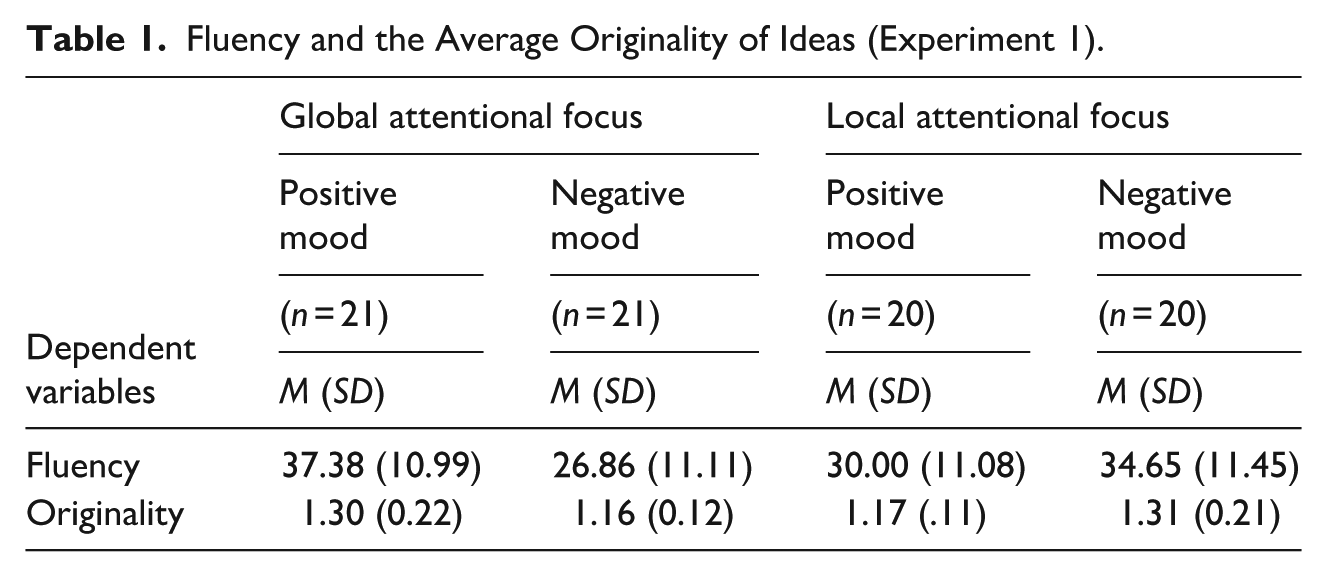
Hypothesis 1 predicts that when a global attentional focus is initially primed, groups subsequently put in a positive mood will generate more ideas than will groups subsequently put in a negative mood. By contrast, when a local attentional focus is initially primed, groups subsequently put in a positive mood will generate fewer ideas than groups subsequently put in a negative mood. To test this prediction, we performed a 2 (initial attentional focus) × 2 (affect) analysis of variance (ANOVA) on the number of non-redundant ideas generated. We found a statistically significant interaction effect, F(1, 78) = 9.48, p = .003, ηp2 = .108. Neither the main effect of attentional focus nor the main effect of affect was significant. As shown in Table 1, when a global attentional focus was initially primed, groups generated more ideas in the positive mood condition than in the negative mood condition, F(1, 78) = 9.34, p = .003, ηp2 = .107. On the other hand, when a local attentional focus was initially primed, groups tended to produce fewer ideas in the positive mood condition than in the negative mood condition. However, this latter difference did not reach a conventional level of statistical significance, F(1, 78) = 1.74, p = .191, ηp2 = .022. Thus, while a significant interaction was observed, it seemed due more to the effect of the mood manipulation when a global attentional focus was initially primed than when a local focus was initially primed. Hypothesis 1 was therefore only partially supported.
Fluency and the Average Originality of Ideas (Experiment 1).
Originality of Ideas
Hypothesis 2 predicts that when a global attentional focus is initially primed, groups subsequently put in a positive mood will generate ideas that are more original than the ideas generated by groups subsequently put in a negative mood. By contrast, when a local attentional focus is initially primed, groups subsequently put in a positive mood will generate ideas that are less original than the ideas generated by groups subsequently put in a negative mood. For the originality ratings, we found only a significant interaction effect, F(1, 78) = 12.73, p = .001, ηp2 = .140. Neither main effect was significant. As shown in Table 1, when a global attentional focus was initially primed, the rated originality was higher in the positive mood condition than in the negative mood condition, F(1, 78) = 6.28, p = .014, ηp2 = .074. But when a local attentional focus was initially primed, the rated originality was lower in the positive mood condition than in the negative mood condition, F(1, 78) = 6.45, p = .013, ηp2 = .076. Thus, Hypothesis 2 was fully supported.
Discussion
Experiment 1 offers initial evidence for the flexible relationship between affect and cognition in idea-generation groups. However, it did not shed light on the group-level processes underlying the observed interaction effect between shared affect and attentional focus. To address this limitation, Experiment 2 examined reductions in idea fixation as a potential underlying mechanism. Moreover, to increase the robustness of our findings, we employed a different idea-generation task and used a different mood manipulation.
Experiment 2
Method
Participants and Design
Two hundred fifty-two undergraduate students (male = 77, female = 171, others = 1; not reported = 3) from introductory psychology courses at a private U.S. university participated for course credit. They were divided into 84 groups of three and randomly assigned to conditions in a 2 (initial attentional focus: global vs. local) × 2 (affect: positive vs. negative) between-groups design.
Procedure
We followed the same procedure as in Experiment 1, with two exceptions. First, we used a different mood manipulation. After individually completing the Navon Letter Task, participants in the positive mood condition read positive phrases like “I feel cheerful” while listening through earphones to Mozart’s Eine kleine Nachtmusik. Participants in the negative mood condition read negative phrases like “I feel worthless” while listening to Mahler’s Adagietto. To enhance the mood induction, all participants were asked to reflect on and internalize the affective states conveyed by the phrases and music (Velten, 1968; for a meta-analysis, see Joseph et al., 2020).
Second, we used a different idea-generation task. After the mood induction, participants moved to a central table, where they spent 15 min collaboratively generating ideas for repurposing a vacant space previously occupied by a campus restaurant (Goncalo & Staw, 2006). One group member, randomly chosen, acted as the scribe, recording ideas in a Microsoft Word® document. Each group session was video recorded to allow for later analysis of cross-member category shifts, which served as a potential mediating variable. Immediately after the brainstorming task, participants individually completed a brief questionnaire assessing the intensity of six affective states (happy, sad, good, bad, positive, and negative) to check the effectiveness of the mood manipulation. They rated how strongly they felt each affective state during the mood induction task on a 7-point scale (1 = Not at all, 7 = Very much). They were then thanked, debriefed, and dismissed.
Dependent Variables
Like Experiment 1, we assessed group creativity by evaluating both the quantity and quality of ideas generated collectively (see Guilford, 1967; Nijstad & Stroebe, 2006).
Fluency
Fluency was measured as the number of non-redundant ideas generated by each group. A research assistant who was unaware of the hypotheses and experimental conditions reviewed the idea lists and identified a total of 3,943 non-redundant ideas, removing duplicate ideas within each group. Repeated ideas across different groups were treated as unique. On average, groups generated 46.94 non-redundant ideas.
Originality of Ideas
To obtain subjective ratings of idea originality, a pair of research assistants who were unaware of the study’s hypotheses and experimental conditions independently rated all 3,943 ideas. Originality was defined as “an idea that is infrequent, novel, unusual, and original” and evaluated using a 5-point scale (1 = Least Original, 5 = Very Original). Because participants were informed that the space had previously been used as a restaurant, ideas repeating that concept (e.g., new restaurant, well-known chain restaurant) were typically assigned the lowest creativity score (i.e., 1 on a 1–5 scale). The coders demonstrated significant inter-rater reliability (r = .61, p < .001), which is comparable to the reliability reported by Goncalo and Staw (2006) for the same idea-generation task. To control for differences in fluency across groups, group-level originality scores were computed as the mean originality rating of all ideas generated by each group.
Reductions in Idea Fixation
Because our research concerns the extent to which idea fixation is reduced during group interaction, we operationalized reductions in idea fixation as instances in which a new speaker generated an idea belonging to a different category from the idea produced by another member immediately beforehand. Consistent with this operationalization, category shifts generated by the same speaker were not coded, as they do not reflect a member’s responsiveness to another member’s idea.
To establish the categories of ideas generated by groups, two trained research assistants—who were unaware of the hypotheses and experimental conditions—independently coded the ideas generated by approximately two-thirds of the groups. Each idea was classified into one of 41 mutually exclusive categories, based on prior research using this task (e.g., Goncalo & Staw, 2006). For example, all ideas suggesting that the space be used for a grocery store (e.g., Whole Foods, Walmart) were coded into one category. Coders were trained using detailed category definitions. One-third of all ideas (29 groups; 1,373 of 3,943 ideas) were double-coded to assess reliability. Intercoder agreement was high for both the categorization of individual ideas (Cohen’s kappa = .89, p < .001) and the total number of categories identified per group (r = .97, p < .001). Any disagreements were resolved through discussion.
After the idea categories were established, cross-member category shifts (events reflecting reductions in idea fixation) were coded as follows. A trained research assistant—unaware of the study hypotheses and experimental conditions—examined each group’s Microsoft Word® transcript (which recorded all ideas in chronological order) along with the video recording to verify speaker identity and timing. A category-shift event between members was recorded when a new speaker generated an idea that belonged to a different category from the idea produced immediately beforehand by another member. For example, if Member 1 proposed an idea in the Fast-food restaurant category (e.g., “Subway”) and Member 2 followed with another idea in the same category (e.g., “McDonald’s”), that transition was coded as 0, reflecting an instance of idea fixation (i.e., remaining within the prior idea category). In contrast, if Member 2 proposed an idea from a different category such as education and academic support (e.g., “Classroom”), this cross-member category shift was coded as 1, indicating reductions in idea fixation. Only idea-relevant contributions were coded; off-topic remarks and conversational fillers were excluded but occurred infrequently and were easily identifiable in the transcripts 1 . Given the clarity of the transcripts, video data, and coding rules, a single trained coder conducted the reduced-fixation coding, and inter-rater reliability was not assessed for this phase.
Results
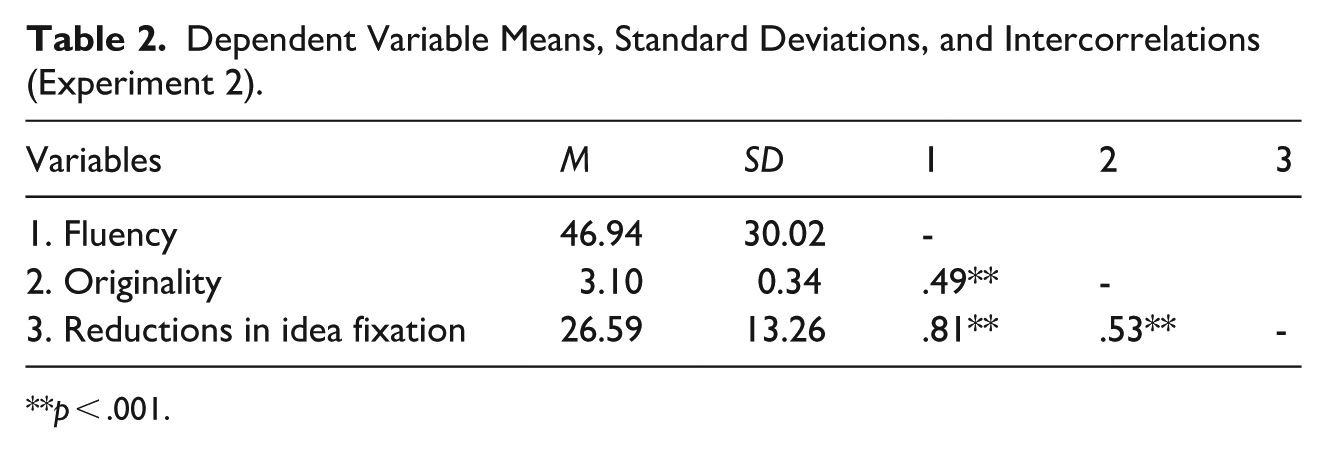
Descriptive statistics and correlations among the variables are shown in Table 2.
Dependent Variable Means, Standard Deviations, and Intercorrelations (Experiment 2).
p < .001.
Manipulation Check
Based on the six items of the post-experimental questionnaire, we computed composite scores of positive affect (α = .89) and negative affect (α = .89) by averaging the three respective items. These individual-level scores were then aggregated to the group level by computing the mean positive and negative affect scores for each group. Consistent with our compositional conceptualization of shared affect, aggregation was considered appropriate when groups exhibited meaningful between-group variance in affective composition. The resulting intra-class correlation coefficients indicated significant between-group variance for both positive affect (ICC(1) = .19, p = .002) and negative affect (ICC(1) = .34, p < .001), supporting group-level analysis.
To provide complementary information regarding within-group agreement, we also computed rwg indices. For positive affect, rwg values ranged from 0.00 to 1.00 (M = .51), and for negative affect, values ranged from 0.00 to 0.98 (M = .47). Although these values fall below a commonly used threshold (e.g., 0.70), such variability is theoretically consistent with evidence that emotional reactions to the same stimulus vary across individuals due to differences in affect intensity and appraisal processes (Larsen et al., 1987; Siemer et al., 2007). Moreover, because affect was assessed retrospectively after completion of the group task, some additional variability may reflect differences in how individuals recalled their earlier affective experience. This level of variability is consistent with the compositional framework adopted here, as shared affect refers to alignment in affective states rather than perfect homogeneity among members.
We then conducted two-way ANOVAs on the group-level affect scores. As expected, groups in the positive mood condition reported higher positive affect (M = 5.44, SD = 0.62) than those in the negative mood condition (M = 4.42, SD = 0.81), F(1, 80) = 41.05, p < .001, ηp2 = .339. Likewise, groups in the negative mood condition reported higher negative affect (M = 3.67, SD = 1.13) than those in the positive mood condition (M = 2.07, SD = 0.76), F(1, 80) = 59.19, p < .001, ηp2 = .425. No other effects were statistically significant. These findings confirm that the affect manipulation was effective at the group level as well.
Hypothesis Testing
Fluency
Hypothesis 1 predicts that a positive mood will lead to higher fluency than a negative mood under a global focus, while a positive mood will lead to lower fluency than a negative mood under a local focus. To test this prediction, we conducted a 2 (attentional focus) × 2 (affect) ANOVA on the number of ideas generated. We found a significant interaction, F(1, 80) = 6.53, p = .012, ηp2 = .075. No main effect was significant for either attentional focus or affect. As shown in Table 3, when a global attentional focus was initially primed, groups tended to produce more ideas in the positive mood condition than in the negative mood condition. However, this difference did not reach a conventional level of statistical significance, F(1, 80) = 2.45, p = .118, ηp2 = .030. On the other hand, when a local attentional focus was initially primed, groups generated significantly fewer ideas in the positive mood condition than in the negative mood condition, F(1, 80) = 4.14, p = .045, ηp2 = .049. Thus, Hypothesis 1 was only partially supported.
Fluency, the Average Originality of Ideas, and Reductions in Idea Fixation (Experiment 2).
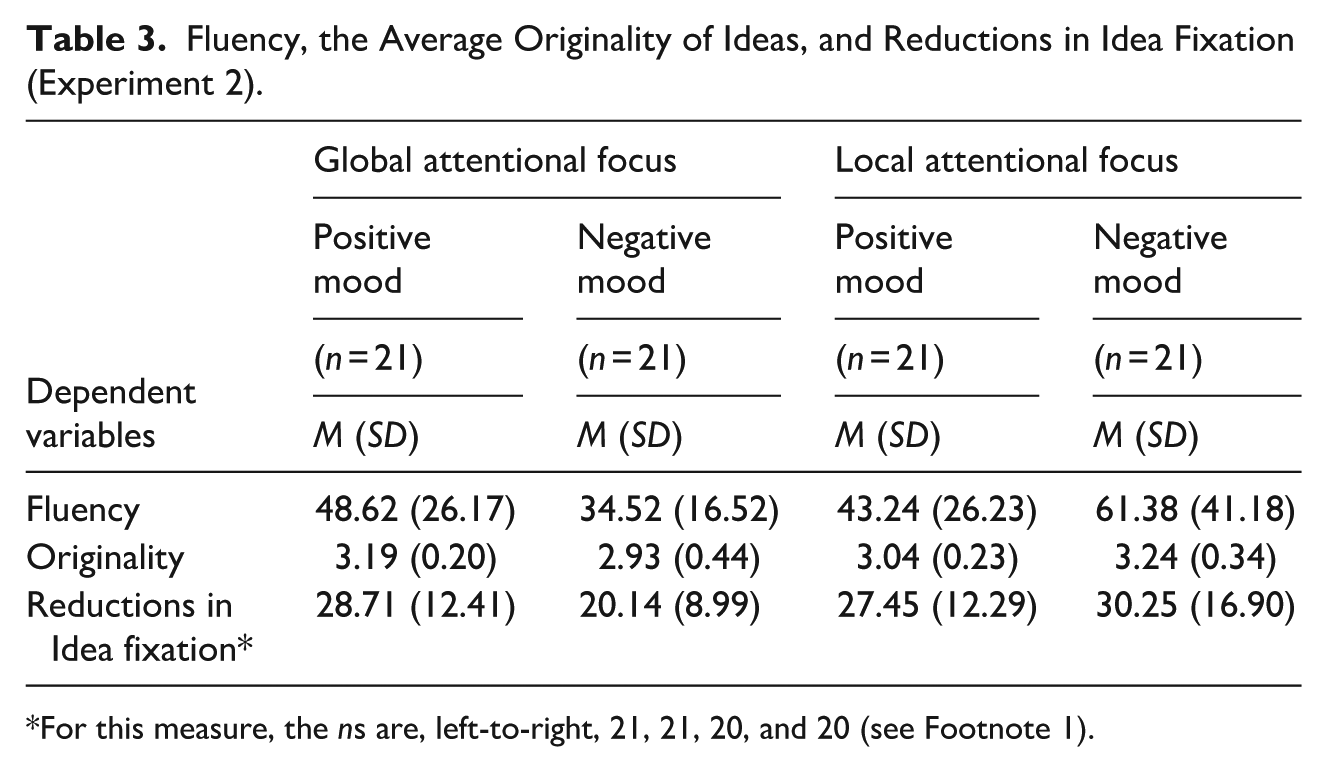
For this measure, the ns are, left-to-right, 21, 21, 20, and 20 (see Footnote 1).
Originality of Ideas
Hypothesis 2 predicts that a positive mood will lead to greater originality than a negative mood under a global focus, while a positive mood will lead to less originality than a negative mood under a local focus. Consistent with this, we found only a significant interaction effect, F(1, 80) = 11.07, p = .001, ηp2 = .122. Neither main effect was significant. As shown in Table 3, when a global attentional focus was initially primed, the rated originality of the ideas was higher in the positive mood condition than in the negative mood condition, F(1, 80) = 7.10, p = .009, ηp2 = .082. But when a local attentional focus was initially primed, rated originality was lower in the positive mood condition than in the negative mood condition, F(1, 80) = 4.16, p = .045, ηp2 = .049. Thus, Hypothesis 2 was fully supported.
Mediation Analysis
Hypothesis 3 predicts that when a global attentional focus is initially primed, groups subsequently put in a positive mood will exhibit greater reductions in idea fixation (i.e., more cross-member category-shift responses) than groups put in a negative mood. By contrast, when a local attentional focus is initially primed, groups subsequently put in a positive mood will exhibit smaller reductions in idea fixation than groups put in a negative mood. To test this prediction, we conducted a 2-way ANOVA using the number of cross-member category-shift responses per group as the dependent variable. The analysis revealed a significant interaction effect, F(1, 78) = 3.97, p = .049, ηp2 = .048, and neither main effect was significant. As shown in Table 3, when a global attentional focus was initially primed, groups exhibited more cross-member category-shift responses in the positive mood condition than in the negative mood condition, F(1, 78) = 4.63, p = .035, ηp2 = .056. By contrast, when a local attentional focus was primed, groups tended to show fewer cross-member category-shift responses in the positive mood condition than in the negative mood condition, F(1, 78) = 0.47, p = .495, ηp2 = .006. However, the latter difference was not statistically significant. Thus, Hypothesis 3 was only partially supported.
Finally, Hypothesis 4 predicted that the interaction between initially primed attentional focus and subsequently induced mood would influence idea originality indirectly through reductions in idea fixation. To test this prediction, we conducted a moderated mediation analysis using PROCESS (Model 8, version 4.2; Hayes, 2022). Mood states (effect coded: negative = −1, positive = +1) were specified as the focal predictor, initially primed attentional focus (local = −1, global = +1) as the moderator, reductions in idea fixation (i.e., cross-member category-shift responses) as the mediator, and idea originality as the outcome.
Consistent with the ANOVA results reported for Hypothesis 3, the interaction between shared mood and attentional focus significantly predicted reductions in idea fixation in the moderated mediation model, B = 2.84, SE = 1.43, t(78) = 1.99, p = .049. As shown in Figure 1, reductions in idea fixation significantly predicted idea originality, B = 0.012, SE = .003, t(77) = 4.82, p < .001. The conditional indirect effect of mood on originality through reductions in idea fixation was significant when attentional focus was global (B = 0.051, 95% CI [0.012, 0.105]), but not when attentional focus was local (B = −0.017 [−0.075, 0.042]). Importantly, the index of moderated mediation was significant (B = 0.068 [0.001, 0.148]), confirming that the indirect effect differed across levels of initially dominant attentional focus. These results suggest that shared mood influences group creativity indirectly through its effect on group-level reductions in idea fixation, and that this indirect pathway operates primarily when a global attentional focus is initially dominant. Thus, Hypothesis 4 received partial support.
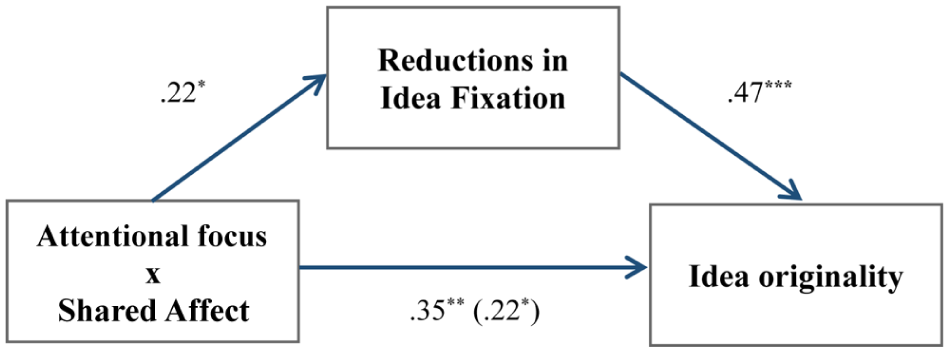
Mediation model.
Meta-Analysis of Experiments 1 and 2
Although the predicted interaction between attentional focus and affect was statistically significant across both studies for all creativity measures (fluency and originality), not all simple main effects for fluency reached a conventional level of significance. To evaluate the overall reliability of the hypothesized simple effects, we conducted an internal meta-analysis separately for each creativity measure and attentional focus condition (Borenstein et al., 2009; Goh et al., 2016). We computed Cohen’s d for the difference between the positive and negative mood conditions separately within each attentional focus condition. Because both experiments were designed to test the same theoretical predictions using similar methods and participant populations, we expected the underlying effect sizes to be comparable across studies. Accordingly, we reported fixed-effects estimates below, which assume a common true effect size.
For fluency, the weighted average effect size was d = 0.79 (95% CI [0.35, 1.24], p < .001) in the global attentional focus condition, indicating that a positive mood led to higher fluency than did a negative mood. Conversely, in the local attentional focus condition, the effect size was d = −0.47 ([−0.91, −0.03], p < .05), suggesting that a positive mood led to lower fluency than did a negative mood. For originality, the weighted average effect size was similarly strong: d = 0.78 ([0.33, 1.22], p < .001) in the global focus condition, indicating that a positive mood led to greater originality than did a negative mood. In the local focus condition, the effect size was d = −0.76 ([−1.21, −0.31], p < .001), demonstrating that a positive mood led to less originality than did a negative mood.
Taken together, these findings provide robust and consistent support for Hypotheses 1 and 2. All simple effects reached statistical significance in the meta-analysis and exhibited moderate to large effect sizes, offering compelling evidence that the impact of affective states on group creativity is contingent on the dominant attentional focus at the time those affective states are induced.
General Discussion
Much research has been done to examine how affect influences the thinking and behavior of individuals (e.g., Fredrickson, 2013; Schwarz & Clore, 2003). By contrast, relatively less attention has been paid to the role of affect in groups, and only a handful of published laboratory studies have tested the causal influence of shared affect on group creativity (i.e., Grawitch, Munz, Elliott, et al., 2003; Grawitch, Munz, & Kramer, 2003; Pillay et al., 2020). Given the importance of creative teamwork for organizational innovation and social change, we set out to examine this under-researched causal relationship.
Drawing on theories that propose a flexible link between affect and cognition (Huntsinger et al., 2014; Martin, 2001; Petty & Briñol, 2015), we hypothesized that the influence of positive and negative affect on group creativity would depend on whether members adopted a global or local attentional focus as their dominant cognitive style before the affect’s arousal. In support of our hypotheses, we found that when a global focus was initially dominant, groups subsequently placed in a positive mood demonstrated greater fluency and generated ideas that on average were more original, than those placed in a negative mood. But when a local focus was initially dominant, this pattern reversed. The former results are consistent with flexible affect–cognition theories (e.g., Huntsinger & Ray, 2016) as well as prior work based on broaden-and-build and affect-as-information theories (e.g., Grawitch, Munz, Elliott, et al., 2003; Grawitch, Munz, & Kramer, 2003; Pillay et al., 2020), whereas the latter results align only with the flexible link theories.
Theoretical and Practical Implications
Our study has several important theoretical and practical implications. First, we offer group-level evidence for the idea that the relationship between affect and cognition is flexible rather than fixed (Briñol et al., 2007; Huntsinger et al., 2014; Martin, 2001). Previous research testing this idea has focused primarily on intra-individual processes (e.g., Huntsinger & Ray, 2016). The present study, by contrast, demonstrates that these flexible link theories can also explain the role that affect plays in intra-group processes. These theories offer a more fine-grained account of how affective states shared among members influence the creative work of idea-generation groups.
Second, our results might suggest an explanation for the mixed state of affairs that exists in the extant research literature on affect and creativity in groups. Most prior studies done at the group level of analysis have been conducted, either implicitly or explicitly, under the traditional fixed-link assumption that negative affect always triggers a local attentional focus and positive affect always triggers a global attentional focus. If a global focus promotes creativity more than a local focus (Friedman et al., 2003), that assumption leads to the expectation that positive affect should always yield greater creativity than negative affect. But as noted in the introduction, while some studies have found results consistent with this expectation (e.g., Grawitch, Munz, & Kramer, 2003; Pillay et al., 2020), others have found the opposite (e.g., Tsai et al., 2012; Tu, 2009). The present study may help to explain this seemingly inconsistent pattern of findings across studies by suggesting that the underlying assumption of a fixed relationship between affect and cognition might be misguided.
Further, the present study highlights the need to take account of participants’ attentional focus—whether they are focused globally or locally—just before the mood induction is introduced. As our results indicate, if at that moment group members are focused globally, then inducing a positive mood (a “go” signal for the current cognitive style) will likely benefit their creativity relative to inducing a negative mood (a “stop” signal for that style, prompting a shift toward the opposing cognitive style). But if members are instead focused locally, then the opposite is apt to occur: inducing a negative mood (a “stop” signal) will likely benefit their creativity relative to inducing a positive mood (a “go” signal). Thus, if groups in some prior studies were focused globally at the point they encountered the mood induction, while those in other studies were focused locally, quite different results would be expected. This could well explain the mixed pattern of results across studies observed in the literature. Unfortunately, none of the studies we are aware of either assessed or controlled for attentional focus prior to introducing their mood manipulation. So, while this assessment of the literature is intriguing, it is necessarily speculative.
Finally, a practical implication of our findings is that it may be challenging to utilize affect, by itself, as a means of promoting group creativity in applied settings. We found that both positive and negative affect can either help or hinder group creativity, depending on the circumstances under which they are aroused—specifically, whether, at that moment, members’ attention is focused globally or locally. This suggests that one-size-fits-all recommendations regarding the use of affect to improve creativity (e.g., to always induce either positive or negative affect in idea-generation groups) are unlikely to be effective. Instead, practitioners should be mindful of the flexible impact of affective states on cognition, and the complex implications this has for group creativity. They should consider not just the members’ affective state (positive vs. negative), but also their currently dominant attentional focus (global vs. local). According to our findings, positive moods are not always beneficial to group creativity and negative moods are not always detrimental. Practitioners should therefore identify the current cognitive style of group members before attempting to induce positive or negative mood states.
Limitations and Future Directions
Although the current research provides novel insights into the relationship between affect and cognition in idea-generating groups, several limitations should be noted. First, we did not directly verify the group members’ focus of attention (global vs. local) after they experienced the mood induction, nor did we examine the specific interactions among them that may have further mediated the effect of the mood induction on their collective creative productivity. These are important issues worth exploring in follow-up research.
Second, although the hypothesized interaction between attentional focus and affect was statistically significant across both experiments for all creativity measures, the simple main effects on fluency were not consistently significant. Specifically, when a global attentional focus was initially primed, groups subsequently placed in a positive mood generated more ideas than those placed in a negative mood in Experiment 1; however, this difference was not statistically significant in Experiment 2. Conversely, when a local attentional focus was initially primed, the predicted mood difference was significant in Experiment 2 but not in Experiment 1. Importantly, the direction of these effects was consistent with our hypothesis across both studies, suggesting a stable underlying pattern despite variability in statistical significance. This inconsistency raises the possibility that some non-significant simple effects may reflect limited statistical power within individual experiments. Supporting this interpretation, all hypothesized simple effects became statistically significant in our internal meta-analysis, which combined data across the two experiments and thereby increased power. The meta-analytic results showed moderate to large effect sizes within each attentional-focus condition, mitigating concerns about power and strengthening confidence in the robustness of the core interaction pattern.
Third, we were concerned here only with the effects of general positive and negative moods. Groups can, of course, experience many specific emotions while performing a task, and these too may influence group processes and creative performance. For example, according to the affect-as-cognitive-feedback account, anger should also serve as a “go” signal and so have a cognitive effect like that of a positive mood—maintain the cognitive style currently in use. By contrast, anxiety and fear should both serve as “stop” signals and so encourage a shift in cognitive styles (Huntsinger et al., 2014). Testing the impact of these and other emotions in groups would provide additional, informative tests of the affect-as-cognitive-feedback account, and should further expand our understanding of the role that affect plays in group creativity.
Fourth, regarding the manipulation of affective states, we induced positive and negative moods using tasks that were incidental to the group creativity task (i.e., recalling a positive or negative memory or reading emotional phrases). However, in many real-world settings, group members’ affective experiences are integral to the task context (cf. Bodenhausen et al., 2001). For instance, receiving positive or negative feedback about group performance can readily elicit a corresponding mood. Research has shown that affect that is integral to the group’s situational context often exerts a stronger influence on performance than affect that is merely incidental (e.g., Hillebrandt & Barclay, 2017). Accordingly, our use of an incidental affect manipulation may represent a relatively conservative test of the proposed hypotheses. Even so, it would be worthwhile for future research to examine whether similar patterns of results emerge when affect is manipulated in a way that is more integral to the task context.
Lastly, the creative potential of groups can manifest in multiple ways not assessed in the present study, including the usefulness or elegance of proposed solutions (Runco, 2010). The current research focused on an idea-generation task, in which greater idea quantity may increase the likelihood of producing highly original ideas. Although we mitigated this concern by using mean originality scores at the group level and statistically controlling for idea quantity, our findings are limited to this particular operationalization of creativity. Future research should examine whether the flexible impact of affective states generalizes to other forms of group creativity (e.g., problem-solving or constrained-design tasks) and to alternative indicators that are less directly tied to idea quantity or average originality.
In conclusion, the present research demonstrates the possibility of a flexible relationship between affect and cognition in groups performing an idea-generation task. Our findings provide an initial step toward a more flexible understanding of how shared affect impacts group creativity, and we hope that it stimulates further research in this important area.
Footnotes
Appendix A
Appendix B
Acknowledgements
We thank Emma Hicks, Gabriela Paiz Palma, Grace Kho, Kayleigh Cowan, Kendall Al-Halah, Lindze Lunn, and Peyton Dover for their assistance in the conduct of this research, and two anonymous reviewers for their helpful suggestions on an earlier draft of this paper.

Funding
The authors received no financial support for the research, authorship, and/or publication of this article.
Declaration of Conflicting Interests
The authors declared no potential conflicts of interest with respect to the research, authorship, and/or publication of this article.