







Abstract
Realism remains a prominent topic in game design and industry research; yet, a strong academic case can be made that games are anything, but realistic. This article frames realism in games in semiotic terms as iconic simulation and argues that games can gain expressiveness when they move beyond the current focus on iconic simulation. In parallel to natural language, indexical and symbolic simulation are investigated. It is argued that indexical and symbolic simulation reduce the number of parts of simulation without affecting its structural complexity and emergent behavior too much. This leads to a perspective on games that pays more attention to the expressive power of relatively simple game mechanics. This perspective helps designers to maximize the effectiveness of game mechanics in communicating general knowledge embedded within the game system.
Keywords
Within the entertainment game industry, much effort is spent on making games more realistic. Game productions get bigger with every year, as graphics, physics modeling, and artificial intelligence take huge strides to ever more realistic simulations. Although these developments advance our understanding of the medium of games, few developers show an active interest in alternative approaches to games. Certain type of games, such as serious games, suffer from this trend. Compared with other educational media, serious games are already quite expensive to produce. If the players and producers of these games expect a level of realistic sophistication that approaches the level found in Triple-A titles, these games will fail to keep up. This article presents an alternative perspective on games that breaks away from realism and investigates games as a form of abstract, nonrealistic, and rule-based representation. From this perspective, the strength of games does not lie in the accurate modeling of fantasy worlds, but in capturing complex systems with relatively simple rules, while retaining the overall dynamic behavior of the original system being modeled. In this article, I argue that games are excellent vehicles for knowledge, learning, and entertainment, irrespective of whether these games have been created for fun or education, and even if they are not created with photo-realistic assets, detailed physics simulations, and multimillion dollar budgets.
Rules, Representation, and Realism
Games are rule-based artifacts designed to be experienced by one or more players, in which they strive to accomplish some sort of goal. Artificiality, rule-based systems, players, and some sort of goal or quantifiable outcome are common elements found in many definitions of games (Adams & Rollings, 2007; Fullerton, 2008; Galloway, 2006; Juul, 2005; Salen & Zimmerman, 2004; Wolf, 2001). As such, games are a new form of rule-based representation, fundamentally different from static representation through noninteractive text, images, and sounds. Rule-based representation is also found in simulation; games and simulations are related, but where the primary goal of simulation is to model, the primary goal of games is to entertain. According to Klevjer (2002), simulation is a form of procedural representation: Simulation represents rules instead of events. Frasca classifies simulation as an alternative to narrative or representation (Frasca, 2003, p. 223). Bogost (2006) picks up on Frasca’s work when he defines simulation as follows: “A simulation is a representation of a source system via a less complex system that informs the user’s understanding of the source system” (p. 98).
This link between games, rules, and simulation is noticeable in the contemporary focus on realism found in many modern games. Over the years, games have grown increasingly more realistic; more and more games conform to the norms of simulation. The power of modern computers allows us to render nearly photo-realistic images in real time. Games often refer to elements recognizable from real life: real cars, real environments, real weapons, and so on. Games that look and feel realistic sell well. In some cases, the reality a game refers to is purely fictional. Games set in the Star Wars universe depict many things that are not real, but still the players have a clear idea what a Star Wars game should look, sound, and feel like. Much industry research is aimed at making games even more realistic. Realism features prominently in the “Top 10 Hurdles Facing Game Designers Today” published on the website of the magazine Popular Science. All are concerned with the accurate and realistic simulation of real-life phenomena. The following were some of the hurdles listed in the magazine: getting water and fire effects right, realistic movement, rendering human faces, and artificial intelligence designed to capture realistic behavior (Ward, Cantor, & Carey, 2007).
Games as Stylized Representations
In contrast, in certain circles of game critics and scholars, it is in vogue to point out that realism is not what games are about. Poole’s book Trigger Happy deconstructs the supposed realism of games. He argues that most players play games because they allow them to do things that are not possible in reality. A thoroughly realistic race game, for example, would require a player to undergo thorough training before he or she can even try to complete a single round on a racing circuit. A game that is totally realistic ceases to be a game (Poole, 2000). He concludes, “Videogames will become more interesting artistically if they abandon thoughts of recreating something that looks like the ‘real’ world and try instead to invent utterly novel ones that work in amazing but consistent ways” (Poole, 2000, p. 240).
The sentiment that games are different from realistic and accurate simulations can already be found in the early work of Crawford (1983) who states,
Accuracy is the sine qua non of simulations; clarity the sine qua non of games. A simulation bears the same relationship to a game that a technical drawing bears to a painting. A game is not merely a small simulation lacking the degree of detail that a simulation possesses; a game deliberately suppresses detail to accentuate the broader message that the designer wishes to present. Where a simulation is detailed a game is stylised. (p. 9)
The paintings that are most stylized are modern paintings that strive to capture the essence of that which they depict through nonrealistic means. I assume that Crawford is referring to this type of painting.
Juul (2005) also points out that
games are often stylized simulations; developed not just for fidelity to their source domain, but for aesthetic purposes. These are adaptations of elements of the real world. The simulation is oriented toward the perceived interesting aspects of soccer, tennis or being a criminal in a contemporary city. (p. 172)
Games allow us to do things that are not possible in real life, and it is the rules that grant us this power, as long as we, as the player, follow them. However, rules create both limitations and affordances. Without rules, games would have little structure and actions would have little meaning (Juul, 2005). For similar reasons, rules can be linked to agency in pen-and-paper role-playing games, even though many avid role-players tend to downplay the importance of rules. In a pen-and-paper role-playing game, the rules form an interface with the fictional world, and it is through rules that players can affect that world; game rules create agency (Dormans, 2006). When looking at a game, it is more important to look at what the rules allow instead of how they limit the player (see Wardrip-Fruin, Mateas, Dow, & Sali, 2009). Pressing the jump button in a SUPER MARIO BROS (1985) game has the satisfactory effect of making the on-screen avatar jump way beyond the capabilities of any human being. Game rules amplify our own abilities and allow us to explore strategies or tactics in artificial conflict that would be dangerous, destructive, impractical, or impossible in real life.
The Iconic Fallacy
Bogost’s (2006) definition of a simulation as “a representation of a source system via a less complex system that informs the user’s understanding of the source system” (p. 98) closely resembles the semiotic triparte model of the sign drafted by Peirce. In this model, a sign is connected to an object (that which the sign represents) and an interpretant (the mental concept that the sign invokes). This model of the sign is best known for the classification of signs into icons, indexes, and symbols. This classification is based on the nature of the relation between the sign and its object: When a sign resembles its object, it is an icon; when the sign has an existential connection to its object, it is an index; and when the connection between sign and object is arbitrary, it is a symbol (Kim, 1996). Figure 1 combines Bogost’s definition of simulation with Peirce’s model of the sign.

Triparte model of signs and simulation
If games and simulation are a form of representation, then the same categories of relations between their form (simulation) and that which they represent (source system) apply to games. This perspective dictates that games, like any form of representation, always signifies something outside the game. This is true even for games that are created for the purpose of entertainment only. No matter how much the “poetic function” (Jakobson, 1960) of an entertainment game calls attention to the game’s representational form, it still is a form of communication that refers to many meaningful and recognizable elements outside the game. Cultural interpretations of relatively simple and abstract entertainment games like PAC-MAN or TETRIS have been made (Poole, 2000 and Murray, 1997, respectively), and even though these interpretations are sometimes quite far fetched, the point is that, like any form of art, no game exists within a cultural vacuum. As Myers (1999b) points out, “Human play as a cognitive and symbolic act that is fundamental to the human representational process” (p. 486).
Beyond Iconicity
In this semiotic model of games and simulation, realism and iconicity are linked. We call a simulation “realistic” when the simulation (as a system) closely resembles the source system; we call a simulation realistic when it is iconic. From this analogy, two other forms of simulation suggest themselves: indexical and symbolic simulation. If games are ultimately not realistic, indexical and symbolic simulation might be interesting notions to help us understand games better. In the next two sections, I will push the analogy between linguistic signs and simulation one step further. In the sections that follow, I will discuss in detail some constructions found in existing games that we might call indexical or symbolic.
Symbolism in Language
An interesting discrepancy exists between the current focus on iconic games and the highly symbolic nature of language. Natural language is by nature abstract, and not realistic at all: most words do not resemble what they stand for. In addition, it is the abstract nature of language that contributes to language’s great expressiveness. This notion can be traced back a long time. It was already apparent in the works of 17th-century philosopher Locke who observed,
Men making abstract Ideas, and settling them in their Minds with names annexed to them, do thereby enable themselves to consider Things, and discourse them, as it were in bundles, for the easier and readier improvement, and communication of their Knowledge, which would advance but slowly were their words and thoughts confined only to Particulars. (Locke, 1975, p. 420)
It is on similar grounds that, roughly a century later, the philosopher Burke attaches greater aesthetic power to poetry than to the realistic paintings of his age. Poets use words to “obscure” the image they try to get across. Paradoxically, this leads to a mental image that is more vivid and evocative than painting a complete and detailed picture of the same thing (Burke, 1990, p. 55). These days, the development of abstract art has changed all this and has increased the expressive power of the image dramatically, as exemplified by the names used by art history to identify particular genres: impressionism, expressionism, abstract expressionism, and so on.
Saussure identifies the arbitrary character of linguistic signs as their principal characteristic. Although he does not rule out the possibility of nonarbitrary signs, he argues that in human language, most signs are arbitrarily linked to their meaning. Usually, no characteristics of what we are referring to are connected to the sounds we use to make the reference (Saussure, 1983). In other words, language consists mostly of symbols; only a few linguistic icons and indexes exist. For Saussure, it is the human faculty to construct a “system of distinct signs corresponding to distinct ideas” that makes language possible (Saussure, 1983, p. 10). Through the human capability to grasp abstract meanings and handle them in bundles, human expression and understanding is taken beyond the level of particular things and into the realm of general knowledge. In other words, abstract, noniconic presentations contain more expressive and representational power than realistic or iconic representations.
Symbolism in Simulation
Bogost’s definition of simulation quoted above is not complete. Bogost emphasizes that subjectivity is inherent to simulation: “A simulation is a representation of a source system via a less complex system that informs the user’s understanding of the source system in a subjective way” (Bogost, 2006, p. 98). In a simulation, a system is represented through another system. The choices made in the construction of the second system reflect the values of its creator: “No simulation can escape some ideological context” (Bogost, 2006, p. 99). As Bogost insists, this subjectivity can be partly attributed to the fact that with simulation the simulating system is by necessity less complex than its source system. A simulating system always deviates from its source system, and the choices made in that deviation reflect the understanding and/or ideology of the person or group that created the simulation. What Bogost exactly means by “less complex” is not made explicit. In this article, I interpret “less complex” as “consisting of fewer parts.” The number of parts in a simulation is usually lower than the number of their counterparts in the source system. This also means that, in most cases, those parts are abstractions of more complex subsystems in the source system. For example, the parts that make up a simulated weather system bundle many actual air molecules that make up real weather. This makes the simulation more convenient to handle, or to paraphrase Locke, it enables us to consider the multitude of parts of a simulated system in bundles for easier and readier understanding, and for easier and readier communication and improvement of that understanding.
Thus, there always is a difference between a simulated system and its simulation, and that difference always renders the simulation subjective to a lesser or greater extent. However, this subjectivity is the price we pay for the convenience and enhanced understanding that simulations allow. In most cases, the gain in expressive power outweighs the loss in resemblance to particular instances.
When one considers a simulation as essentially subjective, it is worth noting that any claim to realism becomes an ideological maneuver in itself. For example, the high level of verisimilitude in AMERICA’S ARMY (2002) can be read as the rhetoric claim that its apparent realism and correctness in visual representation can be extended into the ideological domain: “The game got its physics right, so its ethical claims must be realistic, too” (Bogost, 2007, p. 78). However, in commercial entertainment, the realism of a game is often framed as a special effect. In these games, realism and authenticity become a spectacle designed to impress and to be appreciated by the audience. Realism, with its high polygon count, plasma effects, and particle engines, is foregrounded and hyperreal—or to use the words with which Geoff King described a very similar phenomenon in blockbuster films, it is “the hyperrealistic spectacle-of-authenticity rather than authenticity itself” (King, 2000, p. 136).
Indexical Simulation in Games
To start looking beyond iconic simulation, the notions of indexical and symbolic simulation are obvious points of departure. In this section, I will discuss the first notion and in the next section, I will discuss the second. The “inventory system” that first occurred in DIABLO (1998) and that has since featured in many other games can be seen as an example of the first. It inspired Warren Spector, developer of DEUS EX (2000), into saying that “Diablo got Inventory right. There’s no sense messing with something that works.” 1 For quite some years now, many computer games have included an “inventory”: The game allows the main character to pick up objects and carry them around. The player can manage these objects in the game’s inventory screen. Most games restrict the number of objects that the character can carry in some way. The game might impose a fixed limit to the number of objects that characters can pick up, or all the game objects might have a weight value attached to it and characters can only carry objects up to a particular load.
DIABLO’s (1998) inventory system takes object size as its main restricting factor (see Figure 2). Each item takes up a number of inventory “slots”; the available slots are limited and organized in a grid. An item may take up
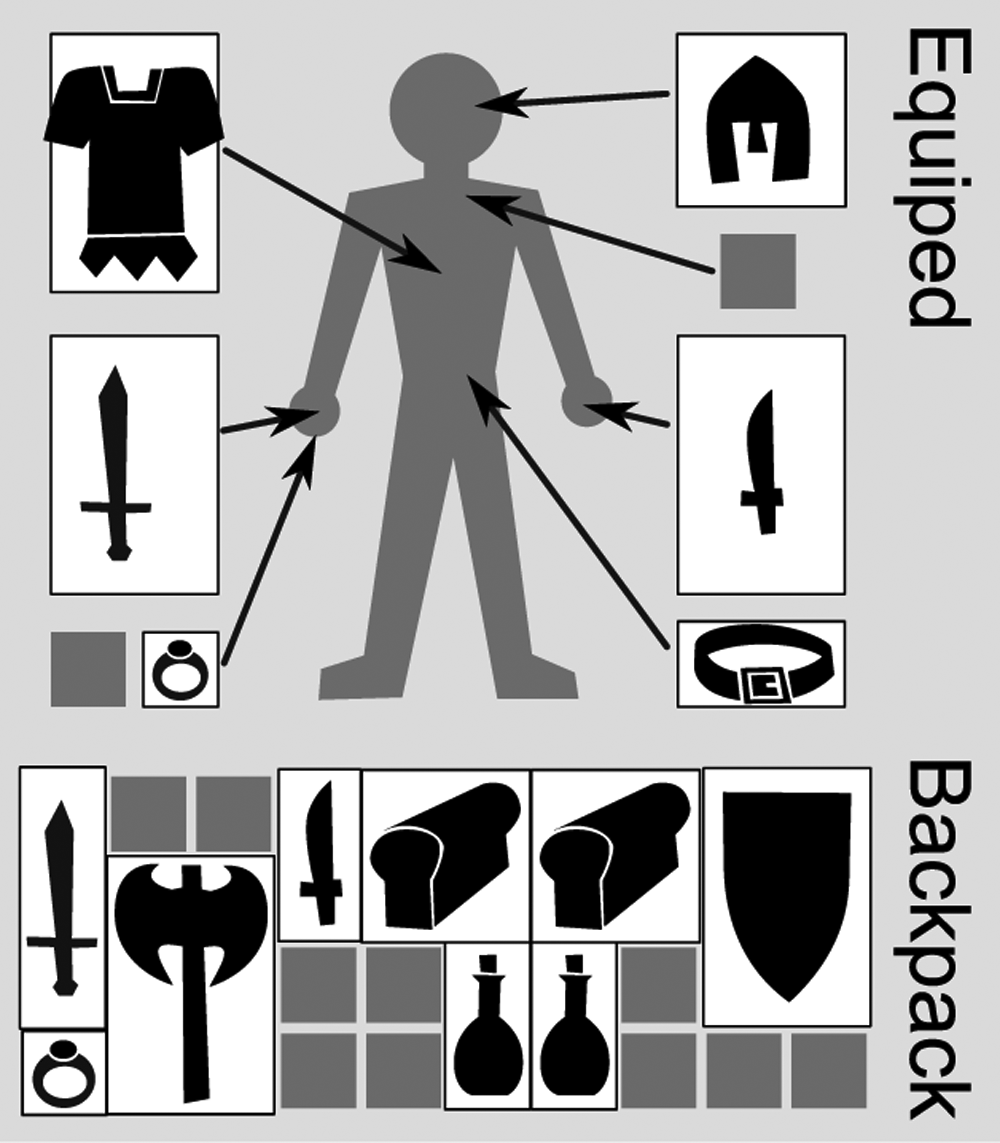
A schematic sketch of DIABLO’s (1998) inventory screen
I argue that this is an example of indexical representation in games. The main restricting factors for somebody to carry objects in real life (shape, size, and weight) are represented by easily understandable 2D shapes. These shapes and their relative size may be existentially connected to the size and weight of their simulated counterparts. Therefore, the simulation qualifies as an indexical construction as it is parallel to indexical signs in which the relation between the sign and its object is also based on an existential connection (rather than resemblance or arbitrary convention).
The number of games that have copied this system in one form or another is a testimony to the quality of this construction. The internal rules and constraints are immediately apparent (not in the least because they are tailored toward visual representation on a screen). The management problems that the system gives rise to are very much like those in real life. The system even allows players to make an inefficient mess of their inventory, teaching them something about the need to organize themselves (although it is not always the best design decision to burden the player with the upkeep of his inventory).
The DIABLO (1998) inventory system very effectively takes many related and similar functioning game rules and replaces them all by a single game mechanism that is well suited to the medium of the video game. Some accuracy of simulation is lost (an item cannot be large and light at the same time), but the overall behavior is retained (the players are limited in what they can carry). The cleverness of the DIABLO inventory is that it collapses all the nuances of managing an inventory into a problem of size, which is easily represented by a computer screen, instead of weight, which was the more common choice before, but which translates to the visual medium of the computer less well.
Another example of indexical simulation is the way most games handle “health.” Health of characters and units is often represented by a simple metric, be it a percentage or a number of “hit points.” Obviously, in real life, the physical health of a person or the structural condition of a vehicle is a complex matter to which many different aspects contribute. By using a generic health for a single character, games bundle all these aspects into one convenient bundle. Both players and computers can easily work and understand the numerical metric to represent the bundle.
Symbolic Simulation in Games
Symbolic simulation goes one step further in breaking away from modeling a system with rules that closely resemble the mechanisms of the source system. The use of dice in many board games tends to be symbolic. For example, the roll of a few dice can stand for complete battle in a game of RISK (1959). In this case, the relation between dice rolling and fighting is arbitrary: One simple action, well known from other games, is used to simulate a multitude of actions for which most players would lack expertise. Dice can replace these battles because, for the purpose of the game, the player should have little influence over the outcome of these battles. RISK is about global strategy, not about tactical maneuvers on the field of battle. A player cannot control the result of dice (not without cheating anyway) just as an army commander cannot win every battle personally; yet, commanders do have influence on the outcome through the choices they make. Likewise, players have some sort of influence on the outcome of individual battles: Committing more armies to a battle allows the player to roll more dice and improve chances for success. Something similar goes for KRIEGSSPIEL (1812) and many successive war games. In contrast to RISK, these games are all about tactical maneuvering on a battlefield. So the rules for these maneuvers are quite elaborate. However, the rules covering actual fighting are left to dice and attrition tables. These are games that focus on tactical skills, not on how to use a gun.
Dice are wonderful devices to create a nondeterministic effect without the need of detailed rules. From a suitable high level of abstraction, a complex and nondeterministic system, such as fighting, has similar effects as rolling a few dice. Especially when the player is not supposed to have much influence over this system, dice mechanics can be used to replace the more complex system. The characteristic randomness of different dice mechanics can be used to match many superficial, nondeterministic patterns created by more complex systems. Pen-and-paper role-playing games have come up with many clever and interesting ways of using dice, both with and without much influence by the player. In fact, dice mechanics related to set of characteristics representing skills and attributes form the core of most pen-and-paper role-playing systems. Often the same mechanics are used to represent a wide variety of actions.
Other examples, such as jumping on top of your enemies to dispose them in the classic video game SUPER MARIO BROS (1985; see Figure 3), fall somewhere in between symbolic and indexical forms of simulation. Although the precise implementation differs from enemy to enemy, and certainly does not work against all enemies, it is a frequent feature throughout the game and the series it belongs to. It is unlikely that I am the first to point out that this method is a little odd, to say the least. However, it has become a convention within platform games that is instantly recognizable to gamers, and ties in with that genre’s defining action of jumping from platform to platform.
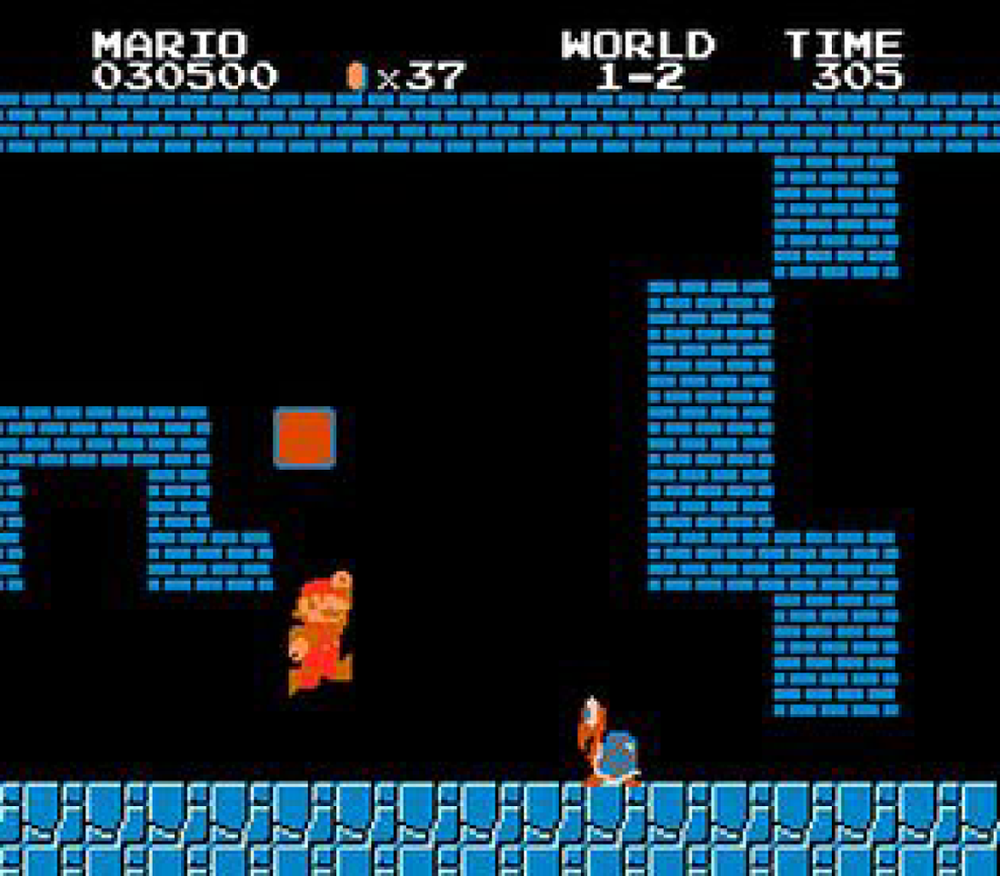
Jumping to avoid or defeat enemies in SUPER MARIO BROS
The connection between jumping on top of something and defeating something in real life might not be completely arbitrary, but its use in platform games has become so conventional that it parallels the definition of a symbolic sign in language. In the real world, creatures exist that can be squashed by jumping on top of them. However, I know of no creature that is lethal when bumped into, but not when stepped upon. What is more, this method of fighting in SUPER MARIO BROS (1985) is motivated more by the use of the genre’s prominent jumping action than it is by any claim to realism. The link between the simulation and what is simulated is both arbitrary and conventional—especially in the multitude of platform games that followed the example set by SUPER MARIO BROS.
However, an affinity exists between the skills needed to defeat enemies in SUPER MARIO BROS and in real life. In the game, it requires timing and accuracy, which are among the skills involved in real fighting. The point is that the simple representation in the game allows us to do more than to hone and train those skills. The simple metaphor of jumping on top of enemies is easy to grasp by the player, but the game then goes on by inviting the player to experiment and develop strategies. In most platform games, each level ends with a “boss” enemy, which is typically designed to test the effectiveness of the player’s strategy. It is the ultimate test for players to demonstrate that they understand and have mastered the simulation, and can combine different moves. These lessons carry over to situations beyond the game. The mentality of the players who have learned these lessons is excellently described by Beck and Wade (2004): “They know that solutions will eventually present themselves, and they have mastered a trial and error approach to many problems in life” (pp. 11-14).
What the jumping on enemies mechanism accomplishes is a very clever way of adding combat rules to a jumping game without introducing new actions. SUPER MARIO BROS (1985) manages to do this by representing actions outside the game with rules already implemented in the game. This reduces the number of actions that players need to learn, allowing players to quickly move on to a deeper, more tactical, or strategic interaction with the game, instead of fussing around with its interface. As argued below, symbolic simulation effectively reduces the system to a simpler construction with more or less equivalent dynamic behavior.
Less Is More: Noniconic Reduction
Indexical and symbolic simulation tend to create simpler game systems than iconic simulation. The reduction in rules that these forms of simulation allow is in general benevolent. Simpler games are easier to learn, yet they can still be quite difficult to master. Games are not the only medium for which the expression “less is more” rings true. In almost any form of representational art, saying more with less means is well appreciated, especially by critics and connoisseurs. Alexander, drawing inspiration from poetry for his pattern language for architecture and design, puts it like this:
This language, like English, can be a medium for prose, or a medium for poetry. The difference between prose and poetry is not that different languages are used, but that the same language is used differently. In an ordinary English sentence, each word has one meaning, and the sentence too, has one simple meaning. In a poem, the meaning is far more dense. Each word carries several meanings; and the sentence as a whole carries an enormous density of interlocking meanings, which together illuminate the whole. (Alexander et al., 1977, p. xli)
In addition,
It is essential then, once you have learned to use the language, that you pay attention to the possibility of compressing the many patterns which you put together, in the smallest possible space. You may think of this process of compressing patterns, as a way to make the cheapest possible building which has the necessary patterns in it. It is, also, the only way of using a pattern language to make buildings which are poems. (Alexander et al., 1977, p. xliv)
For language, or rather for any form of artistic representation, this quality is very important and does not stem from the use of abstract signs only. The combination and structure of these signs or, to use the linguistic term, the syntactical relations between these signs also play an important role. In this light, Chomsky observed that language allows speakers to make infinite use of finite means: The number of words we have may be limited (and is vastly outnumbered by particular things in reality), the number of combinations we can make with them is infinite (Chomsky, 1972, p. 17). This characteristic of language is often called discrete infinity.
It is impossible to quantify exactly how many rules a game should have; it is impossible to quantify how much less is how much more. Each individual design has its own optimal balance between expressivity and number of rules. What is enough rules for one game might be too many or too few for another. Games should seek to balance the number of gameplay options that the rules create on the one hand and the cognitive burden it requires to understand or operate those rules on the other. Saint-Exupéry’s (1939) famous quote “It seems that perfection is reached not when there is nothing left to add, but when there is nothing left to take away” applies extremely very well to games.
Few Rules, Many States
In general, games are good at creating endless possibilities with only a few rules. It is estimated that games like CHESS and GO have more possible game states than the earth has atoms (Shannon, 1950). It is the rules of the game that determine the number possible states, but it is not necessarily true that more rules will lead to more possible states. In addition, when a game can create a large number of possible states without using many rules, the game will be more accessible.
Possible game states and trajectories through a game’s state space are emergent properties of the game’s system of rules. Gameplay, here understood as the meaningful interaction with that system and thus related to these trajectories, is also an emergent property of that system. Some games allow many interesting trajectories. These games arguably have more gameplay than games that generate fewer trajectories or less interesting ones. However, determining the type and quality of the gameplay is hard, if not impossible, by simply looking at the rules. Comparing the rules of TIC-TAC-TOE and CONNECT FOUR (1974) serves as a good illustration of these difficulties. The rules for TIC-TAC-TOE are as follows:
The game is played on a three-by-three grid.
The players take turns to occupy a square.
A square can only be occupied once.
The first player to occupy three squares in a row (orthogonally or diagonally) wins.
The rules for CONNECT FOUR (1974) are (with the differences emphasized) as follows:
The game is played on a seven-by-six grid.
The players take turns to occupy a square.
A square can only be occupied once.
Only the bottom most unoccupied square in a given column can be occupied.
The first player to occupy four squares in a row (orthogonally or diagonally) wins.
While the differences in rules for these two games are only a few, the differences in gameplay are immense—far larger than the difference in cognitive effort needed to understand the rules. In the commercially available version of CONNECT FOUR (1974), the most complicated rule (Number 4) is enforced by gravity: A player’s token will automatically fall to the lowest available space in the upright playing area (see Figure 4). This relieves players from manually enforcing this rule and allows them to focus on the rule’s effects instead. Despite the small difference in the complexity of the rules, TIC-TAC-TOE is suited only for small children, whereas CONNECT FOUR can also be enjoyed by adults. The latter game allows many different strategies, and it takes a considerable longer time to master the game. When two experienced players play the game, it will be an exciting match, instead of a certain draw as is the case with two experienced players of TIC-TAC-TOE. It is hard to explain these differences just by looking at differences in the rules.

In CONNECT FOUR (1974) gravity makes sure players can only occupy the bottom most, unoccupied square in each column
Emergence in Games
These days, emergence of complex behavior from relatively simple elements is an important aspect of many fields of research in the domains of mathematics, physics, and social sciences. In the study of games, emergence is also becoming an increasingly important notion. From the computational side, emergence is an important technique used in anything from development of artificial intelligence to the realistic rendering of water and fire. For Sweetser, the disadvantageous loss of creative control in a system that is set up for emergence is outweighed by the more consistent and intuitive player interactions that such systems allow (Sweetser, 2006). Likewise, game designer Smith argues that attempting to design a totally controlled game environment that allows rich interaction is no longer economically viable, as the sheer amount of detail cannot be efficiently produced manually (Smith, 2001).
One major advantage of games that feature emergent gameplay is that its rule system allows, and often even invites, players to experiment with the game, instead of merely performing the moves as a game designer intended. Ultimately, emergent games allow the transformation of the game rules itself (Myers, 1999a). This has severe consequences not only when building an educational game, but also when the game designer has a particular story or message in mind. For Klabbers, it is the responsibility of the game designer to shape the whole of the game system in such a way that behavior that conforms to the design specifications emerges from its components. At the same time, the system should leave enough freedom for players to act according to their own strategies, goals, and incentives, to elevate the position of the player into that of a reflexive actor. This is “one of the major bottle necks in the design” (Klabbers, 2006, p. 102).
Not all games rely strongly on emergence. Juul differentiates games of progression from “games of emergence” as a historically younger category associated with computer games. Games of emergence are typically classic board games and strategy games with many units and a high level of connectedness (Juul, 2005). Whereas in games of emergence, dynamic play emerges from a large set of possible combinations and strategies, games of progression control the player’s progression through the game. In a game of progression, the player effectively has to perform the moves that the designer has laid out beforehand. A game is a game of progression when a “walkthrough” can be drafted for that game. The rise of computer games, and adventure games in particular, has fueled the evolution of games of progression. Without a computer, the amount of data and the number of special case rules facilitating the progression through a multitude of game spaces would have become unwieldy (Juul, 2005).
The distinction between games of emergence and games of progression is a recall of Crawford’s notions of data intensity and process intensity (Crawford, 2003; see also Harteveld & Bekebrede, 2011). He argues that computers are suited to handle large amounts of data and crunch vast quantities of numbers, but it is the latter ability that sets computers apart from most other media. Handling data is something that all media are good at. The computer often allows faster access to remote locations within the data, an ability put to good use within hypertext (Lister, Dovey, Giddings, Grant, & Kelly, 2003). However, it is the ability to create new content on the fly where the computer really shines. Like no other medium before, the computer has the capacity to surprise players and designers alike (Smith, 2001). For Crawford, games should capitalize on this ability of the computer; games should be process intensive rather than data intensive; they should be games of emergence rather than games of progression.
Designing Emergence
Designing emergence is a notoriously hard, somewhat paradoxical, task. Emergent properties of a system only surface when a system is put into motion. Even when a system behaves in a certain way during all tests, there is no guarantee that it will do so all the time. In this light, the realistic fallacy seems to be a fairly conservative strategy to avoid the difficulties of designing truly emergent games that have relatively simple systems and display interesting, complex behavior. Simply adding more and more detailed rules is only a poor substitute for creating complex gameplay through a lean and elegant rule system.
Using simple means to generate complex gameplay, despite its difficulties, has many advantages. The design becomes easier to manage for the designer, and the game becomes easier to learn for the player. In the three examples of noniconic simulation above (DIABLO’s [1998] inventory, the use of dice in many board games and jumping in SUPER MARIO BROS [1985]), the use of indexical and symbolic simulation resulted in a simpler rule system than an iconic simulation would. This is not a characteristic of the examples discussed above; rather, it is an advantage of using noniconic rules in games in general. Compared with a completely detailed, realistic system that tries to simulate through accurate detail, indexical and symbolic simulation aim to capture the essence of the source system with fewer means. When done correctly, the result is a leaner, more elegant system that minimizes on parts and maximizes on expressiveness.
Emergence can be the result of relatively simple rules; therefore, games do not need to rely on complex rule systems to create interesting gameplay. On the contrary, as CHESS and GO illustrate, games can generate very complex behavior with simple rules. Structural qualities of game mechanics, notably the existence of feedback loops within the game system, are key elements that contribute to emergent gameplay (Dormans, 2008, 2009). Indexical and symbolic simulation are ways of reducing the number of rules without affecting this structure too much.
In essence, indexical simulation bundles a number of related and more or less isomorphic rules into one game mechanism. Symbolic simulation goes one step further, it connects rules in the game where they would not be connected directly in the source system. As with the use of symbols in language, some symbols work better than others. The symbols that work best seem to connect two unrelated rules that still have some affinity between them. In the case of SUPER MARIO BROS (1985), a natural affinity exists between the physical skill and timing involved in both jumping and fighting.
Example: The Development of GET H2O
The development of the serious board game GET H2O (2010), in which I took part, is a very good example of the application of noniconic reduction. In this game, produced as part of an educational program for adolescents in East Africa, the players struggle to survive in the poor residential areas of an African metropolis (see Figure 5). GET H2O is a relatively unknown example; the reasons for using it here are twofold:
As I was also a member of the design team, I had direct access to the reasoning behind many of the relevant design decisions.
The game was deliberately designed to generate a complex social dynamic, on the one hand, but using simple rules that suit African adolescents with little experience in board games, on the other.
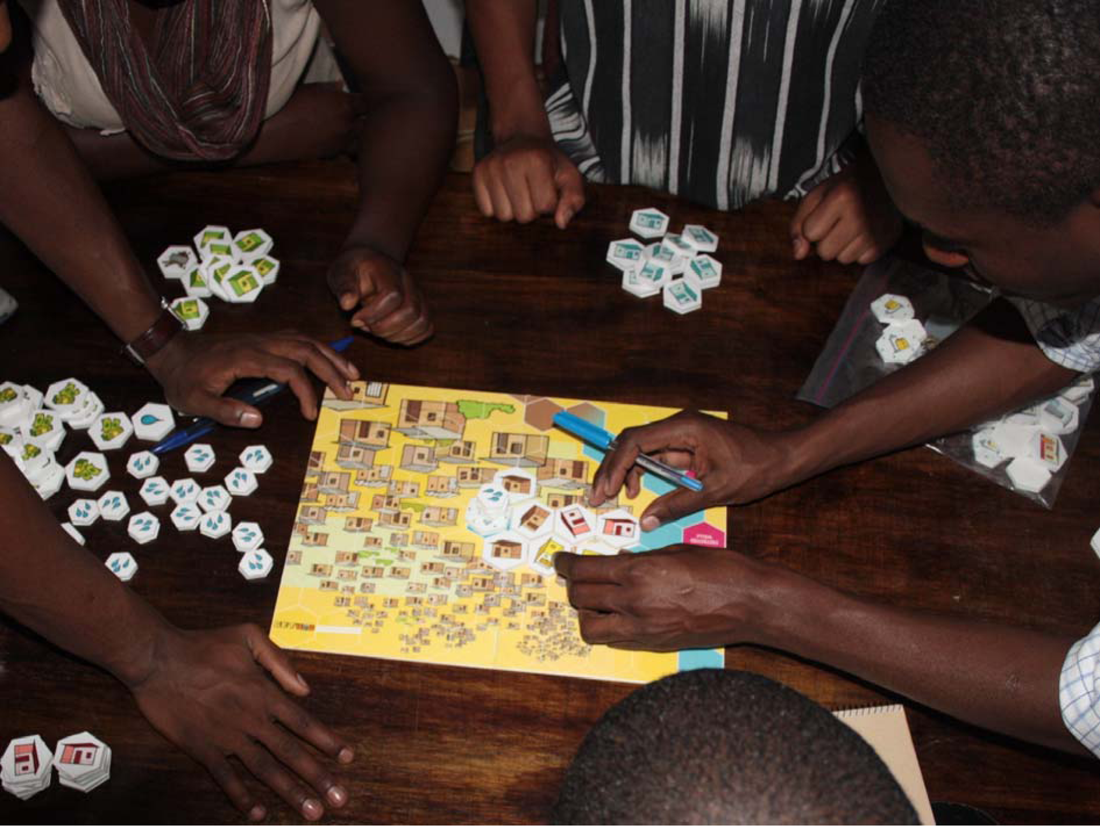
A prototype of GET H2O (2010) being played in Nairobi
In other words, maximizing the expressivity through noniconic simulation was a necessity for this project.
In GET H2O (2010), the vital resources are scarce; players need to carefully balance between personal gain and community efforts. The players only have indirect influence over bad events that might happen, but sometimes players can benefit from these events, sowing the seeds for conflict. The game simulates life in an African metropolis and gives the players a top-down view of their own lives. It is designed to function as a vehicle for exploration, discussion, and reflection.
Instead of trying to simulate the East African urban life in detail, the game reduces the number of resources and rules to a relatively simple set. The game uses three main resources: money, houses, and clean water. The latter two determine how many actions a player can take each turn, while the money is used to build more houses. These resources are under constant threat. Money and water might get stolen; houses might be burned down. In reality, an African family has many more needs, but for the game, these three resources are enough to build an economy of scarcity that generates a dynamic that is recognizable to the target group. The indexical nature of this simulation allowed us to keep it relatively simple yet recognizable to people who grew up in those areas. What is more, this economy creates the particular balance between short-term personal gain and long-term community interests that cause social instability. It was exactly this instability we were after, as the game is supposed to train people in dealing with such a situation in the first place. Simply put, we could have added resources, but we did not need them to replicate the volatile social system we were after.
The game also uses symbolic simulation. After every player has taken a turn, all players discard one playing card without revealing it. These cards are normally used for player actions. The discarded cards are then shuffled and revealed. Every card has a symbol representing bad things that might happen, from corruption and pollution to arson and drought. If the same symbol is played twice, the effects are aggravated: One drought symbol does nothing, but two drought symbols indicate that a drought has struck. Obviously, playing cards has nothing to do with the occurrence of real droughts. The cards are a way of simulating bad events that are mostly beyond the control of the people living in an African metropolis. One that also conveniently ties in with other mechanics of the game is that every player will also get a secret role that allows them to benefit from bad event such as corruption, scapegoating, and arson.
When used correctly, indexical and symbolic reduction reduces the number of elements in a system without affecting its structural complexity and emergent properties too much. In the GET H2O (2010) example, many similar resources that are needed on a daily basis are replaced by just one—water. Yet, as with many economic resources, having access to a resource allows you to get more of that resource, it is part of a positive feedback loop. The feedback loops that operate in the game have a similar structure to the feedback loops that operate in the real economy it simulates. In fact, the game emphasizes these structural features by taking away unnecessary detail. By reducing the number of elements in the game system, the cognitive burden of the player, in keeping track of all these elements, is also reduced, allowing the player to focus more on these features and the strategic interaction that they allow or, in the case of GET H2O, on the social implications they have.
Using indexical and symbolic simulation has more advantages. A system that uses indexical and symbolic reduction can condense the experience, allowing a complete session of play to run much quicker than what the play represents in real time. In effect, the player is confronted with the results of his actions quickly and efficiently. It allows the players to “handle the rules in bundles for the easier and readier improvement of their understanding of the system.” On the one hand, this allows players to go through the process more often, and on the other hand, it will contribute to the pleasurable experience agency and power that drives many commercial entertainment games. In the GET H2O (2010) game, this was certainly one of the design goals. The game can be played in roughly 45 minutes, allowing players to experiment with different strategies efficiently while reducing the costs of failure.
Balance and Coherence
Game designers also benefit from reducing the number of rules. A game system that is reduced to its essence becomes better manageable and easier to balance. Without many parts, designers can focus on those elements and structures that contribute directly to the game’s emergent behavior and more easily tweak that behavior into the desired shape. Games would do well to strive for noniconic, abstract simulation rather that detailed realism. Not only is this economically more feasible, but it is also more interesting artistically and allows for more effective communication.
The LEGEND OF ZELDA (1986) series is a great example of gameplay design in which only a handful of game objects and associated rules are combined in many interesting challenges. The value of each of these objects and their rules does not stem from their power to represent some sort of realistic aspect of adventuring through a dungeon, but forms a potential combination with other objects and rules. The exploration challenges, which the series is famous for, are almost always the result of combinations of simple, reusable gameplay mechanics that are often quite indexical or symbolic. For example, in THE LEGEND OF ZELDA: TWILIGHT PRINCESS, the player can find the “gale boomerang” in the “Forest Temple” level, which creates a gust of air strong enough to activate wind-operated switches and carry small items to the player. This boomerang can be used to carry “bomblings,” little creatures that explode a few seconds after the player grabs him by hand or with the gale boomerang. Effective use of this combination is required to defeat the final boss in that level. The same boomerang is used in the ZELDA games for the Nintendo DS, but in this case, the player can use the stylus to draw the path of the boomerang quite freely, directing it around obstacles unrealistically. Players appreciate this sort of structure as it has the advantage of being inheritably coherent: The function of the gale boomerang remains the same over the entire game and similar between games. Ultimately, the gale boomerang acts as a key to unlock new paths for the player, as do most items in a ZELDA game. Every time the player finds a new item, it adds new pathways through the world the player explores. As has been pointed out before, coherence is a strong contributing factor to gameplay (Poole, 2000). One can even argue that the appreciation of such structures is in its essence an aesthetic appreciation (Huizinga, 1955). It is the appreciation of the craftsmanship of the game designer in building systems with interesting structural qualities from which interesting behavior emerges. It forces one to pay attention to the way the game was constructed and the way it is structured (cf. Ryan, 2001).
The meaning that emerges from these games is not necessarily less detailed or less valuable than games that aim for detailed and realistic simulation. On the contrary, as the challenges of exploration in a ZELDA game are more abstract, the skills and knowledge the game addresses are more generic; the message of a game that is less iconic is better applicable outside the particular settings of the game. This is especially useful when one wants to express something through a game that has value beyond the game and its immediate premise. It is even beneficial for a game like GET H2O (2010), which is designed to replicate a particular situation, because the individual experience of people will in all likelihood differ from the particular experience recreated in the game. Abstracted games will have fewer details and thus usually fewer inconsistencies to distract the players. Players will have more room for personal interpretation making the experience more relevant.
Conclusions
Games and simulations share a representational form: representation of the source system through a system of rules. Even games that are played as a pure form of entertainment are about something. Rule-based representation can take many different forms. Traditional simulation has accurate modeling as its main goal; most games are designed to entertain, while others aim to educate. However, many games still conform to the norms of simulation; they aim to represent a source system by creating rules that resemble the rules of the source as closely and accurately as possible. This type of rule-based representation, in analogy to general semiotics, can be called iconic simulation.
Also in analogy with semiotics, the notions of indexical and symbolic simulation were explored as possible avenues to differentiate games from simulations. As pointed out above, the goal of a game is not the same as the goal of a simulation. Indexical simulation, where the rules of the game have some sort of causal relation with the rules of the source, and symbolic simulation, where the rules of the game are linked to the source by convention, allow for simpler game systems. Although these systems consist of fewer rules and parts, their behavior need not be less complex. The power of noniconic simulation, such as games, lies not in its power to accurately model a source system or in the creation of a vast, realistic game world, but rather in its efficient use of expressive game mechanics. Although it is incorrect to claim that the potential of iconic simulation has been fully explored, it is clear that much more progress can be made by developing indexical and symbolic building blocks for simulation and, more importantly, investigating the effectiveness of particular configurations of such building blocks. Emergent behavior is more likely to originate from the interrelations of game parts than simply the parts themselves. It is the craft of the game designer to create complex systems from appropriate and simple elements. Creating complex simulation with equally complex (or worse, more complex) means has little art in it; yet, this seems to be what many developers aim for.
Indexical and symbolic simulation as discussed in this article are suggestions to go beyond iconic simulation. They are theoretical notions that help reduce a game system to its bare minimum without affecting too much the structure from which the gameplay emerges. This allows the designer to focus on balancing the emergent behavior and provides the player with a better opportunity to explore the ludic significance, or generic knowledge, codified by the game.
Footnotes
Acknowledgements
This article is an expanded, revised, and elaborated version of the authors paper presented at IADIS 2008. The author would like to thank Jacob Brunekreef, Casper Harteveld, Wilko Oskam, Remko Scha, Swen Stoop, and Eleonore ten Thij for reading and commenting on earlier drafts of this and the original paper.
The author declared no conflicts of interest with respect to the authorship and/or publication of this article.
The author received no financial support for the research and/or authorship of this article.