







Abstract
The topic of climate change offers unique challenges to simulation game designers largely because standard game mechanics fail to capture the complexity of this real-world problem. Climate change dynamics are characterized by the second-order delayed effects of carbon emissions on global temperatures and by political actors, who often have unique individual goals and asymmetrical abilities. However, many climate change games exhibit mechanics such as immediate and first-order delayed effects, zero-sum collaborative play, zero-sum competitive play, and players with symmetrical abilities and goals. By examining variants of an asymmetrical three-player common pool resource game, this research illustrates how inclusion or omission of mechanics found in real-life climate change impact the outcome of simulations and gameplay.
Keywords
Climate change presents unique challenges and opportunities for game designers wishing to present climate change politics and science in realistic and fun-to-play simulation games. As with all simulation games, in the design of climate change simulations, it is necessary to emphasize some aspects of climate change and simplify others for the sake of fun and playability. This article focuses on several aspects of climate change that are commonly oversimplified or omitted in popular climate change games. We respect that designers have reasons for omitting these mechanics, but as game designers ourselves, we are curious about the alternatives in game design and wish to provide a look into the implications for changing how climate games represent science and politics. As part of this process, we describe a common pool resource game of our own design that incorporates these elements, and we analyze the effect on gameplay from adding and removing these elements. This article of necessity covers but a limited number of the many aspects of climate change worthy of representation in games. In particular, we focus on aspects that may be challenging to represent using only standard game mechanics. This is because existing games that simulate climate change already provide examples of how to present situations in which players can invest in green technologies, balance budgets, and so on, and they do so using mechanics common to games on topics unrelated to the environment, politics, or climate change.
Here we provide focus on four important characteristics common to climate change science and policy that rarely get simultaneously addressed in climate change games:
Conflicts in climate change debates are often not inherently zero-sum collaborative or zero-sum competitive.
Climate change dilemmas often involve multiple actors each with different abilities and unique goals.
The politics of climate change is both a collective action problem and a social dilemma.
Climate change is a process that includes both short-term effects and longer term delayed effects.
We start with aspects of climate politics. First, conflicts in climate change debates are often not inherently zero-sum collaborative or zero-sum competitive. In climate change debates all, some, or none of the stakeholders may succeed. Therefore, climate change does not map easily onto standard collaborative or competitive game designs. This means that climate politics simulations are ideally ones in which each player has winning conditions independent of other players. 1 Second, climate change dilemmas often involve multiple actors who have different abilities and unique goals. For example, real life presents situations of inequality as can be seen in the dynamics between developed and developing nations. These same inequities, however, may prove difficult to recreate in game design while keeping gameplay enjoyable for weaker players, especially in games with standard competitive designs. This being the case, game designers may opt to make games that have balanced multiple players and collaborative goals, or they can opt for single-player designs, omitting a crucial aspect of climate change dilemmas: multiplayer/multiagent interaction. Third, the politics of climate change is a collective action problem and a social dilemma. Recognizing this, it is clear that each player, acting in his or her own best interest, can create a situation known as a tragedy of the commons. Taken together, these points suggest that more realistic climate change games should be designed such that they incorporate multiple actors with unequal abilities who both cooperate and compete over the resources needed for independent success.
Last, we examine a point on climate science. Finally, climate change is a process that involves delayed effects. Atmospheric temperatures rise after CO2 enters the atmosphere and temperatures can continue to rise long after the rate of emissions decreases. This nonintuitive feature is crucial to understanding how climate change works, and how it effects individual beliefs and actions. However, this may also be intentionally left out of game mechanics in efforts to simplify gameplay. This may be the correct decision from a game design perspective, but it is a decision that has consequences for how closely gameplay reflects the aspects of reality designers wish to illustrate. This article explores these consequences using simulations. We were able to locate games that addressed some of these aspects of climate change, yet we were unable to find any single game that took into account all of the aforementioned aspects incorporated within a single simulation.
This article describes how meeting all of these challenges within a single climate change simulation game is both possible and consequential. Furthermore, this article explores the impact of manipulating gamer goal states (competitive vs. independent vs. collaborative) and explores the consequences of manipulating the mechanism for realizing potential impacts of climate change (from immediate to longer term first- and second-order impacts). To do this, we use modifications of a common pool resource dilemma game, THE FARMERS (Fennewald & Kievit-Kylar, 2012), to investigate several questions:
How can a game balance players with vastly different strengths, abilities, and win conditions?
What game mechanics can support play with independent goals that are neither zero-sum collaborative nor zero-sum competitive, in which players cannot force victories or ties by destroying the environment?
How do independent, collaborative, and competitive play conditions compare?
What is the effect of varying immediate, first-, and second-order delayed effects?
Climate Change Games and Participatory Simulations
Climate change is introduced in an ever-increasing number of games, and here we highlight only a few of the many titles relevant to our discussion about game mechanics and climate change in games. A much more complete analysis of the wide range of games that address the topic of climate change is provided by Reckien and Eisenack (2012), who analyze games by language, format, developer type, issues addressed, and year of publication. We organize our analysis by format into several basic categories: Alternate Reality Games, single-player electronic games, multiplayer board games, and participatory simulations.
Single-Player Electronic Games
Most single-player climate change games tend to also be electronic games and vice versa, electronic games about climate change tend to be single player. Countless games introduce the ideas of sustainability. These include the most popular of city builders such as the SIMCITY 4 (Wright, 2003) and ANNO 2070 (Ubisoft Entertainment, 2011), god games where players assume the role of leaders who make environmental choices and see the impacts of their choices in the form of pollution. More overt games include spin-offs such as ELECTROCITY (Genesis Energy, 2008), a game in which players are awarded a score based on their ability to balance population growth, environment, job creation, and material supply. Other simulations more overtly about climate change include the interactive CEO2—THE CLIMATE BUSINESS GAME (Allianz, 2010), in which players are CEOs who make budget choices for an industrial firm with the goal of achieving the dual bottom lines of turning a profit while reducing greenhouse gas emissions. All of these games involve making decisions with environmental consequences; however, none of these games present climate change as something that players must respond to.
Among single-player games about ecology, the ones that most forthrightly present themselves as climate change simulations are those that follow the mold of CLIMATE CHALLENGE (Red Redemption Ltd., 2006) and FATE OF THE WORLD (Roberts, 2011). In these games, and most particularly in FATE OF THE WORLD, players need to balance the threat of climate change with the need to maintain economic growth. FATE OF THE WORLD situates players in command of global decisions that impact climate change for 100 years. Within that time frame, they must insure energy supply or face global rioting. The game illustrates climate science at a global level, incorporating the second-order delayed effects of carbon emissions on temperature levels. The game also presents the intricacies of real geographical differences, forcing players to choose strategies appropriate for each region of the globe. However, despite its achievements, FATE OF THE WORLD’s only shortcoming is that it was designed as a single-player game because early attempts to make the game multiplayer were not fun for players who played weaker developing nations. Thus, FATE OF THE WORLD is a single-player game with a highly realistic presentation of science and geography, but an unrealistic political situation (one person unilaterally makes decisions for the entire world).
Alternate Reality Games
In the category of Alternate Reality Games, one game stands out. WORLD WITHOUT OIL (Eklund, 2007) was a massively played online game run in 2007 that asked players to imagine what life would be like if an oil crisis occurred. Although not about responding to climate change per se, it is worth mentioning because players approached the topic of oil at the ground level, trying to live their own real lives for 33 days as though oil prices had soared, blogging about the lifestyle changes they made as they attempted to reduce gasoline consumption. In this case, the game really is not a game with winners and losers, but really a simulation in which individuals pursued personally defined goals. In not focusing on competitive or collaborative play, but rather focusing on independent goals, WORLD WITHOUT OIL successfully addresses our call for simulations involving actors with individual goals and abilities. The game does not include in its scope the social dilemma of climate change politics, nor does it include the second-order delayed effects of climate change science that other games do; however, it is not meant to do either. Overall this serves as excellent training for life in the future, but it is not aimed to simulate climate change science and politics.
Multiple-Player Board Games
As with the category of single-player electronic games, many games are in this category, including popular games. Perhaps the game with the highest name visibility is CATAN SCENARIOS: OIL SPRINGS (Assadourian & Hansen, 2011) a free to download expansion of the famous, SETTLERS OF CATAN (Teuber, 1995). In CATAN, players take on the role of tribes settling an island called “Catan” and competing to attain 12 points before other players. In the expansion, however, they also have the option of accessing oil wells. These wells enable them to gain oil, and in turn increase production, but consequently pollute the island. The expansion offers an eco-friendly motivation, a Champion of the Environment token for the player who cleans the most pollution. The game also introduces social dilemma elements because the pollution impacts all players, but maintains first-order delayed effect representation of climate change dynamics and a competitive structure that provides a direct incentive for ecological friendliness that is nonexistent in real-climate-change politics. Like many competitive board games about climate change, this expansion discourages pyrrhic victories, victories in which all players have done poorly, but one player has simply done less poorly. This is accomplished with rules that state that all players can lose if the environment is too poor. This condition is a better representation of climate change dynamics than pure competition, but still results in frequent anomalies such as losing players destroying the environment simply to keep others players from being able to win. The independent goals variants we will describe later do not lead to this unrealistic mind-set.
A game that even more overtly represents global climate change is KEEP COOL (Eisenack & Petschel-Held, 2004). In KEEP COOL, players play with different goals and abilities, some playing as developed nations and others as developing nations. Like CATAN SCENARIOS: OIL SPRINGS, KEEP COOL has a competitive structure in which all players can lose. In the game, players need to produce greenhouse gases in order to gain points and win, but all lose if global temperature rises too much. In the game, designers balance the representation of climate science with game design, keeping a one-to-one correspondence between the production of greenhouse gases and the rise in global temperature (pollution tokens, temperature tokens, and points are all one in the same). This design makes play of KEEP COOL more straightforward for players and allows it to capture many of the mechanics we call for except for second-order delayed effects and independent goals.
WINDS OF CHANGE (Haas, Hasselmann, & Jaeger, 2005) contains mechanics similar to those found in KEEP COOL, with an even greater focus on the balance between green and gray technology. In the game, players choose to build either green or gray cities. Because only one player can win, players are locked in a collective game of chicken, in which they seek to stall the production of other green cities, but risk a collective loss in the process. The game adds the ability to remove CO2 emissions from the atmosphere, allows players to change the climate and global temperature by more than two degree Celsius (but only at great risk), and allows for investments in know-how and insurance policies.
GLOBAL WARMING (Bucak, 2011) follows a similar design to the aforementioned games. In the game, players place oilrigs in various countries and collect oil. They use points gained from oil to fulfill mission cards that bring about happiness points. The player who develops the most happiness wins, but if players collectively produce too much pollution, the player who produced the least amount of pollution wins instead. The game guarantees a single winner and no second-order delayed effects.
Other games that fit the general mold of a game in which one player can win, but all will lose if emissions are out of control, include CLIMATE GAME (Games for Business, 2009), ECOLANDIA (Angiolino et al., 1989), and CO2 (Lacerda, 2012), a game that is currently in release.
In CLIMATE-POKER (Meyer, 2009), players collect cards that list detailed facts about nations. To win, players must assemble coalitions of nations (large sets of similar cards). The game is informational, but not a true simulation of climate politics: Only one player can win, and no debate among players about climate policy is present. However, the game does give players a keen sense of the tenuousness of coalition building through mechanics that force players to discard cards, just as nations back out of agreements in real life.
Other games build on the theme of climate change, but are not simulations of climate change. NICE WEATHER (Enoksson, 2008) is a game about transporting vacationers to warmer destinations, in which players can, unrealistically, intentionally instigate climate change in their favor, warming the north of Europe to keep vacationers from traveling south. ANTARCTICA: GLOBAL WARMING (Zuuring & Zuuring, 2006) portrays a war for Antarctica following ice cap melting, using the setting, but not the mechanics of climate change. SAVE THE WORLD: A COOPERATIVE ENVIRONMENTAL GAME (Shreeve, 1989) is a purely collaborative roll-the-dice and move-the-piece ecological quiz game that tests knowledge, but does not simulate climate change.
Participatory Simulations
In addition to commercial and educational games, a multitude of participatory simulations are used for research and consulting (e.g., Barreteau, Le Page, & Perez, 2007; d’Aquino, Le Page, Bousquet, & Bah, 2003; Dorner, 1989/1996; Leifert & Ham, 2008). In many cases, these simulations are designed to help stakeholders understand how to respond to local changes in climate. For example, FORAGE RUMMY involves farmers in a participatory process of devising plans for adapting dairy production to mitigate climate change (Martin, Felten, & Duru, 2011). d’Aquino et al. (in press) use a game to help tribal leaders from Senegal, West Africa, better understand how to adapt land use practices in reaction to changes in local climate. Pettenger (2006) present a classroom activity for an introductory International Relations course that simulates post-Kyoto Climate Change Treaty negotiations. Another example is the UVA Bay Game, a simulation of the complex social and ecological dynamics of the Chesapeake Bay watershed (Plank, Feldon, Sherman, & Elliot, 2011).
The use of participatory simulations of climate change extends to academic researchers who use computer simulations to study systems thinking and to represent the tragedy of the commons. For example, Janssen, Holahan, Lee, and Ostrom (2010) test player behavior in a timed foraging simulation in which several players share a space where resources slowly expand when left untouched. Players are able to earn a small monetary reward whenever they collect a resource. Even though players stand to earn the most money from allowing resources to expand first and then collecting them in the last minute of the simulation, the most common result in the experiment is a free-for-all in which players start collecting earlier that would be optimal simply to beat the other players to the monetary reward. This results in total resource exhaustion prior to the end of the time limit. One criticism of this work is that it is never rational in this scenario to leave any resources in the commons at the end of the game. Dorner (1989/1996) similarly examines player behaviors in complex systems and interviews participants to study where conceptual misunderstandings originate. These simulations, while not all explicitly about carbon emissions, contain the potential for exploring second-order delayed effects; however, many (but not all) of them lack explicit player goals, and hence are simulations, not games. Others institute reward systems that assume zero-sum rationality and promote self-interested, rational behavior typical of competition, but do not promote independent goals.
Mechanics for Simulating Climate Change
Of the many aspects of climate change that deserve attention, we have selectively highlighted only four aspects. Additional aspects not directly studied in this article, but which relate to climate change science and politics, include investing in research and development of green technologies, carbon sequestration, cap-and-trade programs, the difference between corn-based ethanol and soy-based biodiesel (of which corn-based ethanol has a very high socioeconomic impact on food prices and soy biodiesel has a very low impact), peak oil production, population growth, increased per capita demands for energy, political stability, and so on.
Nonzero Sum Interactions
Most climate change games, including WINDS OF CHANGE, KEEP COOL, GLOBAL WARMING, CLIMATE GAME, ECOLANDIA, CATAN: OIL SPRINGS, and CO2 involve zero-sum competitions in which a single player must beat all others. Occasionally in these competitive games, players can tie for first and/or lose as a group (if the environment becomes destroyed; for example, Eisenack, (2012). However, these games leave little chance for all players to simultaneously win, even though it is possible for many people to simultaneously win in real life. In contrast with these competitive games, a few, such as SAVE THE WORLD: A COOPERATIVE ENVIRONMENTAL GAME, are premised upon collaboration among players. FATE OF THE WORLD and CLIMATE CHALLENGE are both single-player games, but effectively operate as collaborative games in which one player makes unilateral decisions for the “team.” Few if any games about climate change leave an open choice for players to decide how much they need to collaborate or compete. Research studies in which climate change is investigated using games have likewise taken cooperative (e.g., Madani, 2011; Uzawa, 1999) and noncooperative (e.g., Carraro & Siniscalco, 1993) approaches. However, real-life geopolitical climate change debates do not call for pure competition or pure collaboration. Nor are they single-player affairs. Instead, it is possible to have more than one winner and more than one loser at the same time. Nations are not racing to be the most eco-friendly or to achieve goals for emission reductions before others do, so much as they are simply trying to do as well as they can to meet individual objectives and to survive environmentally and economically. This study thus aims for game designs that range between the extremes of collaborative and competitive play.
Multiple, Diverse Actors
Another aspect of climate change often simplified in games is actor diversity and multiplicity. In real-life climate change politics, actors in the local and global political arena, such as developing and industrial nations, are not likely to be equal in power and they seldom have the same basic needs and goals (Carraro & Siniscalco, 1993; Milinski, Röhl, & Marotzke, 2011; Parks & Roberts, 2008; Ward, 1996). Rather, multiple actors of various strengths and abilities work toward independent objectives and do so with resources and outcomes in common. Actors may desire the same things such as clean water, and abundant food and energy, but actors may prioritize these desires differently. Therefore, presenting climate change games with multiple actors of different abilities makes sense and can lead to different thinking and outcomes during play. Admittedly, it can be difficult to create asymmetric games that are balanced and remain engaging to play. Some competitive games, however, such as KEEP COOL overcome this challenge by assigning more requirements to more powerful players (e.g., the United States and partners need more points to win than the developing nations). Some climate change games such as FATE OF THE WORLD simplify the challenge of balancing the industrialized and developing nations by employing single-player or collaborative mechanics. However, most, like CATAN: OIL SPRINGS, present play in which all players are equal in ability and desires. Actor diversity is difficult to achieve in competitive game mechanics. Conversely, collaborative game mechanics can allow for diverse actors as seen in nonclimate change games such as PANDEMIC. However, collaborative game designs miss one important facet of climate change politics: Conflict arises between actors when each has a personal stake in attaining and using resources. Such a situation results in a social dilemma because people must choose between fulfilling their own needs and the needs of a larger group they belong to.
Social Dilemmas and the Tragedy of the Commons
Climate change dilemmas are social dilemmas, situations in which actors are forced to choose between acting in their own self-interest and the interest of a larger group of which they too are a part (Kollock, 1998). Many people desire the personal benefits of environmentally harmful behavior (such as cheaper energy from carbon-based fuels or lumber from deforestation), but none desire the deleterious effects of these same behaviors. The individual temptation to use carbon fuels or to chop down trees, despite the harm to the social collective, makes climate change an example of a social dilemma. Specifically, climate change is a kind of social dilemma known as a common pool resource dilemma. Common pool resource dilemmas are situations in which several actors can freely access a pool of common resources and use those resources for personal benefit. Global fisheries are an example of a common pool resource. They are not (generally) owned by anyone, are openly accessible, and difficult to regulate. When too many fish are removed from the common resource pool (the global fishery), the result can be depletion of the fishery for all. This can happen because many people have an incentive to take more than their share from the commons even though this action is not sustainable and not desirable for humanity. When a commons is negatively affected in this way, it is known as a tragedy of the commons (Hardin, 1968). Understanding how to deal with and prevent the tragedy of the commons is one of the most urgently important topics in scientific research (Ostrom, 1999). Although the tragedy of the commons is rarely an explicit topic of games, the tragedy of the commons occasionally emerges in games, particularly in massively multiplayer online games (Smith, 2006, 2007).
Social dilemmas like climate change are collective action problems, multiagent affairs in which actors have difficulty coordinating their efforts (Hardin, 1982; Olson, 1965; Ostrom, 1990). As a collective action problem, climate change would be more accurately represented by a multiple player, instead of a single-player, game. In addition, within common pool resource dilemmas we rarely find diametrically opposed “good” and “bad” guys, meaning the situation is not likely to be one well represented by competitive play. Although players have a shared stake in their collective future, this shared future is oftentimes threatened by the competing interests of individuals vying for limited resources attempting to ensure short-term gain. This means that a fully collaborative game would be inappropriate as well. In order to more fully and accurately represent the realities of climate change, it is necessary to construct gameplay such that each player has individual goals and can win or lose independently of the success or failure of others. In effect, all players may simultaneously succeed, simultaneously fail, or any subset of players may succeed while others fail. At the same time, players who share a commons can be indirectly affected by the altruistic and deleterious actions of those with whom they share the game world.
Delayed Effects
The last of the elements we explore is the delay between carbon emissions and their subsequent effect on global temperature. In real life, a delay exists between the emission of greenhouse gases and the environmental damage resulting from the increase in atmospheric (and oceanic) temperature. This is one of the least intuitive aspects of climate change science and one of its defining features. In models of climate change, most of the rise in global temperatures caused by greenhouse gases occurs not instantly at the time of emissions, but later due to the persistent presence of greenhouse gases in the atmosphere. This leads to a situation in which temperatures continue to rise after the emission of additional gases has ended and even after the concentration of emissions begins to decrease. Incorporating delayed effect mechanics helps illustrate the nature of real-life climate science and has the potential to change player strategies and thinking within the game.
Games designed to take delayed consequences into account offer a way to learn about this nonintuitive aspect of climate change. As the makers of FATE OF THE WORLD explained at the 2011 Games for Change conference, some players of FATE OF THE WORLD are surprised to see global temperatures continue to rise even after carbon emissions and total levels of carbon decreased. These mechanics are difficult for players to keep track of in a board game, and thus the designers of KEEP COOL have opted for a simple yet innovative one-to-one-to-one game mechanic that linearly models the relationship of carbon, temperature, and game points. This mechanic is helpful for keeping track of carbon because to earn a point, a player must take a piece that also represents a rise in temperature. This article investigates the effect that simplifying this relationship has on gameplay.
Representing These Aspects in Games
Incorporating all of these aspects within a single game is challenging; however, it is possible. In prior work, we suggest rules for a common pool resource game, titled THE FARMERS, that employs the use of shared resources, unequal abilities, varied goals among players, and first-order delayed effects (Fennewald & Kievit-Kylar, 2012). See also a wiki with the game rules and variants being developed (https://thefarmers.wikispaces.com/). In this article we explore this game and several modifications of it as ways of exploring our questions about climate change game mechanics. In this article, we introduce a newer modifications of this same game in which second-order delayed effects are also present, and then we compare these to first-order delayed effects. We also build on our prior comparison of collaborative, competitive, and independent versions of the game. In that prior work, we found that independent player goals lead to gameplay patterns that are qualitatively very different from either competitive or collaborative goal conditions in both human playtests and computer simulations. This work repeats the findings of that prior study regarding the differences between collaborative, competitive, and independent goals and adds additional conditions to test for differences among immediate, first-, and second-order delayed effects as we explain below.
The Farmers
THE FARMERS is a card game that is simultaneously played by two separate groups of three players each: Players A, B, and C at one table, and Players A’, B’, C’ at another table. Each group of three players plants and harvests crops in a common space (see Figure 1). This commons is shared only with other members of their group; the two groups do not interact. As shown in Figure 1, each commons consists of 12 cards. The cards depict different land resource types: trees, wheat, and pasture. Players get points for harvesting these resources. Land can also become empty or destroyed. Empty land is tillable, but does not have anything planted in it. Trees, wheat, and pasture may only be planted on empty lands. Once lands are harvested, they become empty. Land can become destroyed, or environmentally degraded, through erosion that happens when the number of trees is insufficient. Destroyed land remains unusable until it is restored (i.e., turned back into empty land). This restoration of destroyed land is costly for players.
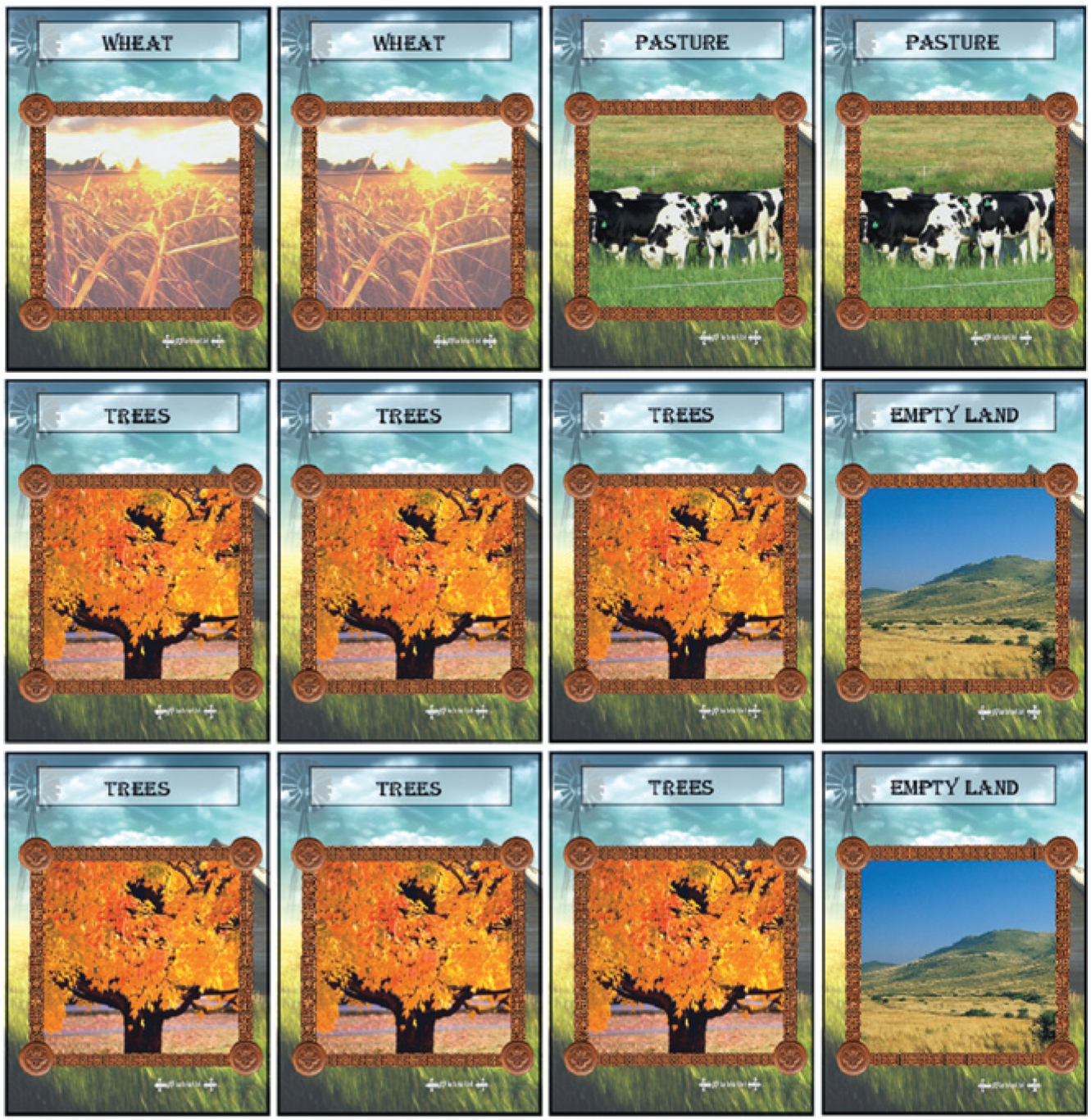
The commons cards in THE FARMERS.
With each turn, all three players at each table choose one of the following nine actions: harvest trees, harvest wheat, harvest pasture, plant trees, plant wheat, plant pasture, gain a point, restore eroded land, or sanction other players (see Figure 2). The goal of the game is to acquire points by harvesting beneficial resources (either trees, wheat, or pasture). The game lasts 30 rounds. With each round, the commons reacts to the actions of players. The key tension for players is between accruing points by developing land into farms and conserving land as forests in order to prevent environmental damage. A player’s score is computed by summing points earned by harvesting resources across the 30 rounds. In addition to valuing each crop differently, players also differ in their skills. Farmers A, B, and C harvest, plant, and cash in crops at different rates. Furthermore, they are often not the best at planting or harvesting the resources they most desire (see Figure 3). Thus, they are dependent on each other and must collaborate.
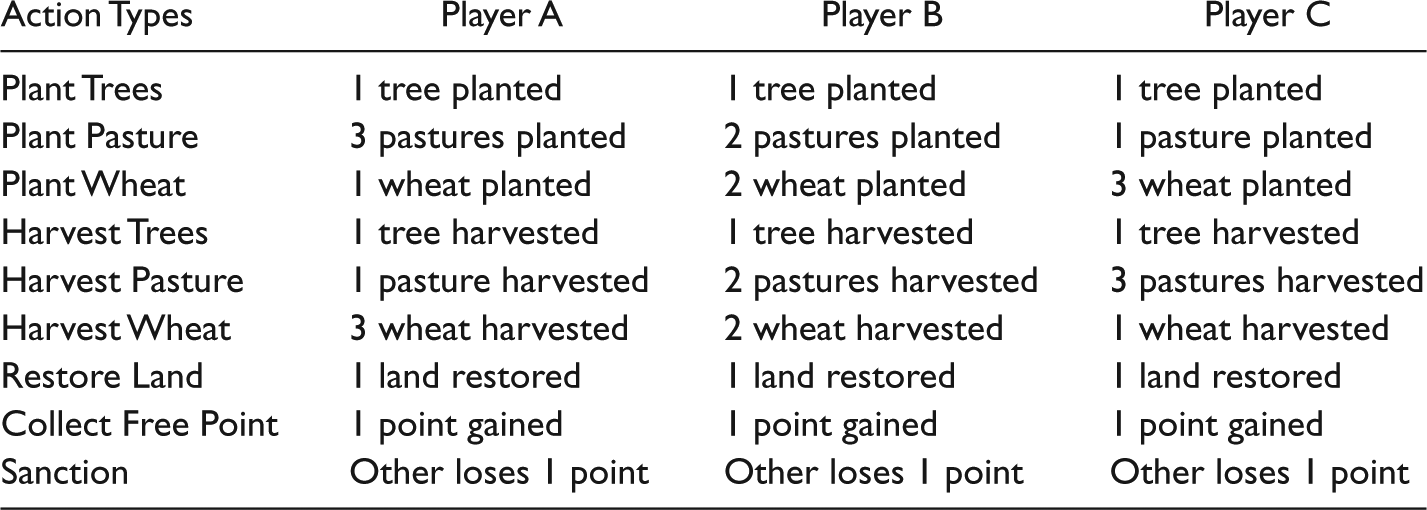
A player’s choices for each round of play in THE FARMERS.

The payoff matrix, the number of points each player receives for each unit of each resource harvest for each type of resource.
Players A’, B’, and C’ at the second table have identical skills and starting conditions to Players A, B, and C at the first table. Some players can harvest one crop better than others and others can plant crops that others can harvest (see Figure 2). Therefore, even though each player is different in ability from the other players at their own table, they can be fairly compared with the corresponding player at the other table who has the exact same abilities. A is only competing against A’, B against B’, and C against C’. We thus have three winners and three losers. However, players’ experiences are not one of pure competition, because players do not compete within their group. For example, even if Player A has a higher score than B and C, this does not result in Player A winning if A’ has a higher score than A. Nor is the gaming experience purely collaborative among players within a group, because players do not win just from being in the group with the higher total score. Because players are focused on doing the best for their own position, we term this the independent goals condition. Later in this article, we compare the independent goals condition with conditions in which players are told either to compete with members of their group (the competitive condition) or to compete as a group against the other group (the collaborative condition).
As shown later, the collaborative, competitive, and independent goals conditions lead to qualitatively and quantitatively different gaming experiences and outcomes for players. Collaborative and competitive conditions are inappropriate for climate change simulations because they suggest that either only one party can ever truly “win” and that all others fail, or they suggest that we all win or fail together. In climate debates, it is possible for half of the actors to succeed and the other half to fail. The independent goals condition more accurately reflects the fact that in real life, people and nations are not in zero-sum competition with other nations, trying to prevent them from doing well. Rather, each player, like nations and individuals alike, is usually simply trying to do the best she or he can for her or his own position. Having a counterpart helps players establish this mind-set and act more as they would in real life—where personal success is not contingent on the condition of one’s neighbors. The independent goals arrangement is particularly important for climate change games, because this independent goals condition does not encourage players to aim for pyrrhic victories.
THE FARMERS utilizes a very simple mechanism to represent unpredictable climate change. At the end of each round, a pair of six-sided dice is rolled. If the number rolled is greater than the number of trees in the commons, then environmental degradation occurs: Land in the commons is randomly selected to be degraded. Players are not able to use this degraded land until it is restored. Trees therefore protect against erosion and environmental damage. When too many trees are removed from the common resource pool, land is more likely to become destroyed, resulting in less land available for farming and thus lower scores for players. A social dilemma is present because it is in the best interest of the group to preserve trees in order to avoid environmental degradation, but players simultaneously have a personal incentive to remove trees from the commons in order to make room for lucrative crops and score points.
The design of THE FARMERS addresses our first two questions: “How can a game balance players with vastly different strengths, abilities, and win conditions?” and “What game mechanics can support play with independent goals that are neither zero-sum collaborative nor zero-sum competitive, in which players cannot force victories or ties by destroying the environment?” THE FARMERS focuses players on achieving independent goals in which they are neither inclined to be fully collaborative nor fully competitive with their neighbors using a two-group structure with paired opponents. Because of the strategic value in maintaining a number of trees and because the game grants certain players specializations (some players are particularly good at planting the crops that other players value), the game rules encourage cooperation because players must collectively maintain their commons sustainably to score more points than their opponents in the other group. However, because land itself is in limited supply, the game also encourages in-group competition for access to the land.
Experiments Using THE FARMERS and Its Variants
With this article, we introduce modifications to THE FARMERS in order to test our remaining two questions: “How do independent, collaborative, and competitive play conditions compare?” and “What is the effect of varying immediate, first-, and second-order delayed effects?” The original game has independent player goals and first-order delayed effects (environmental quality is a function of the presence or lack of trees, but one step removed because the actual degradation is a factor of both the trees and an intermediary die roll that represents the weather). Here we expand on both of these aspects. First, we make both immediate (zero) order delayed effect rules and second-order delayed effect rules. The immediate effect rules tie degradation of the commons directly to the number of trees (without a dice role). The second-order delayed effect rules further delay degradation of the environment using a system similar to greenhouse gas concentration buildup.
In addition to exploring the order effects, we build on our prior comparison of collaborative, competitive, and independent versions of the game (Fennewald & Kievit-Kylar, 2012). In that prior work, we found that independent player goals lead to gameplay patterns that are qualitatively very different from either competitive or collaborative goal conditions in both human playtests and computer simulations. This work repeats the findings of that prior study regarding the differences between collaborative, competitive, and independent goals and adds additional conditions to test for differences among immediate, first-, and second-order delayed effects as we explain below. Here we introduce eight new versions of the game, for a total of nine versions: collaborative goals immediate order effects, collaborative goals first-order delayed effects, collaborative goals second-order delayed effects, independent goals immediate order effects, independent goals first-order delayed effects, independent goals second-order delayed effects, competitive goals immediate order effects, competitive goals first-order delayed effects, competitive goals second-order delayed effects.
In our test, we modify the immediacy of cause and effect in these ways:
Immediate effect condition
In this condition, a die roll is subtracted from the number of trees. If this number is positive, that number of tree cards is removed from each player’s harvested tree collection (with no player being able to go negative). This directly affects the final score of each player.
First-order delayed effect condition
In this condition, a die roll is subtracted from the number of trees. If this number is positive, then that is the number of land degradations that occur. For each degradation, a (nondestroyed) land tile is randomly selected. If it has resource on it, it becomes empty land. If it is already empty, it becomes destroyed land. Land degradation indirectly affects the final score of each player: When devastation occurs, players lose land available for crops, their main source of points. In this first-order delayed effect condition, not having trees will not directly impact player scores, as in the immediate effect condition.
Second-order delayed effect condition
In this condition, a carbon counter tracks total atmospheric carbon concentration on a number line. The total value of carbon starts at zero. Each turn, a die roll is made. The number of trees is then subtracted from the die roll. This difference (positive or negative) is added to the carbon counter (values do not go below zero). A second die roll is then made. That second number is compared with the carbon counter value. If the value of the roll is less than the carbon counter, then the difference determines the number of degradations that occur. Thus, it is not the tree count that immediately affects degradations, but the carbon count, which itself was affected by the tree count in the past! In this way, this mechanic reflects a second-order delayed effect.
Furthermore, we compare gameplays with competitive, collaborative, and independent goals. The manipulations were as follows:
Competitive
Scores were compared between the three players at a game session (A vs. B vs. C). The player with the highest score relative to other players in the same game session wins.
Collaborative
Scores were compared between groups (A + B + C vs. A’ + B’ + C’). The cumulative score of all players at a game session was compared with the cumulative score of another game session. The group with the higher score wins.
Independent
Scores were compared between individuals of the same position, but in different game sessions (A vs. A’, B vs. B’, and C vs. C’). The player with the highest score of the pair wins. In the independent goal version, the two tables do not interact or exchange information, thus keeping the groups completely separate during gameplay.
Simulations and Playtests
Both computational simulations and human playtests of THE FARMERS and its variants were performed. That is to say, for both computational and human playtests, each of the nine conditions were run: collaborative goals immediate order effects, collaborative goals first-order delayed effects, collaborative goals second-order delayed effects, independent goals immediate order effects, independent goals first-order delayed effects, independent goals second-order delayed effects, competitive goals immediate order effects, competitive goals first-order delayed effects, competitive goals second-order delayed effects. Games each consisted of 30 rounds. In the collaborate and compete conditions, each game was conducted separately with no interaction between games. In the independent goals condition, games were paired and die rolls were shared between groups. In human playtests, players were able to learn their competitors’ score at any given time although the moves made and board layouts of the other games were unknown to opposing players.
Computational Simulations
Evolutionary algorithm simulations were used to determine how optimal strategies and game outcomes varied under the different game conditions. Evolutionary algorithm simulations are computational simulations that set up conditions in which artificial agents perform a simulation—in our case, play a game—using rules that are randomly defined prior to the simulation. For example, in our simulations of THE FARMERS, these artificial agents are assigned probabilities of choosing each of the nine possible actions: plant trees, plant forest, plant wheat, harvest trees, harvest forest, harvest wheat, restore land, gain a point, and restore land.
In a game that emphasizes independent goals, evolutionary algorithms are particularly appropriate because, just as in biological life, agents who are the most successful in their ecological niche will pass on their behavioral strategies. In the game, each agent has nine options. Therefore, in the simulation, we assumed that the optimal strategy for each agent would be a mixed strategy that combined these nine strategies. By mixed strategies, we mean that at the beginning of the simulation, a probability is randomly assigned to each of the nine options for every one of the agents. Then, during each of the 30 rounds, each of the three agents probabilistically selects one of the nine strategies based on the assigned probability. For example, one agent may be assigned a 10% chance of selecting “plant trees,” a 2% chance of selecting “harvest wheat,” a 30% chance of selecting “plant pasture,” and so on, but their counterpart in the other group may have different probabilities. At the end of the 30 rounds, strategies with the highest scores are noted. The next game is played between agents with the highest scoring strategies and agents with similar strategies. (These similar strategies are determined by slight random variations in the exact percentage of probabilities.) This process was repeated one million times. Over the course of one million games, the agents at first changed their strategies quickly, but eventually arrived at stable strategies. This evolutionary computational analysis is functionally equivalent to running one million human playtests in which players are not able to communicate or choose their own strategies, but rather are provided probability spinners or dice that determine their choices each round.
While this may be an unrealistic assumption for a globally optimal strategy, mixed solutions are commonly used in economic and educational models and provide feedback on strategy results (Russell & Norvig, 2010). Like us, other researchers of climate change have also used evolutionary computation to understand cooperation (Santos & Pacheco, 2010). A possible shortcoming of this approach is that players might wish to employ different strategies during different points of the game. To explore this potential problem, we also tried time-variant strategies in which agents were assigned different mixed strategies for different temporal blocks of the game. For example, the probability of selecting “plant trees” might be 0% in the first 10 rounds, 10% in Rounds 11 to 20, and 5% in Rounds 21 to 30. Although it might seem that this would return very different results, in reality, this produced nearly identical results to keeping probabilities the same for the entire 30 rounds. Readers may also note that the simulation would be more realistic if the artificial agents were programmed to adjust their strategy based on the conditions in the commons (e.g., to plant crops if ample empty land is available or to avoid harvesting trees if only a small number of trees are present). However, conditioning a player’s actions on the board configuration or on moves made by another player increases the genome size exponentially, and such techniques were considered impractical for implementation. While genetic programming with artificial intelligence that could adjust strategies based on conditions in the commons might also have been an option, the resulting strategies would have been difficult, if not impossible, to compare between conditions, and thus we opted for pure mixed strategies.
Fitness, or the ability to pass on genetic information to the next generation of artificial agents, was calculated differently for the three different types of gameplay. In the collaboration version, the fitness of each player was calculated as the sum of the scores of all players. In the competition version, the fitness of each player was his or her score minus the average score of the other two players. In the independent version, the fitness was just the score of that individual. The evolutionary algorithms were run until a stable state was achieved (between 50 and 100 generations). Because all conditions peaked at about this point, a static cutoff of 150 generations was chosen.
Computational Simulation Results
Even with such a simple representation, the agents still played quite differently across the versions. This is indicated on graphs of the scores for these algorithms seen in Figure 4 as well as the distribution of action selected at the end of the run for each player in Figure 5.
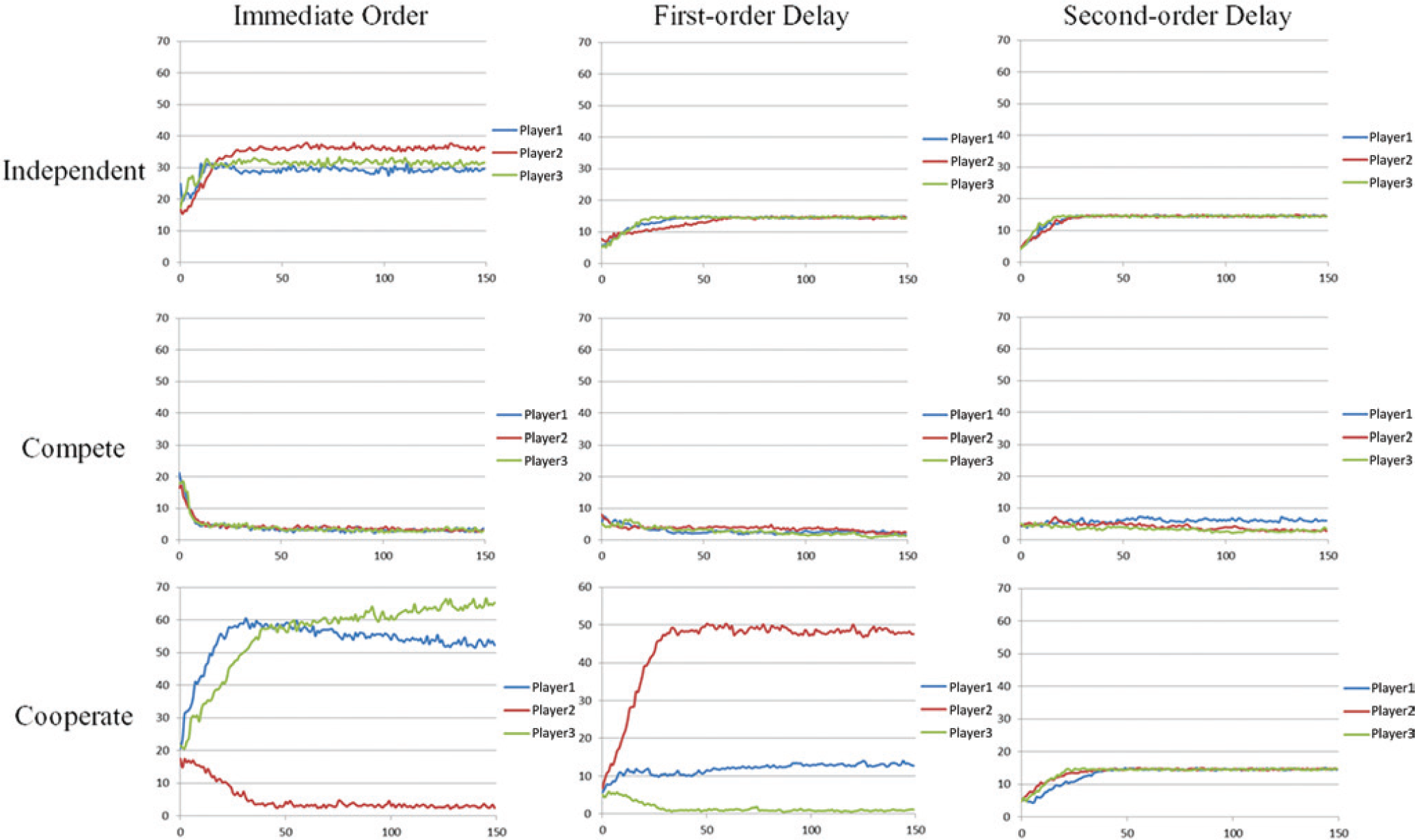
Score trace for all genetic algorithms.
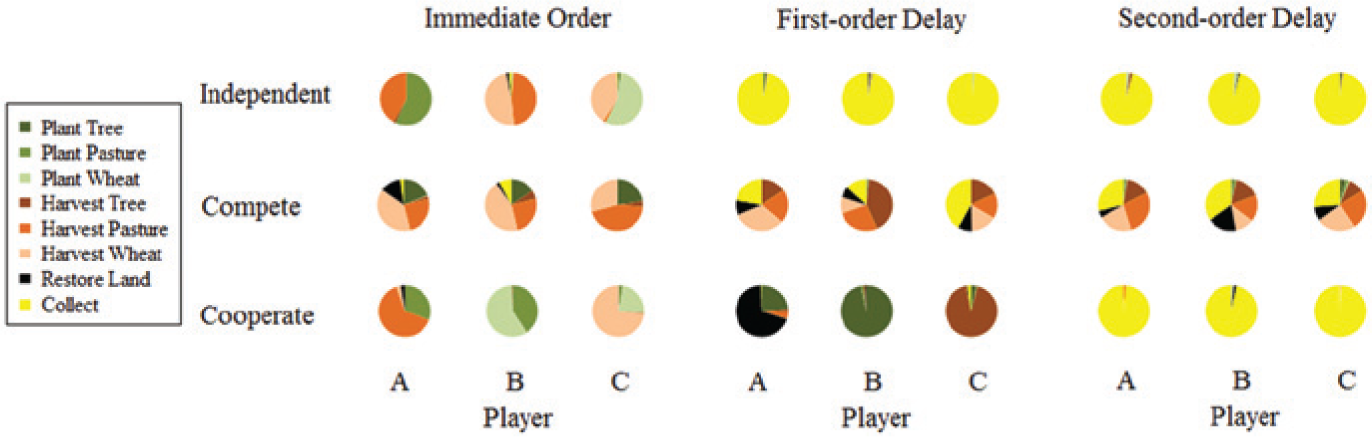
Final maximal mixed strategies for each condition.
Referring to Figures 4 and 5, we see that, as expected, the collaborative condition produced the greatest combined scores as well as the maximum individual player scores. Because some players are better at generating points than others, the optimal strategy in the collaborative game is for the player(s) with low payoffs to assist player(s) with higher payoffs, therefore raising the total score of the group. However, this contribution to total group score comes at the cost of the one or two individual players who play an assisting role. This makes the collaborative game the condition with the greatest difference between high and low individual scores. In the independent goals version, agents are evolved to optimize personal scores. The total number of points earned for the group is less than that in the collaborative rules condition, but on the other hand, points are distributed more equally among agents. In the competitive condition, points are also distributed relatively evenly, but agents all earn very low, even negative, scores.
When looking at the distribution of actions taken, we notice that the independent goals condition has a much stronger focus on playing the collect action (a nonharmful, but nonbeneficial action to the community as a whole). The compete version actually produces the most diverse agents who tend to play a variety of different action types. Collaboration leads to players who specialize in either planting or harvesting, but few that perform both action types.
Competitive game simulations regularly ended with the destruction of most of the land. Agents evolved selfish and punishing strategies that did not regard the commons simply to maintain a higher score than others. This is the only condition in which average player scores drop below their initial randomly assigned mixed strategy in the genetic algorithm. In the competitive condition, agents win as long as they do better—even if their world is destroyed. A pyrrhic victory, however, is not a real victory in the independent goals game, so agents in the independent goals game evolve cooperative strategies. This shows the independent and competitive conditions to be distinct.
The greater the difference between action and effect, the more likely players are to use the harvest action, ignoring the common pool and taking personal advantage of a pooled resource. Playing with delayed effects, agents more often allowed conditions to emerge that resulted in a tragedy of the commons. As expected, the first- and second-order delayed effect conditions caused some of the players to use their repair land cards (a somewhat “altruistic” action that is actually counterproductive under the first condition). Players managed the commons most sustainably in the immediate effect condition.
Of some special note is the difference between the immediate and first-order collaborative conditions. The score results are reversed in these two conditions. In immediate effect conditions, Players A and C score large points on the back of Player B and in the first-order condition, the roles are reversed. Player B is the generalized player, scoring fewer points for any individual payoff, but the same collectively (see Figure 3).
Human Playtest and Results
Human playtests were conducted with adults above the age of 18 who were provided rules prior to playing. For each condition, at least two groups played the game, and for some conditions, particularly the first-order conditions, the testing was repeated up to 10 times to establish a base line. Analysis of these games included direct observations during play, recording and transcription analysis, and postgame interviews. These playtests revealed similar play styles, strategies, and outcomes for each of the nine conditions to those seen in the computational simulations, and corresponding differences in player communication were also observed. In competitive conditions, players did not communicate much and resorted to frequent sanctioning. Occasionally, weaker players in the competitive condition teamed together to harm a more successful rival, but otherwise communication and coordination of efforts was minimal. Competition was fierce across all three delayed order effects and players did not play very differently or talk much about the environment, aiming to simply harvesting as much as they could before all land was destroyed. When players did talk, they occasionally tried to organize others to play cooperatively. Sometimes this tactic was genuine, and other times it involved deception and lying, inspiring comments such as, “He just broke our trust.” Quite amazingly, however, in one instance during competitive play, a player in the lead agreed to plant trees, but only because he was already in a guaranteed position to win. This particular action came following the appeal, “There’s no way that you’re not going to win and (by not planting a tree) you’re just risking it for all of us,” implying that the players still wanted to avoid collapse out of pride, even if they could not win. Of the competitive game variants, the second-order condition was the most interesting to watch, with planting and harvesting continuing up until the game devolving into a sudden and irreversible one-turn collapse. The players, fearing the unknowable second-order effects, often played less risky at first. However, after a few turns with no punishment, they quickly became riskier in their tactics, leading to the sudden collapse.
In collaborative conditions, players took turns, asked for help, shared, used “us” and “them” language, and saw their group as a team whose primary objective was to compete with the other group. In the collaborative condition, groups almost always tried to calculate a way to attain the highest possible score for the group, players would assist the players who stood to gain the most points, and the teams often tried hard to maximize land use against the probability of the die rolls. Occasionally, players argued about how much land was safe to use as farmland. This was especially the case in the second-order delayed effects condition, where some players were surprised by sudden impacts on the environment resulting in “I told you so” style comments from other team members.
More than in the other conditions, playtests of the independent goals versions showed a wide range of play styles. Occasionally, players in the independent goals variants even chose to sacrifice points by using their turns to help others instead of harvesting. At other times, a player would act selfishly, and so the other players occasionally, but not always, sanctioned the player in response. Some of the players used charisma and threats to manipulate others. Some groups were very aware of the need to work as a group in order to avoid environmental degradation from the beginning, and prior to the first turn, did extensive planning on how to manage the commons sustainably. Other groups did not talk about the sustainability of the commons even until the very end. Most often, however, players learned and reacted throughout the game, bargained, and took turns to see who would be responsible for foresting, who would be able to harvest, and who would plant the next crop. Many groups even tried to calculate fair distribution of resources and balance the risk of land use. The typical number of trees per turn in the independent goals version was in-between that seen in the collaborative and competitive conditions, but typically much more like that seen in the collaborative condition. Groups who were less talkative and spent less time planning ahead tended to be harsher on the environment, with play more closely resembling competitive play, whereas the most talkative groups were the most protective of the environment, maintaining eight, nine, or even more trees on the board at a time (even though this was often not a winning strategy). Often the most talkative groups worked out complicated and explicit systems of turn-taking even prior to the start of the game to decide how to manage the land. These groups were also the most proactive and reactive to the carbon counter in the second-order conditions.
Players of the independent goal versions of THE FARMERS stated that they were constantly emotionally torn between the need to work as a team and to protect their own personal interests, while players of the collaborative and competitive variants focused solely on their collaborative or competitive goals, respectively. Exit interviews suggest that even players who were not environmentally sustainable and who failed to coordinate reforestation generally did understand the needs of the commons, but were distracted by the competing motivations of the social dilemma in which the need to increase one’s personal score was perceived as more immediate. This delayed effect was especially exacerbated in the independent goals condition with second-order delayed effects. In this condition, some players were genuinely surprised when environmental degradation took effect after they had become accustomed to having few trees. As a general rule, players better understood the immediate and first-order delayed effect variants. Many players were taken aback—at least initially—by the second-order variants and remarked that they would have played differently had they better understood the second-order nature of the system dynamics involved.
Conclusions
In this article, we provided THE FARMERS as evidence that it is possible to create a climate change game that simultaneously presents second-order delayed effects as seen in climate change science and also diverse agents with different goal conditions who interact in a common pool resource dilemma that may result in a tragedy of the commons as seen in climate change politics. Human playtests and computational simulations of THE FARMERS suggest that providing players with independent goals results in play that is qualitatively different from collaborative and competitive gameplay, with players acting in a range of ways that include both self-preservation and altruistic turn-taking, even coming from the same player during the same game. These playtests and simulations also suggest that the delayed effect mechanics lead to player confusion, disagreement, and increased likelihood of environmental degradation. The more delayed the effect, the less players were able to coordinate their efforts. The same was true for the simulations. However, these second-order delayed effects had little impact on purely competitive gaming because in competitive gaming, players were willing to settle for pyrrhic victories. In contrast, delayed effect mechanics have more substantial impact on collaborative and especially independent goals gameplay. The greatest impact of second-order delayed effects on independent goals was likely due to players’ focus on keeping pace in attaining points and putting off or forgetting about the buildup of carbon. Because the second-order independent goals condition, which most accurately represents real-life climate change, plays so differently from the other conditions, designers of serious games about climate change may wish to consider using independent (and nonzero sum) goals and delayed effect mechanics within their game designs as these games lead to different, and more life-like gaming experience.
Footnotes
Acknowledgements
This work would not have been possible without the support and time of many playtesters and colleagues who have brainstormed with us, particularly David Phelps and Edward Castronova. Nor would it have been possible without Klaus Eisenack, who encouraged this particular study to move forward and who worked with us patiently throughout the manuscript development process. Finally, a very special thanks goes to Sharon Lindenfeld, whose many hours editing, playtesting, and providing ears to listen was invaluable to this work becoming a reality.
Declaration of Conflicting Interests
The authors declared no potential conflicts of interest with respect to the research, authorship, and/or publication of this article.
Funding
The authors received no financial support for the research, authorship, and/or publication of this article.
Notes
Author Biographies
Contact:
Contact: