






Abstract
Background
This study aims to describe the development and testing stages of a prototype solution with gamification elements designed to raise awareness of the barriers faced by individuals with mobility impairments in their homes.
Methods
A user-centered design approach was adopted, incorporating insights from a prior systematic review to establish requirements that integrated gamification elements. Emily’s Journey was developed in C# using the Unity3D game engine, followed by usability testing to assess its usability and user perceptions.
Results
Usability testing indicated that Emily’s Journey was perceived as useful for identifying accessibility barriers and supporting awareness. Participants provided high scores on the System Usability Scale (SUS ≥ 70,3), suggesting that the game was engaging. Feedback suggested that the game may support awareness of accessibility barriers.
Conclusions
This study successfully demonstrated the potential of gamification in addressing home mobility barriers for individuals with limited mobility. The findings contribute valuable insights into the application of gamification in technology, paving the way for future innovations in creating more accessible and inclusive living spaces.
Introduction
According to the World Health Organization WHO, (2023), approximately 1.3 billion people live with significant disabilities, representing around 16% of the global population, or one in every six individuals. The prevalence of motor impairments is expected to increase, not because healthcare contributes to greater disability, but rather due to advances in treatment and survival following traumatic injuries, reduced neonatal mortality, and population aging, which allow more individuals to live longer with chronic conditions that affect mobility (Allen et al., 2006; Villarreal Laguna et al., 2024). As medical advancements and an aging population contribute to increasing mobility impairments, technologies such as 3D printing and robotics drive the development of assistive devices, essential for more than 2.5 billion people worldwide, improving functional independence and well-being (Carnemolla & Bridge, 2019; Villarreal Laguna et al., 2024; Willems et al., 2022; World Health Organization, 2024), while also highlighting certain barriers (Carnemolla & Bridge, 2019; Villarreal Laguna et al., 2024).
The definition of disability is complex and dynamic, reflecting multiple dimensions of the concept through the interaction between individual impairments and environmental and social barriers that may limit full and effective participation in society (Babik & Gardner, 2021; Kołłątaj et al., 2023). A physical and/or mental limitation prevents a person from independently fulfilling essential needs for a normal individual and social life, potentially affecting various vital functions, including cognition, mobility, vision, hearing, behavior, among many other areas (Babik & Gardner, 2021; Mishra et al., 2019; World Health Organization, 2022). Disability is the product of a complex relationship involving an individual’s health condition, personal factors, and external circumstances that reflect the environment in which they live (Kołłątaj et al., 2023). The manifestation of a disability as incapacity is influenced not only by the severity of the health condition but crucially by the individual’s ability to engage in social contexts, which is significantly shaped by environmental barriers and support systems (Babik & Gardner, 2021; Kołłątaj et al., 2023).
In cases of mobility impairments, when they occur, barriers arise in daily tasks that were previously taken for granted (Villarreal Laguna et al., 2024). Simple activities such as opening doors, bathing, and climbing stairs can become challenging, requiring significant effort or even being impossible to perform without assistance (Aitken et al., 2020; Allen et al., 2006; Eriksen et al., 2015).
Accessibility and home modifications are essential to mitigating the difficulties faced by individuals with mobility impairments in their environment (Allen et al., 2006; World Health Organization, 2022). Although discussions about aging and disability may be uncomfortable, it is crucial to recognize that these are experiences that everyone will eventually face (Aitken et al., 2020). Addressing these issues proactively can contribute to fostering a culture that values well-being and autonomy at all stages of life (Villarreal Laguna et al., 2024).
Given the increasing prevalence of mobility impairments and the challenges they impose on daily activities, it is essential to develop innovative solutions to raise awareness of the importance of accessibility and necessary adaptations in the homes of individuals with motor limitations.
One such innovative approach is gamification, which has shown great potential in various fields to enhance user engagement and motivation (Castellano-Tejedor & Cencerrado, 2024). Gamification refers to the use of game elements and mechanics in non-game contexts to encourage engagement and promote behavioral and cognitive changes (Castellano-Tejedor & Cencerrado, 2024; Cheng & Ebrahimi, 2023; Villarreal Laguna et al., 2024). The main elements of gamification include points to quantify progress, continuous feedback to guide objectives, leaderboards to stimulate competition, badges and achievements as rewards, social networks to encourage collaboration, progress bars to visualize stages, interactive tutorials for familiarization, and challenges to engage users in task completion (Villarreal Laguna et al., 2024).
In the healthcare context, gamification has emerged as a powerful tool, driving patient engagement, improving treatment adherence, and influencing attitudes (Araújo et al., 2024; Fernandes et al., 2018, 2022a, 2022b, 2024; Gonçalves et al., 2024a, 2024b). These examples highlight the transformative potential of gamification in addressing health-related issues (Araújo et al., 2024; Castellano-Tejedor & Cencerrado, 2024; Cheng & Ebrahimi, 2023). However, its application in raising awareness of mobility barriers in home environments remains underexplored (Villarreal Laguna et al., 2024).
This study aims to describe the development and testing stages of a prototype solution with gamification elements designed to raise awareness of the barriers faced by individuals with mobility impairments in their homes. To this end, it compiles specific adaptation techniques of gamification to increase awareness and improve home mobility for individuals with motor limitations, a crucial topic given the need to create more accessible and inclusive environments.
Methods
Study Design
The design approach of this study follows an exploratory and iterative methodology based on user-centered design principles for the development of a game prototype (Lopes et al., 2018; Pagulayan et al., 2003). The project began with a comprehensive review of the context, previously published (Villarreal Laguna et al., 2024), resulting in the definition of literature-based requirements that served as the foundation for the tool’s development. This methodology followed the stages of requirement definition, prototype development, and usability testing (Lopes et al., 2018). The adopted approach is iterative, incorporating an initial prototype, continuous user feedback collection, and usability testing. Through this process, new requirements can be identified and implemented to refine the solution until a model that meets users’ needs is achieved.
Requirement Definition
Previous literature reviews have identified the need for gamified solutions that enhance awareness of accessibility barriers within the home environment, highlighting the importance of developing innovative tools to address this challenge (Villarreal Laguna et al., 2024).
However, despite the growing use of gamification in health and rehabilitation contexts, existing technological approaches in this field remain largely focused on motor training, exergames and functional recovery (Fernandes, Magalhães, et al., 2022; Willems et al., 2022), rather than on educating users about environmental accessibility issues (Aldersey et al., 2018; Villarreal Laguna et al., 2024).
This gap reinforces the innovative nature of the present prototype, which aims to promote critical reflection on how home environments may constrain autonomy and participation among individuals with reduced mobility (Chi et al., 2023; Tzeng & M, 2019). To address this gap, the selection of gamification elements, namely points, progressive challenges, continuous feedback, and rewards, was guided by evidence demonstrating their potential to enhance engagement, motivation, and behavior change in health-related contexts (Castellano-Tejedor & Cencerrado, 2024; Cheng & Ebrahimi, 2023; Fernandes et al., 2018).
Based on this analysis, four essential requirements were defined to guide prototype development: (1) intuitive controls to ensure easy interaction with the game environment; (2) an accessible and user-friendly interface to support engagement; (3) the integration of gamification elements, such as points, rewards, and progressive challenges, to reinforce motivation; and (4) the representation of real home accessibility barriers and corresponding solutions faced by individuals with mobility limitations.
Prototyping
The prototype was developed using Unity3D, a platform chosen for its specialized tools for creating educational and interactive games. The game’s logic is not centered on the main character but rather on interactive objects, which can modify statistics, trigger mini-games, or require prerequisites to simulate realistic action sequences. The mini-games are activated by an invisible 2D layer, becoming visible when triggered. They simulate accessibility challenges, demonstrating how object modifications can facilitate interaction.
The initial version included basic mechanics, character statistics, time limits, and objectives to encourage player engagement. The environment was designed to reflect real-life situations, aiming to enhance awareness and understanding of accessibility and inclusion. The tool is not only intended for individuals with disabilities but also for those without disabilities to raise awareness, as well as for individuals involved in building or renovating homes to make them more accessible.
Evaluation Strategy
The evaluation phase is essential for testing usability and user satisfaction. The process involved testing with a diverse audience, followed by the administration of a questionnaire to collect both qualitative and quantitative feedback. The questionnaire comprised four sections: demographic data, overall user experience, interface usability, and qualitative evaluation. The System Usability Scale (SUS) (Brooke, 1996; Martins et al., 2015) was used to assess system usability through 10 standardized items. This instrument was originally developed by Brooke (1996) and later translated and validated for the Portuguese population by Martins et al. (2015). Responses were recorded on a 5-point Likert scale (1 = strongly disagree to 5 = strongly agree), in accordance with the original SUS format. Scoring followed the standard procedure: for odd-numbered items, 1 was subtracted from the response value, and for even-numbered items, the response value was subtracted from 5. The total score was then multiplied by 2.5, resulting in a final score ranging from 0 to 100, where higher scores indicate better usability.
For the development and testing of the prototype, the SUS was used as the primary usability assessment tool. Although widely recognized as a robust and reliable instrument, it does not capture additional dimensions such as immersion, playability, or overall user experience. These aspects will therefore be considered in future evaluations of the game, along with its broader impact.
The questionnaire, which included the System Usability Scale (SUS) and open-ended questions, was administered to participants via an online form hosted on the Office 365 platform. A convenience sampling approach was used, with the survey link distributed to 15 participants, of whom 8 completed the questionnaire.
Quantitative data were analyzed using descriptive statistics to summarize participants’ sociodemographic characteristics and the results obtained. Open-ended responses were analyzed through content analysis, involving systematic review, coding, and grouping of responses into themes reflecting participants’ perceptions of accessibility barriers, educational value, emotional engagement, and suggestions for improvement.
Ethical Considerations
The study received ethical approval, ensuring that participants were properly informed about the objectives and purpose of the research while guaranteeing the confidentiality and anonymity of the collected data.
Prototype Game
The prototype game Emily´s New Journey is an educational game designed to raise awareness about the barriers faced by individuals with reduced mobility in home environments. It was developed to promote a sense of empowerment and motivation as players progressively overcome accessibility challenges presented throughout the game. Through a gamified approach, players experience the daily challenges encountered by individuals with motor disabilities and learn about accessible solutions. The game’s main title screen and navigation can be observed in Figure 1 (Figure 1(a)–(c)). The prototype game Screenshot
Narrative
After an accident, the game begins using a wheelchair and realizes that her once-comfortable home is now filled with obstacles. Determined to regain her independence, she identifies barriers and implements adaptations to improve the accessibility of her living space. This journey is translated into game mechanics that simulate real-life situations, allowing players to explore challenges and solutions for creating a more inclusive environment.
Game Structure
The prototype game is structured into “days,” each consisting of two phases: the main phase and the upgrade phase.
In the main phase, the player must complete objectives within a time limit by interacting with objects in the house and selecting actions from the menu. When clicking on a listed object, an action menu appears, detailing possible interactions. When the character approaches the object, a mini-game (Figure 2) is activated, simulating barriers faced by individuals with reduced mobility. “Emily’s New Journey” mini games example
In the upgrade phase, following the main phase, the player can select up to three objects to improve, making them easier to use and reducing the character’s stress levels. The interface changes, removing the character and allowing the player to choose which elements of the house to modify. After each upgrade, the mini-games become more accessible, and messages appear explaining the initial barrier and the solution implemented.
Game Mechanics
The game incorporates systems that directly influence gameplay and user experience, specifically the Stress and Energy System and Object Interaction. Whenever Emily interacts with an inaccessible object, her stress and frustration levels increase. While frustration decreases over time, stress remains until the end of the day. Emily’s energy also gradually depleted. The player’s performance is evaluated based on these parameters (Stress and Energy System), and the game ends when stress is low, and energy levels are sufficient to keep Emily active.
To interact with objects, the player simply clicks on the desired object, displaying an action menu in the upper-right corner of the screen. After selecting an action, Emily automatically moves to the object, triggering a mini game.
Mini-Games and Learning
The game features a total of ten mini-games, each designed to simulate challenges faced by individuals with motor disabilities (Figure 2). Below are the names and descriptions of the mini games: − Refrigerator Minigame – Simulates the difficulty of reaching items on the upper shelves of a refrigerator for wheelchair users. − Cutting Minigame – Represents the challenge of cutting food on a counter that lacks adequate space for leg accommodation. − Cooking Minigame – Demonstrates the difficulty of cooking when utensils and stove controls are not accessible. − Dish Washing Minigame – Shows the barriers to washing dishes when the sink is too high or lacks space for wheelchair access. − Washing Machine Minigame – Simulates the difficulty of using a top-loading washing machine. − Closet Minigame – Represents the challenge of reaching and organizing clothes inside a tall wardrobe. − Bath Towel Minigame – Highlights the difficulty of reaching towels on high racks in the bathroom. − Toilet Minigame – Simulates the obstacles of using a toilet without proper support bars for safe transfers. − Tub Minigame – Demonstrates the challenge of entering and exiting a bathtub without grab bars. − Stairs Minigame – Represents the barrier faced by wheelchair users when encountering stairs without ramps or elevators.
Impact of Improvements
When an object is upgraded during the Upgrade Phase, the corresponding mini game becomes easier, demonstrating how small changes can significantly enhance environmental accessibility. Additionally, the player receives explanations about each improvement, supporting awareness of architectural barriers and viable solutions.
Results
Game Evaluation
A comprehensive evaluation of the game was conducted through an online questionnaire, focusing on usability, user experience, and interface, to obtain qualitative and quantitative insights into usability and user perceptions.
Participants’ Characteristics
Partcipants’ Characteristics
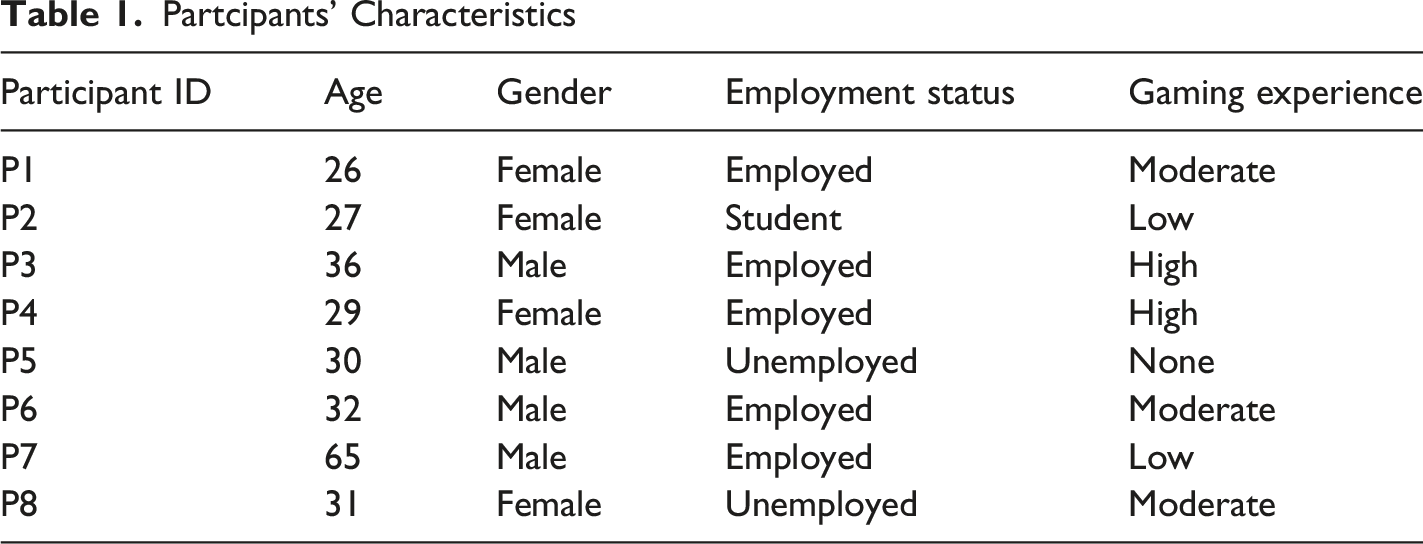
The participants had diverse employment statuses: two were unemployed, one was a student, and five were employed. Only one participant reported knowing someone who uses accessibility adaptations. None of the participants identified as having a disability.
Regarding gaming habits, one participant played video games daily, while two played multiple times per week. Three participants played at least once a week, and two played rarely.
Evaluation of Emily’s New Journey
System Usability Scale (SUS) Score

In addition to usability evaluation with the SUS, open-ended questions were used to gather qualitative insights and subjective feedback. These questions ranged from general thoughts about the game to technical aspects such as controls, user interface, and other components.
Summary of Participants’ Qualitative Responses

Awareness of Accessibility Barriers
Participants reported an increased awareness of how home environments can pose challenges for individuals with reduced mobility. One participant stated that “barriers exist in the simplest parts of our homes, even without us realizing it. It would be difficult for me to live in my own house.” Another emphasized that although the game was set in a domestic context, it encouraged reflection about accessibility challenges in other spaces, such as “streets, parks, or even at my own workplace.”
Educational Value
They also highlighted the novelty and relevance of the game’s educational purpose, acknowledging its potential to promote learning about accessibility. As one participant noted, “the biggest source of learning for me today was this game. An excellent package for such an important and detailed message.”
Empathy and Emotional Engagement
Emotional engagement and empathy were further reported, particularly when players supported the character in becoming more autonomous. The sense of progression was perceived positively: “The mini games that started on day 2 were fun, and the fact that they became easier over time showed how the character was getting more comfortable at home.” Another participant valued the challenge itself, explaining that “it’s tricky to grasp the movement dynamics of someone with different abilities, but that was one of the things I liked most.”
Suggestions for Improvement
Despite the overall positive reception and a mean engagement score of 4.25 out of 5, participants identified areas for improvement, including issues related to controls, camera movement, and the difficulty level of certain mini games. They also suggested that the interface could appear more professional and that instructions could be clearer, indicating important refinements for future iterations.
Discussion
The study “Emily’s New Journey” successfully achieved its objective of describing the development and testing phases of a prototype solution incorporating gamification elements to raise awareness about mobility barriers in home environments. The Emily’s New Journey prototype employed gamification elements combined with practical scenarios to create an educational and engaging experience. This approach is supported by previous studies highlighting the potential of gamification in promoting education and behavioral change across various contexts, including health and education (Castellano-Tejedor & Cencerrado, 2024; Fernandes et al., 2018, 2022a, 2024; Villarreal Laguna et al., 2024).
The game Emily’s New Journey was designed to allow users to experience the daily challenges faced by individuals with reduced mobility, fostering a deeper and more empathetic understanding of the numerous difficulties they may encounter (Allen et al., 2006; Carnemolla & Bridge, 2019; Villarreal Laguna et al., 2024). According to the World Health Organization WHO, (2023), approximately 1.3 billion people live with some form of disability, underscoring the critical importance of accessibility and inclusion awareness. Despite the recognized significance of accessibility, home modifications are often only prioritized when necessary, emphasizing the need for strategies that effectively communicate the benefits of such improvements (Villarreal Laguna et al., 2024).
Gamified tools, such as virtual simulations and applications, are essential for facilitating the visualization and planning of accessible home modifications for individuals with disabilities, optimizing their implementation (Tzeng & M, 2019; Aldersey et al., 2018; Chi et al., 2023). By developing user-centered gamified applications (Villarreal Laguna et al., 2024), as demonstrated in this study, designers can contribute to the development of tools that support improvements in home environments for people with disabilities (Villarreal Laguna et al., 2024; Tzeng & M, 2019). Regarding the evaluation of Emily’s New Journey, usability testing demonstrated how users understood the themes and challenges faced by people with disabilities after playing the game. Participants expressed enjoyment in immersing themselves in the perspective of a wheelchair user and found the gameplay engaging. However, they also experienced frustration in certain parts of the game, an important aspect of fostering empathy but also highlighting the need for better balance in difficulty.
In terms of usability, the SUS score obtained was 70, indicating above-average usability but revealing substantial room for improvement, particularly in balancing the difficulty of the mini-games. All participants appreciated the concept and gained increased awareness of the topic, providing positive feedback that can inform future work. Participants agreed that the game helped them identify unfairly designed spaces and barriers for individuals with mobility impairments. However, because SUS only evaluates perceived usability, it does not capture important aspects of the gameplay experience such as immersion, engagement and emotional involvement, which should be assessed in future evaluations.
Some participants even acknowledged that the game helped them recognize obstacles in their own homes and other environments they frequent, such as workplaces or public spaces. By simulating realistic accessibility challenges, the game effectively enabled users to recognize and empathize with the daily obstacles faced by people with mobility disabilities (Aitken et al., 2020; Villarreal Laguna et al., 2024).
By immersing players in interactive scenarios that simulate accessibility challenges, the game promotes greater empathy and understanding. Through engaging gameplay mechanics and well-thought-out narrative elements, it effectively educates players on the everyday obstacles encountered by individuals with disabilities. These approaches can heighten awareness and encourage active participation in efforts to promote inclusion and accessibility across various environments (Tzeng & M, 2019; Chi et al., 2023).
The feedback aligns with previous studies indicating that gamification can effectively transform perceptions and raise awareness of complex issues (Aldersey et al., 2018; Araújo et al., 2024; Castellano-Tejedor & Cencerrado, 2024; Cheng & Ebrahimi, 2023; Chi et al., 2023). By placing players in scenarios that simulate accessibility challenges, Emily’s New Journey provides a robust platform for raising awareness about the barriers individuals with mobility impairments face within their living spaces.
The work developed aligns with the theoretical foundations presented in the Introduction, where gamification is described as a strategy capable of enhancing motivation and promoting behavioral change in learning contexts (Castellano-Tejedor & Cencerrado, 2024; Fernandes et al., 2018, 2024; Villarreal Laguna et al., 2024). The increased reflection demonstrated by participants regarding accessibility barriers also reflects the principles of experiential learning, which emphasize the role of meaningful interaction in developing empathy and enhancing understanding of the real challenges faced by individuals with reduced mobility (Allen et al., 2006; Carnemolla & Bridge, 2019). Furthermore, the prototype design follows recommendations in the literature advocating for inclusive, user-centered technological solutions that support accessibility and home adaptation (Tzeng & M, 2019; Chi et al., 2023). Despite these encouraging findings, further evaluations are required to incorporate a broader set of metrics, including measures of immersion and player experience, as well as larger and more diverse samples, to assess generalizability and medium-to long-term impact.
Limitations
The study presents several limitations. It is important to highlight that no pre- and post-intervention measures were used to objectively assess changes in awareness, learning, or empathy; therefore, the conclusions are limited to perceived impact based on participant feedback. The study was also constrained by sample size and time limitations. The small number of participants may limit the generalizability of the findings, and future studies should include larger and more diverse samples, comparing results between individuals with and without mobility impairments.
Additionally, time constraints restricted the implementation of more extensive and iterative testing cycles. These limitations underscore the importance of rigorous planning and the allocation of adequate resources in the development of user-centered technological solutions (Pagulayan et al., 2003).
Conclusion
This study outlined the development and testing phases of Emily’s New Journey, a game designed to raise awareness about the mobility barriers faced by individuals with disabilities in their homes. The prototype represents a promising advancement in the use of gamification to address significant social challenges, such as mobility barriers for people with disabilities.
The study provides a solid foundation for future research and practical applications, suggesting that gamification can play a crucial role in education and raise awareness about inclusion and accessibility. It highlights the importance of a user-centered methodology in the development of such tools. Collaboration between game developers, healthcare professionals, and disability communities is essential to creating solutions that are not only technologically advanced but also deeply aligned with the real needs of users.
The practical applicability of this prototype is broad, as it can be integrated into formal educational settings, community awareness initiatives, and professional training in fields such as healthcare, architecture, design, and accessibility. Additionally, the flexible structure of the game enables future scalability, either by expanding scenarios, incorporating new types of barriers, or adapting the experience to different profiles of functional limitations. Future research should further investigate the medium- and long-term effects of this approach on attitude and behavior change, as well as include larger and more diverse samples, particularly individuals with mobility limitations, allowing the evaluation of the prototype’s effectiveness in real-world contexts and supporting the optimization of both gameplay experience and educational impact.
Footnotes
Acknowledgement
The authors would like to express a special acknowledgment to Hugo, the son of one of the authors of this study. During the development of this project, it was not anticipated that he himself would come to face challenges resulting from a hemorrhagic stroke caused by an aneurysm, including accessibility barriers, stigma, and prejudice. His strength, resilience, and daily determination reinforce the importance of promoting a truly inclusive society and inspire the continuous improvement of solutions that foster awareness and social change.

Informed Consent
Electronic informed consent was obtained from all participants prior to data collection. Participants were provided with detailed information regarding the study objectives, procedures, the voluntary nature of participation and confidentiality. By proceeding to the online questionnaire, participants indicated their informed consent to participate in the study.
Author Contributions
LV: Resources, Software; Formal analysis, Investigation, Methodology, Project administration, Validation, Writing – original. MJC: Conceptualization, Formal analysis, Supervision, Investigation, Methodology, Writing – review & editing. MCF: Conceptualization, Formal analysis, Supervision, Investigation, Methodology, Writing – review & editing. CSF: Conceptualization, Formal analysis, Supervision, Investigation, Methodology, Writing – original draft, Writing – review & editing.
Funding
The authors received no specific grant from any funding agency in the public, commercial, or not-for-profit sectors for this research. The authors received no financial support for the research, authorship, and/or publication of this article.
Declaration of Conflicting Interests
There were no conflicts of interest related to the study. The authors are solely responsible for the content and writing of the paper. The authors report no conflicts of interest.