







Abstract
Three focus groups were conducted with residential construction workers from local New Jersey labor organizations to characterize barriers to fall protection use among residential construction contractors who work for companies with fewer than ten employees. Thirty-six residential construction workers volunteered to participate, the average age was thirty-nine years, and twenty-four (67%) were of Hispanic origin. Twelve (33%) of the participants reported having fallen from greater than 6 ft at work and twenty (56%) of the participants had known someone who has fallen from greater than 6 ft. Sixteen (44%) had not been provided with fall protection equipment by their employer and eighteen (50%) reported their current employer had not provided workplace safety training. Factors that created barriers to use of fall protection equipment such as equipment availability, employee/employer relationships, cultural differences, and company size were identified. Results from this study confirm that falls remain a concern among residential construction workers in small companies.
Introduction
Many workers in the United States are regularly exposed to fall hazards. According to the Occupational Safety and Health Administration (OSHA), 1 of the 4188 work-related fatalities in private industries in the United States in 2011, 738 (17.6%) were in the construction industry. Falls were the leading cause of death in the construction industry, followed by electrocution, struck by object, and caught-in/between. The Bureau of Labor Statistics reported that 666 workers died in the United States due to falls, slips, or trips during 2011. 2 About 541 of the fatal falls occurred from higher levels, 115 occurring from 10 ft or less.
In New Jersey, there were a total of 99 fatal occupational injuries in 2011, twenty-one (21%) of which were in the construction industry with six being due to falls, slips, or trips. 3 There were an estimated 270 nonfatal injuries in the construction industry due to falls in New Jersey in 2011. One-hundred thirty (48%) of these cases ranged in age from 25 to 34 years, 130 (48%) were White, and all cases were men. One-hundred eighty (67%) of these were falls to lower levels. Seventy (26%) of the cases either tripped or slipped, resulting in falls on the same level. 4
Foreign-born workers may be more likely to be employed in jobs/positions in more dangerous work environments. 5 Hispanic workers make up a large part of the construction workforce in the United States. According to the U.S. Department of Labor, Hispanics accounted for one in four construction workers in the United States in 2012. 6 The percentage of civilian employment by Hispanic Origin in 2010 was 18.7 in New Jersey and 14.3 in the United States. 7 Dong et al. found that Hispanic construction workers were more likely to suffer a fatal injury than White, non-Hispanics (OR = 1.48, 95% CI: 1.05–2.10). It was also found that immigrant Hispanic workers were more likely to experience a fall, 5.5 per 100,000 full-time employees, which was significantly higher than Hispanics born in the United States, 4.1 per 100,000 full-time employees. 8
There are more than 45,000 construction companies (NAICS 23) in New Jersey. Residential construction companies make up 15,739 (33%) of construction companies in New Jersey, and 15,309 (97%) of these residential construction companies have ten or fewer employees. 9 Employees of smaller companies are more likely to have a fatal fall as opposed to employees in larger commercial construction companies.10 It has also been reported that companies with fewer than nine employees were more prone to work-related injuries compared with larger companies. This may be a result of smaller companies having lack of finances for safety programs, being less likely to be inspected by government agencies, and more likely to take on riskier work.10,11
Techniques for preventing falls are well known in the construction industry and OSHA has established regulations for the protection of employees from fall-related injuries. 12 According to 29 CFR 1926.501 (b)(13), residential construction workers have to be protected by conventional fall protection equipment or other protection measures when working 6 ft or more above lower levels. 12 OSHA also mandates that employers and employees select fall protection equipment specific for a given situation; use proper construction and installation of safety systems; supervise employees properly; use safe work procedures; and train workers in the proper selection, use, and maintenance of all protection systems. 13
Despite OSHA regulations, the existence of fall protection equipment, guidelines, and recommendations on best practices, falls still remain the leading cause of death in the construction industry in the United States. 14 Falls in the residential construction industry have been linked to several factors such as company size, language barriers, lack of equipment, and lack of training. Huang and Hinze 15 showed that falls from roofs were often due to employees underestimating hazardous situations, lack of personal protective equipment (PPE) or inadequate PPE, removing safety devices, and using defective safety devices. In a study investigating 150 New Jersey day laborers, Ochsner et al. 16 indicated that a majority of the workers did not receive PPE from employers and most provided their own work boots and safety glasses. Also, more than 90% of the workers mentioned that they did need fall arrest equipment.
The purpose of this study was to characterize fall protection equipment usage patterns and barriers to the use of fall protection equipment among residential construction workers in New Jersey employed by small construction companies (fewer than ten employees).
Methods
A convenience sample of individuals employed by residential construction companies with fewer than ten employees in the state of New Jersey was asked to volunteer to participate in this study. To enable maximum efficiency and increase numbers of eligible subjects, the focus group sessions were arranged to follow meetings of union or workers’ centers. This strategy was used because we thought that workers would be more likely to collaborate with the researchers if approached directly rather than if we approached workers through their employers. Volunteers attending these group meetings completed a short questionnaire and then participated in a focus group. The questionnaires were used to collect demographic information about them and their companies. The purpose of the focus group was to canvass employees of residential construction contractors with fewer than ten employees to identify barriers to workplace/worksite safety and solicit opinions on intervention strategies. Sessions consisted of a presentation outlining the problem of occupational falls, and structured discussions of currently available educational and training materials regarding the proper use of fall protection equipment and barriers to their use.
Study Participants
Thirty-six residential construction workers volunteered to participate in the study. Participants were recruited with the help of liaisons who were either in charge of a construction union or who operate nonprofit organizations such as New Labor, which work with the immigrant workers throughout New Jersey. E-mail requests were also sent to university researchers who study the health and safety of construction workers and may have known other potential collaborators. Three focus groups were conducted. Focus Group 1 consisted of volunteers who were union members from The Laborers’ International Union of North America, Local 55, in Newark, NJ. Focus Groups 2 and 3, conducted in Newark and Lakewood, NJ, respectively, consisted of nonunion workers from New Labor, which is a nonprofit organization for Hispanic workers.
Questionnaires
Each focus group participant was asked to complete a short questionnaire. The questionnaire was designed to collect information on: basic demographics, which would help research team members to identify populations most at risk, if workers had experienced or knew of someone who had experienced falls from greater than 6 ft, use of fall protection equipment, availability of fall protection equipment at their worksites, and training provided on the use of equipment. Questionnaires were provided in both English and Spanish.
Focus Groups
The focus group discussions then provided an opportunity to delve deeper into some of the topics and canvas residential construction workers to identify barriers to workplace/worksite safety and solicit opinions on intervention strategies. The focus groups were conducted in three separate sessions that lasted approximately one hour each. Spanish interpreters were present at Focus Groups 2 and 3. Three members of the research team who are all occupational health researchers attended each focus group and served as focus group facilitators. Each focus group began with an introduction of the research team and an explanation of the study and its risks and benefits. A consent form, available in both English and Spanish, was also provided and explained to each participant and signed prior to participation. The facilitator emphasized that the focus group was voluntary and encouraged participants to discuss topics raised by the facilitators and others in the group.
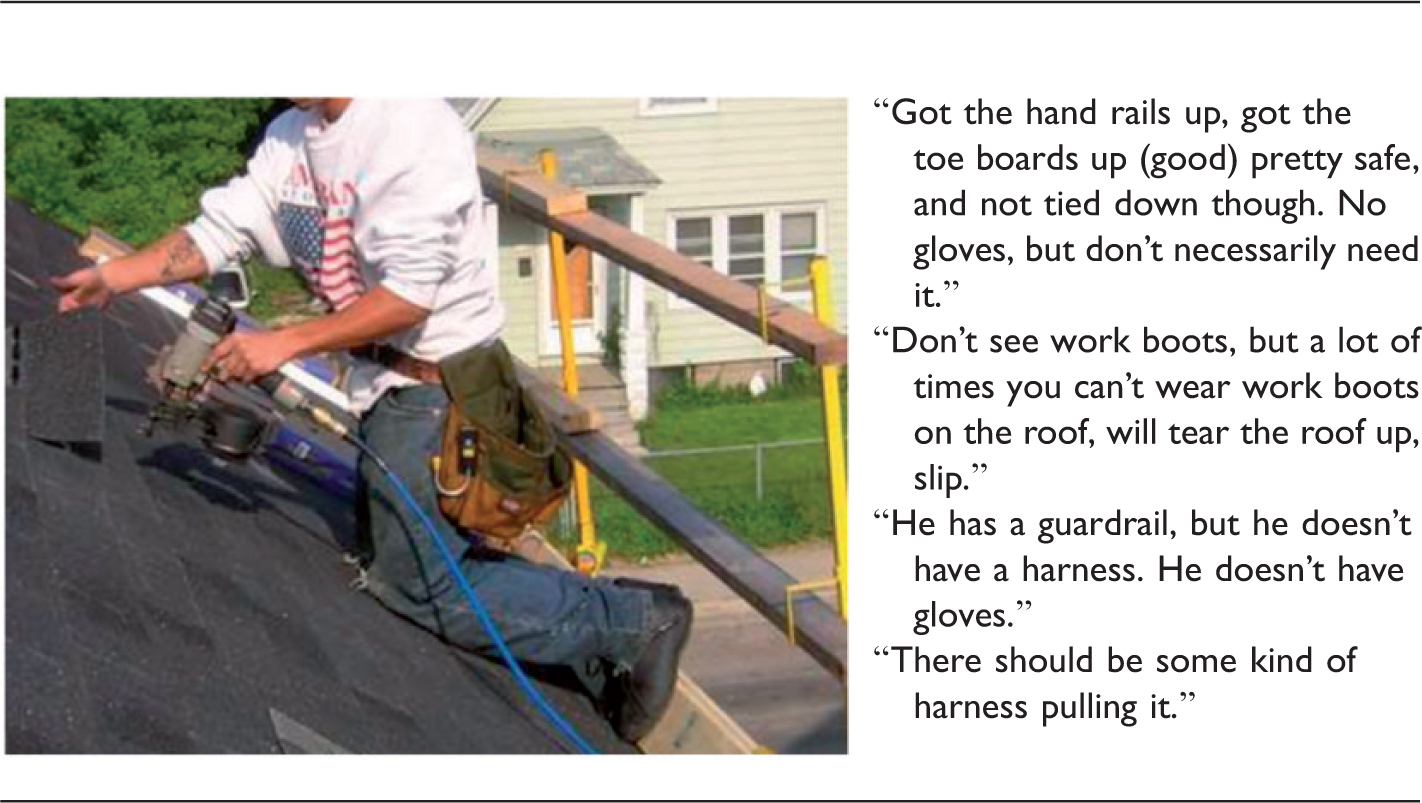
An exercise was conducted to assess the participant’s knowledge of and attitudes about fall protection equipment. First, participants were shown a series of photos of construction workers performing certain tasks on the job and were asked to identify correct and incorrect work practices. Participants were given the opportunity to identify improper use or the lack of fall protection equipment and PPE. Participants were also encouraged to discuss currently available education and training materials, barriers to use of equipment, work place safety, and rooftop falls.
The research staff also provided information on a new National Institute for Occupational Safety and Health (NIOSH) adjustable guardrail system, which complies with 29 CFR 1926.502(b). The guardrail system is designed to prevent residential construction workers from falling from or through roofs or floor openings and existing skylights. The guardrail system (Figure 1) requires that top rails must be 42 inches and withstand 200 pounds; mid rails must be able to withstand 150 pounds; that it have surfacing to prevent punctures, lacerations, and snagging of clothing; and no steel or plastic banding.
1
Participants were asked about the guardrail system, to elicit feedback on its acceptability of use.
NIOSH guardrail system.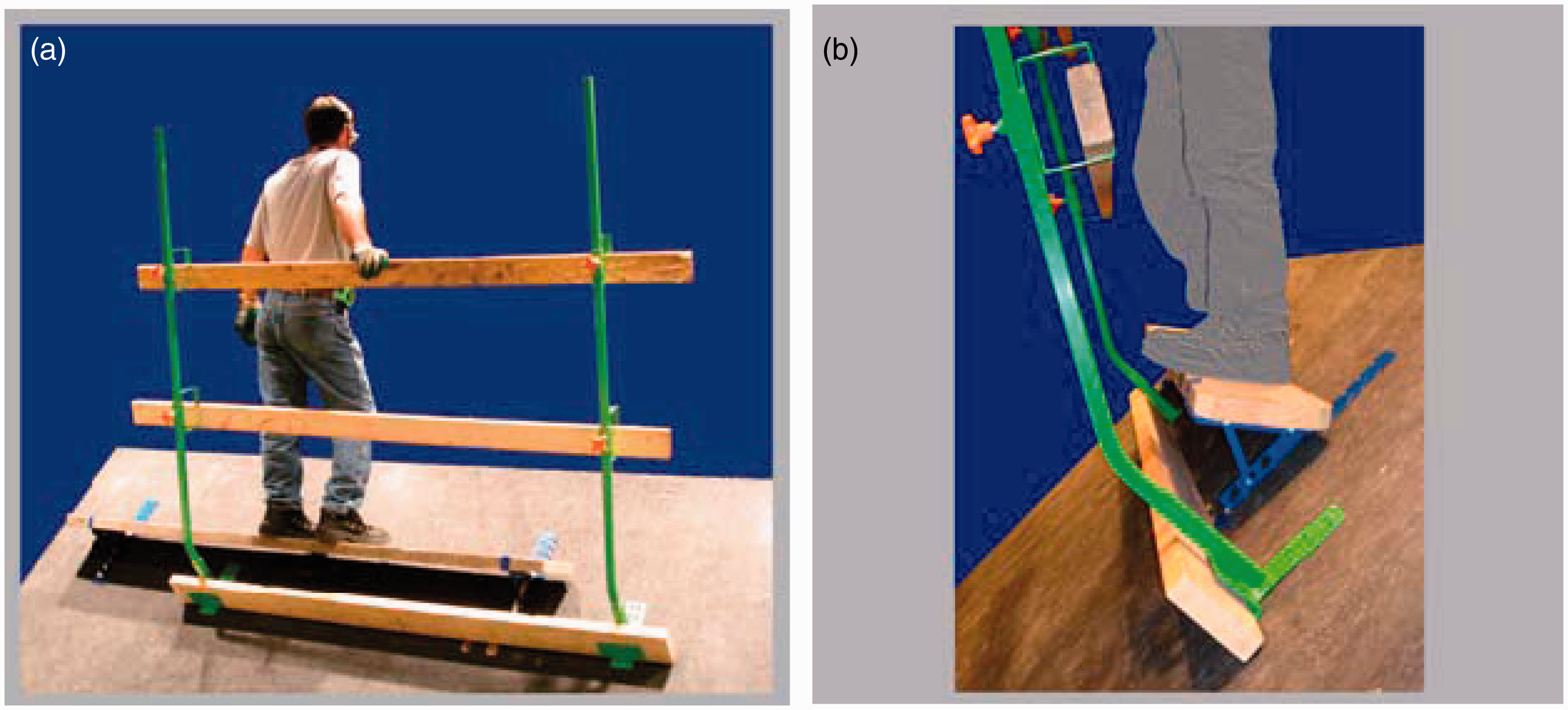
At the conclusion of the focus group, each participant was provided an index card and asked to write down three factors they considered barriers to the use of fall protection, and any additional information they thought the research team should know about their experiences as construction workers or suggestions for improving construction workplace safety. Participants were each given a$50 gift card to compensate them for their time.
Data Collection and Analysis
Data from the questionnaires were entered into a Microsoft Access database and were analyzed using SAS©. 17 Basic descriptive statistics such as means and percentages were used to summarize the quantitative data from the questionnaire. Along with note-taking, a tape recorder was used to record participant responses during the group exercise portion of the focus group. The focus group transcriptions were inputted into NVivo™ software. 18 This software was used to organize qualitative data collected through the focus groups and to allow the research team to sort out emerging themes such as training, use of PPE, and perceptions on safety.
Institutional Review Board
This study was evaluated and approved by the institutional review boards of both the New Jersey Department of Health and Drexel University.
Results
Questionnaire
Thirty-six residential construction workers volunteered to participate in a focus group. Participants ranged in age from 20 to 65 years, with an average age of 39 years, and thirty-five (97%) were men. Twenty-four (67%) were of Hispanic origin, three (8%) were White, and eight (22%) were Black. Spanish was the primary language spoken by participants from New Labor. Twelve (33%) were union members and belonged to The Laborers’ International Union of North America, Local 55, and twenty-three (64%) were nonunion members from New Labor. Twenty-two (96%) of the nonunion members are of Hispanic origin and eight (67%) of the union members are Black.
Of the thirty-six participants, twelve (33%) had fallen from a height of greater than 6 ft at work and three (25%) were injured as a result of the fall. Five (42%) reported that they were not wearing fall protection equipment at the time of the incident. Of the individuals who had fallen and were injured, the number of days missed from work ranged from two to seven days.
Twenty (56%) of the participants reported that they knew someone who has fallen from greater than 6 ft while at work. Eighteen (90%) of the participants reported that the person was not using fall protection equipment during jobs that were 6 ft or higher and eighteen (90%) reported that the person who fell was injured. Participants reported an average of seventy-three days of work was lost due to falls from heights greater than 6 ft.
Use of Fall Protection Equipment by Residential Construction Workers (N = 36).
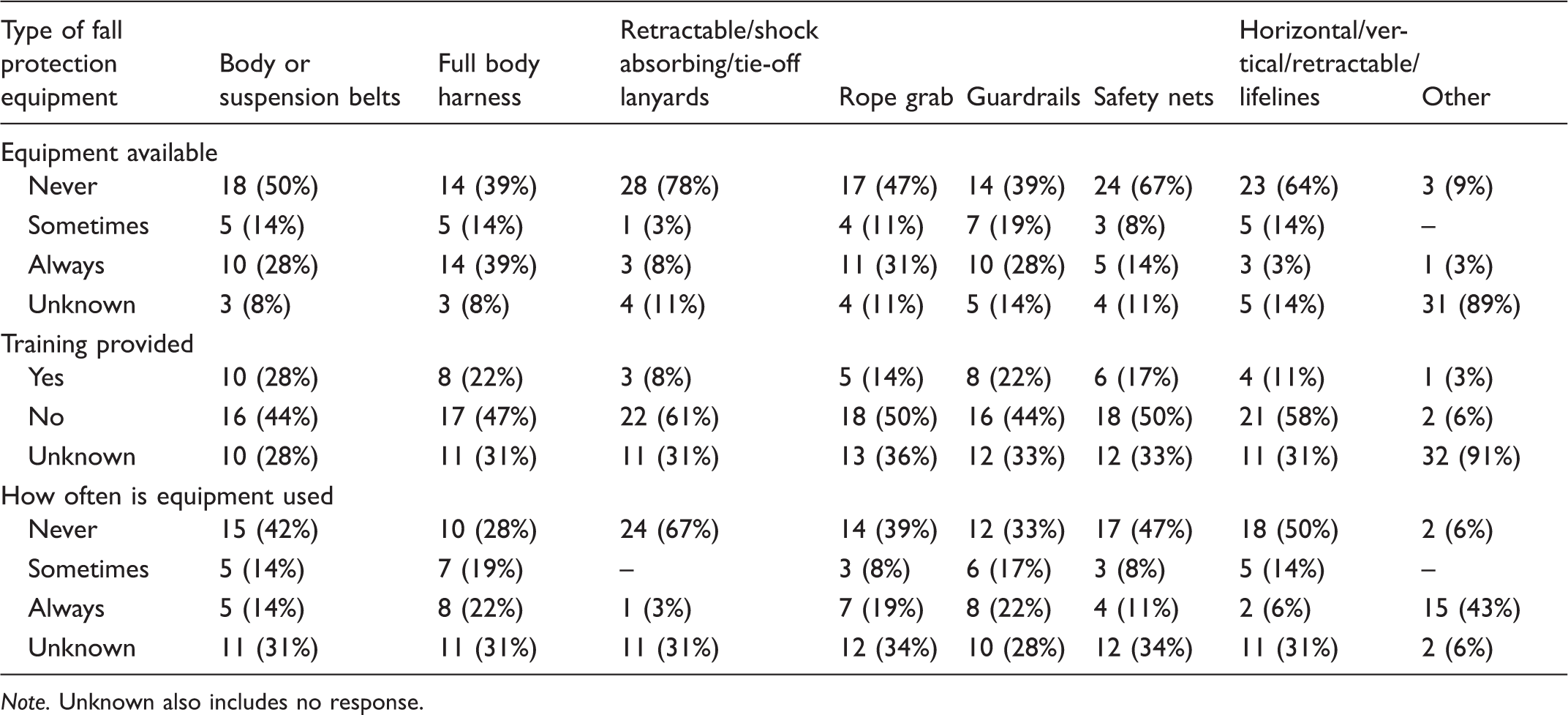
Note. Unknown also includes no response.
Job Safety Training Provided by Employer.
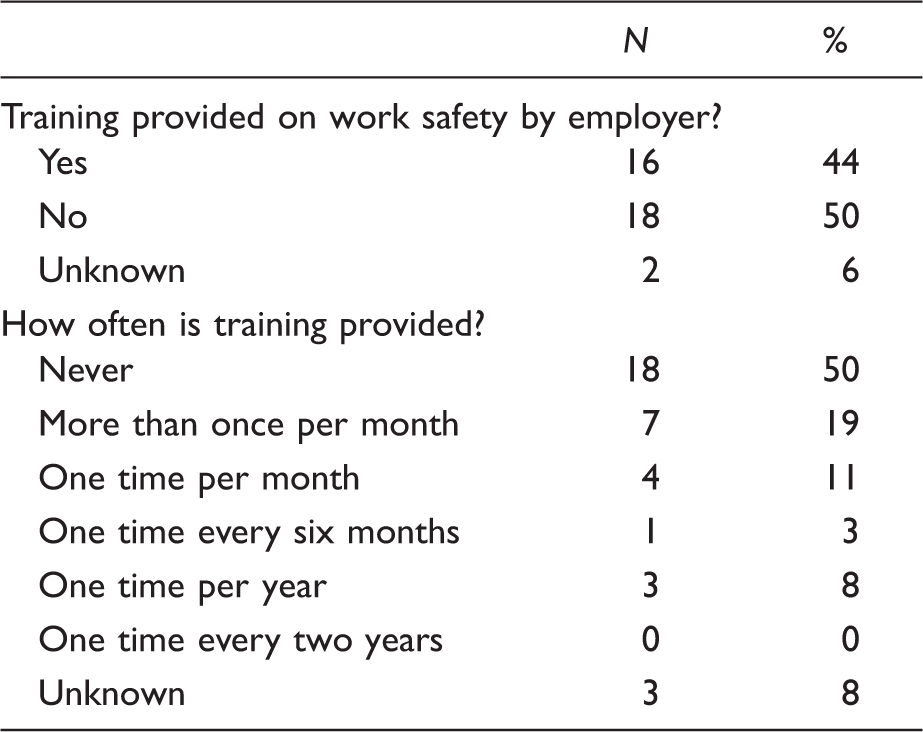
Focus Group
Activity
Work Practices in the Residential Construction Industry, Participant Responses.
Members from both the union and the workers center also provided critical suggestions that may help in designing intervention programs and educational materials regarding the importance of fall protection use and job safety. For example, one participant stated, “I would like OSHA to check every month in every company” while other participants provided the following suggestions: “Safety incentives to contractors? More active enforcement. Media attention” and “Enforcement makes fatalities a lesser rate.”
Focus group and other discussion
Participants were also given an overview of the NIOSH adjustable guardrail system and asked to comment. Initially members from both organizations agreed that convenience of use was a predictor of fall protection use. For example, participants indicated that “anything more than 20 minutes they wouldn’t do it [setup]” or that “sometimes it is not used because it makes working harder.” Upon receiving information that NIOSH has developed a new guardrail system, some workers expressed that safety matters and they would use the system even if it took one to two hours to set up, especially if working on the same site for more than one day. However, participants also mentioned concern in regard to employers being unlikely to purchase or provide such systems. For example, participants mentioned “that [it] is a waste of money and time – the boss would say that” and “of course we would do it, but it’s not in our hands to make that determination, even if we propose these ideas to the employer, if the employer doesn’t do it, it doesn’t matter.”
Two main themes that emerged from analyses of focus group discussions were factors that promoted or caused barriers to the use of personal protective equipment (PPE) and training. Factors that promote training and the use of PPE include whether or not employers directly provide the equipment to workers and the size of the company. Larger companies may have more resources to provide equipment and training to their employees. Participants seemed to agree that being a part of a union also has its advantages in regard to training and having fall protection equipment. A Local 55 member stated, “Since I came to the union, I learned about fall protection, and they try their very best to provide a safe environment.”
Eighteen (51%) of the participants had indicated that they had been in situations where they did not use fall protection during a residential construction job where they were working at a height greater than 6 ft. Focus group participants reported that factors creating barriers to the use of fall protection equipment include employers not providing PPE, workers not feeling comfortable wearing certain types of PPE, and lack of communication about health and safety in the workplace between workers and the employer. Members of Local 55 agreed that one of the biggest challenges in the workplace is that fall protection often is not provided by the employer. A member made the following comment: “I’ve worked in construction all my life, virtually no fall protection, it is not available.” Other member responses may suggest that the relationship between the employee and employer may affect the use of protective equipment. One member commented, “Flipside, no fall protection, a big challenge to ask for fall protection, they might not want you there, that is a bigger challenge.” A second member mentioned, “The company does not provide proper fall protection equipment. They threaten to fire if you stir up the crew. Would like to be able to work in a safer environment rather than worrying about falling.” Members from New Labor also emphasized the lack of availability of equipment as one member stated, “I don’t use fall protection equipment because they don’t give it to me.” As indicated by members of both New Labor and Local 55, employers may not be providing equipment due to financial reasons. One member from Local 55 stated that “they don’t have the money to get it.” Members from New Labor also indicated employers not wanting to spend money: “Sometimes the boss says protective equipment is very expensive.”
New Labor participants, who are primarily Hispanic, brought up cultural differences as a barrier to receiving training and being provided fall protection equipment. Members indicated that “there is a difference between American workers and Latino workers, this work is more risky. Americans won’t accept some work conditions.” Hispanic participants seemed willing to take more risks as participants indicated that it is “necessity, for the family, to make money” and It is a decision that we have to make under our own conscience and also balance the need for having the job. Sometimes we have to decide on not doing the job if it is too dangerous, but if you need the money.
Discussion
The participants of this study were employees of small residential constructions companies. They expressed their concerns that there are actual and potential barriers to use of fall protection equipment such as ease of use, cultural differences, lack of training, lack of resources (availability of this equipment), and management (enforcing the use of fall protection and PPE). The questionnaire data provided quantitative statistics on these characteristics and the focus group discussion allowed us to explore in more detail knowledge, attitudes, and practices regarding fall protection equipment and other PPE for residential construction work.
Participants indicated comfort and convenience were factors in using fall protection equipment. For fall protection systems to be implemented voluntarily, they should be practical, simple, economical, and protective. If equipment was uncomfortable, took too long to set up, or makes the job more difficult, construction workers would not use the fall protection equipment. This is similar to results found by Johnson et al., 19 who found that discomfort and decreased productivity due to use of fall protection equipment led to noncompliance. It was also found that passive protection systems like guardrails were preferred by employees since these systems were less likely to interfere with work. When focus group members from New Labor and Local 55 were presented information on the NIOSH guardrail system, participants stated that they would not be provided the guardrail systems by employers even when employees were willing to take the time to install the systems. Participants felt employers would not spend the money and did not want employees spending time setting up the systems. According to Potts et al., 20 for larger construction companies, motivation by supervisors and employers was an important factor in ensuring the safety of employees and the commitment of upper management to encourage safety was key. Besides comfort and ease of use of fall protection equipment, Johnson et al. 19 also indicated that employees were noncompliant due to supervisors not enforcing the use of protective equipment.
A majority of the study participants were of Hispanic origin. During the focus group discussions, members of New Labor tended to emphasize cultural differences, when their responses were compared with those of the members of Local 55. Foreign-born workers face unique challenges in the workforce. According to the U.S. Department of Labor, factors such as low education level, lower literacy level, less knowledge of English, and less knowledge regarding workers’ rights have been identified. 6 Although we did not explicitly ask the Hispanic workers about their documentation status, those who are undocumented may choose to work in smaller companies that might be less likely to check status. Some of the Hispanic workers did imply that they were more willing than their American-born counterparts to take risks, such as working in situations where PPE is not provided, due to their financial obligations toward their families and because it is hard to find other work.
Smaller residential construction companies may not manage occupational safety as effectively as larger companies. 21 Huang and Hinze 15 stated that falls were more likely to occur during commercial and residential projects that were smaller and lower budget. In a study that reviewed various strategies to prevent falls from heights in larger construction companies, Potts et al. 20 contacted and interviewed twenty-five large construction companies. Results indicated that safety training was a key factor responsible for the fewer number of injuries and fatalities as compared with that of smaller companies. However, larger companies have more financial resources that allow for training and availability of fall protection equipment along with stronger support from management. 20
Members from the union, Local 55, indicated that there were benefits to being a union member in the construction industry in regard to available equipment, training, and feeling safer on the job. This was also seen in a study conducted by Dedobbeleer et al., 22 where union workers stated that they often received training, whereas nonunion workers rarely received training on equipment and OSHA regulations. Gillen et al. 23 also showed similar results. Union workers were more likely to report that they perceived their supervisors as caring about their safety, were made aware of dangerous work practices, and received safety instructions when hired. Employers tend to be more compliant with OSHA standards and other safety practices when employees are union members and companies are larger in size. 24
Worker centers and local stakeholders such as community organizations, municipal governments, and faith-based organizations also exist to help respond to the challenges faced by workers in an effort to reduce violations of workers' rights. 25 As an example, local organizations such as New Labor, universities, and worker centers in New Jersey worked together to develop and implement a program to train immigrant day laborers as safety liaisons. 26 New Labor is a not-for-profit organization that provides another example of this. They combine new and existing strategies to improve working conditions and provide a voice for immigrant workers throughout the United States. New Labor has helped workers voice their concerns about low wages, harsh working conditions, and workers’ rights. 27
Conclusion
This study showed that employees (union and nonunion) of small, residential construction companies face barriers to the use of fall protection equipment. The identified barriers to the use of fall protection equipment included availability, lack of training, ease of use, cultural differences, and lack of employer oversight. On the basis of these outcomes, we recommend the following: smaller construction companies should utilize OSHA consultation services; state and federal agencies should collaborate with local organizations/stakeholders, such as New Labor, to identify and disseminate new, acceptable approaches to reduce falls in small residential construction companies; employer awareness should be raised regarding available, cost-effective fall-prevention tools such as the NIOSH Guardrail System, NIOSH ladder application, and others; and agencies with the authority to protect the health and safety of workers should organize formal alliances with residential construction companies to promote safe work environments.
Footnotes
Acknowledgments
The authors would like to thank the Laborers’ International Union of North America, Local 55, (Hector Ortiz), New Labor (Marien Casillas-Pabellon and Louis Kimmel), Dr. Betsy Marshall of Rutgers University School of Public Health, and all our focus group participants.
Declaration of Conflicting Interests
The author(s) declared no potential conflicts of interest with respect to the research, authorship, and/or publication of this article.
Funding
The author(s) disclosed receipt of the following financial support for the research, authorship, and/or publication of this article: This project was part of the New Jersey Fatality Assessment and Control Evaluation project, funded by the National Institute for Occupational Safety and Health, grant # 5U60OH008485-09.