







Abstract
In response to recent litigation, Colgate Palmolive hired Exponent to determine if various samples of their cosmetic talc products contained asbestos. Anderson et al., Exponent employees, claim to report the findings of these analyses in their paper “Assessment of Health Risk from Historical Use of Cosmetic Talcum Powder.” The microscopist who reviewed the samples found four anthophyllite fibers. One of the authors of Anderson et al., Patrick Sheehan, who is not a microscopist, directed the reviewing microscopist to alter the report and add the qualification that “…this classification was inconclusive due to the small number counted.” Deviations from the referenced analytical methods, however, would account for the small number of fibers counted relative to the limit of detection. Anderson et al., reported that “no asbestos fibers were detected in any of the eighteen samples analyzed” based on the report’s altered conclusions.
Commentary
For the past several years, users of Colgate Palmolive talc products who developed mesothelioma have sued the company, alleging that asbestos in the talc caused their mesotheliomas. In response to the litigation, Colgate Palmolive hired Exponent to determine if various samples of their products contained asbestos. Anderson et al.
1
(all authors cite Exponent as their affiliated institution) claim to report the findings of these analyses in their paper “Assessment of Health Risk from Historical Use of Cosmetic Talcum Powder.”
1
Forensic Analytical Laboratories, the laboratory hired by Exponent to perform testing, performed the analytical microscopy and their initial report of the microscopy stated that four anthophyllite asbestos fibers were present in three of eighteen talc samples; these results are quite different from those reported in Anderson et al.:
1
No asbestos fibers were detected in any of the 18 samples analyzed. Of the 18 samples, two samples contained one fiber, and a third contained two fibers, which were initially reported as anthophyllite asbestos, noting that this classification was inconclusive due to the small number counted.
In his initial report dated 21 June 2011, Floyd labeled two fibers from Sample S3–3-MR as “anthophyllite.” Figure 1 shows the initial report for the fiber identified in grid opening I9. 4

The initial report for the fiber identified in grid opening I9.
After receiving the above findings, in a 5 September 2011 e-mail from Patrick Sheehan to Mark Floyd, Sheehan directed Floyd to change his report: “Please resend with anthophyllite replaced with transition
b
in the header.”
4
Floyd complied. The same results for the two fibers in Sample S3–3-MR appeared in the revised report dated 28 October 2011, but with the heading changed to “transition fiber.” After directing Floyd to remove “anthophyllite” from the fiber labels and before receiving the second version of the report, Sheehan e-mailed Floyd, “Please provide the lab report and micrographs and spectral composition for the 4
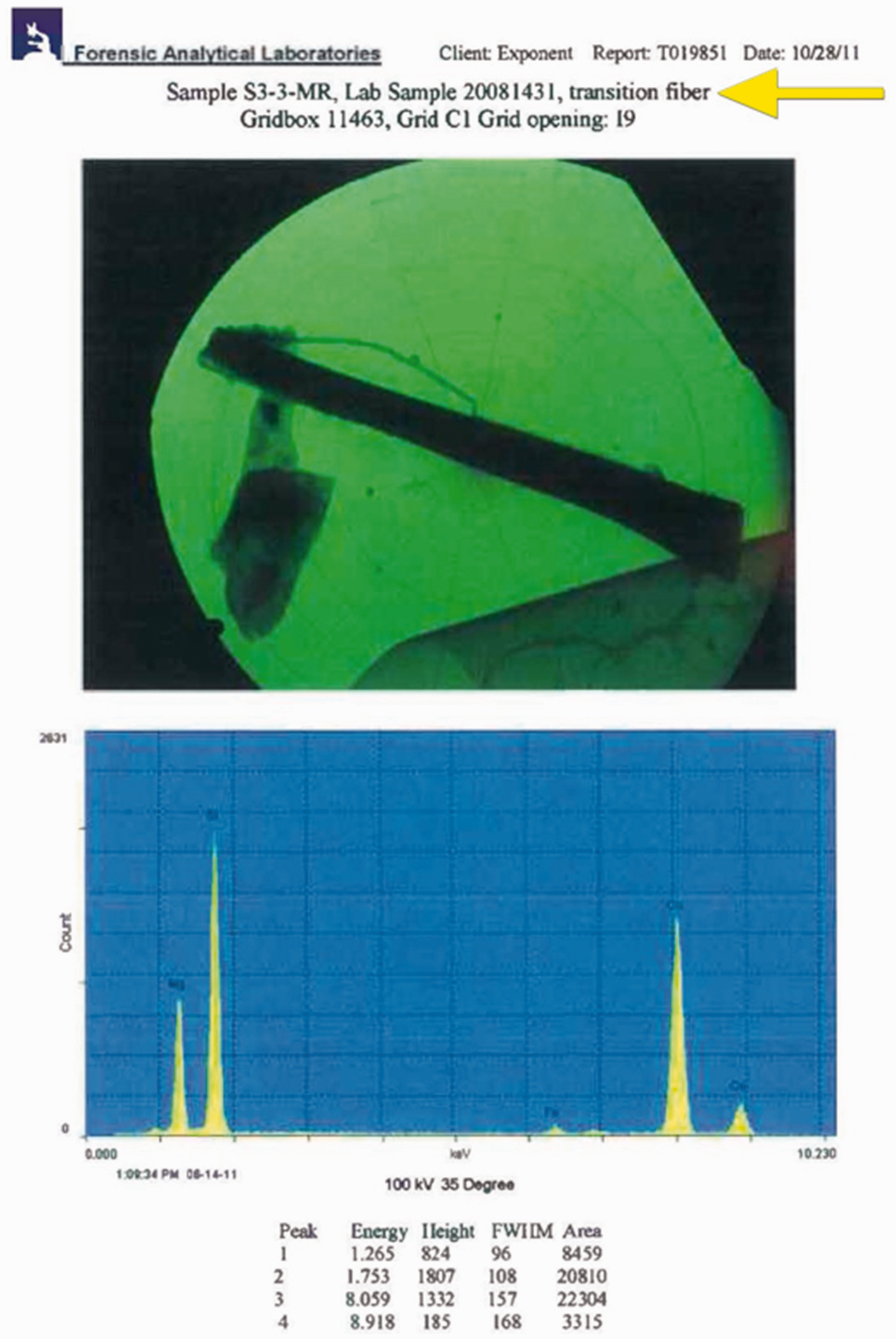
The altered report for the fiber in grid opening I9.
Footnote 3 of Floyd’s revised report to Exponent adopts Patrick Sheehan’s rationale for reclassifying these fibers, “This classification was inconclusive due to the small number counted.” In a related e-mail to Floyd, Sheehan wrote:
7
Below are two proposed alternatives for footnote 3. The current classification statement is not sufficiently clear to me and appears unnecessary. I believe that the final statement may also be misleading as written and may not be necessary. Are either of the two alternatives acceptable or could they be modified to be acceptable? Anthophyllite (AN) was the only amphibole or serpentine mineral type detected, and only Anthophyllite (AN) was the only amphibole or serpentine mineral type detected, and only
Changing reports was not a standard practice for Floyd. At his deposition, he testified that his clients suggested language changes less than 1 percent of the time. Floyd stated that, had Sheehan not requested modifications, he would have used the “boilerplate” language from his initial report. Despite the information in the revised report, Floyd testified that, by his method, the fibers he found were asbestos. 8
Sheehan requested the changes so that the results could be used to support the Colgate Palmolive litigation defense. Sheehan told Floyd:
9
Subject: SAED micrographs Thanks for the reply. Please remember that we need sufficient quality pictures to document the transitional nature of these three fibers as
Anderson et al. 1 collected and analyzed airborne samples according to NIOSH 7400 and 7402 analytical methods.1–3 A simple review of both NIOSH methods reveals that the minimum air sampling volume required to reach the limit of detection of the method is 400 L.2,3 The experimental design by Anderson et al. 1 used 48-min sampling with an air volume of 121 to 211 L. 1 By selecting a smaller sampling volume, the authors failed to follow the minimum requirements to reach the method’s limit of detection, resulting in exposure underestimations. Since Floyd’s original reports indicate the presence of asbestos in the bulk product used for exposure simulation, the small sampling volume selected is the main reason why Anderson et al. 1 could not detect a significant number of asbestos fibers.
Finally, Anderson et al. 1 claim that their paper is an “Assessment of Health Risk from Historical Use of Cosmetic Talcum Powder.” They did not report that Floyd had found anthophyllite asbestos in Johnson & Johnson Baby Powder in 2004. 10 In addition, Anderson et al. 1 restrict their analysis to the issue of asbestos content, ignoring other well-defined and accepted risks of talc-related medical problems among cosmetic users, like fatal aspiration and talcosis.11–44 Further, risks should not be isolated from benefits and reasonable alternatives. “Cosmetic talcs” sold as dusting powders have no demonstrated health benefits. Moreover, there are safer substitutes that would eliminate both the asphyxiation and cancer risks. Roll-on talc powders are available for adult use and dustless baby powder is available for infants. 45 Finally, corn starch has been used in cosmetic powders for decades. It is indisputable that corn starch does not contain asbestos and, if applied with an applicator, will not result in fatal aspiration.
Footnotes
Authors’ Note
This commentary was originally submitted as a letter to the editor to Risk Analysis, the journal that published Anderson et al. 1 The Risk Analysis Editor rejected the letter partly because he did not consider depositions to be a valid reference source.
Declaration of Conflicting Interests
The author(s) declared the following potential conflicts of interest with respect to the research, authorship, and/or publication of this article: David S. Egilman has been retained in asbestos and talc toxic tort litigation at the request of injured consumers and workers and at the request of asbestos product manufacturing companies defending similar cases; Joan Steffen works for Dr. Egilman as a research assistant. Dr. Egilman was not an expert in the case Lori Konopka-Sauer and Richard Konopka vs. Colgate-Palmolive Company; he was an expert in Gail Lucille Ingham et al. vs. Johnson & Johnson et al.
Funding
The author(s) received no financial support for the research, authorship, and/or publication of this article.