







Abstract
Because Career Technical Education (CTE) programs at the community/technical college level are among the few places new construction workers receive training or preparation, they are an important vehicle for educating new and young workers about occupational health and safety (OSH). We developed recommendations for (1) OSH “core competencies” that all postsecondary construction students should achieve and (2) “essential elements” for OSH education in construction training programs. Based on a review of the literature, subject matter expert focus groups, and iterative engagement with an expert advisory group, we identified fourteen core competencies and a list of essential supporting elements at the school, program, and instructor levels. Knowledge and recognition of the importance of effective safety and health management systems served as the foundation for elements and competencies. Findings provide an important starting point for systematically improving the preparation of construction CTE students that can help keep them safe on the job.
Keywords
Introduction
Construction is a large, dynamic, and dangerous industry where skilled workers are currently in great demand. It is well established that new and young workers are at greater risk of injury as they enter an already risk-filled industry.1–3 In 2016, at least 8720 young construction workers (aged 16–24 years) were injured on the job, losing at least a day away from work. 4 Thus, the need for adequate training in both the skills of one’s trade as well as safety and health is critical for these workers. Some of these new construction workers will enter the industry through apprenticeship programs, typically conducted as part of large construction projects that are more likely to be covered by union contracts, with more training and resources available for health and safety. 5 An equivalent or greater number, however, will enter the industry through postsecondary Career Technical Education (CTE) programs at the community or technical college level. Such programs (e.g., electrical, carpentry, plumbing, masonry, and general construction) train approximately 78,000 students annually, 53 percent of them under the age of twenty-five. 6 The number of new apprentice registrations only recently increased to 57,300 in 2016, a 39 percent increase since 2012. 7 Less than 2 percent of current construction workers are apprentices.8,9
Construction experts suggest that CTE graduates are more likely than apprentices to begin their careers in residential construction,5,10,11 where workers are less likely to be unionized 7 and less likely to participate in a safety program due to the small size of firms in residential construction. 12 CTE programs are therefore an important vehicle for educating young workers about construction health and safety and are sometimes the only place where young workers in the construction industry will come in contact with health and safety training. 5 There has been some progress on the part of both educators and industry to improve occupational safety and health (OSH)-focused learning standards especially at the secondary school level.13–16 Little has been published, however, about what OSH education should look like for students in postsecondary programs, and what is actually happening in these settings. 5 In an effort to develop some guidance in this area, and as part of a larger study focused on the quality of OSH education in postsecondary CTE construction programs, we conducted qualitative research with construction and OSH experts, to develop a set of recommendations on (1) what constitutes OSH “core competencies” that all postsecondary construction students should achieve and (2) what “essential elements” within construction training programs are needed to support the attainment of these competencies.
Methods
To achieve the goals of our study, we synthesized available evidence on effective and promising practices for OSH education and collected additional new data through focus groups with construction and OSH experts and through the project’s Advisory Group made up of CTE instructors and administrators, and OSH professionals (see Figure 1).
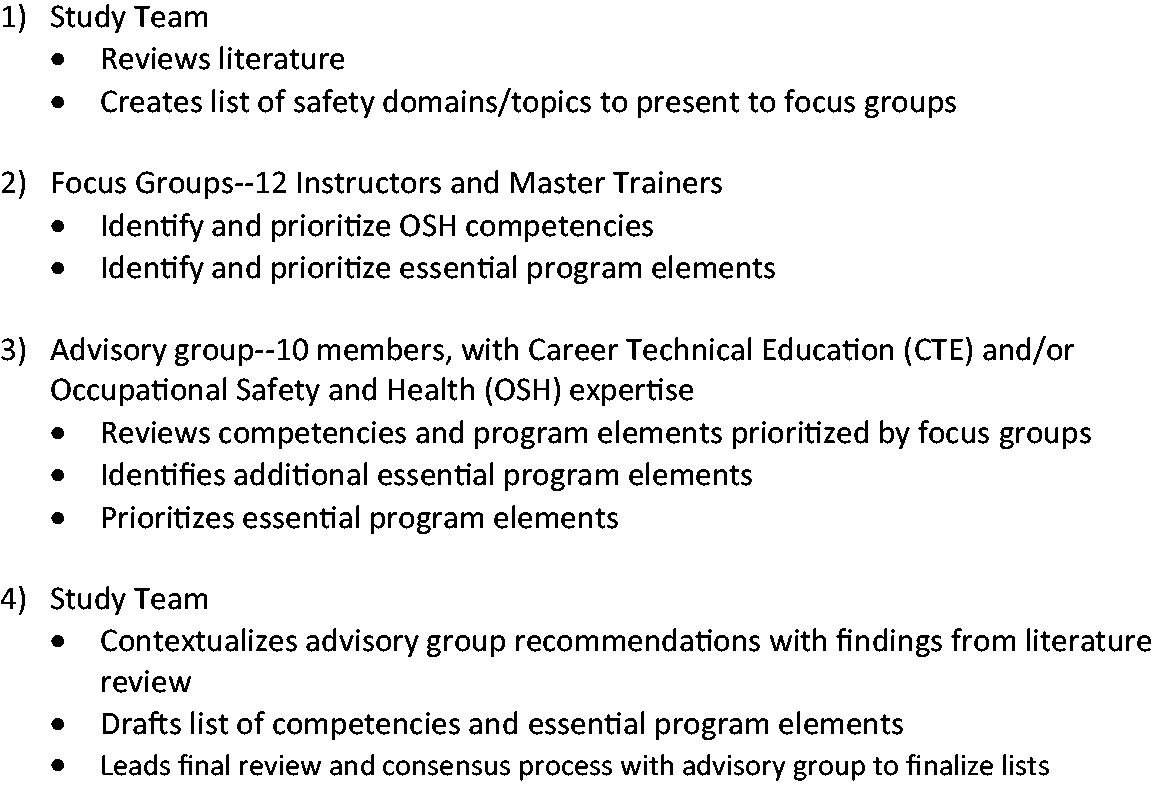
Research process outline.
Synthesizing the Existing Knowledge
We reviewed the available scientific literature to identify elements shown to contribute to effective OSH preparation for students in postsecondary CTE construction programs, including effective approaches to teaching young adult learners in general, and about OSH in particular. In addition, we collected samples of OSH competencies articulated by education agencies, occupational health agencies, union apprenticeship programs, and trade organizations. Using these sources, we developed a preliminary list of OSH competencies and programmatic and instructor elements that support their attainment. These lists were used to stimulate discussion in our focus groups with subject matter experts as described below.
Assembling the Experiential Evidence
We conducted two subject-matter expert focus groups with a total of twelve instructors or master trainers with significant involvement in CTE construction programs. Focus groups were held in 2015 in Atlanta, Georgia and Berkeley, California. Six subject-matter experts participated in each focus group, which lasted four hours.
Participants were recruited through referrals from the project’s Advisory Group and were screened for experience in postsecondary construction CTE programs as well as a health and safety background. Ten participants were instructors in CTE construction programs within community or technical colleges, two of whom were teaching in union apprenticeship programs integrated within CTE programs. The remaining two were master trainers for union apprenticeship programs who did not work in a CTE program directly, but who were actively involved in organizations and efforts to shape CTE programs in their states. Several participants also had some level of administrative responsibility in their CTE programs. Participants represented a range of trades including carpenters, sheet metal workers, welders, insulators, energy workers, and laborers; came from ten states across the country; all were male.
To facilitate our discussions, we developed a semi-structured focus group guide based on the competencies and elements identified from our review of the literature. Each focus group began with participants identifying what they viewed as “core” safety and health competencies that construction students in postsecondary CTE programs should achieve (e.g., health and safety knowledge, skills, and attitudes that support safe work and problem-solving on the job). Participants were then asked to consider and discuss existing lists of competencies developed by the National Institute for Occupational Safety and Health (NIOSH), 17 SkillsUSA, 18 the National Center for Construction Education and Research, 19 and the California Department of Education. 20 By the end of the discussion, we had developed a list of core competencies the focus group participants agreed were most important for postsecondary construction students to achieve.
With these competencies as the focus, we then discussed what the participants viewed as the program and instructor elements needed in order for students to achieve these competencies. To start, we asked participants to brainstorm and write down their own ideas. We then asked them to consider and discuss the list of program elements developed from the literature. Participants were asked to add any items from these lists they found to be of significance to their own brainstormed list. The final step in each focus group was to have participants separately rank the competencies and elements by importance. These rankings were discussed among the group and a final, prioritized list of “core” competencies and “essential” elements was drafted.
After the focus groups were completed, the audio-recordings of each session were transcribed. Two members of the study team analyzed the data for themes related to OSH competencies and program elements related to effective OSH education,21,22 which allowed us to identify the conceptual domains for the competencies and program elements. Researchers used ATLAS.ti 23 in the analysis.
Results from the focus groups were shared with the project’s ten-member advisory group in an all-day, in-person meeting. Advisory group members included three administrators or lead instructors from CTE construction programs, all with extensive experience as instructors at the community college level; leaders from five national CTE organizations; and three occupational health professionals with expertise in health and safety education and young workers. Advisory group members were asked to consider and discuss the lists of core competencies and essential elements we had assembled and whether any additional elements should be added. At the conclusion of our discussion, we finalized the two lists and then asked each member to prioritize what they viewed as the most important “core” OSH competencies and the “essential” program and instructor elements needed to support their attainment. Elements that were identified and prioritized by advisory group members and/or focus group participants were included in our final lists presented below.
This research project was approved by the University of California Berkeley’s Office for the Protection of Human Subjects and the West Virginia University Institutional Review Board.
Results
In this section, we present our final lists of OSH core competencies and essential elements necessary for their attainment. We provide our qualitative results and, where it exists, supporting literature for selected competencies and elements that emerged as primary areas of focus.
Core Safety and Health Competencies
We identified fourteen core OSH competencies that all graduates of postsecondary CTE construction programs should achieve (Table 1). The list incorporates many of the learning objectives from the Occupational Safety and Health Administration (OSHA) Outreach Training Program’s ten-hour construction course, 24 which focus group participants and later, advisory group members, agreed represent a good minimum baseline. Additionally, the list aligns with NIOSH’s “8 Core Competencies for a Safe, Skilled and Ready Workforce” established in 2013. 14
Core Occupational Safety and Health Competencies for Graduates of Career Technical Education Construction Programs.
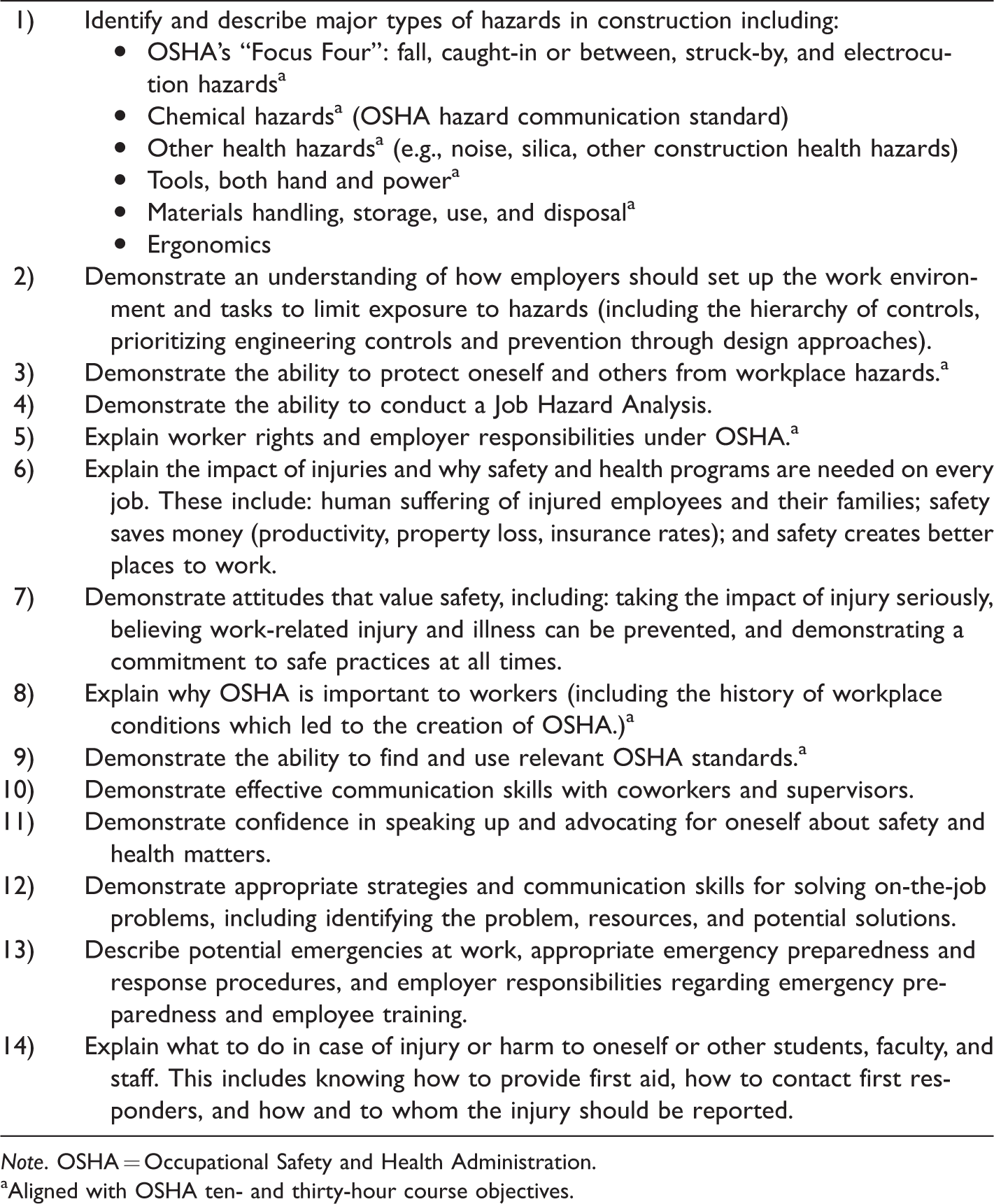
Note. OSHA = Occupational Safety and Health Administration.
aAligned with OSHA ten- and thirty-hour course objectives.
From our process, four conceptual domains of core OSH competencies emerged. These are (1) valuing of safety, including understanding the seriousness and impacts of injury and having a commitment to using safe work practices; (2) knowledge and understanding of state and federal OSH protections and regulations and the ability to find other relevant OSH information; (3) the capability to safely perform specific tasks or to work with specific types of equipment (especially hand and power tools and use of fall protection); and (4) problem-solving skills to identify and address workplace hazards, including critical thinking skills, the ability to conduct job hazard analyses, communication skills, and confidence to speak up about identified hazards.
The last domain in particular was emphasized in the focus groups. Participants described these problem-solving skills as the ability to recognize potential safety issues or hazards, an understanding of how those issues and hazards can and should be addressed by employers and employees, and then having the communication skills, strategic planning skills, and confidence to raise concerns effectively with their supervisors, or to identify resources and strategies to protect themselves even in less-than-ideal work environments. Participants did not describe teaching problem-solving specifically. Performing a job hazard analysis (JHA) or job safety analysis (JSA) was repeatedly emphasized as an approach that incorporates the skill set necessary for evaluating the task, recognizing/identifying hazards, understanding their root causes, and addressing or abating hazards. As one participant noted, Construction sites are hazard-riddled so [students] need to recognize those hazards … if they do recognize something, they gotta raise the question to speak your mind and think for yourself, to raise the questions to whoever. One of the ways that you teach adaptability is maybe to ask [students] to think about what kinds of things can go wrong with this tool. . . . Students need to learn to be cautious and learn to think before acting. Do a mini JSA on what you’re about to do . . . . Adaptability and how you teach it is to actually look at the job before they just jump in.”
The importance of teaching critical thinking, problem-solving, and self-advocacy skills to new and young workers is also supported in the literature. In general, health education models indicate that attitudes, normative beliefs, and self-efficacy are more likely than health knowledge to determine health behavior.25,26 This is particularly important for young workers, who are less likely to speak up given their specific challenges (e.g., precarious employment, which can lead to feelings of intimidation or fear of losing one’s job, limited experience, and lack of confidence), and underscores a need to incorporate into their training an understanding of the barriers they may face in the workplace.27–30
The other domain that was emphasized in the focus groups centered on the need for students to value safety. Focus group participants stressed the importance of the OSHA ten-hour and thirty-hour basic health and safety training course objective that students understand how work-related injury and illness impact individual workers, their families, coworkers, and the employer, as well as the quality and productivity of the work. They felt that valuing safety was based in large part on students’ risk perceptions around how likely they were to be injured and how serious the impact would be.
Valuing safety was also connected with participants’ ideas about “safety culture.” To some, this meant students “valuing safety,” understanding its importance, and taking the time to work safely, both on the job and off. For others, it meant being able to recognize employer attitudes toward safety and to handle those challenging environments, including refusing to work at places where safety is not a clear priority for the employer. Entry-level workers don’t really have the power to control [the safety culture] on the job site they’re on. But they should be able to recognize if their employer has that culture of safety. And maybe question whether or not they want to keep with that employer. [The] ability to recognize a culture of safety versus a culture of production.
Essential Elements That Support the Attainment of OSH Competencies
We identified multiple elements that were seen as essential for the attainment of the identified OSH competencies. These elements exist at the school-, program-, and instructor levels and are organized into two overarching domains: (1) elements that model and support effective safety and health management systems (SHMS) and (2) elements that support effective teaching of safety and health competencies. The advisory group concurred with most priorities identified by focus group participants and helped strengthen the SHMS frame.
1) Elements that model and support effective SHMS. Among these elements, listed in Table 2, eight exist at the school-level and nine at the program-level. One of the main points of discussion among the focus group participants was the critical importance of demonstrated management commitment, or in this case, school administrator commitment, to having an effective SHMS at the institutional level. Effective SHMS is core to OSHA’s safety and health recommendations. 31 The advisory group underscored that the SHMS of a CTE construction program forms the backdrop for students’ foundational understanding and practice of safety at school and on the job. OSHA’s evidence-based 32 SHMS recommendations are reflected in both the school- and program-level essential elements in Table 2.
Elements that Model and Support Effective SHMS.
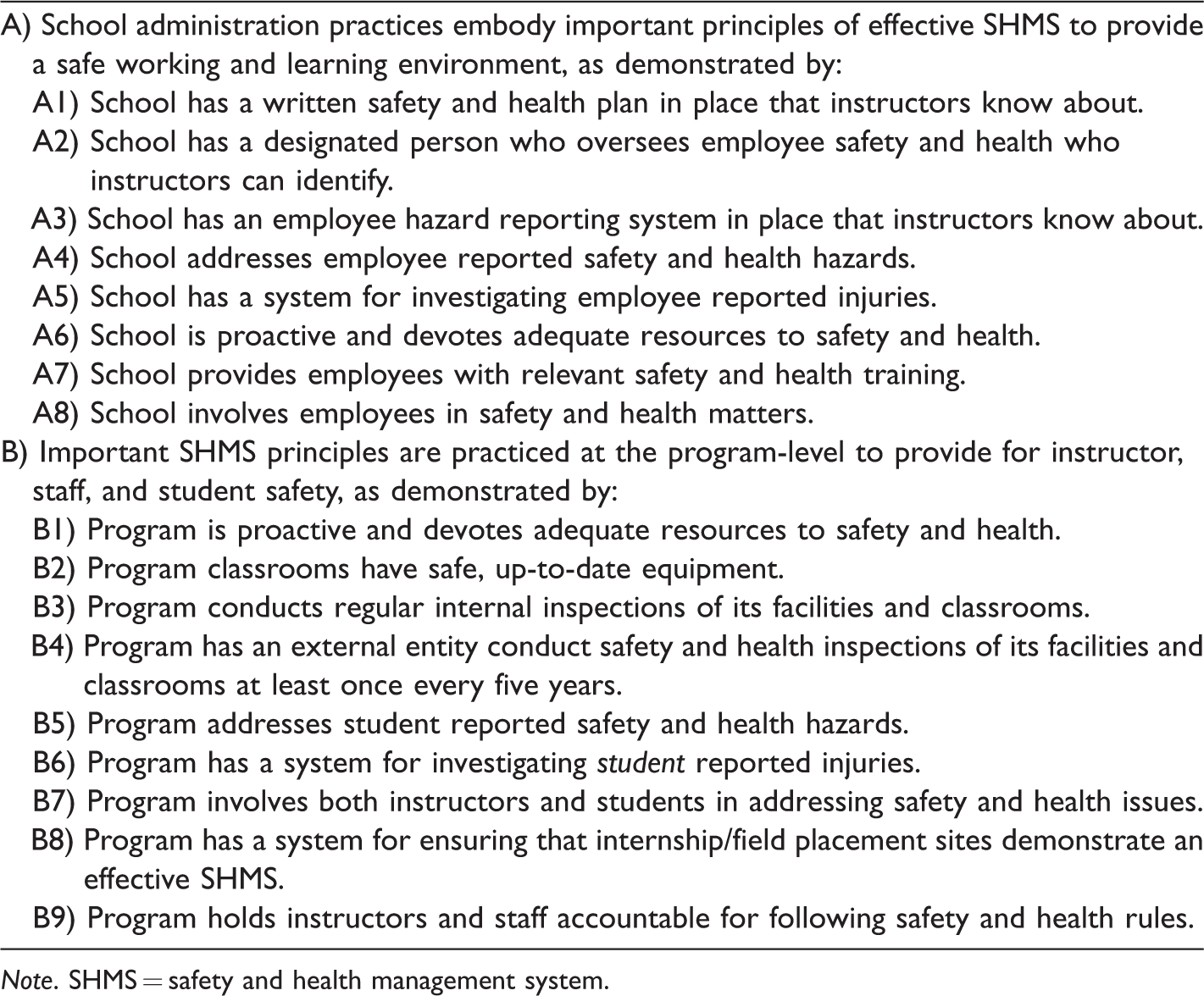
Note. SHMS = safety and health management system.
Focus group participants also placed a strong emphasis on the need for effective SHMSs to be supported and visible at every level—the school administration, CTE program administrators, instructors, and students. Key SHMS factors that contribute to good health and safety practice include employee involvement, management commitment to safety, and accountability at all levels.33,34 Focus group participants noted that “demonstrated management commitment” in the CTE environment includes things like making resources available to instructors and having administrators address issues in a timely way. They also strongly prioritized the need for adequate financial resources for equipment that is up to industry standards (e.g., cordless nail guns) and for addressing health and safety issues.
Focus group participants discussed the importance of designating someone to be actively responsible for health and safety at the administrative level, the need for administrators to better understand everything that goes into creating a strong health and safety program in any CTE program including what is happening in the classrooms, and the need to ensure that regular safety inspections take place at the school site as part of the program. Focus group participants also noted the importance of students experiencing direct involvement in SHMS procedures at the school, which meant not just being trained in performing specific work tasks safely, but participating in inspections and knowing that they are conducted regularly, participating in systems to report and address hazards, and observing their instructor’s leadership on this issue. Focus group participants wanted to see this reflected in classroom practices: When we talked about the instructors reporting to admin, and our inspection issues, this also has students doing it. Students engaged in inspections, reporting hazards. The students see a lot of stuff that you as an instructor miss. . . . I put them in groups of five with a clipboard. I’d give them each a shop to go to and find hazards and boy would they come back with some sizeable stuff.
Program-Level Elements That Support Effective Teaching of Occupational Safety and Health Competencies.
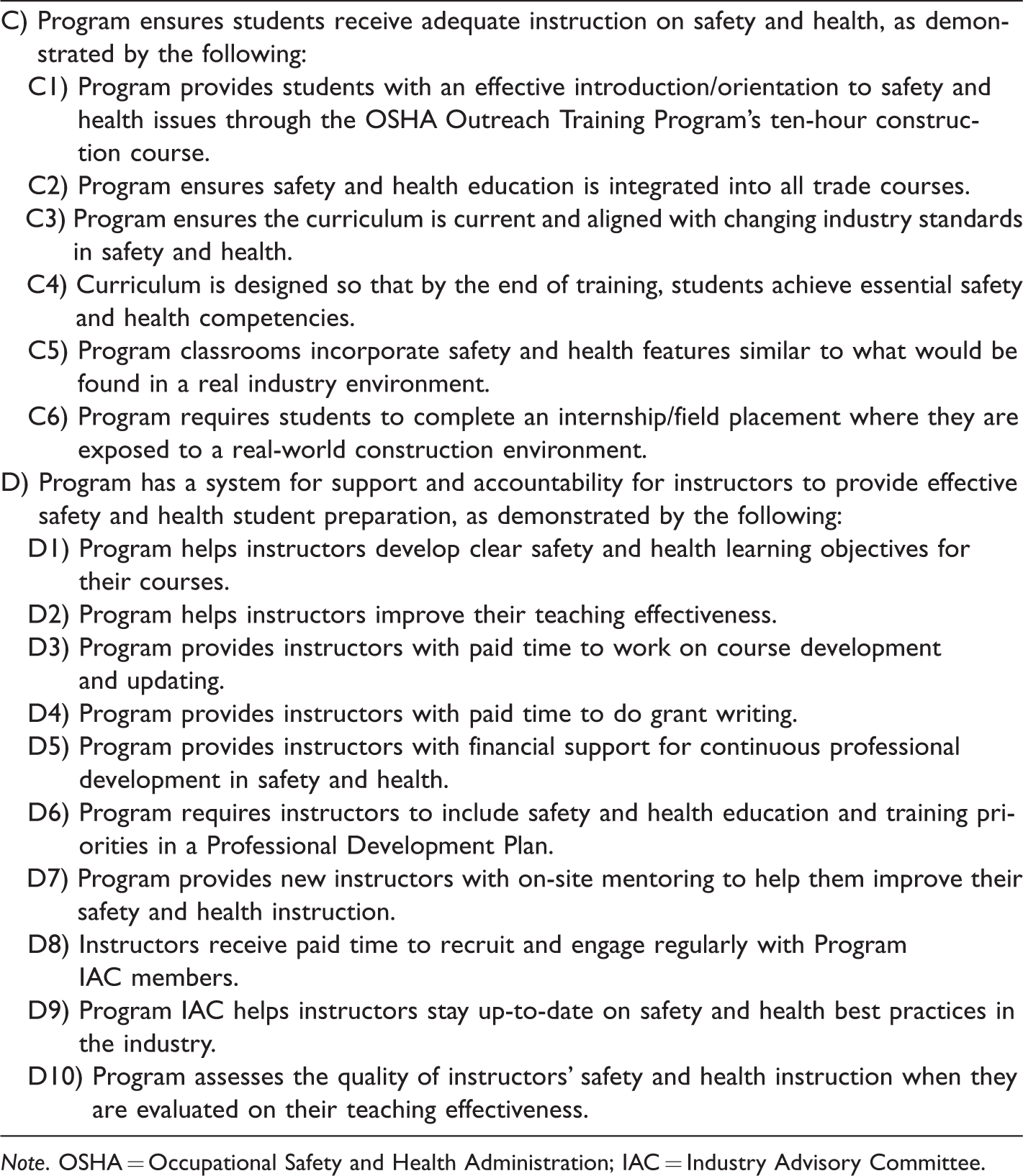
Note. OSHA = Occupational Safety and Health Administration; IAC = Industry Advisory Committee.
Instructor-Level Elements That Support Effective Teaching of Occupational Safety and Health Competencies.
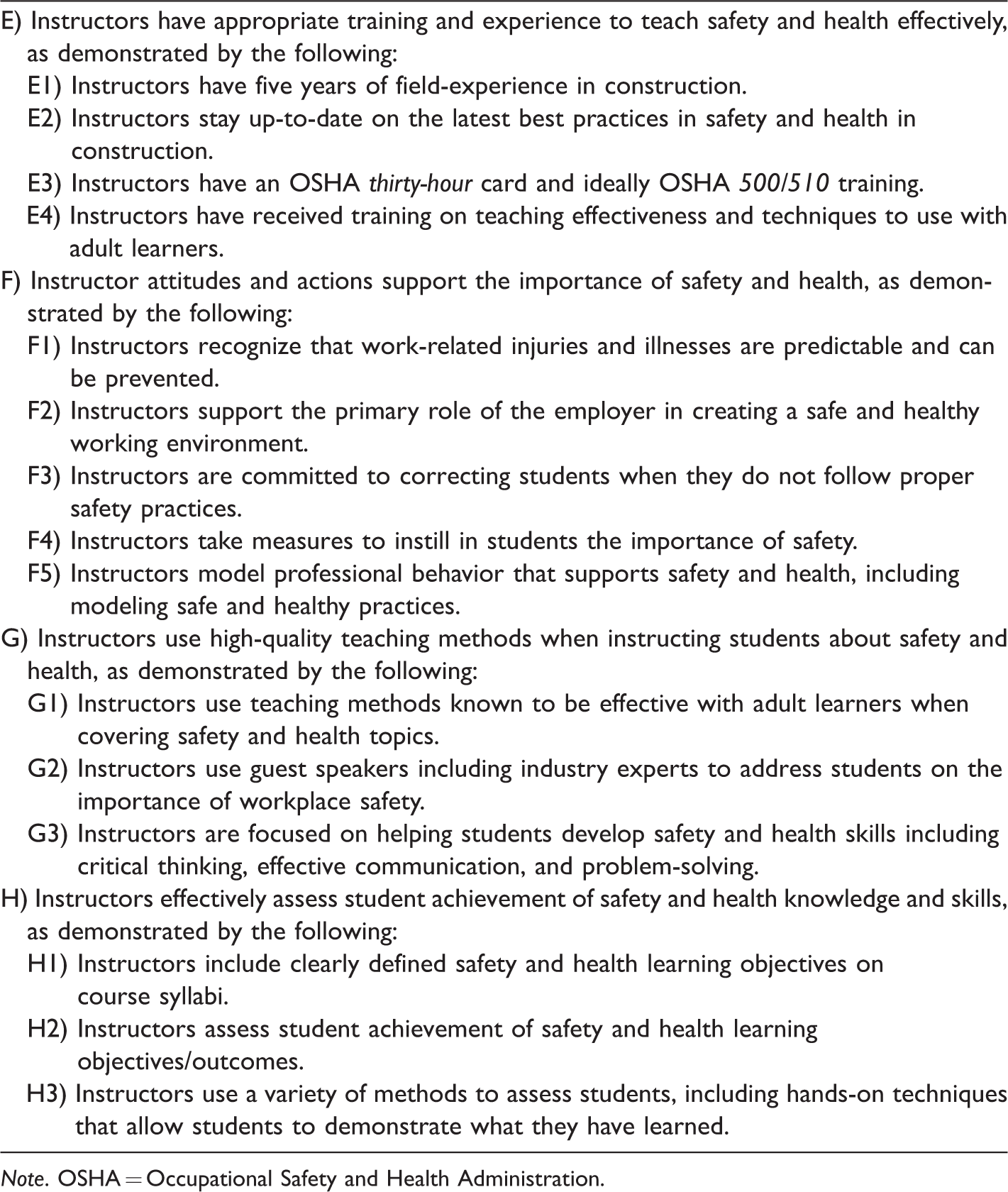
Note. OSHA = Occupational Safety and Health Administration.
Looking at the program-level first, essential elements include mandates regarding curriculum content, such as including OSHA ten-hour or thirty-hour content, alignment with industry standards, and integration of health and safety throughout coursework, as opposed to offering it through stand-alone courses. The elements also include systems of support and accountability for instructors to ensure that their teaching skills are effective, they stay up-to-date in health and safety, and they engage effectively with their industry advisory committees (IAC; all described further below).
In terms of curriculum requirements, many focus group participants prioritized the OSHA thirty-hour training course as an essential component of the curriculum, pointing out that the industry is moving toward requiring foremen to have an OSHA-30 card, which in turn is pushing their programs to provide it. Others discussed challenges with having enough course time to include an OSHA thirty-hour course, although most agreed that the OSHA ten-hour course was not a fully sufficient introduction, especially given the difficulty of covering all of the content in ten hours in an effective, participatory way.
Other participants prioritized specific information or skills that are typically covered within an OSHA ten-hour or thirty-hour course, such as the JHA. Several respondents prioritized as essential the OSHA thirty content that teaches students the critical importance of effective health and safety programs in (1) preventing human suffering (death, injury, impact on families, coworkers); (2) saving money (productivity, property loss, insurance rates; and (3) creating a better place to work (employees are less at risk and feel safer, have better morale).
Another aspect of required training discussed was the need for students to complete a field experience. Many focus group participants felt that it was essential for all students to have some kind of real-world construction experience, with some participants’ programs involving internship opportunities. While all agreed on the importance and value of hands-on field experiences, many indicated that it was not realistic to make an actual supervised field placement a required part of a program. Time, placement opportunities, and logistical issues (such as liability and workers’ compensation issues) were cited as barriers. Some felt that students could gain similar experience through school-based construction projects and other hands-on construction work in the CTE lab or shop, though one respondent declared that field experience was the most important aspect of training for students.
It was noted that if there is an offsite field experience requirement, CTE programs should have a system for ensuring that participating work sites demonstrate effective SHMS (e.g., site visits and assessment tools for initial screening, and procedures to follow if the site is at any point determined to have inadequate safety procedures). Advisory group members strongly agreed with this recommendation.
In addition to curriculum requirements, focus group participants noted the critical need for programs to have systems for support and accountability for instructors so they can provide effective safety and health education. While instructors in the focus groups valued autonomy in the classroom, they also valued having an administration that helped standardize high-quality instruction, providing support and curriculum guidance where necessary. This is what we have been talking about, about getting [the administration] more in tune to what’s going on. Even in my program, a lot of the OSHA things were not done until I came in and I implemented them. Now the college is starting to implement it in the other programs, but it wasn’t happening until I came in and set it up in my program. I asked him, ‘well how come you’re not doing it in these other programs?’
Focus group participants also suggested that programs should have active and supportive IACs. The important role of IACs in both supporting and shaping CTE construction programs was a common theme in the focus groups and echoed by advisory group members. Multiple participants prioritized these partnerships as essential to having strong OSH training and visibility in their programs. They explained that a good advisory committee can help guide curriculum content to keep it current, can provide job or externship opportunities for students, and can also support instructors in extending financial and equipment resources. Participants noted that advisory councils or committees are required for all CTE programs, either through federal funding requirements or other local education mandates for CTE programs. Administration should make sure instructors are involved at the advisory board level . . . come to our classrooms, see what we’re doing, have us on the board, so when contractors say this is what we need, we’re there talking with them. The instructor has to implement in the classroom. A lot of times the administration doesn’t want you there.
Finally, mentorship was prioritized by several focus group participants as a way for programs to support their instructors. Participants described how mentoring can be provided through continuing education and through relationships with other instructors. Concerns about programs only paying lip service to mentoring generated discussion around the possibility of developing related structures and requirements (e.g., definitions of mentoring, frequency of contact).
The overlap between certain program-level elements that create a system of support and accountability for instructors (Table 3: Elements D1-10) and certain instructor-level elements (Table 4: E1-4, F1-5, G1-3, H1-3) reflects the complementary need for administrative support for instructors, paired with instructor initiative to implement specific practices in the classroom. Participants noted that individual instructors can implement some of these practices without administrative support, but that good systems allow strong instructors to perform at their peak and at the same time support new or less-skilled instructors in improving their classroom practices.
At the instructor-level (Table 4), there were four main areas into which the essential elements can be categorized: training and experience; attitudes and beliefs; teaching methods (participatory, hands-on training, where students practice problem-solving and communication skills they will need in the workplace); and assessment methods that allow the instructor to properly assess whether students have achieved the OSH core competencies listed in Table 1.
There was a strong emphasis among focus group participants on the qualities and practices instructors themselves bring to the job. These include the need for trade experience, safety and health training, and pedagogical training, as well as the importance of demonstrating “management commitment” to health and safety in the classroom through modeling actions and attitudes that support the importance of safety and health.
Adequate safety and health training and teacher training were discussed extensively in the focus groups. In other studies,37,38 instructors have reported a lack of training on how to effectively teach about health and safety, and a desire for formal OSH training and clear, ready-to-use lesson plans. Requirements for instructors to have the OSHA 500/510 courses (construction-focused training courses required to become an OSHA-authorized Construction Industry Outreach Trainer who can in turn teach the OSHA ten- and thirty-hour courses) was a theme with substantial support in both focus groups. Participants emphasized that the OSHA 30 is inadequate as preparation for teaching safety and health, but also acknowledged challenges for some instructors to meet OSHA’s more stringent requirements regarding the amount of safety and health experience required in order to take the 500 trainer course.
Participants separately prioritized the importance of strong teaching skills, pointing out the need to balance field experience and the requisite technical knowledge and skills with having effective teaching skills. I can hire somebody that’s been on the job for twenty years, hell of a carpenter, knows everything, but not how to teach.
As noted in the section on OSH core competencies, focus group participants emphasized the need for students to develop positive safety attitudes and values, which is predicated on the instructor sharing and modeling these values. Desired attitudes among instructors include their understanding that injuries are predictable and preventable as well as supporting the primary role of the employer in creating a safe and healthy working environment. See Table 4 for the full list.
Another key instructor-level element discussed in the focus groups was the importance of instructors using high-quality teaching methods such as effective hands-on instruction, with several participants noting that their courses were required to be between 50 and 80 percent hands-on with the remaining time to be spent in the classroom. Participants observed how using a variety of teaching methods addresses different learning styles, with hands-on approaches being particularly important for learning construction skills. You need different teaching strategies for different learners . . . . Some students learn by reading but a majority, especially construction students I think, they learn by doing and actually watching. To expect somebody to learn how to do something by showing them a picture or explaining how to do it is not really a good idea in my opinion.
Focus group participants strongly articulated the need for students to develop critical thinking and problem-solving skills, but instructors were unable to describe any educational activities that were specifically designed to teach these skills to students, a problem also reflected in other studies focused on young workers.28,29
Finally, participants noted the need to use a combination of written and demonstration/performance evaluation methods in order to better gauge student learning and account for the different strengths that different students possess. Written assessments used included quizzes and exams, and formats included multiple choice, fill-in-the-blank, identification of hazards in a graphic provided, essay, and writing JHAs/JSAs. Students are required just for that intro level course to develop a personal JSA just for what it is that they are going to do. They kind of go through the steps mentally and on paper and [have to] be able to list some of the different safety concerns. For instance, if you're doing some oxy fuel cutting, some of the things that you need to look out for are your hoses, make sure that your water pressure is set correctly, make sure that there are no flammables in the area and things like that. Just be able to plan out your job scope and see some of the different hazards that exist.
Discussion
Both the focus group and advisory group subject matter experts in this study focused attention on the need for systems to be in place that support well-qualified instructors, including modeling and supporting a strong, multi-level SHMS throughout the classroom, program, and school. This underscores the critical role played by both administrators and instructors in providing effective safety and health education in postsecondary CTE programs. It also underscores the role of training within a larger system of safety—that training is not the primary prevention strategy. As part of this approach, focus group and advisory group subject matter experts emphasized the need to articulate safety and health skills as problem-solving, critical thinking skills, built on students’ understanding of how an effective SHMS works.
Themes that emerged from focus group participants’ experiential evidence are mirrored in the limited literature available, as noted in the results section. Two areas merit additional discussion—the focus on SHMS and the recommendation for explicitly including the OSHA ten-hour course content as an essential element.
The Role of SHMS
The idea that SHMSs should be reflected in CTE learning environments developed into an important structural foundation for the identified “essential elements.” While SHMS may seem to be a step removed from education in the classroom, Okun et al. 14 note that students need to experience, understand, and value the critical importance of structural supports for safety and health for which employers are responsible. OSHA’s SHMS recommendations for construction employers 31 are based on evidence that shows lower injury rates and costs for employers with safety and health programs that include seven core components: management leadership, worker participation, hazard identification and assessment, hazard prevention and control, education and training, program evaluation and improvement, and coordination when there are multi-employer worksites. 32 Further, SHMSs are recommended, and in some states required, 45 for all businesses.
While many students from postsecondary CTE programs may end up in less-than-ideal work environments, the focus group and advisory group subject matter experts participating in our study emphasized the importance of students learning in and internalizing the experience of working in an environment that reflects high industry standards where the SHMS is a part of everyday operations. This approach creates a context where students can experience positive results from participating in SHMS activities, helping to develop self-efficacy and the confidence to participate actively and effectively in a future company’s SHMS, or even establishing an effective SHMS as an employer themselves. It further underlines the primary role of the employer in setting up a safe workplace. Even the best training cannot be expected to prevent the majority of injuries and illnesses in construction on its own.46–48
It is important to acknowledge and address the gap between a model SHMS and approach to OSH that values prevention through design and the hierarchy of controls, and the actual working environments that students from these CTE programs will enter, likely without union protection. As one participant noted, new workers do not typically have the power to change a workplace’s culture and would be unable on their own, for example, to implement some of the most effective components of a SHMS. Likewise, new or young workers attempting to raise safety concerns may also encounter the challenging realities of employment relations and precarious work, including intimidation, retaliation, and the pressures to prove themselves as tough, uncomplaining workers to whom employers are inclined to keep giving work. Programs must prepare students to strategically apply what they learn about safety in light of the challenges present in the construction industry. Mentorship may have a role to play in providing support after the student leaves the CTE program, and labor-management apprenticeship programs offer potential models with ongoing mentorship and training layered onto work experience.
The Role of OSHA Ten-Hour Training
Providing students with an introduction to safety and health through the OSHA ten-hour construction training course is included among the essential elements as a minimum starting place for safety and health education. It is important to note that we recommend this content be taught using high-quality teaching methods (based on adult learning principles described earlier) rather than the lecture-based approach used in many OSHA ten-hour courses. The research on the protective impact of the OSHA 10 training is not definitive, though some existing data are suggestive. One recent comparison of injury and fatality rates between the seven states that mandate OSHA 10 training for workers in public construction projects and other states showed promising but nonsignificant downward trends in both rates. 47 Another study showed a 13 percent (but statistically nonsignificant) reduction in injury claim rates among 17,000 union carpenters with OSHA 10 training, with higher reductions in claim rates for carpenters in their apprenticeship years. 48 At the same time, these researchers underline the need for quality training. Our list of elements includes an emphasis on integrating OSHA 10 and all safety and health training into all trade skills courses as well as incorporating established adult-learning pedagogical practices. A particular concern to note, raised by the advisory group, was the disproportionate attention to safety issues versus health issues (including ergonomic hazards) in actual discussion among focus group members. Ergonomic hazards in particular are a major contributor to work-related injuries in construction, are included in our list of key hazards to be covered, and need to be emphasized in any construction training program. Other hazards such as workplace violence, including sexual harassment, were also not raised by any of the SMEs in this study. Despite this, we recognize these issues are of increasing concern and are of particular importance in the very gendered construction industry. 49
National Survey and Essential Elements Guide
These lists of essential elements and competencies were developed as part of a larger study and were used in a national survey of CTE administrators and instructors to describe the extent to which the elements were in place in postsecondary construction CTE programs. The elements and some of the findings from the larger study were shared in a guide tailored for CTE administrators and instructors along with tools to assess their programs and support implementation and are currently available at http://bit.ly/cte-guide.
Everyone in construction training agrees that students “need to learn safety,” but clear guidelines about the full spectrum of what to teach and how to effectively provide the training, including outlining the resources and support systems necessary, have been lacking. The essential elements identified through this study help to fill this gap and lay the foundation for articulating clear steps that CTE programs can take to ensure that the most effective training is taking place in their construction programs, and that it is done as part of a clearly articulated SHMS.
Conclusions
This study, drawing on existing research and experiential evidence from subject matter experts, outlined for the first time a formalized list of essential programmatic, instructor, and curriculum elements that support effective safety education in postsecondary CTE construction programs. This can be an important starting point for CTE administrators and instructors, as well as policy-makers, for improving the preparation that students receive to be competent in OSH skills that can help keep them safe on the job.
Further research is needed to identify model programs that reflect these essential elements as well as to continue to explore emerging or newly recognized hazards, develop further evidence to determine which elements most strongly support student OSH competency, and identify the barriers and supports that enable programs to have these elements in place, including supportive state-level policies.
Footnotes
Acknowledgments
The authors gratefully acknowledge the support and guidance of their advisory group members and the contributions of their focus group participants.
Declaration of Conflicting Interests
The author(s) declared no potential conflicts of interest with respect to the research, authorship, and/or publication of this article.
Funding
The author(s) disclosed receipt of the following financial support for the research, authorship, and/or publication of this article: This research was supported by CPWR: The Center for Construction Research and Training (CPWR) through NIOSH Cooperative Agreement Number U60-OH009762. Its contents are solely the responsibility of the authors and do not necessarily represent the official views of CPWR or NIOSH.