







Abstract
In 2020, medical cannabis is legal in thirty-six states and adult use (“recreational”) cannabis is legal in fifteen, despite cannabis remaining illegal at the federal level. Up to 250,000 individuals work as full-time employees in cannabis. During the COVID-19 pandemic, California, Colorado, and other states deemed medical cannabis business as essential, raising occupational challenges and safety issues for cannabis employees. In 2020, interviews were conducted with Ethan, an extraction lab assistant in Las Vegas; Haylee, a trainer with a cannabis company in Sacramento; and Belinda, a Wisconsin-based occupational health and safety trainer, to showcase concerns and experiences in cannabis workplaces and training programs. Findings from interviews reveal pro-worker activities to promote workplace safety and labor unionism while large multistate operators seek to optimize profits and obstruct workers' rights. Knowledge gained through the interviews contributes to discussions to lessen the potential exposure of the cannabis workforce to COVID 19.
Keywords
Introduction
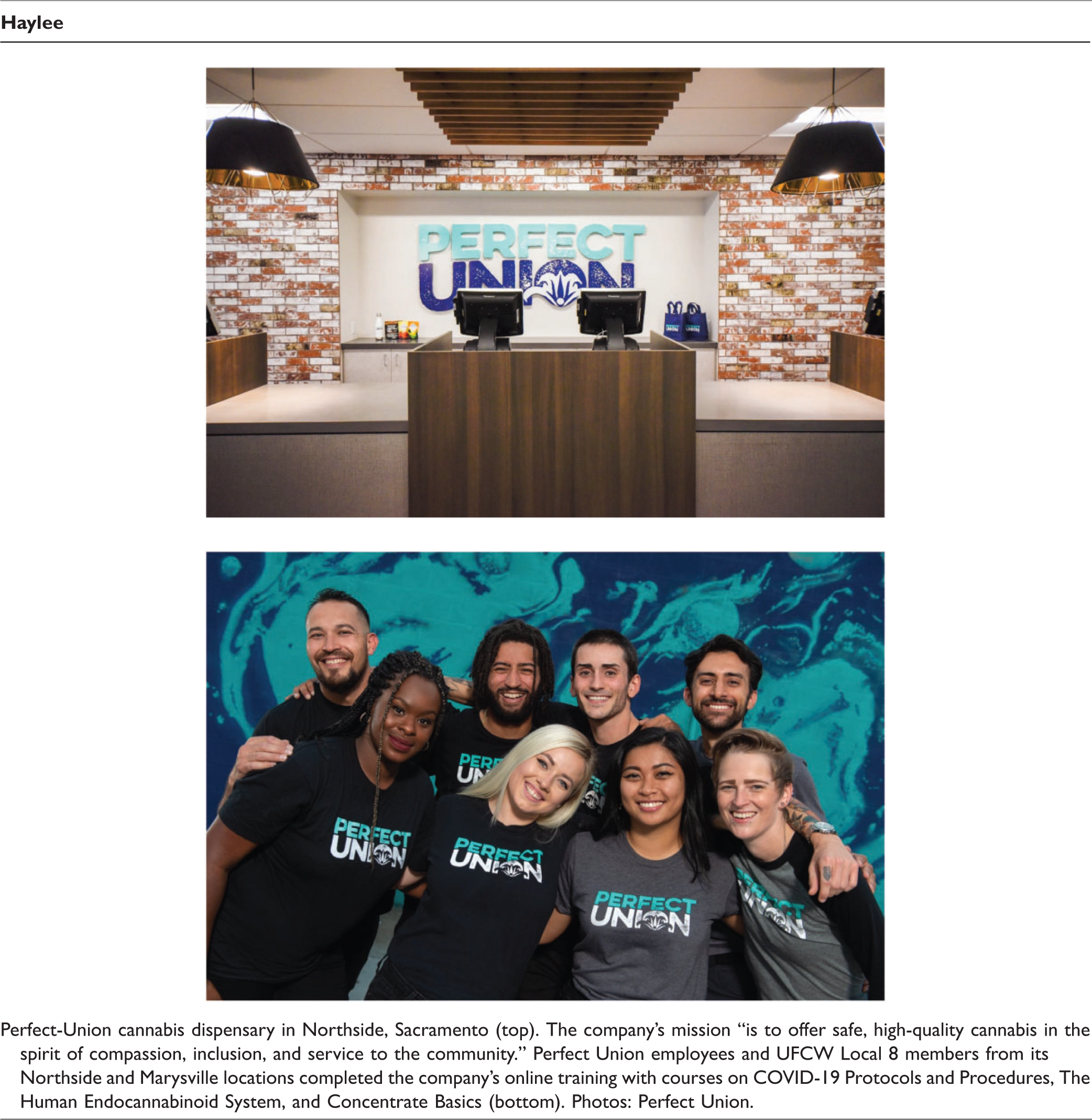
Nearly twenty-five years ago, California emerged as the first state to legalize cannabis for medicinal purposes. In 2020, medical cannabis is legal in thirty-six states and adult use (“recreational”) cannabis is legal in fifteen, despite cannabis remaining illegal at the federal level. Up to 250,000 individuals work as full-time employees in the cannabis industry. In 2020, interviews were conducted with Ethan, an extraction lab assistant in Las Vegas, Nevada; Haylee, a trainer with a cannabis company in Sacramento, California; and Belinda, a Wisconsin-based occupational health and safety trainer, to showcase concerns and experiences in cannabis workplaces and training programs. These conversations show that workers face job hazards such as mold exposure and concerns about personal protective equipment and respiratory health. Employees confront hazards due to the pandemic and the status of cannabis as an “essential” business. An additional challenge faced by workers and the industry as a whole is the stigma attached to cannabis, as Haylee mentions in her interview. Haylee’s employer, Perfect Union, has operations in California, New Mexico, and Rhode Island, with collective bargaining agreements in each of these states. On its website, Perfect Union states that the company name refers to the way it relates to customers. To us, and based on our conversation with Haylee, Perfect Union embodies the company’s pro-worker culture and the normalization of labor unions in the legal cannabis sector.
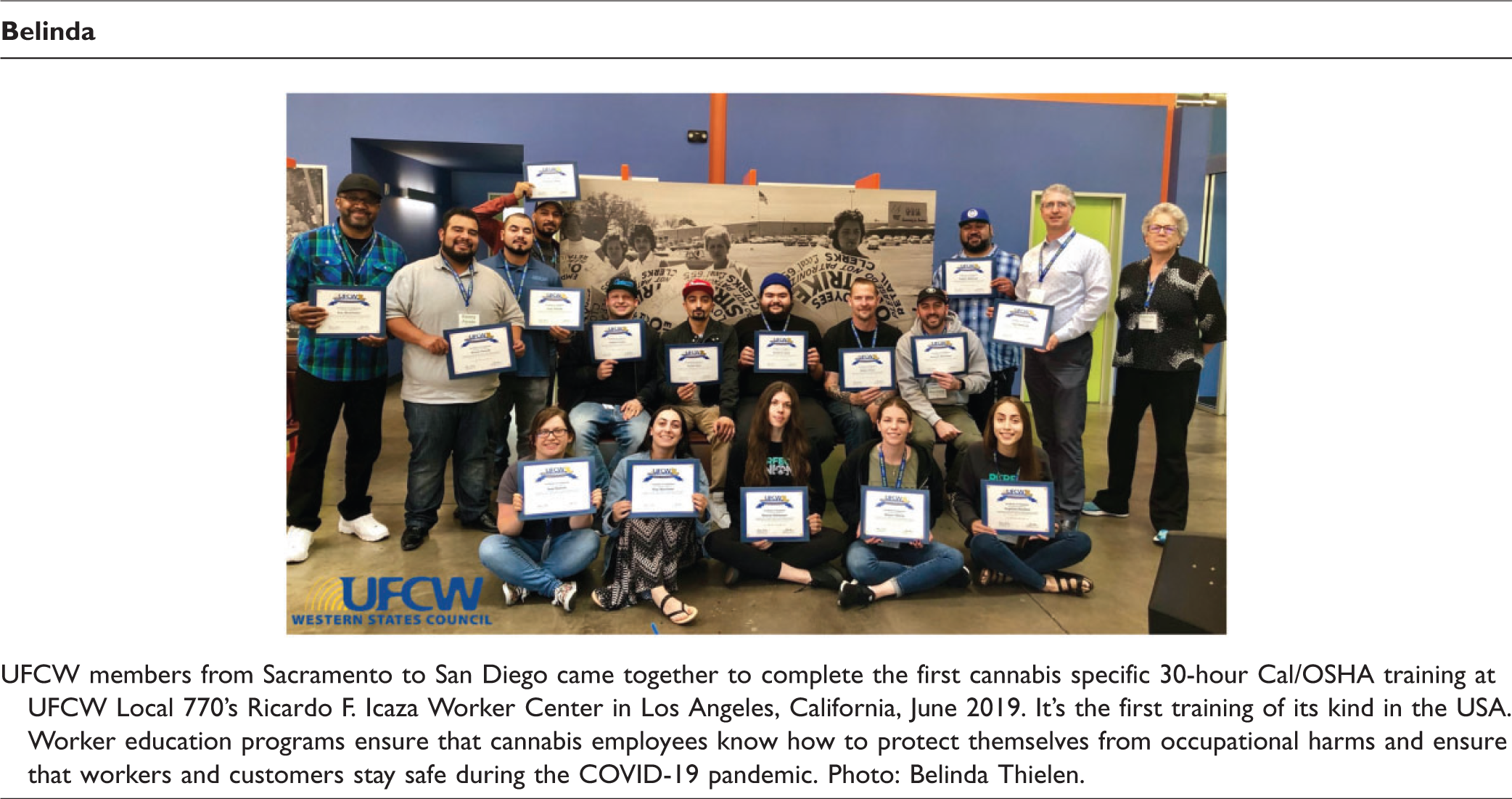
Belinda discusses the popular education approach that informs her pedagogy in workplace trainings for cannabis workers that she conducts as an educator with the United Food and Commercial Workers International Union (UFCW). The UFCW represents about 12,000 cannabis workers in fifteen states. Beginning in 2019, Belinda administered ten cannabis-specific health and safety trainings (thirty hours each training) in California as part of state rules that require each licensed cannabis business to train one worker and one manager. She suggests that genuine equity in the workplace is impossible in an economic system that places a low value on the lives of workers. Findings from interviews reveal pro-labor activities to promote workplace safety and dignity while large multistate operators seek to optimize profits and cut labor costs. Insights from conversations with individuals engaged in cannabis index emerging cultures of workers’ rights in legal states and in states undergoing cannabis legalization where stakeholders engage with workplace safety, compliance issues, and labor unionism. New knowledge gained through the interviews contributes to discussions to lessen the potential exposure of the cannabis workforce to COVID-19. The interviews were conducted by Marty Otañez, Associate Professor, Anthropology Department, University of Colorado Denver, and Jassy Grewal, MPA and Legislative Advocate, Western States Council, United Food and Commercial Workers International Union.
Interview With Ethan
MARTY: Tell us about your background and how you got into the cannabis industry.
ETHAN: I’ve been working in cannabis since 2018. I made my way to Las Vegas and have been working in laboratories, learning as much as I can. I came from a Southern California city where a legal regulatory framework from cannabis did not exist; it is kind of like the wild wild west out there. Before cannabis, I worked in the grocery industry and the service industry.
MARTY: You work as a cannabis lab technician, doing extractions. Take us through what is a lab technician for folks to get a better understanding of your job?
ETHAN: As a lab technician, most of the day is spent performing procedures associated with the processing and the extraction of cannabis material. That’s everything from regulatory procedures like recording data and chain of custody on the product to handling, producing, and even packaging it as well. A lot of time is spent maintaining equipment and assisting the lead extractors, our supervisors. It’s all the work with half of the liability of the final product.
MARTY: What do you mean when you say, “With half of the liability of the final product?”
ETHAN: In the cannabis industry, we are responsible for the products that we put out as extractors. A lot of the feedback that’s coming back to the lab will go to the supervisors and lead extractors. A lot of the responsibility for the final product falls on them. Being a lab technician, it’s more just getting the job done and being there to facilitate the work that needs to get done that day.
MARTY: As a lab technician, you work with hydrocarbon extraction. Explain to us the extraction process.
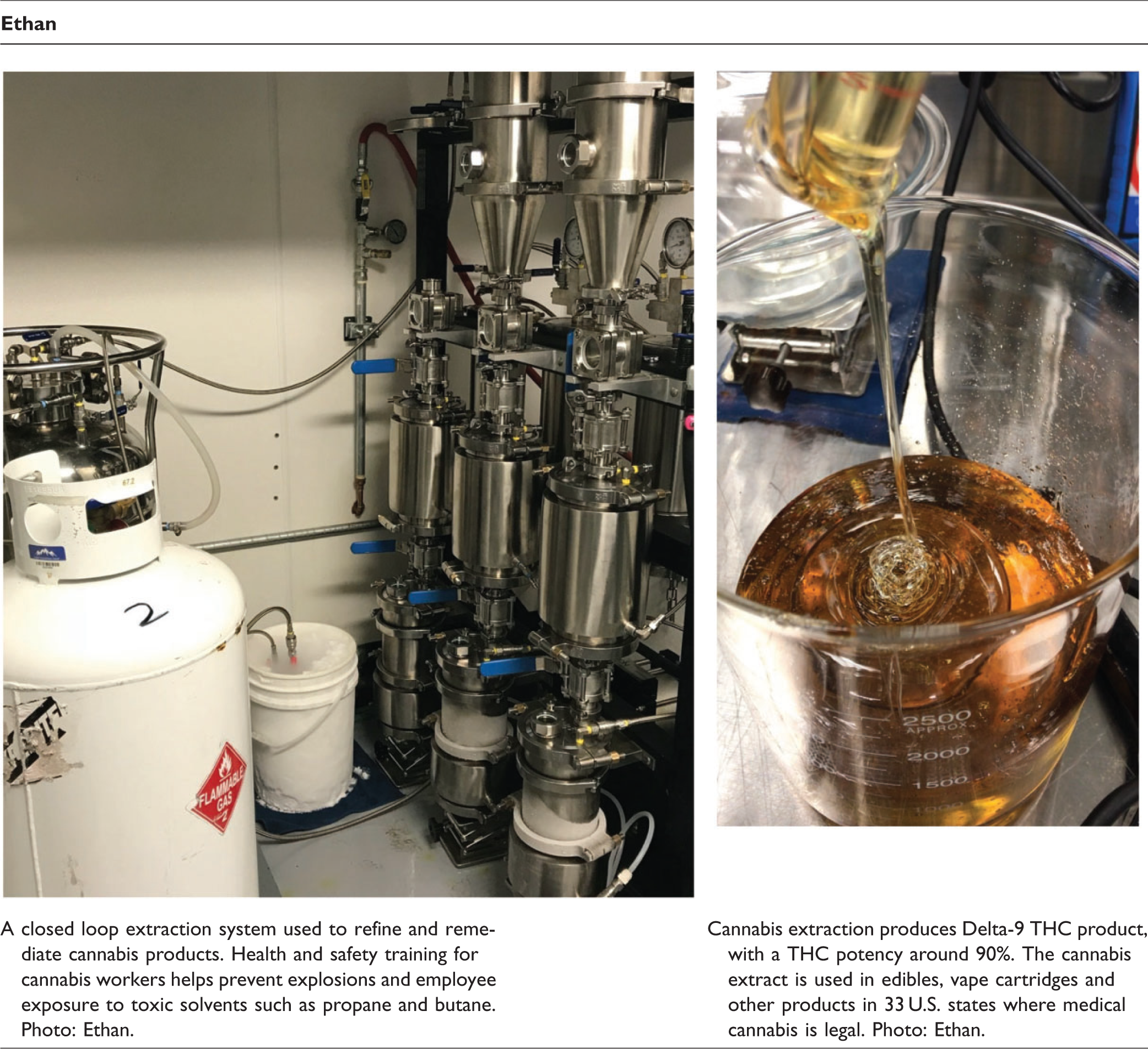
ETHAN: Extraction is taking fresh, clean cannabis material, and extracting the active compounds from it to make concentrates. Remediation is taking contaminated material and remediating it to a product that is viable to sell. I want to make this clarification because we do both processes in the lab. As far as hydrocarbon extraction goes, that’s just using an organic solvent to achieve this goal. We use butane/propane mixtures. You take that solvent and using industrial grade equipment you process the material with it. You put it in the machine, run the solvents past it and pull off the active compounds that you’re looking to extract from the material like cannabinoids, flavonoids, and terpenes.
MARTY: What would be some of the end products of extraction, contrasted with products from the remediation process?
ETHAN: With extraction, it’s a lot less steps in the remediation. You take the clean fresh cannabis material and run it through the hydrocarbon extractors. You get a crude material that you then pour off and evaporate off residual solvents. It creates products like shatters, waxes, butters, and sauces. There’s a whole variety of different final products that can come out of it depending on the cannabis material that went in. With remediation, there’s a lot more steps to it. You have the extraction and filtration steps. You have a recovery step and a short path distillation. The final product of remediation is D9 distillate or Delta-9 THC. This is a product used in vape pens and edibles. It tends to be a much more valuable product than typical concentrates, in part due to the low cost of material and a high retail value of the final product.
MARTY: I’ve heard that in the past five years in over thirty-three states where cannabis extraction occurs, there have been at least ten different explosions. Is an explosion a concern for you in the extraction process?
ETHAN: That’s a big concern and rightfully so. The volatility of the solvents used in the processes, butane, propane, any fraction of a natural gas has a high susceptibility to explosion. Ethanol is another solvent used in large volumes in the lab as well. Obviously, highly flammable. That’s one that I think the media has covered quite a bit. People doing it in improper atmospheres and settings and mishandling the solvents which can lead to pretty drastic outcomes.
MARTY: Do you have any health concerns as a lab technician dealing with extraction?
ETHAN: On the side of remediation, the quality, and often times contamination of starting material, that was a big eye opener for me, especially the microorganisms.
MARTY: What are some of the problems with source material?
ETHAN: If you look at cannabis as an agricultural industry, it’s obviously a cash crop. With any sort of large crop, you have issues of microorganisms and other contaminants. Earlier, I suggested that things like molds, fungus, bugs and all sorts of natural invaders that aren’t suitable for human consumption can get on the plants. With a lot of the larger cannabis grow facilities, the sanitation of the rooms isn’t necessarily up to par. Perhaps due to employee turnover, the knowledge base for keeping clean environments isn’t always there, and these things exponentiate the potential to unknowingly contaminate crops. Each legal state has regulations set up to test the material to make sure that it’s suitable for consumption. If these tests fail, you have two options. You can either waste all the money that you invested in that crop and destroy it. Or you can send it through a remediation process where it goes into a lab and through hydrocarbon extraction, filtration, and distillation. Through these activities, you can remove even the smallest of micro-organisms and other contaminants. If you’ve done the process right, you retest and have a pure product. This isn’t discussed as openly as I believe it needs to be. Through my own research I know that there are companies in Nevada that are seeing upwards of 50 percent fail rates on their harvests. This is extremely high. I think it’s due to the indoor climate where we cultivate in Nevada. We are in the middle of the desert. If you’re not growing in a greenhouse, you’re growing in a building, and that comes with its own challenges.
MARTY: What are examples of sanitation problems in labs or cultivation facilities?
ETHAN: Cannabis uses a high humidity environment to grow. As the plants proceed through their lifecycle, you start to see changes in the plants, either in the root systems, stems or leaves. You can also view it in the growing environment. Let’s say there’s certain devices used in the grow environment like dehumidifiers. Any moisture buildup is ideal for the mold spores and allows them to reproduce. This is something that’s very hard to visually observe until it’s already there. You can see it on the plants, devices used in grow rooms, and even on structural aspects of the buildings occasionally.
MARTY: Have you been affected along health lines due to the remediation process?
ETHAN: The first step of the remediation process is to take the contaminated material and prep it for extraction. You do this by taking the material and physically putting it in a filtration device. We call them socks because they’re kind of long like a tube sock. This tube sock-like tool acts as a micron filter, a sort of mesh net that keeps in the material while it’s in extraction, but still allowing the active components to pass through. You fill up these micron socks and prep them to go into the machine. Every day that’s probably three, four hours of the work preparing the material for extraction. Working with that material day in and day out, ten hours a day. At first, I didn’t have any issues with it. Then, one day in the lab, my body responded to it with a severe allergic reaction. I had difficulty breathing and swelling in my face enough so that my supervisor said that I should step out for the day. I had weeks and weeks of a full body rash and sores as a response to the molds and other fungi that were growing on cannabis material.
MARTY: Did you seek medical care for your symptoms?
ETHAN: Because this happened at work, I was sent to a contracted urgent care provider. The thing that’s tricky about mold exposure is that unless you’re talking to a specialist, you can’t be diagnosed. And, until you’re diagnosed, you can’t be treated. The first three doctors I saw all claimed that my symptoms and what I was going through was beyond the scope of their practice. They were urgent care physicians and not able to diagnose something that was infectious. Only after seeing an infectious disease specialist and an allergist who specializes in mold, I was tested for, and diagnosed with, chronic exposure to Alternaria Alternata. The process involved a series of blood panels and physical examinations.
MARTY: Do you have any long-term effects because of the exposure to the contaminants in your cannabis job?
ETHAN: I have asthma now along with other immune system complications. It’s not a severe form of asthma, but it has inhibited my ability to breathe and do physical activity.
MARTY: What were you thinking or feeling that day when you had that conversation with your supervisor that you should go home?
ETHAN: I was trying to justify the reaction. I was trying to think if I had perhaps eaten something. Then it clicked that I need to figure out what I was working with that day. Because that would be the most reasonable source of what triggered this reaction. After being relieved from work and going to multiple urgent care health facilities and having them tell me “We can’t diagnose this. This is beyond our scope. You need specialists for this type of thing.” I started diving into it myself and learning about mold reactions and hypersensitivity reactions.
MARTY: After you returned to work, what was the reaction of your company?
ETHAN: They started to realize that there was something serious going on and that the company should start putting workers in Tyvek coveralls and start using respirators in certain environments. I went to my CEO and gave him World Health Organization and CDC guidelines for mold exposure in the workplace to give him some sort of insight on how this is happening and how this happened to me. I continued to come to work daily even with the symptoms. Through my process, the HR representative was very sympathetic to what was happening with me and wanted to help. There’s only so much one can say when you’re representing the company. It got to the point where I was trying to explain to the company the situation of what had happened, presenting test results, presenting doctor’s notes, and correlating what happened to me under their employment.
There was zero concern for my well-being, aside from one or two people, just out of genuine concern that I was having a severe reaction, and they wanted to make sure I was alright. As far as addressing the issue and sitting down and digging into the issue and putting stuff on the table, and coming to an understanding, it was a complete rejection of anything that I presented on the subject and a complete dismissal of any claims that I had working for this company.
After working for a while, my doctors and I figured out that because there’s mold proliferating in the building, me being in the environment and being exposed to the quality of air inside the building was triggering my hypersensitivity and not allowing my symptoms to subside and to return to a normal state. I was instructed by my healthcare providers to no longer return to that building. From there it just became a dispute with the employer over hospital bills and lost wages. Then, it was just a full out denial of responsibility and kind of pushed me under the rug and eventually ended my employment.
MARTY: Did you have any luck demonstrating an association between the cannabis you worked with on the day of your exposure and test results that the company received from labs showing failed testing results?
ETHAN: There is a way to do that. Unfortunately, the company did not provide all the recorded data. They withheld it. There is a chain of custody of data that every time someone touches the product, it must be recorded and signed off. As I worked with daily product, I recorded the batch numbers and lot numbers of what I was working with. The batch numbers and lot numbers correlate to the testing results that were presented for that specific product. I can prove it through chain of custody, looking at which material I worked with, what it tested for, and what it failed for. The thing that has proven difficult is getting that data from the company and testing labs. Obviously, that’s important data for them. It’s not something they want to freely give out.
MARTY: What should be done to protect cannabis workers from contaminants during the remediation process?
ETHAN: More appropriate personal protective equipment (PPE) is needed, such as Tyvek suits, N95 respirators with the proper filtration mechanisms, and eye protection. Remediation is the final process with the cannabis plant, but a lot of prevention measures fall on the cultivators and the people who spend time with the plants from germination to flower. If humidity controls aren’t adjusted, it can contribute to mold growth. Improvements in PPE and improvements in cultivation skills in the beginning processes so that remediation isn’t necessary would be ideal.
MARTY: Tell us about any training that you had, in general or specific to the remediation process.
ETHAN: The training that I received in the company was not specific to the extraction or remediation processes. The only trainings that I received were about sexual misconduct and food handling and sanitation. There wasn’t any training pertaining to the actual processes or health and safety regarding the materials that I worked with.
MARTY: In terms of quality and safety, do you think your employer had the best interest of the workers in mind?
ETHAN: When you are on the labor side of the cannabis industry, you spend your entire days working closely with this product. You develop a very keen sense of what’s good, what’s bad, what could be better, and what could be done differently. A lot of the time suggestions are shut down due to the difficulty of the issue or things not being financially viable as far as the final products.
MARTY: Do you think having a union might help increase health and safety protections for cannabis workers?
ETHAN: Yes. I personally have never been involved with a union. I can’t really speak on it other than from the outside. I grew up in a union-heavy area in northern Indiana, with a lot of steel mill unions. I saw the long-term effect of unionization in larger industries and how the involvement of unions can allow the labor force to build a bridge between the work they do and the work management does, and to have a voice to be heard and have the ability to be represented and considered seriously as the industry moves forward. Also, unions provide protections in situations where businesses may not feel obligated to protect workers.
MARTY: Could you tell us about your experiences or any concerns that came up when you worked as a cannabis employee during the COVID-19 pandemic?
ETHAN: We were shut down and I was furloughed. A lot of people were terminated. Many workers and I were taken off work for two to three months. Nevada declared cannabis an essential industry, so the company did stay open. Most of the workforce was furloughed or laid off. Eventually the government intervened and said that we’re going to open in phases and “let’s bring some workers back.” We went back to work and not long after that we started having positive tests for COVID pop up in multiple facilities. Everyone was kind of on edge about that. The company’s response to COVID was insufficient. Surgical masks were there before the pandemic. They’re obviously going to be there after the pandemic. Gloves were there before it, too. There were a couple measures that they took such as staggering the staff so there’s less people congregating in certain areas or working in certain rooms. We had temperature checks and encouraged social distancing. A lot of people took the precautions into consideration, but when you have a certain volume of space to work in, you can only do so much. A lot of people took the precautions to heart, but at the same time you must perform your job. The employers tried the best they could but from the labor side, perhaps more could have been done.
MARTY: Share a conversation you had with your supervisor or manager that reflected your concerns about COVID-19, or any discord that existed between employees and management?
ETHAN: The one thing that made me decide to separate from the company was that we came back to work after an initial COVID response. They told us, “Hey, you guys can go home, quarantine if you’d like, and if you feel comfortable, come back to work.” We came back to work and continued to work, continued to try to adapt to the situation. On a Friday, the company found out that one of the employees who’d been working in a facility for the last week, tested positive for COVID. The company figured this out on Friday and the following Monday, they had everyone report to work. When we all got there obviously people began talking and realizing that this had happened. Instead of handling it in a professional manner and calling a meeting, they had us work the whole day. By the end of the day they organized an impromptu management meeting saying, You can go home, but there’s no guarantee your job will be here. We know you guys have been here for two days since we found out the exposure was in this building. You can leave now if you want, but when you come back, we may have to fill your spot.
Unfortunately, in big business it tends to be that labor is disposable. If you can’t do what’s expected of you then someone will come in the next day and do what is expected of them. Not to shine too much of a negative light on this industry, but there’s a lot of good people, great teams, and great companies out there. They are fighting and battling for better cannabis for our communities and they are being challenged by big money, big industry, and the challenges that come along with developing into a larger industry.
MARTY: You are currently not working in the cannabis industry. Do you plan to return?
ETHAN: I absolutely do. I’m looking forward to it. This has been an incredible learning experience. My previous job increased my understanding of extraction in many unexpected ways. You don’t need solvent-based extraction. When you’re looking for yields and large profit margins, it’s the way to go. But there are methods developed by the community for solvent-less extraction. All you use is heat and water to get a higher quality product and I believe a higher quality product than we’re producing in these labs at least qualitatively. I look forward to getting back into the industry. I’m going to work a lot more towards the solvent-less sector and advocating for that, while also trying to learn myself and inform other people of potential dangers in the industry moving forward.
Interview With Haylee
MARTY: What is your background and how did it help you get into the cannabis industry?
HAYLEE: I actually was not formally educated or trained in cannabis. I rode horses for ten years and trained horses before I moved from Arizona to California. I struggled with anxiety and cannabis was very helpful. I didn’t know a lot about the science of it. The company took me under its wing. After my managers saw that I was passionate about cannabis and wanted to learn more, they provided me with the tools and resources that I needed to do so.
MARTY: Tell us about your work in cannabis.
HAYLEE: I am the Director of Training and Development for Perfect Union, a cannabis company headquartered in Sacramento, California. I have been in this position since March of 2020. Prior to this, I was head trainer of our flagship store for several years before taking on the role of general manager at our second location. I’ve been working in the cannabis industry for six years. I started as a bud-tender and worked my way up to head trainer, eventually becoming a supervisor and then general manager. I also did some finance-related work and bookkeeping. I’ve worked in almost all areas of the company.
MARTY: How did you become involved in being a cannabis trainer?
HAYLEE: When I started working in the industry, it was still medical only and I got so much joy helping people who came into the dispensary. By passing on a little bit of knowledge, I was able to make their day, or make a difference in their life. I love the science of cannabis and there wasn’t a lot of established research at the time. I spent a lot of time researching reputable sources and coming up with a curriculum. I shared these materials with my coworkers and general manager. That’s when she asked me to become a trainer. I’m passionate about providing education to our guests who need it and passing on the knowledge.
MARTY: What are the kinds of trainings that you do and who takes the trainings?
HAYLEE: Retail training is the main type of training that we do. We have an online training platform that we use mostly for cannabis education. The curriculum is still not quite as structured as I would like it to be, but we’re getting there. Eventually it’s going to be a lot more structured so we can use the curriculum in our new stores and have our head trainers execute it successfully.
MARTY: What are some of the topics discussed in the trainings?
HAYLEE: Cannabis is a very regulated industry. We are monitored closely by the BCC (California Bureau of Cannabis Control), which influences a lot of what goes into the training. We make sure that our bud-tenders are informed about the different regulations, including things like purchase limits. Everyone also gets trained on our emergency action plan. Our managers and supervisors are CPR-trained. Recently, we’ve made it mandatory to educate our bud-tenders about COVID and how to prevent the spread, because that’s something that is severely impacting our business right now. We are making sure that we’re taking all the proper protocols to stay open and keep our employees and our guests safe.
MARTY: Before we talk about the pandemic, can you tell us about a couple training modules that employees were excited about or found more interesting than others?
HAYLEE: Two come to mind—The Human Endocannabinoid System and Cannabis Concentrates Basics. The module on the endocannabinoid system is designed to be simple, because once you get into the science of it, it’s very complicated. The endocannabinoid system can be found in most mammals. It helps our body maintain a state of homeostasis, which is a constant, internal environment despite external fluctuations. Almost every single person I’ve talked to about our training platform mentioned this module by name and said how much it helped them. When you think about it, the endocannabinoid system is essential to understand if you’re making recommendations for medical patients. It allows you to tap into what this person wants or needs, and make a more accurate recommendation, therefore making them happier. They’re going to get home and enjoy the product because it’s exactly what they wanted.
MARTY: How has the pandemic influenced your training for employees?
HAYLEE: The COVID-19 module was huge because education is a big piece of understanding how this disease spreads and how serious it is. There’s a lot of misinformation that gets circulated. Being able to provide people with reliable resources to educate themselves was a big piece for me, and not even necessarily limited to training, but just how we operate in the retail environment in general. I stress to my trainers that it’s crucial that all new hires are well educated about keeping a sanitary environment. It is important to us to make sure that people understand what chemicals to use, where to use them, when to clean, and what the common touch areas and surface areas that need to be sanitized regularly.
MARTY: Can you go into more detail about what protocols or precautions the company is taking to ensure the workers are protected and it can stay open?
HAYLEE: Everyone has gone through the COVID module which covers how the virus is spread and what we need to do in our stores to make sure that we’re not contributing to it. Our employees are required to wear masks at all times. If they’re eating or drinking, they have to be socially distanced. Typically, we ask them to try to go outside if possible because our stores don’t have a ton of space in the back. We also ask our employees to use masks and gloves. All of the guests who come in have to wear a mask. If they can’t wear a mask due to certain medical conditions, or they’re uncomfortable, we have face shields available for them. We have people running around who are cleaning and wiping down all the common surface areas every hour. We’re trying to do as much as we can behind the scenes to make sure that everything is sanitary and clean.
JASSY: When the company was developing training modules for COVID, what led you to the training platform as opposed to flyers or other dissemination methods? How effective was it in terms of educating employees about what was needed to be done?
HAYLEE: We have the online platform, but we have posters that went out. Additionally, we also had several notices that went out to the general managers and also held meetings with each crew before their shifts. Our online training platform is effective because our employees can access it on their phones and computers. They can also download the courses. For those who don’t have internet access, we can download training modules as a PDF and print it out. Everyone has a different learning style. With our training platform you can embed videos and integrate posters from the CDC. We can also assess employee progress on courses to ensure that they’re completing everything. If they’re struggling with a certain topic, we can see that and supplement it with in-person training to make sure that they are digesting the information.
MARTY: The information and practices in the workplace associated with COVID-19 seem to impact the customer experience. What happens when a guest enters a store, makes a purchase, and exits the dispensary?
HAYLEE: The guest will walk up to the store and get into line with their mask on. Then, once they’re ready to go in the building, the security guard will open the door for them and allow them into the reception area. We have hand sanitizer stationed there for them. After checking in at the front desk, the guest would be let into the sales area where we’re enforcing social distancing. The guest would then consult with a bud-tender and make their purchase. After the guest leaves, the bud-tender would wipe the station down.
MARTY: Can you recall an incident when a guest voiced a concern during the pandemic?
HAYLEE: Most guests were very understanding. There were those who didn’t want to comply with the mask order. We took them aside, explained that this is what we have to do to stay open and apologized for the inconvenience. We never want to upset our guests, but it is our responsibility as a store to make sure that we’re doing everything to protect not only our other guests, but also our employees. Employees see hundreds of people a day and whenever we had someone that didn’t want to comply with our policies regarding the pandemic, we just really tried to spend the time and explain the why behind it, and usually that was successful and they were more than understanding.
MARTY: Did you have any concerns or fears at the beginning of the pandemic?
HAYLEE: I was fearful that we weren’t going to be deemed an essential business and that we were going to have to shut down. Once we got word that we are essential, my mind immediately shifted to how we were going to handle the increase in foot traffic. We experienced a significant increase in people coming into the shop, each and every day. It was extremely hectic for a while. A lot of people turned to cannabis because they were stressed out and anxious. They’re sitting at home all day and don’t really have an outlet to help them combat the anxiety that they’re experiencing. We had a lot of new guests coming in to try cannabis for the first time. We had people stocking up out of fear that we were going to run out of products. It was really all hands-on deck to try to manage the increase in foot traffic for a while. Secondary to this is the safety of our employees and our guests. With that increase in foot traffic, the chances of COVID spreading in one of our locations is higher. Ordering masks was very stressful because there was a shortage when the pandemic first hit. Trying to get face shields, trying to get hand sanitizer, and stocking up on cleaning supplies made it feel like we were sprinting for a couple of weeks, but now we’ve gotten to a good place.
MARTY: Are the company’s employees paid to participate in the training?
HAYLEE: Yes, they are paid. Employees complete all of the online training before they start on the job training. That way they are primed and ready to absorb whatever we’re going to throw at them in person. The training system tracks their time spent on a course. We can see how much time that they are spending on a certain course and pay them accordingly.
MARTY: Are workers' rights included in the training?
HAYLEE: Not right now, but I am working with my HR (Human Resources) team to create something like that. We are in the process of going paperless, so we’re getting a new HR program and once that’s established, my Director of HR will send me over all the information.
MARTY: Why do you think it’s important that your employee training includes workers' rights?
HAYLEE: Everyone deserves to know what their rights are. I think that if everyone is educated on what they’re entitled to, they feel more empowered to speak up. Also, from an employer perspective, it lets them know that we genuinely want the best for them. They’re entitled to these things and we want to be able to hold ourselves accountable if we’re not living up to that standard. The more educated they are, the more they can hold us accountable. It’s a win-win situation because our employees are going to be happier and therefore pass that onto the guests.
JASSY: How do you put together course materials or figure out what’s most important for your workers to know in the training?
HAYLEE: When I made a training manual for us five years ago, I asked myself, “How did I approach this journey of getting to know cannabis?” I started with the fundamentals—learning about the flower, differences between Indica and Sativa, and the anatomy of the cannabis plant. I tried to have a very commonsense approach to the training and make it as accessible as possible. Because of the pandemic, we lost a lot of people and we have a lot of new people on the team right now. They are enthusiastic and excited to get into the industry. My focus has been on getting them up to speed because a lot of our tenured staff is very well educated. My focus has been on teaching new employees the basics and later we are going to dive in a bit deeper.
MARTY: Is there one or two health or safety issues that stands out in the retail end of your company?
HAYLEE: In the current climate, there has been an increase in potential robberies or threats against cannabis dispensaries. We are one of the only businesses still open that have a lot of desired valuables on site. We have hundreds of thousands of dollars of product in our stores, so we are a perfect target for anyone who is looking to make a robbery. We make sure that our staff is well educated on what to do if something like this did happen. With the pandemic, we are making sure that everyone is aware and comfortable with the procedures that we have in place.
JASSY: It sounds like training is a core part of your business and what you do for your workers and customers benefit. Is it common in the cannabis industry to have a training focus or is this unique to your company?
HAYLEE: I have never worked for another cannabis business, so I can’t speak to that personally, but anecdotally from all of the staff members that I’ve talked to recently, and all of our new hires, no. Usually people get paired up with someone for a couple of days and then they’re on their own and they just have to figure it out. This is unfortunate because this industry has so much potential. We’re in the early stages of the cannabis industry and now that it’s becoming more legitimate and recognized, there’s so much potential for people to grow, and we’re all about promoting within. This is why we’re so passionate about training and investing in our people. We don’t want to just hire someone for a couple months. We want people to make a career out of this because there’s potential to do so. I never thought six years ago that I would still be in the cannabis industry. I was like, “Oh, this will be a fun job to get me through college.” Today, it’s something that I’m looking to retire from. I’m proud that we’re one of the only cannabis businesses that I’m aware of that has such structured training programs and taking the time to make sure that our staff is well educated and set up for success.
JASSY: There is a requirement in California that a licensed cannabis company has to have one worker and one supervisor certified in the Cal/OSHA 30-hour general industry course. Have you heard of any workers or supervisors in the company who have taken the Cal/OSHA 30-hour course?
HAYLEE: I know several people have within the company. I couldn’t tell you by name. We do have people taking that course and that’s something that we’re actually looking to get more people involved in.
JASSY: Have you heard from any of the employees who completed the training about if they liked or didn’t like the course?
HAYLEE: My assistant Brittany took the course a while ago and said it was extremely helpful. I want to learn more about it because the more knowledge that we’re able to obtain and infuse in our programs, the better. I know that we have a couple people interested in taking the course and we’re just kind of figuring out the timing and the scheduling, and what makes most sense in terms of who takes the course.
MARTY: Could you talk about the impact of labor unionization in the cannabis industry?
HAYLEE: I’m not as educated as I would like to be on the history of unions. It is a big deal because from a business perspective, unionization legitimizes cannabis as an industry. And from just talking with employees, they really appreciate that we are willing to work with the union to ensure that they’re represented and protected. It is an added level of security for them. We are currently working with the union to nominate union shop stewards. We try and be as involved as we can because they’re a resource and we want to be able to pull from that whenever we need to. Overall, it’s been a very positive relationship.
MARTY: Can you expand on the link between legitimization and unions in the cannabis industry?
HAYLEE: There is still a big part of our society that sees cannabis as something that’s taboo and not considered something that is acceptable for people to partake in. They see it as something scary and intimidating. I think that cannabis should be recognized as a legitimate business because it helps a lot of people. The more connections that we can make with things like the union, or getting involved with different community outreach programs, the more that we can connect to our community and expand in ways other than a retail environment. That really helps people see that we’re not here to sell drugs or get people wrapped up in the stereotypical “stoner” lifestyle. We’re here to do good by the people in the communities that we serve. That’s what we’re passionate about. That’s why this company was started. I think having more legitimate connections with things like the union helps people understand this concept better.
MARTY: Is there one thing that keeps you up at night about your job as a trainer in the cannabis industry?
HAYLEE: I’m not good at being put on the spot [LAUGHTER]. The only thing that keeps me up at night is wondering how we’re going to open all these stores next year because we are still relatively small and we’re growing quickly. But that’s just out of pure excitement. I haven’t bud-tended in three or four years, and I was at our Eastside location a couple months ago when I saw a guest who I haven’t seen in almost four years. I was walking into the building and he was walking out. He recognized me and was like, “Haylee?” How are you? It’s so crazy to see you here.” It’s just that little moment that speaks to the type of connections that we make with our guests. People enjoy coming into our store to speak with our staff; it’s more than just making a purchase. We’re making connections with these people, forming genuine bonds, and that’s what we’re all about. We’re here to help people. We’re here to help the communities that we’re in. I hope that other businesses in the cannabis industry can take a piece of that and learn from it, making it part of their mission to help the communities that they occupy. We help the people who come into our stores because a lot of people do use it as medicine and for those who don’t, it’s just a way to relax and enjoy the time. I hope that we can continuing to decrease the stigma against cannabis and make it more acceptable and accessible to people.
Interview With Belinda
JASSY: How did you get involved in the cannabis industry?
BELINDA: The UFCW, the union that I work for, was organizing in the industry, and some of the organizers were interested in finding out what the health and safety issues are. Sometimes that’s a really good way to talk with workers, to get workers engaged in organizing campaigns. So, I started to educate myself about cannabis. I visited some union friendly facilities and right away was concerned about one of the processes that’s really common in the industry—the use of flammable solvents as extraction solvents. As I was learning about the issue there was a terrible accident in New Mexico at a manufacturing facility. A butane extraction system blew up and severely injured a worker. I had the opportunity to go out there and investigate in depth. I talked to the fire marshal, the owner of the facility and other cannabis processors. The explosion confirmed for us that there are serious health and safety issues in the cannabis industry. We realized that if the union was going to organize workers, we had to understand the industry much better.
MARTY: Why are workers’ rights important to you as a health and safety trainer?
BELINDA: The basic right that workers have is the right to a safe workplace. The employer has a responsibility to provide that safe workplace. This is the basic thing that workers need to know. There are certain rights to information that are part of the details of how you know whether or not you have a safe workplace. In the union, I tell the workers as a union member you have a right to any information that impacts your health and safety. I think that’s really important because implied in that right is your ability as a thinking person to access and process information. Some employers would be happy to say, “Well, I’ll tell workers everything here is safe. It’s my job to make it safe. I’ll tell them this is safe.” Often employers will add, “Well we don’t want people to get worried or overreact.” The right to information means that workers have a right to evaluate what the risks are on their own.
JASSY: What do you believe to be the most prominent health and safety hazard to workers in the cannabis industry?
BELINDA: The cannabis industry has been operating for centuries basically unregulated. The cannabis industry is full of knowledgeable people who know all aspects of the production process. But they have never operated within the context of regulation, learned the perspective, or developed the skills for discernment of recognizing hazards. The industry has operated for so long without that perspective. There certainly are a range of hazards. I think it would be boring for me to list the hazards. Certainly, the hazards are changing as the industry changes in volume, and the process changes. I think that the biggest hazard is just lacking that one perspective, that one discernment capability.
JASSY: What health and safety issues still need to be addressed in the industry?
BELINDA: There are a lot. The industry is changing so fast. The equipment that was being used at the beginning of the year when we started doing this class has changed. I kept looking up stuff, trying to get examples of machinery and equipment and the scale of the industry has been changing so fast that as the scale changes and the different equipment is used then of course the hazards will change. If industry continues to use hand trimming, hand trimming is going to cripple workers. That’s one thing that absolutely has to be addressed, unless the way it’s done is changed based on the needs of the human body.
MARTY: The hand trimming concern is interesting. Why do you think there’s a fear that with hand trimming there’s going to be some long-term effects on workers?
BELINDA: It’s the ergonomics of hand trimming and the history of the industry. Skilled trimmers are people who have a past or a history of working piece rate. What these trimmers do is go in and work as hard as they can, as fast as they can. They are focused on production because that’s how they’re getting paid. We know that repetition force, posture force, and repetition are the three factors that interact to create ergonomic risks, or risks of cumulative trauma injuries. There’s clearly high repetition. We know that the way trimming is done that often the tools that are being used for trimming get gummed up with the resin over time. It doesn’t seem to us as an increase of force, but when you’re using these small muscles of the hand, it creates a demand for more force. You’ve got this combination of force and repetition, high repetitions and increasing force that’s needed to do the work. People don’t stop and clean their tools. They don’t stop and let their hands rest and heal. They just keep working. There’s some good initial work that NIOSH (National Institute for Occupational Safety and Health) did on the hand trimming operation. They actually put sensors on trimmers’ hands and measured the risk of ergonomic injury, or repetitive motion injuries to these workers. It’s pretty clear that workers who do this for any length of time are going to end up with soft tissue injuries.
JASSY: There’s currently no standard for mold exposure. Can you discuss this and any other issues where standards are undeveloped?
BELINDA: Mold is a tough issue. I’ve tried to learn as much as I can about this with respect to the cannabis industry because a lot of workers bring up the question of mold. I don’t think that focusing on mold in and of itself is going to be an effective approach to this problem. I think the problem is air handling and water handling, and to a certain extent, materials of construction in the industry. Mold is an issue in outdoor grows but the biggest place it’s an issue is in indoor grows. I’ve heard of new indoor grows that have been constructed with no floor drains. Well, of course you’re going to have water issues. In a grow that has an irrigation process going on and there are no floor drains where you have to flush the growth material, you have to be able to control the water. I’ve seen indoor grows where the partitions for the different rooms are made of drywall. Drywall is a very absorbent material. If you don’t control construction materials, then you’re providing this beautiful place for mold to grow. You have to have some control over how things are grown. If we focus on the mold itself, what’s going to happen is there’s going to be a push for fungicides which tend to be the most toxic pesticides. I just think from a worker’s health and safety perspective that’s a dangerous approach. Air handling is part of this issue too. We know that in indoor grows the growers try to have a CO2 enriched atmosphere, instead of having ventilation where a certain percentage of outside air is brought in and then inside air is exhausted. The grows tend to just recirculate the same air. This preserves the CO2 enriched atmosphere, but it doesn’t help to control it. I think it presents a hazard for workers because they’re just working in this stale air where the mold spores don’t get diluted. The humidity is difficult to control and so the combination of air handling and water handling to me, are the things that we and the industry could develop best practices for the control of mold without focusing on the mold itself. Mold is tough to quantify and tough to know at what point it’s a hazard to workers. I’d rather see best practices in the general environment of grow rooms than focusing on the mold.
JASSY: Do you believe there’s sufficient training in the cannabis industry addressing worker health and safety?
BELINDA: I don’t believe there’s sufficient training in the cannabis industry or any other industry for worker health and safety.
JASSY: If a cannabis employer has an exemplary health and safety track record, do you believe training is still needed?
BELINDA: Absolutely training is needed. Look at the Deepwater Horizon case where the drilling rig exploded. Before the explosion, Deepwater was celebrating some record number of days with no loss or accidents. That’s a great track record right. But the thing is that there is such a thing as rare catastrophic events in any workplace. Occupational safety and health people don’t know what a good track record is. We don’t know how you can look at an employer and know that they have taken care of the health and safety needs of their workplace. We don’t know what that metric is. I think rather than looking at a track record because we don’t have reliable metrics for that, what we want to look at is do employees and management develop an eye for recognizing hazards? If that is in place then even as the industry changes and new risks are introduced, they will be able to recognize them, evaluate their seriousness and find ways to control them.
JASSY: The UFCW Western States Council developed the first cannabis specific Cal/OSHA 30-hour general industry training. What qualifications or attributes make for an ideal participant in the UFCW Cal/OSHA training?
BELINDA: The students don’t have to come in with any qualifications at all. The qualifications have to be on the teacher. What attributes make the instructor appropriate? The basic principle in popular education is that what the teacher does is make it possible for the students to be themselves. It’s up to the teacher to make a classroom that works for the participants.
JASSY: California has their own health and safety division known as Cal/OSHA. Cal/OSHA has the same or stronger standards than federal OSHA. What is the main difference between the Cal/OSHA 30-hour training and other trainings?
BELINDA: The Cal/OSHA training is very comprehensive. The injury and illness prevention program (IIPP) is a unifying feature. Everything that we talk about in the class comes under IIPP, as opposed to other OSHA trainings, the 10- and 30-hour training for just Federal OSHA, that’s one of the differences with Cal/OSHA. I would say that the UFCW Cal/OSHA 30-hour training is unique.
JASSY: Especially during this time we’re finding out how important IIPP’s are and other industries, and what that means in an age of COVID. So, that’s been incredibly important for the UFCW. What modules in the training do students find relevant and easy to understand?
BELINDA: Everyone related to the workplace stress module. That was interesting to me because I like the more technical stuff, and the stress module was not something that I anticipated spending a lot of time on. There was a lot of engagement in the workplace stress module. People felt relaxed and engaged in the topics where they already had a frame of reference, for example, gender issues and workplace violence, and as I said, workplace stress. But when I was thinking about this question and by the way, thank you guys for these questions. One of the modules that is actually pretty challenging is the one on flammable materials. I wanted participants to be able to navigate the OSHA and NFPA (National Fire Protection Association) classification systems for flammable liquids, and to really start to grasp how they could gauge the risk based on those classification systems. I gave students a spreadsheet with the common solvents, both flammable and non-flammable. The spreadsheet included the common solvents used in the cannabis industry and the corresponding safety data sheets. I had them classify each of the solvents according to the NFPA and OSHA classification systems that are slightly different. I expected a lot of complaints and moaning and groaning and not finishing the assignment. I was impressed with how hard people worked on that assignment and how seriously they took it.
MARTY: Why do you think the stress module was one of the most talked about sections in the training?
BELINDA: We had really good material from Cal/OSHA that we used in that module. We used a checklist to gauge how much control a person has in the workplace. The issue of control is recognized as one of the major factors in workplace stress. Sometimes we think that an increase in responsibility is the stressful aspect at work. What people have found who study this is that it’s not the level of responsibility, but it’s the level of control a person has overall in the workplace. The other thing that we did is divide the group into managers and union members to discuss the questions. It was an opportunity for people to talk freely about some of the things that really concerned or bothered them. We had to force people to end their discussions and come back together because they would have talked about that for a really long time. This points not to the subject matter as much as one of the strengths of the training—that people had an opportunity to talk to other people in the industry about their experiences.
JASSY: What modules in the training do students find difficult to understand?
BELINDA: The confusing thing that many people in cannabis have to grapple with is the multiplicity of authorities having jurisdiction and that there is no place you can go to find out who are all the authorities having jurisdiction over how you run your business. You kind of know the Fire Marshall, the city, the municipality, health department, or the Cannabis Board. They all have their fingers in the pie. But even the fire structure with building codes is not consistent. So, it’s who are the authorities having jurisdiction and what code and what year of what code are they enforcing. These are complex questions with no good place to go for an answer. The best thing we can do in class is to reassure people, don’t feel bad that you don’t understand this because very few people do. Just do your best. Be prepared to make mistakes. Be prepared to ask a lot of questions.
JASSY: What modules surprised students the most?
BELINDA: The thing that they were surprised about was that they have rights. That it’s, that the employer has a responsibility to provide a safe workplace and that there are actually health and safety regulations that are relevant to the cannabis industry.
JASSY: In your opinion what is the impact of the Cal/OSHA training on workers and their workplaces?
BELINDA: I hope that workers who participated in this training feel empowered to stand up for their right to safe workplaces. If this happens, it will change the industry.
MARTY: What does genuine equity in the cannabis workplace look like?
BELINDA: I think from a health and safety perspective, capitalism is not designed to view workers lives as valuable. I don’t see how true equity and the true value of workers' lives can coexist with capitalism. There is always a limit to the value of a worker’s life. I was a factory worker and I found that I was just as important as anybody else in the world. It was insulting to me that my boss didn’t think so. It surprised me that my value was so limited. It is part of our right to exist as human beings that our work should not involve the sacrifice of our health. We’re seeing this being played out right now in the pandemic, where we’re willing to sacrifice some workers’ health and lives so that our lives and our economy are not disrupted.
Footnotes
Declaration of Conflicting Interests
The author(s) declared no potential conflicts of interest with respect to the research, authorship, and/or publication of this article.
Funding
The author(s) received no financial support for the research, authorship, and/or publication of this article.
Author Biographies
 ).
).