







Abstract
Researchers, corporate decision-makers, government agencies, and international bodies want to know how to improve safety and limit the serious social and economic consequences of occupational injuries. Understanding how to deliver effective training is important to achieving this aim. Gamification is considered a new frontier in effective safety training. This study tested the use of gamification in safety training, considering two Italian companies that used a live-action role-play methodology called “PratiCARE la Sicurezza.” Workers who were required by Italian law to receive safety training or retraining participated in a pre–post study. Collection of measures relating to knowledge, attitudes, behaviors, and perception of the health and safety climate took place at baseline and immediately after the intervention. Participants’ average safety knowledge at the end of the training was significantly better than the initial level, indicating that the training improved workers’ knowledge level.
Keywords
Introduction
The unacceptably high number of occupational injuries in the EU-27 (3332 fatal injuries and more than 3.1 million non-fatal injuries in 2018) 1 costs 476 billion euros per year. 2 It is necessary to improve occupational health and safety interventions in order to reduce injuries.
There is very little research investigating the effectiveness of safety training. Hence, many questions are still unanswered.3–5 While training is only one of many critical aspects of safety science, it is important for companies and policy makers to know both the best training content and the best training methods to deliver that content to workers.
More engaging training may be better because it encourages the application of safety knowledge and skills, 6 as does using examples of both safe and unsafe responses to potentially dangerous situations.7–9 Furthermore, active participation during training increases learners’ interest 10 According to the principles of andragogy (adult education), 11 the use of examples, a participatory approach, and linking the content covered to every-day practice all contribute to facilitating learning in adults and experienced workers.
Training interventions using a constructivist approach 12 were delivered at a knitted fabric manufacturing company (KFPC) and a heavy lifting and transportation company (H&HL). Therefore, reference was made to the experiential learning model 12 , which categorizes the acquisition of new knowledge, skills, and attitudes into four modes: concrete experience, reflective observation, abstract conceptualization, and active experimentation.
This study primarily addresses whether occupational health and safety training with live-action role-playing (LARP) has a beneficial effect on workers. Following Robson et al. 4 and Ricci et al., 5 the effect of LARP training was assessed for knowledge, attitudes, behaviors, and health. In addition, following Ricci and Nucci, 13 this study collected data about a safety climate and satisfaction as training outcomes.
Citing Griffin and Neal, 14 Kapp 15 has conceptualized work performance by two dimensions: safety compliance (with rules and procedures, related to the task) and safety participation (aimed at proactively promoting safety as a value and not as a mere fulfillment of obligations, related to the context). This frame of reference avoids the victim-blaming bias inherent in behavior-based safety, which tends to result in the failure to report injuries and hazards, leading to a lack of awareness of the related risks and the absence of mitigation. For these reasons, behavior-based safety prevents injured workers from getting the care they need and shifts medical costs from employers to workers. 16 When injuries are not reported, the apparent improvement in the incidence of adverse events does not necessarily correspond to better safety performance. Even the possible absence of injuries would not be synonymous with safety. From a Safety-II perspective, while accidents clearly indicate the absence of safety, a lack of accidents cannot necessarily be used to infer a low probability of harm. 17 Safety performance is therefore not dependent on ensuring that as few things as possible go wrong but that as many things as possible go right. To this end, workers are a resource who help make the system safer by developing effective ways to manage the conditions under which people work. 18
Is it possible to learn safety through play? The use of features from the world of games in different contexts is called “gamification,” which allows the application of game mechanics to promote learning and problem-solving. 19 Coonradt 20 was among the first to analyze the differences between the world of play and that of work, noting that the main difference between the two lies in the clarity and centrality of the objectives. The world of work suffers from the lack of clear objectives. At work, feedback is often inconsistent and vague. By contrast, in a game, winning is defined as achieving a precise goal or objective. Taking inspiration from games has proved to be an effective method of involving individuals in improving their results and in achieving pre-established objectives, such as safety.21–24 Much depends on how the teacher introduces gamification. An active learning process through direct experience and problem-solving may be most effective. 25
Gamification's goals are to increase people's interest in the content presented26–28 and to improve learning levels. 29 The concept of gamification implies that the user has fun. This differs from training without entertaining.30,31
The game has been defined as a system in which players collide in an artificial, rules-defined conflict that allows for the achievement of a quantifiable result. 32 It has a systemic component, defined based on its construction, and an experiential one that derives from the player's involvement. 33 It is the set of mechanisms and methods of a game that supports the player in creating a gaming experience.
Gamification has been successfully applied in health promotion 34 through role-play aimed at influencing users’ choices about their own dietary lifestyles. In another application, game elements were included in a training program on technological safety. The course initially presented the content as a bulleted list in a series of slides. To prevent trainees from finding the course boring, the trainers converted each point on the list into a small part of a story, forming a larger fictional tale. 35 The data suggest that learners appreciate narrative material, perceiving it as more fun, engaging, and easily recognizable than purely descriptive or explanatory text. 36 Hence gamification can positively help to improve learning results, but only with carefully designed training. Poorly designed training will not lead to improvement and may in fact result in worse performance. 35
Why gamification? Training, even mandatory safety training, does not always lead to learning, due to boredom, distractions, lack of clarity, and the reduced involvement of workers in learning activities. Through gamification, on the other hand, it is possible to involve participants who enjoy the experience and open up to new learning opportunities because they are driven by the curiosity to learn or win. In addition, gamification offers the possibility of repeating a scenario with an adverse outcome to analyze and make improvements. This can lead to a positive attitude towards learning and the achievement of ultimate success. 37
A simulated learning environment (SLE), which represents figures and features of everyday reality, can be an effective example of gamification for the acquisition and retention of new knowledge.38–40 In an SLE, it is necessary to address fidelity, verification, and validation. 41 The fidelity, or level of realism of the simulation, defines the degree of similarity of the training situation to the operational situation. 42 Verification, on the other hand, assesses whether an SLE works as expected, while validation checks whether the conclusions reached by a simulation are similar to those of the real world. 43 Simulations do not have to reproduce the real world exactly. In fact, simpler simulations make it possible, especially for the less experienced, to focus on priority variables and details. 41
A relevant feature, immersion, is the degree to which one perceives the game as realistic and affectively engaging. 44 In the case of LARP described here, immersion depends on (1) the role and characteristics of the characters; (2) the perception of self within the scenes represented; (3) the reaction produced by the representation; and (4) a guarantee of being able to express oneself without suffering negative consequences, fully allowing the playful learning experience. Immersion allows each learner to have a distinct role within the ludic activity, making the content immediate and relevant to the players. Immersion is determined by the participants’ perception of the game narration and by participants’ consequent responses. It refers to the degree to which the player feels like a real agent within the game world. Immersion can be achieved only to the extent that the game interaction is carefully designed.
Another aspect to consider is the presence of surprising events during the gaming experience: such events improve the understanding of a story, creating uncertainty, increasing the user's cognitive interest, 45 and involvement. 46 In addition, evidence indicates that surprising events do not change the amount of effort, subjective difficulty, or fun compared to games with no surprising events. 47
The training course “PratiCARE la Sicurezza” (in English the title can be considered as “Practice, care, safety”) was founded in 2014 48 through the establishment of a community of practice, 49 made up of experts in safety sciences and communication sciences. It draws upon the Theatre of the Oppressed 50 pedagogy of Paulo Freire, 51 as well as upon andragogy, 11 and it is grounded in typical principles of gamification. Through LARP, 52 the trainers (who are prevention experts) represent to workers, entertainingly, adverse events that actually happened on the job (typical SLE). After the first enactment of an accident, workers have to replace the trainer-actors, repeat the scenes, modify them, and avoid adverse events. This gives everyone a chance to learn from any unsuccessful attempts. It leads to learning through the analysis and correction of errors. All of this results in continuous unforeseen and surprising events, changing the scenario arising from the improvisation of those who play the different roles from time to time (typical in gamification). This serious but entertaining didactic experience produces a piece of shared knowledge, through interaction between participants/players and trainers/actors. The method allows participants to experience and not simply to observe, which helps them to learn through active involvement.53,54 This training course seeks to change the conditions in which workers operate by addressing the systemic factors that, according to Reason, 55 result in errors.
The aim of this study was to test the effectiveness of “PratiCARE la Sicurezza.” This gaming approach is a LARP, representing with theatrical modalities what really happened in the workplace or what may very well happen. The study collected measures of knowledge, attitudes, behavior, and health perceptions.3–5 In addition, we aimed to test the effect of training on a safety climate, because it represents a contextual factor that contributes to antecedents of safety performance, at both an organizational and an individual level. 56 Further, we sought to understand the effect of training in enabling workers to improve the safety conditions in which they work, since error is a consequence of systemic factors. 55 We therefore conducted a qualitative follow-up aimed at better interpreting the quantitative results. 57
The following hypotheses were evaluated:
(H1): The delivered safety training interventions produce improvement in knowledge, attitudes, behavior, health perceptions, and safety climate, when compared to baseline. (H2): Participants are highly satisfied with the training.
This study is a safety training effectiveness evaluation carried out in two different Italian companies that participated voluntarily. Each company was guaranteed personalized training based on adverse events that had occurred in its own workplace. Workers’ safety representatives in each company were actively involved in the research project. Italian law provides this role in every company with at least one worker. Workers have the right/duty to elect a person who acts as a spokesperson for their demands on occupational health and safety. She/he is elected by the workers and not nominated by the employer. In many cases, the choice coincides with a trade union representative. He/she remains in office for three years and is eligible for re-election. The employer must ensure that she/he will receive adequate training, which consists of a 32-hour course with an annual update of four hours for companies with up to 50 workers and eight hours for companies with more than 50 workers. The minimum number of elected representatives is one for companies or production units up to 200 workers, three for companies or production units from 201 to 1,000 workers, and six for all companies or production units over 1,000 workers.
After describing the materials and methods for the verification of H1 and H2, the results and discussion follow.
Materials and Methods
Participants
A convenience sample of companies was recruited. Included in this study were workers required by Italian law to receive safety training or retraining. In addition, they had to have sufficient comprehension of the Italian language.
Intervention in a Knitted Fabrics Production Company (KFPC)
The intervention involved all the workers of this company (n = 102, n = five non-Italians, corresponding to 4.90%), with the exception of top management personnel, for reasons related to the aim of the study. The mean age of the participants was 43.55 years (SD = 11.90), and 57.84 percent of them were male (n = 59). Regarding the professional qualifications, 28 (27.45%) were white-collar workers, while 74 (87.25%) were blue-collar workers. In the textile industry as a whole, demographic features are the following: mean age of 43 years, 52 percent male, 22 percent white-collar, and 78 percent blue-collar worker. 58
Furthermore, 13 out of the 102 participants were precarious workers (12.75%). In accordance with legal regulations, fixed-term employment contracts may be freely stipulated to meet technical, organizational, productive, or replacement requirements, even if they relate to the employer's ordinary business activities. Finally, 28.43 percent of the sample (n = 29) had been given a specific role in the company's adverse event prevention system (e.g., member of the first aid team).
The training consisted of three four-hour sessions: one on risk perception and non-technical skills, by an occupational psychologist, an expert in adult learning; one about prevention of musculoskeletal disorders, conducted by a specialist in exercise and sport sciences; and one with the LARP “PratiCARE la Sicurezza.” In the LARP session, work-based scenarios included collisions between pedestrians and forklifts, risks of interference with contractors working on-site, electrocution risk, risk of cutting, risk of burn, work-related stress risk, use of hearing protection, repetitive movements, manual handling of loads, and emergency management. At the beginning of this training module, a woman who was injured at work told her story.
Six sessions of the course were held, with about 15–20 participants in each. The groups were set up in such a way as to ensure the greatest possible homogeneity regarding potential occupational risks. The research measured knowledge, attitude towards safe practices, and safety climate.
Intervention in a Hauling and Heavy Lifting (H&HL) Company
The intervention involved 143 workers of this company (31 women, 21.68%, and 112 men, 78.32%). The mean age was 45.44 years (SD = 9.57), company seniority 16.05 years (SD = 9.40), and 12 workers (8.39%) were not Italian. In terms of education, 39 (27.27%) had completed compulsory education, 71 (49.65%) had a diploma, 30 (20.98%) had graduated, and in three cases (2.10%) the data were missing. Finally, 84 (58.74%) participants were professionally qualified (e.g., white-collar workers) while 59 (41.26%) were blue-collar workers. In this industry as a whole, demographic features are the following: mean age of 42 years, 22 percent female, 48 percent white-collar workers, 11 percent not Italian workers, and a diploma is required.59–63
The training was provided in nine different sessions with about 15–20 participants in each; the sessions each lasted four hours and were conducted through the LARP “PratiCARE la Sicurezza.” The groups were set up to guarantee the maximum possible homogeneity concerning the potential occupational risks present in different job tasks. The work-based scenarios were these: suspended load safety; forklift safety; near miss, accident, and injury analysis; maintenance procedures; risks of interference with external companies; work-related stress risk; risk of crushing; safety in heavy skidding and lifting; and signaling and delimitation of construction sites.
The measures of effectiveness, described below, detected knowledge, self-reported behaviors, perceived health, and the safety climate.
Intervention in a KFPC, Scales Description
Knowledge: adapted version of the scale proposed by Ricci et al., 64 characterized by different formats: two items, recognition of the safe behaviors presented as a photographic stimulus (e.g., safety signage), with three alternatives and only one correct answer; 15 items, production—paper and pencil—of the correct answers to questions on the role of prevention and the safety procedures (e.g., “What is the safest action in the event of an earthquake tremor?”); three items, recognition of the correct answer, among the four alternatives, on obligations and sanctions that the law imposes on workers.
Attitudes towards the safe practices: self-evaluation questionnaire, made up of four items (e.g., “Applying the safety procedures at work prevents one from working well”), adapted from Ricci et al., 65 with responses given on a five-point Likert-type scale (from one “completely disagree” to five “completely agree”).
Safety climate: Italian version in a reduced form to 11 verbal items, rated on a four-point Likert scale (from one, “completely disagree” to four “completely agree”), of the NOSACQ-50. 66 The items measure perceptions with respect to the actions of management (e.g., “the management involves the workers in decisions concerning safety”) and colleagues (e.g., “the workers of this company help one another to work safely”).
Satisfaction with regard to the training: questionnaire made up of five items, 65 rated on a five-point scale (from one, “wholly unsatisfactory” to five, “wholly satisfactory”).
Intervention in an H&HL, Scales Description
Knowledge: adapted version of the scale proposed by Ricci et al., 64 composed of six items, production—paper and pencil—of the correct answers to questions concerning personal protective equipment, emergency procedures, and occupational risks and dangers (e.g., “What is the safest action in the event of an earthquake tremor?”).
Behaviors: self-evaluation questionnaire to measure the frequency of certain behaviors, made up of four items (e.g., “I use the safety walkways correctly when passing through the work areas”), adapted from Ricci et al., 65 with responses given on a seven-point scale (from one, “never” to seven, “always”).
Health perception: VAS scale of EuroQol-5D (EQ-5D), an instrument for the measurement of quality of life. 67
Safety climate: Italian version in a reduced form to ten verbal items, rated on a seven-point Likert scale (from one, “completely disagree” to seven, “completely agree”), of the NOSACQ-50. 66 The items measure perceptions with respect to the actions of management (e.g., “the management involves the workers in decisions concerning safety”) and colleagues (e.g., “the workers of this company help one another to work safely”).
Satisfaction with regard to the training: questionnaire made up of five items, 65 rated on a five-point scale (from one, “wholly unsatisfactory” to five, “wholly satisfactory”).
Procedure
The data collection took place immediately before the opening session and immediately after the last one. The last questions asked were about worker satisfaction with the training.
The questionnaires were filled out in a rigorously anonymous form. In order to match the before and after responses of the participants, each participant was asked to calculate a univocal code according to the criteria established by the researcher. All participants freely agreed to take part in the study, signed an informed consent form, and provided their sociodemographic data. All the research activities were performed in total compliance with the ethical and deontological code of psychologists, and with the Declaration of Helsinki. This study was performed according to the American Psychological Association (APA) and National Association of Psychology ethical standards for the treatment of human subjects. Since data collection was anonymous and involved no identifying information and no medical treatment, no human research subjects approval for the study was requested. Participants were informed that their participation was voluntary, that they could leave the study at any time, and that their data would be treated anonymously. In addition, they were informed that by starting the survey they would be considered to have read and accepted the informed consent.
Data Analysis
In terms of the descriptive analyses, the means, standard deviations, counts, and percentages were reported for continuous and categorical variables. A paired samples two-tailed t-test was used to compare the means pre- and post-training, after evaluation of normal distribution with the Kolmogorov-Smirnov test. The significance level was set at alpha = 0.05. The Cohen's d was used to measure the effect size. Statistical analyses were conducted with SPSS 21.0.
Six-Month Follow-Up Qualitative Investigation
Eight workers from different departments were randomly selected from each of the two companies involved (KFPC, six women and two men; H&HL, two women and six men) to participate in this qualitative survey. A worker health and safety representative; the health, safety, and environment manager; and three safety supervisors (in Italian preposti) were always present in the two different groups as safety specialists. In this way, it was possible to collect heterogeneous contributions concerning the different work activities, with a fairly wide range of potential responses and at the same time ensuring the involvement of each participant. 57
Instrument
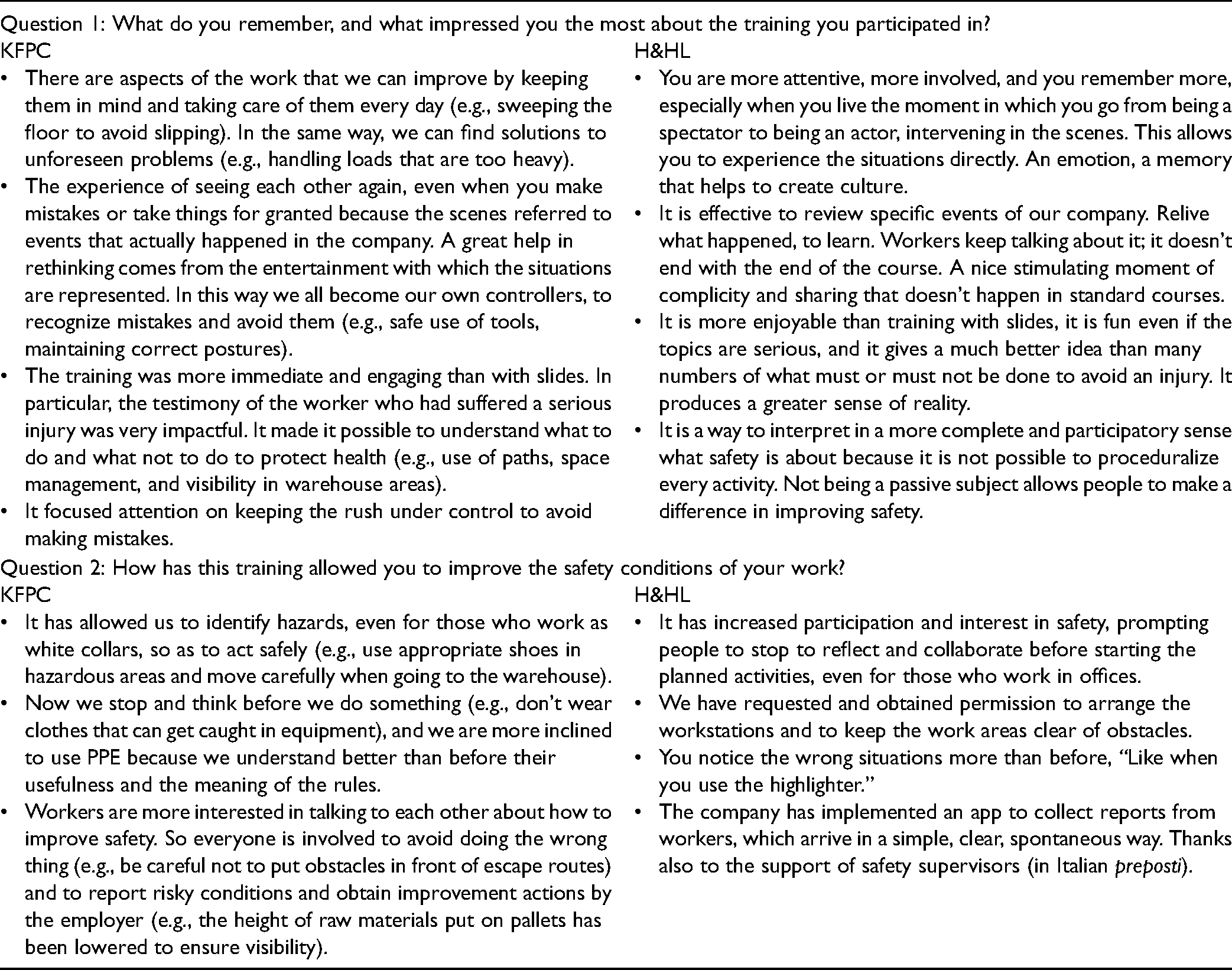
In order to understand, on a qualitative level, the degree to which training enabled workers to improve their safety conditions, a single focus group technique 57 was used for each company. This measure allows evidence to be gathered through group interaction, on the topic proposed by the researcher. 57 See Table 2 for results.
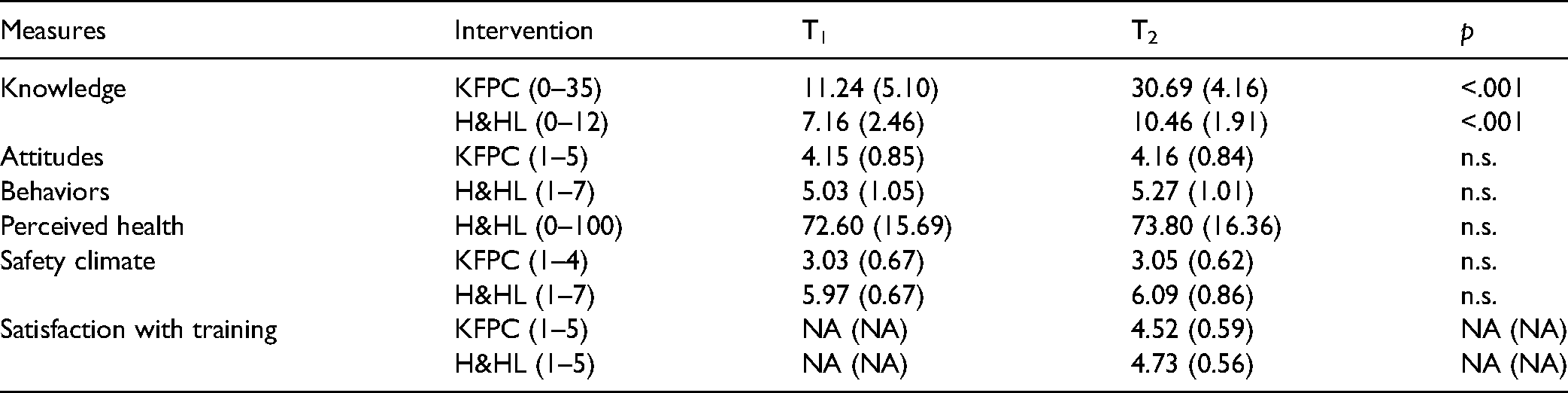
Mean (Standard Deviation) of all the Measures Surveyed T1, T2 per Intervention (Minimum and Maximum Score), and Corresponding p-Value Within Subjects t-Test.
Procedure
Data collection took place in a company meeting room, during usual working hours, more than six months after the end of the training. In order to ensure an adequate level of attention during the discussion and the emergence of all content relevant to the survey, each meeting lasted about an hour. 68
Each focus group was structured with a “funnel” pattern, so as to maintain the same initial standard questions for both situations considered, but with the opportunity of delving into specific content for each of the two different occupational contexts. 57
In order to ensure data validity, the moderator took a structured approach to managing interactions among participants. He encouraged those who tended to speak less and limited those who tended to impose themselves in the discussion. 57
During each focus group, data were collected by taking notes on what participants were saying and by observing their behaviors.
Data Analysis
Using qualitative content analysis, 69 information was systematically coded into categories, thereby uncovering patterns not detectable by simply reading the notes taken by the researcher.
The data were then coded in two stages. 68 In the first step, category codes were created, associated with the different reflections that emerged and recurring keywords for each specific theme. In the next step, the principal investigator eliminated, combined, or subdivided the initial categories, paying attention to the recurring ideas and themes related to each other. This allowed for a comparison of the content that emerged in the two different companies involved in the survey.
A synthesis of data from the six-month follow-up qualitative investigation is presented in Table 2.
Focus Groups in the two Companies Involved: Questions and Answers.
Results
The data collected partially confirm H1 because the mean value of knowledge significantly increased after the course, showing a large effect size (Cohen's d): KFPC, 4.18; H&HL, 1.50. The other outcomes (safety climate, attitudes, perception of health, and behaviors), instead, remained substantially unchanged. Furthermore, the very high level of satisfaction with training, in both subsamples (KFPC, 4.52/5; H&HL, 4.73/5), confirmed H2. Table 1 reports the mean and standard deviation surveyed before (T1) and after (T2) the training and corresponding p-values related to changes pre- and post-training within subjects. Satisfaction with training, for evident reasons, was measured only after the intervention.
Safety training using gamification significantly increased knowledge relating to personal protective equipment, emergency procedures, and occupational risks and dangers. There was a non-statistically significant increase in other measures after the training. This could encourage companies to use gamification as an alternative to less effective traditional methodologies (e.g., classroom lectures).
The findings of the six-month follow-up qualitative investigation are summarized in Table 2.
Discussion
The gamification of “PratiCARE la Sicurezza” is effective because it addresses the needs of the participants and corresponds to the principles of adult learning. This method facilitated the development of knowledge and produced a very high level of satisfaction with training. The method allows workers to learn by experiencing an SLE rather than by observing from the outside. As action theory states, the active involvement of the participants facilitates learning.53,54
Content analysis (see Table 2) of the qualitative data collected through focus groups corroborates the evidence of effectiveness in both workplaces studied. Workers learned “to recognize mistakes and avoid them” (KFPC), “to understand what to do and what not to do to protect health” (KFPC), “keeping the rush under control to avoid making mistakes” (KFPC), “what must or must not be done to avoid an injury” (H&HL), and to “notice the wrong situations more than before” (H&HL). They also expressed a great satisfaction with the training, saying that “the training was more immediate and engaging than with slides” (KFPC), and that it showed “a nice stimulating moment of camaraderie and sharing that doesn't happen in standard courses” (H&HL), and that “it is more enjoyable than training with slides; it is fun even if the topics are serious” (H&HL). Participants clearly confirmed that this method allows workers to learn by experiencing an SLE and not simply by observing. KFPC workers appreciated “the experience of seeing each other again, even when you make mistakes or take things for granted because the scenes referred to events that actually happened in the company. A great help in rethinking comes from the entertainment with which the situations are represented.” H&HL workers said that “you are more attentive, more involved, you remember more, especially when you live the moment in which you go from being a spectator to being an actor, intervening in the scenes. This allows you to experience the situations directly. An emotion, a memory that helps to create culture.” Likewise, they said that “it is effective to review specific events of our company. Relive what happened, to learn. Workers keep talking about it, it doesn't end with the end of the course.” Moreover, participants noted that “not being a passive subject allows people to make a difference in improving safety.” Thus, workers specifically stated that they had experienced immersion 70 through the LARP in which they participated. This is because the content of the role-play was immediate and relevant to the actors, so that they felt like protagonists within the play world.
It may seem obvious and trivial to be able to say that a training intervention has produced an improvement in knowledge, compared to the baseline. This is what we all hope for after any training intervention. However, it is a common experience that this does not always happen and that, when it does occur, the degree of effectiveness can be highly differentiated. One meta-analysis 3 looked at 49 studies that had evaluated safety training effectiveness for knowledge improvement, according to commonly accepted principles. 71 The analysis found a lack of effect for two studies, and in the remaining studies, it found an effect size that was small (10), medium (14), large (8), and very large (15). Eleven of these showed levels higher than the result of the H&HL sample (1.50), but all were under the KFPC sample score (4.18). Another systematic review 4 considered five studies that had assessed the effect of training on knowledge, none involving similar workplaces with similar learners to those covered by the present study. One study showed no evidence of an effect, and the others ranged from medium (1.50) to very large (3.58) effect, but always under the result of the KFPC sample. Similarly, another meta-analysis 5 identified seven studies in the knowledge domain, all but one evidencing a positive training effect. The overall combined effect size was 1.03 (confidence interval: 0.49–1.58) and far exceeded the evidence synthesis algorithm's criterion of large effect (0.80). Again, no intervention showed evidence of approaching the level of performance recorded here for the KFPC, and none of the samples involved workplaces and learners similar to the contexts we analyzed. In light of these data, it is clear that our findings add knowledge not yet published, considering the work contexts and employee characteristics analyzed. There was an Italian study 13 that evaluated the effect of a training partially provided through LARP, but it was done in a sample of metal-mechanical companies, which are very different workplaces from those in this study.
The lack of improvement in attitudes is consistent with data classifying this kind of evidence as insufficient 4 or unsatisfactory. 65 The unchanged perception of health is consistent with recent meta-analyses, which have found modest effects in some cases and no effect in others. 5 Significant effects were found only in long-term interventions. These findings indicate that it is not possible to demonstrate the short-term impact of training on occupational health. 4 In this sense, training alone may not be sufficient to achieve significant effects.
Even the behaviors do not vary from baseline. This may be due to the absence of data collected over time. Robson et al. 4 examined ten studies that found behavioral effects, most of which were positive. Follow-up typically took place at six months. Similarly, the absence in this study of an effect of training on safety climate may be due to the time needed for training to have an effect on climate. It is possible that time may have a greater effect on the impact of training on behaviors and damage to health than it does on knowledge. 3 We therefore intend to collect follow-up data to be presented in a forthcoming publication.
Given the nature of an ecological study, the training and data collection, in this case, involved a convenience sample, rather than a fully representative sample of companies. Bearing in mind the necessary caution in generalizing the results, all the workers who were required by Italian law to receive safety training or retraining participated. It would certainly have been useful to provide for a control group, but this limitation also follows from the ecological nature of the study. In fact, the participating companies decided to adopt this method because they considered it more effective than others, and it was not possible to recruit companies that would make a different choice. Data collection for a meta-analytic evaluation of safety training effectiveness included 95 quasi-experimental studies. 3 A systematic review of these studies 4 evidenced a general lack of high-quality randomized controlled trials. Another meta-analysis 5 identified only seven randomized controlled trials out of 28 studies. Five studies made use of random sampling. There were three non-random investigations comparing training and control groups. Why these limitations? It is likely that this is because of the difficulty of carrying out complex investigations in the field. Investigations have to be done at places and times and by methods that are possible. The body of evidence available from these less-than-perfect studies offers us a great opportunity to know more about the criteria for quality training and how to evaluate its effectiveness.
A final methodological limitation is a fact that this study did not compare different training methods. This was due to the impossibility of imposing on the companies that voluntarily participated in this research training other interventions that they considered less suitable and in which they were not interested. However, the previous evidence 3 has demonstrated greater knowledge acquisition for training methods requiring trainees’ active participation, similar to the intervention presented in this manuscript.
The results of this study will provide scholars and practitioners with knowledge about gamification and useful elements that allow for improving the quality and avoiding errors in the delivery of safety training. The courses presented here, combining examples and a participative approach, overcome the limits of traditional classroom lectures. This is especially useful to improve learning about occupational health and safety and assumes a great value for high-risk sectors such as manufacturing and hauling and heavy lifting.
Experimentation with this methodology and the measures used in this study offer an intervention that allows companies to deliver quality training and to test its efficacy. In addition, we emphasize the need for future research examining the influence of situational variables (e.g., safety climate) on safety training.
Finally, the results indicate that gamification may be effective in additional occupational contexts (e.g., the construction industry). Applying LARP to safety training in other areas and verifying its effectiveness appears to be the most promising avenue for further research.
Conclusions
Unfortunately, we still know too little about factors that make safety training effective. The scarcity of data regarding the effectiveness of safety training seriously hinders the evidence-based identification of the strengths and weaknesses of training. More training effectiveness data could make an important contribution to limiting the serious social and economic consequences of injuries at work.
Having demonstrated the quality of the LARP adopted the current study was limited in not having quantified the impact of other training methods. An opportunity was missed to integrate the LARP into training sessions on risk perception and on prevention of musculoskeletal disorders in one of the companies involved (KFPC). However, our research corroborates the findings of Burke et al., 3 who analyzed 95 quasi-experimental studies and concluded that training involving behavioral modeling, a substantial amount of practice, and dialogue is generally more effective than other methods of safety and health training. Given the ecological nature of this study, it would not have been possible to exclude some of the companies that voluntarily joined the experimentation, imposing the adoption of different training interventions.
Based on the qualitative data collected, we can document that this training allowed workers to improve the safety conditions of their work. In the KFPC focus group, it emerged that following the training, “workers are more interested in talking to each other about how to improve safety. So everyone is involved to avoid doing the wrong thing (e.g., be careful not to put obstacles in front of escape routes) and to report risky conditions and obtain improvement actions by the employer (e.g., to ensure visibility, the height of raw materials put on pallets has been reduced).” Similarly, in the H&HL example, “The company has implemented an app to collect reports from workers, which arrive in a simple, clear, spontaneous way. Thanks also to the support of safety supervisors.” Additional comments were that “We have requested and obtained permission to arrange the work stations and to keep the work areas clear of obstacles,” and that the training “has increased participation and interest in safety, prompting people to stop to reflect and collaborate before starting the planned activities, even for those who work in offices.”
With proper organizational and economic resources, it is appropriate to collect data over time by repeated follow-up. In this way, it is possible to test the persistence of effects and possible delayed outcomes (e.g., behaviors).
Thanks to the voluntary participation of two Italian companies that used a LARP called “PratiCARE la Sicurezza,” this study made it possible to evaluate the effects of gamification in safety training.
The encouraging results contribute to filling a scientific gap by showing a marked increase in safety knowledge on the part of the participants at the end of the training. The excellent satisfaction scores testify to the quality of the intervention. This suggests that providing this kind of training in other contexts would improve the knowledge level of workers in those contexts as well. The secret of success lies in delivering interesting interventions with content that is closely related to everyday practice, instead of being limited to illustrating normative obligations. These results provide researchers, corporate decision-makers, government agencies, and international bodies with additional knowledge as to how to deliver training to workers.
Footnotes
Declaration of Conflicting Interests
The authors declared no potential conflicts of interest with respect to the research, authorship, and/or publication of this article.
Funding
The authors received no financial support for the research, authorship, and/or publication of this article.