






Abstract
Teaching songs from a wide variety of cultures is commonplace in music classrooms around the United States. Students gain understanding of and insight into a wide range of cultures by singing their songs and listening to their music. The Afghan Children’s Songbook Project is a project focused on preserving and returning traditional songs, eradicated by the Taliban. This project opened up an entirely new level of awareness about the importance of not only learning traditional songs, but also the role they play in teaching tolerance and cultural understanding for a group of third to fifth graders in Connecticut. By adopting the Songbook Project as a service learning project, the students learned firsthand about bias and prejudice, but through many meaningful experiences that integrated not only music but all the arts, the students shifted their initial beliefs and gained true cultural understanding of Afghans.
Teaching songs from a wide variety of cultures is thankfully common practice in most music classrooms around the United States. We are fortunate to have access, through multiple forms of technology, to songs from almost every corner of the world. And, in most cases, we also have available to us the details about the songs: where they are from, when they are sung, and for what purpose. By incorporating this information into our teaching, by participating in singing the songs and listening to the music, students gain a deeper understanding of and insight into a wide range of cultures from many ethnic groups around the world. Until recently, however, I didn’t totally understand how powerful this process can be for teaching tolerance, breaking down assumptions, and enhancing cultural understanding.
Over the past 7 years, I’ve been directing The Afghan Children’s Songbook Project. I began this project quite by chance when, almost 7 years ago, while rummaging through my bookcase, I came across a small songbook of Afghan children’s songs I had created in collaboration with Afghan musicians and poets in 1966–1968 while in the Peace Corps in Afghanistan. Keenly aware of the turmoil and destruction that has afflicted Afghanistan over the past 30 years—and particularly concerned about the severe censorship of music that was imposed by the Taliban—I feared these children’s songs might quite possibly be eradicated from the culture and lost forever. In a moment of deep concern, I vowed to somehow return the songs to the children of Afghanistan. (To note—By 1996, under the Taliban rule the list of forbidden things grew—music, dance, theatre, film and television, cameras, photography, sculptures, magazines, newspapers, most books, festivities, children’s toys, applause, even . . . squeaky shoes.)
Launching the project, I quickly realized, was not a simple matter. Although I thought it was a good idea, I wondered if Afghans would feel the same way. I hadn’t looked at these songs in almost 40 years. Was this collection an authentic one and worth republishing? Would I possibly be endangering children by trying to reintroduce music back into schools? After sharing my idea and voicing my concerns with Afghans living in the United States, I discovered their response was consistently the same. Each and every one of them was moved to tears on hearing their childhood songs again after so many years. They were thrilled with the idea of not only preserving the songs but also returning them to the children and encouraged me to proceed.
Beyond the monumental task of raising funds for the project, I went on a search to find an Afghan musician who was of a generation that would remember these childhood songs and also had an interest in revitalizing them. I was fortunate to connect with Afghan musician, Vaheed Kaacemy, who lives in Toronto but travels frequently to Afghanistan. He comes from a long line of musicians and has a wonderful combination of skills from composer, musician, to former kindergarten teacher. He was very willing, and in fact, strongly interested in not only researching the ethnic origin of each song but also identifying, if possible, the composer and the lyricist, something I had not done when I initially collected the songs back in the late 1960s.
I was also very fortunate to locate a talented Afghan graphic designer, Arsalan Lutfi, whose company, TriVision, has locations both in Virginia and in Kabul. As a team, we worked together to create a new songbook, based on the original one. We created Qu Qu Qu Barg-e-Chinaar: Children’s Songs From Afghanistan, a songbook with a collection of 16 traditional songs. We wanted the new songbook to be both graphically pleasing and easy to read, knowing that literacy is a big concern in Afghanistan. It was my hope that Afghan children would use the songbook not only to celebrate the wonderful music of their culture but also as a basic reading text. Vaheed felt strongly that the songbook should include musical notation but given that most Afghans are not musically literate and these songs are learned orally, we included a CD of Afghan children singing all the songs. In the songbook package, we also included a cassette tape for those people who do not yet own CD players. The 16 songs in the songbook include songs in Dari and Pashto (the two official languages of Afghanistan), as well as Uzbeki and Hazaragi.
I returned to Afghanistan in the fall of 2009 to evaluate the status of the songbook project and to determine the next steps. Currently, 25,000 songbooks have been distributed in elementary schools and orphanages across Afghanistan. The songbook is a welcomed and cherished commodity. Children are indeed using the book as a basic reading text and it is highly valued since, I discovered much to my dismay, it is the only book they have. As a result of my recent visit, we are now working on producing a teacher training manual, which will provide teachers with simple lessons for enhancing literacy through music. Rote learning is the most common method of learning in Afghanistan and alternative teaching techniques are needed and welcomed.
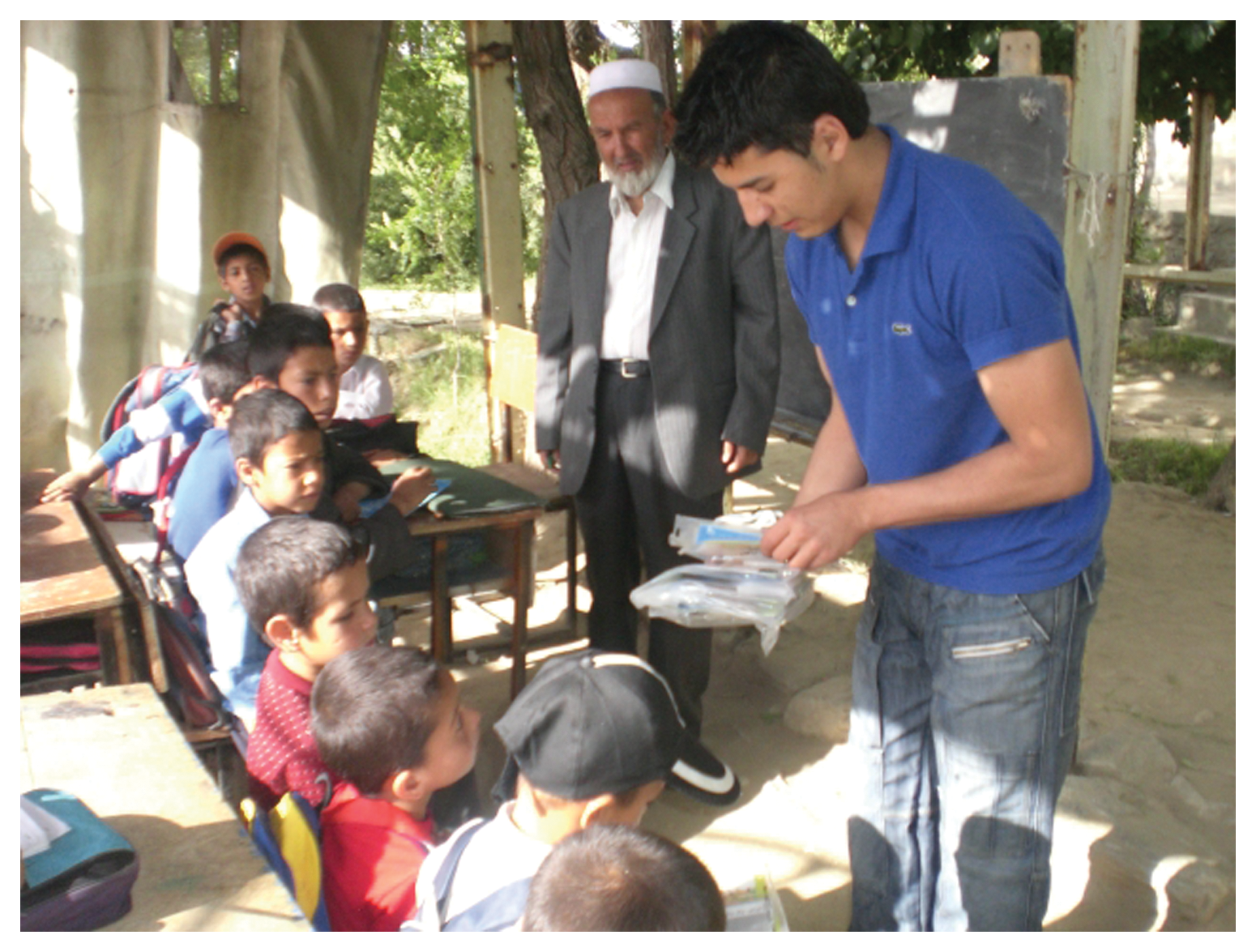
Volunteer delivering songbook in village outside Herat
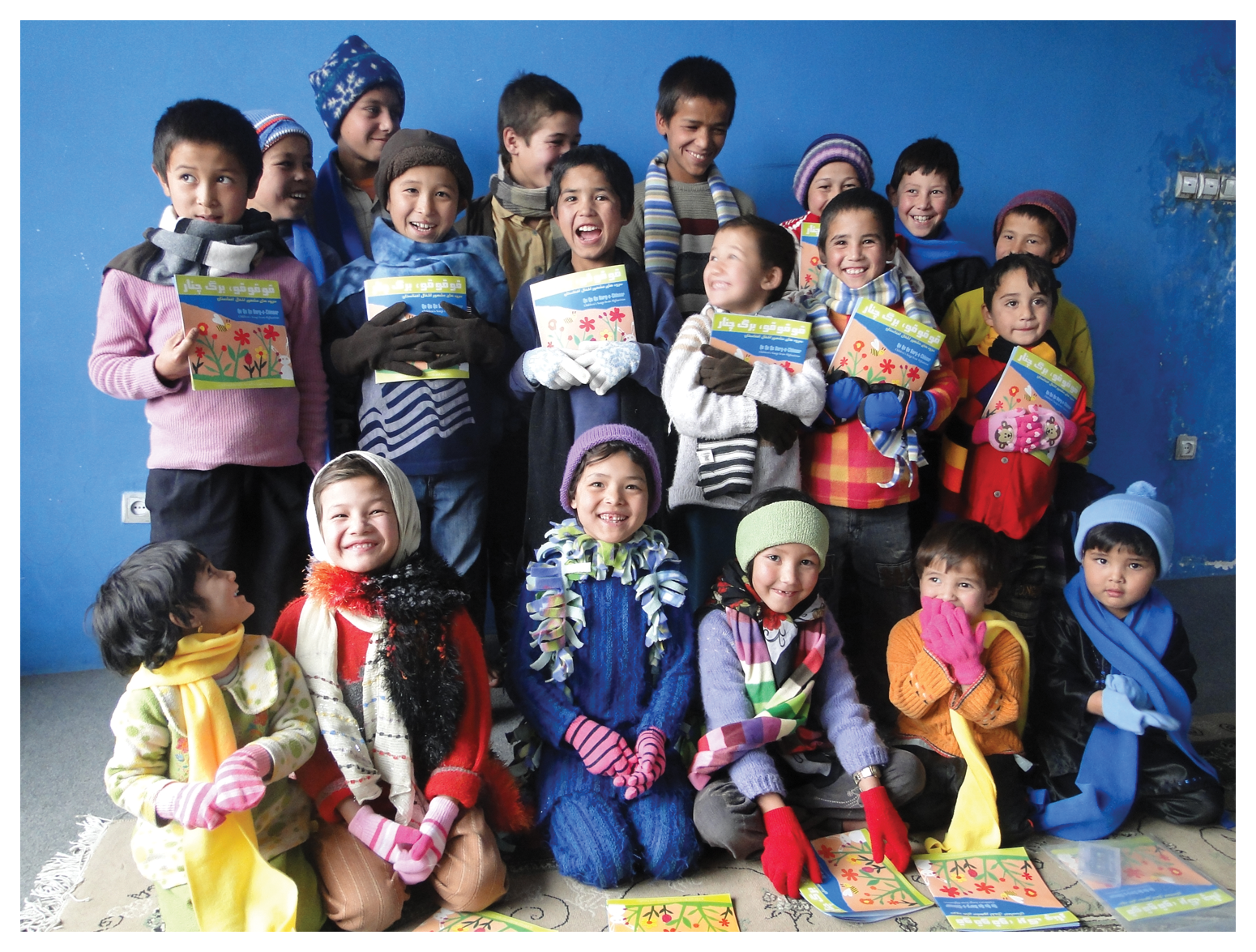
Children from Small Heaven Orphanage, Kabul with songbooks
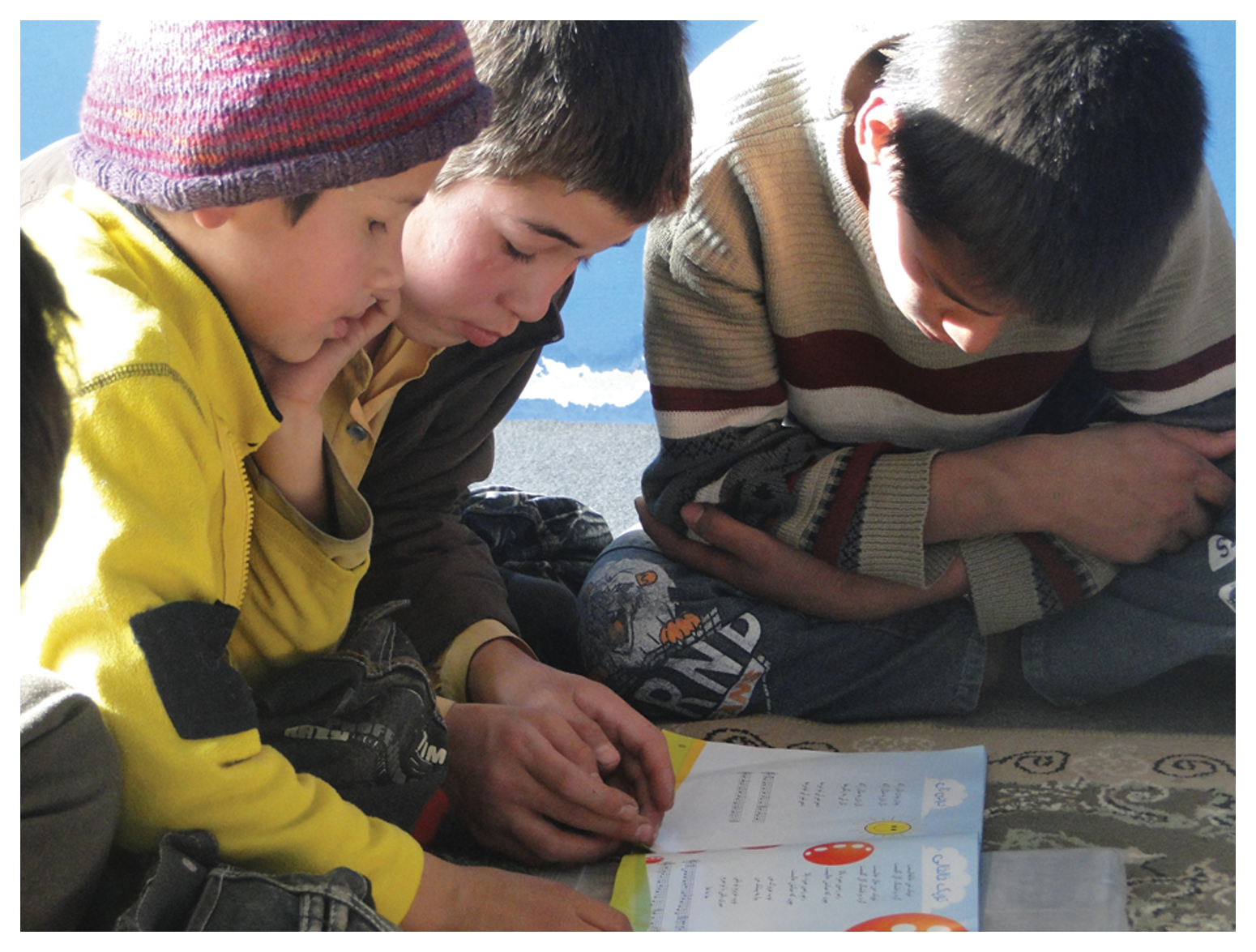
Children using songbooks as a basic reader
The question now presents itself—How does this project connect to music education in the United States? What can we learn from this story?
In conjunction with the Dari version of the songbook, an English version of the songbook was published in 2007 by National Geographic for distribution outside Afghanistan. At a release party in Washington, DC, I was struck by a comment made to me by a young Afghan American woman, pregnant with her first child. She thanked me profusely for putting the songbook together and said, “Now I have something to sing to my child when he is born.” Since then, I have heard similar comments from other Afghan Americans. It is a strong reminder of the importance music holds for cultural identity. Although there is an array of multicultural music available, for many Afghans, the music they most cherish and want to hear is “their” music. This same phenomenon rings true for the many ethnically diverse students we serve in our classrooms.
In the winter of 2009, I was approached by a team of teachers, Grades 3–5, from an elementary school in Connecticut. They had heard about the Afghan Songbook Project and were interested in having their Grade 3–5 students take it on as a service learning project. In total, there would be about 150 children involved. I was delighted with their interest and commitment and offered to support them in any way I could. Working in collaboration with the music teacher, they hoped each class would be able to learn two songs from the songbook. The plan was to share the songs with their families and friends in a final performance. I promised to come to the final performance, speak a bit about the project, and support their effort.
A few weeks after they began the project, I received a call from one of the teachers who wanted to share a very interesting story with me. Each of the teachers introduced the idea of supporting the Afghan Songbook Project to their students by telling them a bit about the history of the project and having them listen to a couple of songs. The reaction in each class was much the same. Although most students were very excited about the project, many wondered why they were supporting a project that involved Afghans. “Don’t we hate Afghans?” they asked. “Aren’t they our enemies?” “We’re at war with Afghanistan, aren’t we?” “Why would we bother to learn their songs?”
Fortunately, this group of teachers considered this to be an opportunity and not a roadblock. This particular school is one of many HOT (Higher Order Thinking) Schools in the Connecticut school district. In HOT schools, the arts are rigorous academic subjects, each with its own sequential curriculum that conveys knowledge not learned through other academic disciplines. HOT schools integrate the arts across disciplines, creating arts-rich environments that motivate students to make connections between and among subject areas and ideas and cultivate a democratic school culture to which all members of the school community contribute and in which individual leadership is emphasized. In this case, the educational philosophy of HOT schools served them well.
Instead of simply abandoning the project, given the initial reaction of some of the students, the teachers took the opportunity to use music and other art forms to teach tolerance and cultural understanding. The students not only learned the songs but also read books written from the voices of Afghan children. They watched videos, heard stories, read poetry, and studied the English lyrics to the songs. They learned about music censorship and imagined how such an edict would affect their lives. They wrote about their feelings and their own experiences with music.
The night of the performance arrived and there was great excitement in the air. Each class, as planned, had learned two songs each. Each song was introduced and the lyrics (in English) were projected on a screen for the audience to read. In some instances, the students had created a dance or movement to accompany the song. Since some of the songs had complicated lyrics, the students chose to sing along with the CD, which was an effective and appropriate solution.
I presented a short talk at the end, showing recent photos of Afghan children with their new songbooks and telling stories about the project. The audience was filled with families and everyone seemed both pleased and genuinely interested in hearing about life in Afghanistan from another perspective. The students themselves were very proud of their accomplishment. They had learned Afghan songs, and beyond that they had helped Afghan children by raising funds to supply more children with songbooks.
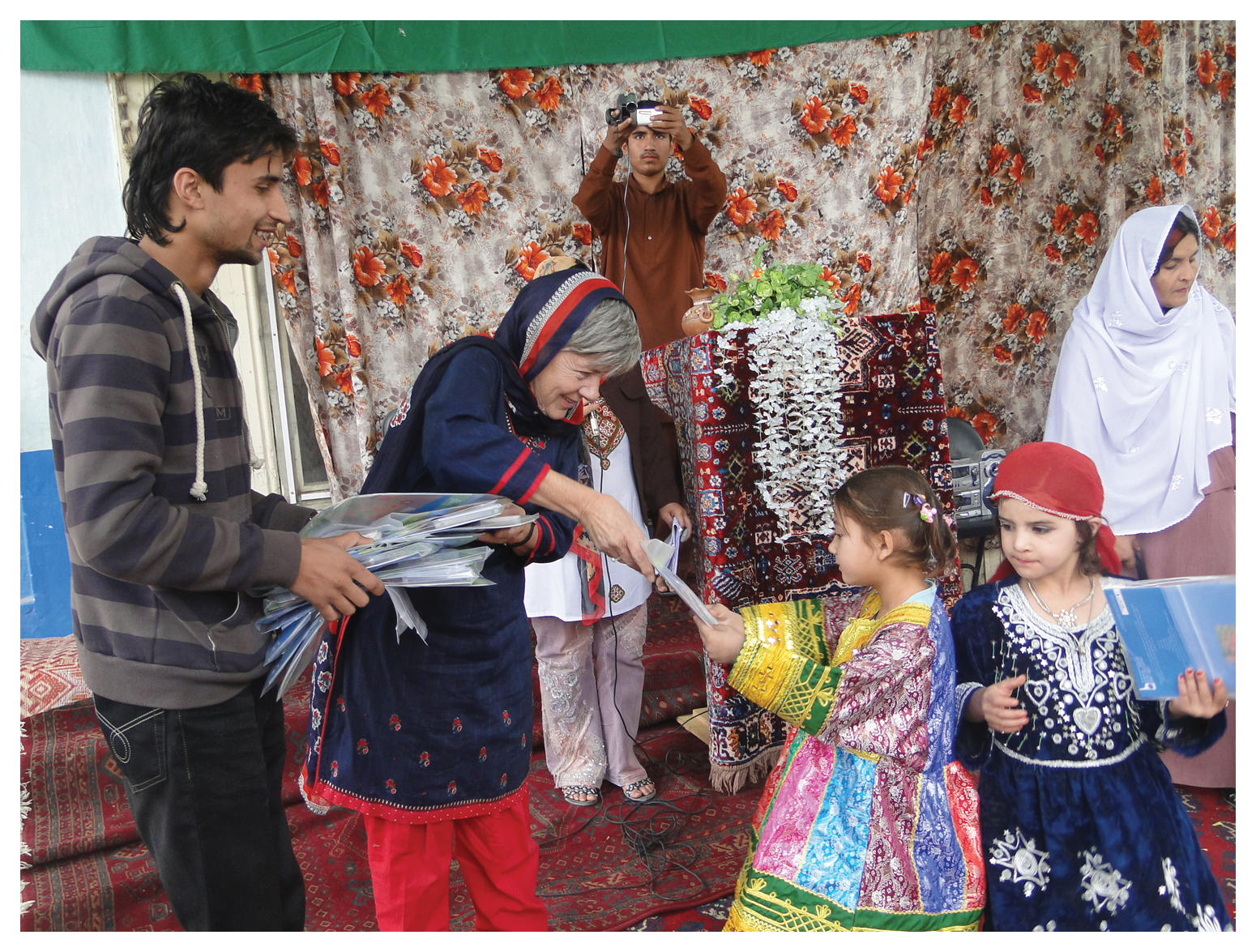
Kindergarteners in Kunduz receiving songbooks
The next day, the teachers and students spent valuable time reflecting and talking together about their experience. What had they learned? What did they like? What did they find difficult or challenging? The responses were telling. Many students commented on how proud they felt to have made a difference in the world. They felt good about helping other children. A significant amount of students admitted to shifting their initial perspective about Afghans. “I was wrong about Afghans,” one of the fifth grade students remarked. “I learned the Afghan kids are just like us in many ways.”
Of equal importance, many parents admitted a shift of perception as well. They were surprised to learn something about Afghanistan that did not include war and terrorism. They also felt pleased to see how engaged their own children were in helping someone else.
Music plays an important role in all of this. Music, beyond all else, can break through barriers and provide a truly human perspective. For obvious reasons, Afghanistan is currently perceived as a place where ethnic groups are in constant conflict. In a few instances, this is true. But music, throughout the long history in Afghanistan, has been the one vehicle that brings ethnic peoples together. The music does not build barriers but breaks them down.
In the case of the students in the Connecticut school, it did just that. By going beyond just teaching the songs and diving deeper into true cultural understanding, the students came away with a lasting experience. They now know what Afghan children sing about. They learned their melodies and chants, they heard their voices. They learned how Afghans were not allowed to sing or make music of any kind. They began to understand the concept of music censorship. And through publicly sharing the songs they, in fact, played an important role in returning the songs back into the world. The Afghan children became real to them. Through the music, they learned about perceptions, assumptions, tolerance, and cultural understanding.
All of our songs are valuable. Whether it’s a song we sing in the car, on the bus, at bedtime, or around a campfire, it matters and it is worth saving. Music not only defines the universal culture, it also defines each of us in our individual lives. As music educators we can help keep those songs alive and honor their value in the world.
One Afghan, a musician living in Kabul at the time of the Taliban regime, told me, “It isn’t about the burned out buildings, or the fact they destroyed our homes or our roads. When they took our music, they took our souls.” We owe it to our children to keep their “souls” alive with their music and to share it with each other.
Footnotes
The author(s) declared no potential conflicts of interests with respect to the authorship and/or publication of this article.
The author(s) received no financial support for the research and/or authorship of this article.