







Abstract
This article reports on a learner-centered kindergarten music program at Gan Michael Kindergarten in Israel. Actual experiences with stories and pictures provide examples of young children engaged in music making as performers, composers, and analytical listeners. The stories include teacher thoughts and reflections, providing a model of teacher as researcher and learner. What can we learn from these stories?
The Story
The music teacher arrived at the preschool to teach music class, and as usual, looked at the “concert board” to see how many concerts were scheduled to be performed on that day. This routine was established when children started to be very active at the music corner and wanted to show what they did there. The music teacher and the preschool teacher decided to establish a “concert routine” to allow the children to share with their teachers and with each other. A “Today’s Concert Board” was set up where children, who had been playing and working on a piece at the music corner, could put their name tags (already prepared) indicating they were ready to perform. Up to four children (solo, duet, trio, or quartet) could perform a joint concert, and no more than three pieces could be performed on the same day. The concert always was the last part of the music lesson. The concerts became a successful part of the music class. But this morning was different. Not only were name tags on the board but also what looked like a score. (Figure 1)
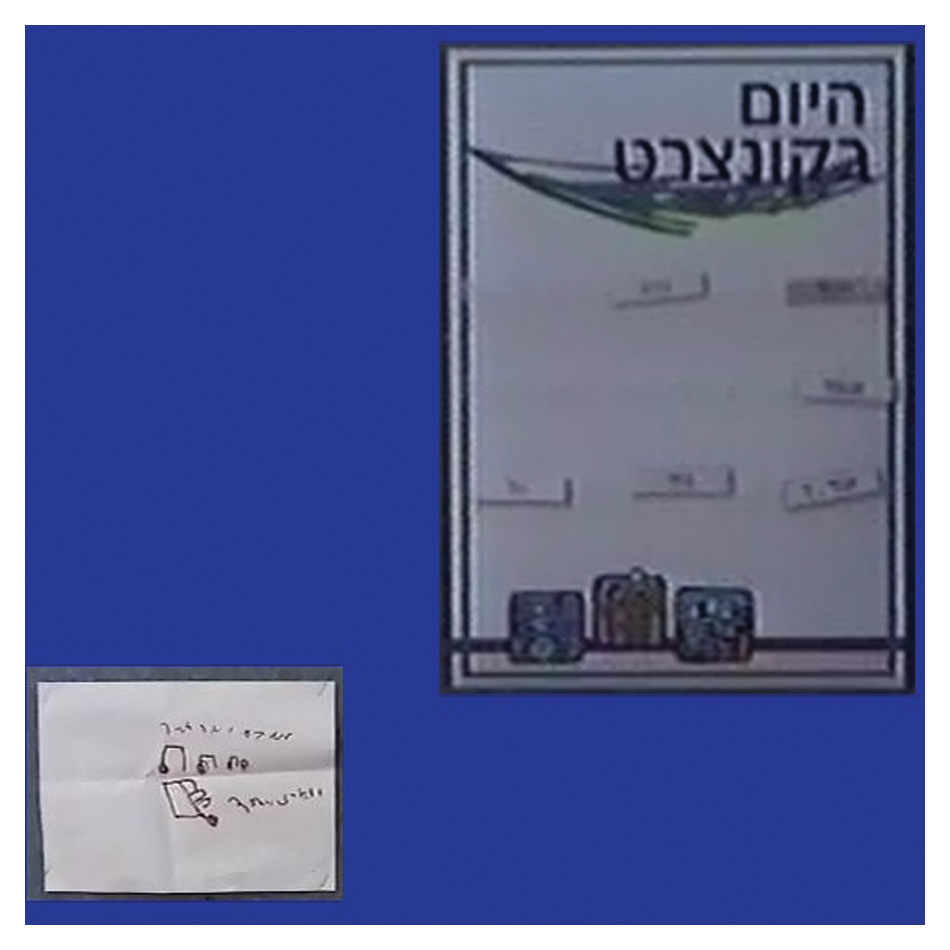
“Today’s Concert Board”
When it was time to perform, the music teacher asked Or, the composer of the score, to explain what he had done before performing his piece. Or explained as he pointed to his score: “Those are the characters of the small drum and those of the big drum.” (Figure 2)
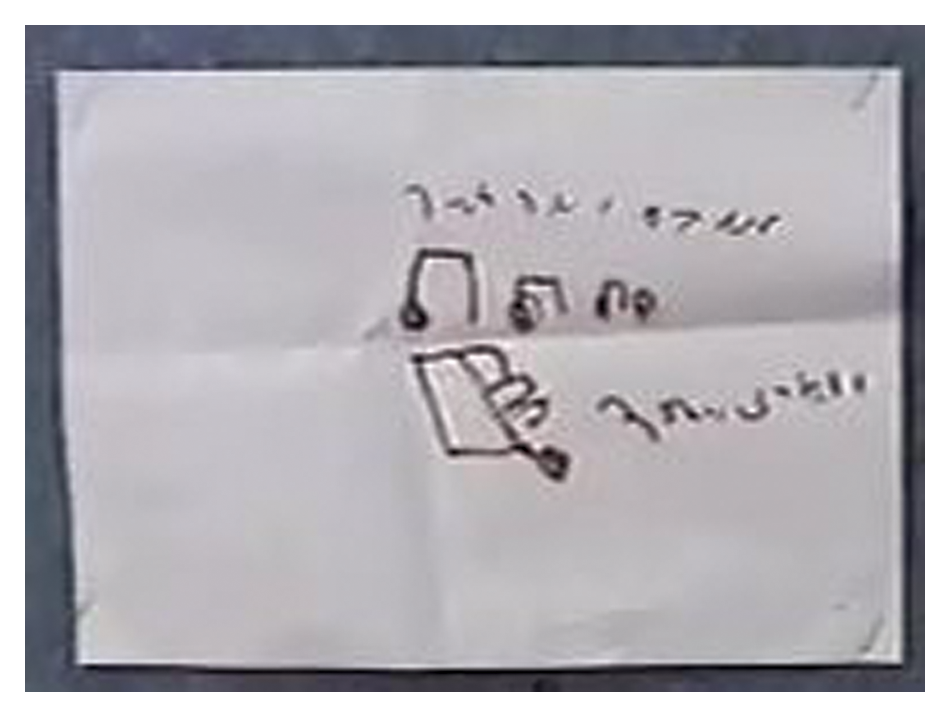
Or’s score for his drum composition
Then he went on to perform his piece on one drum only, but he played a variety of timbres using sometimes his finger tips, sometimes both of his palms, starting with a slow motif that developed into a very expressive accelerando. (Figure 3)
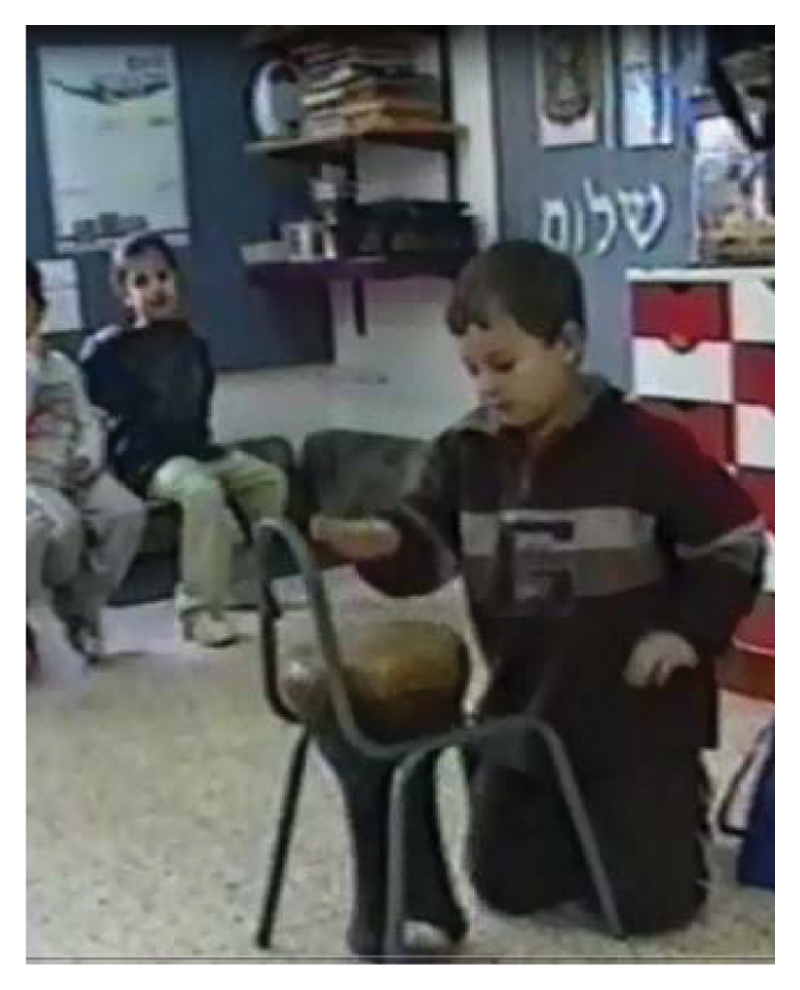
Performing the drum composition
Or’s score provided motivation for the other children, who began adding another way of expressing their music making—a graphic one. The music teacher was surprised at this new addition to the concert board, as she had never asked the children to do so or even taught any music notation!
Or’s notations always featured what looked like pairs of eighth notes, and sometimes pictures of the instruments he played. (Figure 4)
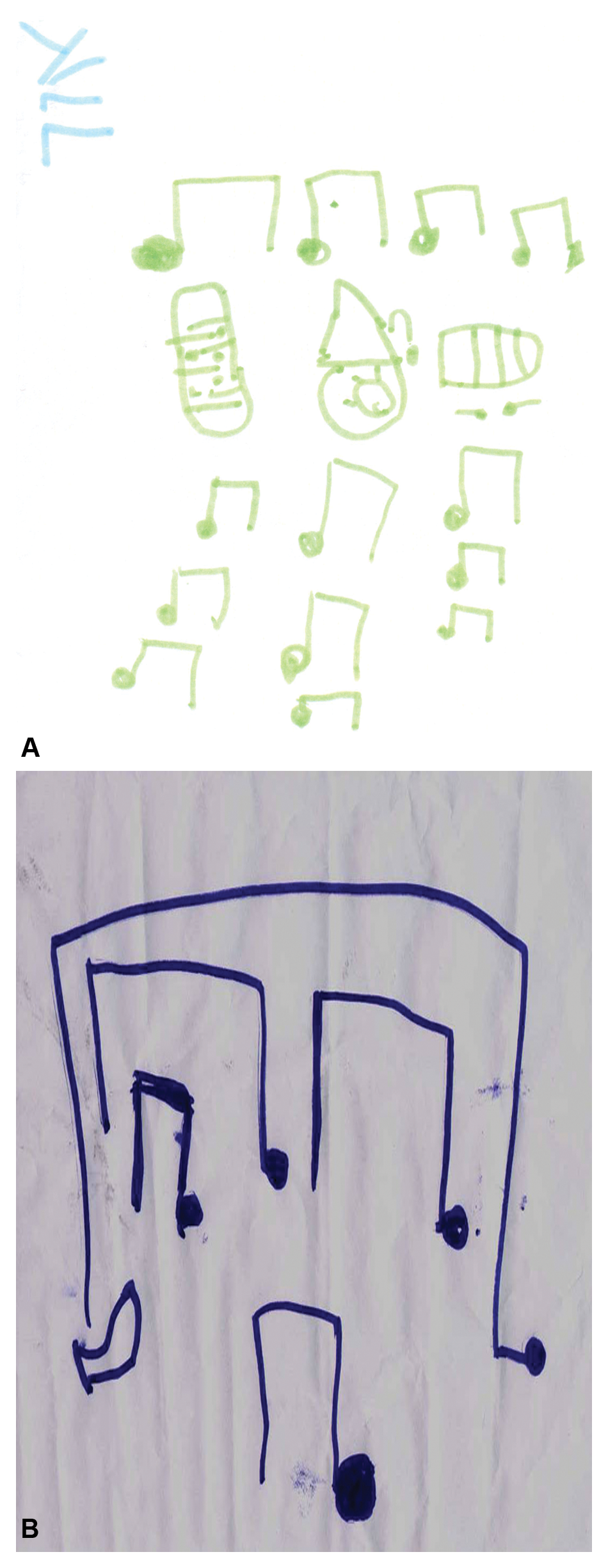
Or’s notations for other “compositions”
Once Or cooperated with another boy in the class who included in his score not only eighth notes but also almost any other character and symbol he knew. (Figure 5)
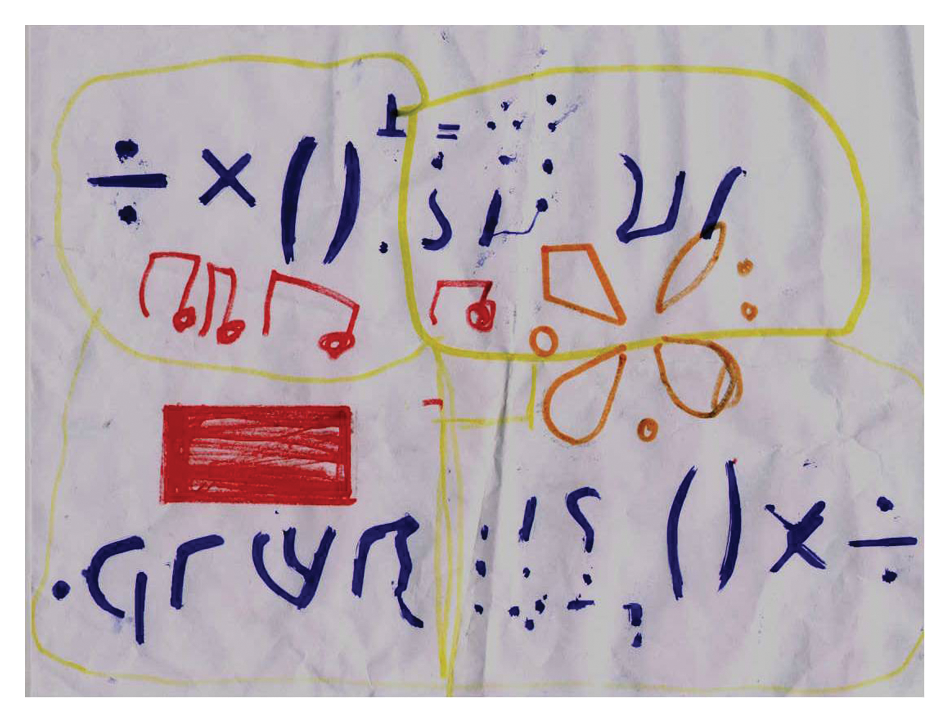
Another preschool child’s notation
On another day, as the music teacher and kindergarten teacher were observing the children during free indoor play, Tomer brought his drawing to show the music teacher. She recognized it as the Hebrew version of “Five little monkey’s swinging in the tree teasing Mr. Alligator can’t catch me” and began singing the song accompanied with the hand game. (Figure 6)

Illustration of “One Little Monkey sitting in a tree, teasing Mr. Alligator”
Building on the teacher’s excited response, Tomer asked if she knew which part of the song he had drawn. The music teacher, who had experience in looking at and reflecting on children’s work, responded that it was the last verse, when only one little monkey was swinging in the tree, and that the monkey’s name was Tomer! Other children heard the conversation, and within minutes other verses of the song were drawn! (Figure 7)
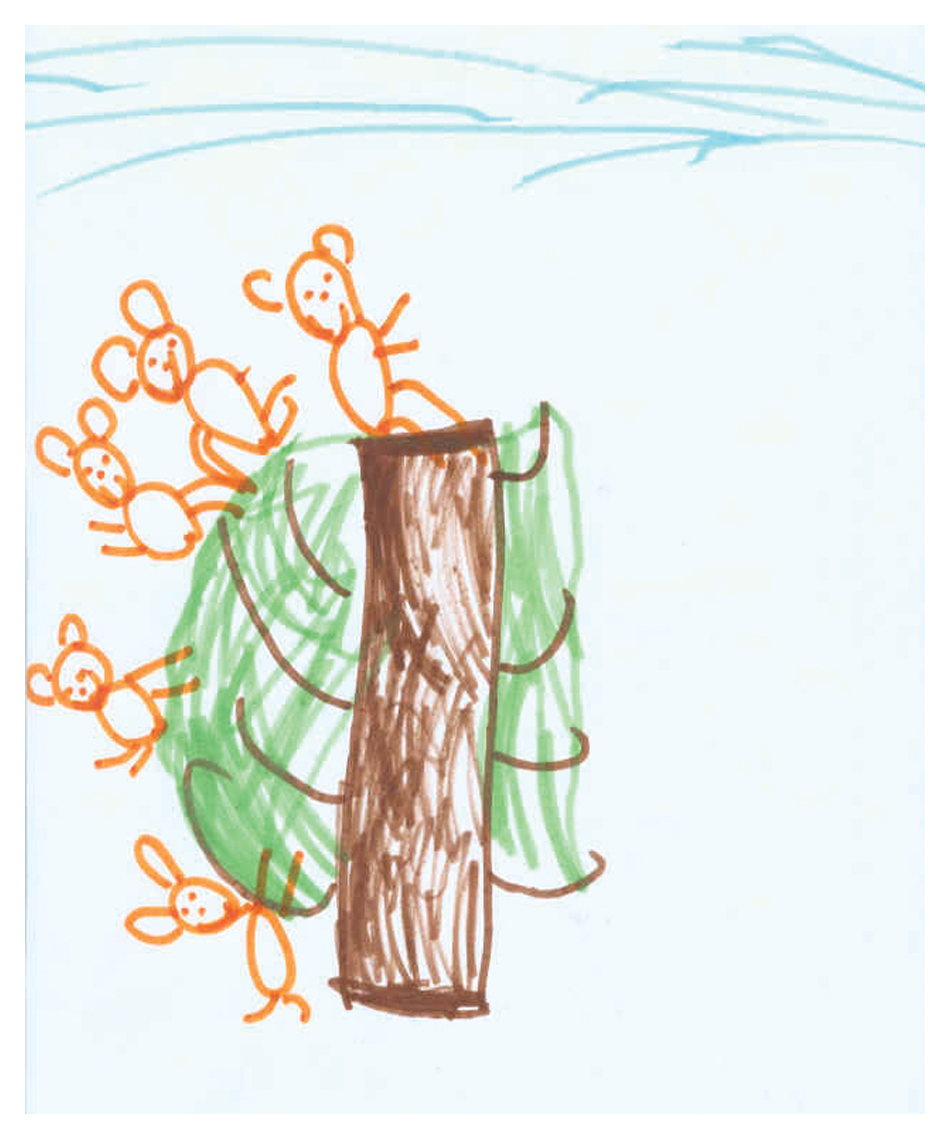
Illustration of “Five little monkeys sitting in a tree”
The following week, all the verses had been drawn. The two teachers decided to gather all the drawings into one folder and also included the music score of the song. (Figure 8)
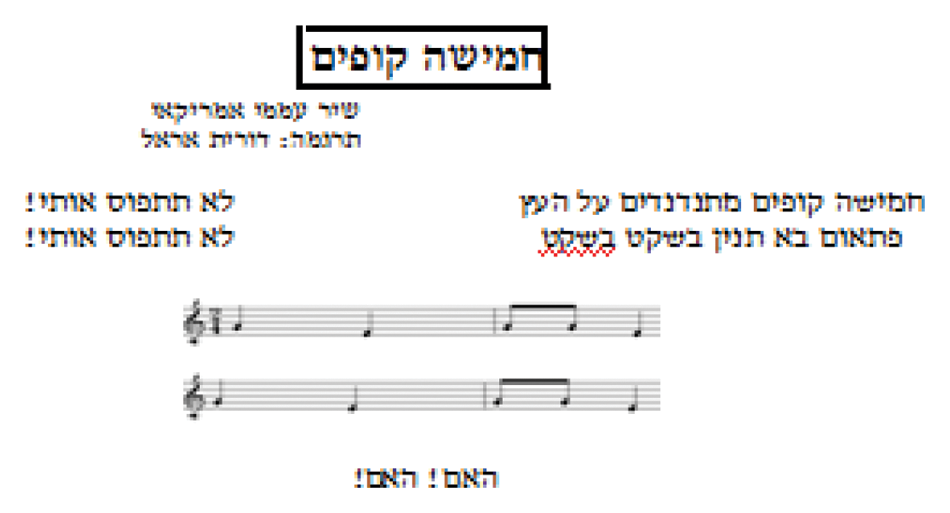
Score in Hebrew for “Five Little Monkeys”
The folder was left at the music corner, and during the next few weeks, children often went to the folder to quietly sing the song. In addition, two boys prepared an orchestrated version of the song. Yuval was in charge of playing the instrument, while Amit’s responsibilities were to sing and turn pages! (Figure 9)
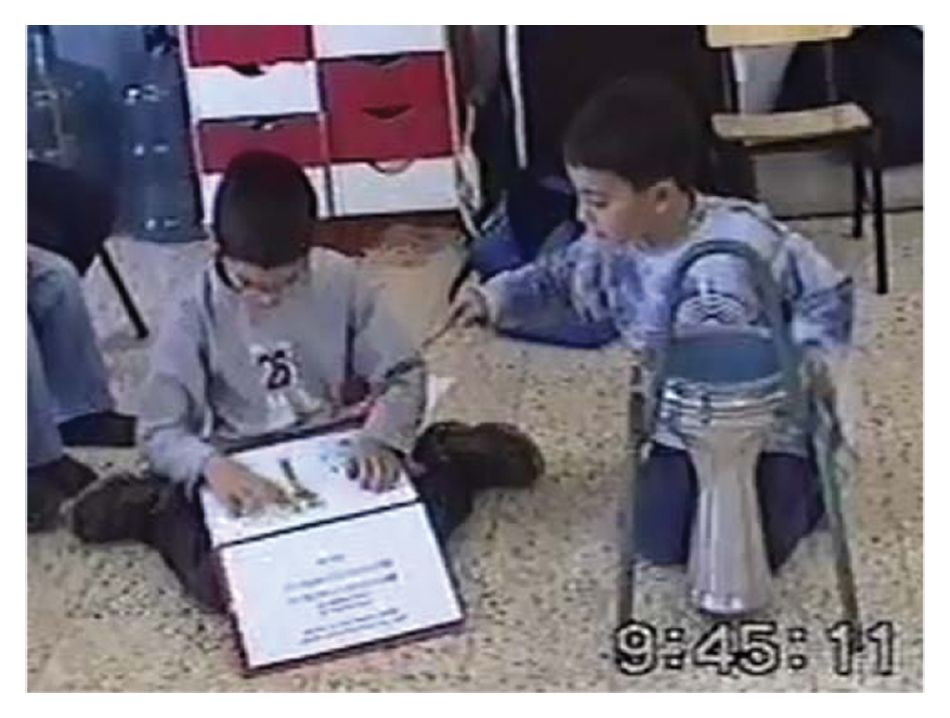
Reading and performing “Five Little Monkeys”
The audience followed the performance and even signaled to Amit when exactly to turn the pages. Yuval struck forte on the drum for the “snap!” and played the rhythm of the other parts on the drum’s rim.
The Place
Or, Tomer, Yuval, and Amit, are children at Gan Michael Kindergarten for 4- to 6-year-olds midway between Tel Aviv and Haifa, Israel. Like most state-sponsored schools in Israel, a music teacher visits each class, usually two times a week. Typically, music teachers move from one class to another, arriving when the children are already seated and prepared for class, presenting the music lesson to the children, then leaving them seated. This teacher-centered or curriculum-centered approach to learning is the norm for music teachers.
However, in the Gan Michael Kindergarten, both the classroom teacher and the music teacher practice a child-centered approach to teaching and learning where children are free to explore, and construct their own knowledge. A music center supports children’s free exploration of singing, playing percussion instruments, musical toys and games, and listening to music with earphones. The music teacher adds items such as finger puppets and song cards. The cards may contain a copy of the song and/or pictures to aid in recalling and practicing the singing repertoire explored during group time.
At Gan Michael, the music teacher not only presents a music lesson but also stays after class to visit with the classroom teacher and to observe the children at play. She gets to know the children and has opportunities to point out to the classroom teacher a child’s interesting musical behavior. The children have opportunities to visit informally with the music teacher, asking questions or sharing their music ideas. As a result of these observations and discussions, the music teacher is able to incorporate into her lessons, themes that she sees children working at with the teacher or during free time. In addition, the classroom teacher is motivated to include music in her own interaction with the children, not only through singing but also through the exploration of sounds, encouraging them to create their own songs, and so on.
The classroom teacher noted that through her active involvement in the music class, her work with the music teacher, and the self-initiated children activities in the music area, she discovered a new language that “makes it possible to discover learning tools used by children in a variety of skills: reading, writing, memorizing, naming, and generalizing.” “When children write music scores,” she says, “it is as valuable as when they experiment with numbers and characters. Music notes are symbols of a language, and I value the way the children use them.” The classroom teacher takes delight when a child comes to the school with her mum, takes her to the music area, shows her a song card and says, “Look at it! I can read!” then sings the song, pointing at the printed words.
The kindergarten teacher also noted a child in the class with some learning difficulties, who found in music an excellent organizing tool and used a variety of symbols to remember his concert piece. “He used previous knowledge and creativity in his scores that any educator who believes in literacy can only rejoice in.”
Informing Our Own Practice
A careful look at this glimpse into Gan Michael Kindergarten might inform our own teaching. A summary of what the music teacher seems to value may help.
Collaboration: The music teacher recognizes the importance of working with the classroom teacher to learn more about the children and the classroom curriculum, as well as to include the classroom teacher in the music education process.
The importance of play: By adding a music center to the room the music teacher provided opportunities for children to explore their understanding of music in a playful setting. The center also encouraged the children to continue music making even when the music teacher was not present.
Honoring the children’s knowledge: Both the music teacher and the classroom teacher recognized the children’s needs to share their compositions but needed to find a way to manage their desires to be heard. The “Concert Board” seemed to be the perfect solution. It helped the children take turns, plan and organize when they would perform, and let them know that their performances were important and valued by their teachers. Not only that, the teachers recognized that the children brought music knowledge to the music class from their experiences at kindergarten, at home and other places and saw them as partners in the music learning process. Because the teachers honored the children’s performances, compositions and scores, the children saw themselves as performers, composers, and score writers.
Valuing surprise: The music teacher was not expecting to find a score tacked to the concert board and was surprised because she had never formally taught notation. She came to increasingly value the knowledge the children bring with them to class, and used the “surprises” as opportunities for her to challenge her own thinking about music learning. Bamberger (1991), in her studies on the development of musical intelligence in young children, says that “the events that attracted my attention [were those that] were surprising or unexpected because they implicitly challenged some deeply held tacit assumptions” (p. 269). She goes on to say that every surprise is another clue to understanding, helping her to see what the children were attending to and how their thinking differed from conventional music notation.
Taking time: The music teacher was not driven by her own curriculum and the rush to help the children learn to read traditional notation. She did not worry about what must happen today to be ready for what must happen tomorrow. Again quoting Bamberger:
Seeing a child’s anomalous descriptions in the midst of the pressures and demands of the classroom, it is easier to mark the child’s answer as simply wrong. To notice the invention as interesting or useful requires looking at it, and interrupting or even endangering the going ahead. (p. 271)
Bamberger cautions us that traditional symbol systems, including music, carry implicit assumptions concerning the kinds of objects and relations we take to exist in that domain, thus “shaping and organizing our perceptions to notice certain things while being oblivious to others” (p. 271). In our rush to teach children written music symbols, which might be considered a code kept secret by and revealed only by those in power (Greene, 2001, p. 107), we may be making the learners “oblivious” to their own creative, expressive selves.
Although it is important for children to learn traditional music notation, it may be more important that they come to that knowledge through their own discoveries than through drill and memorization. The story comes to mind of a child who had created a complex set of symbols and was still having trouble representing the sounds he wanted. When his teacher asked if he would like to see another way of doing it and showed him traditional notation, his response was, “Wow, I wonder who thought of that.” Suddenly, traditional notation had a purpose.
In Can I Play You My Song, Upitis (1992) suggests that “Creating an environment where children are free to mess around with instruments and where their compositions and notations will be appreciated, honored, and developed, is decidedly more important than teaching notation explicitly” (p. 4). She goes on to say that what is essential for nurturing musicians is “honoring the directions taken by the learner, providing materials for exploration, acknowledging the meaning in children’s work, and encouraging the development of notational systems in the context of real music-making” (Upitis, 1992, p. 20).
Upitis could be describing the Gan Michael Kindergarten. The music teaching process, the collaboration and the respect for children, provide a strong model for all teachers wishing to support the musical literacy of young children.
Footnotes
The author(s) declared no potential conflicts of interest with respect to the research, authorship, and/or publication of this article.
The author(s) received no financial support for the research, authorship, and/or publication of this article.