







Abstract
Language and music literacy share a similar process of understanding that progresses from sensory experience to symbolic representation. The author identifies Bruner’s modes of understanding as they relate to using narrative in the music classroom to enhance music reading at iconic and symbolic levels. Two sound stories are included for preschool-age children and for students in elementary grades.
Keywords
Reading to children long before they are capable of decoding symbols for language remains an essential component of early literacy instruction. The honored tradition of story time in the home with parents reading to children continues throughout children’s preschool and formal education. In a classroom, shared-book activities are integral to literacy education and assist children in discovering why people read and write. Furthermore, story activities offer opportunities for young children to experience a reader’s fluent and expressive voice while the stories broaden their understanding of the world. Reading teachers note that this whole-class activity enables children to acquire literacy skills at individual levels (Cunningham, Moore, Cunningham, & Moore, 2000). Some children readily connect pictures with text, others develop general print awareness, and many acquire new vocabulary and sight words.
In the music classroom, the shared-book experience provides opportunities for music teachers to aid children in developing music literacy as well as language literacy. Many children’s books are illustrated songs that can be sung rather than read to children. Other books can be read rhythmically with patterns that adhere to a steady beat and specific meter.
When considering Bruner’s (1966) three modes of understanding—enactive, iconic, and symbolic—these musical shared-book experiences contribute to children’s music literacy through the enactive mode. This first mode of understanding is demonstrated through the senses; children listen to the story sung or chanted, and may sing along. Children experience the iconic mode when they connect images to what they symbolize, and the symbolic mode is exhibited when associating abstract symbols (i.e., letters, numbers, music notation) to their meaning. In the typical shared-book experience, the iconic and symbolic modes of understanding remain primarily in the vein of language literacy rather than music literacy. Illustrations of the text foster understanding language through the iconic mode; children connect the images to the words they hear. Also, text availability for children to read along with the teacher encourages the symbolic mode. In addition, classroom teachers purposefully engage children in acquiring the symbolic mode through direct instruction before, during, and after the shared-book experience. Examples include having children point to specific words, asking children with what letter a word starts or ends, and later, having children complete writing activities based on the book’s language pattern or sorting words from the book (e.g., finding words with the same beginning letter or matching words to pictures).
With some alterations in the book and story—as well as the delivery method to children—the shared-book experience can be fashioned to address the iconic and symbolic modes of understanding for music reading. In particular, a story written with predictable text that invites children to participate with musical sounds as the adult reads proffers a unique combination of music and language reading. Andress (1980) labeled this type of narrative activity a sound story.
When written for children in preschool and primary grades, the sound story typically includes music reading at an iconic level. For example, pitch could be represented through careful placement of images, or sweeping lines for melodic contour. Andress’s “The Lovely Princess” (1980) provides an example of a sound story with children reading icons for melodic contour using phonemes of “oo” and “ah” to participate in the story. As stated previously, illustrations of text contribute to children’s language comprehension; however, icons for music literacy must be unique to musical sounds. For example, a picture of a rabbit is a good iconic representation for the word rabbit, but serves as a poor representation for the sound of a rabbit hopping quickly away from a farmer with a rake! When selecting or writing a sound story to foster music reading in the iconic mode, music teachers must be careful to create icons for music sounds rather than language. Two examples of narratives with music are presented in this article; readers will find one for preschool-age or primary-age children and another appropriate for elementary students in third and fourth grades.
“Alice’s Favorite Yellow Hat”
Alice’s favorite yellow hat.
Source. Jennifer Kim. Reprinted with author’s permission.
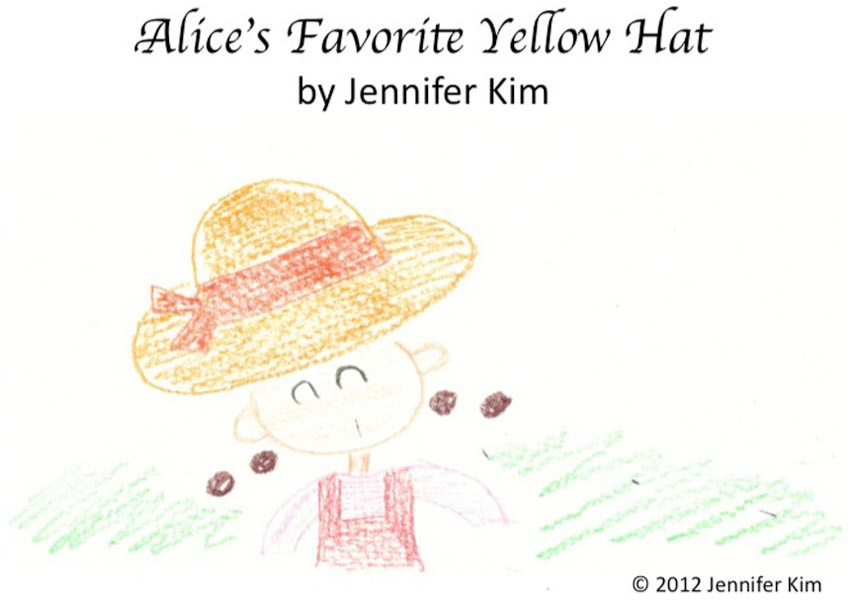
This sound story written by Jennifer Kim (2012)—a cellist and music education certification student at the Peabody Conservatory of Music—provides an example of using predictable text, illustrations for language comprehension, and icons to engage children in music reading skills. Kim’s story uses an experience typical in childhood (playing outside) and a story form that engages children’s interest. The main character, Alice, is playing outside wearing her favorite yellow hat. The cloud sees her and wants to play with Alice, but his way of playing isn’t very nice. He repeatedly blows the yellow hat off her head, and it lands somewhere else. Each time she moves to retrieve the hat, the cloud blows it off again until at last it rests high in the branches of a tree. Unable to reach the hat, Alice weeps because she doesn’t know what to do. The cloud feels bad and decides to help Alice recover her hat. After a second try, the cloud succeeds in blowing the hat out of the tree and on to Alice’s head.
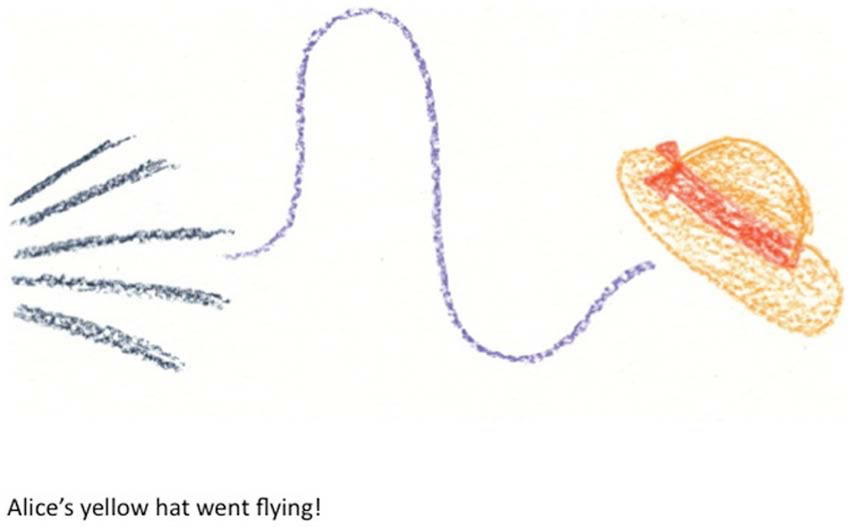
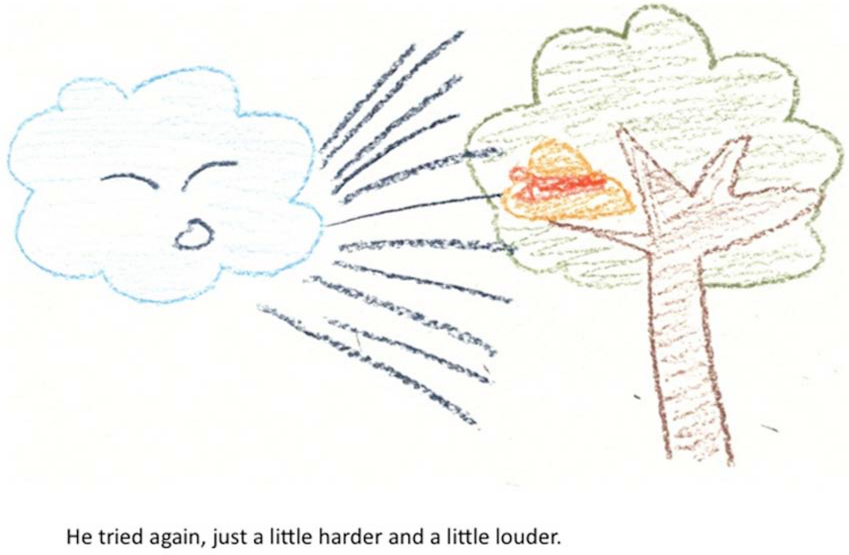
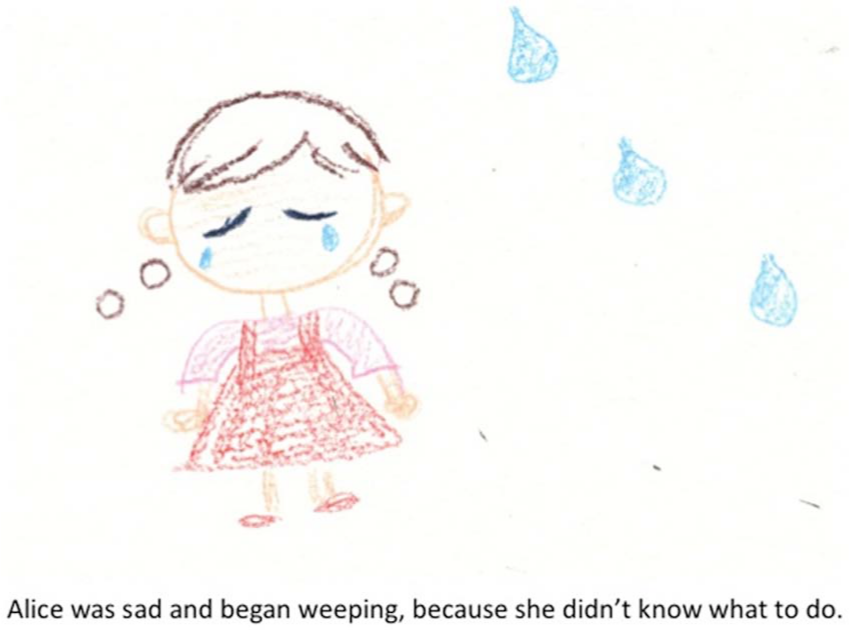
Children readily perceive the narrative pattern of character exposition, conflict, and conflict resolution. The conflict offers an opportunity for children to predict what will happen next in the story, an important aspect of reading comprehension. Kim addresses music reading through icons for melodic contour for children to read using vocal exploration on a neutral syllable (e.g., “oo”) for the movement of the hat, icons for dynamics using “whoosh” for the cloud blowing the hat around, and icons for three descending pitches (e.g., mi–do–la, or do–ti,–la,) sung on a neutral syllable for Alice’s weeping.
Example of icon for melodic contour.
Source. Jennifer Kim. Reprinted with author’s permission.
Example of icons for dynamics.
Source. Jennifer Kim. Reprinted with author’s permission.
Example of icons for descending pitches.
Source. Jennifer Kim. Reprinted with author’s permission.
When reading the sound story to children, the music teacher is encouraged to place the words on the backs of the cards to further focus children’s attention to the music icons. Teachers read the text, then model the music sound while tracking or tracing the music icons. Typically, children join in the music sounds once they perceive the pattern of the story. Inviting children with prompts such as “Let’s try that together” will aid children in participating in the story. (See link “Alice’s Favorite Yellow Hat” in References for full story in PDF format.)
“The Little Red Hen”
The folk tale, “The Little Red Hen,” is a narrative that lends itself to including music during storytelling. This sound story, aimed for elementary-age students, requires the following materials: barred instruments, music notation excerpts (see Figures 1-3), and the text of the story. A retelling of the folk tale is provided, with indications for playing the music excerpts.

Excerpts 1 and 2 for “The Little Red Hen” sound story.

Excerpt 3 for “The Little Red Hen” sound story.

Excerpt 4 for “The Little Red Hen” sound story.
The Little Red Hen (Retold by Audrey Cardany) Once upon a time, there was a Little Red Hen who worked hard everyday to feed her chicks. One morning while in the barnyard with the goose, the cat, and the dog, she discovered some seeds. She asked her friends, “Who will plant these seeds?” [Excerpt (Ex.) 1] “Not I,” said the goose. “Not I,” said the cat. “Not I,” said the dog. [Ex. 3] “Then I’ll do it myself,” replied the Little Red Hen. And she did. [Ex. 4] The wheat grew tall and golden in the sun and was soon tall enough for harvest. The Little Red Hen went into the barnyard and asked, “Who will harvest the wheat?” [Ex. 1] “Not I,” said the goose. “Not I,” said the cat. “Not I,” said the dog. [Ex. 3] “Then I’ll do it myself,” replied the Little Red Hen. And she did. [Ex. 4] At last the wheat was harvested, and it was ready to be ground into flour. “Who will grind this wheat into floor? [Ex. 1] “Not I,” said the goose. “Not I,” said the cat. “Not I,” said the dog. [Ex. 3] “Then I’ll do it myself,” replied the Little Red Hen. And she did. [Ex. 4] After the Little Red Hen ground the wheat into floor, it was ready to be kneaded into dough. The Little Red Hen asked, “Who will knead the flour into dough?” [Ex. 1] “Not I,” said the goose. “Not I,” said the cat. “Not I,” said the dog. [Ex. 3] “Then I’ll do it myself,” replied the Little Red Hen. And she did. [Ex. 4] After she finished kneading the flour into dough, she asked, “Who will bake the dough into bread?” [Ex. 1] “Not I,” said the goose. “Not I,” said the cat. “Not I,” said the dog. [Ex. 3] “Then I’ll do it myself,” replied the Little Red Hen. And she did. [Ex. 4] When the bread was finished baking, the Little Red Hen took it out of the oven to cool. The bread’s delicious smell drifted into the barnyard, and the goose, the cat, and dog came running. The Little Red Hen asked her friends, “Who will eat this bread?” [Ex. 1] “I will,” said the goose. “I will,” said the cat. “I will,” said the dog. [Ex. 3] “Oh, no you won’t,” scoffed the Little Red Hen. “I planted these seeds. [Ex. 2] I harvested the wheat. [Ex. 2] I ground the wheat into flour. [Ex. 2] I kneaded the flour into dough. [Ex. 2] And, I baked this dough into bread. [Ex. 2] And now, I will eat it and share it with my chicks!” And she did. [Ex. 4]
The lesson procedure is as follows:
Read the story to the children. Identify the pattern of the story. (The hen asks the same questions of her friends, declares she will do the work, and finally states all she has done.)
Display the music notation excerpts and identify where they will be played during the story. Have children read and play the excerpts, then read the story while a small group of children play barred instruments during the story.
NOTE: Excerpts 1 and 2 are played after the questions or statements are read. Excerpt 3 may be played while children sing along or may be played after the text is read. Excerpt 4 is played after the text “and she did” is read.
Invite children to analyze the patterns and their fit to the story. For example, the rising of the voice for questions matches the ascending glissando, and the so to do interval matches the finality of the Little Red Hen’s decision to “do it herself.”
For additional practice, invite individual children to read the story, while other children play the patterns on barred instruments
Conclusion
An important first step toward language literacy is children’s understanding that symbols can represent real people, things, and actions. Similarly, first steps toward music reading include children’s awareness that icons can represent musical sounds—loud or quiet, high or low, short or long, and fast or slow. Just as illustrations in children’s books aid children in connecting images to what they symbolize, music icons provide a bridge between understanding music through listening, singing, and moving (enactive modes), and understanding music through symbolic representation of standard music notation (symbolic mode). For older children, standard notation within the story form is appropriate and incorporates the symbolic mode of understanding music. In “The Little Red Hen” sound story, the narrative provides a context for linking short melodic or rhythmic patterns together. These patterns might other wise be included in a less enjoyable “drill and practice” activity. Ancillary to the music reading at a symbolic mode of understanding in this lesson is an opportunity to explore the nature of the barred instruments: specifically, where the lowest and highest pitches are notated on the staff. Also, to help children discover the “happy” coincidence of the B as the middle line of the staff and the middle of the barred instruments, have them place a finger of the left hand on the lowest pitch and a finger of the right hand on the highest pitch and “walk” one pitch at a time toward the middle of the instrument until the fingers meet on the pitch B.
When listening to stories, children share in the interpretations of others (Dyson & Genishi, 1994), and adding musical sounds provides another way of knowing and expressing those interpretations. For example, in the story “Alice’s Favorite Yellow Hat,” children hear the words that the character felt sad, see an illustration of the sad character, and sing three descending pitches represented by the icons. The concept of sadness is experienced in three ways: (a) linguistically, through the words read aloud; (b) visually, through a picture of the character crying; and (c) musically, through hearing and singing the three descending pitches. The “Little Red Hen” sound story also presents musical ways of knowing other concepts. The concept that the voice ascends when asking a questions is further emphasized with the ascending glissando on a barred instrument. Also, the clear dominant to tonic music relationship punctuates the subtext of the story. The Little Red Hen waits for one of her friends to say “I’ll help,” but each response ends on the fifth of the scale (dominant), leaving her frustrated. When the character emphatically states that she will do the work, the barred instruments play her emotion with a sol to do pattern—an isolation of the V–I cadences heard in tonal music.
In this article, the author has shared an example of sound stories for iconic and symbolic modes of understanding music. Music teachers are encouraged to create sounds stories for their particular students, using topics of relevant interest to the children in their classes. Once sound stories are familiar to children, students can create stories, using icons or standard notation, and further engage in the natural connection of language and music literacy.
Footnotes
Declaration of Conflicting Interests
The author(s) declared no potential conflicts of interest with respect to the research, authorship, and/or publication of this article.
Funding
The author(s) received no financial support for the research, authorship, and/or publication of this article.