







Abstract
Given its importance in children’s development and learning, researchers have rigorously studied play, and many teachers have used it as a classroom tool. Music researchers have observed that music regularly accompanies children’s play because music is part of their culture, and “playing with music” is the most natural form of expression of their existence as musical beings. Hence, play is at the heart of early childhood music, and music teachers design activities that are playful using manipulatives, instruments, movements, and musical sounds to engage children. However, scant research has explored the types of play enacted in guided music settings and how children construct musical understanding through play. This article discusses children’s play and related theories, illustrates how children “play with music” in the guided music setting, and offers practical applications of play in guided music activities.
Introduction
Play is a vital component in the lives of children; it is how they learn about the world around them (Copple & Bredekamp, 2009) and express what is inside them (Froebel, 1826/1907). The importance of play in a child’s education has been noticed as early as the time of ancient Greece. In Plato’s Republic (Plato & Bloom, ca. 380 BCE/1991), Socrates suggested, “Don’t use force in training the children in the studies, but rather play. In that way you can also better discern what each is naturally directed toward” (p. 216). Rousseau (1762/1979), a philosopher who wrote Émile, an important work on the nature of education, also advocated play. He asserted that play contributes to developing a healthy body, which he saw as essential for a healthy mind (Flood & Hardy, 2013). However, it was not until the 20th century that researchers and theorists endeavored to understand play from the developmental (Bruner, 1983; Piaget, 1962; Vygotsky, 1930/1978), social (Parten, 1933), educational (Froebel, 1826/1907), and cultural (Huizinga, 1938/1955) perspectives and proposed applications in children’s education.
The National Association for the Education of Young Children states that play is an important component in developmentally appropriate practice and recommends that teachers include it in the curriculum to benefit the development of children across social, cognitive, physical, and emotional domains (Copple & Bredekamp, 2009). National Association for the Education of Young Children also recognizes that a rich play experience in early childhood contributes to the healthy development of a whole child. Similarly, early childhood music specialists support the idea that playing with music benefits the development of a child as a musical being, as a rich musical experience in the early years will develop children’s potential to learn music and provide the readiness to understand and perform music when their formal music instruction begins (Gordon, 2013; Taggart, 2000; Valerio et al., 1998).
Many early childhood music teachers incorporate play in their curriculum as part of an overall child-centered approach to support music learning of children. Yet there is a concern that play experience could be limited in the guided music setting because, after all, the teacher aims to elicit musical responses and behaviors from children through teacher-led activities (Niland, 2009). Therefore, a continuous discussion is warranted to clarify how play is enacted in the guided music setting and deepen our knowledge of how children construct musical understanding through play. With the intent of improving the ways early childhood music teachers employ play in the guided music setting, I will (a) provide a deeper understanding of children’s play and related theories, (b) illustrate children’s “play with music” based on general cognitive and social play as frameworks, and (c) offer practical applications of these theories in guided music activities.
Children’s Play and Related Theories
Play is at the heart of virtually every child’s learning experience. However, the degree of the child’s engagement in play may differ depending on factors such as cultural background (Edwards, 2000; Pellegrini, 2009; Roopnarine, 2011), home environment (Harley, 1999; Soccio, 2013), and individual capabilities (physical, cognitive, emotional). For example, a child raised in a family where play is valued and perceived as part of natural development and learning would engage in active and creative play. Conversely, a child from a family where play is undervalued and merely perceived as an activity to replace boredom or as an external reward after work might display a different play behavior.
Although we can intuitively identify play, there is no consensus on a formal definition because there are various types of play (e.g., physical play, construction play, symbolic play), each with its own definition (Miller & Almon, 2009). Therefore, rather than an absolute definition, play researchers and experts suggest that it may be more appropriate to identify and describe children’s play on a continuum, as more or less playful (Rubin et al., 1983; Stonehouse, 1999). For example, based on a set of criteria, such as (a) the play is spontaneous; (b) children engage in the play for the simple pleasure of it (the means) rather than looking for the ends; (c) the play is purposeful, which means children do not seek external rewards for it but do it for pleasure or enjoyment; and (d) the play allows trial and error without worry about the consequences of failure, we can describe a degree of child’s play.
The bulk of early childhood education literature includes a discussion on play and related theories. In particular, classic studies on cognitive and social play are most prevalent (Pellegrini, 2011). Piaget (1962) identified play within cognitive development stages: practice play, within the sensory motor stage; symbolic play, within the preoperational stage; and games with rules, within the concrete operational stage. His play theory was later adapted by Smilansky (1968), and she labeled it as functional, constructive, dramatic, and games with rules, which became the standard categorization of children’s play. According to Smilansky, in functional play, the child explores his physical capabilities, repeating actions and manipulations to practice through repetition and imitation. In constructive play, the child creates form rather than manipulating it. Manipulation of objects is no longer exploration but is used for formation (e.g., handling of the building blocks to building something with blocks). In dramatic play, the child assumes simultaneous roles as an actor, observer, and participator and changes the play scenario at will. The highest stage of play development is games with rules, in which children not only begin to adjust to rules and control their behaviors but also modify and invent rules.
Along with Smilansky’s stages of play, Parten’s (1933) identification of four levels of social play—(a) solitary play, when the child plays alone; (b) parallel play, when the child plays beside rather than with others; (c) associative play, when the child plays with others; and (d) cooperative play, when the child plays in a group for some collective purpose—continues to provide a broad framework in describing children’s play from the social perspective. Vygotsky (1930/1978) and Bruner (1983) also advocated social play by discussing how playing with others contributes to the development of a child. Vygotsky proposed a view that children move forward through the play activity because play creates a zone of proximal development, where the child receives guidance from advanced play peers or adults. Zone of proximal development allows children to encounter positive play partners who model, scaffold, guide, and interact so that the child can achieve things that are not possible when tried alone. Bruner (1983) observed children’s play behaviors and found that the factors contributing to rich and elaborate play were the presence of an adult, the interactive play with a partner, and the activity of the class playing together, which the children could use as a model when playing on their own.
Music and Play
Music is part of children’s culture, and “playing with music” is the most natural form of expression of their existence as musical beings. Infants coo and babble in response to sounds, toddlers spontaneously vocalize in their daily routine (eating, being dressed, waiting in a line), and preschoolers are natural inventors of new songs and prolific improvisers. Furthermore, in their free play, children softly hum or create a spontaneous song while drawing, building blocks, or playing with toys in solitary or within their playgroup. Smith (2008) calls this type of spontaneous play behavior musical play and defines it as young children’s interactions within the context of play that involve their unrestricted selection and use of music, music materials (e.g., musical instruments, recorded music), music activities (e.g., singing, dancing, playing instruments) and other materials (e.g., toys, puppets, costumes) to extend and enhance their music experiences and understanding. (p. 26)
As the definition of musical play denotes, it is difficult to determine which behavior (music or play) accompanies which, because both manifest in a synthesized form. In fact, children do not make distinctions such as “this is playing” or “this is musicking” because it is something that they do when they feel a need to play and evoke the Muse Within, a natural tendency to music as muse-ical beings (Bjørkvold, 1992).
The Play Aspects in Music Education Approaches
Almost all music education approaches (Dalcroze Eurhythmics, Kodály, Orff Schulwerk, Gordon’s music learning theory [MLT]) embrace and incorporate play for teaching music. While the approaches are based on different sets of teaching principles, there are also similarities because all value developing children’s natural musicality. For example, almost all approaches encourage moving as a way of expressing the children’s inner musicality. Children express beat moving in locomotion (walking, stomping) alone and with others or coordinate movements in a folk dance. Particularly, Dalcroze Eurhythmics puts an emphasis on developing “good rhythm,” putting movement at the center of the approach. In Dalcroze, children move to “feel” music concepts and “see” the invisible musical sound (Jacobi, 2019) as the teacher provides musical accompaniment (which reflects articulations, dynamics, rhythms, note values, etc.) at the piano.
The notion of “rote first” (sound before sight) to build a musical foundation through various musicking before being introduced to notation is also common across the approaches. For example, children experience singing without notation first. Children learn the song through call and response (most often in Kodály and Orff) or in a holistic way through a rote song teaching, repeating the entire song multiple times focusing on the development of audiation—the thinking in music (in MLT). In addition to voice, instruments are used as another sound medium for expressing music concepts and performing alone and with others. Children may express rhythm (the beat, melodic rhythm, rhythm pattern, ostinato) through unpitched percussion instruments, and the melody through pitched instruments. Particularly, the barred instruments (first adopted and used in Orff Schulwerk) are vital for children in experiencing the drone, tonal ostinato, melody, and improvisation.
In teaching notation, instructional methods such as solfège and rhythm syllables (e.g., Kodály, duration-based or beat-function syllables; Gordon, beat-function syllables; Orff, mnemonic, Kodály syllables or French time name system) help children experience notations in a musical way and eventually use them to perform, read, and improvise. In addition, some teachers choose to use the hand signs with solfège and prestaff visual icons (often in Kodály and Orff), while other teachers teach standard notation through pattern instruction that centers on audiation (MLT).
While the music lessons in a general music class are often structured toward specific learning outcomes, knowing the importance of play in children’s education, the teachers present play in many ways. Children vocal-play with others through chanting, singing, and musically conversing; move in a variety of ways in conjunction with music; explore, manipulate, and improvise on instruments; and imagine through creating and incorporating drama.
The Applications of Play Theories in the Guided Music Setting
Play enacted in the guided music setting looks different from the structured music setting because the teacher cannot expect children (ages 0–3 years) to sit still, follow instructions, or focus on a task. Instead, children sit on their mother’s lap while observing others, crawl or run around the classroom, bob their heads and knees and move side to side in conjunction with music, and respond vocally to music intentionally or unintentionally as they evoke the Muse Within. Thus, teachers should honor children’s dispositions and allow them to be spontaneous, free, flexible, and imaginative in the guided music setting. Gordon’s (2013) assertion that children teach themselves rather than being taught illuminates how play must be at the heart of early childhood music because children learn best through play. In that, it is necessary for the teachers to have a thorough understanding of play and understand how it emerges in the context of music.
Several researchers have discussed children’s musical play behaviors based on the cognitive and social stages frameworks and confirmed that these theories have particular relevance when describing children’s music learning (Littleton, 1998; Morin, 2001; Tarnowski & Leclerc, 1994). Particularly, Littleton’s study on children’s cognitive and social play during free play is notable. Littleton (1998) identified musical play behaviors based on Piaget and Smilansky’s (Piaget, 1962; Smilansky, 1968) cognitive play categories—functional, constructive, and dramatic (see Table 1)—and also offered insight into social play in children’s dramatic play. Littleton (1998) verified that in a free musical play setting, rich social play occurs. She reported that children (a) share ideas on how to make music, play instruments, and create music-dramas; (b) imitate each other’s rhythmic and melodic improvisations; (c) engage each other in vocal or instrumental music conversation; and (d) play cooperatively and settle disagreements successfully.
Cognitive Music-Play in the Guided Music Setting.
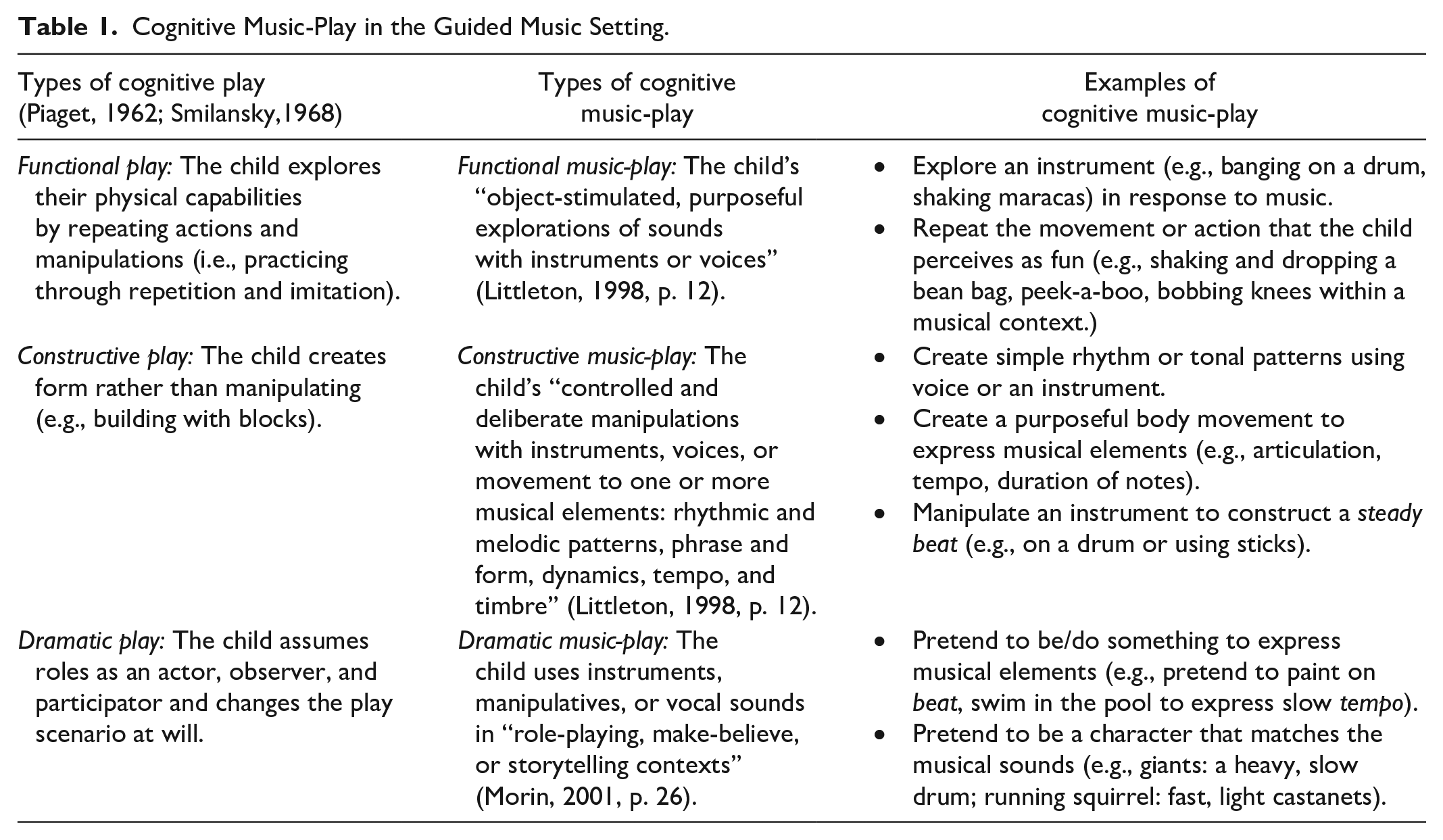
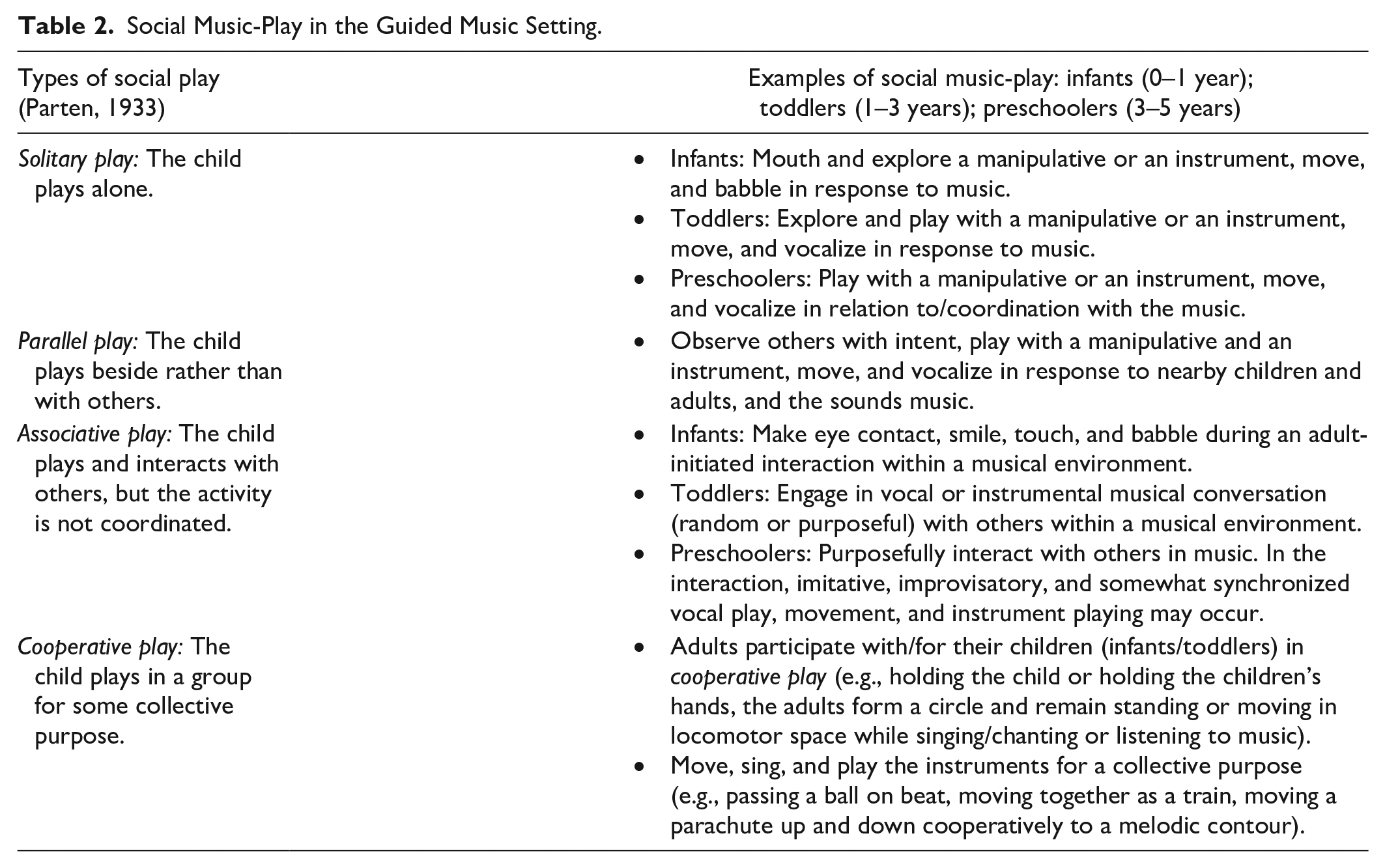
Based on my experiences as an early childhood music teacher, I have observed that cognitive and social play that Littleton has identified also emerge in the guided music setting. In the following section, I will illustrate how cognitive (see Table 1) and social music-play (see Table 2) are enacted in the guided music setting based on the general cognitive (Piaget; 1962; Smilansky, 1968) and social play (Parten, 1933) as frameworks. In addition, examples of cognitive music-play activities are presented in Figures 1–3.
Social Music-Play in the Guided Music Setting.
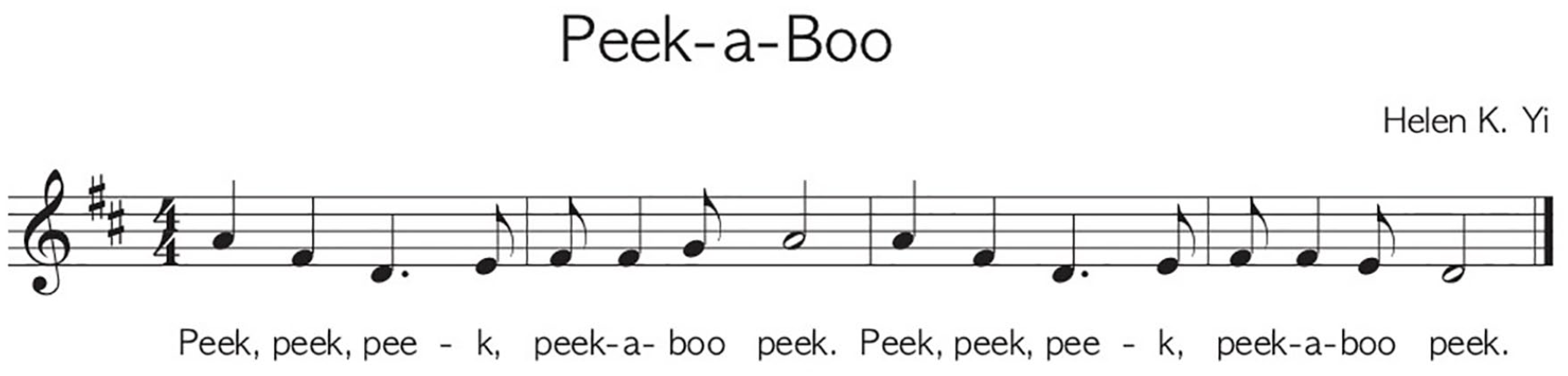
Functional music-play activity.
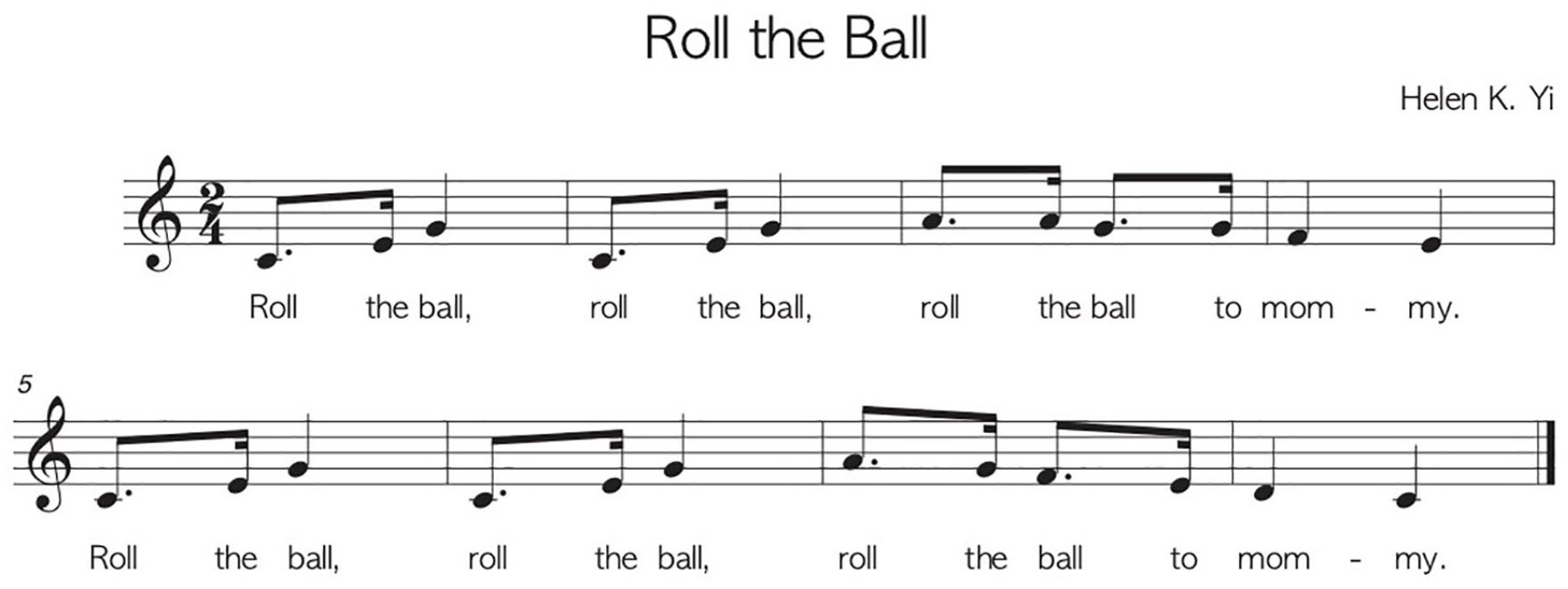
Constructive music-play activity.
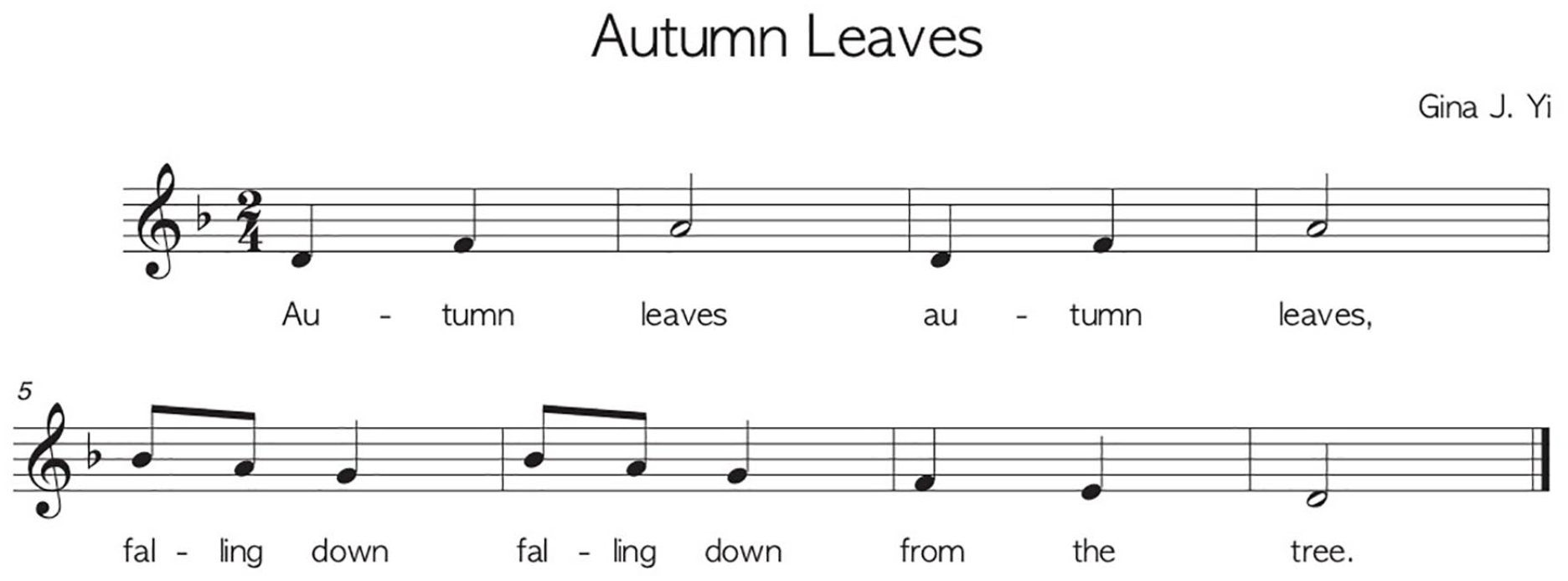
Dramatic music-play activity.
Functional Music-Play
Littleton (1998) referred to functional play with music as “object-stimulated, purposeful explorations of sounds with instruments or voices” (p. 12). In functional music-play, the play-tool (e.g., voice, action, gesture, manipulative, instrument) assumes a role as a humor trigger, inducing immediate interest from children, which encourages their participation. For example, the teacher’s dropping of the egg shakers with a playful vocal exclamation “uh-oh” at the end of the Humpty Dumpty chant might trigger humor. On noticing the humor trigger, toddlers might engage in functional play, repeating what they have perceived as fun, which is dropping the egg shakers over and over again when they hear “uh-oh.” Children engage in functional play because children, as natural players, bang drums, clap hands, stomp feet, vocalize, and move repeatedly for fun. Children become so immersed in “doing” through play that they will get the practice they need without ever knowing they are practicing (Goodkin, 2013). Thus, children teach themselves through play without the teacher imposing instruction.
Constructive Music-Play
Children in constructive play with music demonstrate “controlled and deliberate manipulations with instruments, voices, or movement to one or more musical elements: rhythmic and melodic patterns, phrase and form, dynamics, tempo, and timbre” (Littleton, 1998, p. 12). Children may create a simple tune using voice, improvise a response after the teacher’s call on a barred instrument, or construct a steady beat using various mediums (body, manipulative, percussion instrument). Constructive music-play may also extend to dramatic play in interaction with others. For example, as the child accumulates rhythm vocabularies through vocal dialogues with the teacher, the child will eventually acquire the readiness (the rhythm and tonal vocabularies) to create various tonal and rhythm patterns. On observing the child’s readiness, the teacher could incorporate dramatic play where the teacher pretends to call the child and initiate a rhythm conversation, followed by the duple meter chant, “My Mother, Your Mother.” The child will be delighted to create something after the teacher’s rhythm pattern because they see the phone call activity as fun.
Dramatic Music-Play
In dramatic play with music, children use instruments, manipulatives, and vocal sounds in role-playing, make-believe, or storytelling contexts (Morin, 2001). Unlike a free musical play setting where children self-initiate or invite each other to dramatic play, the teacher is the one who often initiates dramatic play in the guided music setting. In teacher-initiated dramatic play, the teacher proposes a scenario or introduces a play tool rather than assigning a role to a child. Objects are especially helpful in engaging children in play because children are masters at inventing things within a proposed scenario to promote their imagination. Children transform objects without constraints from the real world and invent the roles of objects, knowing that they have complete control over them in the play situation. Therefore, children welcome the teacher’s idea of using a stretchy band as a train to move around to their microbeat steps and a parachute as waves moving up and down to respond to the melodic contour or a hiding cave to crawl under and practice a secret pattern dialogue.
In the children’s play world, play becomes a magic wand, transforming ordinary objects, sounds, or movements into imaginary tools promoting their music-play. The following vignette illustrates how play acts as an imaginary tool in children’s dramatic music-play: In a preschool music classroom, Ms. Stephanie stamps (using a rubber duck as an imaginary stamp) on the child’s hand after each child attempts to echo her rhythm pattern. Children happily engage in the vocal dialogue with Ms. Stephanie; even the shy children are eager to participate in hopes of getting a stamp (which is used as a ticket) to ride the train. Ms. Stephanie tells children that moving their feet will make the train go; moving feet will give fuel for Thomas the Train. One by one, the children step into the stretchy band after showing Ms. Stephanie their ticket. Then they hold up the stretchy band to make a long train and move in locomotion while singing the song “Down by the Station.” The children ride the train around the room, slowing down when going up the hill and speeding up down when going down the hill. Joyful singing and giggling fill the classroom. Several children who are waiting to ride the train also smile when watching the children on the train having fun. Then, Stephen (a 4-year-old child) suddenly blocks the way, and the children scream, “Move Stephen!” Stephen smiles and says, “I am the gate! Say, ‘Open sesame!’” The children giggle and shout enthusiastically, “Open sesame!” Stephen opens the gate for the train with his invented gate-opening vocalization. The children smile and move their feet along hurriedly and go through the gate.
Evidently, Ms. Stephanie had clear musical goals—to elicit children’s rhythm response, step to the beat with varied tempo, and sing while moving. However, the children did not perceive her activity as an instruction, but as an invitation to play. Even Stephen, the child who assumed a role as an onlooker—watching other children play (Parten, 1933)—enhanced play when something triggered a novel idea (“open sesame”) by altering the play scenario.
Another vignette illustrates how a teacher can join a child’s play world by welcoming the child’s novel idea and allowing her to alter the play scenario en route.
After a few rounds of singing the song using the soft streamers to express beat in a variety of ways (painting the wall, sweeping the floor, shaking them), Laura (a 3-year-old child) begins to dab her face with them with a big smile on her face.
Laura might have engaged in functional play by varying and repeating the action that she had just learned (from observing and imitating) or initiated pretend play by pretending to dab her face using the streamers as a towel. In this situation, the teacher can promote Laura’s novel idea by imitating her play action and introducing it to other children (e.g., by pretending to dab on beat). Both the teacher and the child assume a role as a mutual play partner in the zone of play because the adult honors the child’s idea instead of correcting or imposing a strict rule. In the zone of play, adult rules are not imposed, expectations are not established, and new information is not carelessly given without considering the individual child’s capability.
Social Music-Play
Music promotes the social aspect of a child’s play. Music as a means for playing with others (Marsh & Young, 2006) and “being with others,” as well as “being with music,” are frequently observed in children’s musical play (Custodero, 2005). A mother’s singing immediately draws the child’s attention for a musical attunement, and a child singing a familiar tune instigates another child’s urge to sing along. In that, the guided music setting provides a unique social setting where children can observe how other children and adults play with music and hear diverse voices and musical sounds (in terms of range, timbre, and volume). Most of all, children experience music at another level in a social setting. For example, the dynamic (e.g., louder) and the tempo (e.g., faster) of their singing may take a different form, and such stimulus of “others” could deeply engage children in the activity, experiencing ritual-like singing (Moorhead & Pond, 1941/1978).
A guided music setting is conducive to playing with music and others, thus promoting children’s social music-play (see Table 2). For example, children use manipulatives and instruments as tools to express their musicality within a rich musical environment (solitary or parallel play); musically interact with adults and children (associative play); and sing, chant, and move as a group for a collective purpose (cooperative play). Furthermore, in the guided music setting, the teacher can be a “music reference” for adults, providing the “tools” that they can use to nurture and guide (Guilbault, 2005) their children at home. Parents and caregivers may gain a better understanding of the child and confidence as they practice “interacting” with them as they watch the teacher model, learning how to be a music model for their children. As such, the guided music setting is not just for children. While parents’ intention for enrolling their children in early childhood music programs could be to supplement the music learning of their children, this unique social setting offers opportunities for all participants to grow in and share music in a communal way, creating a unique musical culture.
Conclusion
Bjørkvold (1992) remarked that [play] is a way of being, a state of mind in continuous motion. . . . Children do not just play: they live in and through their playing, with a capacity for total flexibility—both here and now and beyond time and space. Children are what they play. (p. 28)
As natural players and musical beings, children play with music wholeheartedly, using all their senses and feelings. They become involved in music holistically using a variety of learning modes: aural, oral, visual, and physical (Neelly, 2001). Moreover, when a child is immersed in play, the experience of “being in the moment” enables the child to encounter the aesthetic because the child is enveloped by sensory messages of color, sound, and movement, meeting personal criteria for beauty (Custodero, 2005). The countless accounts of children “being in the moment” in many studies on musical play (Berger & Cooper, 2003; Kierstead, 2006; Littleton, 1998; Moorhead & Pond, 1941/1978; Smith, 2008; Tarnowski & Leclerc, 1994; Young, 2002) are evidence that young children are able to explore, vary, invent, improvise, and create to pursue the best quality they can produce as any artist would through play.
Play should never be considered lesser in children’s early musical experience, as growing child-musicians without past and continuing experience of “playing with music” will be frustrated when the task (e.g., acquiring the instrument technique or learning to read music notation) is imposed without musical readiness. Without the readiness to achieve a higher level of the task, students will see music instruction as meaningless work or give up on music learning due to lack of experience and understanding. Therefore, the absence of musical readiness will eventually extinguish the “fun” of music because students experience learning an instrument as work and do not reach the level of play. Conversely, students who are “true players” (those who have had rich “playing with music” experience) are frustration proof and see the task as an invitation to play around with a problem (Bruner, 1983). Therefore, it is important to foster children to become the “true players” who seek challenge, so that in time, with readiness, they can transit to the next play level, seeking higher quality of play.
Historian John Huizinga (1938/1955) remarked that “civilization is, in its earliest phases, played” (p. 173) and hypothesized that human culture (e.g., language, ritual, war, philosophy, music, art, romance, etc.) emerged out of man’s capacity to play. In a similar notion, the child’s musical culture perhaps emerges out of a child’s capacity to play with music. The degree of experience in which children play with music establishes the foundation of their successful musical experience or aesthetic experience throughout their lives. Therefore, the essence of play in music is the continuation of “playing with music” throughout their lives, whether they are engaged in music-listening, playing an instrument, improvising, composing, singing, or even playing musically with their own child as a parent.
Footnotes
Declaration of Conflicting Interests
The author declared no potential conflicts of interest with respect to the research, authorship, and/or publication of this article.
Funding
The author received no financial support for the research, authorship, and/or publication of this article.
