






Abstract

Begeer, S., De Rosnay, M., Lunenburg, P., Stegge, H., & Terwogt, M. M. (2014). Understanding of emotions based on counterfactual reasoning in children with autism spectrum disorders. Autism, 18, 301–310.
Beck, S. R., Weisberg, D. P., Burns, P., & Riggs, K. J. (2014). Conditional reasoning and emotional experience: A review of the development of counterfactual thinking. Studia Logica, 102, 673–689.
A major aspect of language development during the latter preschool years and the school-age years is the development of more complex syntax, particularly characterized by the use of dependent clauses. Expression of causal conditionals and counterfactuals typically involve use of dependent clauses, for example,
Causal hypothetical conditional: “If it is warm enough, we will go swimming.”
Causal counterfactual: “If I had put gas in the car, it would have started.”
Although both causal hypothetical and counterfactuals frequently use similar syntactic structures, counterfactuals are more complex than hypothetical conditionals. Both types of conditionals can be used for logical reasoning, but counterfactuals are typically used to promote future problem solving or to regulate one’s emotions. Hence, counterfactual thinking is an important aspect of developing executive function skills.
What Is Counterfactual Reasoning?
Thinking about how things could have been, possible outcomes that did not happen but can be imagined, is known as counterfactual thoughts. Counterfactual thinking is thinking “counter to the facts.” These thoughts consist of the “What if?” and the “If I had only …” that occur when thinking of how things could have turned out differently. Counterfactual reasoning involves imagining alternatives to an event (Epstude & Roese, 2008) and switching back and forth between a real situation and an imagined (counterfactual) one. The term counterfactual reasoning is typically reserved for situations where the individual must put aside what is known to be true and speculate about a false possibility as if it were true. Events in the future (for example) that are counter to the current state but cannot yet be known to be true or false are typically called hypothetical conditional, not counterfactuals. Counterfactual reasoning prepares us to be more cautious in future situations (e.g., “If only I had checked the weather before leaving, I wouldn’t have been caught in the snowstorm”) but also helps to regulate current emotional states (e.g., “At least I wasn’t in the accident”) and are critical to understanding people’s complex emotional responses to events (Roese, 1997).
Types of Counterfactual Reasoning
Researchers distinguish between two types of counterfactual reasoning: upward and downward. Both forms have emotional and behavioral consequences. When persons use upward counterfactual reasoning, they compare a current situation with a better alternative. Upward counterfactual reasoning is typically, although not always, elicited by a negative situation, for example, “If I had waited, she would have given me two cookies instead of one.” Comparing a situation with a better alternative provides an incentive to modify our behavior (Roese, 1997). On one hand, upward counterfactuals may make us feel bad as we think about how things might have gone better. On the other hand, we might learn more effective strategies for success through this reflection—“if only I had done X, maybe next time.” Upward counterfactual reasoning has been related to problem-focused coping strategies, attaining control over negative events, and planning (White & Lehman, 2005).
When persons use downward counterfactual reasoning, they compare their current situation with a worse alternative—what may be termed, “looking on the bright side of life” (White & Lehman, 2005), for example, “The car was totaled, but at least no one was seriously hurt.” While upward counterfactual reasoning is often used to improve future outcomes, downward counterfactuals are often used to improve how we feel about our current circumstances. Despite our lack of success, we can take solace in the thought that it is not as bad as it could be. Individual differences seem to play a role here. Persons with high self-esteem make more downward counterfactuals (“it could have been worse”) in response to negative events, possibly reflecting a self-enhancement strategy and mood repair. This preference for downward counterfactuals in response to negative events or moods is sometimes viewed as a self-enhancement motive, a means to repair negative mood induced by an unpleasant outcome. Some psychologists believe that chronic self-protective downward counterfactuals may be dysfunctional, because it may decrease the likelihood that the individual will learn ways to improve behavior.

Counterfactual reasoning can also be differentiated based on whether you are thinking about how things could have been worse or better and whether you are thinking about what you should have done or what you should not have done:
Upward additive (U+) = “Things would have been better if I had only done X.”
Upward subtractive (U−) = “Things would have worked out better, if only I hadn’t gone and done X.”
Downward additive (D+) = “Things could have been worse if I had done X instead of Y.”
Downward subtractive (D−) = “Things might have been worse if I hadn’t done X.”
Both upward and downward counterfactual reasoning typically results in emotional reactions. For example, upward counterfactual reasoning, in which we consider how things could have turned out more favorably, generally elicits the feelings of disappointment, or even regret, particularly when we feel a high degree of responsibility for the chosen course of action (Zeelenberg, Van Dijk, Manstead, & van der Pligt, 1998). Downward counterfactual reasoning involving reflecting on how things might have turned out worse may induce contentment, or relief when we feel a high degree of responsibility (high agency) for preventing the negative situation (Guttentag & Ferrell, 2004).
Compared with upward counterfactuals and the feeling of regret, the use of downward counterfactuals and the feeling of relief are not so clearly related to future action. Downward counterfactuals provide a means of dealing with the current situation, which has been related to emotion-focused coping strategies (White & Lehman, 2005). When thinking of downward counterfactual thinking, or ways that the situation could have turned out worse, people tend to feel a sense of relief. For example, if after getting into a car accident somebody thinks “At least I wasn’t speeding, then my car would have been totaled.” This allows for consideration of the positives of the situation, rather than the negatives. In the case of upward counterfactual thinking, people tend to feel more negative affect (e.g., disappointment or regret) about the situation. When thinking in this manner, people focus on ways that the situation could have turned out more positively, for example, “If only I had studied more, then I wouldn’t have failed my test.” The fear of regret has a pervasive impact on decision making (Gilbert, Morewedge, Risen, & Wilson, 2004). Adults (e.g., Sanna & Turley, 1996) and children (German, 1999) use upward comparisons more frequently than downward comparisons. Although counterfactual emotions are common place for adults, they appear to develop rather late in children.
Influences on Emotions When Reasoning Counterfactually
Emotions associated with counterfactual reasoning are influenced by the extent to which an individual feels a sense of agency in bringing about a situation or outcome. Table 1 shows some of the emotions associated with upward and downward counterfactual reasoning associated with low and high agency. When one imagines how a situation may have unfolded differently but does not feel personally responsible for the outcome, one may feel contentment or disappointment, which are first-order emotions. First-order emotions are triggered automatically in response to environmental stimuli. However, when someone feels more responsibility for bringing about an outcome, self-conscious or second-order emotions such as regret, relief, guilt, or shame become more common.
Types of Counterfactuals
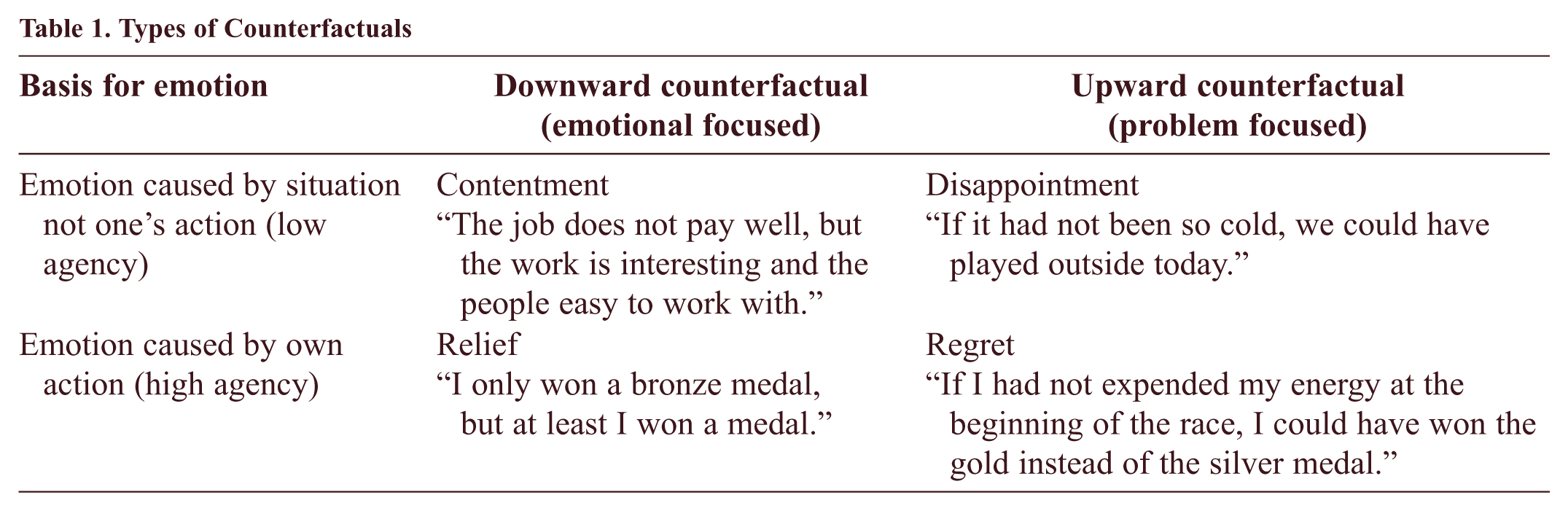
Second-order emotions are those emotions that typically depend on a psychological appraisal of another person. Thus, second-order emotions, which include pride, jealousy, shame, guilt, and embarrassment, cannot be understood merely in terms of an individual’s current first-order mental attitudes (i.e., thoughts, beliefs, and preferences) or situational determinants. Instead, second-order emotions require a contrasting psychological appraisal, attribution, or perspective. Second-order emotions are generally understood later in typically developing children. Regret and relief are also second-order emotions because they also involve contrasting psychological appraisals, but these are imaginations of oneself at another time and thus require counterfactual reasoning. For example, in the case of regret, an outcome (i.e., missing the school bus) and one’s desire (i.e., to be at school on time) need to be integrated with the intentions that underpinned the protagonist’s decision at an earlier time (i.e., staying up too late playing computer games the night before). During this process, one needs to appreciate the nature of the person’s thoughts about how an alternative prior decision may have resulted in different outcomes. In the school bus example, a feeling of regret emerges when the student infers events that unfold from imagining a “false” premise (e.g., having gone to bed earlier). When the counterfactual outcome (i.e., getting to school on time) is inferred from the “false” premise, the resulting emotional response is positive (or neutral) and contrasts sharply with the frustration of missing the bus. This contrast between two possible emotional outcomes requires second-order theory of mind. It is irrelevant that the student is reflecting on his or her own mental states. Theory of mind usually refers to inferring someone else’s state of mind, but could just as well be directed at inferring one’s own state of mind at other (imagined) times or contexts (Baron-Cohen, Tager-Flusberg, & Cohen, 2007). To experience or attribute emotions such as regret or relief, the child needs to understand the role of the person’s reflection on his or her earlier intentions and decisions, which might have gone a different way and brought about a different emotional outcome. Simple first-order emotional responses like contentment or disappointment can be inferred from the match between a person’s wishes and the (positive or negative) outcome and do not require recursive inference.
Development of Counterfactual Reasoning
From age 3, children are able to speculate about possible future consequences of events. For example, children were shown a car in the middle of a straight road in the middle of two garages (Robinson & Beck, 2000). The researcher drove the car to one garage and then asked the children “What if next time he drives the other way, where will he be?’ Almost all the sample of 3- and 4-year-old children answered this future question correctly, indicating the other garage. Thus, children exhibit an early ability to reason about hypothetical conditions that are known to be true or could be true. In contrast, children have much greater difficulty reasoning about things they know to be false—this involves counterfactual reasoning rather than a more simple conditional reasoning. The child must put aside what is known to be true and speculate about a false possibility as if it were true. (Events in the future that are counter to the current state but cannot yet be known to be true or false are typically called hypotheticals, not counterfactuals).
Perner, Sprung, and Steinkogler (2004) asked children to use counterfactual reasoning. They gave the children two travel scenarios in which different routes were possible. In the simple scenario, taking the boat from the boathouse led to the lake and taking the bus from the barn led to the pasture. In the complex scenario, taking the train from the green station led to the lake and taking the train from the blue station led to the mountains; where as taking the bus from the green station went to the mountains and the bus from the blue station went to the lake. In the simple task, children were told that Peter had taken the bus to the pasture and asked “Where would Peter be if he had taken the boat?” In the complex task, children were told that Peter took the train to the lake and asked, “Where would Peter be if he had taken the bus?” Nearly all 3-year-olds answered the simple task correctly, but they did not respond correctly to the complex task; only the 5-year-olds were consistently correct on the complex task. The simple task does not really require counterfactual reasoning. Children do not have to pay attention to the past details of Peter’s actual travel. Instead, all they have to do is make a simple connection between the boat and the lake. Children could respond correctly by using more simple conditional reasoning. True counterfactual thinking requires that children realize that when thinking counterfactually, they need to think about the real world and counterfactual world as related. Counterfactual reasoning requires greater working memory to keep both the real and imagined (counterfactual) world in mind and to compare them.
By age 7, children appear to begin to be influenced by the mutability of the event—the degree to which the person in the event could influence its outcome. Children listened to stories in which two characters experienced the same negative events, but they differed in the decision making leading up to the event (Guttentag & Ferrell, 2004): Bob cycles around the right side of a pond. Today he hit a fallen tree and fell off his bike. David always takes the left path, but today chose to switch to the right. He also fell off his bike. Who feels worse, Bob or David?
Like adults, 7-year-olds predicted that David would feel worse, because he will be more likely to make a comparison with might have been. The researcher appeared to assume that the children appreciated the concept of regret by responding that David would feel worse, but there was no specific reference to the word, “regret.”
The nature of the outcome on a character, however, influenced children’s response to the mutability stories. The 7-year-olds also heard stories designed to elicit relief: Mary and Susan both like pudding of almost all flavors, and they definitely like both vanilla and chocolate. In the lunch cafeteria at school, however, Mary always decides to eat vanilla pudding for her dessert while Susan always decides to eat chocolate pudding. Today at lunch, Susan ate her usual dessert, chocolate pudding. Mary, however, decided not to have her usual dessert (vanilla pudding). Instead, she decided to try the chocolate pudding. Today there were germs in the vanilla pudding and everyone who ate vanilla pudding got stomachaches. Mary and Susan did not get sick because they ate the chocolate pudding, which had no germs in it. Do you think one girl would be happier about eating the chocolate pudding today and not getting sick? Susan, who usually eats chocolate pudding, or Mary, who usually eats vanilla pudding but today decided to eat chocolate pudding instead, or do you think they would feel the same?
Whereas the 7-year-olds responded in a manner similar to adults with the regret stories, for the relief stories, the 7-year-olds usually judged that the two characters would feel the same rather than that the target character would feel better. The primary difference between the regret and relief stories was the valence of the outcomes; whereas the regret stories involved negative outcomes for the characters, the relief involved outcomes that were neutral or positive. Adults tend to engage in less counterfactual analysis when outcomes are positive than when outcomes are negative. This finding suggests that negative outcomes provide a particularly strong trigger for counterfactual reasoning. Even though 7-year-olds may be capable of comparing reality with its alternatives when making judgments of emotions, they may tend to do so only with fairly strong triggers or supports for a counterfactual analysis—the kinds of support provided by situations in which the outcome is negative. Adults, however, may require a less powerful trigger for the comparison of reality with its alternatives and therefore may be more likely than 7-year-old children to apply counterfactual reasoning when making emotion judgments in situations in which the outcome is neutral or positive.
Although preschool children engage in counterfactual thinking (Beck & Guthrie, 2011), it is not until children are about age 7 that they appreciate the emotional consequences from the reflection on counterfactual possibilities. There is some evidence that children as young as 5 years of age can acknowledge regret, but not relief, in themselves (Weisberg & Beck, 2010), but they have considerably more difficulty explaining disappointment, regret, and relief in other people even at 7 years of age (Ferrell, Guttentag, & Gredlein, 2009; Guttentag & Ferrell, 2004, 2008; Weisberg & Beck, 2010).
Implications
Hypothetical and counterfactual conditional reasoning involves the comprehension of complex relationships and the use of complex syntax (dependent clauses and complex verbs) to express these relationships. Effective executive functioning and counterfactual reasoning are associated (Beck, Riggs, & Gorniak, 2009). Students with language impairments, for any reason, typically exhibit difficulty with complex syntax, and students with language impairments, autism spectrum disorders, and attention deficit hyperactivity disorder exhibit executive function difficulties. When addressing executive function deficits, speech-language pathologists should consider developing the language of counterfactual reasoning. See the “Idea Swap” in this issue for details on the nature of syntactic structures in counterfactual reasoning.