






Abstract

Nuske, H. J., & Bavin, E. L. (2011). Narrative comprehension in 4-7-year old children with autism: Testing the weak central coherence account. International Journal of Language and Communication Disorder, 46, 108–119.
Background
Many children and adolescents with high-functioning autism spectrum disorders (ASD) have good structural language but exhibit deficits in discourse comprehension, particularly making inferences. Discourse comprehension requires integration of meanings of individual words, sentences, and paragraphs, as well as key ideas and themes. When listening to discourse or reading text, persons must also incorporate their general knowledge—this all requires global processing. Research indicates that persons with ASD are biased to processing discourse at a local level rather than a global level. They tend to focus on the details of the discourse rather than the overall point or theme of the discourse. Frith (1989) suggested that this focus on detail was due to weak central coherence (WCC). In contrast, typical persons have strong central coherence. A WCC cognitive style may impair comprehension, particularly if inferencing is required. However, task performance may be facilitated by this cognitive style if local processing (attention to detail) is required.
Comprehension of narratives requires both local and global processing. At the local level, listeners or readers must have vocabulary and syntactic knowledge; at the global level, they must have the ability to infer causal relationships between events, distinguish the goal and internal states of the people/characters mentioned, and integrate different parts of the story. Ultimately, listeners/readers must build a mental model or representation of the text. Consider, for example, Jane was invited to Jack’s birthday party. She wondered if he would like a kite. She went to her room and shook her piggy bank. It made no sound.
The listener/reader must make many inferences to comprehend this passage. If the piggy bank made no sound, then there is no money. If there is no money, a gift cannot be bought for Jack, whose birthday is coming up or has just passed as he is having a birthday party. To infer the meaning of Jane’s actions, one must draw on event schema of birthday parties.
Inferences based on event schemas are script inferences. Because script inferences require global processing of event schemas, it can be hypothesized that inferences of this type would be harder for individuals with autism. Script inferences can be contrasted with propositional inferences. Propositional inferences are based on logical relations between story statements. These inferences involve logical deduction between two or more statements or premises in the discourse. Propositional inferences rely on local processing, not the integration of previously acquired knowledge; therefore, persons with ASD may not have greater difficulty with these types of inferences than typically developing persons, and in fact because of their attention to detail, they may even be at an advantage on these types of inferences.
The purpose of this study was to examine the extent to which the WCC cognitive style affects comprehension and inferential processing of spoken narratives. The children with autism were expected to perform comparatively poorer on inferences relating to event scripts and comparatively better on inferences requiring deductive reasoning.
The Study
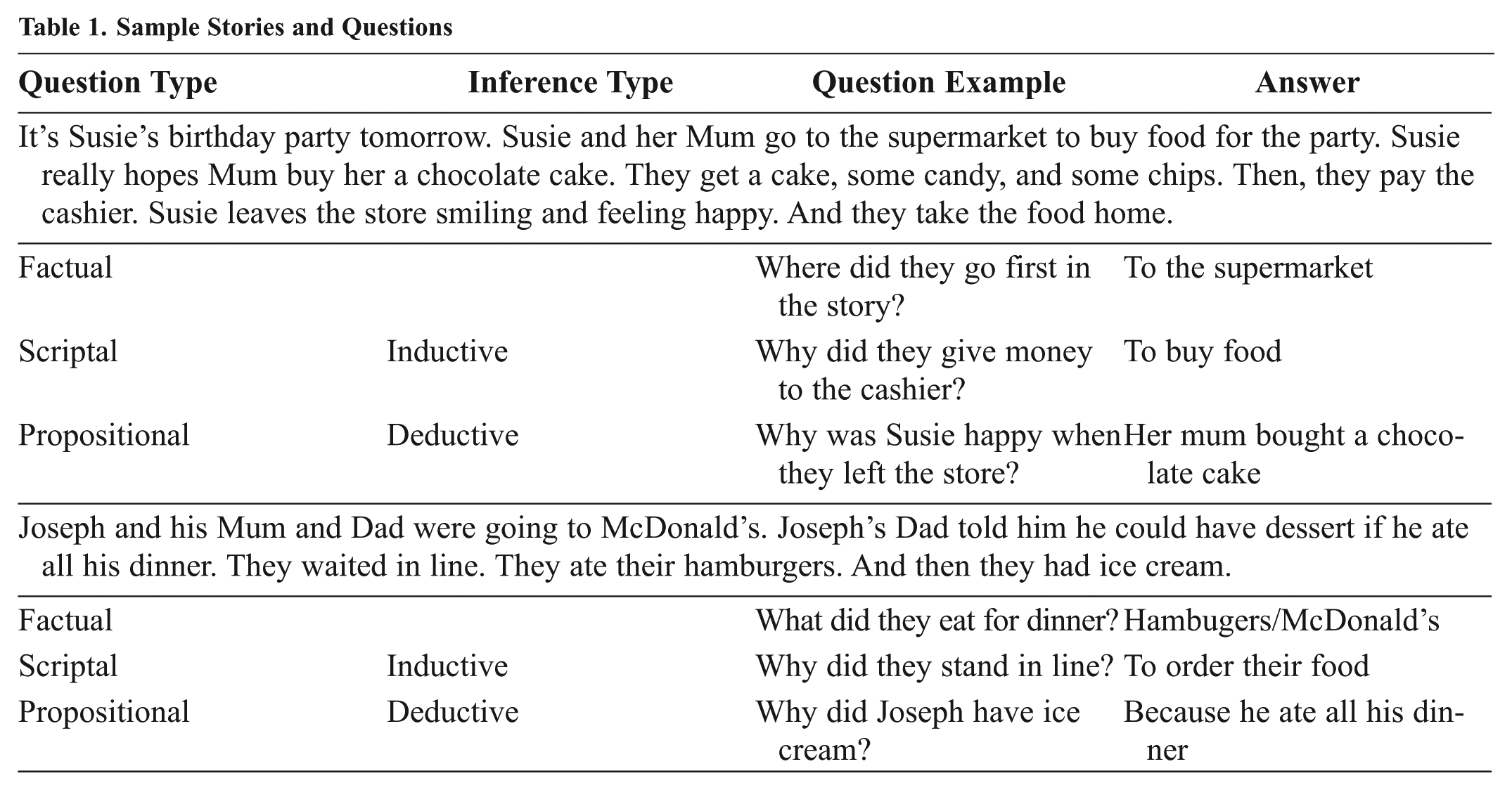
A total of 28 children participated in the study, 14 children with autism aged 4 years 6 months to 7 years 11 months, and 14 typically developing children aged 4 years 2 months to 5 years 4 months. The children with autism were all considered to be high functioning. The children with autism were matched with typically developing children in ability on a verbal and nonverbal measure of intelligence. The Understanding Spoken Paragraphs subtest from the Clinical Evaluation of Language Fundamentals—4 Australian version (CELF-4; Semel, Wiig, & Secord, 2003) was used as one measure of verbal comprehension. Each of stories used had a title and five questions of which two were appropriate for this study: the Main Idea and Detail questions. For example, in a story about a boy’s first day of primary school, the Main Idea question was “Why was Marcus feeling frightened and excited?” and the Detail question was “What did Marcus get when he went shopping?” A second inferential task involving six short stories (five to seven sentences in each) was developed for the study. Each story had with three questions, one Factual, one Script, and one Propositional. The factual questions asked children a piece of information given in the story, and was used to make sure they had listened to the story. The scriptal questions required that children identify the event schema represented in the stories and draw an inference based on their event schema knowledge. The propositional questions required children to make logical deductions based on statements in the stories. Table 1 shows examples of the stories and questions.
Sample Stories and Questions
Results
The typically developing (TD) children and children with ASD did not differ significantly in their scores on the Detail and Main questions from the Understanding Spoken Paragraphs on the CELF-4.
On the inferential task stories, the scores of the TD children and children with ASD did not differ on the factual questions. For the propositional inferences, the TD children scored higher than the children with ASD but this difference was not significant.
On the scriptal questions, the TD children scored significantly higher than the children with ASD.
Discussion
The fact that the children with ASD scored significantly lower on the scriptal questions than TD children is consistent with the WCC theory. The children with ASD appeared to have difficulty recognizing elements associated with an event schema or script—putting the story elements together to identify the event schema requires inductive inferencing. If the children did not recognize the event schemas underlying the stories, they could not answer the scriptal questions. The study authors suggest that the titles on the CELF paragraphs primed the children for a script so that they were better able to respond to the Main Idea questions on the CELF paragraphs.
The results of this study offer implications for intervention. First, before beginning narrative listening or reading activities, speech-language pathologists/educators could prime students by discussing the event schemas in the stories. Furthermore, as the speech-language pathologist (SLP) and students are listening to or reading a text, the SLPs could model how they are putting together cues that enable them to discover the schema or schemas underlying the discourse.
Attending to vocabulary, which is traditionally thought of as a microstructure skill, can facilitate students’ noting elements in a text that provide cues to the schemas. In a recent study, Oakhill, Cain, and McCarthy (2015) showed that students’ breadth of vocabulary markedly influenced their global processing abilities and their abilities to make global or scriptal text inferences. Vocabulary breadth is the number of words that persons have some knowledge about; vocabulary depth is the amount of knowledge one has about words—and the relationships one recognizes between and among words. When students have vocabulary depth, they begin to see relationships among the words they encounter that helps them retrieve a schema. Figure 1 shows an example of possible vocabulary depth for the word Halloween. TD children, who have more vocabulary associations for the word Halloween, will more quickly receive the Halloween event schema when they encounter words such as fall, costume, and candy apples. The review of the article by Lucas and Norbury (2015) in this issue of Word of Mouth demonstrated that many children with ASD have vocabulary deficits that significantly affect their ability to answer inferential questions. Consequently, they not only recommended attention to developing the vocabulary knowledge of students with ASD but also cautioned that these students may have more difficulty than TD students in integrating information into a global, coherent model.
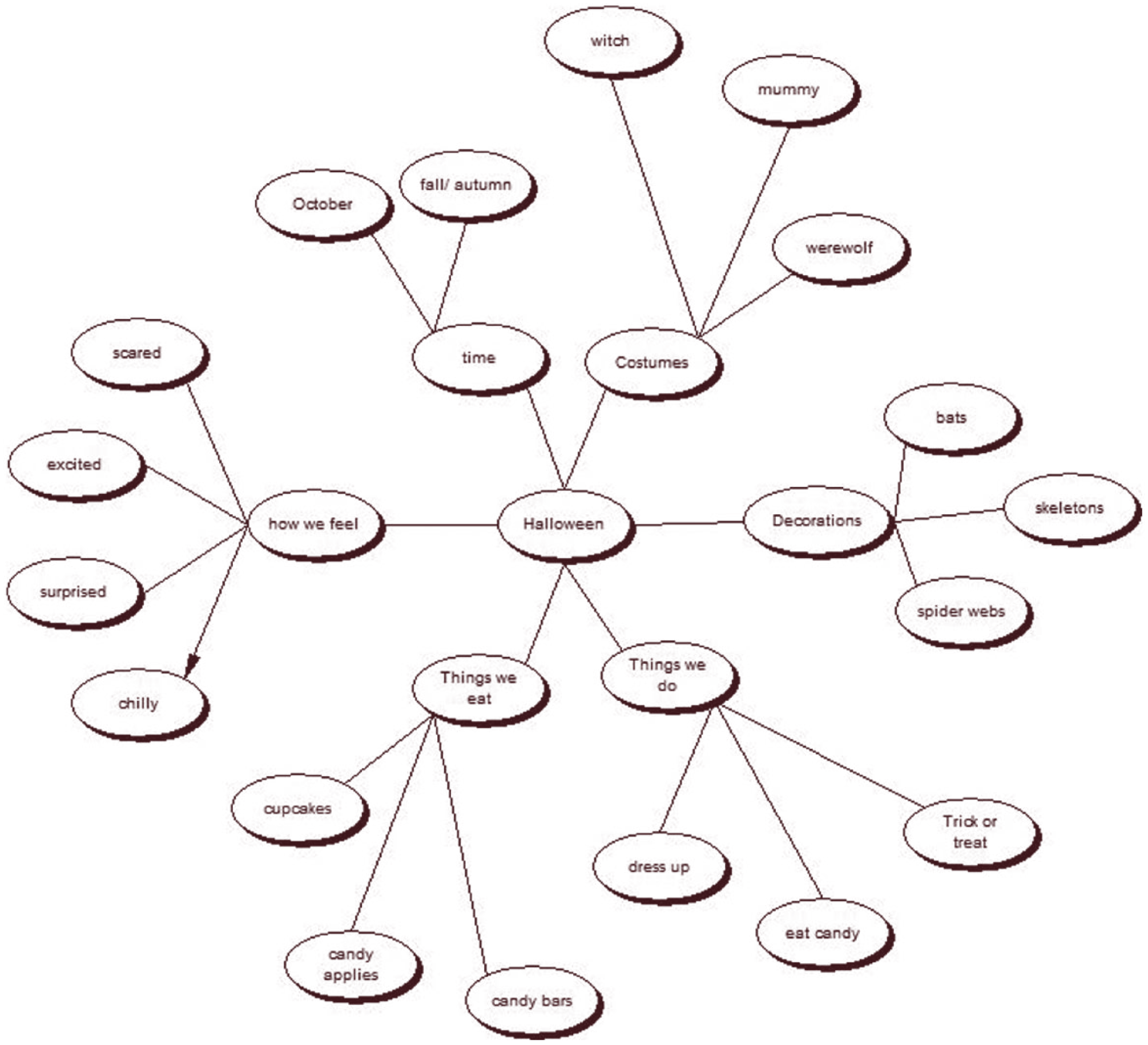
Vocabulary depth for Halloween