Abstract

According to the simple view of reading, reading comprehension is the result of decoding × comprehension (Gough & Tunmer, 1986). Knowledge of vocabulary, syntax, morphology, and pragmatics forms the necessary foundations for comprehension, but is insufficient for comprehension of many texts. Traditionally, teaching of comprehension focused on teaching the underlying language skills and reading comprehension strategies. Hirsch (2007) and Willingham (2014), however, report that what is most critical for comprehension is world knowledge. Willingham explains that whether or not readers understand a text depends far more on how much background knowledge and vocabulary they have relating to the topic than on how much they have practiced comprehension skills. If readers cannot supply the missing information, they have a hard time making sense of the text.
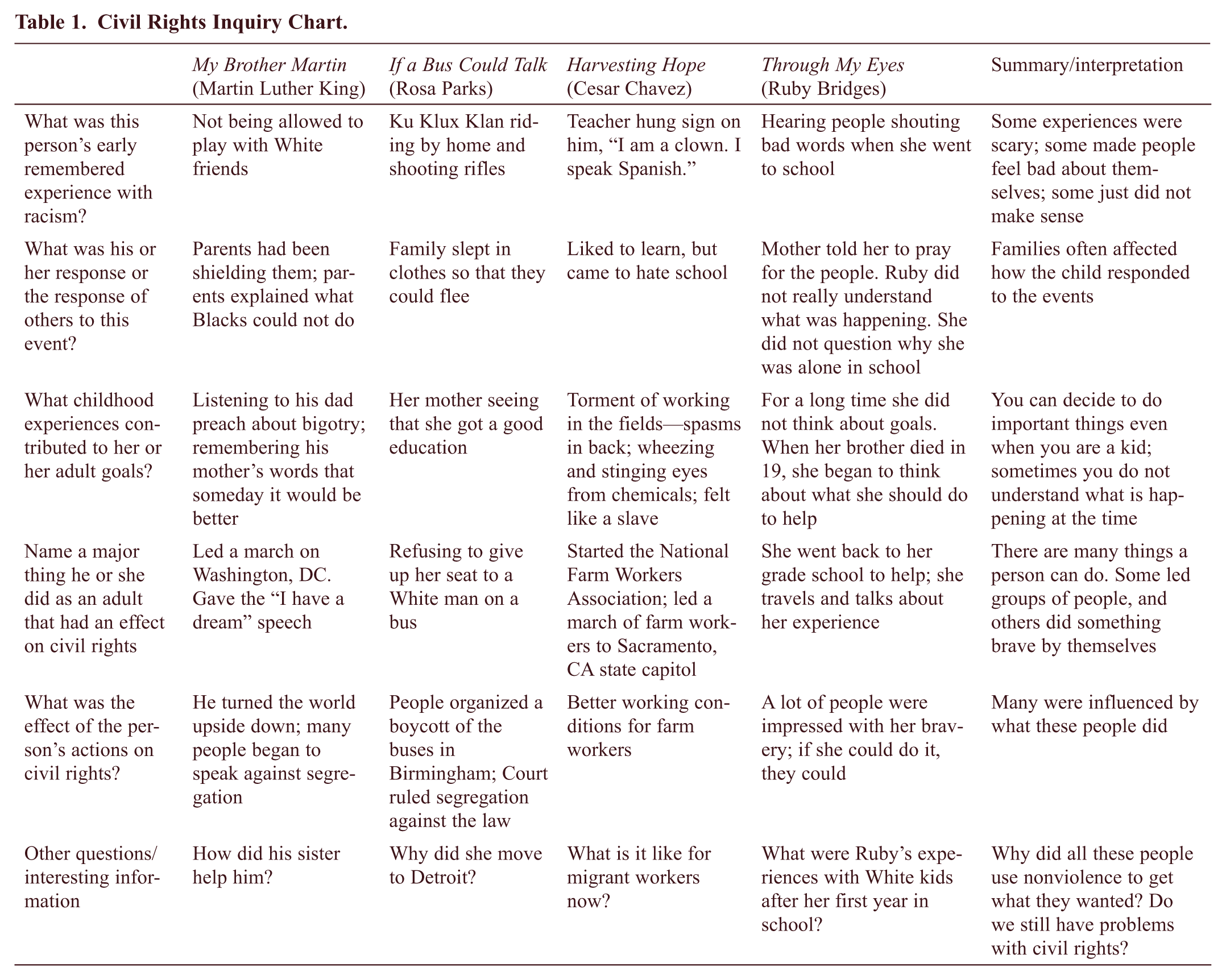
Speech pathologists and educators can promote acquisition of world knowledge by teaching thematically, using meaningful texts that approach topics from a variety of perspectives. For example, when learning about the Civil Rights Movement, students can read narratives such as My Brother Martin (Farris, 2003), Through My Eyes (Bridges, 1999), Harvesting Hope: The Story of Caesar Chavez (Krull, 2003), and If a Bus Could Talk: The Story of Rosa Parks (Ringgold, 1999) and complete an I-Chart (Inquiry Chart) (Hoffman, 1992). The I-Chart provides students with a framework for asking important questions, comparing answers across multiple texts, and coming to their own conclusions about the questions. The chart includes a row for new questions or interesting information that does not ask the basic questions. Table 1 provides an I-Chart framework for Civil Rights. In the process of completing an I-chart, students build their background knowledge on the topic so that they have the content knowledge to bring more complex and abstract academic texts.
Civil Rights Inquiry Chart.