






Abstract

Birdie’s Tree has been designed to support the mental health and emotional well-being of babies and young children, their parents, and families in relation to severe weather events and other natural disasters, including the COVID-19 pandemic. Traumatic events such as natural disasters or other community trauma have a huge impact on children, families, and communities, resulting in a risk to their mental health, which in turn creates an increased risk of family violence. The effect of natural disasters in itself can be immense for young children and families, let alone the added trauma of domestic and family violence.
The Birdie’s Tree website resources are intended to be used in a preparedness phase (before a natural disaster happens), during the response phase (while an event is happening), and in the recovery phase (after an event has occurred). Birdie’s Tree has been developed by the Queensland Centre for Perinatal and Infant Mental Health (QCPIMH), Queensland’s statewide hub of expertise in the mental health and emotional well-being of expectant and new parents, babies, and young children. QCPIMH is a Queensland Government service hosted by Children’s Health Queensland Hospital and Health Service.
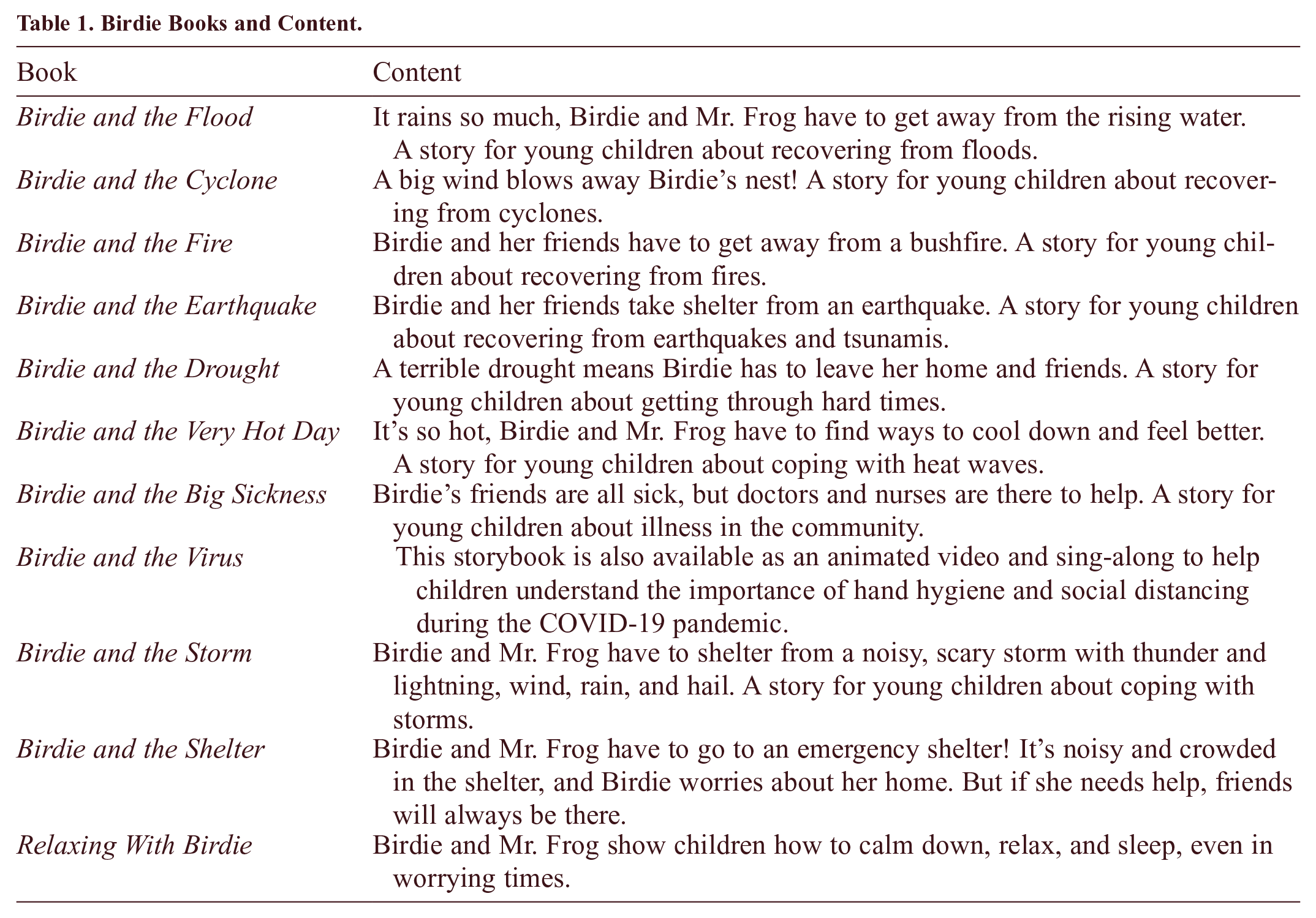
The largest section of the website provides 10 therapeutic storybooks, each addressing a different severe weather event, a natural disaster, or illness/pandemic and one book that describes relaxing/calming strategies (four of the books were written by Andrea Murray, an advanced speech pathologist for the QCPIMH). The central characters in the books are Birdie (a pink cockatoo) and his friend, Mr. Frog. From the website, you can read the 11 Birdie storybooks on a computer, tablet, or mobile phone. Several of the books are in multiple languages: languages of countries where these disasters have occurred. The books also provide a useful narrative structure for discussing the disaster—beginning, middle, and end. The books are intended for toddlers/preschool children. Careful attention was given to the language level of the books to make them suitable for caregivers to share with young children (see Table 1 for a list of the books and their contents). The stories are designed to give children a sense of safety as adults share the stories with them because there is distance between the child’s experience and that of Birdie and Mr. Frog. The child gains a perspective of the experience happening to someone else. It may be similar to their experience; however, it is not their experience. The storybooks allow children to make sense and meaning of what’s happened to them.
Birdie Books and Content.
While listening to the stories, children are not only learning to deal with the disaster, they are also assisted in building a relationship with a caring adult. The books can also support adults who are struggling to entertain or engage with the child during a difficult time. The building of relationships is an important protective factor for children to support resilience growth, particularly as being separated from parents or caregivers is a huge fear for children during natural disasters. Adults do not necessarily have to read the words in the story; they can use only the pictures to discuss the experience.
All the books function as flipbooks—two of them (The Virus and Relaxing books) are also animated. An information/activity sheet is available for each book. Each sheet describes how the child may respond to the stressor, what things caregivers can do, and things to remember (there is considerable overlap in the content of the information sheets). A 5-min video (https://www.youtube.com/watch?v=9B1oKVBAuyY) shows parents how to engage young children in conversational reading. Suggestions are given for how parents can use the stories with their children:
As prompts to talk about coping strategies.
What could you tell Birdie to help him feel better? What could Birdie do when he’s feeling upset?
As prompts to talk about feelings and emotions and introduce relevant language. It can be a useful model for adults who have experienced trauma as it provides them with language surrounding emotions generally as well as the disaster. How is Birdie feeling here? How can you tell? How would you feel if you were in Birdie’s position? I think Birdie is feeling . . . I think this because . . .
To prepare for natural disasters and as a prompt for practical and psychological preparedness
As entertainment during evacuations
As a way to connect with the child and build your relationship
There are also two booklets for parents to help recover from the trauma of a natural disaster: one for families in pregnancy and early parenthood and one for families with babies and young children. The booklets give parents suggestions for looking after themselves and their children. There may be long-term effects as a result of disaster on their physical and social development as well as emotional well-being, particularly when support is not put in place when needed. Relationships are at the heart of infants and young children managing their feelings; hence, it is important for parents and carers to look after their own emotional well-being to effectively support their child.
The website also includes several game-like activities for preschool children: pictures to color on the computer; making faces by selecting skin color, hair, eyes, glasses, mouths, and ears; selecting a picture to show how Birdie feels in different situations (catching a worm, Birdie’s nest is gone); sing-a-long songs (some are familiar children’s songs and some were written specifically to go along with one of the books); four-piece puzzles to put together (when completed the child hears the sound the object in the picture would make); matching who would help in a situation (a fire, fixing a roof); and matching helpers with equipment they use.