






Abstract

https://www.nctsn.org/resources/refugee-services-core-stressor-assessment-tool
or
For 2022, the United Nations High Commissioner for Refugees reported a record high of 100 million people (nearly half of them children) being forcibly displaced due to conflict and persecution. This was at the same time that the United Nations International Organization for Migration (UNIOM) reported that, as a result of COVID restrictions, there was a significant reduction in the numbers of people migrating for reasons other than fleeing violence. Human migration, for any reason, is stressful and puts persons at risk of long-term consequences of trauma, involving a variety of physical and mental health conditions and impairments. Young migrant children are at particular risk of developmental delays. Speech-language pathologists (SLPs) are likely to be challenged in conducting assessments of these children. Assessments must consider not only a child’s present functioning on a variety of tasks in a variety of situations but also must cover the multiple types of stressors that may affect a child’s performance. Refugees/asylum seekers are highly likely to experience stressors at each stage of migration that can contribute to developmental and health problems, including post-traumatic stress disorder (PTSD). The National Child Traumatic Stress Network (NCTSN) describes current stressors in four core stressor categories: premigration traumatic stressors, resettlement stressors, acculturation stressors, and isolation stressors. The NCTSN has a web-based resource, Refugee and Immigrant Core Stressors Toolkit (RICST), which service providers, such as SLPs, can employ to assess the current situation and needs of a particular youth or family in these four categories. Based on the assessment, tailored recommendations for resources and interventions are generated. Interventions that assess and address stress across these four domains—not only trauma or clinical symptoms—may significantly improve mental health outcomes and psychosocial functioning among refugee and immigrant youth.
The RICST is a free, web-based toolkit developed collaboratively with refugee and immigrant service providers and stakeholders who support education, assessment, and intervention-planning for service providers— especially those with limited experience working with refugee and immigrant youth and families. The RICST users navigate each of the four core stressors, engage with sample assessment questions to understand each stressor in depth, rate youth on a spectrum of risk, and receive intervention strategies specific to the assessed risk (i.e., low, medium, high) and stressor domain (i.e., resettlement, acculturation, isolation, trauma). Interactive components accompany didactic content to support learning and knowledge transfer in assessment and treatment planning that is relevant for all providers supporting mental health, well-being, and education.
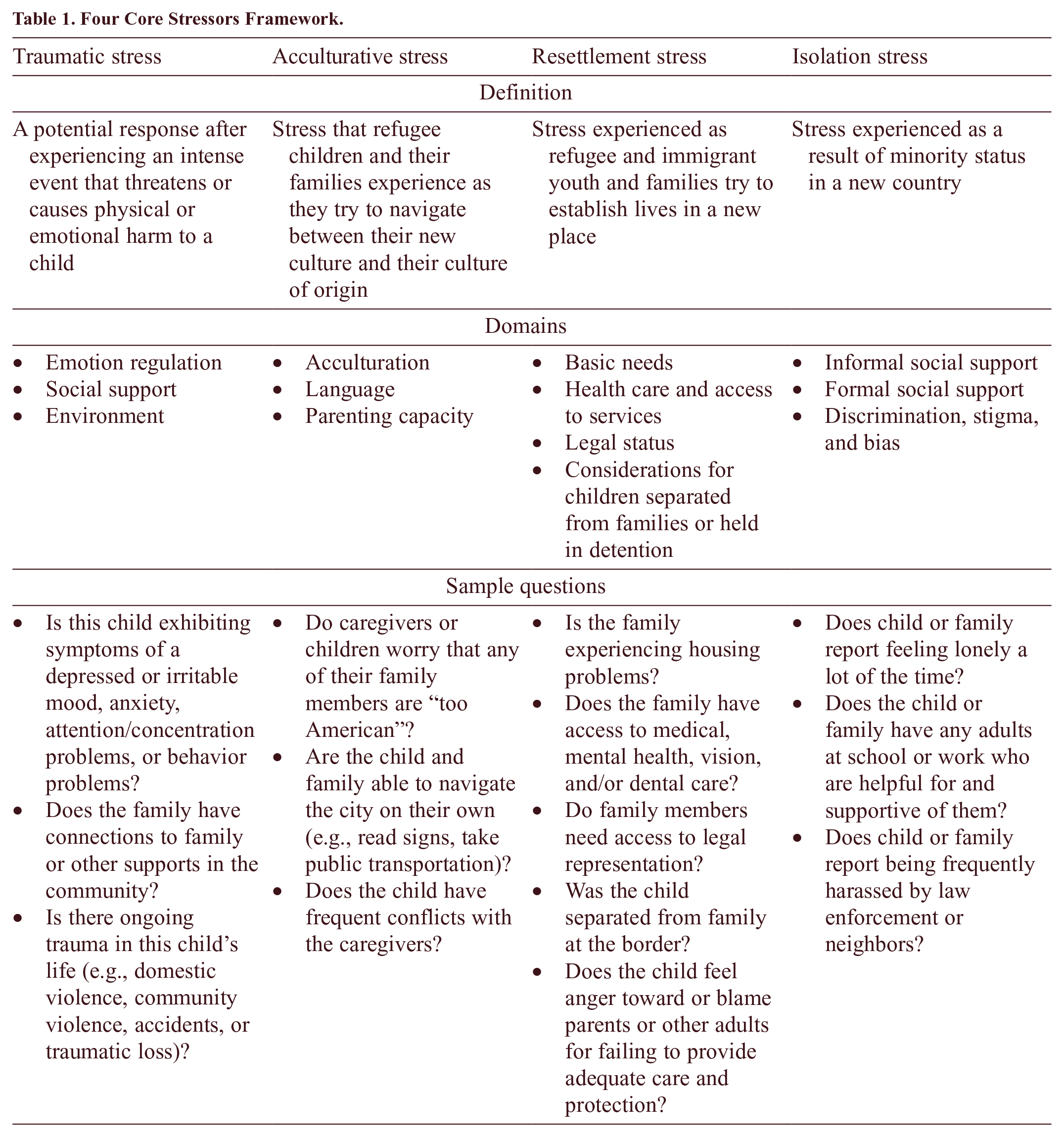
The RICST includes (a) an overview of the Four Core Stressors framework; (b) stressor-specific educational content and sample guiding questions; (c) scaffolding to assess refugee/immigrant youth on a spectrum of low–moderate–high risk for each stressor; (d) specific intervention suggestions and strategies for the provided risk assessment (e.g., interventions for youth rated moderate-risk for traumatic stress); and (e) user feedback and usability questions at the end. Table 1 shows the four core stressors framework with stressor-specific educational content and sample guiding questions to explore each stressor.
Four Core Stressors Framework.
Following educational content and guiding questions related to each stressor, service providers are given a risk assessment table that provides specific examples for how youth who are low, moderate, and high risk within a given stressor may present. Anchors for each level of risk relate to whether a given stressor interferes with youth functioning at school, at home, and in social situations and/or how a stressor detracts from the safety of the youth’s social environment. A low-risk rating indicates a high level of functioning and/or a safe social environment, medium risk indicates diminished functioning and/or a distressed social environment, and high risk indicates severe impairment in functioning and/or a threatening social environment. Service providers are then prompted to select the level of risk for that particular stressor: low, moderate, or high risk. Use of the RICST can facilitate SLPs’ ability to understand a child’s demonstrated function and make decisions regarding the types of services needed. After selecting a risk rating, service providers are presented with intervention strategies specific to the stressor and the risk rating. Intervention strategies commonly encourage collaboration with other services, schools, community members, and/or cultural brokers. The results of the RICST can be printed to share with team members. No assessment of any child should be done in isolation, but this is especially true for immigrant/refugee children. The SLPs need to see the “big picture” of the child’s life.