







Abstract
Objectives: The present study examined the factorial invariance and functional equivalence of the Values in Action Inventory of Strengths (VIA-IS) among the Chinese. Methods: A total of 839 undergraduate students completed the 240-item Simplified Chinese version of the VIA-IS online. Another 40 students participated in qualitative interviews to examine the meaning and function of the items in Chinese culture. Results: A total of 144 items were removed from the original version questionnaire (240-item) because of low item-loading and lack of cultural validity. A Chinese Virtues Questionnaire-96 (CVQ-96) in simplified Chinese containing 96 items (4 items per strength) was adopted. Three subscales (interpersonal, vitality, and cautiousness) were developed after exploratory factor analysis and confirmatory factor analysis. Conclusion: A theoretically meaningful 3-factor model of virtue, comparable to some virtue structures proposed in previous studies conducted in Western countries, was obtained. The inventories being developed can facilitate positive social work assessment and intervention.
Introduction
Character strengths are a family of positive traits manifested in an individual's thoughts, emotions, and behaviors (Peterson & Seligman, 2004). It was proposed that six core virtues could be found in various writings of philosophers and thinkers in major cultures around the world such as Confucianism and Taoism in China, Buddhism, and Hinduism in South Asia, Athenian philosophy, Judaism, Christianity, and Islam in West, which were important for a good life or for cultivating happiness (Dahlsgaard, Peterson, & Seligman, 2005). It was further proposed that 24 character strengths could be grouped under these 6 virtues (Peterson & Seligman, 2004). The corresponding strengths of each of the six virtues are wisdom and knowledge (creativity, curiosity, open-mindedness, love of learning, perspective); courage (authenticity, bravery, perseverance, zest); humanity (kindness, love, social intelligence); justice (fairness, leadership, teamwork); temperance (forgiveness, modesty, prudence, self-regulation); transcendence (appreciation of beauty and excellence, gratitude, hope, humor, religiousness). A 240-item self-reporting English language questionnaire (called the Values in Action Inventory of Strengths, VIA-IS) was developed to measure the 24 strengths (with 10 items per strength) and their corresponding virtues. Different translated versions of the VIA-IS including Chinese, Spanish, Japanese were later developed, and more than 1 million individuals from different countries and regions have completed the questionnaire online (Biswas-Diener, 2006; Linley et al., 2007; Park & Peterson, 2010; Park, Peterson, & Seligman, 2004; Peterson, Ruch, Beermann, Park, & Seligman, 2007).
Subsequent studies have shown consistently that character strengths are positively related to positive psychological outcomes, such as happiness (Peterson, 2006), general health (Otake et al., 2005), well-being (Park et al., 2004), and life satisfaction (Peterson et al., 2007). Zest, hope, curiosity, and gratitude were the most powerful predictors for happiness (Shimai, Otake, Park, Peterson, & Seligman, 2006). Some longitudinal studies had shown they could predict future subjective well-being (Gillham et al., 2011), and identifying and using one’s character strengths was an effective strategy to achieve happiness (Mitchell, Stanimirovic, Klein, & Vella-Brodrick, 2009; Park et al., 2004; Peterson, 2006; Peterson et al., 2007; Seligman & Csikszentmihalyi, 2000; Seligman, Steen, Park, & Peterson, 2005; Wood, Linley, Maltby, Kashdan, & Hurling, 2011).
However, previous related studies conducted in different samples failed to confirm the virtue structure proposed by Peterson and Seligman (2004). In fact, inconsistent results including 5-virtue models (Peterson & Seligman, 2004; Ruch et al., 2010; Singh & Choubisa, 2010), 4-virtue models (Brdar & Kashdan, 2010; Macdonald, Bore, & Munro, 2008), and 3-virtue models (Khumalo, Wissing, & Temane, 2008; Shryack, Steger, Krueger, & Kallie, 2010) were being proposed in different cultures, such as Germany, America, India, Croatia, Australia, and Africa. For instance, in a recent study, Shryack et al. (2010) conducted principal component analysis with varimax rotation of the 24 strengths among 332 participants in the United States and reported a three-dimensional model consisting of agency/self-assuredness, sociability, and conscientiousness. If different virtue structures were obtained among different samples in western countries, it is important to examine the factorial invariance of the virtue structure in Asian countries. More importantly, it was suggested that the same behavior (strength) might represent a different function in different cultures (Cheung, van de Vijver, & Leong, 2011; Leong, Leung, & Cheung, 2010). This issue is referred to as functional equivalence and conceptual equivalence, and it suggests that some items of the VIA-IS may not be appropriate to people with a vastly different culture background. As we know, eastern culture puts more focus on collectivism while western culture on individualism (Hofstede, 1980; Oyserman, Coon, & Kemmelmeier, 2002), and because of this, some items of the VIA-IS may serve different functions in western versus eastern countries. For instance, the item “I never tell outsiders things bad about my team” is a common social expectation in a collective culture of Mainland China that would be applied to most people and may lack the sensitivity to measure the strength related to citizenship. Similarly, the item “I practice my religion” may not be appropriate to represent spirituality in Mainland as most of the people in the country are atheists. In addition, some items representing the strength in Western culture may represent socially unacceptable behavior in China, “When I hear people say something mean, I make a protest” may not merge well into the Chinese social context where a harmonious relationship is always emphasized. Similarly, Item 15 of the VIA-IS (“I have no trouble eating healthy foods”) may not be suitable for those who do not have a clear concept of “healthy food,” most people thought their ordinary diet was healthy enough as the diverse food culture in China, hence, this item will lose its validity in such a context when assessing the “self-regulation” strength. Besides, previous researches used different samples (i.e., college students, undergraduates, ordinary adults, or monozygotic twins) and different factor analysis strategies to examine the factor structures of the VIA-IS, making the results not directly comparable. These two factors must be taken into consideration in the application of exploratory factor analysis (EFA) to the scale revision and refinement (Reise, Waller, & Comrey, 2000).
Based on the above, we believed that research of investigating the factorial and functional invariance of the VIA-IS items in China is important to ensure proper assessment of virtues among the Chinese. Furthermore, Chinese culture has a solid tradition with different domains and conceptual frameworks (e.g., Confucianism, Taoism, Buddhism, Mohism). For instance, Lao-Tse, a Chinese philosopher who established Taoism said in his Tao Te Ching that “Following a main road is easy, yet people delight in difficult paths,” and “Take care at the end as at the beginning, so that you may avoid failure” (Lao-Tse, 2006). The above statements may represent the strength courage among the Chinese. When it comes to Transcendence, he said “Use your own light, and return to the source of light. This is called practicing eternity” (Lao-Tse, 2006). Confucius (1938) said, “Going too far and not going far enough are equally bad.” This reminds us that one should regulate what he or she feels and does (Self-regulation). He also proposed that “When walking in the company of other men, there must be one I can learn something from. I shall pick out his merits to follow and his shortcomings for reference to overcome my own” (Confucius, 1938). This suggests one should take a comprehensive view of a person (open-mindedness) and be good at learning from others (love of learning). A detailed description of the writings of these philosophers is beyond the scope of this article. The above discussion should be sufficient to show that virtues might have different functions and behavioral appearances in Chinese society, and that testing the factorial invariance of the Chinese version of the VIA-IS is imperative to ensure an accurate measurement of virtues and strengths among the Chinese.
To sum up, the present study was conducted to (1) examine whether the 24 strengths could be grouped into the same 6 virtues proposed by Peterson and Seligman (2004) in China and (2) to examine the appropriateness and functional equivalence of the VIA-IS items in measuring the corresponding character strengths among the Chinese. Both quantitative method and cognitive interviewing method were used in accordance to the World Health Organization (WHO) guidelines on translation and adaptation of instruments (WHO, 2011). To our best understanding, this is the first study to examine the structure of virtue among the Chinese. Our results can provide insight on the cultural invariance of virtue structure.
Method
Participants and Procedures
Approval was obtained from the original author of the VIA-IS (Peterson, C.) to conduct the present project to validate the Simplified Chinese version of the VIA-IS in Mainland China. Ethics approval was obtained from the School of Culture and Social Development in Southwest University of China. There were two phases in this study which were conducted simultaneously.
Phase 1
The total sample of this study consisted of 839 undergraduate students from Southwest University recruited through public notice channels (e.g., bulletin board) or class announcements. Mean age of this sample was 20.62 years (SD = 2.12; range 17–25). 365 (43.50%) were males and 471 (56.10%) were females; 3 participants did not provide information about their gender. After informed consent, participants were asked by e-mail to visit the website of VIA Institute on Character ( www.viacharacter.org ) to complete the Simplified Chinese version of the VIA-IS between June and December 2010. After completion of the questionnaire, each participant would receive a debriefing report containing their top five strengths with additional explanation. A research code was provided to identify these participants. All data were downloaded by the VIA Institute on Character and sent to the first author of this study via e-mail after the data collection period.
Phase 2
Cognitive group interviews were conducted among another 40 university students (20 females and 20 males) who had not participated in Phase 1 of this study. Mean age of this sample was 20.57 years (SD = .95; range 19–23). They were recruited from a general psychology education class which all students of the university could enroll. An in-class briefing session was conducted by the first author of this study to encourage students to participate. Students participated on a voluntary basis without remuneration of any form. The purpose of the cognitive interviews was to obtain feedback from the participants regarding the appropriateness and meanings of the VIA-IS items. In order to be consistent with the type of participants of phase 1, undergraduate students were recruited again for phase 2. The results obtained, however, were discussed and triangulated among an expert panel to decide the selection of items (see Data Analysis section). Participants were randomly divided into four groups with 10 participants per group. All interviews were conducted by the first author according to a script with questions on comprehension and appropriateness in Chinese culture context.
Materials
The Simplified Chinese version of the VIA-IS (VIA-IS-SC) has 240 items and was translated from the original English version by the Positive Psychology Laboratory of the University of Hong Kong through the forward translation and backward translation procedures. Respondents were asked to rate to what extent each item could describe them on a 5-point Likert-type scale ranging from 1 = very much unlike me to 5 = very much like me (Peterson & Seligman, 2004). As mentioned before, scores of 24 strengths (10 items per strengths) and 6 virtues can be obtained from the original English language version of the VIA-IS by summing the corresponding items of each scales.
Cognitive interviewing consisted of the following 4 types of questions: (1) Please tell me whether you understand this item or not? What do you think the item is asking? (2) What would you think about when you first read this item? (3) Do you understand the description of response choices in the questionnaire? What is the meaning of “Very Much like Me”? (And so on for other responses) Which one do you choose? Why? (4) Could you select a response choice reflecting your true opinion to this item? Why?
Questions (1) and (2) assessed the functional and conceptual equivalence (Cheung, van de Vijver, & Leong, 2011) of the items by examining participants’ understanding and interpretations of the items. Questions (3) and (4) assessed whether participants could understand the instructions and anchoring descriptions of the scale.
Data Analysis
We chose items for the VIA-IS for final analysis according to the following strategies. First, item level EFA was conducted for each of the 24 strengths separately (with 10 items per strength). An item loading cutoff point of .60 was adopted to decide whether an item was inappropriate to be loaded onto a particular strength (Hair et al., 1998). Bartlett’s tests of sphericity of the 24 subscales were all significant, and Kaiser-Meyer-Olkin (KMOs) were above .75 (range .75–.91). Second, verbal outputs from the cognitive interviews were transcribed into written form, and a triangulation procedure was conducted among all researchers of this project to decide selection of items for subsequent analysis. One of the research team members is from Hong Kong, and he has developed the Traditional Chinese version of the questionnaire. The other authors are researchers in Mainland China who are familiar with both Simplified Chinese and situations in China. All members are conversant in English. Apart from item loadings, we also took cultural appropriateness of each item into consideration as mentioned in the introduction section in item selection. Items which are not culturally appropriate—going against social norm, social expectation, social context, and loss of test sensitivity which were caused by cultural differences—would be excluded so that the final number of items would be less than 240. Developing a shorter version of VIA-IS is justifiable by the fact that the original 240-item VIA-IS may require 40 min or more to complete and a shorter version can increase its brevity and efficiency (Kastner, Sellbom, & Lilienfeld, 2011). Similar to the 240-item VIA-IS and other translated version of the VIA-IS, we adopted the a priori decision that there should be equal number of items per strength. We hope this would facilitate the comparison of data among different studies across countries in future, and when taking into account the practical application, a nearly equal number of items in each subscale would be conducive to controlling acquiescence response set (Moos, 1997). Some items were excluded according to the results of EFA and qualitative cognitive interviews (Phase 2) above. Next, we randomly divided the sample in Phase 1 (n = 839) into two subsamples. EFA was conducted for the first sub-sample while confirmatory factor analysis (CFA) was conducted for the second. The average age of subsample 1 (S1, n = 420) was 20.31 (SD = 1.85; range 17–25). In all 164 (39.05%) were males and 253 (60.24%) were females; 3 participants did not provide information about their gender. Subsample 2 (S2) consisted of 419 participants. Their average age was 20.13 (SD = 1.74; range 17–25). A total of 201 (47.97%) were males and 218 (52.03%) were females. Data were analyzed using the Statistical Product and Service Solutions (SPSS) 20.0 and Amos 20.0.
Results
Selection of Items
Item level EFA of each strength
Table 1 depicts the item level EFA results of each strength. Two significant findings were obtained: (a) the mean loading of items was .56 (SD = .12, range .17–.78), and more than half of the item loadings were lower than .60 and (b) the 10 corresponding items of most character strengths explained no more than 35.00% (mean = 27.31%) of variance with the exception of creativity (explained variance = 43.67%). These results revealed that a number of inappropriate items must be rejected to improve item loading and explained variance
Exploratory Factor Analysis of the 24 Strengths in the Original Values in Action Inventory of Strengths (N = 839)
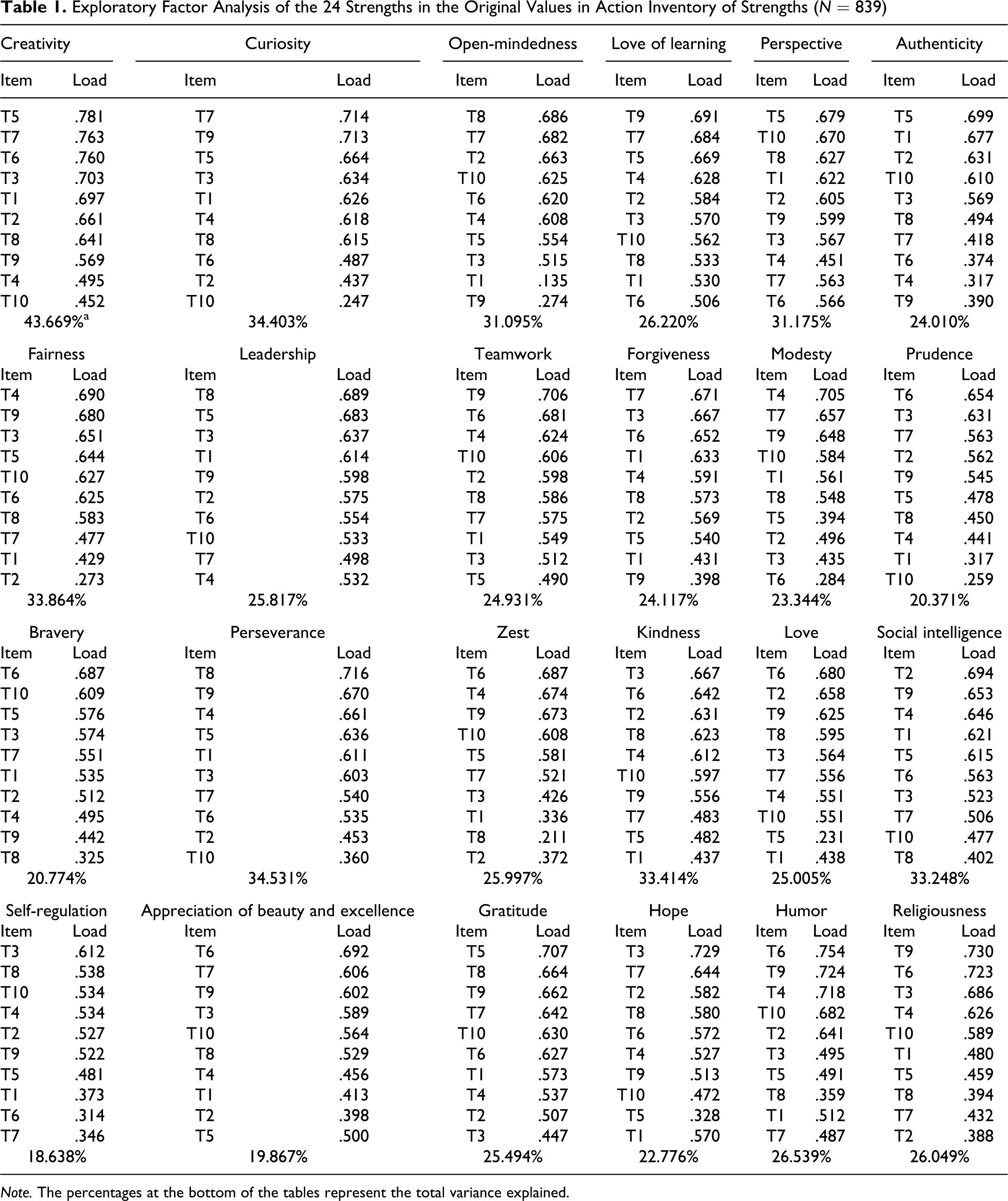
Note. The percentages at the bottom of the tables represent the total variance explained.
Cognitive interviewing
After triangulation, a number of items were deleted because they had low loadings and were not conformed to Chinese social norms. For example, “I always speak up in protest when I hear someone say mean things” (brave, T9 = .44; Table 1) and “I have no trouble eating healthy foods” (self-regulation, T1 = .37; Table 1) had low item loadings and did not synchronized well with the Chinese culture (see Introduction). These items were removed from the item pool. Furthermore, some religion-related items (e.g., “I believe in a universal power, a god”) might illicit different interpretations for people in Mainland, or some items related to gratitude (e.g., “At least once a day, I stop and count my blessings”) which carry a strong religious connotation were excluded. A total of 103 items out of 240 items were removed and 137 items were retained as a result.
Next, 27 of the original 240 items were removed after the semistructured group interviews based on feedback from the participants (remaining items = 110). For example, “I stick with whatever I decide to do” of the original VIA-IS was intended to measure perseverance. However, 17 participants (42.50%) did not consider it as a representation of perseverance in Chinese culture. To avoid potential ambiguity, we excluded this item from the questionnaire. It should be noted that we had retained some items with low item loading for further exploration based on the results of the interviews. For instance, “I can always say enough is enough” was endorsed by almost 92.50% of the participants as a representation of bravery in Chinese culture despite its low loading (brave, T8 = .33; Table 1).
Finally, we had excluded some items to standardize the number of items per strength. Fourteen out of the retaining 110 items with the lowest item loadings were removed. The final Short version of the Simplified Chinese contained 96 items (4 items per strength) to measure the 24 character strengths was adopted for further analyses. This newly developed questionnaire was named the Chinese Virtues Questionnaire-96 (CVQ-96) to distinguish it from the original VIA-IS.
Factor Structure of the CVQ-96
EFA
To examine the factor structure of CVQ-96, a strength-level EFA among the 96 items was performed among S1 (n = 420). Principal components analyses with varimax rotations were used to extract components (Shryack et al., 2010). After several explorations, three factors with eigenvalues equaled to 10.612, 1.932, and 1.322, respectively, were extracted, and these factors together could explained 57.774% of the total variance (Table 2). Factor 1 contained all vitality strengths and some strengths of fortitude in the model of Brdar and Kashdan (2010). It also contained most strengths of self-assuredness in the model of Shryack et al. (2010). This factor is termed Vitality in the current study and explained 44.215% of the total variance. The second factor (Factor 2) contained most of the Interpersonal strengths of Brdar and Kashdan (2010), as well as the sociability strengths of Shryack et al. (2010), and authenticity which reflected strengths related to interacting with others. This factor was named interpersonal and it explained 8.050% of the total variance. The third factor (Factor 3) was called cautiousness and it contained the prudence, self-regulation, judgment, modesty, perseverance, and learning. This factor explained 5.509% of the total variance.
Exploratory Factor Analysis of the Chinese Virtue Questionnaire-96 (N = 420)

CFA
CFA was conducted among participants of S2 (n = 419) to examine the models of the aggregated strengths in sequence. A total of five hypothesized models were proposed for comparison, three of which were constructed by means of merging any two factors into a whole one, then combing with the rest factor into a new model. Apart from the 3-factor related model, another model was constructed by merging all the factors into one. The goodness-of-fit indices of the 3-factor models achieved adequate fit in our sample (χ2 = 829.440, df = 249, goodness-of-fit index [GFI] = .852, incremental fit index [IFI] = .899, Tucker–Lewis index [TLI] = .887, comparative fit index [CFI] = .898, root mean square error of approximation [RMSEA] = .075; Table 3). Standardize path coefficients are shown in Figure 1.
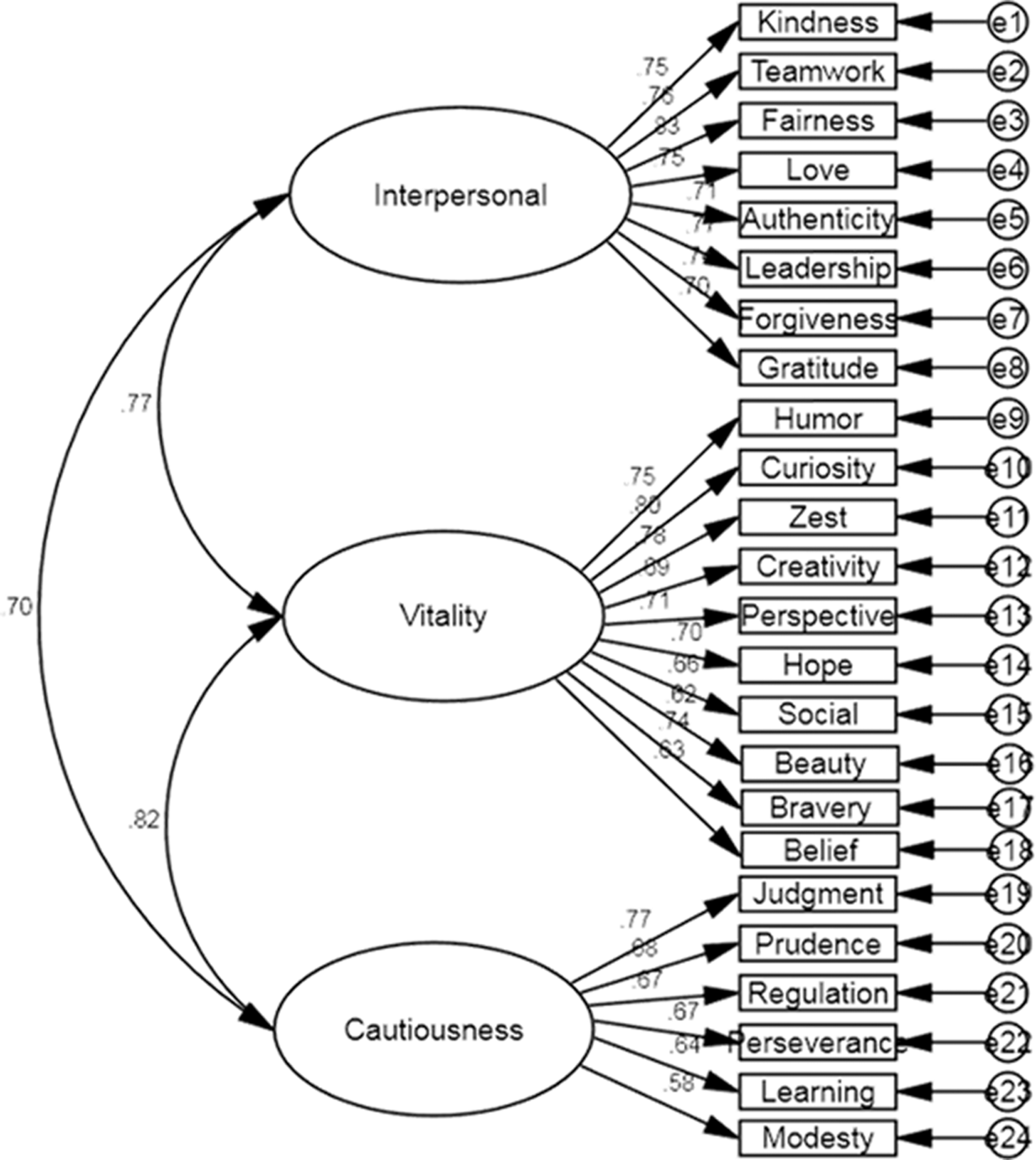
Structure model of Chinese Virtues Questionnaire-96 (CVQ-96) with standardize path coefficients.
Confirmatory Factor Analysis (N = 419)
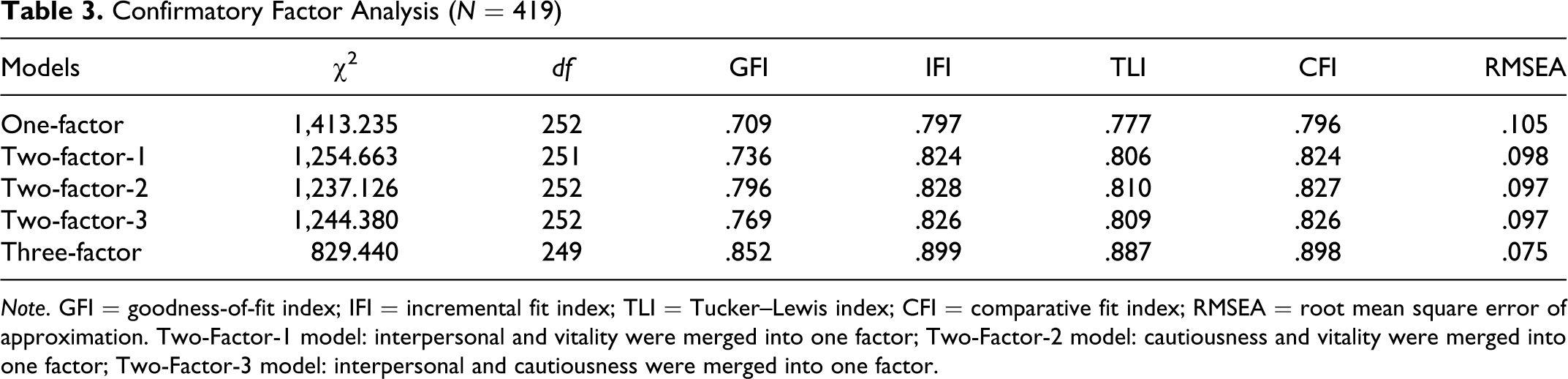
Note. GFI = goodness-of-fit index; IFI = incremental fit index; TLI = Tucker–Lewis index; CFI = comparative fit index; RMSEA = root mean square error of approximation. Two-Factor-1 model: interpersonal and vitality were merged into one factor; Two-Factor-2 model: cautiousness and vitality were merged into one factor; Two-Factor-3 model: interpersonal and cautiousness were merged into one factor.
Correlations
The descriptive statistics of the three subscales of the CVQ-96 (i.e., interpersonal, vitality, and cautiousness) and the correlations among the three subscales were provided in Table 4. The correlations between factors were ranged from .64 to .73, and the Cronbach’s α ranged from .83 to .90 (Table 4).
Descriptive Statistics and Correlations (N = 419)

**p < .001.
Discussion
Peterson and Seligman (2004) stated that their classification would “change in the years to come, as theory and research concerning character strengths proceed” (p. 31). To date, most researches on character strengths relied on English-speaking samples. Park et al. (2006) studied character strengths in 54 nations with the English version of VIA-IS but only 110 of their 83,576 participants were Chinese who were educated enough to complete the English version of VIA-IS. The main purpose of this study was to examine the factor structure and functional equivalence of Simplified Chinese version of the VIA-IS among Chinese undergraduates in Mainland China. The 96 items (4-item per strength) of the CVQ measuring 24 strengths and 3 virtues were developed. Our results served as a supplement of existing findings reported in German (Ruch et al., 2010), America (Peterson &Seligmam, 2004), India (Singh & Choubisa, 2010), Japan (Otake et al., 2005), Croatia (Brdar & Kashdan, 2010), Australia (Macdonald et al., 2008), and Africa (Khumalo et al., 2008).
However, similar to other studies conducted outside of America (e.g. Brdar & Kashdan, 2010; Otake et al., 2005), our factor structure failed to confirm the 6-factor model framework proposed by Peterson and Seligman (2004). A theoretically meaningful 3-factor model was obtained, namely interpersonal, vitality, and cautiousness. Our result suggests that the 24 strengths of Peterson and Seligmam (2004) can be grouped under 3 virtues in our current sample. As mentioned before, Chinese culture has a solid tradition with different domains and conceptual frameworks, thus it will be very difficult and even impossible to have an integrated framework for understanding the Chinese conceptualization of “de”—which is usually translated as virtue in English. However, we argue that the three virtues (i.e., interpersonal, vitality, and cautiousness) measured by the CVQ-96 echo the teaching of three key philosophers (i.e., Mozi, Kongzi, and Mengzi) in early Chinese history. For instance, Mozi proposed a cognitive style called Anti-Fate to oppose fatalism which was one viewpoint of Confucianism, and he argued that all of us need the positive attitude toward life for creating a better and happier life rather than yielding to fate (Mill, 2007). Kongzi, in his The Analects, insisted on regarding “Ren” (kindness) as a core component of harmony and good relationship (Confucius, 1938). Self-cultivation was deemed to be extremely important for individual growth and development by Mengzi (Van Norden, 2007). Furthermore, our 3-factor model is also consistent with the findings of other previous studies (e.g. Khumalo et al., 2008; Shryack et al., 2010). It was observed from Table 2 that the similarities of different models was far greater than the differences, such as a factor reflecting positive behavior toward other people (interpersonal strength, niceness, or sociability), a factor reflecting positive qualities to world/society (vitality strength, perception, positivity, or assuredness), and a factor reflecting some intrapersonal traits (individual strength, cautiousness, or conscientiousness). Such virtue structure might be universal across cultures and should be explored further in future. It could be argued that the high correlations among the three virtues may suggest that the three factors should not be treated as independent constructs (Fowers, 2008). Nevertheless, our CFA results show that the 1-factor model as well as different versions of 2-factor models (Table 3) could not fit the data well. From a theoretical point of view, each of the three virtues should play a unique function in the well-being and cannot compensate for each other. We suggest that the three virtues should be treated as related but independent variables in future research and practice.
Some limitations should be mentioned. First, our samples were university students recruited from one single university in the southwest of China. Our results may not be generalizable to other populations in China. Second, it may be argued that our data collected via the Internet may not be valid and reliable. However, some studies show that data being collected via the Internet are comparable to those collected by face-to-face administration of questionnaires (Gosling, Vazire, Srivastava, & John, 2004). Besides, collecting data via Internet is very common in studies on VIA-IS (Park & Peterson, 2010; Seligman et al., 2005). Hence, we have reasons to trust in the validity of our current data. Last, the current study has examined very limited aspects of the psychometric properties, other properties such as criterion-related validity, predictive validity, and content validity should be investigated in future studies.
Application to Social Work Practice
Regarding application to social work practice, the development of a questionnaire to measure virtue can facilitate social workers to identify strengths and potentials of their clients, so that appropriate positive psychology intervention can be implemented. It is compatible with the “advantages perspective” trend of modern social work practice. In addition, the CVQ-96 might facilitate future research on virtues among the Chinese-speaking communities. Abundant data collected in China might contribute to adding the database of samples and making comparison with those of other countries more easily. Finally, we hope the CVQ-96 could help to measure intervention efficacy to enhance evidence-based positive social work practice.
Footnotes
Acknowledgment
We would like to express our sincere gratitude to Prof. Chris Peterson and Ms. Linda Parker of the VIA Institute on Character for allowing to use the VIA-IS and to provide support to this research.
Declaration of Conflicting Interests
The authors declared no conflicts of interest with respect to the research, authorship, and/or publication of this article.
Funding
The authors received no financial support for the research, authorship, and/or publication of this article.