






Abstract
This article describes the findings from an efficacy trial of a school-based, universal prevention program designed to reduce aggressive behavior of by strengthening emotion regulation and social information-processing (SIP) skills. Three cohorts of third graders (N = 479) participated in this study. The first cohort participated in the Making Choices (MC) program, a second cohort participated in the Making Choices Plus (MC+) program, and a third (lagged) cohort received the standard health education curriculum. Pretest to posttest changes suggest both programs were associated with reduced levels of aggression and improved SIP skills. Gender-moderating effects were observed—boys displayed significant reductions in aggressive behavior and significant increases in positive social goals, whereas girls’ aggressive behaviors and social goals showed no significant changes.
Among the constellation of individual, family, peer, and community risk factors implicated in the development of problem behavior in youth, perhaps the most commonly identified factor is childhood aggression (Dodge, Coie, & Lynam, 2006; Dodge & Pettit, 2003; Loeber, Farrington, Stouthamer-Loeber, & Van Kammen, 1998; Powell, Lochman, & Boxmeyer, 2007; Taylor, Davis-Kean, & Malanchuk, 2007). Childhood aggression has been found to predict peer rejection and victimization as well as problems such as delinquency, drug abuse, teen pregnancy, and poor educational attainment (Côté, Zoccolillo, Tremblay, Nagin, & Vitaro, 2001; Hanish & Guerra, 2000; Kochenderfer-Ladd, 2003; Jokela, Ferrie, & Kivimäki, 2008; Miller-Johnson, Winn, Coie, Malone, & Lochman, 2004; Moffitt & Caspi, 2001; Schwartz, McFayden-Ketchum, Dodge, Pettit, & Bates, 1999; Shaeffer, Petras, Ialongo, Poduska, & Kellam, 2003). In light of these findings, evidence-based primary prevention programs to childhood reduce aggression are needed. This article describes the effects of a universal, school-based prevention program designed to childhood reduce children’s likelihood of engaging in aggressive behavior by improving their skills in regulating emotions and processing social information.
The Reformulated Social Information-Processing Model
The design of the Making Choices program was primarily guided by social information-processing (SIP) theory (Crick & Dodge, 1994; Dodge, 1980, 1986, 2006; Huesmann, 1988). Stemming from early work on social problem solving (e.g., D’Zurilla & Goldfried, 1971; McFall, 1982), the SIP model was introduced by Dodge (1986). Later, Crick and Dodge (1994) reformulated the initial SIP model, such that responses to social situations are formulated through a series of five overlapping cognitive steps. The five cognitive steps include Step 1, encoding of external and internal cues; Step 2, interpretation and cognitive representation of those cues; Step 3, clarification and selection of a goal; Step 4, response search or construction; and Step 5, response decision (for reviews, see Crick & Dodge, 1994, 1996; Dodge, 2006). Summarized briefly, encoding refers to the perception of external and internal cues. External cues are comprised of social and environmental stimuli, whereas internal cues are comprised of one's cognitive indicators of emotional state (e.g., negative thoughts) and physical indicators of emotional arousal (e.g., heart rate, muscle tension, perspiration). Interpretation involves deriving meaning from internal and external cues and inferring the intentions of others. Goals are formulated during a goal formulation phase, and a range of potential responses are generated during a response search phase. In the response decision phase, children evaluate the appropriateness of potential responses and speculate about what might happen if they enact those response options. During this phase, children also assess their ability to successfully execute each of the various responses they have formulated. Enactment is the step during which children apply social skills to carry out selected responses.
The Role of SIP Skills in Aggressogenic Processes
The reformulated SIP model was intended to serve as a global framework for understanding the cognitive operations underlying child behavior, but its primary application has been toward the study of aggressive behavior in children. Many empirical studies have demonstrated the relationship between processing patterns at each of the five SIP steps and aggressive behaviors. Specifically, research suggests that, as compared with their nonaggressive peers, aggressive children encode fewer and more negative social cues (Step 1; Dodge & Newman, 1981; Gouze, 1987; Strassberg & Dodge, 1987); attribute more hostile intentions (Step 2; Feldman & Dodge, 1987); select goals that damage relationships (Step 3); generate fewer and less prosocial responses (Step 4; Pettit, Dodge, & Brown, 1988); and evaluate aggressive responses more favorably and expect more positive outcomes from aggressive behavior (Step 5).
The Role of Emotion Regulation in Aggressogenic Processes
Emotion is an integral component of the SIP model. Emotion is thought to affect behavior by motivating the processing of social information and by attenuating emotional and behavioral responses to physiological arousal (Arsenio & Lemerise, 2001, 2004; Dodge, 1991; Lemerise & Arsenio, 2000; Lemerise & Maulden, 2010; Campos, Mumme, Kermoian, & Campos, 1994). Poor emotion regulation has been linked to physical aggression (for a review, see Eisenberg & Fabes, 1999). When children who have difficulty managing their emotions encounter an emotion-arousing social situation, they more often rely on automatic schema and scripts rather than on unique cues. They also perceive fewer cues, generate fewer solutions, and are more likely to select aggressive responses (Bierman, Smoot, & Aumiller, 1993; Eisenberg et al., 2001; Izard, 2002). Moreover, children with deficits in emotion regulation skills are more likely to display strong affect, which elevates risk for peer rejection and victimization (Eisenberg & Fabes, 1992; Hubbard, 2001; Schwartz et al., 1999) and experience poor overall psychosocial adjustment (Lengua, 2003, Wyman et al., 2009).
Social Cognitive and Emotion Regulation Skills Training for Children
Given the research findings showing linkages between SIP skills, emotion regulation skills, and children’s social adjustment, many programs have been developed and implemented in regular classrooms to teach children social and emotional regulation skills (e.g.,Durlak, Weissberg, Dymnicki, Taylor, & Schellinger, 2011; Wilson & Lipsey,2006, 2007). Some of these programs are multi-element programs that include teachers and/or families in addition to students (e.g., Fast Track, Conduct Problems Prevention Research Group [CPPRG], 1992; Positive Action: Beets et al., 2009); others are child-focused programs in which the child is the primary target of the intervention (e.g., Making Choices: Fraser et al., 2005; PATHS: CPPRG, 2010; and Second Step: Holsen, Smith, & Frey, 2008). Both types of programs have used a variety of theories in designing their curricula, with only a few explicitly using the SIP model or perspective. Although all of these programs were designed to enhance one or more SIP skills, only a few programs addresses process patterns at each SIP step (e.g., Fraser et al., 2005; Greenberg & Kusché, 1998; Kam, Greenberg, & Kusché, 2004; Nash, Fraser, Galinsky, & Kupper, 2003; Orpinas, Parcel, McAlister, & Frankowski, 1995; Van Schoiack-Edstrom, Frey, & Beland, 2002). The majority of evaluation studies of the child-focused programs have reported positive effects on reducing aggressive and disruptive behavior (e.g., Domitrovich, Cortes, & Greenberg, 2007; Fraser et al., 2005, 2011;Slough, McMahon, & Conduct Problems Prevention Research Group, 2008), including recent studies published after Wilson and Lipsey’s systematic review of SIP-based programs (2006, 2007). However, these studies have offered limited evidence to support a link among SIP skills, emotion regulation, and aggressive behavior.
This article reports the findings of a controlled trial of MC and MC+. This study would have two major contributions to the field of promoting social emotional skills and preventing aggressive behavior of children. One contribution of this study is that it uses a theory-based approach to evaluation, by estimating effects on theoretical mediators (SIP skills) and aggressive behavior and testing whether program effects on aggression are mediated through SIP skills. Second, multi-element programs are often achieved at high implementation cost and may pose significant implementation burden on teachers, principals, and other school staff (e.g., Foster, 2010). Thus, another contribution of this study is that it estimates the incremental benefit of adding teacher-and family-oriented strategies to a child-focused program. Evaluation studies which test different versions of a program allow program developers to improve their program and assess whether modifications to the core components are needed.
The Making Choices Program
Making Choices (MC) is a universal school-based intervention designed to reduce aggressive behavior by strengthening children’s social–cognitive and emotion regulation skills. A manual prescribes program content in lessons that are sequenced to build skills through a variety of exercises and activities. The manual includes tips for adapting the curriculum for populations of different ages, cultures, and economic backgrounds. The program has been delivered in a range of school and agency settings.
Two versions of the Making Choices program were evaluated in this study: (a) the classroom curriculum, referred to as MC from here forward, and (b) a multi-element version of the program, Making Choices Plus (MC+). The MC program is a 29-lesson, classroom-based curriculum that is comprised of seven units relating to SIP skills. The first two units address the encoding step. Unit 1 focuses on emotion-processing skills by teaching children how to recognize their feelings and the feelings of others. Activities focus on strengthening skills for managing emotions. Unit 2 focuses on teaching children how to “search for the clues” that tell them what is happening in a variety of social situations. Units 3 to 7 build in progression with each unit addressing the remaining steps of the SIP model, starting with goal formulation and ending with enactment.
Participatory activities utilized a variety of instructional modes to engage students with different strengths and preferences, using both individual and group procedures. For example, children described physiological responses to emotions by coloring outlines of a human body and then discussing the feelings that inspired their drawings. Another group exercise asked students to imagine the intentions behind the actions of comic strip characters. Students also performed skits that dramatized the skills of self-talk and sequential problem solving.
The MC+ program augments the MC classroom curriculum with additional opportunities for parent and teacher involvement: (a) Family Nights (a didactic training program based on the (Strong Families curriculum; Fraser et al., 2004); (b) an application activity manual designed to reinforce lesson content (Fraser, Galinsky, Hodges, & Smokowski, 2004); and (c) a 4-week trial of the Good Behavior Game (Barrish, Saunders, & Wolfe, 1969; Van Lier, Muthen, van der Sar, and Crijnen, 2004). Family Nights was comprised of five evening workshops to which the parents of third graders in MC+ were invited. Content focused on orientation to the third grade, a discussion of community resources, and an introduction to the MC curriculum. The teacher activity manual consisted of 22 activities (3–5 activities per unit) that take approximately 10 to 15 min to complete, which were designed to be incorporated into regular classroom instruction. Teachers were encouraged to implement activities relating to the units being covered in intervention sessions. Finally, teachers were invited to use the Good Behavior Game or other classroom management strategies that rewarded students for prosocial behavior, using specific praise for individuals (e.g., “James is doing a good job of raising his hand”).
Prior studies on MC and MC+
Prior evaluation studies of the MC and MC+ programs found effects on SIP skills, peer acceptance, social competence, emotion regulation, and aggression (Fraser et al., 2005; Nash et al., 2003). A previous study using the same intervention cohorts but a different comparison cohort (N = 548) found positive effects on aggression and social competence, with a slightly broader pattern of effects for MC+ (Fraser et al., 2005). The study also detected an interaction effect for gender, with boys demonstrating greater reductions in aggression than girls. Posttest-only measures of SIP skills suggested that intervention students in both MC and MC+ were more skillful than comparison students in encoding social cues and setting prosocial goals. The current study includes data from a lagged-comparison cohort from whom both pretest and posttest SIP data were collected. It sought to extend the prior study, by estimating the effects of MC and MC+ on SIP skills at posttest and by comparing the effects of MC with those of MC+.
Method
Participants
Two rural schools in Chatham County North Carolina participated in the study. These schools were selected from eight public elementary schools invited to participate in the program, based on their level of interest and the absence of potentially competing social–emotional skills training programs. Because the Making Choices curricum was adopted by the school district as a routine element of their health education curriculum, and because data were obtained for educational purposes, parental notification but not active parental consent was required. The participating schools coordinated data collection and provided de-identified data for analysis. Consent and procedures were approved by the institutional board of the University of North Carolina at Chapel Hill and the school district.
Study Design
Three cohorts of third-grade students from each school (N = 541) participated in the study. Cohort 1 (2001–2002; n = 185) participated in MC; Cohort 2 (2002–2003; n = 202) participated in MC+, and Cohort 3 (2004–2005; n = 154) had no exposure to the intervention (for a participant flowchart, see Figure 1). The addition of a lagged-comparison cohort (Cohort 3), CC, permitted the examination of pretest to posttest changes in SIP skills. This study design improves on the prior evaluation, which had simply estimated posttest-only effects on these skills (Fraser et al., 2005; Nash et al., 2003). Data from Cohort 3 (CC) were collected 1 year following the delivery of MC+ to Cohort 2. Observations of teachers’ classrooms and consultations with principals, teachers, and school social workers confirmed that this comparison cohort had not been exposed to the MC+ intervention. Therefore, the risk of experimental contamination was considered to be minimal (see Figure 2 for study design).
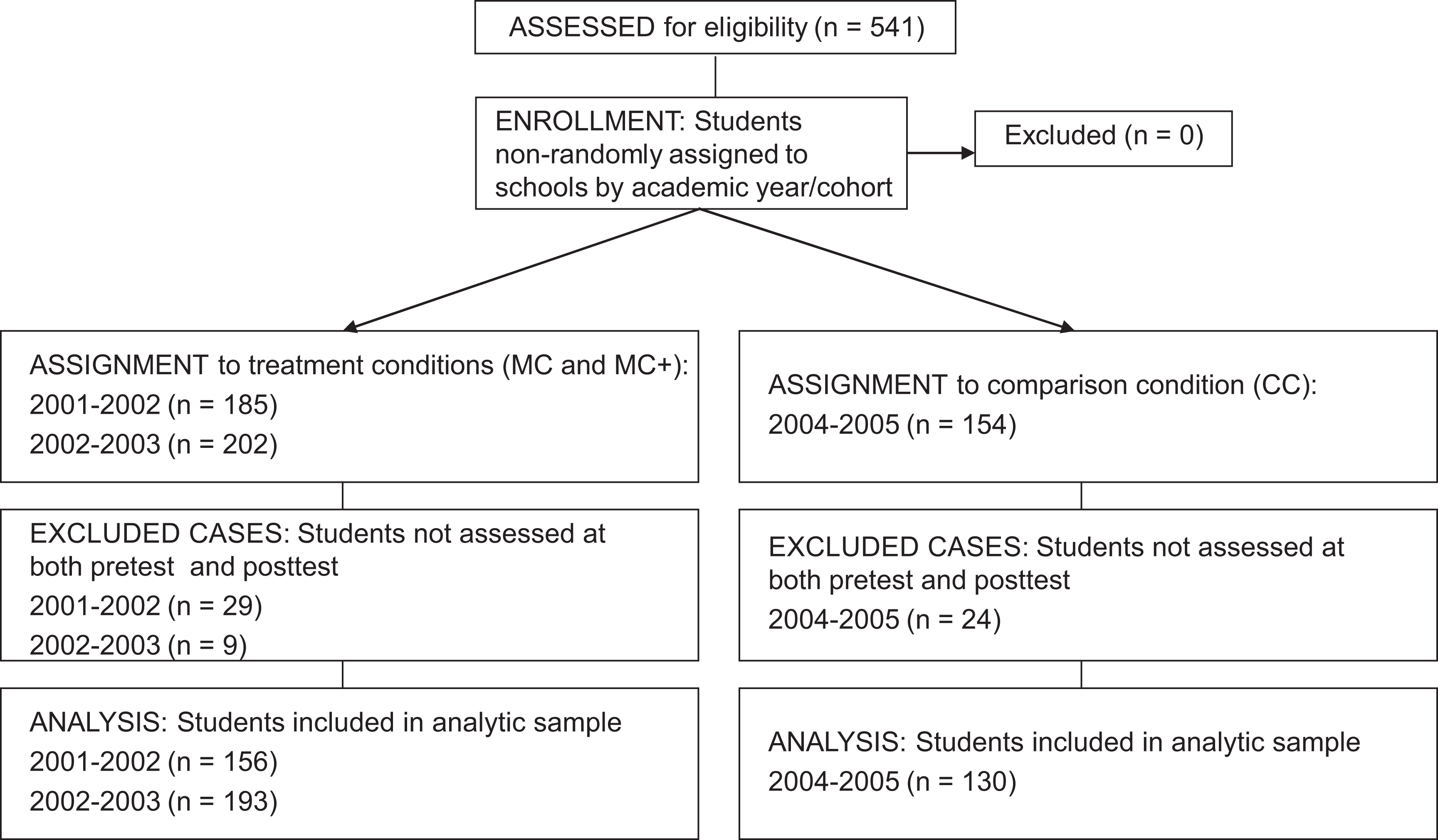
Participant flowchart.
Study design.
Implementation Characteristics
Sessions were led by program specialists who had received a Bachelor’s degree in social work or education. Students in both intervention conditions (MC and MC+) were offered a 23-lesson classroom curriculum. Lessons were delivered weekly for an average duration of 45 minutes. In addition, students in MC+ were offered supplemental classroom activities led by their teachers and their parents were invited to attend multifamily group meetings. On average, MC+ teachers implemented approximately one supplemental activity from the teacher activity manual each week, (according to teacher records and observational data from the first few months of the intervention). In addition, a classroom management component was added. Teachers at one school elected to implement a classroom management strategy called the Good Behavior Game and received training on how to implement this strategy (Barrish et al., 1969), while teachers at the other school opted to rely on existing classroom management protocols. Parents of third-grade children in the MC+ cohort were invited to five orientation programs that were delivered in English and Spanish from 5:00 to 7:00 p.m. in the school cafeteria.
Dosage
Although the intervention was a required part of the school day, student attendance varied due to external factors, such as teachers pulling students out of the classroom for alternative classes, such as English as a Second Language. Attendance was taken at every session. Student’s exposure to the program was estimated by calculating the percentage of sessions attended. About four of five students received at least 90% of the sessions and about two of five attended all of the sessions. In contrast, attendance for family nights (offered to parents of students in MC+) was low. Although project staff attempted to remove barriers to participation and provide incentive for participant engagement (e.g., offering free transportation, providing child care, food, and mailing bilingual monthly newsletters), only 27% (55 of 202) of the children in MC+ had a parent who participated in at least one session.
Analytic Sample
Despite preserving assignment to original study condition (dropping retained students from the enrolled sample to prevent cross-cohort contamination), and including study participants who did not attend all sessions (including 9 who did not attend a single session) were included in the analytic sample, this analysis was not fully intent to treat. Of 541 students, 62 were excluded from the analysis because of missing pretest or posttest data (i.e., CC: 24; MC: 29; MC+: 9), leaving a sample of 479 students. As shown in Table 1, the analytic sample (N = 479) was gender balanced and ethnically diverse (i.e., 45% Latino, 34% White, non-Latino, and 17% African American across cohorts). Study participants ranged from 7.2 to 11.6 years of age (M = 8.7; standard deviation [SD] = .66). Across both schools, 53% of the students were eligible for the free and reduced lunch program (an indicator of poverty status), which exceeded the 2005 national average for fourth graders (41%; US Department of Education, 2006).
Characteristics of the Making Choices, Making Choices Plus, and Comparison Condition Cohorts.

Note. CC = comparison condition. Percentage refers to row percentage. Parentheses denote cell count (n).
Measures
Using teacher and child reports, six outcomes (i.e., encoding, hostile attribution, goal formulation, response decision, emotion regulation, and aggression) were assessed twice a year. Pretest data were obtained in October, so that teachers had sufficient knowledge of their students in order to accurately assess their behavior, and posttest data were obtained in April, so that preparation for end-of-grade tests did not pressure teachers to hurriedly complete the surveys. Data on children’s SIP skills were also collected in classroom settings in October, for pretest, and April, for posttest.
SIP skills
The Skill Level Activity (SLA) instrument, which is an adaptation of the Home Interview for Attributional Bias (Dodge, 1980), was used to measure children’s mastery of four SIP skills: encoding, interpretation, goal formulation, and response decision. The SLA is designed to assess how children respond to common social situations. The instrument includes a series of six short stories that are read aloud, describing ambiguous relational, physical, and instrumental peer provocations. Students are instructed to look at an illustration accompanying the story and imagine that they are the main character in the story. Before each vignette, the reader states, “In this story, another child does or says something that may affect [the main character] in a good or bad way…” and afterward each child answers four questions, each relating to a specific SIP skill. First, to assess interpretation skills, the children were asked to decide whether the provocateur acted friendly, mean, by accident, or can’t tell. Second, the children were asked to encode cues by circling all the clues in the illustration, which told them what was happening. Third, they decided what they “would want to happen” (a goal) from a list of different options. Finally, the children were tested on response decision by deciding “what they would do” in that situation.
A technical report of this measure (Day, 2004) found moderate interitem correlation (Cronbach’s α = .71) for the entire instrument. The interrater reliability for the encoding measure (counting the number of legitimate cues circled by the respondent) is associated with Cohen’s κ ranging from .96 to .98 (Day, 2004), indicating the measure is reliable when scored by multiple raters. Reliability estimates for three of four SIP scales were good (α = .76 to α = .87); however, the internal consistency for the hostile attribution scale was low (α = .51). A reliability analysis conducted for this study replicated the reliability results from the technical report, with adequate reliability for encoding, goal formulation, and response decision (α = .74 to α = .79) and poor reliability for hostile attribution (α = .49). In addition, a confirmatory factor analysis (CFA) for hostile attribution did not converge. To improve the dimensionality and reliability of this scale, items with factor loadings of less than .60 were dropped; a 3-item measure for hostile attribution was constructed using Items 1, 4, and 5 (improving reliability slightly to α = .53). Readers are cautioned that the low reliability of the hostile attribution measure may have attenuated study findings.
Emotion regulation
The Carolina Child Checklist–Teacher Form (CCC–TF) was used to measure the children’s ability to understand and manage emotions. The CCC-TF is a 42-item, teacher-report instrument that is designed to measure social and behavioral factors related to aggressive behavior in children aged 6 to 12 years (Macgowan, Nash, & Fraser, 2002). The CCC-TF is an expansion of the 37-item Social Health Profile (Fast Track, 1997), which is based on the 26-item Teacher Observation of Classroom Adaptation–Revised (TOCA-R; Werthamer-Larsson, Kellam, & Wheeler, 1991). The TOCA-R has been found to have acceptable reliability and validity (Fast Track Project, 1997; Werthamer-Larsson et al., 1991). Items from the emotion regulation subscale related to being able to calm down when excited, controlling temper when there is a disagreement, expressing needs and feelings appropriately, and being good at understanding the feelings of others. Items were rated on a 6-point Likert-type response scale (i.e., 0 = almost never to 5 = almost always). This scale has acceptable reliability (α = .83).
Aggression
The CCC-TF was also used to measure aggression. It includes 24 items from the Teacher Report Form (TRF), a standardized teacher assessment of children’s social competence, adaptive functioning, academic performance, and social and behavioral problems (Achenbach & Edelbrock, 1991; Greenhill & Malcolm, 2000). Aggression was measured using a 6-item narrow-band subscale derived from the aggression subscale of the externalizing problem behavior scale of the TRF (Achenbach & Edelbrock, 1991; Fast Track Project, 2003). We chose to use this subscale rather than the 24-item scale to obtain a more conceptually distinct construct for aggression that excluded items related to oppositional-defiant behavior (e.g., “defiant, talks back to staff”) and hyperactive/disruptive behavior (e.g., “talks too much”). Using a 3-point ordinal response scale (i.e., true, sometimes true, or often true), teachers rate how well each item reflects a student’s behavior during the past month. Items included bullying, fighting, threatening, and teasing. A previous study with kindergarten children found the internal consistency of the subscale to be adequate (α = .81; Fast Track Project, 2003). In the current study, the structure for the subscale was supported (Item 12, “physically attacks people” was dropped because of a negative between-level variance in a multilevel CFA). All items loaded significantly and in the expected direction onto one factor, with a good model fit (comparative fit index = .99; root mean square error of approximation = .06) and acceptable internal consistency (α = .79). Finally, the measure had a moderate level of convergent validity with the TRF (r = .67, p < .001).
Data Analysis
Hiearchical and multiple regression methods were used. Prior to conducting explanatory analyses, attrition and selection bias analyses were conducted to evaluate potential threats to internal validity. All analyses controlled for baseline outcome measures and the demographic characteristics of the participants. Two-tailed tests were used to test study hypotheses, using a critical p value of .05.
Attrition analysis
To estimate the impact of attrition, the characteristics of intervention participants with teacher- and child-rated data at both time points (nonattrited; n = 479) were compared with the characteristics of intervention participants with missing data at any time point (attrited; n = 62). First, participants were compared on pretest behavioral and SIP measures. Results suggested that attrited students had lower pretest levels of encoding, t(514) = 2.21, p = .028, than nonattrited students. Second, chi-square tests of sociodemographic differences between attrited and nonattrited students showed a significantly greater proportion of males in the attrited group (i.e., 67% attrited vs. 50% nonattrited). No other between-group differences were found.
Selection bias analysis
Using cohort assignment as the grouping variable (N = 479), two selection bias analyses were conducted to test between-cohort differences on observed variables. Cohort differences in pretest means were assessed using a one-way analysis of variance, and multiple comparisons were conducted to estimate pairwise differences. Several significant cohort differences were found. MC children had less encoding skill than children in MC+ (p = .011), and children in CC (p < .001). In addition, MC children selected more aggressive responses than CC children (p = .043).
Cohort differences in the ethnic composition of the sample were also found, χ2(6, n = 479) = 13.35, p = .038. A difference-in-proportion test revealed race/ethnicity differences between the comparison cohort and both intervention cohorts and showed that comparison students were more likely to be Latino and less likely to be White, non-Latino than intervention students. Pretest scores were included as covariates in the analytic models to mitigate potential selection bias. To examine the influence of ethnic differences on pretest scores, an independent sample t-test was performed using Latino as the grouping variable. This analysis did not detect between-group differences on any measures; thus, ethnic differences between cohorts were not expected to bias the estimation of treatment effects.
Multilevel models
Multilevel models (MLMs) are generally recommended when assessing the effects of programs that are administered at the group level (Krull & MacKinnon, 1999). One rule-of-thumb for determining whether a multilevel approach should be used is to consider the level of intraclass correlation (ICC) needed to produce a design effect (DEFF). The ICC (ρ) is a measure of the proportion of between-group to total variability, for two-level models, ρ = τ2/(σ2 + τ2). The DEFF is the ratio of the actual variance to the variance computed under the assumption of simple random sampling, DEFF = 1 + δ (n – 1), where n is the cluster size and δ is the ICC (Shackman, 2001). An ICC of .06 was selected as the cutoff because it produced a design effect of 2.0, which is considered high enough to warrant the use of a multilevel approach (Muthén & Sattorra, 1995). Two of six dependent variables (i.e., hostile attribution and response decision) did not have sufficiently large ICCs. For these variables, single-level regression models were estimated using maximum likelihood estimation (MLE). Effects on the other variables were estimated using SAS Proc Mixed Version 8.0 (SAS, 2000); the unconditional ICCs for these variables were aggression (ρ = .09), emotion regulation (ρ = .23), goal formulation (ρ = .06), and encoding (ρ = .09). All models were adjusted for the effects of the outcome-specific pretest measure and demographic covariates (i.e., male, African American, and Latino). For the MLM models estimating the effects of intervention versus comparison, the statistical covariates were included at Level 1 (student level) and fixed effects for the two program indicators (MC and MC+) were included at Level 2 (classroom level). Several preliminary models were run to determine whether the models fit better when including random slopes for the effects of pretest on posttest; however, the random slopes were not found to be significant.
Figure 3 shows the baseline multilevel equation used to estimate the effects of MC vs. CC and MC+ vs. CC on overt aggression. The subscript “ij” refers to an individual student’s score on a particular scale (e.g., student “i” in classroom “j”); the subscript “j” refers to a classroom’s average score on a particular scale. The subscripts for MC and MC+ are “j” because the interventions were administered at the classroom level, meaning all students belonging to a particular classroom were either assigned to the intervention or not assigned to the intervention.

Example of multilevel equation to estimate intervention versus comparison group effects.
Not shown in Figure 3, the difference between MC and MC+ was estimated by replacing the variable for MC with CC, permitting the effect of MC+ to be estimated as the difference between MC and MC+. Moderating effects were tested by adding two cross-level interaction terms, B5j (MC × male) and B6j (MC+ × male), to the model. Consistent with the recommended strategy for testing fixed effects in HLM (Raudenbush & Bryk, 2002), interaction effects were estimated using full MLE procedures and then tested using a deviance test approach. A normal theory chi-square difference test was also used to test interaction effects in the single-level models.
Effect sizes (i.e., Cohen’s ds) represent the magnitude of program effects in the standardized units. For MLMs, the effect sizes were estimated by dividing the parameter estimates for MC and MC+ by the square root of the total variance (δ = β/[(τ2 + σ2)1/2]); Raudenbush & Bryk, 2002). For single-level models, effect sizes were estimated using the Cohen’s d formula, Cohen’s d = (Meanp − Meanc)/ s (Cohen, 1988), which calculates the difference in adjusted means divided by the pooled standard deviation of the data.
Effect sizes were estimated for MC and MC+ relative to the comparison condition. When program effects were moderated by gender, effect sizes were estimated separately for males and females, using conditional models (see Table 4 for effect size estimates).
Results
Sociodemographic Effects
Consistent with prior research (Hughes, Meehan, & Cavell, 2004), gender differences in SIP skills were found. Across cohorts, boys tended to be less skillful than girls in emotional regulation (Table 2; B = −.16, p < .005), encoding (B = −.06, p < .001), response decision (B = −.12, p < .001), and goal formulation (Table 3; B = −.10, p < .001). In addition, African American and Latino children reported less neutral/friendly social goals (African American: B = −.07, p = .034; Latino: B = −.06, p = .018) than White, non-Latino children. Ethnic differences in hostile attribution were also found, with Latino students being rated by teachers as having higher levels of hostile attribution than non-Latino students (Latino: B = .04, p = .043).
Fixed and Random Effects for Conditional and Unconditional Models of the Effects of MC and MC+ Models without Interactions.

Note.CC = comparison condition; Est = estimate; SE = standard error; L1 = Level 1; L2 = Level 2; SIP = social information processing. aSingle-level model.
†Marginally significant effect (p < .10). *p < .05. **p < .01. ***p < .001.
Fixed and Random Effects for Conditional and Unconditional Models of the Effects of MC and MC+ Models with Interactions.

Note. CC = comparison condition; Est = estimate; SE = standard error; L1 = Level 1; L2 = Level 2.
†Marginally significant effect (p < .10). *p < .05. **p < .01. ***p < .001.
Intervention Effects
Effects on SIP skills were varied. Although MC and MC+ had no statistically significant effects on encoding and emotion regulation, both interventions were associated with improved response decision (B MC = .07, p = 0.029 and B MC+ = .14, p < .001) and lower hostile attribution (B MC = −.06, p = .021 and B MC+ = −.12, p < .001; Table 2). In addition, the interventions improved goal formulation among boys. Boys in MC and MC+ (but not girls) were significantly more likely to select neutral/friendly goals in response to hypothetical peer provocations (B MC = .11, p = .016; B MC+ = .20, p < .001) than their same-sex peers in the comparison group (Table 3). On each outcome for which statistically significant effects were found, MC+ was found to be more efficacious than MC. On average, children in MC+ reported significantly greater improvement in hostile attribution (B = −.06; p = .021), response decision (B = .07; p = .037), and goal formulation (B = .09, p < .001) than children in MC.
A gender-biased intervention effect was found for aggression, with statistically significant effects for boys but not for girls (Table 3). Intervention boys had significantly lower scores on aggression at posttest (B MC = −.22, p = .002 and B MC+ = −.22, p = .002), while intervention girls had scores that did not significantly differ from comparison girls (B MC = −.03, p = not significant [ns] and B MC+ = −.05, p = ns). For both boys and girls, the comparison between MC and MC+ was not significant.
As shown in Table 4, the effect sizes for MC and MC+ for SIP skills varied in magnitude from small (for MC+ on encoding: d = .065) to medium (for MC+ on goal formulation, males: d = .853); and effect sizes for aggression were large for males (d = .898 for MC and MC+) and small for females (d = −.122 for MC and d = −.204 for MC+).
Effect Sizes for MC and MC+.

Note. Cohen’s d effect size, using adjusted regression coefficients multilevel models (encoding, emotion regulation, goal formulation, and aggression) and adjusted mean differences for single-level models (hostile attribution and response decision).
Discussion and Application to Social Work
The findings of this study replicate and extend prior findings and suggest that school-based prevention programs can modify children’s SIP skills and reduce aggressive behavior. Contrasting results from meta-analyses of universal elementary school-based programs, which found small effect sizes for aggression (Durlak et al., 2011; Wilson & Lipsey, 2007; Wilson, Lipsey, & Derzon, 2003), MC and MC+ resulted in large effect sizes for boys’ aggression. Because boys who display aggression in childhood are disproportionately involved in delinquency in adolescence, this effect has a practical value to society. Further experimental evaluation studies might investigate whether SIP-based programs produce greater behavioral improvement, on average, than more broadly focused skills training and social–emotional learning programs. Research examining long-term, follow-up effects is also needed (see, e.g., Fraser et al., 2011).
The gender-moderated effects of MC and MC+ might be explained, in part, by the program’s focus on overt aggression. Physical aggression among elementary school girls is uncommon, other aggressive behaviors, such as starting false rumors about a peer and excluding others from a group, are more typical of girls during this developmental period (Card, Stucky, Sawalani, & Little, 2008; Cote, Vaillancourt, Barker, Nagin, & Tremblay, 2007; Underwood, 2003). Therefore, it is possible that girls experienced similar decreases in aggression, but a broader range of aggressive behaviors (such as relational aggression and covert aggression) were affected. This hypothesis is supported by a recent evaluation of Making Choices, which found relational aggression to decrease more dramatically between pretest and posttest for girls than for boys (Traci, 2011).
It is also possible that the proportion of aggressive girls in normative samples, such as ours, is so small as to render most tests powerless. Thus, because girls typically exhibit low levels of aggression, nonsignificant program effects could have resulted from floor effects and low power. This explanation may be supported by studies that have evaluated the effects of the Fast Track program with a high-risk sample. In these studies, high-risk girls and boys who participated in a conduct problems prevention program (N = 891; 31% female) experienced similar levels of behavioral improvement by the end of Grades 1 and 3 (CPPRG, 1999; 2002).
Finally, it is unclear why gender moderated the effects of MC+ on goal formulation but did not moderate program effects on other SIP skills. One possible explanation may be reporting bias caused by gender socialization effects (Underwood, 2003). Girls affected by gender-based, social norms may have been more likely to endorse friendly social goals at baseline, relative to boys, and therefore show smaller decreases from pretest to posttest in goal formulation scores.
Limitations
The study design and analysis limited in several ways. First, the use of a purposive sample prohibits generalizability to a higher-order population of schools across the country. Second, participants were not randomly assigned to study conditions. Lack of randomization increases the potential for selection effects between conditions on observed and unobserved factors. Although the use of a cohort design within schools controls, in part, for site and other potential sources of selection bias, comparisons on background measures revealed several between-cohort differences on pretest measures. These potential selection effects were controlled statistically. Third, the use of a treatment-withdrawal cohort design increases potential for experimental contamination. Prior to obtaining consent for this wave of data collection, teachers reported having discontinued the use and display of MC materials in their classrooms, and they stated that they were no longer implementing MC-related lessons and activities. The threat of treatment contamination appears minimal. Fourth, history is a potential confound in cohort designs. During the 2-year lag between the intervention and the comparison cohorts, the population of Latino children increased from 41% to 57% (n = 479). Indeed, statistical tests conducted with the entire sample showed only one significant difference. At pretest, Latino children were rated lower on cognitive concentration, t(478) = −2.09, p = .037; n = 479, than non-Latino children. Finally, to our knowledge, the cohorts were not differentially exposed to major historical events, such as the implementation of the No Child Left Behind reforms, which could produce systematic differences across conditions.
Other study limitations relate to model specification. First, the use of an MLM limited statistical power to detect small main and moderated effects by decreasing sampling units from the number of students (N = 479) to the number of classroom clusters (J = 28). On balance, the resulting low power does not appear to have compromised significance testing, as main findings fell in the moderate to large effect size range. Second, given that quasi-experimental studies are prone to selection bias, a propensity score analysis might provide an alternative means for balancing cohorts and estimating program parameters. It is not clear, however, that a propensity score approach would provide advantages over the covariance control that we employed (Guo & Fraser, 2010; Shadish, Clark, & Steiner, 2008).
Implications for Prevention
Two major implications can be derived from this study. First, as suggested in prior studies of Making Choices, school-based programs with conceptual foundations in SIP appear to hold the potential to disrupt developmental pathways leading to conduct problems in childhood and early adolescence. Few SIP-focused, school-based prevention programs have measured SIP skills, despite a growing evidence base suggesting that deficits in SIP skills are related developmentally to aggressive and delinquent behavior. This study suggests that SIP skills are responsive to classroom-based intervention strategies.
Second, findings also suggest that it may be possible to strengthen the existing interventions by addressing gender-specific risk factors. Boys appear to have differentially benefited from the programs. Both the MC+ and the more economical (i.e., lower implementation burden) MC interventions had large effects on aggression in males. This study suggests that a universal, school-based primary prevention program targeting SIP skills can reduce aggression in males, who are at greatest risk for engaging in delinquency and crime. Given these findings, further research to explore whether gender-sensitive and gender-specific violence and delinquency prevention programs might yield stronger effects.
Footnotes
Acknowledgment
We are grateful to our colleagues Maeda J. Galinsky and Paul R. Smokowski who served as co-principal investigators in this study. In addition, we thank the students, parents, and teachers who participated in this project.
Declaration of Conflicting Interests
The authors declared the following potential conflicts of interest with respect to the research, authorship, and/or publication of this article: Mark Fraser is the author of the Making Choices program. The treatment manual for Making Choices was published by NASW Press in 2000.
Funding
The authors disclosed receipt of the following financial support for the research, authorship, and/or publication of this article: This study was supported by National Institute on Drug Abuse [Grant R21 5-33627].