







Abstract
Purpose:
The present work addresses the transformation process occurring within the services for minors regarding the relationship with families. This qualitative study aims to explore family-centered practice (FCA) by analyzing the practitioner's perceptions of social work with families in daily practice in the context of Italian social welfare.
Methods:
The authors conducted six focus groups with 38 social services workers and used grounded theory methods to elicit perceptions of the meaning and complexity of the transformation based on the statements of those performing social work with families. From the textual data, codes were identified and grouped into conceptual categories.
Results:
The authors defined two macro-categories called “Aims in practitioner's work with children and families” and “Tools in work with children and families”, which reflect the participants' attitudes and behaviors.
Conclusion:
Professionals and service providers can use our findings to reflect on current conceptualizations of family involvement and FCA in their work and to recognize possible psychological barriers to achieving family participation.
Keywords
The well-being and welfare of children depend mainly on the ability of their family, supported by systems in their communities, to promote positive social and emotional development (Baker et al., 2018). The increasing complexity of family structures and daily life challenges family competence and requires practitioners to update their “relational tools” (Morris et al., 2017). Social practitioners need new expertise to assess family’s strengths, stressors, and priorities (Cook & Gregory, 2020). The strengths approach proposes a new perspective on interventions based on strengths and competence (Saleebey, 2009). Reflecting on the perceptions of models of intervention increases the awareness of social workers about strategies and resources offered to families and also provides information on social workers’ relationship with them (Kriz & Skivenes, 2012). There have been little empirical studies on the strength’s perspective interventions involving parents and on the implication to social worker’s practice (Lietz, 2011; Roose et al., 2014).
The ecological perspective (Bronfenbrenner, 1979) and the family systems theory (Dunst & Trivette, 2009) should reinforce models of service oriented not only to childhood well-being but also to family system. Different family working models are positioned on a continuum from a professionally centered model to a family-centered one, in which each model is characterized by different assumptions and beliefs about families (for a broader treatment of the features of the different models, see Dunst et al., 2002). Achieving cooperation from parents is a difficult task for many social workers (Sudland, 2020), and it is not always considered a positive goal often perceived risky and problematic than potential (Burke et al., 2014). The importance of supporting families is underlined by the study by Manalo (2008) which focused on services provided for families who have difficulty in contacting local support.
Usually, in the parent–professional relationship, the decision-making and planning of intervention are shared between the parents and professionals (Keen, 2007). The importance of the family-centered approach (FCA) when providing services to children gained currency in the research and practice literature (Ayala-Nunes et al., 2018) but lacks studies that explored how the shift in focus could be translated into good practice. The literature well documented the essential components of FCA in primary intervention, early childhood special education, and medical settings (Bailey et al., 2012). The importance of FCA has been supported across a wide range of professions throughout health care (Migliorini & Rania, 2016). The FCA should be harder when families are characterized by multiple risk factors, these multi-problematic conditions must be evaluated and followed carefully (Migliorini et al., 2016). Also, early childhood services are considered as work fields where FCA is most frequently applied. However, specific training on the approach seemed to be important to implement a genuine family-centered perspective within social workers in the early childhood education services (Lau & Ho, 2018).
Social and Early Childhood Education Services in the Italian Context
The expansion social services in Italy increased the complexity of needs and responses, which had an impact on social practitioners’ roles and the tools required. In Italy, the existing knowledge of social workers is scarce and fragmented (Campanini & Facchini, 2012). In the 1970s, social services were reorganized to meet new social needs. In 1971, a national law (L. 6/12/1971 n. 1044) constituted the educational and social services of public interest for children 0–3 years to provide not only temporary custody of children but also to guarantee assistance to the family and facilitate women’s access to work. In 1978, a reform introduced the National Health Service that unified the entire sector of personal services. In this context, a general reform of social services was approved in 2000 (L. 328/2000). This innovative law created an integrated system of social service interventions; in this way, welfare for families and social policies (Campanini & Facchini, 2012) passed from the exclusive protection of the child to supporting the whole family. In recent decades, Italian social services were partly redefined to meet the needs of families and to promote child welfare. Following the social work definition of Ramsay (2003), professionals working in social services, although with different roles, are inspired by the same principles as a guide of their intervention. The model of social and early education services was changed from a child-centered model to one including the involvement and support of parents to enhance competent and responsible parenting (Cardinali & Migliorini, 2013).
In the present study, we will address child social service practitioners’ perceptions of their interventions with families within the branch of child and family social services. In the study are included services aimed to prevent out-of-home placement for children at risk and early childhood educational services.
Purpose of the Present Study
To overcome the gap in the literature about FCA in social and early educational service, the purpose of the present study was to explore the perception of relationships with families in a group of professionals from the social sector in Italy. The study aims to better understand their relationship with families and their perspectives on the ways to work with children in an FCA.
Method
Qualitative Approach
In recent years, psychosocial researchers became increasingly aware of the need to improve qualitative methods in studies to understand the context of people’s experiences (Hennink et al., 2020). A grounded theory approach (Glaser & Strauss, 1967) was selected for the present study, in which there is little or no existing research or theoretical foundation.
Participants and Procedures
Social service professionals were recruited in the minor and family public service of a specific area in a medium-sized city in the northwest of Italy where a volunteer service center will finance the opening of a center for families.
Professionals from the educational area were recruited in 12 public schools in the same city. The researchers conducted six focus groups that included 38 professionals, the mean age was 43.5 years old, and working in several social services (educational centers, community for minors, after-school activities) or in educational services (nursery school, kindergarten) that daily work with families. Focus groups (Krueger & Casey, 2000) were conducted within an institutional setting and ran for approximately 90 minutes. The focus group discussions were audio-recorded and transcribed verbatim. The groups were moderated by a researcher and an observer was present to take notes. Focus group questions were developed by the research team and used in every focus group to ensure consistency across different groups; some flexibility was allowed depending on participants’ involvement and raised the topic. The researchers addressed to two broad topics: “The participants’ aims in their work with children and families” and “The participants’ tools in their work with children and families.”
Consistent with the Ground Theory approach, data collection and analysis proceeded concurrently to ensure to reach the point of redundancy (Lincoln & Guba, 1985) or saturation (Strauss & Corbin, 1998).
Participation in the study was voluntary, and anonymity was assured, in compliance with Italian Law on Privacy n.196/2003. The data presented in the following sections have been made anonymous using pseudonyms. The data collection procedure fully complied with the Research Ethical Code of the Italian Association of Psychology, and the informed consent protocol was obtained from all participants.
Data Analysis
We analyzed focus group transcripts using NVivo version 12, a qualitative data analysis software. Two researchers coded all the focus group transcripts privately and independently of one another. They used a coding scheme in which they looked for recurring topics (Lofland & Lofland, 1995). All disagreements were discussed, and a code was agreed on. The software was used to organize the coded statements into nodes containing similar concepts and hierarchies of categories and subcategories. The data analysis generated some models that depicted professionals’ perceptions and experiences with families.
Results
Participants’ Aims in Their Work With Children and Families
Discussing their aims when working with children and families, the participants identified some key goals that are outlined in Figure 1.

Model of aims in work with children and families.
To promote the social network
In the social worker’s statements, we noted two different meanings on the promotion of a social network: on the one hand, they referred to the network as a collaboration between different professionals, and on the other hand, they considered the importance of building informal relationships on which the family can rely. This dual meaning is highlighted by a social worker: “When I said to promote networks, I was thinking of supporting relationships between social workers and other professional figures that are placed around family but also building a formal and informal support network for the parents” (P 1, Focus 5). The first meaning considered networking as a synergy of different professionals; however, the participants underlined the importance of their work in orienting families who are in difficult situations to services in the area that can help them. “The primary goal is to make this initiative work that is to gather and try to steer parents toward confident relationships and to build bridges with other services” (P 3, Focus 5). Social workers need to have the skill to bridge the institutional environments of social organizations. As one respondent stated: “The relationships with institutions are necessary to provide a bridge to direct the various actions precisely because resources are scarce” (P 2, Focus 6).
To protect minors
The protection of the child was a goal emerged from the focus groups with the social workers. According to participants, it is essential “to guarantee children a safe place, I thought in situations at high risk [for minors]” (P 3, Focus 5). As one respondent stated: “The first aim must be the welfare of the child” (P 1, Focus 6). Based on the social workers’ statements on the protection of the child, the transition from a “children-focused” perspective to a “family-oriented” one emerged in which the operators shifted their attentions to the family as a whole: “protection concerns not only the protection of the child, protection is a collage of everything: the support to escape from critical situations, support for vulnerable parenting, support with external aid” (P 2, Focus 5).
To be a model
Educators seemed to perceive that one of the goals of their work is to be a model for parents. Their baggage of experience could explain this perception, as this educator saw: “They need guidance and we have experience” (P 1, Focus 4). The teachers feel they have to offer parents not only their professional competence but also their own experience on a personal level: The best thing you could do is to share with them your experience, as a teacher, as a woman, and as a mother. I introduce myself to the first-class meeting as a teacher and as a mother of three children!(P 4, Focus 4).
To give support and assistance
Educators underlined as the main objective of their work is to give support and assistance to children and families: “We, on many occasions, give support and assistance” (P 9, Focus 2). In their opinion families ask them the support that the extended family does not provide. As one respondent stated: “Now parents ask to take on the supportive role that once had the extended family, like grandparents” (P 2, Focus 4). The support seemed to concern both practical assistance: “We have assisted parents of children with disabilities, even on a practical level. We tried to help them in all ways” (P 8, Focus 2) and emotional support: “The parent needs trust, reassurance and that the child is well.” (P 4 Focus 4).
To understand children and family
Understanding families, with their difficulties and specificities, is a goal of the work that emerged in the narratives of the educators. An educator saw: “We must understand the child and understand the families, to understand what is inside the child (P 5, Focus 3).” The importance of listening to families emerged to understand the child: “a parent talks about himself, his experience, and how he lived his childhood. Then at that point windows open that allow us to understand the reason for his behaviour with the child” (P 4, Focus 5).
To define a shared project
Regarding the definition of shared projects, operators stressed the importance of “identifying and sharing an educational project to achieve common goals and to establish a relationship of trust” (P 2, Focus 6). To work with families, the “recognition of what may be common goals and ideally the definition of an intervention project, the sharing of actions” (P 2, Focus 5) are fundamental. An important prerequisite for the practitioners when defining the project was to “establish a relationship of trust” (P 4, focus 5) with the parents. “Confidence and the ability to create a space for listening and possible courses of action” (P 5, Focus 5) were basic needs.
To make them feel at home
As one respondent stated: “Parents must move within the service as they move around their home” (P 5, Focus 1). For me if the conditions existed, if the parents feel at home, they will also take care of what happens in the service. Sometimes it happens…[…] for example when they know the spaces, they know how to move (P 4, Focus 1).
To promote family competences and resources
In the focus group discussions, the importance of identifying and recognizing the resources that a family has, even if minimal, and helping parents based on this knowledge emerged. Some operators expressed this concept as follows: “With the families, we seek to identify the strengths that they recognize in their relationship with their children, and we try to strengthen it or to find strategies to highlight it” (P 3, Focus 5). Another participant said: “It’s important, even if it’s difficult, to read positive signs…” (P 1, Focus 6). Educators explained their role in making parents feel competent: “Sometimes they have such uncertain balances that it doesn’t take much to upset them, sometimes an alarm bell rings and we must try to dismantle these fragilities and make them competent subjects” (P 3, Focus 3). The participants also stressed the importance of making these parents autonomous and not dependent on the professional, who help them only for a limited period: “with us they get some parenting resources, but if they learn the process, then they may find other resources” (P 4, Focus 6).
Tools in Work With Children and Families
A second model presents the tools that participants describe in their work with children and families. Social workers identified three macro areas: personal tools, professional tools, and group tools (Table 1).
Model of Tools to Work With Families.
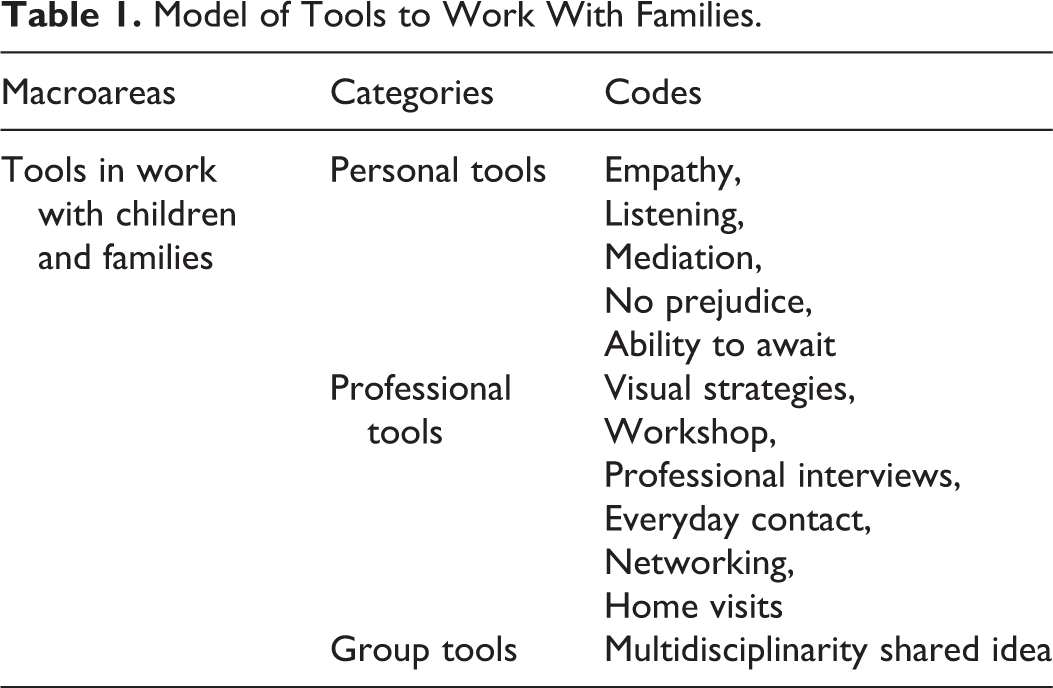
The participants identified several personal tools such as the empathy and ability to understand other’s needs: “empathy, listening, being comfortable in the relationship…” (P 4, Focus 5); “the ability to understand, that is to put me in the shoes of others, creates opportunities…” (P 3, Focus 6). Listening is a personal skill recognized as central to working with children and families to convey trust and harmony: “The more we know how to listen, the more we understand their expectations and the more we can be in tune with them (the parents)” (P 9, Focus 2) “ability to listen and converse, build confidence and trust, expertise and experience…” (P 4, Focus 5). Some participants also reported the ability to mediate: “mediation without taking someone’s side” (P 1, Focus 6) and to abstain from prejudice: “Do not judge from the starting point, even from appearances, do not be biased” (P 1, Focus 2). Another participant stated: “[…] prejudice control is needed because sometimes the parents are initially hostile” (P 4, Focus 1). Finally participants underline the importance of timing and the ability to wait: “In the beginning, it is a slow but fixed job, like a turtle that is slow but goes, goes and nobody stops it, our job is like this…” (P 2, Focus 3). Another saw that this could be difficult to understand: “I have to understand that trust takes time “(P 6, Focus 2).
Concerning professional tools, social workers underlined the importance to offer different opportunities for family engagement: “[…] We should offer varied ways of involvement. There are the rules of service, but then relationships must be cultivated in a more personal way. Meetings can be held formally or more confidentially. A range of opportunities must be offered…” (P 2, Focus 2). Participants noted some resources that allowed them to carry out their work properly; a social worker summarized these competencies: “professional interviews, teamwork, networking, and home visits; opportunities to implement shared projects, effective collaboration with other social services” (P 6, Focus 6). Educators often resorted to direct visual strategies, such as the display of children’s work or the documentation of the activities carried out during the day, because as an educator saw: “sometimes parents have no idea of what happens in the service and seeing it is easier than explaining it” (P 3, Focus 2). Moreover, social workers asked parents to participate in workshops to share with children. This strategy seemed to be appreciated by mothers and dads who collaborate with services to ensure their presence in the child’s daily life; a confirmation could be found in the words of some educators: “This year we did storytelling and dance workshops, we shared the tasks with the parents once every fifteen days, they were very involved” (P 2, Focus 3). Participants recognized the importance of professional interviews: “We always set up an initial professional interview to investigate their expectations and introduce their children” (P 2, Focus 1) and everyday contact: “sometimes they stiffen…instead many times only the everyday contact helps you […] you have to take advantage of that moment “(P 6, Focus 1).
According to the participants, their work in multidisciplinary teams is a key group tool: “Keyword: multidisciplinary team!” (P 1 Focus 5). It was seen both as competence and as a critical issue when there is a lack of adequate training that enables professionals to collaborate effectively. As another educator saw it’s important to share the same idea: “[…] It is important to all share the same idea. Because if the parents follow only you, not a group, not an idea of school, but only you. So, it works no longer” (P 1, Focus 4).
In addition, participants also highlighted some critical points; some social workers reported a lack of specific training on the family and the difficulty in defining their role: “I find it hard to set some limits; my availability sometimes is likely to go beyond the role. In the center, we work a lot with informal conversations, and very often this is misunderstood by the families. Sometimes it is not clear to them what my role is about the family, and this is due to the model that we have; sometimes it’s ok because the informality is important. It gives us confidence because the parents open up more, but sometimes they do not understand the institutionalized role of social workers” (P 4, Focus 5). Others respondents stated: “The mandate is sometimes a little ambiguous; it is unclear what role we must have for the parents”; “Now they (the parents) ask you to take on the role that the larger family once had as if we could be the grandparents” (P 2, Focus 4).
Discussion
This work provides an original contribution to understand the complexity and characteristics of social work with children in FCA. Our participants confirm that child welfare interventions have the aim of promoting family competences and resources within the strength’s perspective (Saleebey, 2009). However, a professionally centered model is still present in workers idea, oriented to protect minor and to give indications to parents. According to a prior study (Michalopoulos et al., 2012), it is important to give priority to family strengths to guide successful change. The focus on families’ resources and empowerment support the idea that it is important to involve families during interventions. A support project should not be imposed by the social worker, but derived from a purpose shared by parents and operators, as the participants underlined. The literature showed the importance of listening and involved families to better understand their needs and to lead to significantly better results in welfare and well-being (Williamson & Gray, 2011). In this study, a relevant aim of the work with families is related to promoting social networks. The relationship between networks and social support is not linear; however, we can say that having a good network, even if it is not sufficient, is important because individuals still need to receive adequate social support (Prezza & Santinello, 2002). Social workers have to encourage the family to relate and maximize the help that can be provided by the available networks; this improves the welfare of the family and consequently the children involved (Williamson & Gray, 2011). Social workers believed that collaboration with other agencies provided important resources for coordinating, engaging, and managing cooperative intervention programs. Creating a favorable climate and performing a good assessment are skills that the participants are assumed to possess, but workers’ responses suggest that they are not adequately trained to a family-centered model. Participants stated difficulty in defining their role, and community’s perception of workers could obstruct family engagement (Michalopoulos et al., 2012). Training on relational tolls, as centering the orientation on the family (Lietz, 2011), is a current challenge for the workers in the child welfare. Research suggests that we must continue to explore worker efficacy concerning knowledge, life skills, and multicultural awareness.
Conclusion
This study involved social workers and aimed to enhance family-centered practices by analyzing practitioner’s perceptions of work with families in daily practice. Discussions among practitioners on the aims and tools of work can be useful in implementing this approach within the welfare transformation and in promoting awareness of the practice and its principles. This work suggests a need to focus on relevant transformation processes in social services from a focus on children approach to FCA. The results can increase knowledge of how these professionals are developing work with children and families. Social and health services should continue to work to sustain these changes through family support programs, not yet been developed in the Italian context. These transformations could expand child welfare services from a resource for families in crisis to a preventive and supportive service that promotes the well-being of children and their families.
There were some limitations to this study: first it does not consider the parents’ point of view that could usefully integrate the perspective of social workers. Further research could be useful to explore the families’ experiences on social services within the family-centered framework. We have also not considered the real degree of family-centered model application in services, and this may impact social workers’ perceptions. Participants may have higher motivation and interest in FCA than those who took no part to focus groups. This selection bias, however, might have resulted in rich data. Finally, some authors conducted both interviews and data analysis. Although we discussed potential biases, the experiences of the interview may have confounded the data analysis process. However, the iterative interaction between data and analysis may have contributed to increasing validity (Morse et al., 2002).
Professionals and service providers can use our findings to reflect on current conceptualizations of family involvement and FCA in their work and to recognize possible psychological barriers to achieving family participation. This article should contribute to the growth of the literature on FCA in Italy and could provide an interesting suggestion for another international context that is facing a similar transformation in social work.
Footnotes
Acknowledgments
The authors would like to thank Celivo (Volunteer Services Center) and Early Childhood Education and Care Centers in our city for supporting and funding the project as well as those who participated in this study and assisted in recruiting the participants.
Declaration of Conflicting Interests
The authors declared no potential conflicts of interest with respect to the research, authorship, and/or publication of this article.
Funding
The authors disclosed receipt of the following financial support for the research, authorship and/or publication of this article: The authors received financial support for the research from Celivo and Municipality (ECEC).
