






Abstract
Child maltreatment is a global public health issue affecting the well-being of millions of children (Stoltenborgh et al., 2014). In China, although harsh and controlling parenting strategies are declining in the current generation of parents, physical discipline is still considered beneficial for children's future (Qiao & Chan, 2005; Wang, Cheng, et al., 2020; Wang, Wong, et al., 2020). The prevalence of child physical abuse in China was estimated at 36.6% (Ji & Finkelhor, 2015), which was significantly higher than the international and Asian estimates in a study by Stoltenborgh et al. (2013). Specifically, the pooled prevalence was estimated at 43.1% for minor physical abuse, 26.6% for severe physical abuse, and 7.8% for very severe physical abuse (Ji & Finkelhor, 2015). Another study found that 30.0% of Chinese primary and middle school students reported that they had suffered from emotional abuse (Wang, Cheng, et al., 2020; Wang, Wong, et al., 2020). The high incidence of child maltreatment places an immense burden on the public health system (Margolin & Gordis, 2000).
Child maltreatment significantly impairs individuals’ psychological well-being and social functioning (Goemans et al., 2021; Schneiderman et al., 2021). It has been shown to cause mortality, disability, delinquent behaviors, and mental health problems, such as posttraumatic stress, depression, and anxiety (Gardner et al., 2019; Strathearn et al., 2020). The consequences of child maltreatment can persist into adulthood, damaging individuals’ daily routines and decreasing their self-esteem (Zhang et al., 2022). In China, physical and emotional abuse caused gross domestic product losses of 0.84% and 0.47%, respectively, in 2010 (Fang et al., 2015). Considering the high prevalence and serious consequences of child maltreatment, effective evidence-based interventions to prevent child maltreatment in China are urgently required.
Interventions aimed at preventing or reducing the risk of child maltreatment have increased in recent years. Although a meta-analysis found that programs aimed at preventing child maltreatment have limited effects, moderator analysis showed that providing parent training instead of only support, such as social, emotional, and material support, had larger effects (Euser et al., 2015). For instance, several meta-analyses have indicated that parent training programs could prevent or significantly reduce child maltreatment (Gubbels et al., 2019; Van Der Put et al., 2018). Most parenting training programs strengthened positive parent–child interactions, taught parents nonviolent discipline techniques, and improved their positive parenting skills, which are the effective components in reducing maltreatment rates and associated risk factors (Gubbels et al., 2019; Kaminski et al., 2008). However, substantial evidence-based parenting training programs originated in high-income countries (Chen & Chan, 2016), and effective and affordable parenting programs are scarce in low- and middle-income countries (LMICs), where the need is the greatest (World Health Organization, 2020).
To fill this gap, Oxford University, University of Cape Town, and Bangor University, together with the World Health Organization (WHO) and United Nations International Children's Emergency Fund, developed the Parenting for Lifelong Health for Young Children (PLH-YC) program, which is an evidence-based, culturally appropriate, and affordable parenting program to reduce the risk of violence against children and improve child well-being in LMICs (Lachman, Kelly, et al., 2016; Lachman, Sherr, et al., 2016; World Health Organization, 2020). The PLH-YC is a group-based parenting program for families with children aged 2–9 years. It is based on the social learning theory (Bandura, 1977) and has a structured manual that emphasizes the importance of establishing a strong foundation of positive parent–child relationships before learning behavior management and discipline strategies (Lachman, Kelly, et al., 2016; Lachman, Sherr, et al., 2016; Mamauag et al., 2021).
PLH-YC was originally tested in a small-scale (N = 68) randomized controlled trial (RCT) in South Africa, and the results revealed moderate treatment effects with an increased frequency of parent reports of positive parenting and observational assessments of parent–child play (Lachman et al., 2017). A larger RCT (N = 296) conducted in the same context indicated an immediate improvement in observed positive parenting and positive child behaviors, and its effects persisted for one year (Ward et al., 2020). In addition, the PLH-YC and its adapted versions have been expanded to LMICs in Asia, such as Thailand, the Philippines, and Malaysia (Lachman et al., 2023; Mamauag et al., 2021; McCoy et al., 2021). McCoy et al. (2021) conducted a single-group pre–post pilot study in rural Thailand using the local public health system and found that the adapted PLH-YC reduced overall maltreatment, physical and emotional abuse, and child neglect. Another RCT study embedded an adapted PLH-YC program in the Philippine conditional cash transfer system and found moderate reductions in physical and emotional abuse, neglect, and overall child maltreatment (Lachman et al., 2021).
In recent years, an increasing number of parenting programs have been developed and implemented in mainland China. The target population of these programs included general families (Gao et al., 2022; Guo et al., 2016; Luo et al., 2019), immigrant families (Wang, Cheng, et al., 2020; Wang, Wong, et al., 2020), families of children with behavioral problems (Leung et al., 2008), and families with children with autism or developmental disabilities (Fang et al., 2022; Leung et al., 2016). Chinese parenting programs have focused on improving child development and health and parenting practices and reducing parenting stress and child behavioral problems (Gao et al., 2022; Luo et al., 2019); however, no programs deal with child maltreatment.
There is a lack of evidence-based and affordable parenting programs aimed at preventing child maltreatment in mainland China. Parenting interventions appear to be as effective as in their originating countries when transported to other countries despite differences in culture and service provision (Gardner et al., 2016). Leijten et al. (2016) demonstrated that cross-culturally adapted parenting programs can achieve success if they are based on underlying core principles, such as parent–child relationship building through play and positive attention and child behavior change through social learning.
Based on the above considerations, we decided to introduce PLH-YC to mainland China. The cultural attitudes and beliefs of Chinese parental support corporal punishment and intergenerational parenting for young children constitute an important context in adapting the PLH-YC, and the structure of the PLH-YC needs to address Chinese parents’ concerns. Specifically, many Chinese parents continue to believe that “beating is caring and scolding is love”), and they regard their own children as private property that can be handled arbitrarily, considering it their right to beat their child as part of parenting (Qiao & Chan, 2005).
This study aimed to test the feasibility, acceptability, and preliminary effects of this culturally adapted parenting program in the Chinese context. The following research questions (RQs) were proposed for feasibility and acceptability:
What are the rates of participant recruitment, retention, enrollment, attendance, and dropout?
How do Chinese parents perceive the program acceptability?
What level of fidelity is the program delivered?
What are the enabling factors and barriers of participation perceived by Chinese parents and program facilitators?
The following RQs were proposed for preliminary effects:
Is there a reduction in child maltreatment, its associated risk factors (parental stress, parental depression, and child problem behavior), and improvement in protective factors (positive parenting and social support) after the program?
What are the changes perceived by Chinese parents and program facilitators?
Method
Research Design
This study conducted a pre–post single-arm pilot trial with no control group in mainland China. A mixed-method design was employed because of the small sample size, and qualitative data was utilized to explain, interpret, and enrich the quantitative findings. Written informed consent was obtained from all participants. Ethical approval was obtained from the Institutional Review Board of Renmin University of China.
Participants
Parents
The trial was conducted in two stages. Stage one was conducted from June to August 2022 and stage two was conducted from September to December 2022. The two stages differed in recruitment and delivery format because of the strict lockdown policies caused by COVID-19 in China, with strict lockdown policies. Stage one was a face-to-face group intervention and stage two was an online group intervention through a real-time video conferencing platform. In stage one, participants were recruited through a rural primary school, which is a convenience sample in Hunan Province, central south China. The principal and teachers of the primary school-issued posters to parents, and parents interested in the program could register. In stage two, recruitment was completed through online advertisements and the WeChat-based platform developed for this study. Parents recruited in stage two had access to the Internet.
Inclusion criteria were (a) having at least one child aged 3 to 9 years, (b) residing in the same household as their children for at least four nights per week to ensure adequate time for practicing parenting skills, and (c) being available to participate in weekday program sessions. If parents had more than one child aged 3 to 9 years, they were asked to select one target child with more difficult behaviors, as these children were more likely to be punished violently. Exclusion criteria were (a) children with a diagnosed developmental delay or mental disability, (b) parents with mental disorder, and (c) parents who once participated in similar parenting programs.
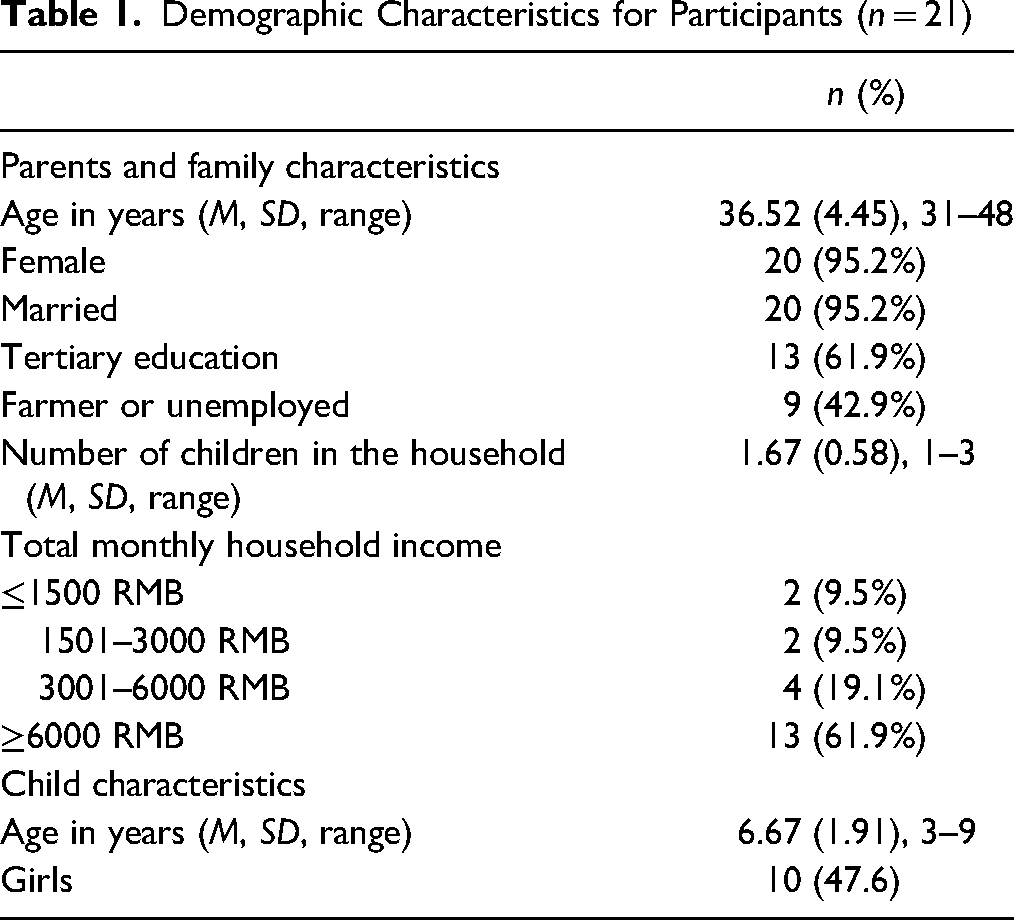
After establishing the inclusion criteria, two trained research coordinators contacted the parents by phone or through home visits to confirm their participation in the program. Table 1 presents participant characteristics. Among the 21 participants, the majority were female (n = 20, 95.2%) and married (n = 20, 95.2%). The mean age was 36.52 (SD = 4.45). Nearly half of the participants were farmers or unemployed (n = 9, 42.9%), and had not received tertiary education (n = 8, 38.1%). In total, 9.5% of the participants’ monthly household income was below 1,500 RMB. There was an average of 1.67 children per household (SD = 0.58), and half of the target children were girls (n = 10, 47.6%), with a mean age of 6.67 years (SD = 1.91).
Demographic Characteristics for Participants (n = 21)
Program Facilitators
Five facilitators with a mean age of 25 years were recruited from Renmin University of China. They included two Ph.D students in social work and three master of social work students, none of whom had prior practical experience in working with parents. The rationale behind the inexperienced facilitators’ recruitment was to assess whether inexperienced facilitators could implement the program with high fidelity under the supervision. During the recruitment process, the research team evaluated the facilitator's professional background, openness to learn and interest in parenting programs, and ability to communicate with parents.
Before the program, 24-hr training in 8 days was conducted by professors, who specialize in child development and parenting. To make sure that each facilitator had a better understanding of the principles and methods of PLH-YC, didactic and active learning activities were included in the training workshops, such as small group discussion, role-play, and behavior rehearsal. All facilitators were provided supervision after each session by one practitioner experienced in child protection.
Intervention
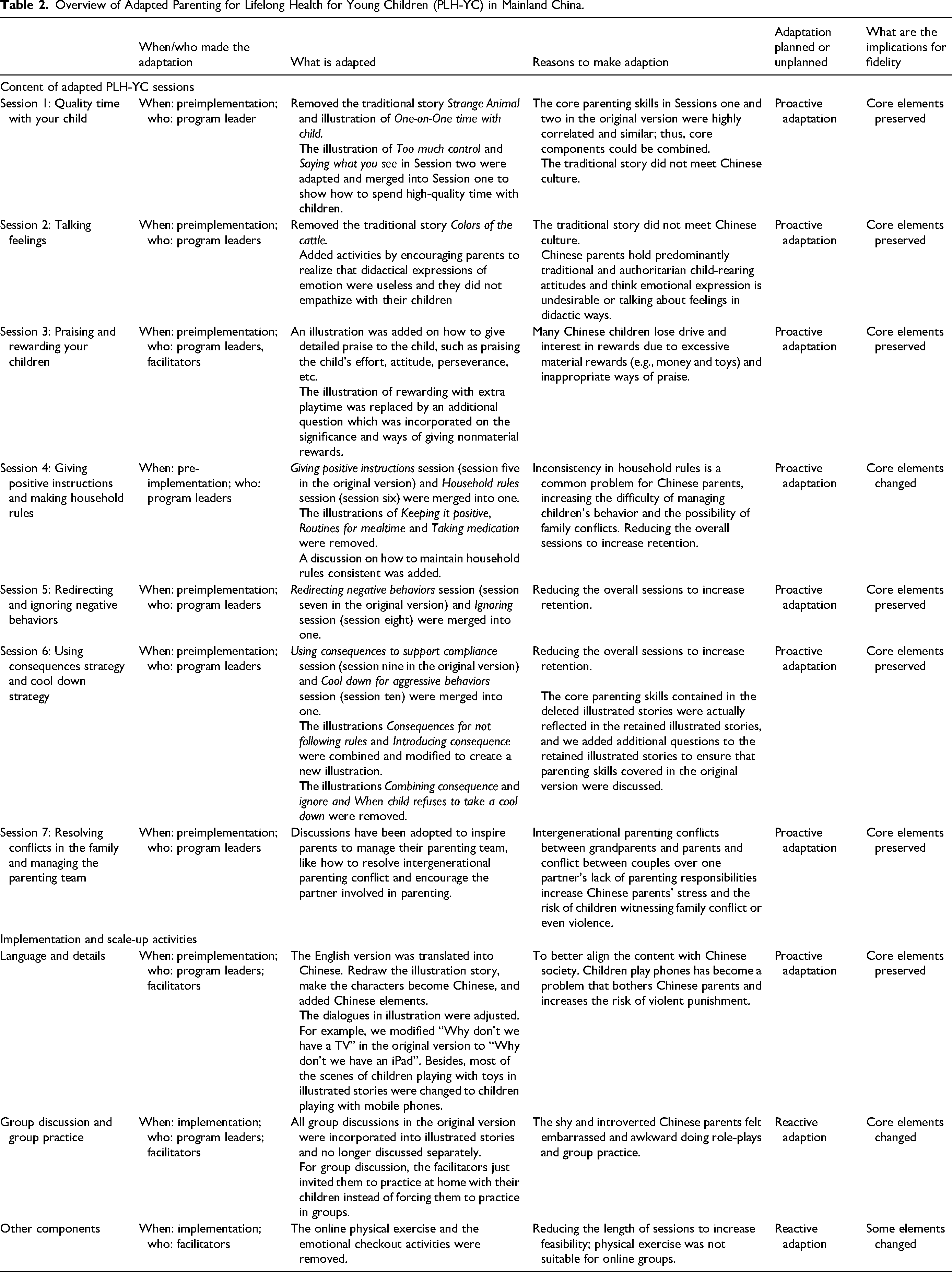
PLH-YC is a group-based, nondidactic, and collaborative parenting program based on social learning principles. The original PLH-YC facilitator manual and parent handbook are freely available online (https://www.who.int/teams/social-determinants-of-health/parenting-for-lifelong-health/programme-manuals). This was an evidence-based and low-cost parenting program designed for LMICs. At the beginning of the study, permission to translate (the translation process was available upon request) and the use of the PLH-YC were obtained from the developers. Program adaptation to the Chinese context began in April 2022, and the adaptations are summarized using the Framework for Reporting Adaptations and Modifications—Enhanced in Table 2. The original 12-session version was reduced to eight sessions to improve retention of parents and ensure delivery efficiency.
Overview of Adapted Parenting for Lifelong Health for Young Children (PLH-YC) in Mainland China.
Parents were first invited to join WeChat groups (in both stages), where program facilitators weekly sent text message “boosters” to remind them of core parenting skills and encourage them to practice learned skills at home. WeChat group also provided opportunities for parents to share their parenting experiences and communicate child problems. Before the first session, program facilitators conducted a 1-hr online/offline home visit to introduce the program, gain trust from the parents, and help them establish tailored goals. Preprogram visits also allowed participants to communicate with facilitators about their goals and challenges in parenting. Home visit was also offered during the group sessions to address participants’ individualized concerns.
The group session was delivered to two parent groups in two stages (one group for each stage), each of which included about 10 participants. The program was delivered face-to-face in a primary school in stage one, while it was delivered via the Tencent Meeting, a video conferencing tool used in China, in stage two. Each session was delivered by two facilitators and two observers. Participants attended our program once per week, with each session lasting for about 120 min.
In stage one, refreshments were provided in each session, and toys (e.g., gobang, Chinese checkers, and the Monopoly game) were used to increase parent–child interaction, and they rewarded participants who performed well, such as attending the program on time and participating in the program interaction actively. In the final session, program facilitators rewarded each participant with an exquisite set of stationery for their children. However, these gifts were not provided to participants in stage two due to the limitations of the online format.
Data Collection Procedures
Data during stage one was collected at two assessment points: baseline in June 2022 and posttest in August 2022, and in September for the baseline and December 2022 for the posttest in stage two. In stage one, participants independently completed questionnaires in paper format at home and returned them within the predefined time. In stage two, participants completed questionnaires through Questionnaire Star, a professional online questionnaire software platform, one week before the program. Completion of the questionnaires took 30 to 45 min.
Qualitative data were collected from three sources: (a) individual interviews with all 36 participants who had completed the pretest assessment, (b) focus group discussions with 16 participants who completed the program, and (c) focus group discussions with program facilitators. Individual interviews with participants were performed after the program delivery at the participants’ homes in stage one and through Tencent Meeting in stage two. In individual interviews, we mainly investigated the reasons for parental participation, overall acceptability of the program (e.g., schedule, logistics, content, delivery format, and program facilitators), and enabling factors and barriers to engage in the program.
Focus group discussions with both parents and program facilitators were conducted in a private classroom in the primary school in stage one, and through Tencent Meeting in stage two, which lasted for approximately 90 min. Finally, there were 16 parents available for focus group discussion. Focus group discussions with only program facilitators (n = 5) were further conducted to identify the enabling factors and barriers of parental involvement and general opinions regarding the program. Focus group discussions and individual interviews were recorded with written notes as a backup. Privacy and confidentiality of the collected data were ensured throughout the study.
Measurements
Demographic Information
Demographic information included parent factors: age, gender (female = 1), marital status (married = 1), level of education (tertiary education = 1), employment status (unemployed or farmers = 1); family factors: number of children under 18 per household, annual monthly household income; child factors: age and gender (girl = 1).
Feasibility Outcomes
Feasibility was determined based on participant engagement (recruitment, retention, enrollment, attendance, and dropout rates), acceptability, and intervention fidelity.
Participant Engagement. The recruitment rate was determined based on the number of potential participants who were contacted, met the inclusion criteria, passed the screening, and completed the pretest assessments following informed consent procedures (McCoy et al., 2021). The criterion for success was recruitment rates of at least 40% of those who are eligible (March et al., 2020). The retention rate was calculated as the percentage of participants who completed the intervention. The acceptable retention rate was >70% of participants completing the study (Korman et al., 2020). The enrolment rate was based on the percentage of participants who attended at least one group session and was considered feasible if participants completed ≥65% of the program (Korman et al., 2020). The attendance rate was recorded by program facilitators during each session, and the dropout rate was the percentage of participants who missed three consecutive sessions and were unavailable for home-visit consultations.
Program Fidelity. Content fidelity was measured using a checklist consisting of items that captured key intervention strategies for each session. It was developed by the research team following the treatment components of the adapted PLH-YC and the PLH-YC Facilitator Assessment Tool (Martin et al., 2023). Either “present” or “absent” was recorded to indicate whether a content area was covered during a session, with a standard of 80% regarded as high intervention fidelity (Borrelli et al., 2005).
Process fidelity was measured using a 16-item Group Facilitation Competency Checklist (Wong et al., 2019). This checklist includes four subscales: (a) facilitating focused group discussion (five items), (b) communication skills (four items), (c) interpersonal style (three items), and (d) session structure (four items). It contains four response categories: 0 = not observed, 1 = observed, not done well, 2 = observed, done adequately, and 3 = observed, done well. The scores range from 0 to 48 points. Content fidelity and process fidelity were assessed by two independent observers, and if there was any disagreement, it would be resolved by the supervisor who watched video recordings.
Program Acceptability. Acceptability was measured using a 38-item questionnaire adapted from the Incredible Years Parent Program Satisfaction Questionnaire (Webster-Stratton, 1989). Participants reported how they perceived the usefulness of the teaching format (7 items, e.g., “illustrations and group discussion”), parenting techniques (11 items, e.g., “quality time with children”), acceptability of program facilitators and group members (9 items, e.g., “group's support of parent” and “group leader was helpful”), and whether the program fulfilled their overall goals and expectations (11 items, e.g., “my expectation for good results from the program was optimistic”). Items were evaluated on a five-point Likert scale ranging from highly disagree (0 point) to highly agree (4 points), and the sum of the scores for these items was the total score, which ranged from 0 to 152.
Effectiveness Outcomes
Primary Outcomes. Child maltreatment was measured using the physical and emotional abuse subscales of the Parent–Child Conflict Tactics Scale (Straus et al., 1998). Participants reported the number of times they had perpetrated physical and emotional violence toward their children in the last two months. Physical and emotional abuse dimensions have four and five items, respectively, and are rated on a nine-point Likert scale scored (0 = did not happen; 8 = more than eight times). The Chinese version of the physical and emotional abuse subscales has shown good internal consistency with previous studies (Fu et al., 2019; Xing & Wang, 2017). In the present study, the internal consistency reliability of the scale was 0.79 for emotional abuse and 0.84 for physical abuse.
Secondary Outcomes. Based on previous PLH-YC studies, parent reports of secondary outcomes included positive parenting measured using the Parenting Young Children scale (McEachern et al., 2012), parental stress measured using the Parental Stress Scale (Berry & Jones, 1995), parent–children relationship measured using the 15-item Child–Parent Relationship Scale (Pianta, 1992), children's behavioral problems measured using the Conners Child Behavior Scale, Conduct problem subscale (Conners et al., 1998), depression measured using the 10-item Center for Epidemiologic Studies Depression Scale (Mohebbi et al., 2018), and social support measured using the 8-item Medical Outcomes Study Social Support Survey (Moser et al., 2012). Detailed information on the reliability of these scales and their applications in China were available upon request.
Data Analyses
Quantitative Data Analysis
Participant engagement, intervention fidelity, and acceptability were analyzed using descriptive statistics. To examine pre–post changes in primary and secondary outcomes, baseline and posttest scores were compared using a paired-sample t-test. Given the small sample sizes, Hedges’ g was chosen over Cohen's d to calculate the effect sizes for all outcomes, and effect sizes were classified as small (g = 0.20–0.49), medium (g = 0.50–0.79), and large (g ≥ 0.80; Cohen, 1969).
Qualitative Data Analysis
Thematic analysis was used to analyze the qualitative data that were collected from parents and facilitators (Braun & Clarke, 2006). First, the transcripts were read and initial open codes were generated. In the initial coding, the text segments of important materials related to the study questions were labeled. Next, researchers repeatedly read transcripts, reviewed segments of text attached to each code, and categorized the initial coding scheme to generate a set of themes that captured the essence of focused group discussion and individual interviews.
Individual interviews and focus group discussions were audio-recorded. Data were transcribed verbatim in Chinese and analyzed by two Ph.D students fluent in English and Chinese. The initial coding was done in Chinese, and the themes and results were then translated into English. Codes, themes, and results were finally checked by a bilingual researcher.
Results
Feasibility Outcomes
Levels of Participant Engagement
The levels of participant engagement were feasible, with overall high rates of recruitment, enrolment, attendance, and acceptable dropout rate. The participant flowchart is shown in Figure 1. A total of 74 participants from the two stages were recruited, and 52 participants were successfully contacted, with an acceptable recruitment rate of 70.3%. Among the 52 contacted participants, 41 (78.8%) met the eligibility criteria, and 32 of 41 (78.0%) eligible participants signed informed consent forms. Of the 11 participants who did not meet the inclusion criteria, four had children over the age requirements, four were grandparents, and three did not live with their children. A total of 32 (43.2%) participants consented to participate in the program and completed the pretest assessments.
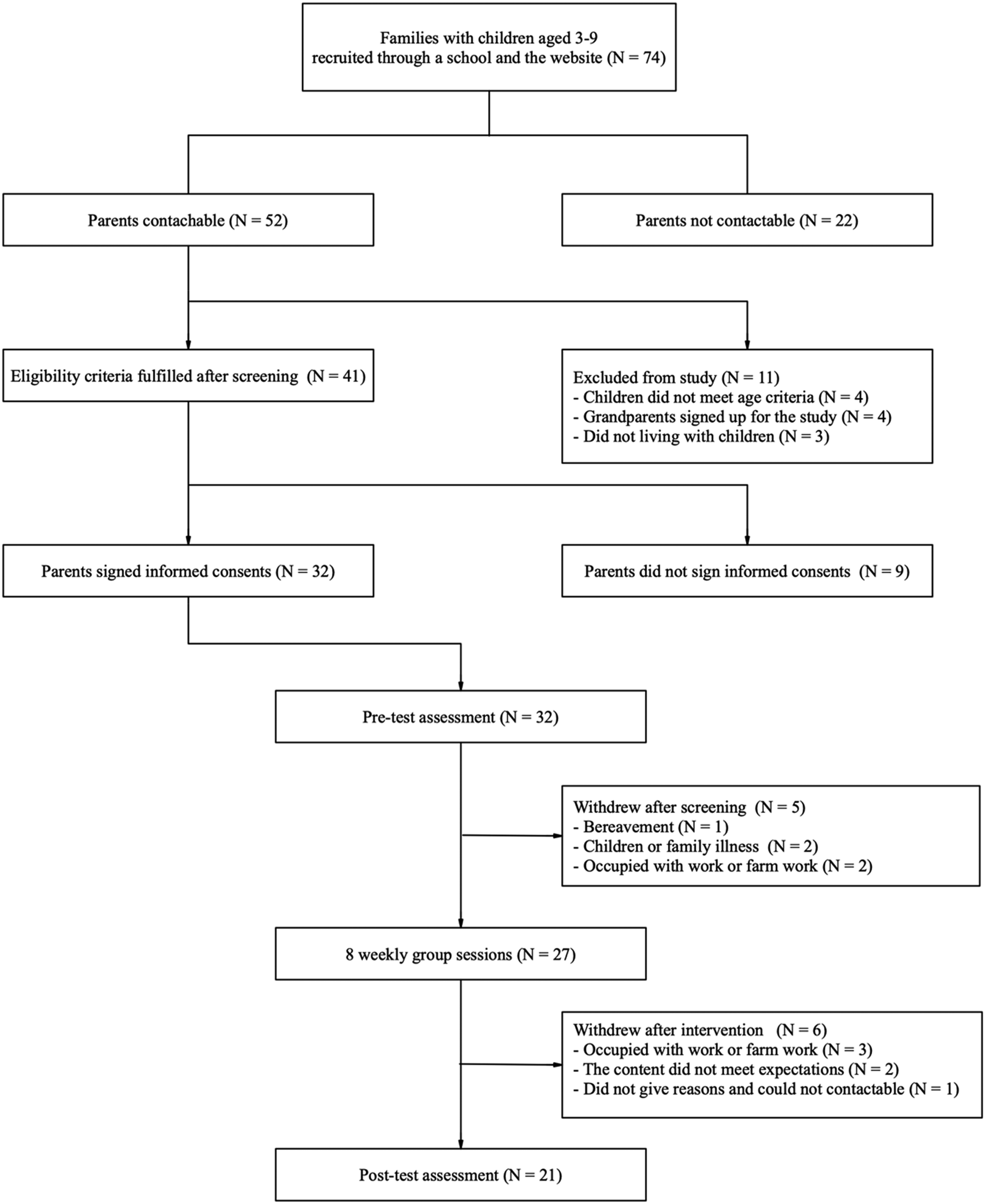
Study flow diagram.
Five parents withdrew after the pretest assessment, and six withdrew after missing at least three consecutive sessions, resulting in a 65.6% retention rate at the posttest. The reasons for program withdrawal were being occupied with work (n = 5), having to care for sick family members (n = 2), the contents not meeting expectations (n = 2), bereavement (n = 1), and no reason provided or lack of contact (n = 1).
There was a high rate of overall program enrolment, with 80.8% of the participants attending at least one session. Parents attended an average of 6.09 of the eight sessions. Among the 21 enrollees, 17 (80.9%) attended five or more sessions, and nine (42.9%) missed only one or no session. The reasons for missed sessions included being occupied with work, being busy with household chores, and severe weather conditions.
Acceptability
The program was highly acceptable to the participants, as assessed using the adapted Incredible Years Parent Program Satisfaction Questionnaire (M = 128.71, SD = 9.35). Specifically, participants rated the overall program as highly acceptable and felt it helped them enhance the parent–child relationship and manage children's behavior more effectively (M = 36.76, SD = 2.98). In addition, participants gave high ratings for delivery format (M = 23.80, SD = 2.93), parenting techniques (M = 36.62, SD = 3.46), program facilitators (M = 21.29, SD = 2.96), and support from the group (M = 10.24, SD = 1.45).
Evidence from the qualitative interviews supported these results. Overall, the participants evaluated the program positively and noted that it was well-designed, easy to understand, and helpful. Participants were pleased with the delivery format. One parent stated, “At first, I thought it was a traditional lecture, but I preferred the form of this program… Discussing illustrated stories with other parents inspired me to reflect on my interactions with my child” (Parent # 13, interview). Participants were also satisfied with the support from the group and program facilitators. When I communicated with parents in the group, I found that the child-rearing problems that had bothered me were common, which eased my pressure and anxiety to some extent… Every time I shared opinions, program facilitators also encouraged me and made me feel understood and supported. (Parent # 12, interview)
In addition, most participants found the concept was easily grasped by parents, and materials intuitively made sense. One parent stated, “The scenes in illustrated stories often occur in my family and easily resonate with me” (Parent # 3, interview).
Fidelity
Facilitators’ adherence to the program, as measured using the content fidelity checklist, was generally high. On average, program facilitators were able to adhere to 88.2% of the intended program components (SD = 1.8, range 85.75–89.45). Fidelity was especially high for illustrated stories (M = 100.0, SD = 0.0) but lower for role-play (M = 41.7, SD = 25.8) and closing components, such as emotional checkout, compliment circle, and body relaxation (M = 72.0, SD = 6.2).
Overall, the mean process fidelity score for the whole program was 35.57 (SD = 2.90). Mean scores for facilitating focus group discussion, communication skills, interpersonal style, and session structure were 11.93 (SD = 1.27), 9.57 (SD = 0.76), 7.14 (SD = 0.66), and 6.93 (SD = 1.14), respectively.
The designed time length of each session was 120 min, whereas the average actual usage length of each session was 130 min (SD = 9.37). Session 2 had the shortest usage of 112 min, and Session 6 had the longest usage of 142 min.
Enabling Factors and Barriers to Parents’ Engagement
Enabling Factors. Both parents and program facilitators identified several enabling factors to encourage parents to attend or continue attending the program. Three main themes emerged: home-visit consultation, favorable results for parents, and provision of childcare services and homework tutoring.
Home-visit consultations in rural areas helped build a trusting relationship between parents and program facilitators and reduced parents’ doubts and concerns about program costs and facilitators’ identity. One facilitator said, “Without home visits, I believe most of the parents would not attend the first session because parents did not trust us and might think we were cheaters if we only contacted them by phone” (Program facilitator # 2, interview). In addition, all parents highlighted the value of home visits, which helped them address parenting concerns and problems. One parent stated, “Home visits allowed me to share my daily hassles or concerns about rearing children with program facilitators, during which time they gave me some suggestions to reduce my worries” (Parent # 5, interview).
Favorable results for parents encouraged them to continue attending the program. Most of the parents highlighted the value of the program and mentioned that they learned parenting skills to improve their relationship with their children and families and manage their children's behavior. One parent stated, “I think the program is useful. Now I can spend more quality time with my child… My husband is also gradually involved in parenting… Quarrels within my family have been reduced” (Parent # 11, interview).
Providing childcare services and homework tutoring was effective in engaging parents by reducing their worry about finding childcare and relieving the burden of tutoring homework. One parent stated, “I would not be relieved to attend the program if I could not take my child with me, because no one can look after him at home” (Parent # 2, interview). Another parent reported, “I was happy that [my child] could be well-tutored here” (Parent # 5, interview). In addition, children encouraged their parents to participate. One parent stated, “Every Saturday, [my child] got up early and urged me to attend the program” (Parent # 7, interview).
Barriers. Both program facilitators and parents discussed three personal barriers: parents highly valuing their children's academic performance, lack of intrinsic motivation, and household chores or social obligations.
Parents highly valuing their children's academic performance was the biggest barrier to their engagement. In using nonviolent discipline sessions, they tended to discuss the learning problems and difficulties encountered by children. Failure to meet the demands of parents to improve their academic performance increased the likelihood that parents declined to attend the program. One parent stated, “My aim is to learn scientific methods to improve my child's grades, but this program does not seem to involve that, which is a little disappointing” (Parent # 7, interview). A program facilitator said, “Some parents were always looking for ways to improve their children's academic achievement from us. Their enthusiasm toward the program decreased when we could not meet that need” (Facilitator # 1, interview).
The second barrier was the lack of intrinsic motivation to change parenting styles. In stage one, parents were recruited by school teachers, and most parents thought their children would get more attention in school if they attended the program; however, the change in their intrinsic motivation was weak. A program facilitator said, “Some parents did not have the motivation to change, they just wanted to please teachers” (Program deliver #1, interview). A parent reported, “I wouldn’t have signed up if the teacher hadn’t issued posters in the class group” (Parent #29, interview).
Household chores and family obligations occupied most daily activities for parents, preventing them from attending programs regularly. Most parents mentioned that they would like to attend the whole program, and did not want to take time off, but work and unforeseen events that happened each week kept them from attending sessions. One parent stated, “[My child] had a birthday last week, or I would visit relatives next week; such household trifles prevented me from attending some sessions” (Parent # 9, interview).
Preliminary Effectiveness
Postintervention Changes Assessed by the Quantitative Analysis
Primary Outcomes. The pre- and post intervention comparisons on primary and secondary outcomes are presented in Table 3. Results showed a large size effect on emotional maltreatment (Hedges’ g = −0.84, 95% CI [−1.46, −0.22], p = .002) with a significant reduction following the intervention from a mean score of 6.81 (SD = 1.20) to 3.14 (SD = 0.53), a medium size effect on physical maltreatment (Hedges’ g = −0.63, 95% CI [−1.24, −0.18], p = .046) with a significant reduction in mean scores from to 2.01 (SD = 0.80) to 0.28 (SD = 0.17). For general maltreatment, there was a large size effect (Hedges’ g = −0.86, 95% CI [−1.48, −2.36], p = .005), with a significant postintervention reduction from 8.81 (SD = 1.79) to 3.43 (SD = 0.59).
Comparisons of Pre- to Postintervention for Primary and Secondary Outcomes.
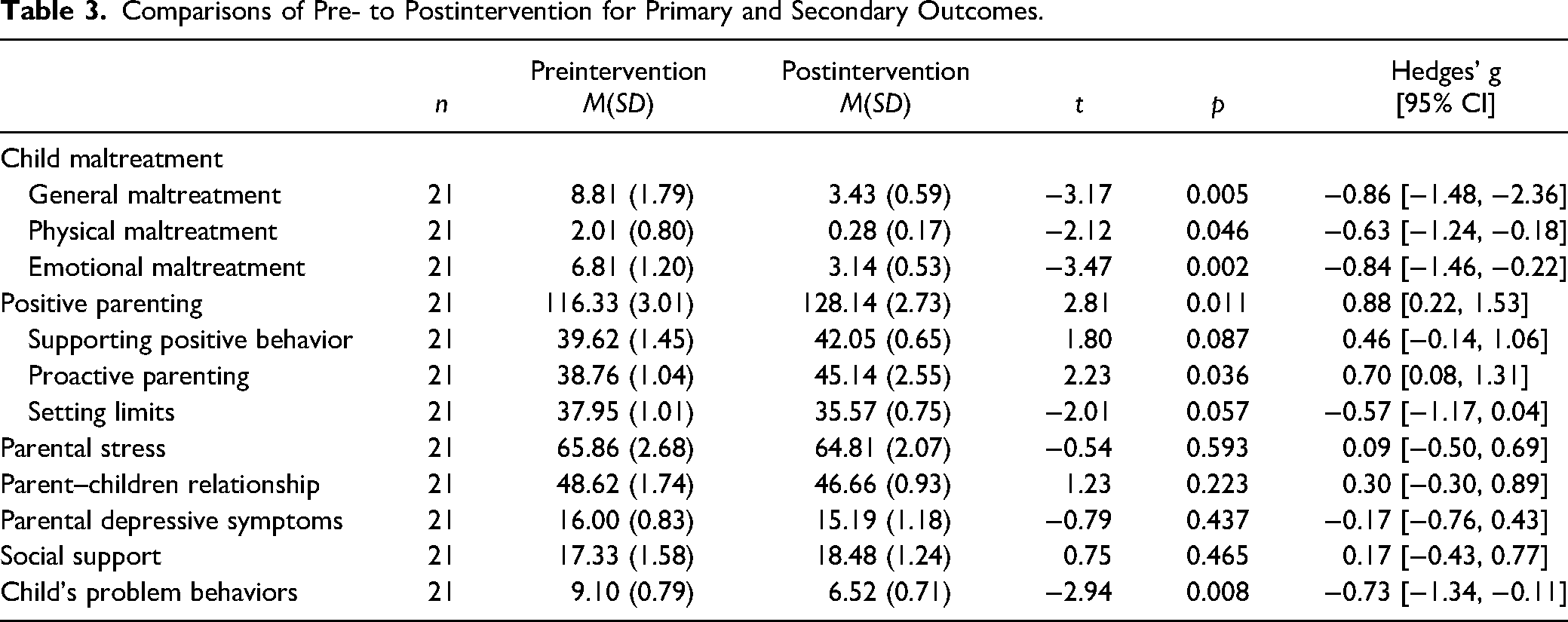
Secondary Outcomes. Parents reported increases in overall positive parenting with a large size effect (Hedges’ g = 0.88, 95% CI [0.22, 1.53], p = .011), as well as for the subscale on proactive parenting with a medium effect size (Hedges’ g = 0.70, 95% CI [0.08, 1.31], p = .036). There was a significant medium effect on child behavior problems (Hedges’ g = −0.73, 95% CI [−1.34, −0.11], p = .008), decreasing from a mean score of 9.10 (SD = 0.79) to 6.52 (SD = 0.71).
Nevertheless, there was no significant change in the parent–children relationship (Hedges’ g = 0.30, 95% CI [−0.30, 0.89], p = .223), social support (Hedges’ g = 0.17, 95% CI [−0.43, 0.77], p = .465), parental stress (Hedges’ g = 0.09, 95% CI [−0.50, 0.69], p = .593), or parental depression symptoms (Hedges’ g = −0.17, 95% CI [−0.76, 0.43], p = .437).
Postintervention Changes Assessed by the Qualitative Analysis
Reduced Usage of Violent Discipline and Psychological Aggression. Most parents reported that they seldom used violent methods or psychological aggression to discipline their children after the program. This was partly because they could use praise and nonviolent discipline to manage children's behavior. One mother of a seven-year-old girl said, My family uses a lot of praise now. [My child] used to be scolded every day, from when she got up in the morning, but the amount of scolding is much less now. If she doesn’t get up, I have more strategies to deal with her rather than yelling or threatening to hit her. (Parent # 6, group discussion)
Mindfulness-based stress reduction techniques, such as pause and cool down strategies, were linked to avoidance of violent discipline. These strategies allowed parents to consciously regulate their emotions and stress. One mother of a nine-year-old boy remarked, I had five bamboo sticks, and when I was angry with him, I would bind them together and beat him repeatedly. Since I attended this program, when I get angry, I can take a deep breath to calm myself down, or leave the site for a break to avoid having a direct conflict with the child or hitting him. (Parent # 8, group discussion)
Increased Positive Parenting Skills and Stronger Parent–Child Bond. Many parents noted that a key outcome of the program was acquiring positive parenting skills and knowledge, such as spending high-quality time with their children and talking about their feelings, which were perceived to facilitate stronger parent–child bonds and attachments. One mother of a five-year-old boy described that talking about their feelings resulted in a closer relationship: Sometimes, when I was angry, I tended to express my complaints first and ignore [my child]'s feelings. Now, I realize that I should acknowledge my child's feelings, even the difficult ones. Since I have paid attention to his feelings and emotions, [my child] is happy to share his emotions and thoughts with me, and I feel like we are getting closer. (Parent # 16, group discussion)
In addition, parents noted that positive parenting provided them with opportunities to learn about their children's interests and abilities, which improved parent–child relationships. The mother of an eight-year-old boy shared, When I spent time playing with [my child] and let him take the lead, I observe him, during which time I found many of his hobbies and great ideas that I did not know before. So, I gave him a lot of praise and positive affirmation … I think we have stronger emotional connection than before. (Parent # 10, group discussion)
Reduced Behavioral Problems and Increased Compliance Among Children. Most parents indicated that their children exhibited fewer behavioral problems and were more compliant, including having a mild temper and greater compliance with instructions, developing good habits, and playing with screen-based devices in moderation. One mother of a nine-year-old boy reported being bothered by her child's bad temper preintervention but noted, “I feel that [my child] has changed quite a bit. He can curb his temper now and care more about me” (Parent # 7, group discussion). The mother of a six-year-old boy stated, Every time I asked [my child] to turn [the TV] off, he seemed not to hear. But now, I’m sitting next to him, holding his hands, looking into his eyes and giving a clear positive instruction to turn off the TV, and he can follow this. (Parent # 11, group discussion)
Changes in children's compliance were closely related to positive parenting, establishment of household rules, and use of the consequence strategy. Parents explained that with the combined use of household rules, transition warnings, consequences, and praise, children developed good habits, such as having self-discipline and finishing their homework on time. One mother of a six-year-old boy explained how she used praise and transition warnings to make her son follow household rules: [My child] was encouraged by the establishment of rules on learning, and I also set an alarm as a transitional warning to remind him to do tasks in advance. We made a deal that he would get Legos as a reward if he followed the rules for at least a week. Now, his motivation is much better than before. (Parent # 13, group discussion)
Increased Parenting Confidence and Feeling Supported. Most parents thought highly of the group format, where they acquired many parenting skills from each other and gained praise and acknowledgment from other members of the group. The groups made parents feel more relaxed, encouraged, and confident in caring for their children. One mother shared, I have more confidence in parenting now, and the whole situation is getting better and better. I understand my children better, and I also know it is common and normal for the child to have a problem, so I am not worried about it anymore. (Parent # 15, group discussion)
In addition, program facilitators noted that parents encouraged and praised each other during the program, which allowed parents to feel supported. One of the facilitators stated, “In one session, a mother was moved to tears and felt supported after receiving compliments and praise from other parents because she thought she did not have any merits due to rarely being praised and recognized at home” (Program facilitator # 4, interview).
Increased Family Contact and Reduced Family Conflict. Many parents stated that the program helped them reduce family conflict and increase family contact by managing the parenting team and regulating their emotions. One mother of a seven-year-old boy reported often losing temper with her family preintervention but stated, “I lose my temper with my family much less since I attended the program. I try to calm down and not complain even if I am dissatisfied… I find conflicts in my family decreased” (Parent # 8, group discussion). Furthermore, parents encouraged their partners to be involved in parenting and strengthened family bonds, as shared by the mother of a seven-year-old girl: My husband is gradually participating in parenting. He used to play games after work and seldom played with our child. But I invited him to read illustrated stories together and gave him praise and positive attention since I attended the program… He now spends time playing puzzles or blocks with our child… I feel like my family is tight-knit. (Parent # 6, group discussion)
Discussion and Application to Practice
The adapted program in this study is one of the few evidence-based parenting programs conducted in the Chinese context that aims to reduce child maltreatment. This study was not designed to evaluate the intervention effects; rather, this feasibility pilot study used a pre–post design without a comparison group and aimed to inform future randomized controlled trials in China.
Our findings support the feasibility of implementing an adapted child maltreatment prevention program for Chinese parents. Although the retention rate (65.6%) was below the 70% threshold, the high rates of program recruitment, enrolment, and attendance, with a dropout rate within an acceptable range, suggested that most parents were willing to engage in the parenting program and feasibly incorporate the program into their weekly routines. Moreover, parents exhibited high acceptance of the program. The reason behind the low retention was parental low motivation to change, resulting in high susceptibility to unexpected obstacles. According to the health belief model, parents are more likely to participate if they perceive their family problems as more serious (Shenderovich et al., 2018). Therefore, stricter inclusion criteria should be established, such as parents with children with behavioral problems, to improve the retention rate. Several other aspects must be considered prior to future delivery. Program delivery should be avoided in seasons that are prone to extreme weather conditions, such as summer or winter, and busy farming seasons. Providing childcare services, particularly homework tutoring, can result in higher engagement rates in rural China. Additionally, although the recruitment rate (70.3%) in our study was lower than that in the original version of PLH-YC implemented in South Africa (81.03%), the acceptability, fidelity, enrolment rate, and attendance rate were consistent with that of South Africa (Lachman et al., 2017).
Data on treatment fidelity also support the feasibility of the intervention. Overall fidelity were over 80%, and lower checklist scores were generally associated with role-play activities and insufficient time to complete all components. Role-play activities were not delivered according to the manual because of time limitations and cultural characteristics. As parents had household duties, such as cooking and looking after families, session time was controlled within 120 min; therefore, program facilitators prioritized time for illustrated stories. In addition, although role-play provided parents the opportunity to practice new parenting skills in the group, shy and introverted parents felt embarrassed and awkward in performing role-play. Therefore, program facilitators adjusted role-play under the supervisor's suggestion after the first session. In the second and third sessions, program facilitators invited parents to practice the skills at home with their children rather than doing them in groups. In subsequent sessions, parents were encouraged to practice parenting skills through semi-open-ended role-play. Moreover, the findings indicated that program facilitators with limited previous experience in the field were able to deliver the parenting program with high content and process fidelity under supervision. This can mainly be attributed to detailed structural manuals that enhance the delivery and fidelity of implementation (Dusenbury et al., 2003). As professional human resources for parenting programs are limited in LMICs, this finding has strong implications for policy and program planning, implying that program facilitators with limited experience can effectively deliver the parenting program using structural manuals under supervision.
Despite the small sample size and a reduction in length from the original 12-session version of the PLH-YC, parents generally felt that they benefitted from the eight-session program. Parents reported a reduction in all primary outcomes, with large effects on general child maltreatment and emotional abuse and moderate effect on physical abuse. Analyses of secondary outcomes showed additional reductions in behavioral problems among children and improvements in positive parenting behaviors. The findings regarding primary and secondary outcomes were consistent with those of a pre–post study conducted in Thailand (McCoy et al., 2021). Secondary outcome findings were consistent with those of RCT studies conducted in South Africa (Lachman et al., 2017; Ward et al., 2020). The results regarding positive parenting were consistent with those of the Behavioral Parent Training program among Chinese parents (Gao et al., 2022), which reported that parenting skills effectively improved by strengthening parent–child bonds and stopping misbehaviors.
In addition, the findings were supported by a qualitative analysis, which emphasized perceived changes in parents, including reduced violent discipline and psychological aggression, increased positive parenting skills, strengthened parent–child bonds, reduced behavioral problems among children, and increased child compliance. However, compared to other parenting programs implemented in China (Gao et al., 2022; Leung et al., 2008), the intervention effect on parental stress was not significant. This might be caused by the emphasis on discipline and management of behavioral problems in the later stages of the program, which resulted in a greater focus on children's negative behaviors and stressful interactions in later sessions before assessment. Long-term follow-up assessments are required to examine potential delayed treatment effects. Although it is important to remain cautious regarding results without a control group, these findings supported the feasibility of this adapted program and suggested that it could lead to an array of positive effects; therefore, further testing using an RCT is merited.
This study had several limitations. First, the outbreak of COVID-19 forced us to move the program online in stage two, which excluded some potential participants, such as those with limited internet access. Second, the sample size in this study was small, and the study did not include a control group, limiting us to establish causality; thus, these results can only be considered tentative. Additionally, the small sample size did not allow us to explore the impact of demographic information on feasibility outcomes (dropout rate and enrollment rate) and primary outcomes (child maltreatment). Third, the results may not be generalized to fathers, as most participants were mothers. In China, the level of paternal involvement in child-rearing is gradually increasing, and parenting is no longer considered only a mother's duty (Li, 2015); therefore, to attract fathers to participate in parenting programs in the Chinese context deserves further exploration. Previous studies on engaging fathers in parenting programs, including designing content relevant to fatherhood, delivering sessions by male program facilitators, and father-only groups, provide direction for future trials (Panter-Brick et al., 2014). Fourth, the research data were collected from limited sources. We did not collect data from children or other family members, and the measurement of child maltreatment relied on parents’ self-reports. Future trials should collect data from children and other family members and increase measurements using observational tools to obtain a comprehensive understanding of program effects. Fifth, as parents require time to practice nonviolent discipline (Whittingham et al., 2009), the results may be limited by the timing of the postintervention assessment immediately after program delivery. A longer-term follow-up is required to examine the potentially sustained, delayed, or decreased treatment effects in future trials. Sixth, the content fidelity used in our study was self-developed and did not examine the psychometric properties. This may cause the fidelity we measured different from that previously reported in other countries implementing PLH-YC. Finally, child neglect was not assessed in this study. Parent group sessions indicated that parents did not realize that they should show or tell children that they love them and the impact of not doing so before they attended the program. Previous studies have shown that neglect, especially emotional neglect, is among the most prevalent types of child maltreatment in China (Wang, Cheng, et al., 2020; Wang, Wong, et al., 2020). It suggests that measures should be expanded and include child neglect, especially emotional neglect, in future studies.
Despite these limitations, this study makes an important contribution to the literature on the implementation of parenting programs to reduce the risk of child maltreatment in China. Considering the feasible, acceptable, and promising nature of the current findings, evaluation of the impact of this adapted parenting program in a future controlled trial in China is warranted. The findings of this study, such as attrition rates, can provide a reference for sample size calculations for a forthcoming RCT. Several factors, such as setting strict inclusion criteria, collecting data from a variety of sources, incorporating child neglect into the analysis, and exploring long-term effects, need to be strengthened for further RCTs in China.
Footnotes
Declaration of Conflicting Interests
The authors declared the potential conflicts of interest with respect to the research, authorship, and/or publication of this article: Jamie M. Lachman is the CEO of Parenting for Lifelong Health (PLH), a charitable organization based in the United Kingdom that developed content for the Naungan Kasih Parenting Program. Jamie M. Lachman also receives occasional fees for providing training and supervision for PLH programs. Jamie M. Lachman and Zuyi Fang have participated/are participating in a number of research studies involving the program as investigators, and the University of Oxford receives research funding for these. Conflict is avoided by declaring these potential conflicts of interest and by conducting and disseminating rigorous, transparent, and impartial evaluation research on both this and other similar parenting programs. No profit or financial gain will be made from this program.
Funding
The author disclosed receipt of the following financial support for the research, authorship, and/or publication of this article: This study was supported by National Social Science Fund of China (20ASH018).
