







Abstract
Purpose: With the uptick in videoconferencing platforms resulting from the COVID-19 pandemic, there were increased reports of videoconferencing fatigue among students. Previous research and measures have been developed to capture videoconferencing fatigue. One instrument, the Zoom Fatigue Scale (ZEF), has been previously researched, demonstrating validity and reliability. Despite this, there is a dearth of knowledge regarding the validity and reliability of videoconferencing fatigue instruments among social work students. Method: This study examined the psychometric properties of the ZEF instrument by conducting a confirmatory factor analysis (CFA) among social work students. Results: Significant findings from the CFA concluded that the ZEF instrument has strong content, convergent and discriminant validity. The results indicate that the ZEF instrument is psychometrically sound in measuring videoconferencing fatigue among social work students. Discussion: Measuring videoconferencing fatigue is vital for academic institutions to implement preventative measures to alleviate it.
Following the need for social distancing due to the COVID-19 outbreak, academic institutions shifted their course delivery practices from traditional in-person instruction to remote instruction via videoconferencing platforms (Camilleri, 2021). Videoconferencing platforms are useful for providing direct instruction, facilitating class and group discussions, sharing resources, and employing many other methods to engage students in learning. This rapid expansion of videoconferencing had numerous benefits within educational settings (Bashir et al., 2021). Although videoconferencing has existed for decades, the COVID-19 pandemic prompted an uptick in the utilization of platforms such as Skype and Zoom within academic institutions (Knox et al., 2023; Rodríguez & Pulido-Montes, 2022).
Due to this rapid transition and expansion, a concerning phenomenon emerged: videoconferencing fatigue (VF), also known as “Zoom fatigue” (Shockley et al., 2021). VF refers to an individual feeling exhausted or tired after utilizing videoconferencing platforms (Bennett et al., 2021). VF manifests in ways that impact an individual's cognitive, physical, emotional, and social well-being (Li & Yee, 2024). While many institutions reinstated face-to-face learning post-COVID, students continued to utilize videoconferencing due to its ongoing benefits (Lockee, 2021). Videoconferencing continues to complement face-to-face learning, while post-COVID fatigue persists (Nesher Shoshan & Wehrt, 2025).
Videoconferencing Fatigue Among College Students
Concerns have been raised related to the impact of VF among higher education students. The majority of higher education students reported learning difficulties and emotional, cognitive, and physical symptoms related to VF (Massner, 2022). VF has been linked to other mental health symptoms, including anxiety, depression, and lower academic well-being among students (Deniz et al., 2022). VF has hampered learning, including making students feel unable to understand the course content, leading students to avoid speaking up, and preventing active engagement in the learning process (Salsabila et al., 2021). It has negatively impacted students’ engagement in learning, and their perceived class satisfaction (Cho & Im, 2024).
Moralista et al. (2022) found that VF was also moderately present and experienced among graduate-level students in teacher education. At the same time, the approximate prevalence of VF was found to be between 41% and 56% among medical students (de Oliveira Kubrusly Sobral et al., 2022). A high level of VF was found among nursing students (Oducado et al., 2021). Similar impacts likely affect social work students.
Videoconferencing Fatigue Among Social Workers
Social workers have a long-standing history of utilizing technology in human service agencies and in their practice. Information and technology play a vital role in improving clinical practice while ensuring their ethical and social justice use (Goldkind & Wolf, 2015). Social work education gained substantial traction through the use of videoconferencing, enabling it to transform learning from a physical classroom to a virtual one(Mclaughlin et al., 2020). Today, there are 350 accredited Master of Social Work (MSW) programs across the United States, and of those, 234 offer an online option (CSWE, 2026). Students can attain their MSW degree completely online (Davis et al., 2019). This transition during COVID-19 also necessitated a shift in social work students’ field placements to remote settings (Mitchell et al., 2022). Changes in social work education posed a fundamental pedagogical challenge and left social work students unprepared (Rinkel et al., 2023). Social work students now had to navigate videoconferencing platforms for class, work, and even their field placement.
As technology has permeated the social work sector, technological challenges for social workers have been well documented (Benzin et al., 2015). The COVID-19 pandemic has accentuated these challenges. Social work students and educators faced anticipated challenges when using videoconferencing platforms (Goldkind et al., 2020). Social work students also reported challenges with social work placements due to the rapid shift to online learning and the use of videoconferencing platforms (Council on Social Work Education, 2020).
As social workers utilize technology platforms for academic and clinical purposes, there is well-documented evidence that they experience fatigue related to technology and videoconferencing use (Gates et al., 2021). VF among social workers may be related to the time spent on videoconferencing (Bender et al., 2021). Additional research is needed to promote well-being and develop preventative measures for fatigue and burnout among social workers (Hilty et al., 2023). While there is well-documented evidence that VF impacts social workers, there is limited knowledge about how to measure VF among social work students using a valid and reliable scale.
Videoconferencing Fatigue Scales
To conceptualize this new phenomenon, VF, early attempts were made to develop preliminary measures and definitions (Bennett et al., 2021; Li et al., 2022). Previous research has developed validated measures of VF. As further investigations to ameliorate VF among college students emerged, Knox et al. (2023) developed and validated a scale to capture VF among college students, which is effective in measuring fatigue and burnout both in-person and videoconferencing contexts. Although it is a validated and reliable tool among college students, no existing measure specifically captures VF among social work students.
Li and Yee (2024) developed a reliable and valid tool to measure VF among higher education students. The final scale comprised 17 items across the domains: psychological, technical, social, and productivity. As this instrument can be used to measure the factors contributing to VF, it was administered to undergraduate students. The existing measure does not capture VF among social work students, a critical gap that needs to be filled.
Another scale, used in the present study, the Zoom and Exhaustion Fatigue Scale (ZEF), measured several areas of VF across the following dimensions: general, social, emotional, visual, and motivational fatigue (Fauville et al., 2021). This measurement tool was used with other populations in various studies (Beyea et al., 2025). While previous research frameworks and measures have been developed to capture VF, to our knowledge, the existing literature on measuring VF among social work students remains limited.
Purpose of Study
Social workers continue to face complex client needs, while undergoing changes in digital technology (Heinsch et al., 2025). With this ongoing demand of social work services to deal with complex client needs, social workers have reported higher levels of stress (Ratcliff, 2024). Since social workers are among the largest groups providing behavioral health services in the United States (Lombardi et al., 2024), it was vital to include only MSW students to fully prepare the social work workforce for a virtual world. Coupled with the ongoing demands for videoconferencing and its potential to cause VF, our current study must advance the understanding of VF as there remains a knowledge gap regarding social worker students’ use of videoconferencing and its contribution to VF (Hilty et al., 2023). This current study aimed to assess the content, convergent and discriminant validity of the ZEF scale with a sample of social work students. The specific research question of this study is: Is the ZEF measurement a reliable and valid scale among social work students?
Method
Sample
The study consisted of a sample of MSW students across the US from accredited social work programs. This study was conducted with an anonymous cross-sectional survey administered online through Qualtrics Survey Software. Study participants were recruited through purposive convenience and snowball sampling methods. Using available public information, a list of accredited MSW-level schools and contacts was gathered through the Council of Social Work Education's (CSWE) website. This sampling method was selected to recruit active MSW students in accredited programs in the United States.
Ethical Approval
This study was approved by Yeshiva University's IRB and was exempted from ongoing review. Written Informed consent was obtained from all the participants.
Data Collection
A recruitment email was sent to graduate-level social work school administrators across the US. School administrators were asked to distribute the recruitment email among their graduate social work students. Using a snowball sampling method, the recruitment email was also distributed among the researchers’ academic personal and professional networks. The email invitation included an introduction to the study, the study's eligibility criteria, the survey link, and the principal investigators' and IRB's contact information, all to ensure anonymity. A total of 298 responded to the survey. Data was collected in 2022, and the survey completion took about 15 min or less. All data and consent were collected via Qualtrics.
Upon entering the online survey, the study participants were directed to the main page, which outlined the purpose of the study, consent information and consent progress, the potential risks and benefits, and procedures to safeguard the participant's information. Once the participant has consented, the study participants answered basic demographic information, and the ZEF scale questionnaire.
Scale Format
The ZEF is a 5-point Likert-type scale consisting of 15 items, adapted and developed by Fauville et al. (2021). Each question item on the ZEF scale asked the respondents to indicate their level of agreement to statements concerning Zoom fatigue (1=“not at all,” 2=“slightly,” 3= “moderately,” 4= “very,” 5= “extremely”), except for the two frequency questions (marked with asterisks) from 1 = “Never,” 2 = “Rarely,” 3 = “Sometimes,” 4 = “Often” to 5 = “Always.” Overall, the instrument demonstrated reliability and validity in measuring Zoom fatigue (Fauville et al., 2021). The Cronbach's alphas were above .8 for each construct and showed high reliability (ɑ = 0.95), with which all the scale items were highly correlated. The ZEF scale is freely available for use (Fauville et al., 2021).
Results
Participant Characteristics
The study sample consisted of MSW students (N = 298) currently enrolled in a CSWE accredited graduate level social work program. The majority of the sample was female (83.9%) followed by male (10%) and trans, queer, nonbinary, and other (4%). The students identified as white (62%), Hispanic or Latino (15%), Black or African American (10%), American Indian (5%), Asian (3%), and other (5%). The mean age of the full sample was 33.54 (SD = 11.63). Table 1 displays the demographics of the sample.
Demographics of the Sample.
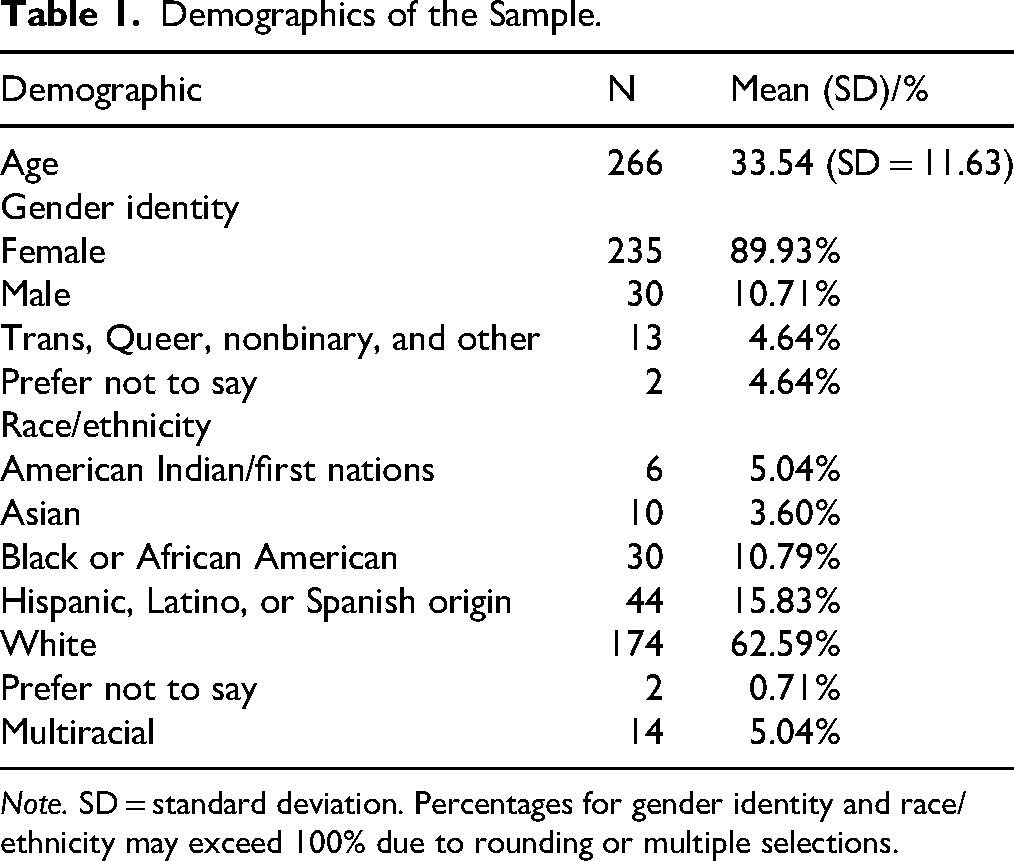
Note. SD = standard deviation. Percentages for gender identity and race/ethnicity may exceed 100% due to rounding or multiple selections.
Confirmatory Factor Analysis
Confirmatory factor analysis (CFA) was employed to verify if the empirical findings from the original CFA of the ZEF scale could be replicated. The theoretical framework for this analysis was based on previous empirical findings from the original CFA of the ZEF scale. The total number of cases analyzed was 298, which is considered acceptable for CFA (Kline, 2011). Goodness-of-fit indices included the model chi-square, the Comparative Fit Index (CFI; Bentler, 1990; Claiborne et al., 2014), the Tucker–Lewis Index (TLI; Tucker & Lewis, 1973), and the root mean square error of approximation (RMSEA; Browne & Cudeck, 1992).
The probability of obtaining a Type I error in chi-square decreases as sample size increases; large samples of 200 or more are more likely to be significant, while small samples are more likely to lead to incorrectly accepting a model (Type II error). As a result, evaluation of additional fit statistics is warranted. CFI and TLI values above 0.95 suggest an acceptable model fit (Byrne, 2010; Hu & Bentler, 1995; Hu & Bentler, 1999). RMSEA values between 0.05 and 0.10 are considered acceptable. Models with values above 0.10 represent a poor fit. For the RMSEA, it is recommended that the 90% confidence interval's lower bound be no greater than 0.05 and its upper bound no greater than 0.10 (Kline, 2011).
The CFA was conducted with STATA 19.5 using maximum likelihood of missing values as an estimator to determine the best-fitting model (StataCorp, 2025). The maximum likelihood with missing values functions for each individual case, maximizing efficiency, reducing bias, and retaining statistical power (Cham et al., 2017). While the items in the CFA were tested for multivariate normality and not met, this assumption of multivariate normality is not uncommon (Cain et al., 2017; Micceri, 1989). The original ZEF model demonstrated a satisfactory fit, with an RMSEA of 0.86 and TLI and CFI values below .95. The revised model maintained all five factors, resulting in a chi-square statistic of 189.48 (degrees of freedom = 67; p < .01). Conversely, the revised model had a slightly higher RMSEA of 0.089 (95% confidence interval = 0.074–0.104). Additionally, the CFI was 0.96 and the TLI was 0.95. Table 2 displays the factors and the corresponding items for the study model compared to the original one. Table 3 displays the goodness-of-fit results from the CFAs. The model was respecified, and it can be done if the following criteria are met: theoretical soundness, a good fit to the data, and a reasonably parsimonious model (Auerbach et al., 2013; Claiborne et al., 2014; Joreskog, 1993; Kline, 2011, p. 8).
Standardized Estimates for Exogenous Covariates on Latent Variables by Group.
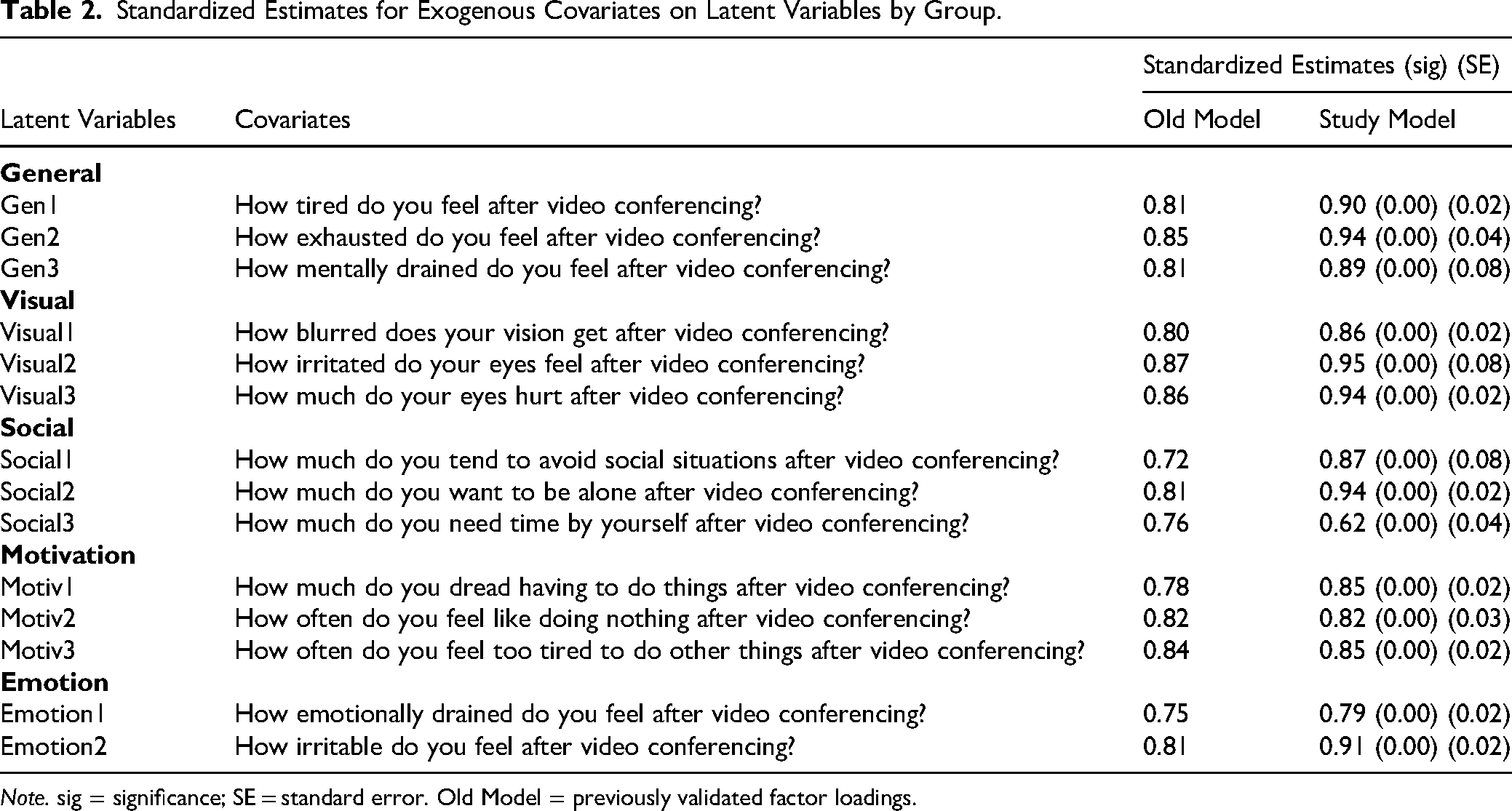
Note. sig = significance; SE = standard error. Old Model = previously validated factor loadings.
Summary of CFA Fit Statistics.
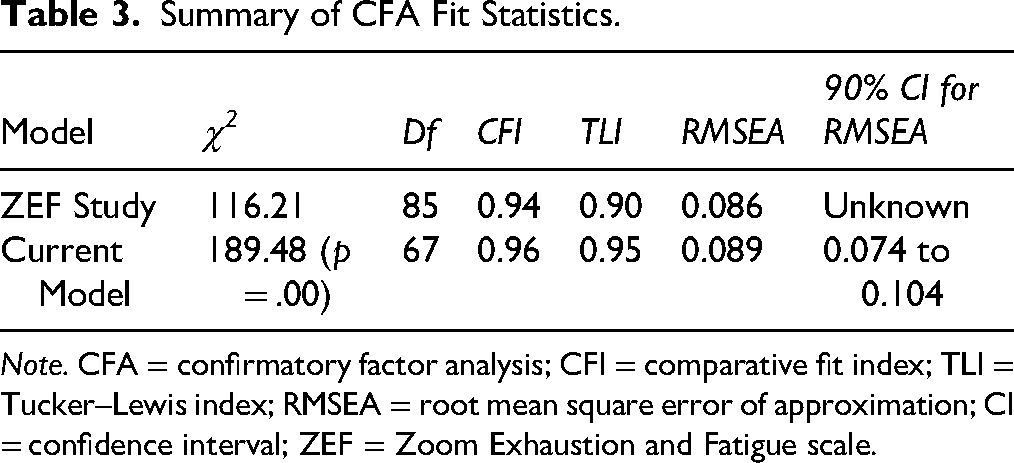
Note. CFA = confirmatory factor analysis; CFI = comparative fit index; TLI = Tucker–Lewis index; RMSEA = root mean square error of approximation; CI = confidence interval; ZEF = Zoom Exhaustion and Fatigue scale.
The model was respecified using model indices which estimates the reduction in chi-square if a parameter is added. In this case, the error terms for motiv2 and motiv3 (see Table 3 for variable descriptions) were correlated. It is suggested that a parameter should only be added if it produces a substantial reduction in the chi-square and is theoretically justified (Acock, 2013, p. 27). The rationale behind adding the parameter to the model is the assumption that feeling excessively tired is strongly associated with a desire to decrease activity. The correlation between the error variances was .49. Finally, one item was removed, “How moody do you feel after videoconferencing?” The item was removed since removing it reduced the chi-square value, and the term “moody” is vague and unclear.
Validity
Content validity is established by demonstrating both convergent and discriminant validity (Rubin & Babbie, 2011). Convergent validity is a measure of the degree to which items on a scale correlate with one another (Rubin & Babbie, 2011). In CFA, this can be assessed by examining factor loadings. High factor loadings (≥0.50) indicate convergent validity (Auerbach & Beckerman, 2011; Kline, 2011). The standard errors were small, ranging from 0.01 to 0.04, reflecting the stability of the factors. Discriminant validity examines the independence of constructs from one another. In CFA, this involves examining the relationships among latent concepts, which are established by correlations between these factors ideally of less than 0.85 (Brown, 2015). A correlation of .90 between latent factors has also been suggested as a cutoff for accepting discriminant validity (Gold et al., 2001; Henseler et al., 2015; Teo et al., 2008). One correlation was above the .85 threshold: the correlation between social and motivation was .86.
Reliability
Chronbach's α, the most common test for internal consistency, was utilized. Though there are no absolute standards on how high a coefficient should be to consider a scale reliable, the following cutoff values were used: α ≥ .90 is considered excellent, α ≥ .80 considered very good, and α ≥ .70 considered adequate (Kline, 2011). The Chronbach's α coefficients for the respecified model were in the very good to excellent range. The coefficients are as follows: general α = .94; visual α = .94; social α = .85; motivational α = .91; and emotional α = .86. Figure 1 displays the confirmatory factor analysis.
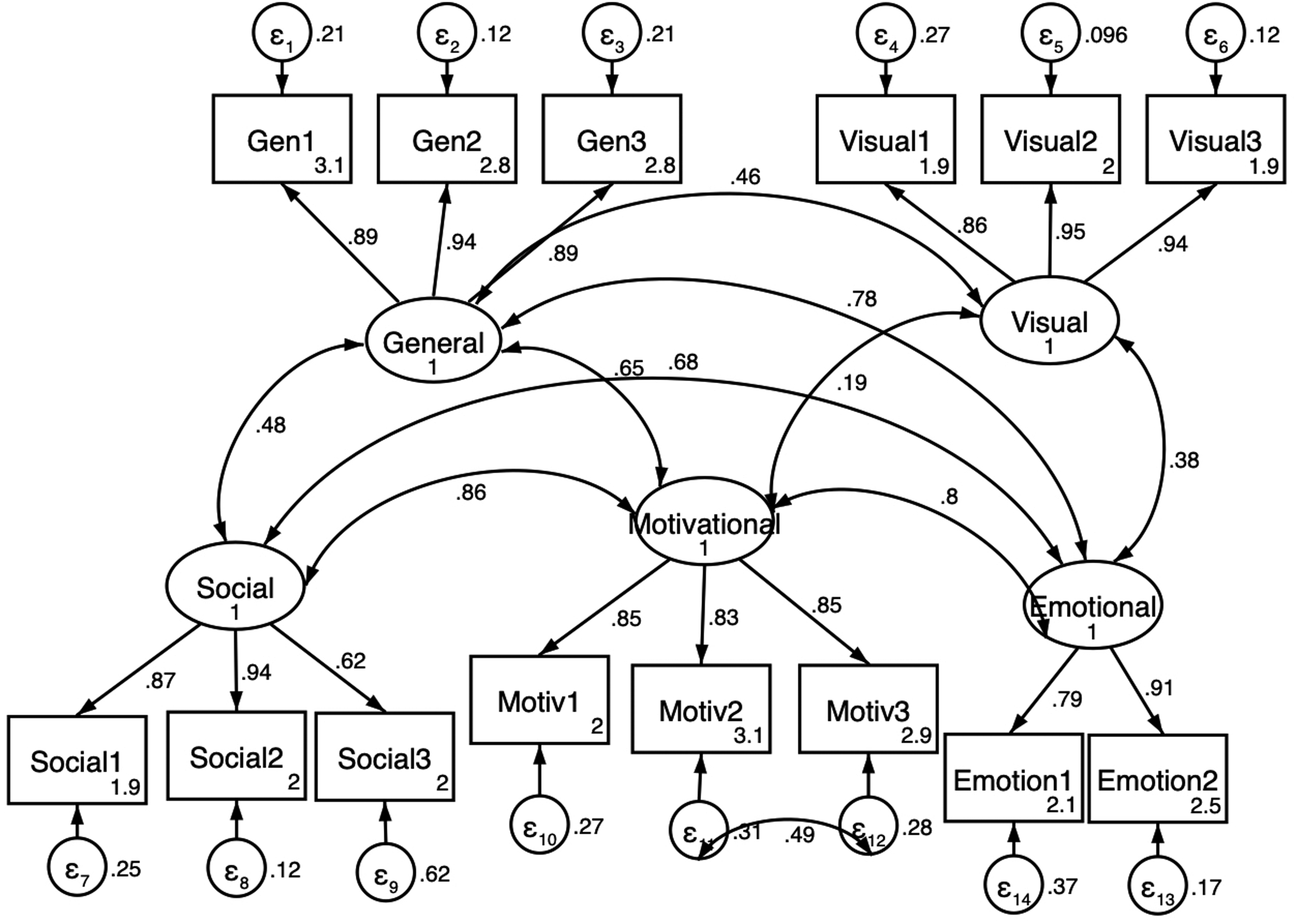
Confirmatory factor analysis.
Discussion and Applications to Practice
The purpose of this study was to test the reliability and validity of the ZEF scale among social work students. Social work students were included in this study to gain further understanding of the ZEF's psychometric properties within this population. Similar in content to the scale developed by Fauville et al. (2021), which demonstrated high reliability and validity. The findings from this study support the convergent and discriminant validity of the ZEF scale among social work students. The study's results are comparable to those of the original study, though the CFI improved from 0.94 to 0.96, and the TLI improved from 0.90 to 0.95, indicating better fit in these statistics. However, the RMSEA increased slightly from 0.086 to 0.089. The results indicate that the scale maintains its reliability, and the final model consists of 14 items that assess five dimensions of fatigue.
The ZEF scale is a valuable contribution to the social work literature. Given the dearth of literature related to videoconferencing fatigue among social workers, the study's results suggest that the instrument can be used to measure videoconferencing fatigue among social work students, allowing the social work profession and academic institutions to respond reflexively. Given that videoconferencing plays a significant role in social work education, this instrument can further assess videoconferencing fatigue among social work students, providing insights that enable academic institutions to develop potential interventions to enhance learning (Basch et al., 2025).
Considering that videoconferencing fatigue can impact social work students’ learning, the instrument serves as an opportunity to prepare academic instructors and institutions for further training on combating videoconferencing fatigue. As the social work profession has a continued desire to combat and prevent technology-related fatigue (Hilty et al., 2023), this instrument serves as a vehicle for implementing training and best practices to ameliorate videoconferencing fatigue. This valid and reliable instrument can guide the development of training content. Graduate social work programs can evaluate social work students’ levels of fatigue during their social work education and may wish to create training opportunities for faculty to address student fatigue. Preventative measures may be implemented; academic instructors are encouraged to adapt their andragogy for online education, given the challenges of fatigue (Heinsch et al., 2025).
Findings from the use of this instrument can be useful in informing pedagogical practices for instructors for videoconferencing as a teaching tool. Adapting teaching practices, such as implementing nonmandatory practices for turning on video cameras, enhancing the relationship between instructors and students, and implementing a distraction-free environment, is vital (Li & Yee, 2024). Instructors can use this instrument to adapt the class environment to combat VF by utilizing previously identified outlined techniques (e.g., Webb, 2021).
Although our study has several strengths, it also has several limitations worth noting. First, although the instrument was administered to graduate-level social work students, their year in the social work program was not captured. The length of time in the social work program may influence the study's results. Second, although the majority of the sample is female and White, which is representative of the social work profession (Bureau of Labor Statistics, 2025), the psychometric properties may vary for those with different demographic characteristics. Third, the psychometric properties were not tested among licensed social workers, a limitation of the study. Lastly, the study used convenience and snowball sampling methods, which can inherently introduce selection bias. The lack of random selection in the sampling method means that generalizations cannot be made about its representation of the entire population of social work students. Despite the limitations, this study provides evidence to support the use of this instrument among social work students to measure VF.
Future research should reassess the psychometric properties of the ZEF tool using a random sampling to generalize its applicability to the broader social work population. Additionally, further research should be conducted to evaluate the concurrent and criterion validity of the ZEF. For instance, it would be beneficial to investigate the correlation between the ZEF and burnout scales. Furthermore, the ZEF should be assessed for its predictive ability in relation to worker attrition and job satisfaction. Future research should utilize this instrument to determine its effectiveness in assisting social workers and students in preventing burnout and fatigue.
Further implications of this study provide strong support for further measurement and assessment of fatigue levels to inform micro, mezzo, and macro interventions. These study findings have implications for other health and mental health impacts among social workers. As VF can be taxing on social workers’ health, we must assess how it impacts their work productivity in providing services (Elbogen et al., 2022). This study and the use of the CFA can serve as a model for social workers across various work settings, helping them better prepare to cope with VF. With coping skills and other supports in place, social workers and students can be better equipped to provide high-quality services to their clients. Since the tool has demonstrated validity and reliability, we hope it can be used to create preventive and training content with practical implications for social work practice.
Footnotes

Funding
The authors received no financial support for the research, authorship, and/or publication of this article.
Declaration of Conflicting Interests
The authors declared no potential conflicts of interest with respect to the research, authorship, and/or publication of this article.