







Abstract
Purpose
Service learning (SL) is a recognized experiential pedagogy that offers reciprocal benefits, yet most research focuses on service providers. This study examined the benefits for disadvantaged children who were service recipients in an SL course.
Methods
We used a single-group pretest–posttest design and a matched sample of 216 Grade 3 students (49.54% girls, mean age = 9.34 ± 0.62 years).
Results
Repeated-measures multivariate analyses of variance revealed significant improvements in academic development (F = 20.92, p < .001,
Conclusions
These findings support SL's effectiveness in promoting positive development among disadvantaged children, highlighting SL as a promising strategy for enhancing children's holistic development.
Children from disadvantaged backgrounds face multidimensional challenges that extend beyond material deprivation. In the context of China's rapid urbanization, migrant and left-behind children, especially those from rural migrant worker families, encounter unstable living conditions due to parental work mobility, insufficient family educational support, and psychosocial difficulties such as adaptation difficulties, marginalization, low levels of self-identity, diminished self-efficacy, loneliness, and other behavioral and mental health issues (Wang et al., 2020; Xiong et al., 2021; Zhou et al., 2019). According to recent statistics, China's migrant child population had risen to approximately 71 million by 2020 (UNICEF, 2023). These intersecting vulnerabilities highlight urgent needs for effective intervention.
Ideally, a well-developed social welfare and service system would effectively meet the multifaceted needs of disadvantaged children. In many Western countries (e.g., the UK and the USA), professional social workers play a central role in addressing these children's needs. They assess the needs of children and their families and develop targeted intervention programs (Healy, 2019). This professional social work route emphasizes evidence-based and collaborative approaches, often involving long-term follow-up with service recipients. Western countries, such as the USA and New Zealand, have integrated child welfare within broader social welfare frameworks, linking family support with housing, health, and employment services (Welbourne & Dixon, 2015).
However, such a model relies on professional social work and well-developed welfare systems, which typically require substantial financial investment, an adequate supply of trained professionals, and well-established cross-sectoral networks (Midgley, 2017). These requirements pose considerable challenges for countries where social work professionalization and institutionalization are still developing. In China, for example, despite rapid progress in social work education and professional development in recent years, the ratio of professional social workers to migrant children remains low. As a result, many migrant children are not effectively reached by conventional social services. Therefore, it is imperative to develop complementary strategies. Such strategies should be cost-effective and capable of engaging more stakeholders in service delivery, expanding service coverage, and responding to the evolving needs of disadvantaged children. Service learning (SL), as both a pedagogy and a practice that integrates university students’ academic learning with structured community service, mobilizes educational resources to support disadvantaged populations, thereby offering a valuable complement to professional social work and extending its reach.
SL as a Promising Strategy and Its Dual Beneficiaries
SL is “a type of experiential learning which provides an opportunity for learners to enhance their understanding of concepts and theories in a practical environment” (Salam et al., 2019, p. 573). A prevailing scholarly consensus holds that “reciprocity” lies at the heart of SL (Khiatani & Liu, 2019; Maddox & Trost, 2024). As noted by Kendall, “Reciprocity is the exchange of both giving and receiving between the ‘server’ and the person or group ‘being served.’ All parties in service learning are learners and help determine what is to be learned.” (Kendall, 1990, pp. 21–22). This principle of reciprocity distinguishes SL from conventional community service or volunteerism, as it rejects the paternalistic, unidirectional assistance typical of traditional models (Kendall, 1991). Instead, SL emphasizes co-learning and shared empowerment, ensuring all stakeholders contribute to and benefit from the exchange.
Practically, SL underscores a bidirectional transformation. For service providers (e.g., university students), SL offers opportunities to apply academic concepts and disciplinary knowledge to real-world contexts, such as community services, where they observe various facilitating and hindering factors of service implementation, and practical experiences are refined through continuous structured reflection, thereby generating new theoretical insights, developing practical skills, and gaining personal growth (Stefaniak, 2020; Voss et al., 2015). Empirically, substantial research on SL courses or programs across regions (e.g., the United States, Spain, Korea, Singapore, and China) consistently revealed that the SL pedagogical approach enhanced university students’ various competencies (e.g., communication, problem-solving), knowledge application, leadership qualities, social responsibility, and well-being (Choi et al., 2023; Davis et al., 2021; Salam et al., 2019; Sotelino-Losada et al., 2021; Zhu, Tang, et al., 2026; Zhu et al., 2023). Such development of competencies and personal growth holds considerable potential to equip them to take action in complex environments (Aramburuzabala & Cerrillo, 2023; Huda et al., 2018). Consequently, SL is recognized as an exemplary pedagogical strategy in higher education that fosters students’ understanding of contemporary societal complexities and develops competencies that meet society's long-term sustainability needs (Sotelino-Losada et al., 2021).
On the other hand, from the perspective of communities, meaningful SL participation allows them not only to access external resources and professional expertise but also to become empowered to address their local challenges collaboratively (Lillo, 2019). Community organization administrators recognized that SL initiatives expanded organizational support networks, increased access to valuable resources, and infused new energy into community operations (Geller et al., 2014). Studies collecting feedback from community members suggested that SL participation helped reduce preexisting biases, deepen understanding of social issues, and identify potential solutions to community challenges (d’Arlach et al., 2009; Vizenor et al., 2017). These recipient perspectives support the positive impact of effective SL programs on encouraging in-depth reflection on shared experiences and fostering a bidirectional transformation of knowledge between campuses and communities.
More significantly, SL's bidirectional capacity-building framework holds particular promise for addressing the needs of underprivileged children. These children are at a critical developmental stage where foundational academic attitudes, social-emotional skills, and self-perceptions are being shaped. However, due to socioeconomic disadvantage, including but not limited to insufficient family educational support and unstable living conditions, they often face multiple challenges such as diminished self-efficacy, low learning motivation, weak interpersonal skills, and elevated levels of depression and anxiety (Hofer et al., 2024; Jones Harden & Slopen, 2022; Rakesh et al., 2024). These intersecting psychosocial difficulties can derail long-term positive development. Through university-community partnerships, SL mobilizes university students as a vibrant pool of human resources to provide psychosocial support, academic enrichment, and life skills training for underprivileged children. In the short term, such supportive activities may enhance children's interest in learning and academic self-efficacy (Eppler et al., 2011). Over the longer term, the core psychosocial competencies intentionally cultivated through SL initiatives, such as resilience, effective communication, and self-determination, may support the development of essential adaptive capacities that disadvantaged children often lack opportunities to build due to limited access to enrichment resources. These competencies constitute critical developmental assets that could equip disadvantaged children to navigate future adversities and sustain positive developmental trajectories (Benson et al., 2011). Furthermore, such targeted support may buffer against the cumulative stressors associated with socioeconomic disadvantage, thereby promoting well-being and reducing mental health risks.
It should also be noted that SL's reciprocity principle suggests that school-age children, as service recipients, experience meaningful benefits through participation in SL initiatives. A handful of studies identified the benefits of SL programs for children and adolescents. For example, primary school students from middle- and upper-income families demonstrated greater empathy, enhanced civic awareness, and a stronger tendency toward community participation after SL participation (Scott & Graham, 2015). Elementary school students from low-income families in rural America demonstrated improved academic adaptability and sustained engagement in learning after participating in SL (Eppler et al., 2011). Similarly, after attending SL programs, adolescents from Mongolia (Su & Chi, 2016) and southwestern China (Ma & Cheung, 2018), who had limited access to English-language educational resources, demonstrated increased interest in learning English, greater confidence in speaking English, and measurable improvement in study performance. In Hong Kong, a study found that more than 90% of 1,854 secondary school students reported that participation in SL increased their interest in learning and self-confidence (Shek et al., 2020).
Moreover, SL's dual-empowerment approach indicates its potential not only as an innovative pedagogy but also as an effective strategy to support vulnerable populations and supplement social services. By integrating university students into service initiatives for disadvantaged children, SL creates opportunities for mutual growth. Specifically, university students gain practical experience and develop civic responsibility, while children receive otherwise unavailable developmental resources. In this sense, SL may serve as an important complement to traditional social work interventions. Therefore, it can be argued that SL's inherent reciprocity aligns with the core principles of Education for Sustainable Development. SL aims to bridge global goals with local practices through experiential learning and place-based action, thereby narrowing the gap between policy aspirations and grassroots implementation.
Despite empirical findings supporting the mutual benefits of SL for both parties, some scholars raise concerns (Khiatani & Liu, 2019) due to insufficient evidence on the extent of service recipients’ benefits from SL. Compared with extensive research on how SL benefits service providers (e.g., university students), far less attention has been paid to service recipients. Most of the existing literature acknowledges reciprocity as a theoretical cornerstone of SL, yet empirical evidence from service recipients’ perspectives remains insufficient. For example, some SL programs have been specifically designed for underprivileged children. However, their focus remains on providing university students with real-world social issues to cultivate their social responsibility (Habib, 2021; Tien et al., 2023). Indeed, these SL initiatives have been shown to enhance university students’ civic awareness and increase their awareness of community service (Habib, 2021; Tien et al., 2023), but the perspectives of underprivileged children who attended these programs remain relatively underrepresented. This imbalance not only obscures the actual dynamics of bidirectional empowerment in SL practice but may also lead to misjudgments regarding the social efficacy of such programs. In essence, as mentioned earlier, the potential benefits of SL for underprivileged children, coupled with its inherent reciprocity, may serve as a supplementary mechanism to address systemic shortcomings in China's social policy. As such, whether service recipients, particularly underprivileged children in China, derive meaningful benefits is a critical indicator of an SL program's effectiveness and warrants further investigation.
Benefits of Service-Learning for Chinese Underprivileged Children
China's household registration (hukou) system ties access to public resources, including education, to one's registered place of origin. Consequently, migrant children, lacking local hukou, have historically often been excluded from local resource allocation systems (Wang, 2008; Zhang et al., 2018). Urban public schools prioritize enrollment for local hukou holders, while migrant children face stringent documentation requirements (e.g., parental social security proof, residency permits) and bureaucratic hurdles, which constitute structural barriers that disproportionately affect highly mobile worker families. Many migrant children are consequently funneled into under-resourced private schools with uneven educational quality (Wang, 2008). While policy efforts have sought to address these inequities, gaps persist in areas such as mental health services, extracurricular opportunities, and social integration support (Wang, 2025; Zhao, 2025). To address this pressing social challenge, SL offers a promising approach to deliver multifaceted benefits to this vulnerable group and mitigate these inequities through university-community partnerships. University students engaged in SL apply theoretical knowledge and professional expertise to design targeted interventions (e.g., tailored curricula), while participating children gain academic and social support and develop intrapersonal and interpersonal skills, thereby fostering psychological resilience. This dual empowerment approach thus addresses immediate educational needs while building long-term psychosocial capacities that support positive development.
Several empirical studies provide preliminary evidence that SL participation can enhance psychological well-being and foster positive developmental outcomes among underprivileged children and adolescents in China. For instance, scholars observed that elementary school children from migrant households showed increased confidence, improved interpersonal skills, and a clearer sense of life purpose after participating in SL programs (Yu et al., 2019). Similarly, previous research demonstrated that an SL-based curriculum significantly improved academic performance and psychological well-being among primary school students from migrant families in the Chinese mainland (Li et al., 2023). In addition, impoverished Yi ethnic minority adolescents reported that SL activities strengthened their psychological resilience in the face of adversity, boosted self-confidence, and cultivated a more optimistic outlook for the future (Zhou et al., 2022). These valuable findings suggest the potential benefits of short-term SL programs for underprivileged youth in China. By activating the intrinsic agency of these young individuals, SL may help cultivate their psychosocial competencies, enabling a transformative shift from passive recipients of aid to proactive agents of change (Taylor, 2008).
Research Gaps
First, despite several studies focusing on the gains of service recipients from SL programs, far fewer studies have examined outcomes for service recipients compared with those for service providers (e.g., university students). Moreover, existing studies have primarily explored service recipients’ learning interests in specific subjects (e.g., Ma & Cheung, 2018) and psychological well-being (Li et al., 2023; Zhou et al., 2022). Notably absent from the literature are comprehensive assessments that simultaneously examine how underprivileged children benefit from SL across multiple interrelated domains, including academic self-efficacy, psychological resilience, interpersonal skills, social behavior, and mental health. This multi-domain focus is essential because these developmental assets are frequently compromised among disadvantaged children (Hu et al., 2014; Huang et al., 2021). Additionally, these dimensions do not operate in isolation but rather are inherently interconnected. For instance, low academic self-efficacy may co-occur with diminished resilience, while deficits in social competence can heighten the risk of both internalizing and externalizing behavior problems (Ray et al., 2020). Self-efficacy and social competence have been shown to mediate socioeconomic inequalities in emotional symptoms among school-age children (Meilstrup et al., 2019), and social-emotional skills and academic performance are bidirectionally related among disadvantaged children (Huang & Zeng, 2023). Children with negative self-perceptions (e.g., low resilience) and weak social competence often demonstrate more withdrawal, aggressive behavior, and psychological difficulties, and poor mental health can further undermine academic engagement (Hofer et al., 2024; Jones Harden & Slopen, 2022). A holistic assessment across these domains is therefore necessary to capture a comprehensive picture of SL benefits and determine whether SL can serve as an effective approach to promote positive development in this vulnerable population.
Second, few studies have investigated gender differences in the benefits of SL programs for recipients despite the importance of such analysis in current mental health research. Some studies have shown that migrant boys demonstrated greater improvements in academic performance and life satisfaction than girls (Li et al., 2023), while others have reported that Chinese female adolescents in Hong Kong benefited more from a positive youth development (PYD) intervention than their male counterparts (Shek & Zhu, 2020). However, the generalizability of these findings remains uncertain, as many SL studies have not explicitly tested for gender effects. Thus, there is a great need for further research on gender differences (Zhou et al., 2022).
The Current Study
This study aimed to address the aforementioned gaps by examining changes in outcomes among underprivileged Chinese primary school students from a suburban area who are migrant children, as service recipients after participating in an SL course, and testing whether these changes vary by gender. By focusing on service recipients, this study provided direct empirical evidence regarding the underexamined reciprocity principle of SL. Furthermore, the study contributes to the limited literature on gender differences in SL outcomes by explicitly testing whether boys and girls benefit similarly from SL participation.
To examine SL's impact on these disadvantaged children, the study systematically assessed four interrelated domains, including academic development, PYD qualities, well-being, and mental health risks, within a single investigation. Each domain was operationalized through multiple indicators. Specifically, academic development was indicated by learning interest, knowledge acquisition, and academic self-efficacy. PYD qualities encompassed core developmental assets and psychosocial competencies, including social competence, emotional competence, resilience, and self-identity, which are frequently compromised in disadvantaged children. Well-being was measured through life satisfaction and meaning in life, and mental health issues were assessed through depression, anxiety, and stress.
To achieve the above purposes, the study employed a single-group pretest–posttest design to compare multiple outcome indicators before and after these children's participation in this SL course. Given that existing findings on gender differences in SL outcomes are inconsistent (Li et al., 2023; Shek & Zhu, 2020) and remain limited, we did not specify directional hypotheses regarding gender effects. Based on preliminary evidence from prior studies that SL participation enhanced academic motivation (e.g., Eppler et al., 2011; Ma & Cheung, 2018), strengthened competencies (e.g., Zhou et al., 2022), improved well-being (e.g., Shek et al., 2020), and alleviated mental health difficulties (e.g., Li et al., 2023) among children and adolescents, we proposed the following four primary hypotheses, each corresponding to one of the four outcome categories:
Method
Research Context
The present study was embedded within an SL course entitled “Service Leadership through Serving Children and Families with Special Needs, Xi’an,” offered at The Hong Kong Polytechnic University during the 2023–2024 academic year. This course was a 3-credit undergraduate course that required university students to complete a 135-h structured learning process comprising various components prior to their direct service with children. Specifically, the course included three 3-h lectures that introduced theoretical knowledge of SL. Students also completed 10 h of online self-study modules on SL concepts to deepen their understanding. In addition, they attended six 3-h small-group workshops (20–22 students per group) focused on developing service skills, covering topics such as understanding the needs of underprivileged children and adolescents, communication, teaching, and classroom management. They were required to design service proposals during these workshops and engaged in mock teaching to refine their instructional plans. They also engaged in self-study and structured reflection after classes to consolidate their learning.
Upon completing the lectures and workshops, these university students applied their knowledge and skills in a real-world service setting. Specifically, they implemented their service proposals during a four-day summer camp held from late June to early July 2024. The service recipients were underserved children from a local primary school in a suburban area of Xi’an, China, specifically migrant children who relocated with their parents from remote areas in pursuit of better employment opportunities. This vulnerable group is more susceptible to mental health issues and behavioral problems compared to their urban counterparts (Hu et al., 2014; Zhang et al., 2019). Additionally, migrant children exhibited significantly lower levels of academic emotions and self-concept (Huang et al., 2021).
During the summer camp, university students worked in groups of five to six, with each group assigned to lead one class of 20–25 children. To support these children, the service curriculum comprised four subjects: daily-life English, interesting science, health, and personal development. These subjects were selected to foster the holistic development of underprivileged children by enhancing their learning interests, interpersonal skills, and well-being (Li et al., 2023), while also helping fill gaps in educational resources that these children often experience. Each subject was taught for at least two lessons, and each group of university students delivered a total of 12 lessons to their assigned class over the four days of the camp. In addition to classroom instruction, opening and closing ceremonies were held at the camp to give children opportunities to perform on stage and celebrate their achievements, thereby fostering a sense of accomplishment and belonging.
Regarding instructional methods, the summer camp course emphasized interactive lessons that incorporated experiential, cooperative, and reflective learning as core pedagogical strategies. Rather than following a standardized curriculum, university student groups designed their own teaching content and activities tailored to the specific developmental needs of the children in their classes, based on their understanding gained through the lectures and workshops. A variety of child-centered teaching methods were adopted across the four subjects. For instance, daily-life English lessons employed situational dialogues, songs, and interactive games to spark children's interest in language learning and build confidence in speaking English. Interesting science lessons featured simple hands-on experiments and group activities designed to cultivate curiosity and scientific thinking. The health curriculum used storytelling, visual aids (e.g., pictures, videos), group discussions, and practice to convey knowledge about personal hygiene, nutrition, and healthy lifestyle habits in an engaging manner. The personal development curriculum integrated role-playing scenarios, collaborative problem-solving tasks, and guided reflection exercises to strengthen psychosocial competencies, including emotion regulation, communication, and interpersonal skills.
Participants and Procedures
Inclusion Criteria
Participants were Grade 3 students from a local primary school in a suburban area of Xi’an, China, who attended the four-day SL summer camp in 2024. All enrolled students were eligible to participate.
Participant Flow and Final Sample
A total of 289 Grade 3 students were assigned by the school to 12 summer camp classes, with 20–25 children in each class. Among the 289 children, 248 (85.81%) completed the pretest questionnaire administered one week before the summer camp, and 257 (88.93%) completed the posttest at the end of the camp. Children who did not complete both questionnaires or whose pretest and posttest responses could not be matched due to missing or invalid identification codes were excluded from the analysis. No other exclusion criteria were applied. Consequently, this yielded a matched sample of 216 children, which was included in the final data analysis.
Data Collection Procedures
The pretest questionnaire was administered one week before the summer camp, and the posttest was administered at the end of the camp. At both time points, the questionnaire was administered in the classroom under the guidance of trained school teachers (pretest) or postgraduates recruited from a local university, who elaborated on the instructions and provided clarification when necessary to ensure children's comprehension of the items.
Measure
The instruments used in this study are as follows. All of these tools demonstrated satisfactory internal consistency in this study (Cronbach's αs ≥ 0.62 for all scales at pretest and αs ≥ 0.66 at posttest). Detailed reliability data, including Cronbach's α and inter-item correlations for each scale at both time points, are available from the corresponding author upon request.
Academic Development
Three components were used to assess academic development: learning interest, knowledge acquisition, and academic self-efficacy. The first two components were measured using a scale that has been validated and shown good psychometric properties among Chinese children and adolescents (Li et al., 2023), comprising five items measuring learning interest (e.g., “I am interested in learning”) and five items on knowledge acquisition (e.g., “I gained much knowledge”). A six-point Likert scale (1 = strongly disagree; 6 = strongly agree) was used for all items. Prior research on Chinese primary school students reported good internal consistency for both the subscales (Cronbach's αs ranged from 0.82 to 0.94 across pretest and posttest; Li et al., 2023). The third component, academic self-efficacy, was measured using a 10-item scale (e.g., “I believe in my ability to do well in my studies”) that has been validated among Chinese children and adolescents (Ding, 2022; Wei et al., 2014). The scale utilized a five-point Likert scale (1 = strongly disagree; 5 = strongly agree). A past study with Chinese primary school students reported strong reliability of this scale (Cronbach's α = 0.92; Wei et al., 2014).
PYD Qualities
The Chinese Youth Positive Development Scale (Shek et al., 2007), which has been validated among Chinese children and adolescents (Li et al., 2023; Shek et al., 2022; Zhou et al., 2020), was used to measure PYD qualities in the present study. The study utilized 11 subscales, each comprising three items: social competence (e.g., “I know how to communicate with people”), emotional competence (e.g., “I can express my emotions appropriately when I am upset”), cognitive competence (e.g., “I know how to look at things from different angles”), behavioral competence (e.g., “I can deal with criticism with an open mind”), moral competence (e.g., “I have high ethical standards for my behavior”), resilience (e.g., “I do not give up easily when faced with difficulties”), bonding (e.g., “When I need help, I am sure my teachers will help me”), prosocial norms (e.g., “I care about people in society who have suffered misfortune”), self-determination (e.g., “I have confidence over my own decisions”), clear and positive identity (e.g., “I am a confident person”), and belief in the future (e.g., “I have the confidence to solve my future problems”). A 6-point Likert scale (1 = strongly disagree; 6 = strongly agree) was used for all items. In a prior study with Chinese primary school students, the subscales also demonstrated good reliability (Cronbach's αs ranged from 0.77 to 0.91 across pretest and posttest; Li et al., 2023).
Well-Being
Well-being was indicated by life satisfaction and meaning in life, measured using the Chinese version of the 5-item Satisfaction with Life scale (e.g., “In most ways, my life is close to my ideal”) and the 5-item Presence of Meaning subscale of the “Meaning in Life Questionnaire” (e.g., “My life has a clear sense of purpose”), respectively (Lin et al., 2021; Zhou et al., 2024; Zhu et al., 2022; Zhu et al., 2023). All ten items were rated on a six-point Likert scale (1 = strongly disagree; 6 = strongly agree). Previous research using these two scales in Chinese child and adolescent samples has reported good internal consistency for both measures (Cronbach's αs were 0.85 and 0.88, respectively; Lin et al., 2021; Zhou et al., 2024).
Mental Health Issues
For the category of mental health issues, depression, anxiety, and stress were measured using the three subscales in the Depression Anxiety and Stress Scale-21 (Lovibond & Lovibond, 1995). This scale has been adapted and validated among Chinese children and adolescents (Zhou et al., 2025; Zhu et al., 2026a). The participants indicated how often they experienced the symptoms listed in each subscale (depression: seven items, e.g., “I felt downhearted and blue”; anxiety: seven items, e.g., “I felt I was close to panic”; stress: seven items, e.g., “I found it difficult to relax”) over the past week on a four-point scale (0 = less than one day or none, 3 = 5–7 days for almost all the time). Prior research using this scale with Chinese adolescents has reported adequate reliability for all three subscales (Cronbach's αs ranged from 0.87 to 0.90; Zhou et al., 2025).
Research Analysis Plan
This study employed a single-group pretest–posttest design, and the data analysis plan was structured to draw inferences about changes over time using appropriate parametric tests. Only participants who completed both the pretest and posttest questionnaires with valid matching identification codes were included in the analyses (N = 216). No imputation procedures were applied for those lost to follow-up or unmatched (n = 73). Given that all participants were recruited from the same grade level (i.e., Grade 3), the sample could be considered highly homogeneous in age. Consequently, age was not included as a factor in subgroup or differential outcome analyses in the present study.
To examine changes among children across the four outcome categories (i.e., academic development, PYD qualities, well-being, and mental health issues) after the SL summer camp, the primary analysis relied on a series of repeated-measures general linear models (RM-GLMs) in SPSS 27.0 (IBM Corp., 2020). These models specifically tested the within-subjects effect of Time (pretest vs. posttest), the between-subjects effect of Gender (male vs. female), and their interaction (Time × Gender). Given that there were multiple indicators for each outcome category, the omnibus time effect for each category was first tested using multivariate analysis of variance (MANOVA), followed by univariate analyses for each indicator if the omnibus effect (i.e., pretest vs. posttest) was significant. This approach provides a robust inferential test of pre–post change that is more appropriate than simple t-tests for designs with multiple correlated outcome measures. For all RM-GLM analyses, partial eta squared (
Ethical Considerations
The study was reviewed and approved by the Institutional Review Board at The Hong Kong Polytechnic University (Reference number: HSEARS20230904006). Parental or guardian consent was obtained by the school prior to children's participation in both the summer camp and the evaluation study. At both pretest and posttest, children were informed that their participation was voluntary, that they had the right to withdraw at any time without penalty, and that the information they provided would be kept strictly confidential. All participants in the study provided written consent before responding to the questionnaire.
Results
Descriptive Statistics and Preliminary Analyses
Table 1 presents the means and standard deviations at pretest and posttest, the mean difference (MD) between posttest and pretest, and the percentage of participants whose scores changed in the expected direction for all outcome indicators, separately for boys and girls. The matched sample comprised 216 children (50.46% boys; mean age = 9.34, SD = 0.62, range = 8–10). For all positive outcome indicators (i.e., academic development, PYD qualities, and well-being), the MDs between pretest and posttest were positive (ranging from 0.11 to 0.49), with nearly half of the participants (ranging from 28.70% to 59.43% across indicators) showing higher posttest scores. For mental health issue indicators (i.e., depression, anxiety, and stress), the MDs were negative (ranging from −0.04 to −0.17), with about half of the participants (ranging from 31.43% to 57.58% across indicators) showing decreases from the pretest to the posttest.
Results of Repeated Measures Multivariate Analysis of Variance.
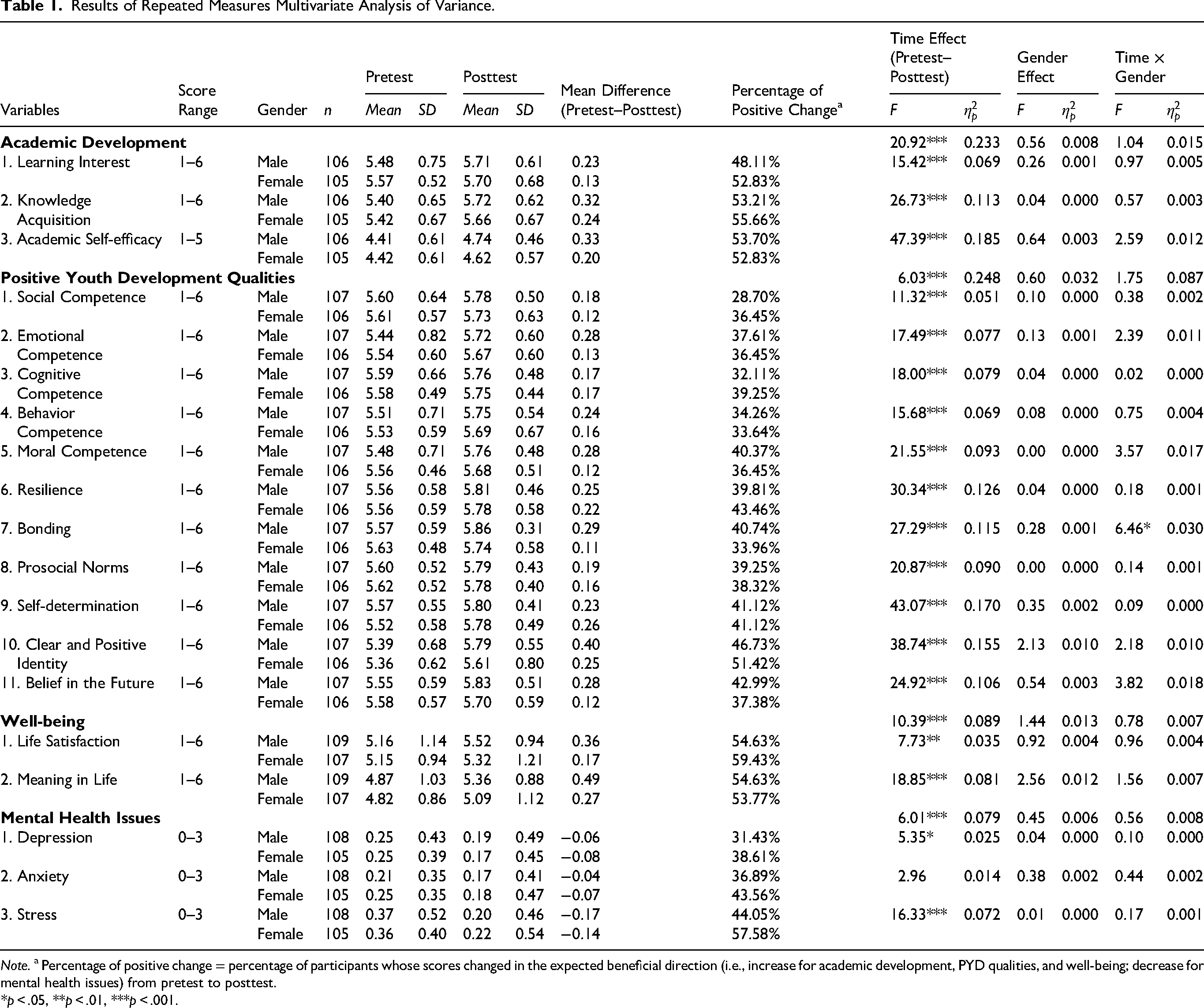
Note. a Percentage of positive change = percentage of participants whose scores changed in the expected beneficial direction (i.e., increase for academic development, PYD qualities, and well-being; decrease for mental health issues) from pretest to posttest.
*p < .05, **p < .01, ***p < .001.
Academic Development
Hypotheses 1a to 1c predicted that participants would demonstrate significant increases in learning interest, knowledge acquisition, and academic self-efficacy from pretest to posttest. As shown in Table 1, results of the repeated-measures MANOVA on the three indicators showed that the omnibus time effect for academic development was significant, F = 20.92, p < .001,
PYD Qualities
Hypothesis 2 predicted that participants would show significant improvements in PYD qualities from pretest to posttest. The repeated-measures MANOVA on all 11 PYD indicators revealed a significant omnibus time effect (F = 6.03, p < .001,
Well-Being
Hypotheses 3a and 3b predicted that participants would report significantly higher levels of life satisfaction and meaning in life at posttest compared to pretest. The repeated-measures MANOVA on the two indicators yielded a significant omnibus time effect, F = 10.39, p < .001,
Mental Health Issues
Hypotheses 4a to 4c predicted that participants would exhibit significant decreases in depression, anxiety, and stress from pretest to posttest. As shown in Table 1, the omnibus time effect for mental health issues was significant (F = 6.01, p < .001,
Gender Differences
The interaction effects between time and gender were examined for all outcome indicators to explore whether boys and girls showed differential patterns of change. The results of omnibus multivariate tests were organized in Table 1. For most indicators, the Time × Gender interaction was not significant, indicating that boys and girls benefited comparably from the SL summer camp. One exception emerged for bonding, showing a significant Time × Gender interaction (F = 6.46, p < .05,
Discussion
The full extent of SL's reciprocity remains an open question because fewer empirical studies have examined the benefits of SL programs for service recipients (Khiatani & Liu, 2019). Responding to scholars’ calls for more attention to the effectiveness of SL-related initiatives in promoting the development of underprivileged children and adolescents, this study addresses the notable research gap by investigating the effects of an SL course on migrant children from the Chinese mainland as service recipients. The present study employed a single-group pretest–posttest design and assessed changes across four interrelated outcome domains, including academic development, PYD qualities, well-being, and mental health issues, using a matched sample of 216 disadvantaged Grade 3 students. Overall, significant positive changes were observed among the participants following the SL summer camp across all outcome measures, including enhanced academic development, strengthened PYD attributes, increased well-being, and reduced mental health issues. Additionally, boys and girls showed comparable favorable changes.
Academic Development
One of the research objectives was to examine whether SL participation benefits children's academic development, specifically learning interest, knowledge acquisition, and academic self-efficacy. Due to restrictions imposed by China's household registration (hukou) system and limited familial educational support, Chinese migrant children face long-term structural challenges, including insufficient access to educational resources and weak academic foundations (Wang, 2008). To address this issue, the SL course allowed university students to design and deliver an enriched curriculum covering multiple subjects, such as English and science, to enhance migrant children's academic knowledge and mitigate their educational disparities. The present findings indicated positive changes in migrant children's interest in learning and perceived knowledge acquisition after participation in the SL course, consistent with prior research (Ma & Cheung, 2018; Shek et al., 2020). More critically, children also showed increased academic self-efficacy, which may strengthen their confidence in learning, promote more positive attributional styles, and foster a more proactive learning attitude, ultimately leading to better academic achievement (Schunk, 2023; Zimmerman & Moylan, 2009). The current positive findings suggest that SL initiatives have the potential to stimulate motivation to learn among disadvantaged children and adolescents. This may be attributed to intensive support and guidance in SL, which can empower these service recipients, fostering their resilience, self-efficacy, and goal-directed behavior (Benson et al., 2011; Masten, 2001), aligning with broader theories of empowerment (Rappaport, 1987).
PYD Qualities
In addition to academic development, service recipients also showed positive changes in PYD qualities, encompassing both intrapersonal and interpersonal competencies. During the summer camp, university students implemented carefully designed interactive activities, such as role-playing scenarios and group discussions, to teach children skills in multiple personal development domains, including emotional competence (e.g., emotion recognition and regulation), resilience (e.g., persistence in the face of difficulties), communication skills, perspective-taking, problem-solving, empathy, self-efficacy, goal-setting, and perseverance. These activities may help children recognize their strengths and value, build trusting relationships with peers and university students, and experience meaningful contributions, thereby cultivating a sense of achievement and fostering growth in generic skills (Benninger & Savahl, 2016; Wachs et al., 2020). For migrant children, improvements in these psychosocial competencies may yield long-term benefits by equipping them with the psychological resilience to navigate challenges. This bidirectional skill-building process presents the reciprocal nature of SL. While university students gain practical experience, these migrant children acquire critical life skills. This reflects how SL could build community capacity in ways that top-down social work interventions sometimes cannot.
Well-Being and Mental Health
Notable improvements were also observed in migrant children's well-being and mental health, with increases in life satisfaction and sense of meaning in life, and decreases in stress and depressive symptoms. These positive changes may be attributed to three possible mechanisms. First, children may have increased mental health literacy and awareness, as university students taught them essential knowledge about mental health, hygiene, and adaptive coping strategies (e.g., stress management and the expression of negative emotions). Enhanced understanding and practical skills may help children regulate their psychological states more effectively. Second, the summer camp employed small-class instruction with 5–6 university students managing and teaching 20–25 children. Such a class size was much smaller than children's regular school classes, fostering an intimate and supportive environment for interpersonal engagement. This structure may have fostered emotional security through consistent peer and mentor interactions and increased a sense of belonging and contribution, both of which are strongly linked to better mental health and well-being (DeWit et al., 2016; Jeanmougin et al., 2024). Third, the aforementioned improvements in intrapersonal competencies (e.g., emotion regulation, resilience, self-determination) and interpersonal skills (e.g., problem-solving, communication, and cooperation) likely contributed to more positive self-perception and greater engagement in meaningful activities (Durlak et al., 2011; Weissberg et al., 2015). As children develop these competencies, they may experience greater autonomy and empowerment in navigating challenges and completing tasks, reinforcing their sense of purpose and satisfaction. The non-significant change in anxiety warrants further investigation. It is possible that anxiety symptoms, which are often more context-dependent and sensitive to immediate environmental stressors, may require longer or more targeted intervention to produce measurable change.
Gender Differences
Previous research (Li et al., 2023) has shown that boys exhibited greater improvements than girls after SL participation in certain PYD qualities (e.g., prosocial norms and moral competence). Such a gender difference was interpreted as a more pronounced “catch-up effect” for boys than for girls in SL and other programs incorporating elements of social skill training and emotional support. Specifically, primary school boys may have a lower baseline level of development than their female peers in some socio-emotional skill domains; consequently, they are more likely to improve. In line with previous research (Li et al., 2023), this study observed a similar “catch-up effect” among boys regarding one particular PYD quality, that is, bonding. The significant interaction between time and gender for bonding indicated that boys, who reported slightly lower bonding at pretest, experienced greater gains in their sense of connectedness to others following the SL camp. However, the effect size for this interaction effect was small.
Nevertheless, the overall pattern of results indicates that boys and girls demonstrated comparable positive changes across all other domains (academic development, PYD qualities, mental health, and well-being). The small class size, with each university student supervising 4–5 children in the present SL program, may have enabled university students to provide sufficient attention and support for each child and address their unique needs more effectively. This may help mitigate gender-based disparities in engagement and performance by creating a more inclusive and supportive learning environment. As a result, both boys and girls benefited equally from the SL summer camp. Further research is needed to replicate and validate the present findings.
Theoretical and Practical Implications
This study carries several theoretical and practical implications. Theoretically, the present study provides empirical evidence of the multifaceted benefits of SL for disadvantaged community groups across academic, intrapersonal, interpersonal, and psychological domains. While previous research has predominantly focused on the benefits to service providers (e.g., university students), the present findings suggest that SL is a promising framework for empowering service recipients and promoting their holistic development. This reinforces SL's theoretical principle of reciprocity and provides much-needed evidence from the perspective of service recipients. More broadly, this study supports SL as an effective strategy for advancing the vision of social sustainability and sustainable educational development. By enhancing key developmental assets among migrant children, such as psychosocial competencies, academic self-confidence, interpersonal connectedness, mental health, and sense of meaning in life, SL may help mitigate the immediate challenges posed by structural social inequalities (e.g., the household registration system). It empowers vulnerable groups, including migrant children, with the capabilities and skills necessary to overcome the adversities they face. In the current Chinese context, which emphasizes educational equity, our findings provide theoretical support for integrating SL into broader educational and social policies. Furthermore, by positioning SL as a feasible supplement to professional social work, this study offers insight into how educational institutions could actively participate in the provision of social welfare, thereby expanding the toolkit available to policymakers and practitioners.
Practically, the current study demonstrates that even a short four-day summer camp can benefit disadvantaged children in multiple domains (e.g., academic self-efficacy, psychosocial skills, and well-being), all of which are essential for their long-term positive development. This suggests that even short-term educational programs, if theoretically and empirically grounded, clearly structured, and supported by active engagement from both providers and recipients, can yield immediate beneficial outcomes. Local educational institutions and social organizations could adopt similar short-term programs to support disadvantaged children, particularly in contexts where resources for long-term interventions are constrained. In addition, our results indicate that boys and girls benefited similarly from well-designed and well-organized SL activities. This finding encourages educators to prioritize creating inclusive and supportive learning environments when designing similar SL courses, ensuring that all children, regardless of gender, can fully engage with and benefit from the program. Regarding instructional and interaction modes, the present study suggests that a small class-size format (e.g., 5–6 university students guiding 20–25 children) may be effective in short-term educational programs. This format ensures individualized attention for each child and may be particularly suitable for contexts marked by uneven distribution of educational resources. It may serve as a useful model for the community-based rollout of SL programs.
Implications for Social Work Practice
Beyond the general practical implications outlined above, our findings carry specific implications for social work practice. First, this study provides empirical evidence supporting SL as a promising, viable, and cost-effective complementary strategy that social work practitioners could integrate into their service delivery models, particularly in contexts where professional social work resources are insufficient to meet the needs of vulnerable populations. By partnering with higher education institutions, social work agencies can mobilize university students as a supplementary workforce, thereby extending their reach to vulnerable children who might otherwise be underserved by conventional service systems.
Second, the multi-domain benefits observed in this study, echoing similar conclusions in prior research (e.g., Li et al., 2023; Zhu, Tang, et al., 2026), support the view that SL, as an effective instructional approach, could address the holistic needs of disadvantaged children. Rather than targeting a single problem area, SL programs can simultaneously promote academic engagement, build psychosocial competencies, and reduce psychological distress, making them an efficient and integrative intervention tool to facilitate social work.
Third, the small-group, relationship-centered format adopted in the study demonstrates a cost-effective approach, as providing such personalized attention in traditional social service settings often requires prohibitive resources. By leveraging existing university resources and volunteer efforts and by building university-community partnerships, this low-ratio but high-engagement design can become a replicable model for promoting social services across different regions.
Finally, the bidirectional, reciprocal nature of SL can help bridge the gap between university-based social work education and community practice, offering a structured pathway for future social workers to develop practical skills while making meaningful contributions to vulnerable communities during their training. Given China's rapid urbanization and ongoing educational reform, we recommend stronger collaboration among government bodies, higher education institutions, and community organizations to integrate SL into social work curricula, teacher training programs, and community service systems. Such integration has the potential to generate broader educational and social benefits.
Limitations and Future Research Directions
This study has several limitations. First, although scholars suggest that primary school children aged eight and above are capable of completing self-report questionnaires under guidance (Borgers et al., 2000; Chambers & Johnston, 2002; Riley, 2004), the data in this study relied exclusively on children's self-reports, which may be susceptible to biases such as recall bias or social desirability. Future research could incorporate multi-method data collection, including observations and service provider reports, as well as teacher evaluations, to enhance validity and triangulate findings. Additionally, incorporating qualitative methods, such as interviews or focus groups, could provide a more comprehensive understanding of the program's impact.
Second, this study employed a single-group pretest–posttest design without a control group. The absence of randomized assignment and a comparable control condition limits the ability to draw definitive causal inferences regarding the observed improvements. Future studies should include a matched control group (e.g., children from the same school who do not participate in the SL summer camp) or, where feasible, employ a randomized controlled trial design to more rigorously examine the causal effects of SL activities.
Third, the intensive short-term summer camp lasted only four days. Although significant positive changes were observed, the long-term sustainability of these effects remains unknown. It is unclear whether the benefits would persist over time without ongoing support. Future research should include follow-up assessments (e.g., at 3, 6, and 12 months post-intervention) to evaluate the durability of outcomes and to determine whether the effects are merely short-term gains or represent lasting developmental changes.
Fourth, the sample consisted solely of migrant children at Grade 3 from a single city in the Chinese mainland who voluntarily participated in the program, which may limit the generalizability of the results to other regions or populations. Replication studies using larger, more diverse samples across different geographical locations and demographic characteristics are needed to confirm the broader applicability of the findings. Additionally, future research could examine whether the effects of SL vary across different age groups (e.g., lower vs. upper primary grades) to determine whether developmental stage moderates program outcomes.
Conclusion
SL, as a theoretical framework, emphasizes the principle of reciprocity. However, current literature has predominantly focused on the benefits for service providers, with limited empirical examination of whether corresponding benefits extend to service recipients. This study addressed this gap by focusing on migrant children as service recipients and examining whether they demonstrated positive changes following participation in a four-day summer camp as part of an SL course. Pretest and posttest comparisons revealed that these migrant children showed improved academic development (e.g., study interest and academic self-efficacy), enhanced PYD attributes (e.g., social competence, emotional competence, resilience, self-identity), greater life satisfaction and sense of meaning, and reduced mental health problems. Minimal gender differences were observed in such positive changes. These findings support the view that SL programs can provide critical developmental support to disadvantaged children and represent a promising approach for promoting holistic development among vulnerable children and adolescents. These multifaceted benefits support the reciprocity principle of SL philosophy and the effectiveness of its dual empowerment framework, indicating that it can complement traditional social work. By providing empirical evidence, this study underscores that SL is not merely a pedagogy but also a powerful tool for advancing social equity and sustainability. Furthermore, this study positions SL as a feasible and cost-effective complement to social work. Traditional social work interventions often require substantial resources and well-established infrastructures, posing a challenge in the current Chinese context. By mobilizing university students as key contributors, SL initiatives can expand the social welfare system's coverage, address immediate educational and psychosocial needs, and build long-term community capacity.
Footnotes
Acknowledgments
We sincerely thank all the participants who contributed to this project.

Ethical Approval
Ethical approval was obtained from the Institutional Review Board at The Hong Kong Polytechnic University (Reference No.: HSEARS20230904006). It was confirmed that the research complied with ethical standards and was performed in accordance with relevant guidelines/regulations.
Informed Consent
Informed consent was obtained from participating schools. Parental or guardian consent for children's participation was collected by participating schools. Children were informed that their participation was entirely voluntary, that they could withdraw at any time without penalty, and that all information provided would be kept strictly confidential. Written consent was obtained from each child before they responded to the questionnaire. All personal data were anonymized.
Author Contributions
XZ: conceptualization, methodology, formal analysis, writing—review & editing, supervision. Y-T T: methodology, writing—original draft, writing—review & editing. DD: conceptualization, writing—review & editing, supervision. DS: supervision, funding acquisition. All authors read and approved the final manuscript.
Funding
The authors disclosed receipt of the following financial support for the research, authorship, and/or publication of this article: This study and the preparation of this paper are financially supported by the Project WeCan Foundation (5-83E3 and N-ZHBN).
Declaration of Conflicting Interests
The authors declared no potential conflicts of interest with respect to the research, authorship, and/or publication of this article.
Data Availability Statement
Data will be made available from the corresponding author on request.