






Abstract
Professional competencies are central to social work for several reasons. They provide a framework through which social workers develop their professional identity and define the profession's role. In social work education, they guide curriculum development and the evaluation of learning outcomes (Curran et al., 2025), while also constituting an important area of research. Professional competencies are a dynamic concept whose content adapts to social changes and evolving demands of practice. They emerge through the interaction of research and practice, reflecting both what social work aspires to be and what it is in practice, which may sometimes lead to controversies. The following section introduces the concept of professional competencies and discusses the dominant approaches to their operationalization for normative, practical, or scientific purposes.
Approaches to Researching Social Workers’ Professional Competencies
Professional competencies are clusters of knowledge, skills, and attitudes purposefully applied in professional contexts (Mulder, 2014). They represent integrated and internalized abilities to perform work effectively and are composed of various foundational competencies (Mulder, 2014). Bogo (2010) distinguishes between procedural competencies, reflected in direct work with service users through assessment, intervention, and communication, and meta-competencies, encompassing cognitive and interpersonal abilities, professional behavior, values, and ethics. This hierarchical structure provided the conceptual framework for the present study.
Given their importance, three dominant approaches to the operationalization of professional competencies can be distinguished, each reflecting a different purpose (Table 1).
Approaches to the Operationalization of Professional Competencies in Social Work.
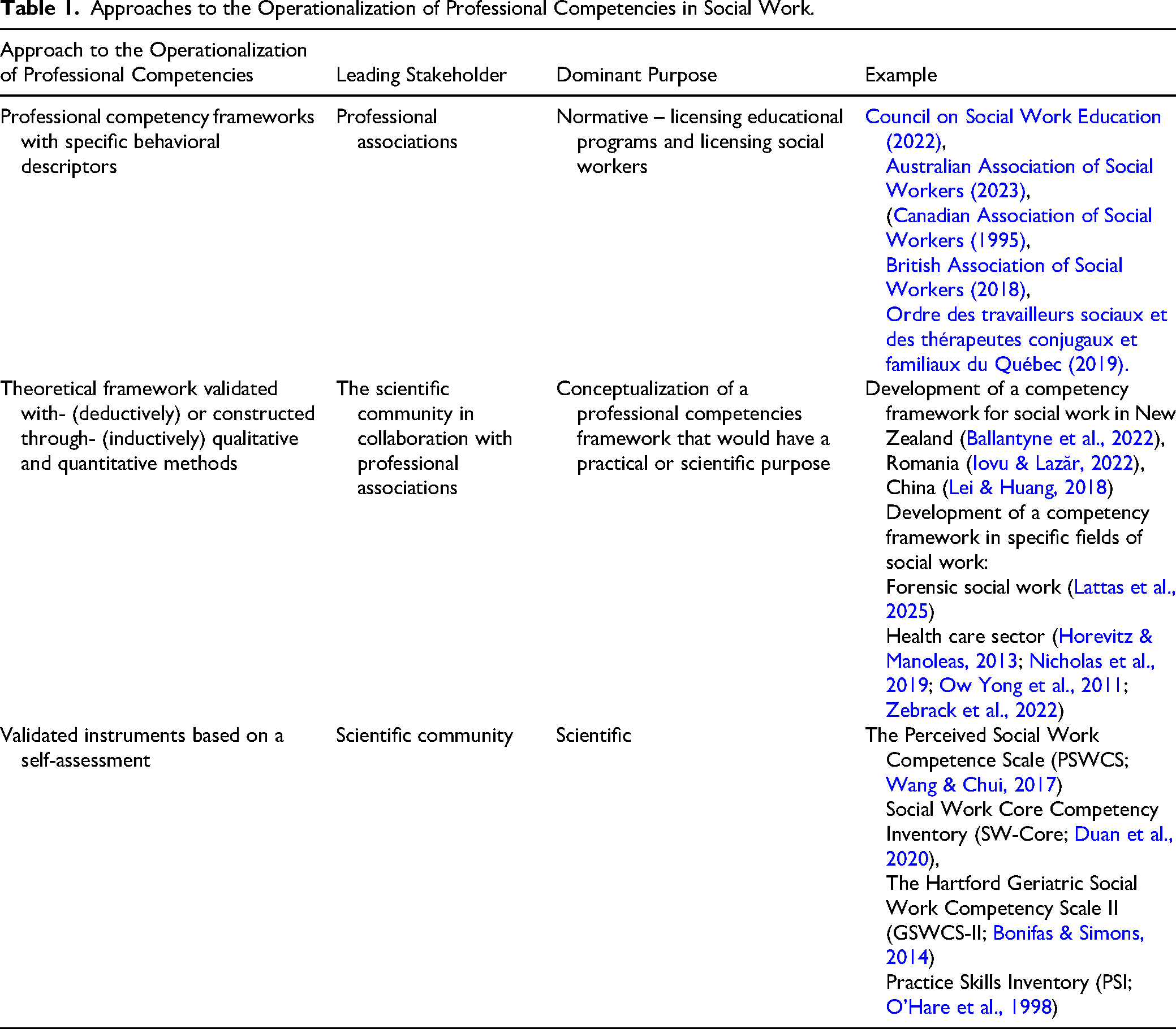
The first approach has a dominant normative and practical purpose through the development of competency frameworks by professional associations that can be used in licensing professionals or education programs. The frameworks can be additionally evaluated or refined with empirical research (e.g., Dunn & Yeoman, 2011; Ravalier et al., 2021; The College of Social Work, 2015).
The second approach serves both practical and scientific purposes by developing competency frameworks through the integration of theoretical analysis with sequential and mixed-method empirical research. To preserve the multidimensional nature of these frameworks, studies often start with many indicators that are gradually reduced using deductive or inductive approaches. Researchers evaluate the relevance, applicability, importance, and appropriateness of competency indicators for specific levels of expertise. Several studies have used a deductive approach where a theoretical model was validated using (a) qualitative methods (Ballantyne et al., 2022), (b) quantitative survey (Iovu & Lazăr, 2022), (c) sequential qualitative and quantitative methods (Horevitz & Manoleas, 2013), or (d) sequential quantitative and qualitative methods (Ow Yong et al., 2021). In some other examples, the inductive approach was used, i.e., empirical findings were synthesized into a theoretical model. These studies utilized Delphi methodology (Lattas et al., 2025; Lei & Huang, 2018) or concept mapping (Zebrack et al., 2022) in combination with qualitative and quantitative methods, or using only qualitative methods (Nicholas et al., 2019).
The third approach focuses on the development and validation of self-assessment instruments for measuring professional competencies and is described in the following section.
Validated Instruments for the Self-Assessment of Professional Competencies
According to the literature, self-assessment instruments of professional competencies should meet several criteria. First, they should capture the multidimensional nature of professional competence by integrating knowledge, skills, values, reflexivity, and professional judgment across multiple domains (Drisko, 2015; Poulin & Matis, 2015). Second, they should minimize dependence on specific organizational contexts to reduce attributional bias (Drisko, 2014). Third, they should be sufficiently sensitive to differentiate levels of expertise and avoid ceiling effects (Bandura, 2006). Furthermore, professional competencies should also be distinguished from related constructs such as suitability for practice (Tam et al., 2013), empowerment (Frans, 1993), and self-efficacy (Holden et al., 2017; Pedrazza et al., 2013). Although these instruments demonstrate good psychometric properties, the following review focuses only on measures that directly measure professional competencies or skills to ensure conceptual clarity.
The Perceived Social Work Competence Scale (PSWCS; Wang & Chui, 2017) is based on the distinction between procedural and meta-competencies. It comprises 48 items across nine subscales, with respondents rating their confidence in possessing specific skills on a 5-point Likert scale (1 = not at all confident, 5 = very confident). Although originally validated with social work students, the instrument has subsequently been applied to samples of social workers practitioners. In a study conducted on a sample of 149 social workers in Latvia, factor analysis retained 30 items across eight factors: Consultation Skills, Emotional Support Skills, Case Management Skills, Professional Resilience Skills, Retrospective Consultation Skills, Team Working Skills, Community Work Skills, and Formation Skills (Kievišienė, 2025). All subscales demonstrated good reliability (αs = .91, .87, .89, .88, .89, .85, .89, and .88, respectively), while the overall reliability of the scale was α = .99. High reliability coefficients have been reported in other studies (e.g., Zhang et al., 2020; Zheng et al., 2020; Zheng et al., 2022).
In China, the Social Work Core Competency Inventory (SW-Core; Duan et al., 2020) was developed based on Bogo's theoretical framework (2010) using a sequential design that integrated a literature review, interviews, and a quantitative survey. The instrument was validated on a sample of social workers (N = 305) and students (N = 626). Initially comprising 47 items, the scale was subsequently reduced through factor analysis to 24 items organized into eight subscales. Participants assess their competency levels on a 4-point Likert scale (1 = I cannot do it, 4 = I can do it completely), responding to the question: “Evaluate the levels of competency according to your actual situation.” The subscales and their corresponding reliability coefficients for the social worker subsample were knowledge and theory (α = .87), communication and cooperation (α = .88), value and ethics (α = .84), planning and assessment (α = .85), casework skills (α = .81), group work skills (α = .88), community work skills (α = .88), and research and development (α = .84).
The Hartford Geriatric Social Work Competency Scale II (GSWCS-II; Bonifas & Simons, 2014) comprises 40 items, initially divided into four subscales: 1) values, ethics, and theory, 2) assessment, 3) intervention, and 4) aging services, programs, and policies. A fifth subscale, Leadership in the Practice Environment, was subsequently added. Participants assess their skills on a 4-point Likert scale (0 = not skilled at all, 4 = expert skill). In a study conducted with Canadian social workers (N = 133), factor analysis further divided the Assessment and Intervention scales into two subscales each. The assessment domain comprised core geriatric assessment (α = .90) and specialized geriatric assessment (α = .73), while the intervention domain included core geriatric intervention (α = .90) and specialized geriatric intervention (α = .84).
Practice skills inventory (PSI; O’Hare et al., 1998) assesses clinical social work skills. The original 75-item instrument was tested primarily on 285 trainees in the United States. In a later study, the PSI was applied to a sample (N = 281) of experienced clinical practitioners and reduced to 23 items. Participants rated how often they use each skill in practice on a 5-point scale (5 = very often, 1 = never/almost never). A factor analysis extracted four subscales with good reliability: supportive skills (α = .86), therapeutic skills (α = .81), case management skills (α = .81), and insight facilitation skills (α = .80). In subsequent testing, the instrument was further reduced to 14 items across three subscales while maintaining satisfactory reliability (.81–.83) (O’Hare et al., 2002).
These measurement examples show that, despite differences in development procedures and the number of competency domains, most validated instruments for assessing social work competencies are generally multidimensional and have satisfactory psychometric characteristics. However, variations in the conceptualization and operationalization of competencies limit comparability across studies. While some competencies, especially the procedural ones, appear consistently across the scales, meta-competencies show substantial variation. Moreover, some instruments (e.g., SW-Core and PSWCS) assess general social work competencies, whereas others (e.g., GSWCS-II and PSI) are designed for specific fields of practice, such as geriatric or clinical social work.
The literature review identified several important gaps. First, few studies demonstrate the transition from competency frameworks to psychometrically validated measurement instruments. Second, validated self-assessment measures of professional competencies remain limited across different geographic contexts and fields of social work. Existing instruments vary considerably in their conceptualization and operationalization of meta-competencies and often do not comprehensively cover the range of relevant competency domains, limiting comparability across studies. These gaps motivated the development and validation of competency scales for social workers in Croatia. The instrument was grounded in the international literature while remaining responsive to the national context, providing a foundation for future cross-cultural research and validation.
Croatian Context
Social work in Croatia is acknowledged as an academic discipline and a regulated profession, supported by a licensing system and more than 70 years of education of social workers. Despite this tradition, no formal competency framework has been established. Although the Social Work Profession Act (OG 16/19, 18/22) defines methods and procedures of social work practice, it does not specify professional competencies. There is also a lack of research on professional competencies at the national level. To date, only one theoretical paper has addressed generic professional competencies (Buljevac et al., 2020), and one study has examined competencies in palliative care (Štambuk & Obrvan, 2017). Consistent with research from other countries, several studies have explored competencies among social work students (Huić et al., 2010; Leutar & Žilić, 2014; Ricijaš et al., 2006), while a study on employability and career development included selected professional competencies but did not use validated assessment instruments (Matković et al., 2018).
In recent years, the profession has come under strong public pressure following several tragic events within the social welfare system. These pressures accelerated reforms, and in 2022, the social welfare centers were centralized, further strengthening the state's control over the key institutions of social work and social welfare. Similar to the situation in Croatia, the academic and professional community in the United Kingdom responded to a crisis by offering to strengthen the profiling of social workers through the competency framework, with the intention of implementing it in educational programs (Allen, 2022).
One of the key institutions for social work in Croatia is the Croatian Social Work Institute (CSWI), which served as a setting for this research. Since 2023, Croatia has had 94 social welfare centers organized as regional offices of the CSWI. Social workers account for 61% of all employees in these centers, and 45% of all licensed social workers in Croatia are employed within this organization. Social welfare centers thus represent the backbone of the national social welfare system, where social workers assume the role of foundational experts, making practice in these institutions crucial for understanding social work in the Croatian context. Statutory social work is carried out within social welfare centers, where social workers perform with more than 150 public authorities. Work is organized in front and back offices, with generalist practice implemented in front offices, while back offices are specialized in work with families, adults, or cash benefits. National studies have consistently demonstrated high levels of occupational stress and burnout risk associated with increasing administrative demands, workload, and statutory responsibilities (Friščić, 2013; Ilijaš, 2023).
Given the central role of the CSWI within the Croatian social welfare system, the competency framework developed in this study may also be relevant to other areas of social work practice, including community, nongovernmental, health, and judicial settings. However, given the dominance of generalist practice within CSWI, lower recognition of certain specialized social work competencies (e.g., counseling, group support, community work) or some meta competencies (e.g., critical social work) might be expected on the sample of social workers in CSWI.
The limited availability of validated instruments internationally, together with the absence of a national competency framework in Croatia, provided the rationale for this study. The aim was to theoretically and empirically define the framework of professional competencies for Croatian social workers and to develop and psychometrically validate the Multi-Scale Inventory of Social Worker Professional Competencies (SW-MSIPC).
Study Design
This study was part of the project Social work in Social Welfare Centers, led by the Croatian Chamber of Social Workers and Faculty of Law at the University of Zagreb in collaboration with the Ministry of Demography, Family, Youth and Social Policy, and Croatian Association of Social Workers.
An exploratory sequential mixed methods design (Creswell & Plano Clark, 2011) was used to develop and validate a new instrument for measuring professional competencies among social workers employed in local offices of the CSWI.
The scales were developed through several phases in which social workers were involved as key informants, ensuring the theoretical grounding, professional relevance, and contextual appropriateness of the final instrument. This manuscript presents the final psychometric evaluation while providing an overview of the preceding development phases.
Prephase: Literature Review
A comprehensive literature review was conducted to identify and systematize key domains and subdomains of professional competencies in social work. The review provided the theoretical framework for scale development, identifying eight conceptual domains encompassing procedural and meta-competencies: 1) procedural competencies, 2) professional behavior, 3) theory integration competencies, 4) ethical competencies, 5) community work competencies, 6) cultural competencies, 7) organizational involvement competencies, and 8) critical social work competencies. Indicators within each domain were identified and subsequently translated into scale items.
Following the literature review, the research team reviewed the preliminary item pool to evaluate its relevance to social work practice in Croatian social welfare centers, as well as item clarity and conceptual fit. Overlapping, ambiguous, and multipart items were removed, resulting in preliminary versions of eight competency scales: 1) procedural competencies (89 items), 2) professional behavior (34 items), 3) theory integration competencies (23 items), 4) ethical competencies (28 items), 5) community work competencies (19 items), 6) cultural competencies (16 items), 7) organizational involvement competencies (37 items), and 8) critical social work competencies (21 items).
Phase One: Qualitative Research
The first phase involved qualitative research to assess the relevance and applicability of the proposed competency framework within Croatian social welfare centers and to provide initial content validation of the generated items. Specifically, the study evaluated item clarity, comprehensiveness, and relevance, identified gaps and redundancies, and generated additional items where important competencies were not adequately captured.
Participants
A total of 87 social workers from 47 social welfare centers participated in this phase of the study. The quota sample was used to ensure diversity in terms of geographic region and length of professional experience, with the aim of capturing a range of perspectives within Croatian social welfare centers.
Most social workers were female (73.6%), aged between 30 and 65 years (M = 46.2, SD = 10.35). Regarding education level, 64 participants held a university degree, and 9 had completed a professional college program. Social workers had an average of 16.1 (SD = 11.13) years of work experience in social welfare centers, ranging from 2 to 42 years.
Data Collection
Data were collected through 10 focus groups. The interview guide was developed for this study by the research team. Participants were first introduced to the eight competency domains and asked to rank their importance for everyday practice in social welfare centers. Each participant then reviewed a subset of procedural competency domains, as well as two additional domains, and assessed the clarity and relevance of the corresponding items. This was followed by structured group discussions, during which social workers provided feedback on the clarity, relevance, and applicability of the competencies to social work in Croatian social welfare centers. Participants were also given the opportunity to suggest revisions, additions, or the removal of items if appropriate.
Focus groups were moderated by two members of the research team with educational backgrounds in social work. Each focus group lasted approximately two hours and was conducted in the facilities of social welfare centers. All sessions were audio-recorded and transcribed verbatim.
Ethics
Participation in the focus groups was voluntary. Prior to participation, all social workers received written and verbal information about the study and provided informed consent. Social workers were informed that discussions would be audio-recorded, transcribed, and analyzed in anonymized form. To protect confidentiality, all identifying information was removed from transcripts, and participants were reminded to respect the confidentiality of information shared during the group discussions. Access to the data was restricted to members of the research team.
Data Analysis
The qualitative phase was designed to support content and face validation of the competency framework and the preliminary item pool developed during the literature review. Because the competency domains and corresponding items had been theoretically derived prior to data collection, a deductive qualitative content analysis was conducted (Hsieh & Shannon, 2005). The predefined competency domains served as the analytic framework for organizing and interpreting participants’ feedback.
The unit of analysis consisted of social workers’ responses regarding the competency domains and scale items. Two members of the research team who had not moderated the focus groups independently reviewed the transcripts and coded participants’ feedback. Coding focused on the clarity, relevance, comprehensiveness, contextual applicability, redundancy, and wording of competency items and domains. Items were revised when participants identified problems related to clarity, wording, contextual relevance, or conceptual fit with the intended competency domain. Items were removed when feedback consistently indicated redundancy, substantial overlap with other items, limited applicability to practice in Croatian social welfare centers, or ambiguity in interpretation.
Following independent review, coding decisions were compared and any discrepancies were discussed until consensus was reached. The resulting recommendations were subsequently reviewed by the full research team, which reached agreement regarding item retention, revision, addition, or removal.
Results
The focus groups confirmed the relevance of the proposed competency domains for social work practice in Croatian social welfare centers and provided initial evidence of the content and face validity of the scales.
Following the focus groups, an expert panel consultation was conducted to further improve the content validity of the scales. The panel consisted of eight experts representing each partner organization involved in the project. The experts reviewed the revised items, assessing their conceptual clarity, relevance within each domain, and linguistic precision. Their feedback led to further refinement of several items. As a result of both the focus group discussions and input from the expert panel, eight revised competency scales were prepared for initial testing (Opačić et al., 2020): 1) procedural competencies (42 items), 2) professional behavior (19 items), 3) theory integration competencies (13 items), 4) ethical competencies (20 items), 5) community work competencies (9 items), 6) cultural competencies (9 items), 7) organizational involvement competencies (17 items) and 8) critical social work competencies (9 items). Competence levels were assessed using a 5-point Likert scale ranging from 1 (not at all capable) to 5 (highly capable).
Phase Two: Pilot Study
Following the qualitative phase, a pilot study was conducted to examine the preliminary factor structure and internal consistency of the competency scales.
Participants
The pilot study was conducted on a convenience sample of social workers (N = 115) employed in social welfare centers across Croatia. The sample consisted of 91.2% women. Social workers ranged in age from 25 to 64 years (M = 42.47, SD = 11.94). The majority held a master's degree in social work or social policy (64.9%), followed by those with a pre-Bologna master's degree in social work (22.8%), a college-level professional qualification (6.1%), a specialist postgraduate or doctoral degree (3.5%), and a bachelor's degree in social work (2.6%). Length of work experience in social welfare centers ranged from 10 months to 41 years and 10 months (M = 13.63, SD = 11.64).
Data Collection
The questionnaire included sections on demographic and work-related characteristics. Questions related to demographic characteristics included gender, age, educational level, marital status, and number of children. Professional characteristics included length of work experience, length of service at a social welfare center, department of employment, current job role, and professional development experience. The questionnaire also included measures of professional identity, workplace self-efficacy, and job satisfaction.
Professional identity was measured using the Macleod Clark Professional Identity Scale (MCPIS; Adams et al., 2006). The scale consists of nine items (e.g., “I feel I have strong ties with members of this profession.”), which are measured on a 5-point Likert scale (1 = strongly disagree; 5 = strongly agree). The total score was computed as the average of all item ratings, with a higher score indicating a greater sense of professional identity. Previous research has reported good internal consistency (α = .83) (Worthington et al., 2013).
Self-efficacy was measured using an adapted version of the General Self-Efficacy Scale (GSE; Schwarzer & Jerusalem, 1995). The scale consists of 10 items rated on a 5-point Likert-type scale ranging from 1 (does not apply to me at all) to 5 (completely applies to me). In this study, the scale was modified to assess self-efficacy in the workplace context. An example item is: “I always manage to solve difficult problems at my workplace if I try hard enough.” The total score was calculated as a sum of all item ratings, with higher scores indicating higher perceived workplace self-efficacy. The Croatian version of the scale has demonstrated satisfactory reliability (α = .75–.90) (Ivanov & Penezić, 2002; Penezić et al., 1998).
Job satisfaction was measured using a single item assessing overall satisfaction with participants’ current job in a social welfare center. Responses were provided on a 5-point Likert scale ranging from 1 (very dissatisfied) to 5 (very satisfied).
Results
The construct validity was assessed using exploratory factor analysis (EFA) with the principal axis factoring method. The number of factors to retain was determined by multiple criteria: parallel analysis, the Kaiser-Guttman criterion, Cattell's scree test, the percentage of explained variance, and interpretability of the factor solutions. Because these criteria did not always converge, no single criterion was treated as decisive. In line with literature recommendations, greater weight was given to parallel analysis (Hayton et al., 2004) while final decisions were based on the comparison of alternative factor solutions (Henson & Roberts, 2006). Alternative solutions were evaluated based on their interpretability, conceptual coherence, simplicity of structure, and the presence of problematic cross-loadings. Items were iteratively reviewed and removed if they showed high cross-loadings on multiple factors, low loadings on any of the factors (< .30), or contributed to multicollinearity. The solutions that produced clearly interpretable factors with minimal cross-loadings and meaningful correspondence to theoretically defined competencies were selected as the final factor solutions for each scale.
Given the relatively small sample size in relation to the number of items, these analyses were primarily used to inform item screening, scale refinement, and initial evaluation of the factor structure. Internal consistency was evaluated using Cronbach's alpha and McDonald's omega coefficients. Factor loadings, retained items, explained variance, and reliability coefficients for each scale and subscale are presented in Table 2.
Factor Structure, Variance Explained, and Reliability of Competency Scales.
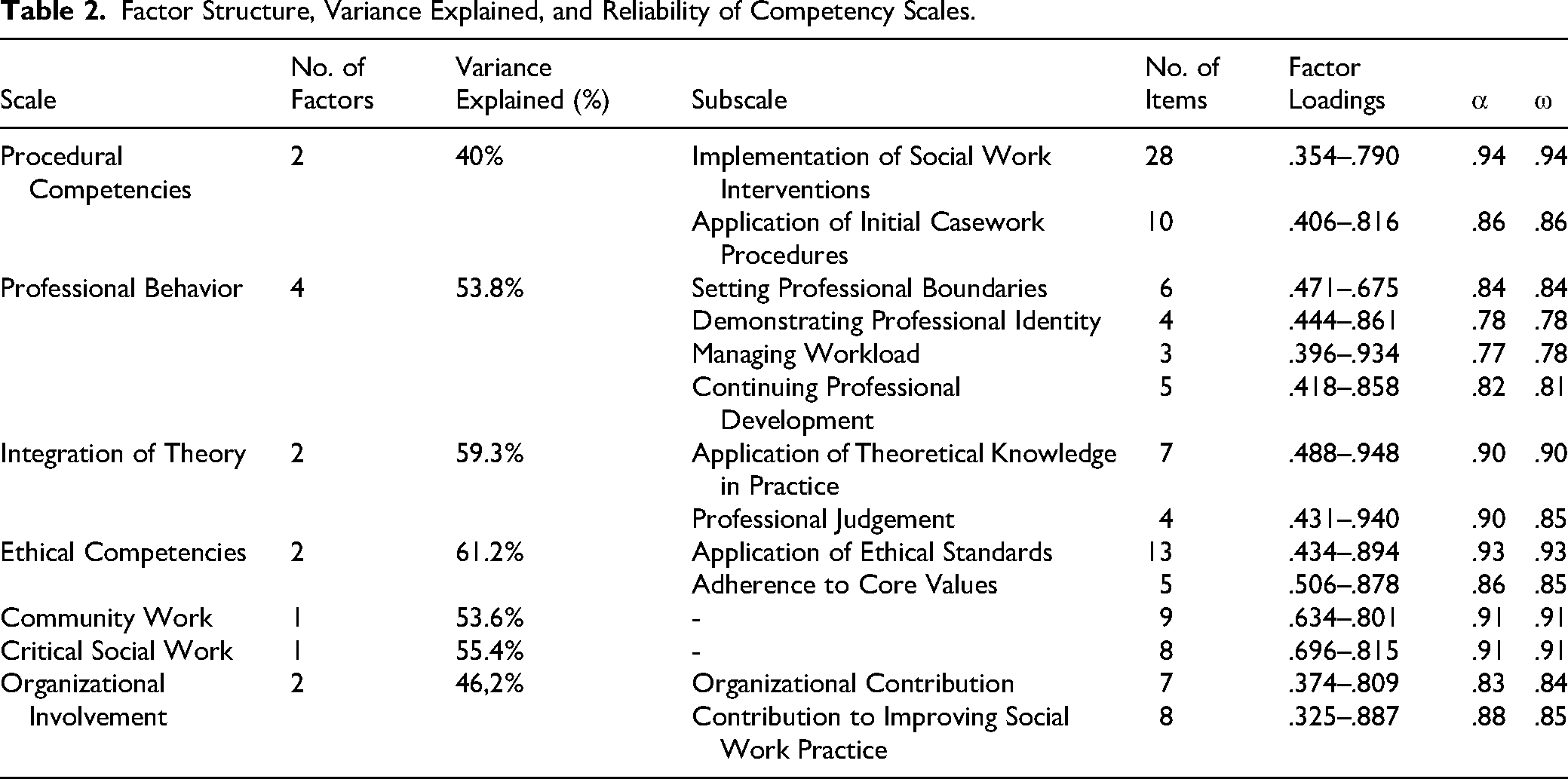
Most scales showed clear and interpretable factor structures with satisfactory explained variance and moderate to high item loadings (generally > .40), supporting item retention. An exception was the Cultural Competency scale, for which factor analysis was not conducted due to high multicollinearity among items. Items that related to respect toward different social groups were highly intercorrelated (r > .80 or r > .90), suggesting item redundancy and limited discriminant power. Cronbach's alpha values ranged from .77 to .94, and McDonald's omega from .78 to .94, showing acceptable to excellent internal consistency. Descriptive statistics for the scales are presented in Table 3. (Table 3).
Number of Participants, Range, Minimum and Maximum Values, Mean, and Standard Deviation of Total Scores on Scales and Subscales.
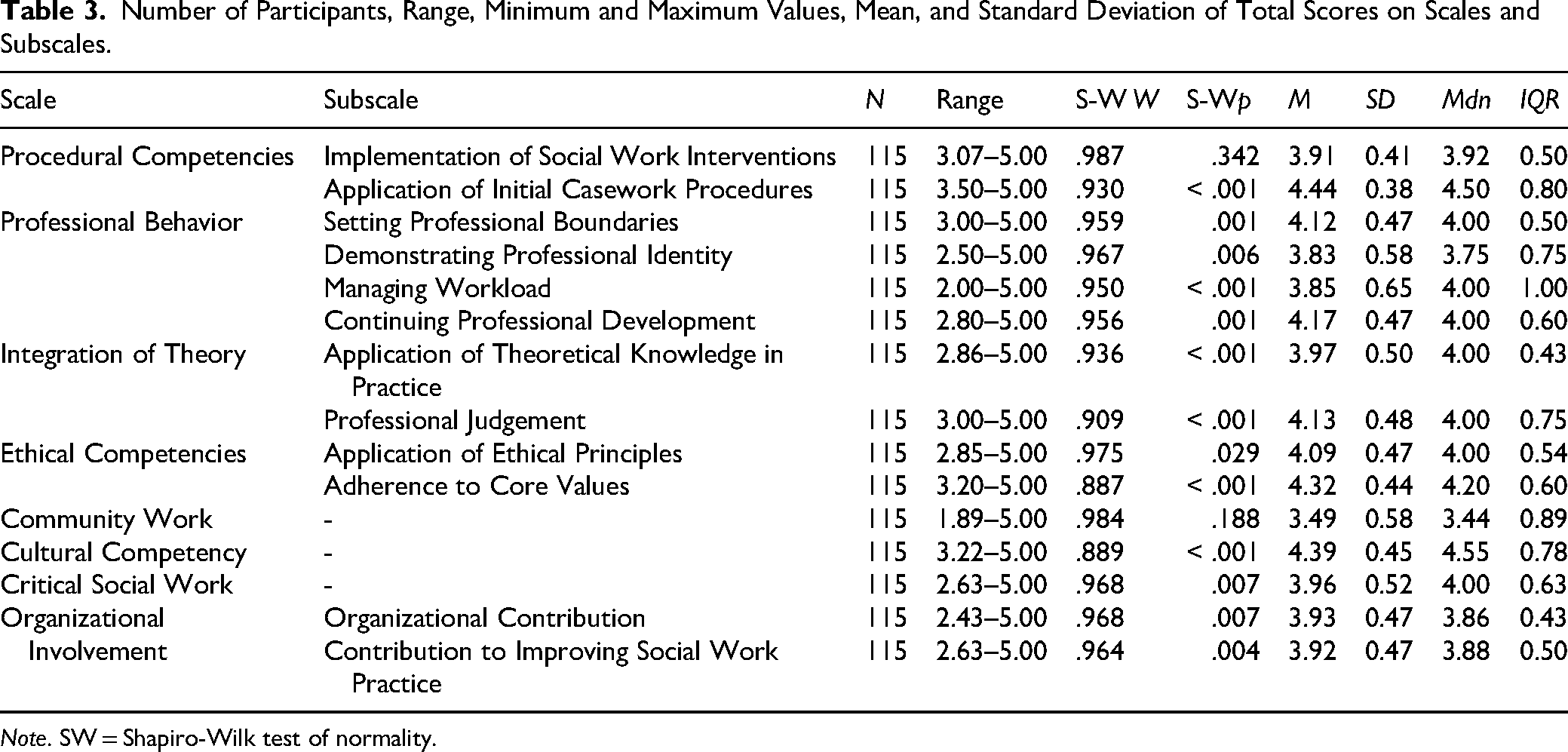
Note. SW = Shapiro-Wilk test of normality.
Across most scales and subscales, central scores were above the scale midpoint with relatively low variability, showing generally high self-perceived professional competencies among social workers (Table 3). The Community Work Competency scale was an exception, showing a lower mean (M = 3.49), a wider response range (1.89–5.00), and an approximately normal distribution, implying greater variability and discriminative capacity. In contrast, the negatively skewed distributions across nearly all scales point out to potential ceiling effects that may limit their ability to differentiate among social workers at higher levels of self-perceived competence.
To examine the criterion-related validity, Spearman correlation coefficients were calculated between the competency scales and five other variables: workplace self-efficacy, professional identity, job satisfaction, length of service, and professional development experience (Table 4).
Correlations Between the Subscales and Criterion Variables.
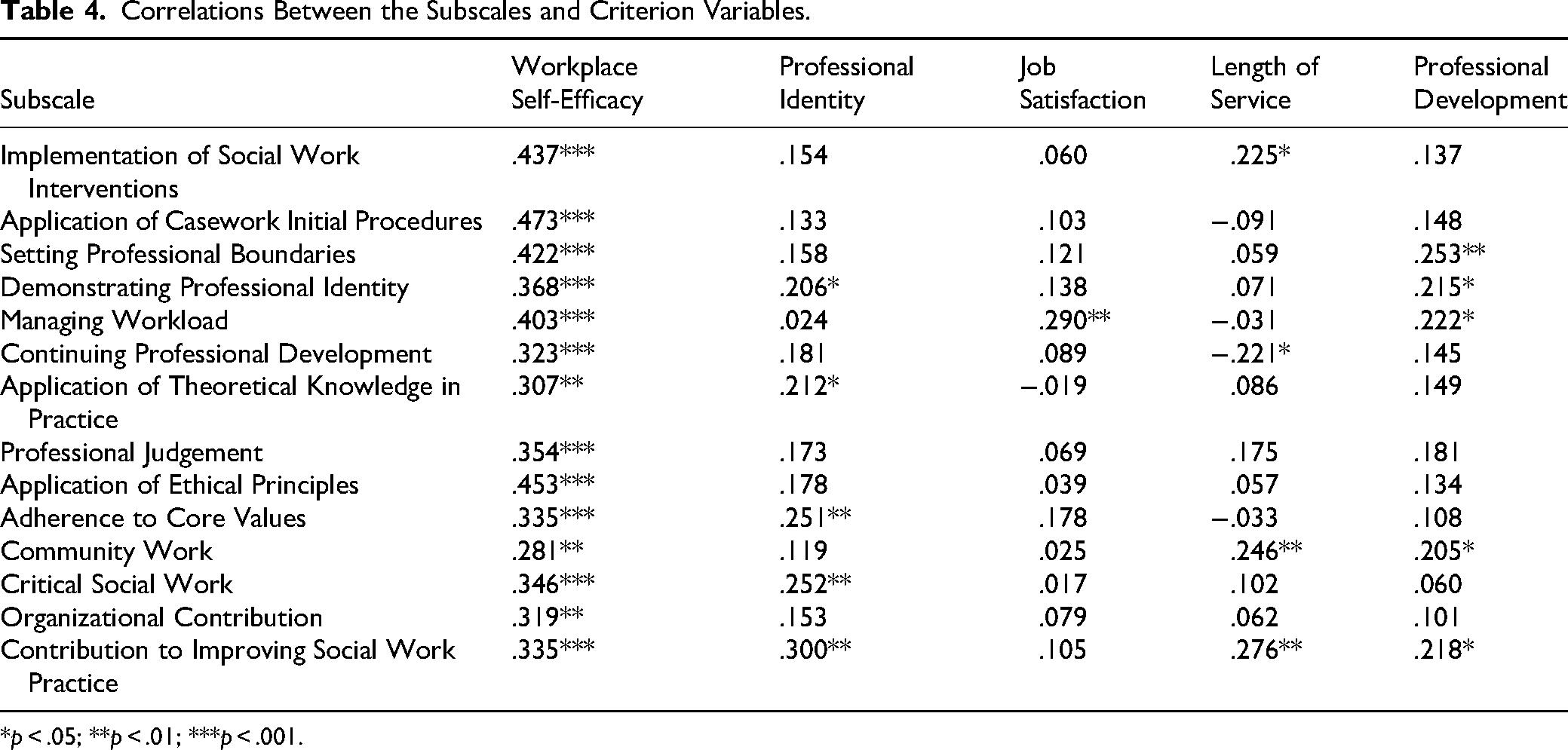
*p < .05; **p < .01; ***p < .001.
All scales and subscales showed small to moderate positive correlations with workplace self-efficacy (r = .28 – .47), showing that social workers who perceived themselves as more professionally competent in each domain also reported higher levels of workplace self-efficacy. Professional development experience was positively associated with several competency subscales, suggesting that these scales may be sensitive to professional experience gained through additional training or lifelong learning. Similarly, several scales and subscales were significantly correlated with professional identity, implying conceptual alignment. Correlations with job satisfaction and length of service were smaller and less consistent. Some low or non-significant correlations may also be attributed to the limited variability of several subscale or scale scores, including negatively skewed distributions and potential ceiling effects. Overall, these findings provide preliminary support for the criterion-related validity of the competency scales, particularly in relation to workplace self-efficacy and professional identity, while also suggesting the need for further refinement to improve sensitivity.
Based on these preliminary findings, eight refined competency scales were prepared for the next phase of psychometric evaluation(Opačić et al., 2020): 1) procedural competencies (38 items); 2) professional behavior (18 items); 3) theory integration competencies (11 items), 4) ethical competencies (15 items), 5) community work competency (8 items), 6) cultural competency (4 items), 7) organizational involvement competencies (15 items), and 8) critical social work competency (7 items).
Phase Three: Large-Scale Survey
The final phase involved a large-scale survey to examine the psychometric properties of the competency scales.
Participants
The survey was conducted on a convenience sample of social workers (N = 905) employed in 95 different social welfare centers across Croatia, representing approximately 71.2% of the target population (Ministarstvo rada, mirovinskoga sustava, obitelji i socijalne politike, 2021) and indicating a high response rate.
Most participants were women (92.4%), with a mean age of 41.37 years (SD = 11.45), ranging from 24 to 65 years. The majority held a graduate degree in social work or social policy (70.6%), followed by those who had completed a graduate degree in social work under the pre-Bologna system (19.8%), those holding a higher vocational school qualification (4.6%), a postgraduate specialist or doctoral degree (3.0%), or a bachelor's degree in social work (2.1%). Length of service in social welfare centers ranged from less than 1 month to 50 years and 5 months (M = 13.30, SD = 11.56). Most participants (84.1%) had not participated in any form of professional development or lifelong learning lasting at least one year. Among those who had (15.9%), psychotherapeutic training was the most common.
Data Collection
All data and measurement instruments used in the large-scale survey were the same as those applied in the pilot study, except for the job satisfaction measure, for which a different instrument was used.
The measure of job satisfaction differed from that used in the pilot study. In this phase of the study, the short-form version of the Minnesota Satisfaction Questionnaire (Weiss et al., 1967) was used to measure job satisfaction to obtain a more psychometrically robust measure of job satisfaction and to strengthen the assessment of criterion-related validity in the final phase of instrument validation. The scale consists of 20 items describing different aspects of job satisfaction, divided into two subscales: intrinsic and extrinsic satisfaction, from which a general satisfaction score can also be calculated as the sum of scores across all items. Participants rate each item on a 5-point Likert scale (1 = very dissatisfied, 5 = very satisfied). The Cronbach's alpha for general satisfaction typically ranged from .84 to .91, for intrinsic satisfaction from .86 to .90, and for extrinsic satisfaction from .80 to .85. In this study, only the general job satisfaction score was calculated. However, four items were removed due to low factor loadings, and the total score was calculated as the sum of the remaining 16 items.
Procedure and Ethics
The questionnaires were self-administered and distributed to social workers in social welfare centers by social work students collaborating on the project. Directors coordinated data collection, and participants completed the questionnaires individually at their workplaces. Completed questionnaires were collected on the same day or returned by post if participants were absent.
Participation in the study was voluntary. Social workers received written information about the study. The study was anonymous, and confidentiality was ensured. Access to the data was limited to members of the research team, and all questionnaires were securely stored. Participants were informed that all analyses would be conducted at the aggregate level and that no analyses specific to individual social welfare centers would be conducted.
Results
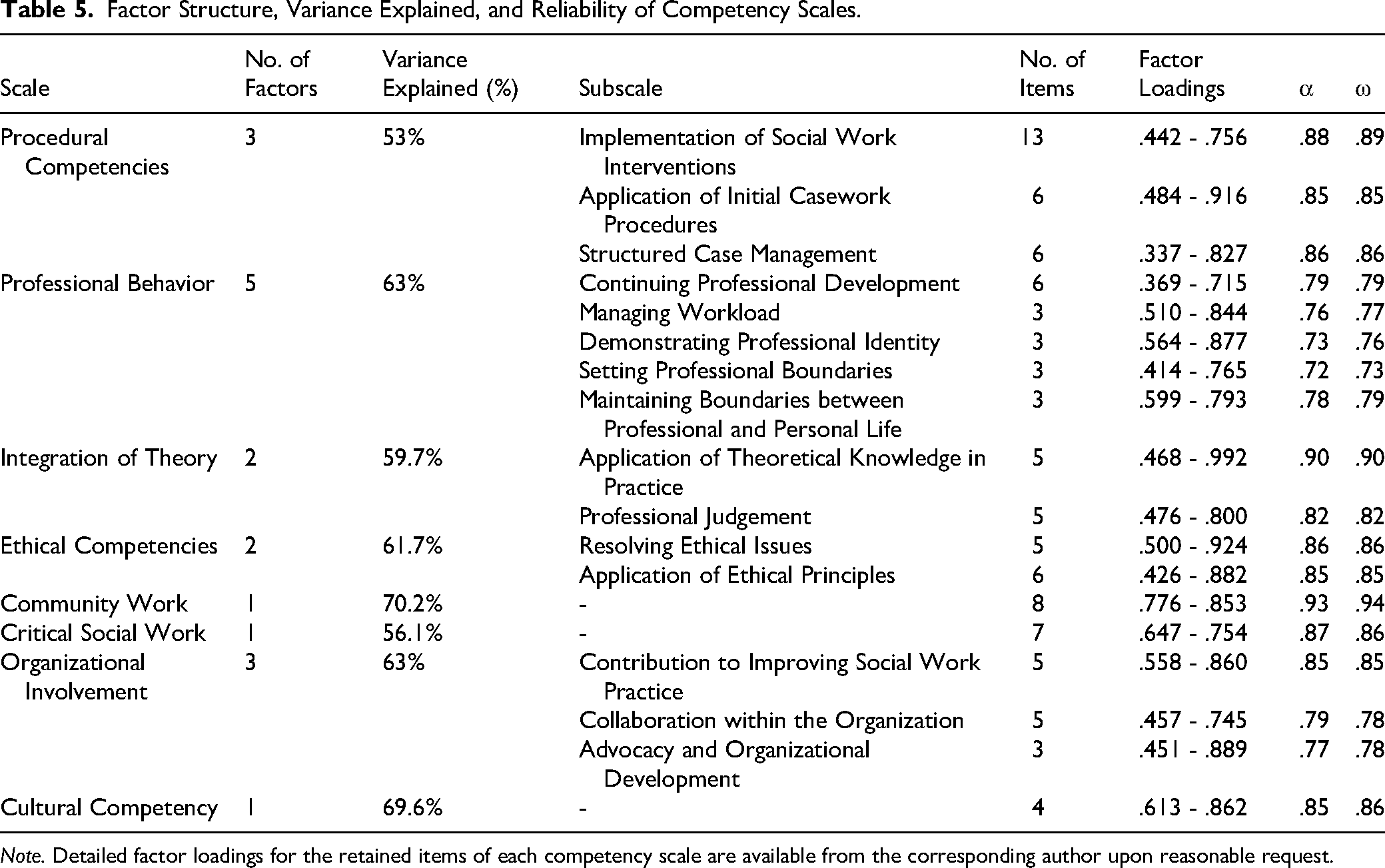
Construct validity of the scales was assessed using EFA with the principal axis factoring method. The number of factors to retain was determined using the same factor-retention criteria and decision-making process described for the pilot study. The suitability of the data for EFA was evaluated using the total percentage of variance explained, the Kaiser–Meyer–Olkin (KMO) test, Bartlett's test of sphericity, and the determinant of the correlation matrix. EFA was considered suitable when the total extracted variance exceeded 50%, KMO values ranged between 0.5 and 1, Bartlett's test was statistically significant (p < .05), and the determinant value exceeded .00001 (Field, 2013). Internal consistency was estimated using Cronbach's alpha and McDonald's omega coefficients. The results of the factor analyses, including explained variance, retained items, and internal consistency coefficients for each scale and subscale, are presented in Table 5.
Factor Structure, Variance Explained, and Reliability of Competency Scales.
Note. Detailed factor loadings for the retained items of each competency scale are available from the corresponding author upon reasonable request.
The EFAs provided initial evidence for the factor structure of the SW-MSIPC scales, with factor solutions explaining between 53% and over 70% of the variance across competency domains. Multi-factor scales including procedural competencies, professional behavior, integration of theory competencies, ethical competencies, and organizational involvement competencies comprised interpretable subdimensions reflecting distinct aspects of social work competencies.
Factor loadings were mostly within a moderate to high range (.337–.992), with most exceeding the commonly accepted threshold of .40, supporting the relevance of retained items within the proposed factor solutions. The community work competency scale (.776–.853) and the subscale application of theoretical knowledge in practice (.468–.992) showed particularly high loadings. Items with loadings at the lower end, such as those around .337 in the subscale structured case management within the procedural competencies scale, suggest potential areas for item refinement, possibly related to clarity or conceptual alignment. Notably, several unidimensional scales community work competency, cultural competency, and critical social work competency, despite high reliability and percentage of variance explained, appear conceptually narrow due to high item overlap.
Internal consistency ranged from acceptable to excellent across all subscales (α = .72–.93; ω = .73–.94). As expected, reliability was lower for brief three-item facets (e.g., subscales within the professional behavior scale), consistent with attenuation due to scale length.
Based on the findings on construct validity and internal consistency, finalized versions of the eight competency scales were established and are presented in Table 6.
Final Version of the Multi-Scale Inventory of Social Worker Professional Competencies (SW-MSIPC).
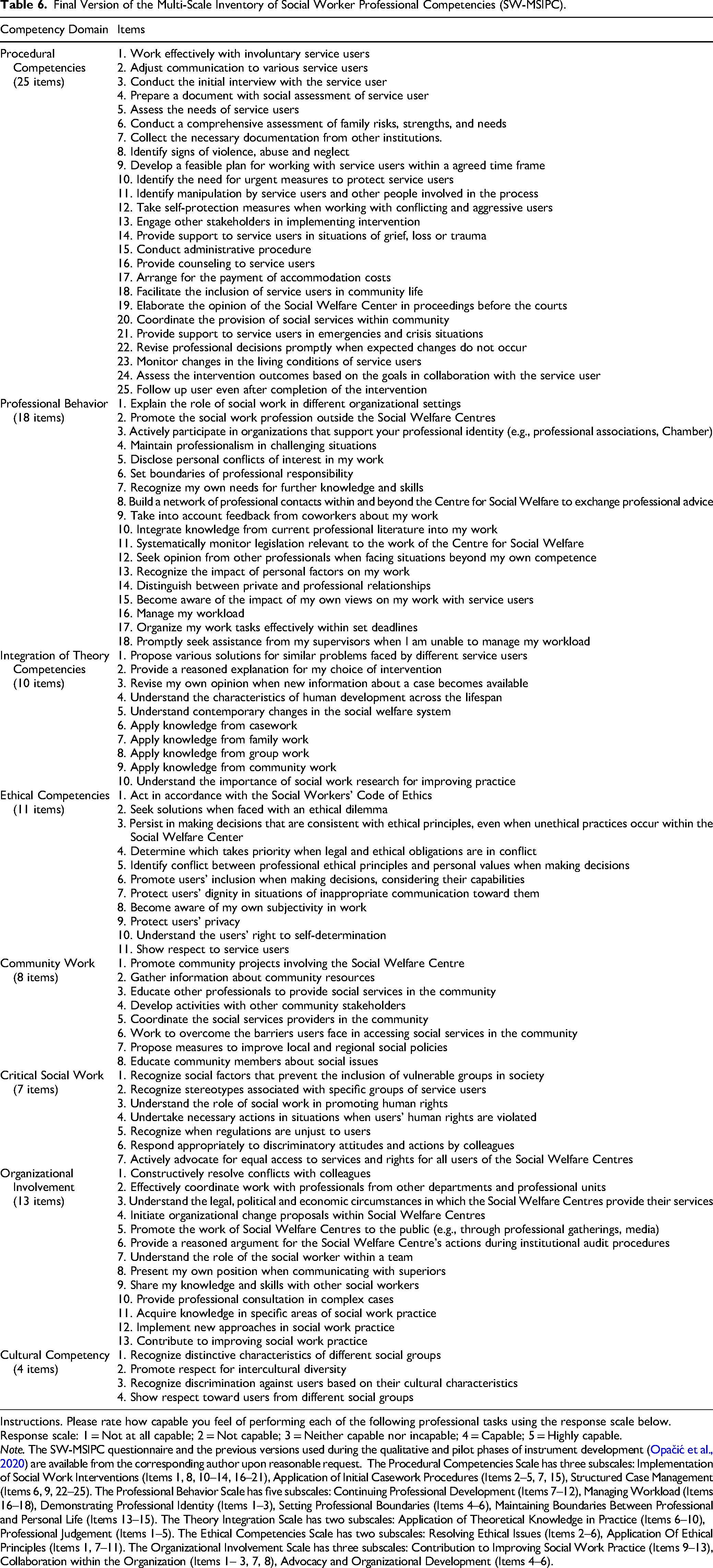
Instructions. Please rate how capable you feel of performing each of the following professional tasks using the response scale below.
Response scale: 1 = Not at all capable; 2 = Not capable; 3 = Neither capable nor incapable; 4 = Capable; 5 = Highly capable.
Note. The SW-MSIPC questionnaire and the previous versions used during the qualitative and pilot phases of instrument development (Opačić et al., 2020) are available from the corresponding author upon reasonable request. The Procedural Competencies Scale has three subscales: Implementation of Social Work Interventions (Items 1, 8, 10–14, 16–21), Application of Initial Casework Procedures (Items 2–5, 7, 15), Structured Case Management (Items 6, 9, 22–25). The Professional Behavior Scale has five subscales: Continuing Professional Development (Items 7–12), Managing Workload (Items 16–18), Demonstrating Professional Identity (Items 1–3), Setting Professional Boundaries (Items 4–6), Maintaining Boundaries Between Professional and Personal Life (Items 13–15). The Theory Integration Scale has two subscales: Application of Theoretical Knowledge in Practice (Items 6–10), Professional Judgement (Items 1–5). The Ethical Competencies Scale has two subscales: Resolving Ethical Issues (Items 2–6), Application Of Ethical Principles (Items 1, 7–11). The Organizational Involvement Scale has three subscales: Contribution to Improving Social Work Practice (Items 9–13), Collaboration within the Organization (Items 1– 3, 7, 8), Advocacy and Organizational Development (Items 4–6).
In addition to factor structure and reliability, descriptive statistics for the competency scales were examined (Table 7). Across most scales, scores were positioned toward the upper end of the scale, with relatively low variability and negatively skewed distributions indicating high levels of self-perceived professional competence. Subscales within procedural competencies, professional behavior, theory integration competencies, ethical competencies, organizational involvement competencies, as well as the critical social work and cultural competency scales, showed elevated central tendencies and limited dispersion, indicating that most social workers rated themselves highly in these domains. Conversely, the community work competency scale showed a central score closer to the midpoint and greater score variability.
Number of Participants, Range, Minimum and Maximum Values, Mean, and Standard Deviation of Total Scores on Individual Scales and Subscales.
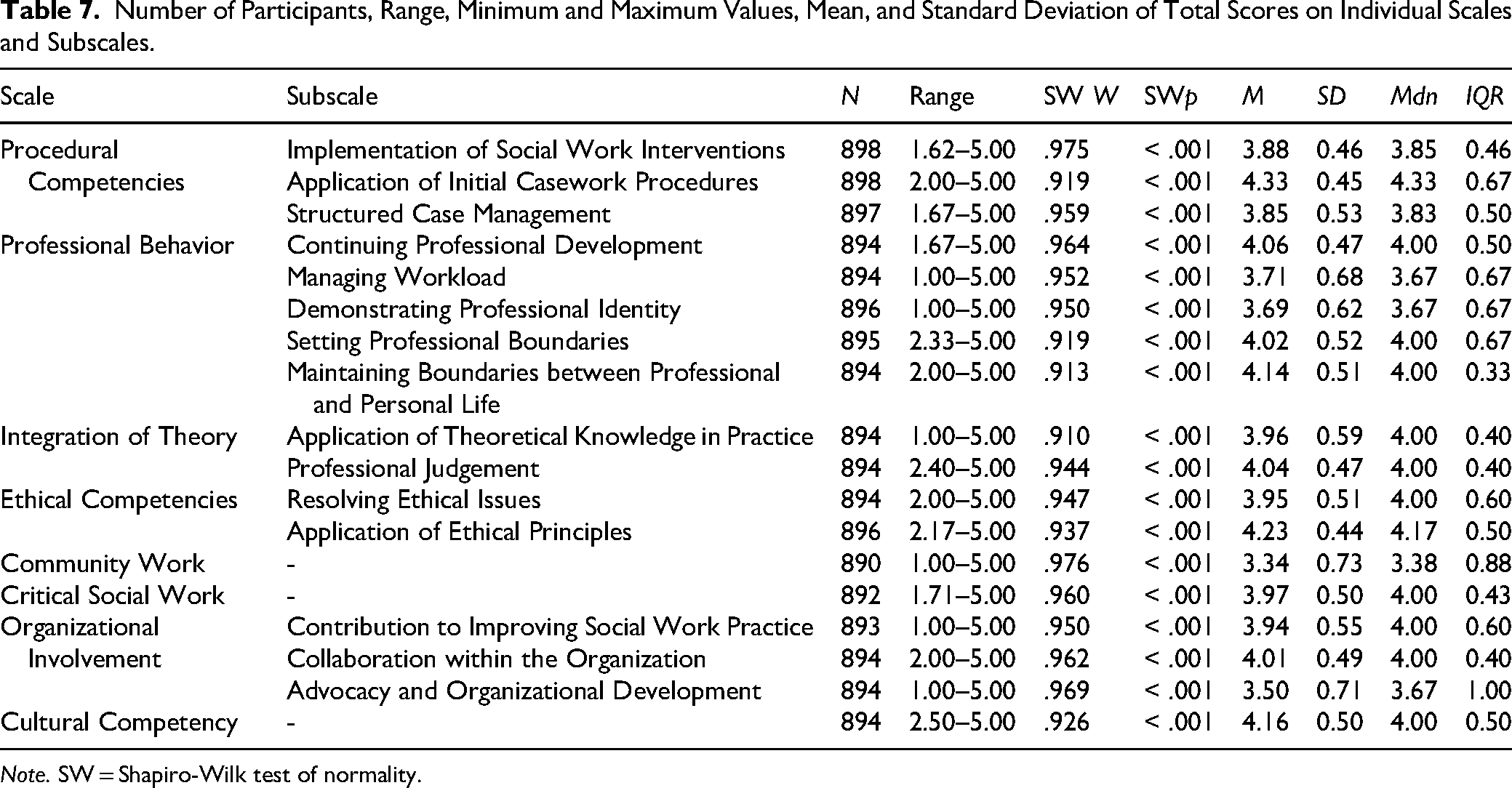
Note. SW = Shapiro-Wilk test of normality.
Criterion-Related Validity
Criterion-related validity was examined using Spearman's correlation coefficients. Consistent with the pilot study, the criterion variables included workplace self-efficacy, professional identity, job satisfaction, length of service in social welfare centers, and professional development experience. Correlation coefficients are presented in Table 8.
Correlations Between the Subscales and Criterion Variables.
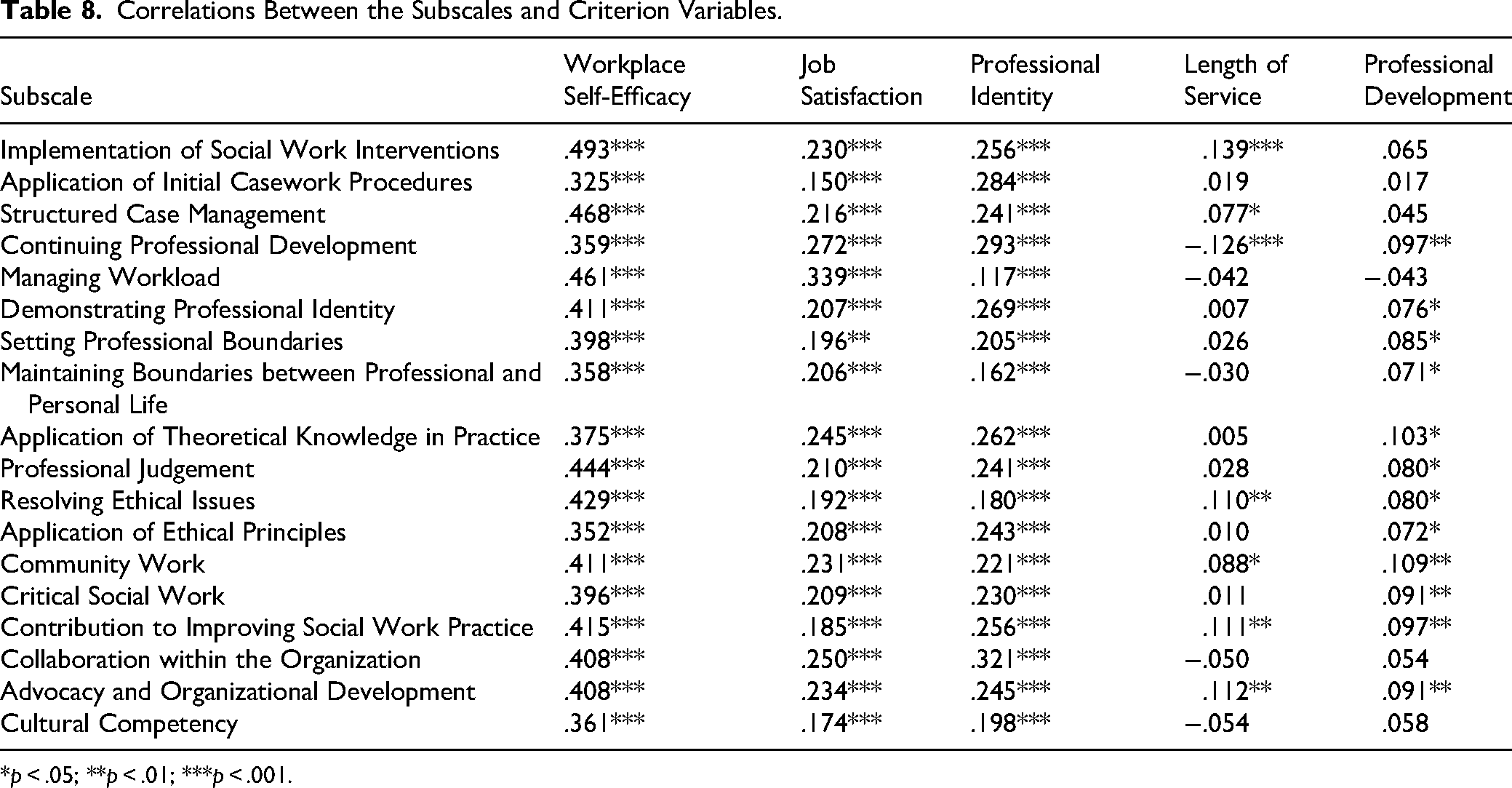
*p < .05; **p < .01; ***p < .001.
Correlational analyses of the competency scales and criterion variables provide preliminary evidence for the criterion-related validity of the scales. Workplace self-efficacy was the most consistently associated criterion, showing moderate correlations with most of the competency scales (r = .33 – .49). Professional identity and job satisfaction were positively associated with all competency scales, although the correlations were generally smaller. In contrast, the length of service in social welfare centers showed very low and inconsistent correlations with competency scores, with most coefficients below the conventional threshold for meaningful interpretation (r < .10). Correlations with professional development experience were also small (r < .15) and limited to a few competency domains.
Discussion and Applications to Practice
The present study developed and psychometrically evaluated the multi-scale inventory of social worker professional competencies (SW-MSIPC) using an exploratory sequential design. The findings provide preliminary evidence for the reliability and construct validity of the instrument, while identifying areas for further refinement.
The integration of qualitative and quantitative methods aligns with recommendations that mixed methods enhance conceptual clarity and establish validity through multiple approaches (Zhou, 2019). By combining literature review, qualitative inquiry, expert consultation, and psychometric testing, the study ensured that the competency scales were both theoretically grounded and contextually relevant (Fetters et al., 2013; Gogo & Musonda, 2022). Similar research in social work has shown that including a qualitative phase improves instrument reliability and contextual appropriateness (Enosh et al., 2015). The present study therefore provides an example of a rigorous integrated mixed-methods framework for developing and validating competency measures in social work, consistent with recent advances in instrument development and validation using research (Zhang & Browne, 2025).
The SW-MSIPC contributes to the assessment of both meta- and procedural competencies in social work (Bogo, 2010). Compared with other existing instruments, it provides a more comprehensive framework by encompassing a broader range of theoretically derived competency domains. The validated meta-competency domains include professional behavior, ethical competencies, theory integration, organizational involvement, community work, cultural competence, and critical social work, while the procedural competency scale captures key aspects of work with service users, including assessment, intervention, and case management. Together, these domains reflect the multidimensional nature of professional competence by integrating cognitive, behavioral, and value-based components, consistent with established conceptual frameworks for competency measurement (Drisko, 2014, 2015; Poulin & Matis, 2015).
However, the scale development and validation process involved a substantial reduction in indicators and dimensions of competencies relative to the initial theoretical framework. During the qualitative phase, the largest revisions were made to the community work, procedural competencies, theory integration, and professional behavior scales to enhance their relevance for social welfare center practice. Subsequent psychometric testing led to further refinement, with the largest reductions in the critical social work and cultural competency scales.
Although the SW-MSIPC provides broad coverage of professional competencies, several theoretically proposed domains were not empirically confirmed as distinct dimensions. These included reflexivity, understanding one's own cultural identity and the causes of oppressive practices, application of specific theoretical approaches, communication and intervention skills as separate procedural competencies, research competencies, teamwork, and collaboration between science and practice. Some of these competencies have been identified in previous instruments (e.g., Duan et al., 2020; O’Hare et al., 2002; Pedrazza et al., 2013; Tam et al., 2013), but were not confirmed as distinct dimensions in the Croatian sample. This reduction may partly reflect the statutory nature of social work practice in Croatian social welfare centers, where social workers usually perform generalist practice. In addition, excessive workload and increasing administrative tasks (Friščić, 2013; Ilijaš, 2023) may limit opportunities to apply specific interventions and, therefore, demonstrate more specialized competencies. It may also reflect a pragmatic orientation of practitioners, consistent with Lei and Huang's (2018) argument that competencies are often reduced through the pragmatic, technical, and depoliticized view of the profession. The tendency toward competency reduction could be interpreted as a tension between two different approaches to defining competence suggested by Mulder (2014): integrated occupationalism and situated professionalism. The present study conceptualized the competency framework from the perspective of integrated occupationalism, emphasizing holistic recognition of knowledge, skills, and values. However, competencies may be redefined within the professional community and under the influence of other external stakeholders (e.g., Ministry, professional associations, etc.). Future research should continue monitoring these dynamics to appropriately address educational outcomes.
At the structural level, factor solutions in the pilot study were less stable and, in some cases, constrained by multicollinearity and item cross-loadings. The Procedural Competencies and Organizational Involvement Competencies scales changed from two-factor to three-factor solutions, while the Professional Behavior scale expanded from four to five factors in the large-scale study, likely reflecting the greater stability afforded by the larger sample. In contrast, the Community Work and Cultural Competency scales remained unidimensional across both phases, supporting their conceptual coherence. Despite these differences, the core domains of professional competence were supported in both studies, providing support for the theoretical framework established during instrument development. However, the presence of cross-loadings indicates that several items require further refinement. In addition, the factor structure was examined using exploratory methods only, and measurement invariance across relevant groups was not examined. Future studies should therefore confirm the proposed structure using CFA or ESEM, examine measurement invariance, and explore higher-order or bifactor models (McDonald, 2013).
Internal consistency ranged from acceptable to excellent (α/ω = .72–.94). High reliability coefficients were observed for the ethical competencies, theory integration, community work, cultural competency, critical social work, and procedural competency scales, consistent with previous research (Bonifas & Simons, 2014; Duan et al., 2020; Kievišienė, 2025; Zheng et al., 2020). Lower reliability was found for several three item subscales within the Professional Behavior and Organizational Involvement scales, which is consistent with the influence of scale length on internal consistency estimates (Streiner, 2003). McDonald's omega coefficients showed a similar pattern. Although the internal consistency estimates were generally satisfactory, reliability was assessed only through internal consistency coefficients. Consequently, the temporal stability of the competency scales remains unknown.
Several findings indicate directions for further refinement of the SW-MSIPC. Some unidimensional scales appear overly narrow, with high item overlap and limited coverage of the construct, which may constrain validity at higher levels of competence. In addition, a small number of items demonstrated weak discrimination and should be revised or replaced to improve conceptual clarity and domain coverage. Future studies should also evaluate test-retest reliability using repeated measurements over time.
In terms of score distributions, both pilot and large-scale study findings showed high central tendencies, low variability, and negatively skewed distributions. Ceiling effects were most pronounced in the subscales application of initial casework procedures, application of ethical principles, maintaining boundaries between professional and personal life, and the cultural competency scale, showing consistently high self-assessments across study phases. This consistency suggests that ceiling effects are not merely an artifact of the small pilot sample but may reflect a broader challenge in the self-assessment of professional competencies. The presence of ceiling effects can be attributed to limited instrument sensitivity, social desirability bias, or insufficient meta-cognitive ability to accurately evaluate one's own competencies (Kruger & Dunning, 1999). In contrast, the community work competency scale displayed a more balanced distribution, showing potential to discriminate between different levels of self-perceived competence.
Similar ceiling effects have been reported in previous studies (Duan et al., 2020; Kievišienė, 2025), where community work competencies also showed comparatively lower scores than other domains. Greater score variability has been observed in studies using heterogeneous training samples (Zhang et al., 2019) or performance-based assessment methods, such as practice-based evaluation tools and OSCE assessments (Bogo et al., 2012; Regehr et al., 2011, 2012), suggesting that traditional self-assessment instruments may have limited sensitivity in differentiating higher levels of competence. Although several SW-MSIPC domains, particularly professional ethics, organizational involvement, and procedural competencies, conceptually encompass different levels of complexity, the observed score distributions show limited differentiation within the present sample. For cultural competency and critical social work competency, earlier reductions in the item pool likely contributed to ceiling effects and high self-assessments (Bandura, 2006).
Although most scales showed high self-reported competency scores among social workers, their reduced variance and pronounced negative skewness imply that the scales may have limited discriminative power in identifying distinctions among social workers with higher levels of competency. These findings highlight the need for further refinement of item content, particularly through the inclusion of indicators targeting higher levels of professional competence. Future studies should include a broader range of indicators, particularly items that differentiate at higher competency levels, and incorporate performance-based or scenario-based items to increase cognitive demand. The use of item response theory (IRT) or Rasch modeling could provide more detailed insights into item functioning and help identify items that fail to differentiate at higher levels of competence. In addition, attribution bias may have influenced responses in domains such as Professional Behavior and Theory Integration, where ratings may reflect opportunities to apply competencies within organizational settings rather than actual competence (Drisko, 2014).
The reported ceiling effects also have practical implications for the use of the SW-MSIPC. The instrument appears better suited to assessing competencies among social workers with low to moderate levels of self-perceived competence than to differentiating among those with higher competency levels. Consequently, differences between highly competent social workers or between groups with high competency levels may be difficult to detect. These limitations should be considered when using the instrument for evaluation purposes, professional development, or comparisons between groups with generally high levels of competence.
The findings provide preliminary evidence for the criterion-related validity of the scales, with the highest correlations with conceptually proximal constructs such as workplace self-efficacy and professional identity. Broader career-related factors, including length of service and professional development experience, showed weaker correlations. Length of service does not necessarily reflect the quality of professional competence, as previous research has demonstrated only a weak relationship between accumulated professional experience and actual observed performance, emphasizing the importance of deliberate practice, feedback, and reflective learning processes (Anders Ericsson, 2008). Similarly, in the present study, professional development experience was measured broadly and did not capture the type, quality, or practice relevance of training. Previous studies have emphasized that continuing professional development contributes to competence primarily when it is purposeful, reflective, and connected to ongoing professional learning (Beddoe & Duke, 2013; Davys & Beddoe, 2020).
The stronger associations with workplace self-efficacy are theoretically expected, given that both constructs reflect practitioners’ perceptions of their professional capabilities, although they remain conceptually distinct (Holden et al., 2017; Pedrazza et al., 2013). Moreover, self-assessments of competence are known to show only modest correspondence with external indicators because they are influenced by metacognitive, contextual, and feedback-related processes (Eva & Regehr, 2005, 2011). Accordingly, the weaker associations with length of service and professional development experience should not be interpreted as evidence that these factors are unimportant for competence development, but rather that they represent relatively limited criterion variables for validating a multidimensional self-assessment instrument. Future validation studies should include more differentiated external criteria, such as the quality of continuing professional development, supervision experiences, peer or supervisor assessment, and observed professional performance.
In addition to the limitations discussed above, two further issues should be considered. First, although the study achieved high coverage of social workers employed in Croatian social welfare centers, the findings may not generalize to other practice settings or cultural contexts. Future cross-cultural validation studies are needed to examine the transferability of the domains within the instrument and its applicability beyond the Croatian welfare system. Specifically, future research should assess the psychometric properties of the SW-MSIPC scales across diverse cultural and practice contexts. Additionally, given the high national coverage in this study, future research could explore measurement invariance across subgroups (e.g., region, years of experience, or work department) to verify that the scales perform equivalently for different populations. Second, although participation was voluntary and anonymous, recruitment through social welfare centers and coordination with center directors may have led some participants to perceive the study as institutionally endorsed, potentially increasing socially desirable responding. This possibility should be considered when interpreting the high self-assessed competency scores and ceiling effects observed across several scales. Future studies could reduce this risk by using independent recruitment procedures and online data collection methods.
The practical implications of this study are twofold. First, the competency framework, developed through literature review and refined through expert consultation and qualitative study, informed the development of career advancement criteria within the Croatian social welfare system and the definition of learning outcomes for bachelor's, master's, and doctoral social work programs in Croatia. Second, although the SW-MSIPC was not designed for policy or curriculum development, it provides a valuable tool for assessing professional competencies among social workers. The instrument can help identify competency domains requiring further development and inform the design and evaluation of continuing professional development initiatives and educational programs, including those offered by the Academy of Social Welfare.
Conclusion
The SW-MSIPC represents a contextually relevant measurement tool for assessing professional competencies among social workers in Croatia. This study highlights the importance of developing competency measures that are sensitive to the national context and developed in collaboration with the professional community. The findings provide initial evidence supporting the psychometric properties of SW-MSIPC and its usefulness for assessing key domains of social work competencies in the Croatian context, while establishing foundation for future validation studies in other cultural and practice settings With further refinement and validation, the SW-MSIPC has the potential to become a valuable resource for research and professional development, contributing to the ongoing advancement of competency assessment in social work.
Footnotes

Funding
The authors disclosed receipt of the following financial support for the research, authorship, and/or publication of this article: This research was funded by the Croatian Chamber of Social Workers through the research project Social Work in Social Welfare Centers.
Declaration of Conflicting Interests
The authors declared no potential conflicts of interest with respect to the research, authorship, and/or publication of this article.