






Abstract
Keywords
Introduction
Purpose
An increasing amount of research has supported the positive role of gratitude in individuals’ health and well-being in the last two decades (Chopik et al., 2019; Corona et al., 2020; Hill et al., 2013). Gratitude is a positive psychological trait that involves an orientation towards noticing the positives in life, and it can alleviate psychological distress and promote psychological well-being (PWB) (Wood et al., 2008). Women tend to feel and express gratitude more than men and benefit more from it (Kashdan et al., 2009). However, women in China experience greater body image disturbances in a highly objectified society (Yin et al., 2022); thus, this study aims to examine the influence of gratitude on body appreciation and holistic health among women in China.
Background
Women's PWB issues have become a significant public health concern in China. The overall prevalence of mental disorders in China is estimated at 16.6%, affecting ∼100 million individuals, with depression being one of the most common conditions; the prevalence of depressive disorders was higher in women than in men (Lu et al., 2021). According to the 2024 National Mental Health Survey conducted by the Institute of Psychology, Chinese Academy of Sciences, among a representative sample of 6,871 adults, depressive symptoms peaked in the 18–34 age group of females, and anxiety levels were consistently higher in women than in men (Sun et al., 2025). In addition to the mental health crisis among young adult women, middle-aged Chinese women (40–60 years) showed a prevalence of depressive symptoms of 26.0% and anxiety symptoms of 12.6% (Wang et al., 2022).
The adverse consequences of poor PWB in women extend beyond mental health. Depression and anxiety are associated with increased health risks, including cardiovascular disease, impaired immune function, and elevated mortality risk (Liu et al., 2020). In China, depression has been identified as a leading cause of nonfatal health loss (World Health Organization, 2022). Furthermore, psychological distress negatively impacts social functioning, workplace productivity, and quality of life, with women experiencing greater functional impairment from depression than men (Albert, 2015). Despite these substantial burdens, mental health service utilization remains low, with fewer than 20% of affected individuals receiving adequate treatment (Huang et al., 2019). Therefore, it is urgent to develop low-cost and highly feasible psychosocial interventions to improve women's holistic health in China.
Literature Review
A recent meta-analysis has supported the positive role of gratitude in individuals’ body image and PWB (Linardon et al., 2022). Ryff and Keyes (1995) defined PWB as a state of optimal human functioning that goes beyond the experience of happiness, also involving the realization of one's own potential and true self. PWB emphasizes the ability to realize one's potential to pursue a meaningful and fulfilling life (Kardas et al., 2019). It consists of six dimensions: purpose in life, autonomy, personal growth, environmental mastery, positive relations with others, and self-acceptance (Ryff, 1989). Previous studies have supported the predictive role of gratitude in all subdimensions of PWB, except for autonomy (Voci et al., 2019; Wood et al., 2009). Gratitude can also reduce body dissatisfaction and positively influence women's body image (Dunaev et al., 2018). Body appreciation is defined as accepting, favorably evaluating, and caring for the body, while also rejecting narrowly defined cultural ideals as the sole definition of beauty (Avalos et al., 2005). However, beyond the studies mentioned above, relatively little research has focused on the relationship between gratitude and body appreciation, or on their mutual roles in PWB, especially in the Chinese context where women experience more body image disturbances in a highly objectified society (Yin et al., 2022).
With the growing recognition of gratitude's positive effects, gratitude interventions have been widely explored as feasible and effective strategies to enhance gratitude levels and further foster related positive outcomes. Gratitude interventions refer to structured and intentional practices designed to cultivate individuals’ gratitude awareness and expression, with common forms including gratitude journaling, gratitude letter writing, body-focused gratitude exercises, and gratitude meditation (Emmons & McCullough, 2003; Seligman et al., 2005; Wood et al., 2008). A gratitude journaling intervention can reduce psychological distress and improve well-being. A randomized controlled study found that a 4-week gratitude journaling protocol significantly reduced depressive symptoms (Cheng et al., 2015). Another 21-day randomized controlled trial with 290 adults showed significant improvements in gratitude and subjective well-being following a structured gratitude training (Deichman & Warren, 2025). Meta-analyses also show that these interventions significantly enhance PWB and reduce depressive symptoms (Dickens, 2019). These findings suggest that simple gratitude journaling exercises may serve as an accessible intervention to alleviate psychological distress.
For women in particular, body-focused gratitude interventions have shown promising effects in improving body image outcomes. For example, a two-week gratitude diary intervention improved body appreciation and reduced appearance-related social comparisons among college women (Dunaev et al., 2018), and similar interventions reduced body dissatisfaction (Geraghty et al., 2010). Moreover, gratitude interventions have been linked to better self-rated physical health (SRPH) and health-promoting behaviors in women (Jackowska et al., 2016). Therefore, this study further explores the comprehensive effectiveness of a gratitude intervention on women's body appreciation, PWB and SRPH.
Gratitude promotes body appreciation (Homan & Tylka, 2018), which could significantly predict adults’ PWB (Romano & Heron, 2022; Swami et al., 2018). Additionally, studies indicate that gratitude significantly influences SRPH, and this link can be mediated by psychological outcomes (Hill et al., 2013; Valikhani et al., 2019). However, existing studies mainly adopted cross-sectional designs, and the relationship among gratitude, body appreciation, PWB, and SRPH has not been examined in longitudinal studies, especially in the Chinese context. Gender differences exist in gratitude and body appreciation; women tend to be more grateful but less appreciative of their bodies (He et al., 2020; Kashdan et al., 2009). Therefore, this study aimed to investigate the influence of a gratitude journaling intervention on gratitude, body appreciation, PWB, and SRPH, as well as the underlying mechanisms, among women in China. This study employed a 21-day gratitude journaling intervention and proposed the following hypotheses:
Method
Study Design
This study adopted a randomized controlled trial design with two groups (intervention group vs. control group) × 2 times (preintervention and postintervention). Participants were randomly assigned to the intervention group or the control group using a computer-generated random number sequence. Both groups completed the questionnaire at the two time points to collect anonymized baseline and postintervention data. The intervention group was required to record three small things that made them feel happy each day for 21 consecutive days, following the commonly used gratitude journaling protocol (Bai et al., 2019; O’Connell et al., 2017); the control group only completed the questionnaire at the two time points.
Participants
Fifty-seven participants aged 19–52 years (mean age = 27.39 years) were recruited and randomly assigned to the intervention group (n = 28) or the control group (n = 29). Women were excluded if they met any of the following criteria: (a) were currently taking psychiatric medications or had a diagnosed major mental disorder; (b) had participated in similar gratitude interventions in the past 3 months; (c) were pregnant or had recently given birth; or (d) had severe physical illnesses that prevented regular participation.
Procedures
This study was conducted from October 2025 to March 2026. Participants were recruited through electronic posters via social media platforms. The researchers conducted short preintervention interviews to ensure participants’ eligibility. After providing electronic informed consent, eligible participants completed the preintervention (T0) questionnaire online, which measured demographics, gratitude, body appreciation, PWB (six dimensions), and SRPH.
Following the T0 assessment, participants were randomly assigned to the intervention group or the control group using a computer-generated random number sequence. Participants in the intervention group were instructed to write down three small things that made them feel happy or grateful each day using mobile phone notes. They were asked to send their daily diary entries to the researchers every day for 21 consecutive days. The control group did not perform any daily tasks. After the 21-day period, both groups completed the postintervention (T1) questionnaire, which was identical to the T0 measures. All participants received a small gift as compensation upon completion of both assessments.
Interventions
Participants in the intervention group completed a 21-day gratitude journaling intervention based on the well-established “three good things” paradigm (Emmons & McCullough, 2003). Each day, they were instructed to write down three small things that made them feel happy or grateful, using their mobile phone notes. The instruction read: “Please write down three small things that made you feel happy or grateful today. They can be ordinary daily events, kind acts from others, or personal achievements. Be as specific as possible.” Participants were asked to send their daily entries to the researchers via WeChat or QQ before 8:00 p.m. each day. No feedback or comments were provided on the content to avoid biasing subsequent entries. The control group received no intervention and was instructed to maintain their usual daily routines without any gratitude practice.
Data Analyses
Demographics and baseline outcome measures were compared between the intervention and control groups using independent-sample t-tests to test for homogeneity. To examine between-group differences over time, a repeated-measures analysis of variance was conducted. Between-group effect sizes were expressed as partial eta squared (η2), where values of 0.01, 0.08, and 0.14 correspond to small, medium, and large effects, respectively (Moher et al., 2001). Simple main effect analyses were further performed for post hoc stratified comparisons. Paired-sample t-tests were used to determine within-group effects from preintervention (T0) to postintervention (T1). Within-group effect sizes (ES) were calculated using Cohen's d (Cohen, 1988), with values of 0.2, 0.5, and 0.8 indicating small, medium, and large effects, respectively.
Additionally, to explore the content of participants’ gratitude journaling entries in the intervention group, a thematic analysis was conducted using ATLAS.ti qualitative data analysis software. Following the six-phase procedure proposed by Braun and Clarke (2006), two coders independently read the diary entries to become familiar with the data. Initial codes were generated inductively by annotating relevant segments of text as quotations and assigning descriptive labels at the quotation level. The coders then grouped related codes into potential themes, iteratively reviewing and refining the themes through discussion until consensus was reached. The final thematic structure was defined and named, with the frequency of each theme reported. Representative quotes were extracted from the software to illustrate the thematic findings.
Research Ethics
Informed consent was obtained from all participants before they enrolled in the study. Confidentiality and autonomy of all participants were fully respected. The present study was approved by the Human Research Ethics Committee of the University of Hong Kong (No. EA240395).
Results
Sample
The participant flow process is shown in Figure 1. A total of 83 women were initially screened for eligibility, of whom 26 were excluded based on predefined criteria. The remaining 57 participants were then randomly assigned to either the intervention group (n = 28) or the control group (n = 29).
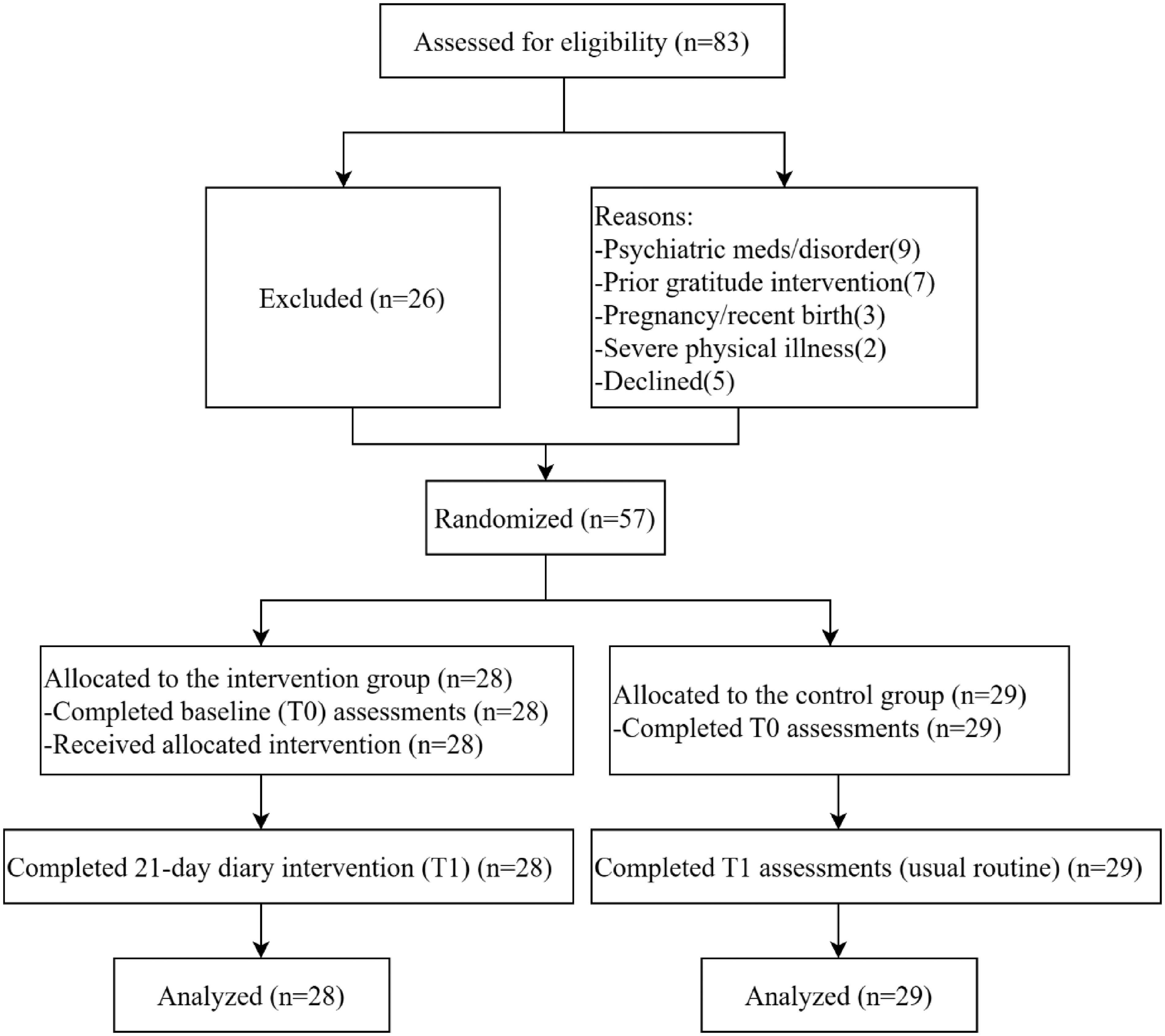
CONsolidated Standards of Reporting Trials (CONSORT) diagram of participant flow.
Participants Characteristics
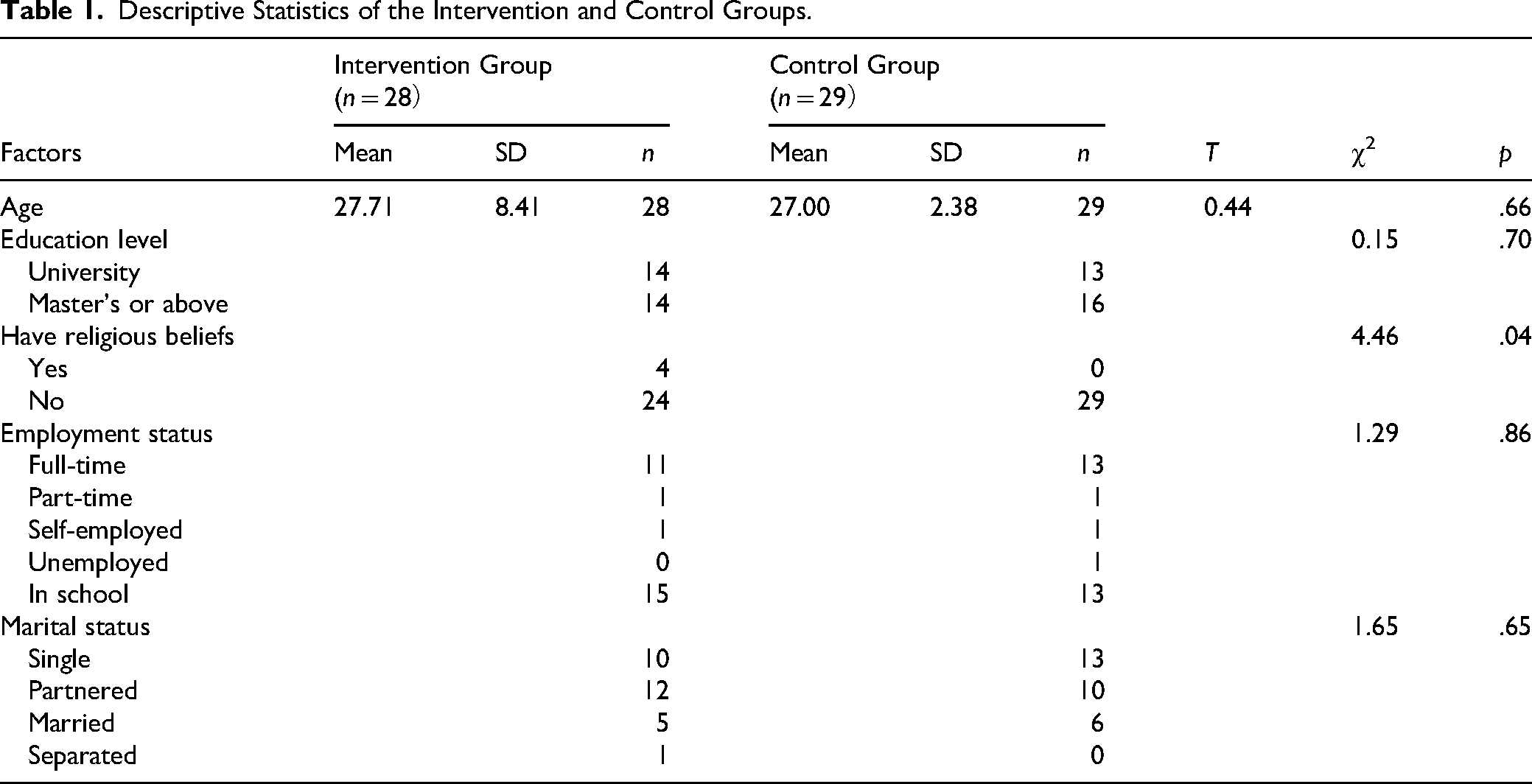
As reported in Table 1, most participants were highly educated young women (∼53% held a master's degree or above, and the remainder had a college or university degree), and 42% were employed full-time. The two groups did not differ in age, education level, employment status, or marital status (all p > .05). A significant group difference was found only for religious belief (p = .04). No other significant differences were observed between the intervention and control groups in any mental or physical health factor at T0 (all p > .05). Religious belief was considered a covariate in the following analyses.
Descriptive Statistics of the Intervention and Control Groups.
Adherence
All participants in the intervention group submitted their gratitude journaling entries as instructed throughout the 21-day intervention period. No participants dropped out of the study at any stage. All enrolled participants completed both preintervention and postintervention questionnaires in full. Thus, adherence to the intervention protocol was high, as the intervention was simple to follow.
Treatment Effects
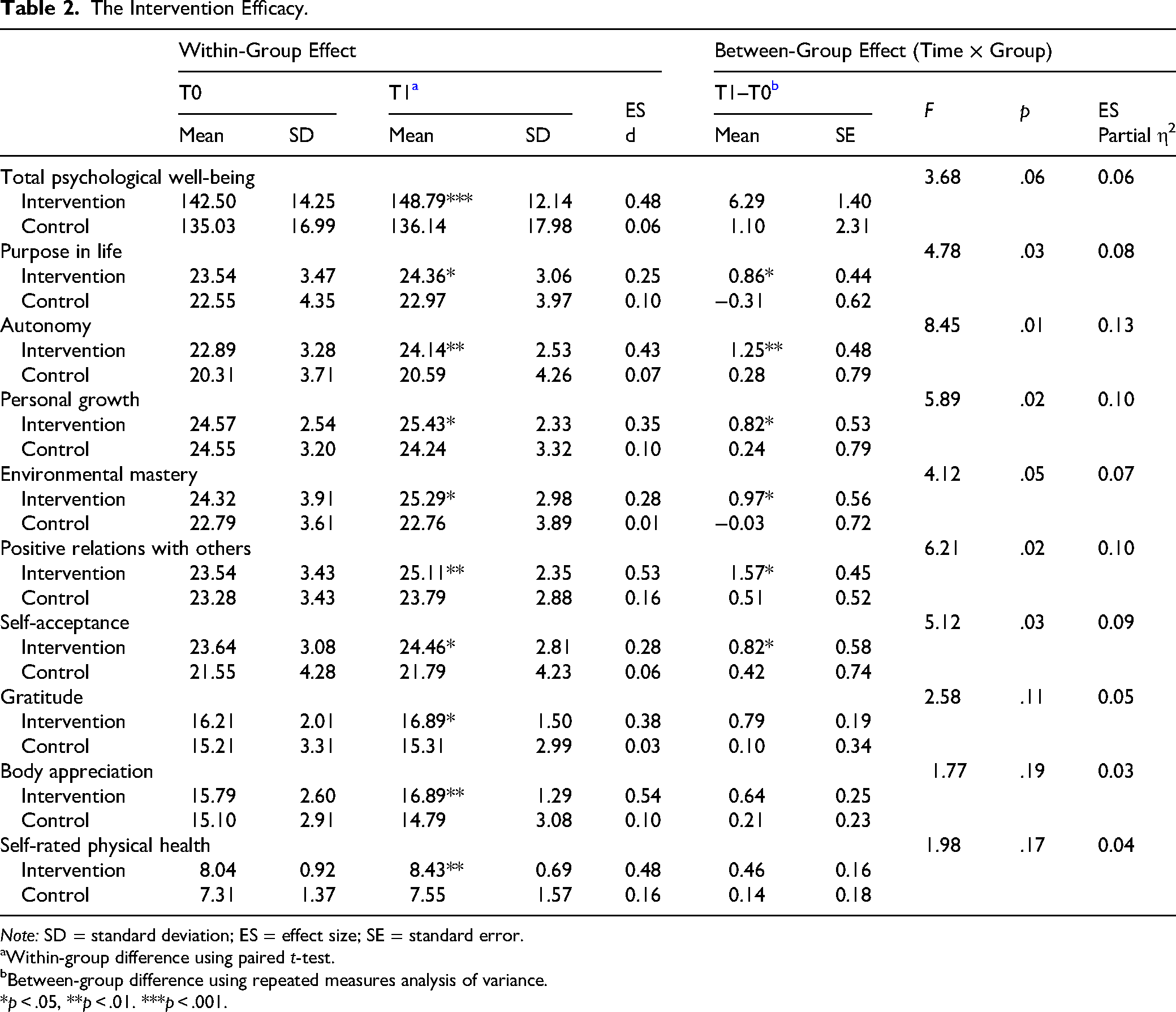
As shown in Table 2, between-group (time × group) interaction effects indicated that the improvement in total PWB was slightly different between groups (F = 3.68, p = .06, η2 = 0.06). However, significant interactions were found for all six dimensions: purpose in life (F = 4.78, p = .03, η2 = 0.08), autonomy (F = 8.45, p = .01, η2 = 0.13), personal growth (F = 5.89, p = .02, η2 = 0.10), environmental mastery (F = 4.12, p = .05, η2 = 0.07), positive relations with others (F = 6.21, p = .02, η2 = 0.10), and self-acceptance (F = 5.12, p = .03, η2 = 0.09). In contrast, the between-group interactions for gratitude, body appreciation, and SRPH were not significant. Notably, the group-by-time interaction analysis was exploratory rather than preplanned a priori before data collection. Further simple main effect analyses via within-group comparisons preliminarily revealed that the intervention group showed a significant improvement in total PWB from T0 to T1 (p < .001, d = 0.48). Among the six dimensions, significant improvements were observed for purpose in life (p < .05, d = 0.25), autonomy (p < .01, d = 0.43), personal growth (p < .05, d = 0.35), environmental mastery (p < .05, d = 0.28), positive relations with others (p < .01, d = 0.53), and self-acceptance (p < .05, d = 0.28). Additionally, the intervention group showed significant improvements in gratitude (p < .05, d = 0.38), body appreciation (p < .01, d = 0.54), and self-rated physical health (p < .01, d = 0.48). Small to moderate effect sizes were observed for the intervention group's pre–post change. For the control group, no significant changes were found on any dimension (all p > .05), with effect sizes d ranging from 0.01 to 0.16. Despite the nonsignificant interaction for body appreciation and SRPH, the intervention group's significant pre-to-post improvement provides partial support for H1 and H3, indicating that the journaling intervention insignificantly enhanced participants’ body appreciation and SRPH to a certain degree. Both the within-group effects and between-group effects of gratitude journaling intervention on PWB and its six dimensions were significant, supporting the research Hypotheses H2 and H2.1 to H2.6. According to the effect sizes η2, all significant between-group effect sizes were around medium.
The Intervention Efficacy.
Note: SD = standard deviation; ES = effect size; SE = standard error.
Within-group difference using paired t-test.
Between-group difference using repeated measures analysis of variance.
*p < .05, **p < .01. ***p < .001.
Based on the 1,764 records of “three happy little things” contributed by 28 participants over 21 consecutive days, the daily records varied in content but consistently focused on small, tangible moments of happiness. Gratitude (e.g., explicit expressions of thankfulness to others or life) accounted for ∼8%, body appreciation (e.g., feeling good about appearance or receiving compliments) for about 5%, PWB (e.g., including interpersonal warmth, personal growth, sense of achievement, natural/environmental pleasure, and positive emotions) for the largest proportion (∼70%), and SRPH (e.g., good sleep, physical comfort, and recovery from minor ailments) for about 15%. The remaining 2% includes other occasional themes. Overall, the records reflect an attentive and grateful attitude toward ordinary life, through which happiness accumulates continuously.
Discussion and Applications to Practice
The present research implemented a brief gratitude journaling intervention to provide preliminary results on the relationship among gratitude, body appreciation, PWB, and SRPH in Chinese women. This finding aligns with the gratitude model of body appreciation in women (Homan & Tylka, 2018) and previous empirical studies (Voci et al., 2019; Wood et al., 2009). This is one of the first studies examining the influence of a gratitude journaling intervention on body appreciation, PWB, and SRPH among Chinese women. It was found that the three-week gratitude intervention significantly improved all six dimensions of PWB, and also promoted body appreciation and SRPH. These findings extend previous cross-sectional research on the relationships among gratitude, body appreciation, and PWB (Homan & Tylka, 2018; Romano & Heron, 2022; Swami et al., 2018) and are in line with studies showing that gratitude interventions can enhance psychological outcomes (Hill et al., 2013; Valikhani et al., 2019). This study provides intervention evidence for the role of gratitude in enhancing women's holistic health, indicating that a low-cost, simple daily gratitude practice can improve PWB across multiple domains, which is consistent with the effectiveness of previous gratitude journaling interventions (Cregg & Cheavens, 2021).
Thematic analysis of participants’ gratitude diaries offers insight into the intervention's mechanisms. Daily entries were dominated by PWB themes, indicating that the practice directed attention toward positive experiences, reinforcing a strength-based lens on daily life. Repeatedly writing “three happy little things” may cultivate a habitual positive appraisal style, fostering positive emotions and sustainable well-being (Boggio et al., 2020; Du & Liu, 2025). Explicit gratitude and body appreciation statements suggest the intervention also helped participants articulate thankfulness and develop a more accepting view of their bodies, pathways linked to improved mental health (Homan & Tylka, 2018). Thus, the qualitative diary content corroborates quantitative findings and suggests that the intervention enhanced well-being through positive cognitive-affective processing, consistent with the broaden-and-build theory (Fredrickson, 2001), which posits that positive emotions, such as gratitude, broaden one's momentary thought-action repertoires and build enduring personal resources, thereby fostering upward spirals of emotional well-being (Du & Liu, 2025).
The intervention significantly improved gratitude, body appreciation, PWB, and SRPH, thereby supporting the theoretical model proposed in the research hypotheses. This model can be used for future cross-sectional studies and intervention studies. Besides its theoretical implications, this study also holds practical significance. As a major component focused on by positive psychology, gratitude can be enhanced through daily practice and simple journaling interventions, which in turn can benefit individuals’ physical health (Boggiss et al., 2020). Moreover, increasing body appreciation can also improve one's PWB and health-related behaviors (Linardon et al., 2022; Romano & Heron, 2022). This study suggests that positive changes in gratitude can help increase body appreciation and personal growth, as well as self-acceptance, thereby improving physical health. Therefore, social workers, health practitioners, and counselors can consider implementing this cost-effective and simple intervention to enhance clients’ holistic well-being. Given the limited mental health service utilization in China (Huang et al., 2019), such a brief, self-administered gratitude diary may serve as an accessible and scalable alternative to complement traditional services.
This study has certain limitations. First, although the randomized controlled design supports intervention effectiveness, the study design did not control for several threats to internal validity, including placebo effects, participants’ desire to please the researchers (the Pygmalion effect or demand characteristics), and the mere passage of time. Consequently, the observed improvements in the intervention group might partly reflect these nonspecific factors rather than the specific effects of the gratitude diary practice. Future studies should include an active control condition (e.g., a neutral diary or a placebo activity) and assess participants’ expectations to isolate the unique contribution of gratitude. Second, the 21-day intervention was brief, and only small to moderate effect sizes were observed. Future research should extend the intervention duration and include follow-up assessments to examine the long-term sustainability of the effects. Third, the sample consisted exclusively of highly educated women from China, which limits generalizability to other genders and cultural contexts. Future studies should recruit more diverse samples (e.g., men, different age groups with diverse educational backgrounds, and other regions) to explore potential gender and regional differences. Fourth, the reliance on self-report measures may introduce response bias; incorporating objective or behavioral indicators would strengthen future research. Finally, the thematic analysis of diary entries was exploratory; future studies could adopt a more rigorous mixed-methods approach with independent coders and reliability checks.
This study explored the effects of a 21-day gratitude diary intervention on gratitude, body appreciation, PWB, and SRPH. The intervention group showed significant improvements in total PWB and all six dimensions compared to the control group, with small to moderate effect sizes. These findings provide evidence for the benefits of daily gratitude practice on PWB and inform future research and practice.
Footnotes

Ethical Approval
All procedures performed in studies involving human participants were in accordance with the ethical standards of the institutional and/or national research committee, the APA ethical standards, and with the 1964 Helsinki Declaration and its later amendments or comparable ethical standards. The present study was approved by the Human Research Ethics Committee of the University of Hong Kong (No. EA240395).
Consent to Participate
Informed consent was obtained from all participants before enrolling in the study.
Consent for Publication
The work described was original research that has not been published previously and is not under consideration for publication elsewhere, in whole or in part.
Funding
The authors disclosed receipt of the following financial support for the research, authorship, and/or publication of this article: This work was supported by the Major Project of the National Social Science Fund of China (grant number 25&ZD186) entitled “Research on Formation Mechanism, Transmission Path and Prevention & Control Countermeasures of Intelligent Social Risks.”
Declaration of Conflicting Interests
The authors declared no potential conflicts of interest with respect to the research, authorship, and/or publication of this article.
Data Availability Statement
The data generated during and/or analyzed during the current study are not publicly available due to [Under Confidentiality Period] but are available from the corresponding author on reasonable request. Participant permissions and all other relevant approvals were granted for this data sharing.