






Abstract
Currently, the dominant cultural beliefs toward disability are negative, and the existing literature is limited with respect to examining how people are using and/or viewing their disabilities positively. The purpose of this study was to identify how individuals living with a spinal cord injury (SCI) viewed and/or used their disability positively, and what contextual influences facilitated this positive approach. This study was a secondary analysis of qualitative data from a larger study. The findings revealed three levels at which disability was viewed and/or used positively by people with SCI: self, peers, and disability community. In addition, several aspects of the participants’ situations were found to facilitate this positive view and/or use of disability: personality, spirituality, support systems, and acceptance of one’s disability. The findings reveal that individuals with SCI are viewing and/or using their disabilities positively in many different ways. This study has significant implications for the direction of future research and for health care professionals who need to increase their advocacy and facilitating roles.
Every year, it is estimated that there are 4,529 new cases of spinal cord injury (SCI), and more than 85,556 people living with an SCI in Canada; 44,000 of these cases are the result of traumatic causes (Rick Hansen Spinal Cord Injury Registry, 2010). Such injuries have significant effects on an individual’s daily functioning, self-image, and participation in society. SCI creates a significant economic impact on both the individual and the health care system, totaling ~$3.6 billion, of which $1.8 billion is associated with direct health care costs (Rick Hansen Spinal Cord Injury Registry). This figure excludes costs associated with lost productivity (National Spinal Cord Injury Statistical Center, 2004). With such significant consequences to the life of the individual, and a high economic impact on the community, there is little mention in the literature of the positive aspects of living with SCI.
Although the consequences of SCI are of great significance to the individual and society, the rehabilitation process has failed to fully satisfy the needs of SCI consumers (Boschen, Tonack, & Gargaro, 2003; Carpenter, 1994; Renwick et al., 2004; Sand, Karlberg, & Kreuter, 2006). The decreasing length of inpatient rehabilitation stay (Spinal Cord Injury Information Network, n.d.) contributes to this shortcoming. Rehabilitation plays a critical role in the process of increasing physical function, maximizing independence with activities of daily living, preventing secondary medical complications, and promoting community reintegration (Grundy & Gardner, 1998; Inman, 1999; Sarrias, Ramirez, & Vidal, 1998). However, SCI consumers feel that they are not sufficiently involved in clinical goal setting, have limited opportunities for peer interaction, and are not adequately prepared for community living (Renwick et al.). To effectively meet the needs of SCI consumers, rehabilitation planning and implementation must be informed and shaped by the perspectives of people with SCI (Hammell, 2007; Renwick et al.). The perspectives of people living with SCI, acquired recently and in the past, will incorporate elements important to that process. One of these crucial elements is viewing disability positively.
The purpose of this study was to identify how individuals living with SCI viewed and/or used their disabilities positively. We initially defined viewing and using disability positively as beliefs, attitudes, and actions that incorporated the following elements: enriching one’s life (e.g., self-advocacy, personal growth), helping others with SCI (e.g., peer education), and contributing to the disability community (e.g., collective advocacy, public education). The objectives of this study were: (a) to identify the different ways in which people living with SCI viewed and/or used their disabilities positively; (b) to identify what influences an individual with SCI to view and/or use his or her disability positively; and (c) to provide best-practice recommendations for rehabilitation professionals to facilitate individuals with SCI to view and/or use their disabilities positively.
Theoretical Orientation to the Study
The dominant view of disability has been guided by the medical model, in which disability is viewed as a deficiency in an individual’s mind or body (Barnes & Mercer, 2003). This model promotes dichotomous roles in society, elevating those who are “able-bodied” to a position above their “dis-abled” counterparts (Imrie, 1997). The result is stigmatization of those with functional limitations, based on inaccurate assumptions concerning their inferiority. The medical model has been repeatedly criticized for focusing solely on impairments and failing to recognize the influence of social, physical, and political environments in the perception and creation of disability (Imrie). This model does a disservice to individuals with SCI by promoting a fundamentally negative view of their disabilities (Imrie).
An alternative approach to disability that underpins this article is the Social Model of Disability (SMD). The SMD clearly distinguishes between impairment and disability, defining the former as a physical limitation and the latter as the disadvantages or activity restrictions society imposes on people with physical impairments (Union of the Physically Impaired Against Segregation, 1976). The SMD locates the problem of disability within various aspects of society, namely its failure to account for the needs of those who are physically impaired within its social organization (Oliver, 1996). However, the SMD has been criticized for remaining at the structural level and not taking into account the unique experiences of individuals living with disabilities (e.g., gender, ethno-racial background, socioeconomic status). In this study we attempted to address this criticism by focusing on personal experiences of disability in the context of societal barriers and the dominant ways in which urban society is organized.
Literature Review
Following an SCI, individuals are faced with numerous challenges, including physical impairments, health complications, and psychological adjustment
Self
Individual narratives and qualitative studies focused on the perspectives of people living with disabilities provide some indication of how disabilities are used positively on a personal level. Several individuals described becoming advocates for themselves when faced with barriers limiting their participation in society (Register, 1992; Zola, 1982). Some accounts reported a slower pace of life following disability, enabling increased control over one’s life, and time for reflection (Hammell, 2004; Monks & Frankenberg, 1995; Register). Often people described how acquiring their disabilities led to personal growth (Carpenter & Clark, 1994; Charmaz, 1991; Chun & Lee, 2008; Hammell, 2004), such as adopting a new positive outlook on life (Chun & Lee; Register) and developing one’s spirituality (Chapin & Kewman, 2001). Relationships with friends, family, and partners were occasionally strengthened following an SCI (Carpenter & Clark; Charmaz, 1991; Chun & Lee; Manns & May, 2007; McMillen & Cook, 2003). Additionally, people with SCI reported exploring new leisure activities (Carpenter; Hammell, 2004). Using disability positively can be achieved in a variety of different forms on a personal level.
Peers
We found within the research on SCI that individuals used their disabilities to help their peers. Peer support is an important component during SCI rehabilitation (Boschen et al., 2003; Kelly, 2007; Sand et al., 2006; Sherman, DeVinney, & Sperling, 2004), and postdischarge in terms of sharing valuable information and ideas (Carpenter, 1994). Post SCI, many individuals desired to provide peer support through volunteerism or counseling (Carpenter; Charmaz, 1991; Hammell, 2004; Register, 1992; Van de Ven et al., 2005). Furthermore, McMillen and Cook (2003) reported that some individuals expressed their desire to assist newly injured individuals in their search for self-identity and in their struggle with despair, offering the understanding and support that comes from one who has experienced a similar journey.
Disability Community
At a broader level, people have used their disabilities positively for the benefit of the disability community at large. Several narratives described efforts to increase public awareness through educating the able-bodied population about disability and adaptive aids (Register, 1992; Zola, 1982). Others have participated in advocacy for the rights of people with disabilities, such as increasing accessibility in public spaces or gaining control over attendant care services (Carpenter, 1994; Hammell, 2004; Titchkosky, 2003; Zola, 1982). Moreover, in a study examining quality of life among people with high-level SCI, giving back to the disability community was identified as an important contributor (Hammell, 2004).
Collectively, consumers have individually achieved significant gains for the disability community. The independent-living movement in the United States was developed by people with disabilities to provide information and services needed to live independently (DeJong, 1979). In Canada, various disability organizations advocated for and won equal opportunity for participation in the electoral process and inclusion in the Canadian Charter of Rights and Freedoms (Boyce et al., 2001; Stienstra & Daubin, 2006). For example, through extensive lobbying, Ontarians living with disabilities initiated a program enabling self-management of attendant services (Yoshida, Willi, Parker, & Locker, 2006). In addition, Steven Fletcher (Minister of State [Democratic Reform] and member of parliament of Charleswood, St. James, and Assiniboia), Sam Sullivan (former mayor of Vancouver), and David Onley (Lieutenant Governor, Ontario) are all living with a disability and have been serving the disability community across Canada through their respective government positions (Boyce et al.; Gillespie, n.d.; Stienstra & Daubin).
Enabling Aspects
Our search of the existing literature revealed a limited amount of research examining the positive use of disability following an SCI. The literature we did find identified that social support (Charmaz, 1991; King et al., 2003), financial resources (Charmaz, 1991), and personal achievements (King et al.) are associated with positive experiences of living with a disability. Indirectly, research on quality of life (QOL) following SCI suggests contextual or enabling factors to facilitating viewing disability positively. Issues related to achieving a high QOL include emotional well-being, physical function and independence (Manns & Chad, 2001), meaningful relationships (Dijkers, 1997; Hammell, 2007), and control of one’s life (Hammell, 2007). Education (Krause & Anson, 1997), meaningful life activities (Hammell, 2007; Inman, 1999; Krause & Anson), peer mentoring (Sherman et al., 2004), accessibility (Inman; Manns & Chad), and adequate finances (Manns & Chad) are also important influences on quality of life. The narratives and studies noted suggest that many individuals viewed and used their disabilities positively. However, the information gained from these studies was somewhat indirect, as the researchers did not specifically examine research questions focused on viewing and using disability positively. Accordingly, our study offered a direct examination of how individuals viewed and used their disabilities positively following an SCI.
Methodology
The current study was a secondary analysis of qualitative data obtained from an original study entitled “Getting On With Life: Meeting Consumers’ Social Adaptation Needs” (Renwick et al., 2004). The original study sample consisted of 80 community-dwelling individuals with complete or incomplete quadriplegia or paraplegia living in Ontario, which is Canada’s largest province in terms of geography and population. Participants came from the five regions of Ontario that represented both rural and urban areas: Thunder Bay, Barrie, Toronto, London, and Ottawa/Kingston. The participants had received their initial rehabilitation from 3 to 20+ years prior to participating in the study. Interviews were conducted between 1999 and 2001. Demographic data on the participants is outlined in Table 1. All procedures and materials used in both the original study and the secondary analysis received ethical approval from the University of Toronto.
Comparison of Demographics Between the Original Study, “Getting On With Life: Meeting Consumers’ Social Adaptation Needs,” and the Present Study

N = 80
N = 52
In the original study, semistructured, face-to-face interviews lasting 2 hours were conducted by trained interviewers. The information sought ranged from participants’ lives prior to and after the SCI event, various aspects of the rehabilitation process, and recommendations for change. During verbatim transcription, names of participants were replaced by a numerical code and all identifying information was deleted. The data were initially coded using descriptive terms based on a coding scheme developed during the original study.
For our study, we selected coded segments relevant to individuals using or viewing their disability positively. Fifty-two participants were represented in these codes, collectively generating approximately 200 distinct coded segments (535 pages) for secondary analysis. In addition, participants who contributed at least three coded segments were chosen for an in-depth reading of their entire interview. This level of analysis provided a broader context in which to interpret the individual’s coded segments. A total of 20 interviews were chosen and read in their entirety. These 20 interviews resulted in another 954 pages for analysis.
Codes Used in the Present Study That Relate to Viewing and/or Using Disability Positively

A transportation service for people with disabilities
The current study consisted of a finer-grained, secondary analysis using a modified grounded theory approach. Our analysis began with detailed memo writing while reading coded segments (Charmaz, 2006), followed by discussion between the student and faculty researchers and further memo writing. Coded segments were then organized into the following preliminary categories: employment, advocacy, family, identity, education, mentorship, spirituality, contribution, civil disobedience, and privileges obtained because of one’s disability. Then these categories, or elements thereof, were organized under three main conceptual groups: using one’s disability positively with regard to oneself (e.g., employment, identity), one’s peers (e.g., mentorship, education), and the disability community (e.g., contribution, civil disobedience). Subsequently, an initial graphic depiction of the key concepts was created. Member checking (Erlandson, Harris, Skipper, & Allen, 1993) was conducted to verify our final analysis, ensuring trustworthiness, by approaching two individuals involved with the previous study. These individuals verified our analysis and confirmed its appropriateness. Pseudonyms are used to protect the anonymity and confidentiality of the participants quoted.
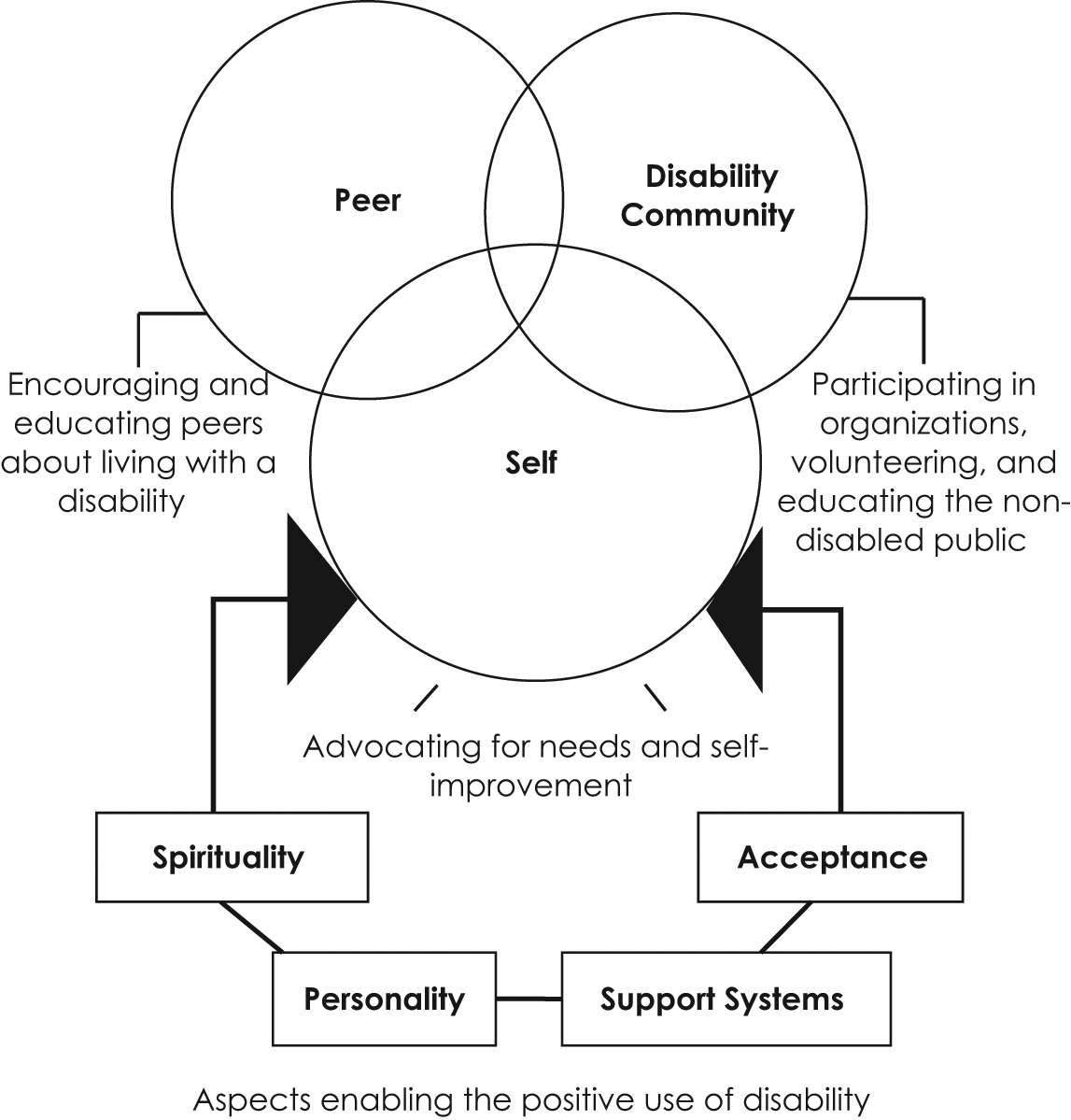
Initial framework
Findings
Descriptive information for the 52 participants (see Table 1) included in the analysis reflected the demographic spread in the original study. The analysis did not reveal any patterns of differences because of gender, level of injury, time since initial rehabilitation, and geographical region. The analysis revealed three distinct levels at which people with SCI viewed and/or used their disabilities positively: self, peers, and disability community (see Figure 1). This level of self-disability represented aspects of using and/or viewing disability to one’s benefit. The level of peers involved using one’s own disability to help others with SCI. The final level described participants using their disabilities for the benefit of the disability community at large, as well as the nondisabled population. These levels were incorporated into an initial graphic depiction (Charmaz, 2006) representing our findings. Participants described involvement in one, two, or all three of the levels, as represented by overlapping circular areas. Participants identified many more positive changes at the level of self as compared to the other levels, leading to size discrepancies of the circular representations.
The analysis also revealed enabling influences that facilitated participants using and/or viewing their disabilities positively at the level of self, represented by the rectangular boxes in our framework linked to this level. These aspects included personality, acceptance of one’s disability, various forms of support, and spirituality. The findings at each level are discussed in detail.
Self
The participants in this study described various forms of using and/or viewing their disability positively at the level of the self. For example, many participants used their disability to advocate for themselves, for personal growth, to improve family relationships, to learn new hobbies and talents, to find a new career, and to obtain certain benefits.
Advocating for self
One of the ways that individuals used their disability positively was to advocate for themselves. Self-advocacy manifested itself in many different ways, both inside and outside of the hospital/rehabilitation setting. Some of the areas in which individuals advocated for themselves were hospital care, attendant care, personal equipment, funding, accessibility, and housing. During rehabilitation, some individuals found that self-advocacy was needed so as to have their individual needs met. A common issue that required advocacy was treatment by different health practitioners. Mike went as far as demanding to choose his own primary nurse and physiotherapist because he was not satisfied with the ones he was assigned:
I ended up going in and telling the head nurse and my doctor, and there was friction between me and my primary nurse. Got along with my occupational therapist great. I refused my physio’s [physiotherapist’s] care. And they came in and tried to pull a heavy [exert medical authority on the subject] and I just said, “Look. I don’t give a fuck. I’ll go down and I’ll do all my classes and do all my work, but when it comes time to do my hour with my physio, you know, forget it.” And then they got into litigation and I understand it, I understood it then, and I said, “Fine. Let me pick a head nurse, or primary nurse, and a new physio. This chick [woman] is trying to hold me back.” . . . Basically, I think I had a couple of problems. Anyways, they let me choose a new physio and a new primary nurse, which was good, and, and it worked for me.”
Attendant services were another area in which participants used self-advocacy. Ryan found that when he moved out into the community he needed assistance, but his family could not completely fulfill this need, which led him to hire an attendant:
It was hard because it’s a, it puts responsibility on [my family] that didn’t help, and my father was dying of cancer at the time. So you know it wasn’t fun and games. My brother was greatly supporting. . . . And I started paying for attendants out of my own pocket sort of very quickly after the rehab [rehabilitation] leaving the hospital, so that I could start getting some independence, give some relief to . . . family could not chip in, step in, and do the whole care that was needed. So I hired my own attendants and paid for them.
In the interviews, many of the participants spoke about having to advocate for themselves to obtain the necessary equipment and funding for the equipment. Henry wrote a letter to his legislative assembly member to obtain funding for a stair glide, so that he would be able to access the upper level of his home:
I had applied for um, to buy, it’s called a stair glide. . . . And um, it was through a government program. . . . And, so then I applied for the stair glide anyway, and they lost my application, and although they had a record of my application and it was filed, they couldn’t find it, so that I would have to apply again the following year. So, um, I found that very uh, very aggravating . . . so I wrote a letter to my member of parliament [legislative assembly] at that time and I also wrote a member, a letter to uh, uh, [name], who was part of the Liberal government I believe . . . and uh, suggested to him that the government’s money all went to [large urban center], and the outlying areas were left unserviced. And anyway, it was more of an embarrassment thing, so [name] himself wrote the uh, wrote and okayed the funding for my stair glide eventually.
Many of the participants spoke about their lack of physical accessibility and had taken it upon themselves to improve accessibility in many different ways. Some participants wrote letters to managers of stores and buildings, others spoke directly to those in charge, and some resorted to civil disobedience. Sharon commented about wanting to watch a movie about a person in a wheelchair, but could not, as the theater could not accommodate her in her wheelchair:
We went to see a movie at this movie theater in [city], and the movie was about a girl in a wheelchair. The theater that it was in was not wheelchair accessible. So, we went and complained to the people, saying, “How can you have a movie about somebody who is in a wheelchair and your theater is not wheelchair accessible?” And I was the one who was asking it.
Harry was upset that the police did not penalize people without the proper documentation parking in spots designated for individuals with disabilities. He took matters into his own hands, with the assistance of his son:
But then we used to get little things where—stickers to put on. . . . My boy put one on a window. And there was no handicapped sticker on [the car]. There was no hand controls, there was nothing. Right? So he put one of these on the window. Well, you’re not allowed to stick anything to anybody’s car. So they phoned me up and said if I do it again I will be charged. Where was the cop [policeman] lets you park there? You know, so it was that kind of thing that kind of rubs you off. Now I just . . . I’ll just take the, because if the cops aren’t around, you just take the gas cap, because the price of a gas cap and the price of the ticket is about the same thing. So, you don’t wreck their car. You just take their gas cap.
Personal growth
Some participants found that disability had a positive impact on their personal growth. Participants mentioned that disability was a catalyst for self-discovery and self-improvement. Some participants found that it allowed them to develop certain skills, whereas others found that it changed their attitudes in a positive way:
Within the first week [of rehabilitation] I was there I needed to get from my room to the cafeteria . . . and this was in the evening. From my room to the cafeteria would have been a thousand feet. That first evening it took forty-five minutes to do that, and as I was going through that forty-five minutes— obviously, it was like doing a marathon—I realized that this was it, this is what I had [pause] that being in a wheelchair was going to be my life in the foreseeable future. It was not going to fix itself. So I made a decision at that time to do everything I could to learn how to do things, and that I would be independent no matter what. So the whole next few months was driven, was based around this goal I set for myself. To learn as much as possible and be as independent as possible. This was the kind of situation where I was going to get information if I was going to deal with this new body. The body is what I had; I had to learn how to use it. (Ryan)
Some individuals reported that their disabilities led to improved family relationships. Melissa spoke about how it brought her family closer: “Positively, things that—my family, it drew us closer. We were always close, but it’s even drawn us closer.”
Discovering new hobbies and talents
Many of the participants found that, after their injuries, they were able to pursue new hobbies and talents. Some participants stated that because of their injuries their lives had slowed down and they had more time to pursue leisure activities. Before his injury, George worked a lot at a grocery store, usually the night shift. Following the injury, he did not work as many hours and had more time for leisure activities:
My pace is kind of slowing down considerably . . . . I’m doing things now that I never thought I would do, so in a way my accident has been a good thing to a certain extent, because it certainly slowed my lifestyle down and took on a whole new adventure, which has luckily for myself turned into a positive by meeting someone and uh, that’s been positive on my life.
Work
Work was also a very positive aspect in many of the participants’ lives. The participants spoke about how their jobs were very important to them and contributed to their self-worth. When asked what was important to him at present, Julian answered,
It’s important for me to continue the fight towards um [pause] towards equity. . . . And that’s part of the reason why I work at [name of workplace]. I think that, I think what I do and what [the television show I work on] represents has the potential to be a positive, an influence for positive change.
When Julian was asked what events in his life since his injury had an impact on him, he answered,
Um [pause], having the opportunity to do some acting was another one. I can’t deny that. ’Cause that’s one of my dreams, and I’ve been able to [accomplish] at least some of my dreams on a infrequent basis. . . . Yeah. Working, working, working. Boy, when I’m not working I’m a different person, I’ll tell you. So the opportunity to employ myself, get money, and to feel a part of the vast [pause] scheme of things out there is critical for me. . . . And I’ve had jobs that I’m generally proud of . . . . Those things have been image enhancing for me.
Obtaining benefits
Finally, some individuals saw their disability as a positive in itself because it provided them with certain benefits that able-bodied people would not receive. For example, a few individuals mentioned that they received preferential treatment at places such as concerts and amusement parks:
I was saying, “Well, I can’t do this, you know, I’m in a wheelchair, bla, bla, bla.” She [another person] was in a wheelchair herself, by the way. Um, and she said, “Well, that could be an advantage sometime,” and then I say, “Well, that’s not really fair.” She says, “If it’s an advantage and you can use it, go ahead and use it.” So, I’ve adapted that attitude in a number of things and uh, uh, it’s something that, you know, I would suggest people look as a positive in that it can get you places that you can’t otherwise get. . . . Give me an example? Well, it’s good when you’re at Walt Disney World to get in the front of the line. (Henry)
Peers
In addition to using or viewing their disability positively at the level of self, many participants spoke of using their disability positively to help other individuals living with disabilities. The forms of helping others that were discussed were peer encouragement and peer education. Participants spoke of providing informal encouragement to their peers, often during their stay in a rehabilitation hospital. The common experiences they shared with fellow patients enabled them to provide meaningful encouragement. Encouraging peers while in hospital became a source of motivation and fulfillment for the individual doing the encouraging:
It was wonderful. The very first healing step that you take is swapping war stories with your fellow inmate, classmate, whatever. . . . You can see people that you can help by just helping them to open their mind a little bit, and to appreciate the advantages of their own situation. (Emily)
Peer encouragement often continued once the participants left the hospital and entered the community. Participants spoke of staying in touch with the friends they made during their hospital stay, as well as visiting those newly injured. One individual shared a few instances of meeting other people living with disabilities while in the community, and the value she found in encouraging them:
I’m helping other people. It’s really rewarding when somebody phones and they’re very upset and . . . they’re a week into their injury and they’re laying in the hospital and they don’t know what they’re doing and, you know, it’s nice to talk to somebody that has been there and can say, “Don’t worry, it’ll all work out eventually.” (Melissa)
In addition to providing encouragement, many participants were involved in peer education. Some participants spoke of educating their peers on an informal basis. Others led structured group education sessions for patients in a rehabilitation hospital, and one individual spoke of developing a guide for people with SCI: “Lending my experiences to other people who [pause] who will have the same experiences, but I can save them a number of steps” (James). Participants spoke of various ways in which they used disability positively to help others through peer encouragement and peer education.
Disability Community
On a broader scale, many individuals indicated that they used their disability positively for the benefit of the larger disability community and the nondisabled public. Several participants spoke about their involvement in various disability-related organizations, whereas others educated the public to increase knowledge and awareness of living with a disability.
Systemic advocacy
Advocating for increased accessibility in public spaces was frequently mentioned. Some participants fought for accessibility in housing through government lobbying or involvement in housing projects. Accessible transportation was also identified as an area of advocacy. One participant spoke about his involvement in establishing an accessible transit system, whereas others described fighting for improved accessibility of existing transit. John’s concerns over accessibility prompted him to form a lobbyist group to address the issue:
We started a, a lobbyist group in [city]. [Name of lobbyist group], and that’s only, we, we started getting worried about accessibility and us being charged by taxis for our wheelchair storage and all these little things that came up.
Public education
Several participants benefited the disability community by participating in formal and informal education of the able-bodied population regarding their disability. However, the education some individuals participated in was injury prevention, which might be conceived as promoting a negative view of disability. Nevertheless, Harry viewed his involvement in injury prevention as a way of assisting others. He explained to some students about the importance of acting safely around a pool to prevent injury:
And her kids would come over and she’d say, “Ask him.” Because she had put in a pool. And they’d say, “How did you get hurt?” And I would tell them, and all that. And they don’t fool around in the pool, this is what could happen. With running and pushing and stuff like that. So you help people that way.
Another individual described casually educating people about his equipment when they showed an interest. Public education was largely driven by a desire to challenge society’s negative attitudes toward disability. Participants enjoyed demonstrating their abilities as wheelchair users and speaking about equality. William stated,
I think my one of the purposes of my life right now is to [pause] to teach people that I’m a public person. You know, I’m a person with a disability. And I’m vocal about it, you know, I’m just as good as anybody else.
Sharon expressed anger at the stigma she faced when other able-bodied individuals treated her differently because of her physical limitations: “I was very mad. You know, I was like, ‘I am still a human being. I am in a wheelchair, but I am still a human being.’” Participants also described a specific role in educating students; for example, Emily mentioned,
That’s the one thing that I do. I like to participate in interviews. I see students, all kinds of students, and if I can impart a little bit of what I find that it takes for all of us to get through the day, I feel good about that.
Organizational membership
Membership on various committees and boards was frequently mentioned during the interviews, ranging from hospital boards, housing boards, and disability-related organizations. Some individuals dedicated their time to a sole organization, whereas others were involved with many through their lifetime. For example, Alan was a member of boards at all of the aforementioned levels, for which he received a citizen-of-the-year award recognizing his contributions. Several individuals found membership in various organizations to be a positive experience; for example:
I’ve been on the Board of Directors [of a housing initiative] for many years. . . . That has been a very, very positive thing, you see. Something else that I never expected to do in my life either is be involved with boards. . . . Like I said, it was probably out of my realm before. (George) It was a huge committee. It was all the access and equity, all over the city. We all got together and that was pretty good, that was a positive thing. . . . I went as a committee member to the Board of the, of the [name of council] for the City of [name]. So I was on the Board there for a couple of months. That was very, very gratifying. That was very gratifying. (Emily)
Participants described several volunteering experiences with organizations that help people with various disabilities. They enjoyed having more time following their injuries to devote to volunteering, and found it added meaning to their lives: “I guess now I am more active in volunteering and helping more people learn about the programs out there, to help them. . . . I can’t stress volunteering as—it’s good, a good healthy way of living” (Robert). Alan described his involvement in an organization that provides equipment to people living with disabilities in countries where they would not otherwise receive it:
All the way through my life as a disabled person I’ve been working in one thing or another to improve things for the other disabled people. . . . I work [pause] two days a week as a volunteer . . . where we build and recycle used things, disabled equipment, like wheelchairs. . . . A lot of stuff goes down to the Bahamas . . . there is a great shortage of those kind of things down there in those countries for [pause] for their disabled citizens.
Enabling Aspects of Disability
In our analysis we found several aspects that enabled participants to view and use their disability positively at the level of self following SCI. These included personality, acceptance of one’s disability, social support, and spirituality. Certain individual characteristics seemed to contribute to one’s ability to view and use one’s disability positively. Confidence, assertiveness, and seeing oneself as an independent person played key roles. For example, Ryan described how his confident nature prior to his SCI helped him to pursue his life goals after injury:
I always had the confidence that no matter what the circumstances were I had value as a person, regardless of being in a wheelchair. . . . I had enough confidence in myself that I could still accomplish things and do things that would give value to myself, and my life around me, and the people around me. So I could still go and work . . . and build a company . . . and be independent.
Others defied those who said they would not be able to achieve something because of their disability. William spoke about his drive to succeed and prove others wrong: “I’m cocky, I’m stubborn, I’m pig-headed. When somebody tells me I can’t do something I will prove you wrong or I will kill myself trying, so . . . .”
Acceptance of one’s disability contributed to using and viewing it positively. Many participants felt that acceptance was ongoing, requiring time and reflection. Although a continuous process, when individuals were able to accept their disability it helped them move forward with their lives. James described his experience of accepting his disability:
It takes about a year, two years to get your head on, kind of, straight after the injury. Then it takes it a number of years to get your ass organized on what you want to do with the rest of your life. . . . I, I’m very happy with myself. . . . I’m [pause] if you go back to if I had to do it all over again, I’d do it the same way again, I wouldn’t change anything. . . . I’m very happy with my life now.
Another enabling factor was support from family, friends, and/or health care professionals. Some participants indicated that support from others was necessary for the positive use of their disability. George expressed the value of his relationship with his wife, and how her support enabled him to pursue activities and life goals:
[Meeting my wife] totally changed my life . . . she’s been the biggest impact on my life. Because, like I said, we do more things than most able- bodied people. . . . We aren’t standing still, uh, we’re definitely moving forward, on with our life, and we have dreams of getting out of here and moving into a house eventually and, you know, but she’s been the number one impact on my life.
Beth described the positive impact her guitar teacher had on her pursuit of music following her SCI:
My teacher is a flamenco guitarist . . . and he wanted me back in his group. . . . So when I was going for the surgery he said that he wants me to stay with him when I recovered. He said, “Even if you are in a wheelchair I still want you to be in my group.” This was very motivating and encouraging. So once I could sit, I grabbed my guitar and started to practice.
Grace was grateful for the support of family and friends to help her overcome barriers while traveling:
And having such an amazing group of friends and family, you know, the barriers were insignificant. If there were stairs, who cares? Each person grab a corner, and carry me up, and you know, when my sister had gone down to [country], thank God she’s, was so strong. They—the plane didn’t have any kind of a lift or anything like that, so [pause] we had no choice but they had to carry me, like, it wasn’t like a big airport at all.
In addition, health care professionals were mentioned as providers of motivation and resources to help participants realize their goals:
I think that she was my first indication of someone who didn’t stop at the scope of their own position. Who looked at the totality of the picture and provided whatever she needed to provide to get you there. Yeah, I met some valuable people and two of them were physios. . . . Well, I think that [pause] that may have helped me to realize that the limits that I was placing on myself were unrealistic . . . that there may [be] another level. There may be another effort that I could make, and I just have to run into the right people. I think probably that did teach me that guidelines were only guidelines, they’re not rules and rights [pause] and if there is something you want or need to accomplish beyond the scope of what it is that you are being held in, there is no reason why you can’t do that: You just have to find the right venue. Find the right person, find the right agency. Go looking for it and find it. (Emily)
Finally, some individuals felt that their spirituality gave them hope and strength to continue with life. Thomas described the positive outlook his faith provided:
Well I want to help others. . . . Too many want to say it’s the end. The end. It doesn’t have to be the end. . . . You’re gonna have your downs, but you don’t have to stay there. And I think, being a Christian, knowing Jesus Christ, that’s a big thing right there. . . . Well, you’ve got scripture and you can read it. Which, I have to admit, I’ve read more in the last two weeks than I’ve ever read.
Living with one’s disability positively on a personal level was facilitated by specific individual characteristics, accepting one’s disability, receiving support, and a spiritual connection.
Discussion
The experiences of 52 individuals from a sample of 80 living with an SCI informed our development of an initial framework regarding how disability is viewed and used positively. The framework consists of three levels at which disability is used positively: (a) self (e.g., advocating for oneself, personal growth, finding new hobbies), (b) peers (e.g., peer encouragement, peer education), and (c) the disability community (e.g., systemic advocacy, participation in disability-related organizations). Included in the framework are several aspects that individuals described as enabling them to view and use their disability positively. A search of the current literature did not reveal an existing framework that encompasses these themes; however, several components of our analysis support and add to what exists within the literature.
As with any secondary analysis, we conducted analyses on this topic. This was only one of a number of key areas investigated in the original study. It might have been possible to gather more in-depth data specific to the research question had we conducted our own interviews with questions pertinent to the research topic. Furthermore, the interviews used for analysis were conducted between the years 1999 and 2001, and many participants were involved in rehabilitation decades prior to their interview. In the years following, there might have been changes to the health care system, sources of funding, and/or accessibility for people with disabilities. These changes might have altered participants’ responses if the interviews were conducted in the present year of 2011. Although the sample used (n = 52) in this study represented the demographics of the complete sample used in the original study (N = 80), saturation was not reached because of unknown information regarding participants’ ethno-racial backgrounds. Nevertheless, this study provides valuable information to the body of literature regarding the positive view and use of disability following SCI.
Using one’s disability positively on a personal level involved self-advocacy, personal growth, improved relationships, participating in new activities, occupational pursuits, and gaining benefits. Personal growth and the development of new activities resemble aspects found in Carpenter and Clark’s category of redefining disability in their study of meaning following SCI (1994). Improved family relationships arose within the theme challenging the bonds of love in DeSanto-Madeya’s (2006) research on the meaning of living with an SCI. The ways in which people with SCI helped their peers included education and encouragement. Carpenter and Clark described how individuals with SCI placed importance on such interactions with their peers. In addition, DeSanto-Madeya emphasized how helping peers brought a meaningful purpose to one’s own injury. Using one’s disability positively for the betterment of the disability community is found in the literature, as well. Educating the public and challenging negative stereotypes was noted in Carpenter and Clark’s category of establishing a new identity.
Within our study, public education in the form of injury prevention was described as a way of helping others within the community. However, people with disabilities engaged in this type of education might unknowingly encourage their stigmatization within society (Wang, 1993). Although research has examined the effects of injury prevention on its intended audiences, consideration must be given to its negative portrayal of people with disabilities. Individuals with traumatic SCI involved in educating about injury prevention should do so with an awareness of the potential negative effects of such efforts (Wang).
The enabling aspects identified by the participants include spirituality, personality, acceptance of one’s disability, and adequate support systems. These further dimensions were identified by the participants as methods that assisted their ability to view and or use their disabilities in a positive fashion. These aspects were found to assist in coping and providing internal strength to progress forward in life while living with their disability. These aspects are similar to those associated with positive outcomes of living with a disability found in the literature (Charmaz, 1991; DeSanto-Madeya, 2006; Hammell, 2007; King et al., 2003).
Part of our framework relates to the final stage in Salick and Auerbach’s (2006) model of adjustment following trauma. Based on people living with visible impairments after trauma, the model outlines five stages of adjustment: apprehension, devastation, choosing to go on, rebuilding, and integration. The findings in our analysis coincide with and add to the positive aspects described in the integration stage, which include giving back to the community and personal growth.
Although various elements of our analysis are supported by the literature, there has been little research addressing this topic directly. It is important to expand this area of research to gain a better understanding of how individuals can view and then use their disability in a positive manner, so that the transition period from injury to recovery can progress with fewer interruptions. Thus, in this study we examined, within a large community-based sample of people with SCI, how they used their disabilities positively. The findings might have importance for people living with other long-term conditions involving some physical limitations.
Health care professionals (HCPs) have been shown to adhere to commonly held negative stereotypes of disability (Carpenter, 1994). This study has challenged these perceptions by demonstrating how people with SCI view and use their disabilities positively. Furthermore, this study identified the potential of HCPs to be an enabling factor for the positive use of disability. Numerous participants in this study commented specifically on the significant impact HCPs can have on their recovery process, in particular helping them to develop a broader view of disability.
During rehabilitation, HCPs must consider the psychosocial dimension of SCI consumers, and resist the tendency to focus solely on treating physical impairments. Newly injured individuals can be encouraged and supported to advocate for change when faced with obstacles in rehabilitation. This empowerment would also help them thrive in the community. HCPs should help prepare individuals to live independently with or without necessary home supports once they leave the rehabilitation facility. HCPs have access to various resources (e.g., housing options, attendant services, financial resources), and they can impart this knowledge of available supports, which might enable individuals to challenge any negative perceptions of their respective situations. During their stay in rehabilitation, HCPs can organize opportunities for community integration to help individuals feel confident to live with a disability upon discharge. By HCPs focusing on an individual’s abilities and interests, individuals can adopt new hobbies or participate in existing ones with modification
HCPs are in a position to facilitate involvement in peer-support programs, such as the one provided through the Canadian Paraplegic Association (CPA, n.d.). Individuals involved in the CPA peer-support program volunteer their time to assist newly injured individuals and their families with various issues (e.g., relationships, self-care, employment, transportation, and sexuality; CPA). HCPs can also introduce newly injured individuals to peer mentors during their rehabilitation stay, as examples of people living positively with disability, and to demonstrate the capacity with which they might be able to assist others in the future.
Regarding participation in disability-related organizations, HCPs should be aware of these efforts and encourage participation when the opportunity arises. One such example is the Ontarians with Disabilities Act Committee, in which individuals and organizations collectively work toward a barrier-free society (Ontarians with Disabilities Act Committee, n.d.). HCPs are also in a position to introduce the positive aspects of living with a disability to their colleagues and the able-bodied population in daily interactions. In essence, health care professionals need to examine their perceptions of disability and adopt an enabling role.
Our initial framework of living positively with a disability would benefit from being tested further on people with SCI as well as those with other long-term disabilities. Additionally, the potential influence of gender and ethno-racial background should be investigated. Future studies should examine the positive view and use of disability directly by targeting questions toward specific levels and connections in our initial framework. This knowledge would help to further develop and test the initial framework presented in our analysis.
Health care professionals and members of society in general often perceive living with an SCI negatively. An initial framework was developed in this study based on a large community-dwelling sample conceptualizing how individuals view and use their disability positively following SCI. The study findings challenge the negative perceptions of society. A shift to disability-positive research is needed to go beyond the boundaries of conventional (negative) disability research. This shift will provide the foundation for a more comprehensive rehabilitation approach.
Footnotes
Acknowledgements
The time given by the participants in the original study and their generosity in sharing their experiences is gratefully acknowledged.
The secondary analysis reported here was completed in partial fulfillment of the requirements for the MScPT degree in the Department of Physical Therapy, University of Toronto, by the first five authors; the last two authors were their research supervisors.
The authors declared no conflicts of interest with respect to the authorship and/or publication of this article.
The authors disclosed receipt of the following financial support for the research and/or authorship of this article: Funding was provided by the Ontario Neurotrauma Foundation (Grant # ONBO-00021) to the last two authors and their colleagues.