






Abstract
Some nurses who provide AIDS care, in addition to experiencing stigma themselves, also exhibit negative attitudes and perpetrate stigma and discrimination toward persons living with HIV (PLWHAs). We used a participatory research approach to explore the nature, context, and influence of stigma on the nursing care provided to PLWHAs in four low- and middle-income countries: Jamaica, Kenya, South Africa, and Uganda. Eighty-four registered nurses, enrolled nurses, and midwives participated in interviews and 79 participated in 11 focus groups. Nurses were very aware of the stigma and discrimination that AIDS evoked, and made adjustments to their care to decrease the manifestation of AIDS stigma. Despite the assurance that PLWHAs were treated equally, and that universal precautions were used consistently, we found that in reality, nurses sometimes made decisions about nursing care that were based on the appearance of the patient or knowledge of his or her status.
Keywords
Stigma directed at persons living with HIV and AIDS (PLWHAs) and their caregivers has coexisted with the global spread of the virus for the past three decades (United Nations Program on HIV/AIDS [UNAIDS], 2003). Indeed, the negative consequences of stigma and discrimination comprise a “secondary psychosocial pandemic” (Sowell & Phillips, 2010, p. 394) that adversely burdens PLWHAs as well as the rest of society. The phenomenon of stigma is multidimensional and is particularly challenging because of the layering of AIDS stigma with stigma from other illnesses (Lekas, Siegel, & Leider, 2011), behaviors, gender, and sexual orientation (Mill et al., 2009). Stigma might be perceived or enacted by the individual toward the self or by others toward the individual and family (Liamputtong, Haritavorn, & Kiatying-Angsulee, 2009). PLWHAs are socially constructed as “other” (Machine, Ross, & McCurdy, 2011), and experience stigma within a context of culture, power, and habitual patterns (Parker & Aggleton, 2003; Rutledge & Abell, 2005). Canadian researchers (Mill, Edwards, Jackson, MacLean & Chaw-Kant, 2010) theorized that stigmatization is a social control mechanism that contributes to the marginalization of PLWHAs.
In many low- and middle-income countries (LMIC), women are at particular risk for the social exclusion and health inequities that often accompany the processes of stigmatization and discrimination (Liamputtong et al., 2009; Mill & Anarfi, 2002; Sowell & Phillips, 2010). Women who work as nurses in these environments must cope with additional pressures related to frequent occupational exposure to infected body fluids, lack of policy to guide clinical decision making, and inadequate supplies of the resources necessary to carry out their responsibilities (Ehlers, 2006; Vitols, du Plessis, & Ng’andu, 2007). Nurses frequently experience stigmatization by association with PLWHAs in the workplace (Delobelle et al., 2009). Because of this, nurses face significant challenges to their capacity to provide quality care to PLWHAs (Mill et al., 2009). There has been limited research to document the impact of stigma on quality of care provided by nurses to PLWHAs (Holzemer & Uys, 2004).
There is a perception that some nurses who provide HIV care, in addition to experiencing stigma themselves, also exhibit negative attitudes (Deetlefs, Greeff, & Koen, 2003; Hodgson, 2006) and perpetrate stigma and discrimination on their HIV-positive patients (Holzemer et al., 2009; Uys et al., 2009; Yeap et al., 2010). Many authors have documented findings of stigmatization by health care providers toward PLWHAs, noting that delayed access to diagnosis and treatment is a worrisome outcome (Guoxi, Moji, Honda, Xiaonan, & Konglai, 2007; Kinsler, Wong, Sayles, Davis, & Cunningham, 2007; Zhou, 2007). Mahendra and colleagues (2007) found that the degree of stigmatizing attitudes of nurses exceeded that of physicians on a stigma-index instrument administered in three facilities in India. Similarly, Andrewin and Chien (2008) surveyed nurses and physicians in Belize and found that the former more often gave differential care to patients based on their HIV status, whereas the latter more often disclosed patient diagnoses to colleagues. In Barbados, seriously ill patients or those deemed to be from a high-risk group were routinely tested by some physicians for HIV without consent (Massiah et al., 2004).
Stein and Li (2008) found that health care professionals demonstrated negative biases and attributions, such as the belief that PLWHAs deserved the illness or were less deserving of sympathy, and were less willing to work with PLWHAs than with patients suffering from hepatitis B. Although some authors (Li et al., 2007; Machine et al., 2011; Mahendra et al., 2007; Wang, Operario, Hong, Zhang, & Coates, 2009) cited an inverse association between knowledge about HIV and stigmatizing behaviors and attitudes, others have found that greater educational levels do not always guarantee more positive or caring attitudes toward PLWHAs (Varas-Díaz & Neilands, 2009; Williams et al., 2006). In this article we explore the nature, context, and influence of stigma on the nursing care provided to PLWHAs in four LMIC countries: Jamaica, Kenya, South Africa, and Uganda.
Methods
Between 2007 and 2012, a large multidisciplinary team with members from Canada and four LMICs collaborated on a program of research. Jamaica, Kenya, Uganda, and South Africa were selected to participate in the research program because of their relatively high HIV disease burden, with HIV prevalence rates in the adult population of 1.8%, 6.2%, 7.2%, and 17.3% respectively (UNAIDS, 2012). The research program was entitled “Strengthening Nurses’ Capacity for HIV Policy Development in Sub-Saharan Africa and the Caribbean,” and involved four interrelated research projects. The overall goal of the research program was to explore the influence of stigma on nursing care for PLWHAs and nurses’ involvement in HIV policy development in the four LMICs.
The principles of participatory action research (PAR; Etowa, Bernard, Oyinsan, & Clow, 2007; Israel, Eng, Schulz & Parker, 2005; Jagosh et al., 2012; Minkler & Wallerstein, 2003) guided the program of research. A national advisory committee in each country provided guidance on the design and implementation of each project and an international advisory committee provided input on knowledge translation strategies for the overall research program.
In keeping with the principles of PAR, the research program was designed to include researchers from diverse disciplines and with various levels of expertise, and to provide opportunities for capacity building of nurses in each of the study countries (Edwards et al., 2007). For example, nurses who were involved in the research program developed research- and policy-relevant skills through capacity-building initiatives that addressed the policy change process, reviewing and interpreting research findings and knowledge translation strategies (Richter et al., 2013). These training initiatives, in turn, led to a significant increase in nurses’ self-rated capacity in these areas. Following a recent review, Jagosh and colleagues (2012) reported that PAR improves “research quality, empowerment, capacity building, sustainability, program extension, and unanticipated new activities” (p. 31).
The qualitative findings reported in this article are based on interviews and focus groups, completed in 2009, that were part of the first project, focusing on nursing practice, workplace policies, and AIDS stigma. Nurses in all participating countries described barriers to and facilitators of their involvement in policy development, and emphasized the importance of participating in policy development to protect not only the patients but also the nurses providing HIV care (Richter et al., 2013). More detailed findings related to nurses’ knowledge of and involvement with HIV and AIDS workplace policies are reported elsewhere (Richter et al.). In this article we focus on findings related to the influence of multilayered dimensions of AIDS stigma on nurses’ provision of care and treatment to patients and families in the study countries.
Purposive sampling was used to recruit participants with a range of experiences (e.g., nurses who rarely provided care for patients with HIV and AIDS and those who frequently provided such care). Inclusion criteria for the participants included being 18 years or older; speaking English; working in a hospital or community setting; being a registered or enrolled nurse 1 or a midwife; and working as a frontline nurse, midwife, or nurse manager. The interviews and focus groups took place in the hospitals and health centers where the nurses worked and lasted 30 to 60 minutes. All interviews and focus groups were conducted in English, audio recorded, and transcribed by team members in each study country. Ethical approval was obtained from the University of Ottawa and from each of the 15 ethics review boards where investigators were located. Informed consent was obtained from each of the study participants prior to the interview or focus group.
Guidelines were developed to assist the research assistants at each site with the conduct and transcription of interviews and focus groups. The same questions were used to guide the interviews and focus groups to ensure consistency and to explore nurses’ experiences in HIV care. Examples of guiding questions include: Please describe your experience in the care of patients and families with HIV and AIDS. Please describe any similarities between how you would care for a patient with AIDS and how you would care for a patient with another illness. How do your nursing colleagues, family, and friends think about your work with patients with HIV and AIDS?
We used an inductive process to iteratively identify themes and relationships among themes in the interviews and focus groups. The in-depth analysis was guided by Morse’s taxonomy (1994) and included comprehending, synthesizing, theorizing, and recontextualizing the data. To comprehend the data, a coding framework was developed using a small subset of the interviews and with input from research assistants and investigators from each of the study countries. We used NVivo 8 (QSR International, 2008) to assist with the management of the data and the coding of transcripts. As the analysis process proceeded, the coding framework was refined to reflect new insights about the data and relationships among the themes. Synthesis and theorizing of the findings took place during virtual and face-to-face research team meetings that were part of the research program. All transcripts were coanalyzed by an experienced qualitative researcher (Mill, Harrowing, or Richter) and one investigator in each of the study countries. This was done to increase rigor and to develop the capacity of the country team members (investigators, collaborators, and research assistants).The study design included the triangulation of data sources (four study countries), data collection methods (interviews, focus groups), and investigators (large, multidisciplinary team) to enhance the rigor of the study.
Findings
Eighty-four nurses, midwives, and enrolled nurses participated in individual interviews (Uganda and Jamaica, 20 participants each; South Africa and Kenya, 22 participants each) and 79 took part in 11 focus groups (Uganda and Jamaica, 2 each; South Africa, 3; Kenya, 4). Among the interview participants, the majority (61%) identified as nurse managers and had an average of 11 years (range 5 months to 33 years) of nursing experience. For detailed demographic information about the interview participants, see Table 1.
Interview Participants’ Demographic Data.
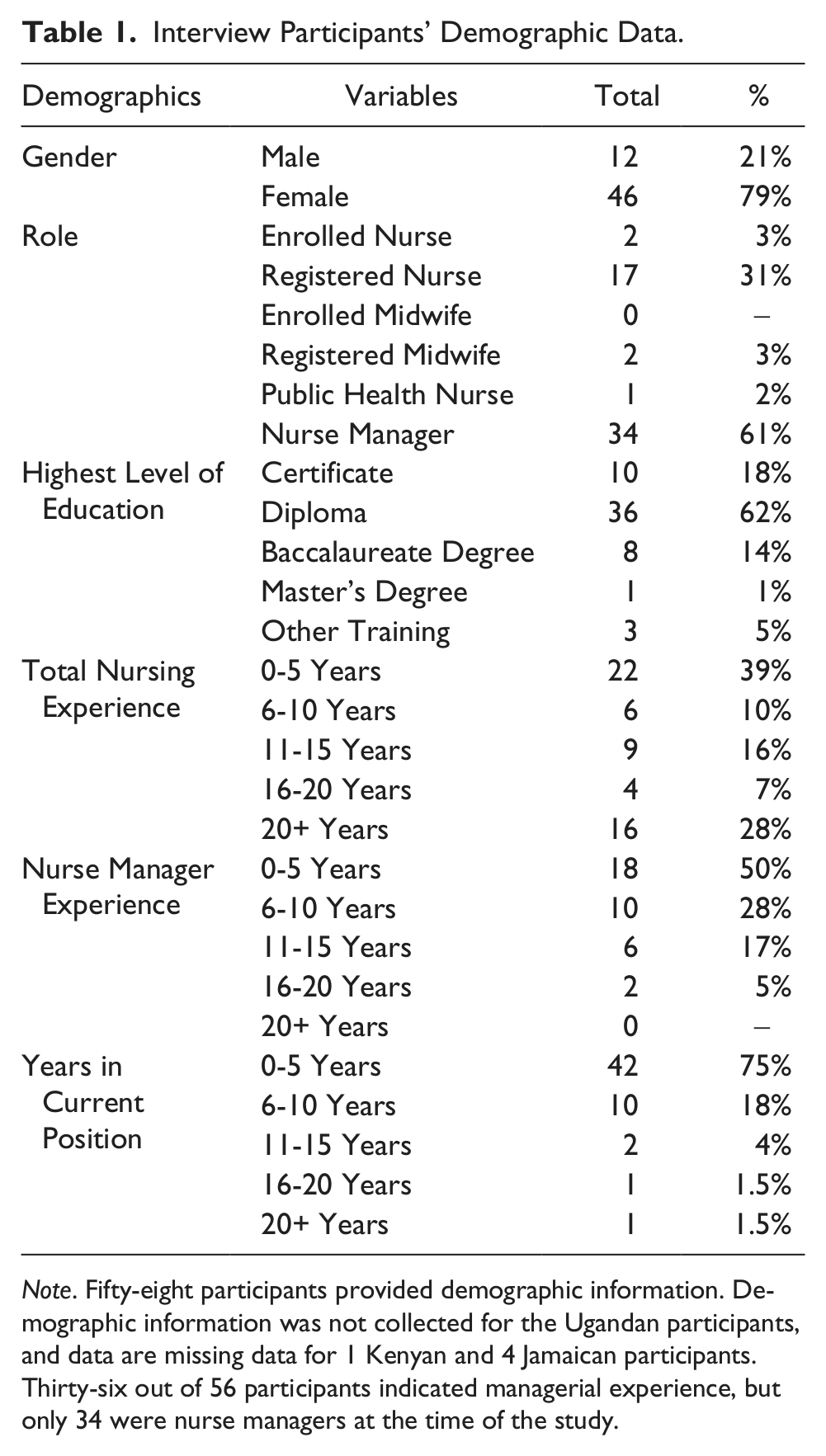
Note. Fifty-eight participants provided demographic information. Demographic information was not collected for the Ugandan participants, and data are missing data for 1 Kenyan and 4 Jamaican participants. Thirty-six out of 56 participants indicated managerial experience, but only 34 were nurse managers at the time of the study.
It was of interest that the themes that emerged from the data across the four countries were the same; however, there was some variation in the specific examples that nurses used to highlight their approaches to the care of PLWHAs. Stigma and discrimination were major factors that influenced nurses’ ability to provide care for their patients living with HIV. The fear of stigma and discrimination also influenced patients’ decision making in relation to the disclosure of their HIV status, which in turn influenced nurses’ ability to provide care.
Caring for Patients With HIV
We were interested in whether nurses treated persons known to be HIV positive differently from other patients. Almost all of the nurses stated that by using universal precautions, “we do not discriminate” in the care provided to AIDS patients. However, participants also acknowledged differential aspects of care when a patient was known or suspected to be HIV positive; at times, this manifested as a lack of care.
Treating all patients equally
Participants asserted that all patients received similar nonjudgmental attention from professional care providers. As a South African nurse pointed out, “We are here for a patient and we have to nurse them in totality irrespective of race, color, creed, or their medical conditions. We have to nurse them equally.” Similarly, a Kenyan nurse said, “Whether they are [HIV] positive or not, you have to make sure that you treat them.” HIV-positive patients were usually treated similarly to those with other infectious diseases, and would only be put in “a secluded area [if they had] diarrhea, or they are suspected of having tuberculosis, that’s the only way. Otherwise they will be among any other patient on the ward.”
A Ugandan focus group member recalled the changes that had occurred to nursing care since the beginning of the epidemic:
Initially we used to segregate these patients; many of them would be taken as infectious. For example, we would always be suspicious of TB [tuberculosis] and other diseases, but these days, unless if one is worrying we always put them together with other patients so that they also feel that they are people like others.
A Jamaican nurse stated that sometimes she double gloved; however, this was done because of the procedure and not because the person had HIV:
You wouldn’t necessarily put on two gloves to go to that patient, because I mean, but for every patient who has body fluids, or I need to tidy them and they have a lot of mess, I put on two gloves, so nobody is saying, “Oh, this person is HIV positive because [the] nurse put on two gloves.” No, it’s because of the procedure that I am doing, and what it requires, you understand?
Treating HIV-positive patients differently
Despite the assurance that HIV-positive patients were treated equally, a number of comments suggested that in reality, nurses sometimes made decisions about nursing care based on the appearance of the patient or knowledge of his or her status:
You get a hunch by looking a lot of times. I have seen it happen a lot of times. You say, “Careful, that one looks suspicious,” even though we are not supposed to do it, but it’s just a hunch.
Similarly, another participant stated, “I go around with them just like any other, especially when they are newly diagnosed and they appear normal just like anybody else.” A Ugandan nurse was more direct in her comment: “We usually don’t put on gloves while working on those without HIV, and [for] those who are HIV positive we usually put on gloves.”
When a patient was known to be HIV positive, nurses often took extra precautions to protect themselves. The use of gloves and “taking extra care” in carrying out nursing procedures were the most common precautions mentioned: “[If] they are very ill, they have open wounds, or like, let’s say they have something like scabies or something like that, then you are going [to] be extra cautious, like you wear double gloves or gown.” A Ugandan nurse stated that patients who were “HIV positive are given detailed attention,” whereas “those who are found HIV negative are given preventive measures.” Similarly, a Kenyan nurse stated, “With the AIDS patients you are taking much more precautions.” A South African nurse said,
If I know about the condition of the patient, I will treat them differently because at times we are talking about the universal precautions. I have to always be careful, put on the gloves and the spectacles in order to prevent the virus.
Ugandan nurses shared several examples of different precautions for HIV-positive patients: “We take more precautions, [are] always careful while handling the sharps, [and] we are required to use gloves.” “For mothers who are in labor, the case is not the same because for positive mothers you have to take precaution not to infect yourself.” Similarly, a Jamaican nurse expressed the different approaches to care based on HIV status:
The only time it would be different if you know they have AIDS and you know [they] might have sores on the body. Taking their [blood] pressure you have to cover your hands with something before you put [the cuff] on; that is just to prevent any transfer. But separate and apart from that, if I am to handle any body fluid I use gloves.
Some of the differences in care reflected nurses’ compassion and sensitivity to the needs of PLWHAs. The long-term chronic nature of the disease, within a context of stigma, resulted in some differences in care provided to patients who were HIV positive. Participants described many of the types of physical care, including nutrition, provision of antiretrovirals, and the prevention of infections, that they provided to patients with HIV. The emotional impact of having HIV and AIDS was also highlighted. A Kenyan nurse pointed out that HIV is a “disease [that] affects the person psychologically, spiritually, and even socially.” Because of this reality, nurses emphasized the psychological support they provided for these patients: “[They] need more emotional support.” A nurse from Uganda suggested, “Those patients with HIV/AIDS are traumatized. They need more moral support, because they come with a lot of fear; they feel isolated.” Additional psychological support was one of the key differences in providing care for patients with HIV: “The main difference is going to be in the psychological aspect of their lives, the stigma prevention and that, so they are going to need emotional support and so on.”
The absence of care
Several nurses mentioned that the absence of care or the placement of a patient on the unit might identify him or her as HIV positive, and consequently could influence the level of care. A Jamaican nurse suggested that the neglect of a patient could quickly identify him as HIV positive:
It doesn’t take much for you to step on the ward and see that this patient is unique in some way. You go to the bed for example. They are in a room and you go there. You will see the tray with the food on the table or wherever they put it. You will see the bedpan not emptied. You just know that there is very little contact with the client, and as I said before, except what [care] is absolutely necessary.
Similarly, a South African nurse said,
Sometimes I feel the people think, “Okay, this is a HIV-positive patient. He is going to die now”—or he’s terminally ill at that time, that they don’t give the care as they must care . . . be they didn’t turn her [over] this time.
A Jamaican nurse had been distressed by the lack of care she had observed for PHLWAs: “The places that they are placed in the ward [were] usually at the end of the ward, and . . . there’s hardly much association with them.” Another nurse recounted a situation when a patient was placed in one area of the unit and was later moved to the back when his HIV status became known:
I remember we had this gentleman, he was twenty-six. Big strapping nice young-looking man, just come in for a very high fever and [it] wouldn’t go away and [he] was having diarrhea. He kept on having [a temperature of] one hundred three or there about, and when they did the rapid [test] he was HIV positive, and he was placed at the back because they weren’t sure why he was positive and he was quite healthy looking.
The location of patients on the unit in relation to HIV status was also known to families. A Jamaican nurse had to reassure relatives that “not everybody who is put there in a room is HIV positive.” Although some of these findings provide evidence that nurses made efforts to treat all patients the same, a few of the narratives suggest that stigma and discrimination continued to influence the caregiving provided by nurses.
Institutional factors influencing care
Nurses mentioned many institutional factors, including resources, physical space, and support, that influenced their ability to care for their patients. More than half of the nurses at all sites spoke about the challenges created by the lack of resources to provide safe patient care. Nurses felt that both physical and human resources were necessary to carry out their nursing work. A Jamaican nurse argued that the provision of adequate supplies to implement universal precautions was essential, yet materials were not always available:
It’s needed. It’s not a want, it’s a need for everybody—we’re supposed to have universal precautions for everybody. But I mean it’s not really [available]. With the turnover of patients they don’t really have that amount of supply.
A nurse who worked in a rural setting in Uganda commented on the challenges related to ensuring adequate supplies in rural areas:
We have a hardship in sterilizing the instruments which we use. We live in rural areas where there is no electricity and so we have to use paraffin to heat up these tools. However, this is also becoming very expensive, and there are few equipments, so it’s hard to attend to two mothers in labor at the same time. They can start pushing at the same time yet you do not have enough instruments to use.
Resources also included the availability of adequate medications and treatments to care for patients. A South African nurse spoke about her feelings of failure when she did not have adequate supplies to carry out the treatment that she knew was essential for her patient:
The most difficult is when I fail the patient. . . . I really feel bad sometimes if when they come to the clinic and they complain of such a thing then we don’t have treatment to treat that complaint that the patient is coming with. . . . I feel bad sometimes. I always feel that they must always, when they come to the clinic they must get treatment and whatever that we should offer to help the patient.
Several participants commented on the shortage of human resources to carry out safe nursing care. A Ugandan nurse stated, “We need more workers. The nurses on duty are very few, and this means we need more voluntary health trainees to offer more support.” Similarly, a Jamaican nurse commented on the difficulty in finding adequate time to provide support and counseling for patients:
As it is right now the workload is such that you don’t get to spend the time that you could. If I sit in here probably with a patient for an hour, or patient and family for an hour, people start banging at the door because they figure that you in there with that patient too long and they want to come in. So you know that is lacking.
Adequate physical space necessary to maintain confidentiality was another important requirement for participants to carry out care of patients with HIV. One of the Kenyan nurses spoke about the challenges to confidentiality posed by working in space that was inadequate:
Most of our facilities, even the rooms we use for counseling, sometimes compromise the confidentiality itself, and so to me the confidentiality is really marked more when it comes to HIV and AIDS. The only part remaining is that we are still having a challenge when it comes to space and it compromised the level of confidentiality, but still we can improve.
A Ugandan nurse shared a similar concern about the lack of physical space and the impact on maintaining confidentiality: “We do not have operational space! We need special rooms to do private counseling. This requires heavy construction that requires money, and now the government can’t take quick action to this effect.” A Kenyan nurse commented, “[If] we had some more spaces and more beds for the patients it would be better.” In addition to the amount of space for care, the positioning of the space could provide challenges to nursing care:
They even fear queuing [in] the line so you will get some of the patients around the window and tell you, “Sister, you can give me the drugs.” It’s like they don’t want people to see them, and if we can have a place that not everybody is seeing them or such.
In addition to resources, nurses spoke of the importance of receiving support from their organization in the provision of care. One Jamaican nurse manager shared the following:
I believe that encouraging and counseling your staff first is important because we are providing the care to the patients. We need to encourage the nursing staff, and you know, counsel them, talk to them, have sessions with them, and that is not being done.
A South African participant shared a similar concern about the lack of support she felt from management. From her perspective, management only visited the ward when they were following up on a mistake. She provided a compelling argument for more support from management:
They [management] should come close to us, and sometimes just give themselves time and work with us and see how, how do we relay, how do we function because of this stuff. So every time they come [they] always look for a mistake or something they would focus on. . . . When they come here, they come yelling at you as personnel here; they do not have good approach.
Another South African nurse also shared a concern that her employer was “ignoring us, the people who are working with the HIV-positive patient. . . . You end up in a day having out of ten people that you saw, six are HIV positive. Imagine how you feel?”
Stigma as a Challenge to Care
Nurses were asked about some of the challenges to caring for persons with HIV and AIDS. About half of the participants mentioned stigma as a significant challenge to disclosure, and subsequently the provision of nursing care.
Stigma associated with disclosure
Nurses were often pressured by relatives to disclose patients’ diagnoses, despite understanding the need to maintain confidentiality. A Jamaican nurse recalled a patient asking, “‘Nurse, when they [relatives] come and look for me, are you going to tell them what is wrong with me?’ I said, ‘No, that would be your decision.’” Although most HIV-positive patients disclosed their status to the health workers, at times they kept the diagnosis secret from their own relatives. A number of the participants explained the challenges they faced in the provision of care when patients had not told relatives their status, as in the following example:
You are unable to explain the process to them so because of this the patient is ill and . . . is not improving, and you can’t explain to them that although the patient is getting ill this is the situation, you know, explain to soothe the whole emotional thing. They just believe that it is you, and especially when the patient dies some of them want to fight you.
Similarly, a Kenyan nurse shared her perspective on the challenges to care when family members had not been told a patient’s diagnosis:
I am not at ease to disclose it to family, and so it hampers me from continuing good care to the infected person. So if the client does not disclose it becomes difficult for you to give the appropriate care you need to give, as opposed to other diseases like malaria, you just tell the relative that your client is suffering from malaria.
A South African nurse believed that “most of the patients are not ready to disclose and as a result, we are not able to give the relevant medications or treat them properly because they don’t even disclose to the health providers.” South African focus group members also suggested that the secrecy surrounding HIV and AIDS made it difficult to provide general assistance and support:
I just think that most of the time the families are excluded, because I don’t know [about] the others, but usually you can’t just say to the family the patient has got HIV, you understand. If they come with the knowledge, then you can assist them.
Likewise, it was difficult to discuss the cause of a patient’s death:
I think the community does not appreciate what we as nurses do, because of the saying [that] goes around in the community: “If someone comes to the hospital he or she will die.” Yeah, that is what we normally hear, and this is even made worse by this confidentiality clause. Because if the community was aware that the patient was positive they would know that is why the patient died.
Many of the nurses emphasized the importance of disclosure to a family member or close friend to ensure that the patient received adequate support. A Jamaican nurse advised,
So you can basically let them try and find a close, close family member they might want to talk to, because when they are not here at the hospital, at home they are going to need somebody to support them so they can sit and talk with them.
A South African nurse stressed the importance of disclosure: “I think they get very much depressed because they’re not sharing it with someone.” Nurses found that patients “get more attention from the family when they know,” and “[relatives] bring nutritious things for them and you see it’s a difference when the relative knows.” A Ugandan nurse also stressed the importance of disclosing to the family “because these are the people who end up helping in the nursing of the patients.” Despite the possibility of receiving extra support, many patients found it difficult to disclose their HIV status to their family because of the fear of stigma and discrimination. A Jamaican nurse was the only person one patient trusted to disclose her HIV status to:
Can you imagine if you have an HIV-positive client, who the only person she feels that she can relate to is you? So whatsoever the situation is, she is calling you and you have to be there to try and see how you can help her to weather the stresses and so on.
Stigma and infant feeding
Participants commented on the stigma associated with formula feeding and the challenges it posed in relation to the provision of nursing care. Mothers had “learned in the antenatal processes that if you do have [HIV] you are not supposed to breast feed.” Therefore when women noticed a mother feeding her baby formula, they would ask the nurse why. One participant recalled a situation when an HIV-positive mother “did not want to take home the baby feed” because this would mean she would have to tell her partner her HIV status. A South African nurse also mentioned that it was difficult for an HIV-positive mother to keep her status secret “if not breastfeeding because . . . she will have [to] buy the formula for feeds.” In a Ugandan focus group, a participant shared some of the repercussions faced by new mothers if they didn’t breastfeed their newborn in front of relatives:
Yes they can even abandon the patient. They cannot even come back to check on her because it will be like a punishment—like, “You brought the disease into the family.” Because HIV is still associated with bad behaviors, like, “You must have messed [had an affair] to get this disease.” . . . That is why even [for] us the nurses it becomes a challenge if you disclose and this woman is abandoned with you. Then you [do not] know what to do next, especially if she is in a paying ward, if other people run away from her.
Stigma and families
The secrecy surrounding an HIV diagnosis could lead to problems with the relationship between the nurse and the relatives: “So it [secrecy] brings them [relatives] to the point of frustration sometimes, and it sort of will take them away from you, where they will say they can’t trust the institution because you don’t know what you are doing.” One nurse stated that it was the patient’s responsibility to disclose the HIV status to relatives; however, “most of the time they do not” because they are afraid of abandonment. One Jamaican nurse recalled that following disclosure, “You have relatives that just forget about that person.”
A South African nurse believed that families neglected HIV-positive patients because “they still think that most of the people contacted HIV through sexual contact, so according to them it’s gonna put a stigma on [the family].” Secrecy made it “difficult to tell them [relatives] what is the problem and what can be the problem leading to this and this.” These situations were challenging for nurses because “it looks to them [relatives] that there’s nothing we do to help them. That’s the problem.” One nurse said, “When they are not aware now, they treat it casual, and any deterioration in condition then the nursing staff, the medical staff get the blame that they are not doing anything for the patient.” Another participant commented,
Working on the wards sometimes . . . when they [relatives] realize that that patient is HIV, they refuse to come back to take them home. Nobody wants to speak with them, and sometimes the relatives go and tell others outside that, you know, what the patient condition is, and that causes them to get depressed and sometimes they even want to take their lives.
Although participants encouraged their patients to disclose their status to family, several participants emphasized that it was the patients’ right to disclose their status. A member of the South African focus group pointed out, “We just leave it into the patient’s hands. The issue of disclosure lies entirely on the patient’s orders. We just don’t force them to disclose.” In another focus group, a participant shared the following:
The most difficult thing is around the issue of disclosure, around the issue of human rights, patients’ rights. Because you’ll remember, HIV has become a human rights issue. Now if it depends on whether I want to disclose or not, and if, if you go and tell somebody about my condition, without my consent, I can sue you or do whatever I want to do. Now, if we can take that away, if that can be removed, I think HIV management would become easier. Say, for example, in comparison with TB [tuberculosis]. In the past people didn’t like TB.
In Uganda the status of an HIV-positive mother could not be disclosed to her husband without her consent:
We still have to have the mother’s consent to disclose her HIV status to her husband. When she says no, then we cannot do much. In this country testing for HIV is still voluntary. Therefore you cannot force anybody in order to protect their baby!
Another focus group member, while acknowledging the importance of human rights, argued that protecting the rights of one individual might not be in the best interests of the community:
He [has] just mentioned the issue of human rights. I wonder if really we are doing the correct thing by treating a person as an individual, because really in the old days when you were diagnosed with TB, there was no concern, no what. The inspector will go into your home and take the whole family to be tested, but now we treat one person in one family. Are we really doing the correct thing? Is this human right issue not obstructing the correct service we should give to the community?
One nurse hoped that once the family learned the true cause of a relative’s death, they would understand the challenges the nurses had faced in providing care: “I just have to think that by the time they know the cause of death they will be more relaxed and cool so they won’t do what they threaten us or whatever.” A South African nurse had faced similar situations with relatives who would ask, “Why is she not getting better? Then it’s getting difficult, because they blame you sometimes because of why she’s not getting better. . . . They feel we’re not doing enough for this person.” A Jamaican nurse summed up the situation very succinctly: “You can’t ask the nurses to give proper adequate and effective care if they don’t know who their clients are.” Secrecy related to the disclosure of HIV status could result in relatives being inadvertently exposed to the virus: “They [relatives] help them be with the washing and then they touch the blood without protecting themselves because they are not aware about the condition of their children at home.”
Strategies to Manage Stigma
Nurses were very aware of the stigma and discrimination that HIV and AIDS evoked, and adjusted their care in an attempt to decrease their manifestation. One Kenyan nurse shared that “general care is standardized so there are no biases or discrimination,” whereas another one suggested, “We need to reduce that stigma so this HIV/AIDS is seen just like any other chronic illnesses. Just like any hypertension, asthma, diabetes, and all those diseases.”
Organization of the unit
The practice of segregating patients who were HIV positive that was seen early in the epidemic was much less common at the time of the current study: “We’ve done away with that. HIV patients are admitted in all the wards according to their problem that was identified on admission.” Similarly, in Jamaica a nurse reported,
What we started doing is putting them all over—integrate them in other cubicles so you would not have all the HIV patients in Cubicle Six. . . . It helps, because basically other patients don’t know the other patients’ diagnoses. . . . We try and maintain that confidentiality.
Nurses in both Jamaica and South Africa recommended mixing patients with HIV with those without HIV to protect their privacy and confidentiality. A Jamaican nurse suggested that when “admitting an HIV patient to the ward, basically you mix them with others, you don’t sort of isolate them or anything.” A South African nurse suggested, “There must be a flow . . . of patients. We must not say that this room is for this. We must mix the patients.” The practice of mixing patients was also felt to contribute to a supportive environment for care. A South African nurse said,
We don’t put them in separate wards. We put them next to the other patients so at least they can talk to the other patients, because if you lie there in a single room being lonely, you become so depressed.
Similarly, a Ugandan nurse stated, “We don’t isolate one who is negative from those who are positive.” Jamaican nurses also mentioned the importance of mixing HIV outpatients with those with other conditions: “You would mix them, you wouldn’t just single out a day [to attend an HIV outpatient clinic]. So they would come with the regular diabetic patients, the hypertensive patients, other medical conditions.”
Maintaining confidentiality
Nurses shared several strategies used to protect the confidentiality of HIV-positive new mothers. A Jamaican nurse stated that she sometimes gave formula to the baby of a non-HIV-positive mother: “I have no other option but to take mummy’s [mother’s HIV-negative] baby and give him formula also, so she [HIV-positive mother] is not alone in the formula giving. Right, so I don’t single her baby out.” Although the practice of giving formula to a breastfed baby raises important ethical issues, it highlights the extreme measures taken by some nurses to protect the confidentiality of their HIV-positive patients. A Ugandan nurse shared her strategy for protecting an HIV-positive mother’s confidentiality: “While giving nevirapine syrup [antiretroviral] to the baby, we take the baby to a secret room to give the baby this medicine.” One nurse mentioned that when a patient was discharged, instead of sending the family members to the pharmacy to pick up antiretrovirals, “What we do is to get the medication for them before they leave, so basically we have to do more for them.”
Despite many nurses stating that their institutions expected them to keep patients’ health information confidential, nurses described additional precautions they put in place to manage sensitive information. One Jamaican nurse mentioned that when she was handling information about HIV status she would “directly take it to that person.” Another nurse mentioned that in her unit, instead of noting on the chart that a woman was HIV positive, the health team decided that to ensure confidentiality “we were going to the maternity ward and we were going to let the nurse in charge know that this is what is happening.” A Kenyan nurse emphasized, “They [HIV-positive patients] like to be treated with a lot of confidentiality.”
Discussion
One of the interesting findings from this study is that regardless of site, and despite differing cultures, nurses used a similar approach to providing care. Nurses in all four study countries highlighted the challenges related to nondisclosure of HIV status, and believed that PLWHAs were treated equally to other patients. Despite this claim, and nurses’ personal attempts to offer inclusive, holistic care, sometimes their colleagues provided differential treatment for persons known or suspected to be HIV positive. Although some of these actions would be considered appropriate, equitable, patient-centered, and based on sound clinical judgment (e.g., nutritional counseling in preparation for initiation of antiretroviral therapy), other examples suggested practices based solely on hunches, physical appearance, and/or insufficient evidence, as well as a level of discrimination related to inadequate knowledge and institutional support. It is essential that all health care providers, including nurses, are knowledgeable about best practices for the care of PLWHAs and use universal precautions consistently with all patients.
The degree to which nurses perceived support from the employer might provide clues for understanding the enactment of stigma. The lack of resources, both human and material, was noted to be a consistent and significant factor in decisions about provision of care. Li and colleagues (2007) identified institutional support as a central influence among service providers in China for the reduction of perceived negative consequences of caring for PLWHAs and minimizing their internalized shame. These researchers reported that health care workers’ perceptions of institutional support were positively correlated with less discrimination intent toward PLWHAs. Less obvious is the connection between the investment in resources, education, and infrastructure by the employer and the nurses’ capacity for providing optimal care in an environment in which they believe they are protected and supported. The workplace environments of the participants might have been influenced by “courtesy stigma” (Phillips, Benoit, Hallgrimsdottir, & Vallance, 2012, p. 681) which, in turn, decreased available support and resources for the provision of HIV care.
The importance of emotional support for PLWHAs identified by nurses has been highlighted previously by Makoae and colleagues (2005). These researchers surveyed 743 men and women living with HIV and AIDS in four countries in Southern Africa and reported that psychological symptoms such as fear, distress, and anxiety were reported more frequently than physiological symptoms. However, in a resource-challenged environment where nurses believe they are not supported by employers, the capacity to offer emotional care might not be easily nurtured among staff. Jewkes, Abrahams, and Mvo (1998) suggested that nurses’ perceived lack of control over the environment contributed to abuse of obstetrical patients in South Africa. It is possible that stigma manifests in a similar context, and that organizational structures and policies might be at the root of negative behaviors by nurses toward PLWHAs.
The decision to adhere to universal precautions when providing care is a complex one, with a number of contributing factors. Participants in our study noted the importance of protecting themselves from HIV infection by using gloves and other protective gear, but cited the lack of adequate resources as a barrier to consistent implementation. Other investigators have observed a lack of knowledge related to transmission risk and implementation of safe injection practices (Delobelle et al., 2009; Kermode, 2004), indicating a need for ongoing education. There has been little discussion of nurses’ perceptions and concerns about transmission of the virus between patients by nurses, and the role of universal precautions in mitigating that risk for patients. Additional research is indicated to explore the absence of the patients’ voices in this discussion.
Participants consistently expressed great concern around the issue of disclosure by patients of their HIV status. Nurses believed that awareness of the diagnosis was essential for provision of appropriate, safe care, and that uncertainty about the status compromised their capacity to offer optimal care. Participants were only too familiar with patients’ reasons for not being tested or for not sharing the results of the test. Many researchers have reported the negative consequences associated with disclosure and the difficult choices made by patients (Mill et al., 2008; Mill, 2003; Sowell & Phillips, 2010). Interventions to decrease stigma and discrimination in health care settings are required to increase the likelihood that patients can request an HIV test and disclose their status in an environment that is safe, confidential, and nondiscriminatory.
Health care providers often are perceived as responsible for breaches of confidentiality that result in discriminatory practices. The Malawi Network of People Living with HIV/AIDS (2003) reported that the majority of such breaches occur in health care facilities. Home visitation or the provision of food supplements that might publicly label PLWHAs were unwelcome because of the potential negative consequences should the interventions be witnessed by others. Akpa, Adeolu-Olaiya, Olusegun-Odebiri, and Aganaba (2011) reported that more than half of PLWHAs in their study in Nigeria were unable to disclose their HIV status to family members or at their place of employment because of fears of stigmatization. Unique to this study, we found that nurses sometimes employ extraordinary measures to avoid such consequences. Although the practice of feeding formula instead of breast milk to the infant of an uninfected mother is not congruent with current guidelines (World Health Organization, 2010), many nurses believe it is prudent to do so. The provision of formula to the baby of a non-HIV-positive mother in an attempt to treat everyone equally, as reported in this study, indicates the lengths to which nurses go to protect patients from accidental disclosure of their HIV status. This potentially unsafe practice could be avoided by ensuring nurses’ access to ongoing education and professional development.
Several authors have discussed factors that contribute to the provision of compassionate, respectful care to PLWHAs. In a recent analysis of the impact of stigma on health, Courtwright (2009) argued that social arrangements that promote self-respect can minimize the impact of stigmatization. Nurses are part of the social environment in which people live with HIV, and therefore it is critical for nurses to treat PLWHAs with respect and dignity. Emphasizing the strengths and assets brought to bear on the situation rather than the defensive and protective strategies employed by care providers has been advocated (Mill et al., 2011). Indeed, some observers have called for proactive strategies to replace reactive ones (LeBel, 2008), or at least to complement them (Kyakuwa, 2009). Similarly Castro and Farmer (2005) have argued that it is the introduction of quality care that improves access, rather than the existence of stigma that impedes it. This is an important perspective to consider when decision makers design and implement thoughtful strategies to reduce and ultimately eliminate the stigma associated with HIV illness.
Conclusion
In this study, stigma and discrimination were major factors that influenced nurses’ ability to provide care for PLWHAs. Patients were often reticent to disclose their HIV status to the nurse, resulting in challenges to the provision of the best possible care for patients. The secrecy surrounding an HIV diagnosis could also lead to problems with the relationship between the nurse and the relatives. Despite the assurance that PLWHAs were treated equally, and that universal precautions were used consistently, in reality, nurses sometimes made decisions about nursing care that were based on the appearance of patients or knowledge of their status. This is of particular concern, because this finding was consistent across the four sites and in settings where nurses had been providing care for PLWHAs for more than three decades. Institutional factors, including resources, physical space, and support also influenced nurses’ ability to provide optimal care.
Despite the challenges to care that stigma presented, nurses demonstrated great compassion for their patients and made adjustments to their care in an attempt to decrease the manifestation of stigma and discrimination. Nurses organized patient units in an effort to ensure that HIV-positive patients could not be identified, and put in place additional precautions to protect the confidentiality of these patients. In some instances, nurses’ efforts to protect the confidentiality of their patient might have resulted in unsafe practice. Although this exemplifies the extreme measures that nurses were willing to take to protect confidentiality, it also demonstrates the need for continuing education.
Contextual factors, including stigma and the availability of resources, must be considered when integrating evidence from research into the development of policy and the promotion of best practice. We have demonstrated that such factors are particularly important in settings that can have resource challenges much greater than those typically found in the settings where much of the research evidence is generated. Furthermore, the care for persons living with HIV and AIDS is influenced not only by these contextual factors, but also by nurses’ attitudes toward their patients.
Footnotes
Acknowledgements
We thank our research assistants and the participants in each of the study countries for their invaluable contributions to the study.
Declaration of Conflicting Interests
The authors declared no potential conflicts of interest with respect to the research, authorship, and/or publication of this article.
Funding
The authors disclosed receipt of the following financial support for the research, authorship, and/or publication of this article: Support was received from the Global Health Research Initiative (GHRI), a collaborative research funding partnership of the Canadian Institutes of Health Research, the Canadian International Development Agency, the International Development Research Centre, Health Canada, and the Public Health Agency of Canada.