







Abstract
Survivors of human trafficking who return to their community of origin must cope with the trauma they experienced as victims as well as the conditions that contributed to their trafficking vulnerabilities. In this article, I examine the psychosocial adjustment process among women survivors of trafficking who returned to Vietnam. Supplemented by participation observation, thematic analysis of in-depth interviews with survivors revealed that throughout the trafficking process, the women experienced multiple abuses and changes in relationships and environments. The women coped by navigating a process of “reconstructing a sense of self,” seeking congruence between their self-understandings and the changing contextual factors while exhibiting three main coping strategies: regulating emotional expression and thought, creating opportunities within constraints, and relating to cultural schemas. The findings underscore the importance of considering contextual factors such as cultural norms and societal values in efforts to assist trafficked survivors reintegrate into their communities.
Keywords
Human trafficking—the exploitation of people through force, fraud, or coercion—is a human rights violation that affects virtually every country in the world. More than 20 million people are estimated to be trafficked globally (International Labor Organization, 2012), and human trafficking generates approximately US$32 billion in criminal profits annually (United Nations Office on Drugs and Crime [UNODC], 2012). Although many boys and men are also trafficked, women and girls comprise the majority of the total number of detected victims, most of whom have been trafficked for sexual exploitation (UNODC, 2014).
Trafficked persons are often subjected to severe violence and trauma, through the use of physical and sexual methods as well as emotional/psychological means (Baldwin, Fehrenbacher, & Eisenman, 2014; Zimmerman, Hossain, & Watts, 2011). The violence and trauma experienced while trafficked can exert profound effects on survivors’ adjustments, even long after the event. Emerging evidence indicates that in addition to physical and reproductive health problems (Sarkar et al., 2008; Silverman et al., 2007), trafficking trauma also puts individuals at risk for mental health conditions such as depression, anxiety, and posttraumatic stress disorder (Abas et al., 2013; Hossain, Zimmerman, Abas, Light, & Watts, 2010; Tsutsumi, Izutsu, Poudyal, Kato, & Marui, 2008).
The increased scholarship on human trafficking in recent years has greatly enhanced our understanding of its health consequences, especially the potentially negative psychological impact. However, most of our current knowledge on trafficking still draws from the literature of related issues such as domestic violence and torture (Clawson, Dutch, Solomon, & Grace, 2009). Although there are important overlaps between these issues, individuals who are trafficked may experience qualitatively different and unique circumstances than those subjected to domestic violence and torture. Yet, few studies have provided in-depth analyses of trafficked survivors’ accounts of their trauma and how these experiences influence their posttrafficking psychological adjustment. Furthermore, in addition to individual factors, trauma and coping are also influenced by many interpersonal and other contextual factors (Harvey, 1996), an understanding of which is crucial to the promotion of healing and health among survivors of trafficking.
Drawing from the stage-based migration research paradigm, Zimmerman and colleagues (2011) proposed the Stages of Trafficking Model to offer researchers, practitioners, and policymakers a conceptualization of “trafficking and health as a multi-staged process of cumulative harm (p. 327).” The model specifies the interdependent stages of recruitment, travel-transit, exploitation, and integration or reintegration—and for some trafficked individuals, detention and re-trafficking. Because of the clandestine and illegal nature of the trafficking activities, however, human trafficking research have mostly been conducted among those who have safely escaped the trafficking situation in the destination countries—while in detention or being assisted to integrate into the host country (Clawson et al., 2009; Derks, 2000; Kelly, 2002). Equally important but understudied are the health issues among trafficked returnees—survivors who return to their community of origin. During reintegration, trafficked returnees must cope with the consequences of the trauma they experienced while trafficked, in addition to the re-emergence of factors that contributed to their vulnerability prior to departure (Zimmerman et al., 2008; Zimmerman et al., 2006).
The purpose of this study is to explore the psychosocial adjustment among women survivors of trafficking who have returned to their country of origin in Vietnam. Vietnam is a major source country for the cross-border trafficking of women and girls into commercial sexual exploitation, labor exploitation in manufacturing industries and domestic work, and forced foreign marriages (U.S. Department of State, 2014). To date, no study has contextually analyzed the experiences of trauma and the posttrafficking adjustment among this vulnerable population.
Method
This study employed both deductive and inductive methods. Zimmerman’s model provided a starting conceptual framework for the study design and data collection, and a temporal framework for the analysis of the findings. I used inductive, thematic analysis techniques (Hsieh & Shannon, 2005; Potter & Levine-Donnerstein, 1999) to explore Zimmerman’s Stages of Trafficking Model as it is applied to the trafficked population included in this study.
Setting and Participants
The study consisted of 15 semistructured in-depth interviews with female trafficked returnees; the interviews were embedded in 10 months of participant observation conducted between 2012 and 2013. The research took place in five Vietnamese border provinces, mostly at posttrafficking project activities implemented by a non-governmental organization (NGO) that provides direct (e.g., shelter accommodation, life skills development, and case management) and indirect services (e.g., financial assistance for educational or vocational training and health care services) to trafficked returnees.
I conducted participant observation in many of the activities at the NGO and at community and professional events to gain an understanding of the participants’ background and the contextual knowledge of human trafficking issues in Vietnam. I partook in communal meals and group activities at the NGO’s shelters, accompanied returnees to the rural villages during their home visits, and attended local and national workshops and conferences on human trafficking. Participant observations allowed me to gain access to the population and served as a means to mutually build trust and rapport for the recruitment of participants for in-depth interviews, which was the primary source of data for this article.
Interview participants included 15 women (age 18–27), of whom seven were trafficked to China, seven to Cambodia, and one to Malaysia. Participants’ average age at the time of trafficking was 15 (range = 13–18). Six women reported being trafficked by friends or acquaintances, five by family members or relatives, and four by strangers or other relationship types. All participants were single at the time of trafficking. At the time of the interview, 13 women remained single and two had married since return.
Data Collection
I obtained permission from the NGO as well as ethics approval from the University of California at Los Angeles prior to conducting the study. I maintained strict privacy and confidentiality of the participants, and conducted the study with additional special considerations per the World Health Organization’s ethical and safety guidelines for interviewing trafficked women (Zimmerman & Watts, 2003).
I conducted all interviews in-person, in Vietnamese, and with a semistructured guide. Prior to obtaining informed verbal consent from the participants, I provided them with detailed verbal and written information on the purpose and procedures of the interview, including the assurance of anonymity and confidentiality.
Informants’ answers served as cues for successive questions or probes, but an open-minded and conversational modality was maintained throughout the interviews (Mack, Woodsong, MacQueen, Guest, & Namey, 2005; Padgett, 2012). Minimal notes were taken to facilitate the participants’ expressions of their experiences as uninterrupted as possible; however, during six interviews where participants declined audio-recording, I took detailed notes and expanded on them immediately post-interview to construct records that resembled transcripts as much as possible. Upon completion of each interview, I thanked the respondent for participating in the study and provided reimbursement (200,000 VND, or US$10) for her time. Contracted native speakers transcribed the audio recordings of the interviews verbatim. I checked the transcriptions for accuracy and noted any relevant situational dynamics from the audio recordings.
Data Analysis
Analysis of interview data proceeded both inductively and deductively, to combine the strengths of multiple “analytic axes” (Padgett, 2012). Zimmerman’s Stages of Trafficking Model provided a starting conceptual framework, as well as, the impetus for a temporal analysis of the survivors’ experiences.
In inductively analyzing the interview transcripts, I adhered to the principles of openness and reflexivity as much as possible, to facilitate the discovery of new understandings of the women’s experiences and knowledge (Campbell & Sharon, 2000). First, I read whole transcripts and participant observation notes to grasp a naïve understanding and to capture a sense of the whole (Burnard, 1991). I then recorded memos and notes to flag in vivo (participants’) terms, issues, or explanations (Creswell, 2007). After achieving an overall understanding from the majority of the texts, I manually analyzed each transcript line-by-line, dividing the transcript texts into “meaning units” that signified an idea, issue, or set of perceptions (Burnard, 1994) and assigning and applying codes (i.e., topics) to extract the essential structure and significance of the meaning units (Dey, 1993). I developed a coding scheme by conducting an iterative process of comparing and contrasting codes against one another, and organizing topics into themes, and themes into domains (Elo & Kyngäs, 2007).
To achieve the study’s primary aim of describing the psychosocial adjustment of Vietnamese trafficked returnees, I categorized the findings into the two domains of “trafficking experiences” and “coping responses.” The “trafficking experiences” domain was divided into three phases—pre-, peri-, and posttrafficking—corresponding to the Stages of Trafficking Model. The identified themes were then assessed against participant observation notes and memos. This process of triangulation confirmed some of the findings from the interview data and re-asserted some contextual variations of human behaviors and experiences that may have been missed or reduced in analyzing interview data—and as such, enhanced the understanding of the themes and how they were interconnected (Creswell, 2009; Spradley, 1980).
Findings
Supplemented by participant observation data, analysis of interviews with trafficked returnees revealed a total of six themes, three in the “trafficking experiences” domain and three in “coping responses (see Figure 1).” Participants’ trafficking experiences are highlighted according to the phases: pre-, peri-, and posttrafficking. The coping strategies that the participants exhibited to manage the emotional and social impact of the experience—throughout the trafficking stages—included the following: regulating emotional expression and thought, creating opportunities within constraints, and relating to cultural schemas.
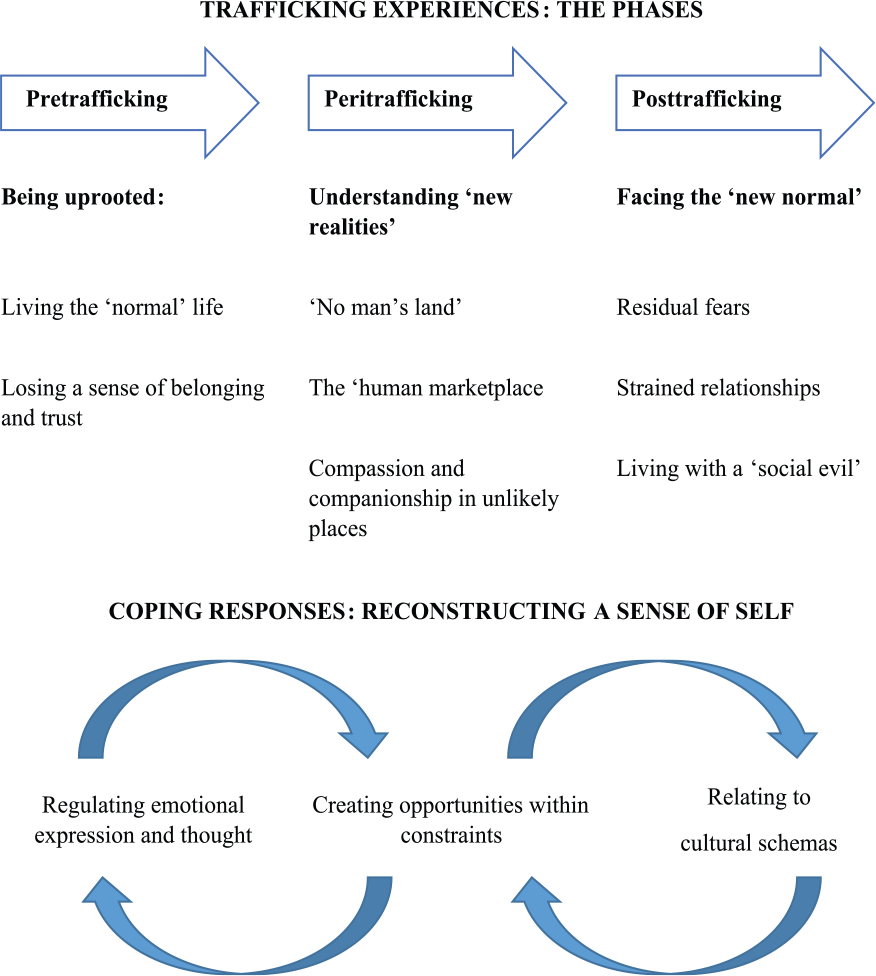
Trafficking experiences and coping responses of Vietnamese trafficked returnees: domains, themes, and properties.
Trafficking Experiences
Pre-trafficking stage: Being uprooted
Living the “normal” life
All study participants originated from poor, rural areas, and often struggled to secure enough food and other basic needs. A woman described the typical way of life for many of the women in the study:
Before, when I was at home . . . I worked in the field all day and did not go to school. I wasn’t able to eat much, so I was very skinny, very small . . . I only ate rice and steamed vegetables, and chili. We only had meat when it was a special occasion. We ate only vegetables for weeks, even months.
In addition, as in many traditional societies, women were expected to adhere to gendered cultural customs and social obligations. For example, a woman explained that many girls in these communities were compelled to drop out of school prematurely to help the family or to marry:
I finished the ninth grade, then I stopped going to school . . . My parents didn’t want me to attend school anymore . . . They wanted me to stay home and help out. They also nagged me to get married.
Marriage is a particularly important life event for women in these communities. Married women usually move into their husbands’ families, changing the household economic structures of both families. Women are expected to—and most do—contribute to the resource-generating activities in whichever household they reside.
In some ethnic minority populations in the Northeast provinces, women become married via the practice of “wife kidnapping,” which is culturally accepted and is a means of proposing marriage unions in these communities. Most families are usually informed of the daughters’ whereabouts shortly after these “kidnappings.” However, traffickers can exploit these traditions; young women may be kidnapped and remain undetected for days because family members may first assume that the missing women had been claimed as wives.
Although these conditions, norms, and practices may appear “austere,” they have formed the basis of the women’s understanding of their social identities and “normal” livelihoods. Family and friends are vital sources of household economic productivity and of interpersonal relationships for many women in these communities. Women generally understood and accepted their social roles and responsibilities as “obedient” daughters and strived to be cooperative members of their communities.
Losing a sense of belonging and trust
Contrary to these norms and values, the trafficking incident disrupts the women’s previously known roles and personhood. In border areas with high volumes of transnational trading activities, traffickers easily gained the women’s trust by offering referrals for jobs and labor contracts.
I was about 14. The guy who tricked me seemed very nice . . . He treated me like I was his younger sister . . . He said that he would recommend me some work in a restaurant. That’s why I went with him.
Another woman was deceived by a person who, after forming a “romantic” relationship with her via Internet chat rooms, offered to take her to the hospital to visit her father. As it turned out, he used this opportunity to sell her:
After we visited my father, he shared that his parents were sick too, and asked if I could come with him to visit them. I said that I couldn’t. He said that it was fine and agreed to take me home. After we passed a gas station, he went on an unpaved road, so I was scared. I said, “I’m not going anymore.” But then these two guys came, also with a girl. He threatened, “Go! Otherwise, you’re going to be killed.” He had taken out a knife.
When it came to family members, usually less deception was involved. A woman, along with her mother and two sisters, were sold by her uncle on the pretense of taking a “trip to the city”:
My uncle said that he was taking us to the city . . . We’ve never been to the city, you know? . . . We reached a river, and he used a small boat to go across. When we got to the other side, we saw two men waiting for us . . . My uncle said that the men were giving us a ride, and my uncle went too. We arrived at a village during nighttime, so we all went to sleep. The next morning, my uncle was gone. The two men said that my uncle had sold us to them . . . My mom wanted us to run away immediately, but the men had knives and guns so we were so scared. They took us to a village and sold the four of us.
For women who were trafficked by family members, they had to reconcile the supposedly protective kinship relations with the reality that these connections had betrayed them. These circumstances contributed to women’s conflicted understandings about kinships, sense of upheaval, loss of belonging, and mistrust in others as they were displaced into foreign environments.
Peri-trafficking stage: Understanding “new realities.”
“No man’s land.”
Uprooted from their family, community, and homeland, the women then faced extreme circumstances. They were held captive and suffered abuse, violence, and trauma. A woman revealed the severity of the danger and brutality of these trafficking destinations:
We arrived somewhere, and they crammed us into a room. There was a man . . . he used his knife/sword and slashed a girl 8 times . . . He said, “See? If you don’t listen to us you will be just like her.” He slashed her from foot to head. Afterwards, he left the corpse in the room. Nobody dared to sleep that night. Blood spilt all over . . . They let us starve for 2 days.
Most women were physically and psychologically disoriented in their new surroundings because of the apparent lawlessness and disregard for humanity in these “no man’s land” environments. Nevertheless, many women attempted to escape. A woman described her various escape efforts and some of the traffickers’ coercive retaliation tactics:
After I tried to run away a couple of times, they became furious at me. This lady warned, “If you continue to misbehave, the owner will call two men to come and kill you.” . . . One day, they actually called those men. They came and took me to a hill behind the house . . . and beat me. They also threatened to kill me.
Even if some women were able to escape their captors, their journeys home were arduous. They often had to travel on foot for days—and almost always food-deprived—to the nearest village or local police station where they could inquire about help. As a woman’s story revealed, some may be re-trafficked in this stage:
My friend and I escaped and got to the police . . . We begged the policemen to let us go back to Vietnam . . . They took us to the bus station and put us on a bus . . . But there was this lady . . . Maybe she knew the driver, because they were talking to each other [in Chinese]. They asked us if we wanted to go eat [fried tofu]. We said no, so they forced us to get off the bus . . . After a while, we met these two women who offered take us back to Vietnam. We went with them . . . They ended up selling us into a brothel.
The “human marketplace.”
Before being sold into commercial sex (CS-trafficked) and/or forced marriages (marriage-trafficked), women were being offered as commodities in “human marketplace” environments, which contributed to their loss of the sense of integrity as a human being. A woman described the growing trade in Vietnamese women in a Chinese border village:
These houses and families . . . were selling Vietnamese women and girls like they did buffalos. You know, like you’d buy a buffalo home, tie it up, etc . . . The families would then sell the girls, mostly to be wives . . . Each family bought and sold their own girls . . . People in the village knew these families because they “specialized” in selling Vietnamese girls. For people from farther away, they’d call ahead [to check on availabilities] before they came to take a look [at the girls].
CS-trafficked women often reported being controlled on their physical appearance, possessions, and mobility. A woman described the abuse that she and others experienced:
The men [traffickers] locked us in a room. They’d come to take us to go “serve the clients.” If we disobeyed, they’d let us starve, wouldn’t feed us. A couple of women tried to escape but were recaptured. The men took an electric cord and beat the women with it, and hung the women upside-down by their ankles and poured fish sauce into their noses.
Marriage-trafficked women also experienced a loss of sense of integrity and trust, but of a different nature. A woman explained that recently “acquired” wives were often isolated from neighbors and were heavily monitored:
At first, the family didn’t allow us to be downstairs. We were only allowed to stay upstairs, so we couldn’t see other people or escape . . . After about a month, they allowed us to go outside. We worked on the farm with them.
Companionship and compassion in unlikely places
During the transit phase, women often met at least one other trafficked woman. Their co-trafficked status, forged under extreme circumstances, became a source of solace and camaraderie. For example, a woman assumed the role of an older sister and helped rescue a younger co-trafficked woman:
After the police rescued and brought me to the station, I called my friend. She didn’t pick up at first, so I thought the owner had taken her somewhere else . . . A little later, she texted me . . . and I asked the police to take me to find her . . . We came back to Vietnam together.
Some marriage-trafficked women were confronted with conflicted attitudes and behaviors toward their destination families. Some families did not abuse the women and genuinely wanted to acclimate the “acquired” wives into the household. As a woman explained, however, she felt discomfort at the “opportunity” to regain a sense of belonging in such a contradictory environment:
When I was sold into that family, I thought, “I would not stay there.” But I still acted like I was content so that they wouldn’t suspect that I was planning to run away . . . They treated me like I was one of their children. I wasn’t beaten or anything. But it was not my home.
Thus, compared with marriage-trafficked women, CS-trafficked women may be less socially isolated. CS-trafficked women had opportunities to interact with others who shared similar experiences and circumstances. For example, a CS-trafficked woman was able to turn to other women for help:
There were about 300 girls in that village, all of them very young . . . We had to serve clients all day . . . The owner lady gave us some condoms in the beginning, but when we ran out and asked her for more, she said, “Screw you. If you die, so be it.” So we went to ask the women nearby. When the owner wasn’t around, we gave each other condoms.
Participants usually projected tolerance and sympathy toward other women they had met, whether the women entered commercial sex voluntarily or were trafficked. A participant explained, “It’s because of their difficult circumstances,” and provided examples of such women:
This older woman—she came here and did this kind of work to escape the debt she had accumulated [in Vietnam], because of her husband’s death in a traffic accident. There was also this very pretty girl. She was bought at first and the owners beat her so much in the beginning, because she didn’t know anything and cried all the time. Later on though, she was having 35–40 clients a day. Sometimes, she was not finished putting on her shirt and there was already another client. The owners were treating her very well then.
Post-trafficking stage: Facing the “new normal.”
Residual fears
Upon return, a major concern that many women expressed was the lack of a sense of safety and security. A woman described a common fear of reprisals:
I was living at the shelter and went to school every day, but I was very afraid. When I was walking to school . . . I imagined that there was someone with a knife walking behind me . . . I heard that some people who had come back—those who were able to escape—were later killed.
Although some of the women’s fears subsided when their traffickers were captured, the fears did not dissipate completely. A woman described some of these residual effects:
Nowadays, I am kind of okay. But still, when I think about it, or talk about it, then I would have nightmares that night . . . I dreamed that my dad killed me, and that my uncle killed me . . . I dream those dreams a lot.
In addition to the emotional and psychological fears, returnees also worried about their economic conditions, which remained dismal. Although women escaped the trafficking situation, they still had to struggle once again with the lack of resources in their communities. The vast majority of trafficked returnees receive short term (maximum 2 weeks) assistance and come back to their community with little or no financial or social service support to rebuild their lives. A woman who married after returning described the economic reality that many trafficked returnees faced:
My husband works. He makes about 100,000 VND (US$5) a day, but we have to pay for a lot of things so the money is gone quickly. As they’d say, “work a day, eat a day.” There’s nothing left at the end of the day.
Stigma: Living with a “social evil.”
In Vietnam, human trafficking is designated as a “social evil,” along with prostitution, pornography, premarital and extramarital sex, drug and alcohol addiction, gambling, theft, and so on. The trafficked returnees—and sometimes, their families as well—often reported feeling socially and emotionally isolated. For example, women often stayed indoors to avoid inquiries from community members. As a woman shared, many returnees feared of being judged and struggled with trusting others:
For me, relationships are mostly about small talk. Other people—we don’t easily let them know. If we share our stories with them, maybe they’ll understand us and be sympathetic. But if they don’t understand, they would judge us . . . It’s very rare to meet good people, so we cannot trust easily. So why talk about it?
Oftentimes, returnees and their families perceived that the most pragmatic way to “move on” was for the women to be married so they could start families like other “normal,” non-trafficked women. However, a woman who became married after returning described her struggle with gaining the acceptance of her husband’s family:
My [now] mother-in-law did not approve of me and my husband getting married. Their family said that . . . I was forced to do some “things” [in Cambodia] . . . I was very sad and left town. But my husband followed me. We lived together in the city for some time. After a couple of months, his mom told us that we could come back . . . Her son made his decision—what was she to say? If she didn’t accept, her son would leave her.
Coping Responses: Reconstructing a Sense of Self
Faced with the extreme changes in their relationships and environments, the women coped to find meaning in their experiences and to manage the ensuing emotional and social impact, by regulating expression of emotion and thought, creating opportunities within constraints, and relating to cultural schemas. These strategies, which were exhibited throughout the trafficking experience, illustrate a process of “reconstructing a sense of self,” whereby women negotiated and reconstituted their self-understandings in relation to the changing contextual circumstances.
Regulating expression of emotion and thought
Because of the traffickers’ use of threats and penalizing conditions, some women inhibited their emotional expression, thoughts, and memories as a means of reducing physical and psychological abuse and discomfort. As a returnee explained, some women suppressed their emotional expression or repressed their resistant attitude to avoid being punished:
When I found out that I had been tricked, I refused to go and I told [the traffickers]: “I’d rather die right here.” . . . They took out a knife and said “If you obey me, I will allow you to have a peaceful life. And if you disobey, I will kill you.” At that time I thought, “Okay, I’ve already crossed the border. I have to accept the situation.” . . . I was so devastated, but I wiped my tears away . . . I said, “Fine, let’s go. I am not afraid of you . . . I’d have to listen to you. Otherwise, I’d be dead, right?”
In addition to regulating emotional expression, women also reported inhibiting their thoughts and memories. “Sometimes I forget,” a returnee shared, and seemed surprised at her apparent ability to “move on” from the experience. At other times, women may actively inhibit memories and thoughts. As a woman described, memories of the trafficking experience continued to negatively affect returnees emotionally and physiologically long after their return:
I used to cry so much until no more tears would come out . . . I cried so much that whenever I cry now, I would have severe [migraine] headaches. It’s probably because I used to cry too much, right?
Memory and thought regulation was also a response to the distressed emotional state or fear of adverse consequences of recalling traumatic events. As a woman explained, some returnees may not want to engage in memory recall efforts to prevent an emotional breakdown: “What I remember most about that experience is . . . argh, I think ‘emotional nightmare.’ I don’t need that. I don’t need to remember!”
Notably, some women mentioned that they were able to discuss their experiences and emotions with other shelter residents because of the shared trafficked backgrounds. A woman expressed a typical response among returnees who resided at the shelters:
I remember and like everything about [the shelter], especially the meals. When I was home during holidays, I’d miss my friends at the shelter . . . Here, we all ate together . . . and there are people that I can talk to . . . At home, it’s lonely and quiet.
Creating opportunities within constraints
As described previously, women reported numerous attempts to escape the trafficking situation despite the risks to their lives. Individuals who were able to escape usually had assessed the circumstances and acted in ways that maximized their chances of survival. In some instances, women created the escape opportunities themselves. For example, a woman supposedly “gave in” to her traffickers’ demands when the “choices” were offered to her:
I didn’t want to be married to him, but I had to accept it. Otherwise, what if they sell me into a brothel, or sell me off to a guy who’s 40, 50 years old in Beijing? So I thought that I had to accept the marriage, but I would find a way to escape later.
However, once in the destination family, she devised means to delay the husband’s and parents-in-law’s expectations to consummate the marriage:
I told the husband’s family that according to Vietnamese traditions, a couple cannot sleep together until they have a wedding ceremony. The mother questioned why there was such a tradition. I gave her an example, I said, “You don’t believe me? My aunt and uncle slept together before the ceremony, and she gave birth to a retarded son.”
Despite the restraints of the trafficking circumstances, some women demonstrated acts of resistance and were extremely resourceful. Not all who were hopeful and had planned their escapes were successful. However, under conditions where death and/or debilitating consequences were highly likely, some trafficked individuals adapted a ruse of acceptance of the situation while assessing the means to remain alive and to manage their physical and psychological pain and suffering. For example, as discussed previously, the women’s experiences and reactions in the “red-light district” environments, where the “voluntary” and the “trafficked” coexisted in close vicinity, seemed to reflect their current understanding of their sense of self with respect to their shared circumstances—and the challenges to survive, rather than the original reasons that led them there.
Relating to cultural schemas
The returnees and their families often attributed some aspects of the trafficking experience to fate, karma, and filial piety—concepts that remain ubiquitous in Vietnam. Fate is the belief that the course of events is destined by a supernatural power beyond a person’s control. Karma, derived from Buddhism, connotes the philosophy that a person’s current and previous actions—and that of their ancestors—accumulate to determine their fate in the future. Filial piety is a virtue based on Confucian philosophy that epitomizes respect for one’s parents and ancestors, and is considered an essential principle of a good society.
Most returnees often explained that the circumstances that led to their being trafficked were usually “beyond their control”; however, they also usually stated that they themselves were responsible for their actions. Although some women viewed that they had endured painful circumstances because of “fate,” they also saw their escape from the trafficking situation as an opportunity to offset the bad karma by doing good deeds. A returnee, who subscribed to the proverb of “học tài thi phận,” which connotes the belief that (mis)fortune can trump talent, explained how the belief in karma propelled her to engage in good behaviors:
When it comes to learning, we learn for ourselves. That knowledge is in our mind . . . As for other things, like using money to bribe others so that we can have higher status . . . Even if we have all those [high-status] things but if we have no knowledge, we ourselves would be doomed. Others would not suffer . . . I just want to continue my studies. I don’t want to be involved with things that use money in those ways.
The concept of filial piety also permeated much of the women’s perceptions of their sense of self. Most women repeatedly expressed their sense of obligation to contribute to the family’s economic welfare and to take care of ailing parents. As a woman explained, illness in the family—and the associated costs of treatments—was a major factor in many women’s and their family members’ decisions to pursue precarious job offers:
My mom was sick a lot. My uncle, who lived in Cambodia, told her that she should move there to see if she could get treated for her health problems, and to see if she could find a job, so that we could improve our lives . . . So my mom took me to Cambodia with her. After some searching, she was able to find stable work there. But, she became ill [with bronchitis] again . . . We tried all kinds of healers but none of them helped. I thought, “My family’s circumstances were desperate. What else was there for me to do, but to find work?”
Women were especially filial to their mothers. A woman’s story revealed that this mother–daughter dynamic likely formed because some women witnessed their mothers being maltreated or abused, typically by the fathers:
Dad beat Mom all the time . . . He was drunk every day, then he’d beat Mom. He refused to stop drinking. But then he started to vomit blood . . . He was hospitalized [for liver cirrhosis]. I went to visit him, but that was when I was tricked and sold.
Another woman’s account also revealed that some women may have experienced maltreatment during their childhood:
Whenever my dad was drunk, he would beat my mom and me . . . I don’t know when he first started to beat me. I think as early as my first memory. My mom said that there was a time, when I was very little, my dad literally kicked me from our house to the neighbor’s door.
Despite of—or because of—these family dynamics, women remained filial, particularly toward their mothers. Family members remained essential to the women’s sense of identity, and upon return, women continued to be influenced by cultural beliefs and values that have previously formed their self-understandings. A woman’s reflection illustrates the conflicted emotions between “fate” and obligations:
I have accepted the situation. I’ve made decisions that led me to that path, and I do not blame anyone. At that time, the situation was dire. My family was in a lot of debt . . . I have to live with the decision that I made.
Discussion
In summary, emergent themes showed that the study participants’ experiences of being trafficked consisted of being uprooted from their expected and “normal” livelihoods, displaced in foreign environments where their sense of belonging and integrity were traumatically injured, and then returned to their families and communities to face still-dismal economic and social conditions as well as the stigma associated with human trafficking. As the result of the severe changes in relationships and environments that threatened their previous perceptions and understandings, the women had to navigate a process of reconstructing a sense of self, exhibiting coping strategies to (re)situate their self-understandings in relation to the context of the evolving environments.
One type of response that the women displayed was the regulation of emotional expression and thought. Human beings’ motivation to avoid negative affect is a widely acknowledged phenomenon (Hayes, Wilson, Gifford, Follette, & Strosahl, 1996). Implications for mental health depend on the specific type of emotional regulation strategy—via suppression, repression, avoidance, and/or denial-like mechanisms. For instance, suppression, whether it is the inhibition of emotion-expressive behavior (expressive suppression) or thought (thought suppression), is generally considered a maladaptive response to stress; particularly, expressive suppression and thought suppression have been documented—mostly in Western societies—to be counterproductive in emotional management (Gross, 1998; Wenzlaff & Wegner, 2000).
Denial, however, may have psychological and social costs but can also yield beneficial results (Lazarus, 2013). Positive uses of denial-like strategies have been observed among people who have suffered serious emotional injuries to their sense of self, such as those living with cancer (Kagawa-Singer, 1993) or HIV/AIDS (Courtenay, Merriam, & Reeves, 1998). The women in this study seemed to down-regulate the expression of emotions and thoughts/memories to manage the adverse circumstances. However, further research is needed to examine the effects of the specific emotion and thought regulation strategies—as well as the cultural contexts—in this and similar populations.
Despite the reality that trafficked individuals have very limited options when subjected to physical and psychological abuse, some women reported attempts to manage the unpredictable and constrained situations in the forms of actions that demonstrated their resourcefulness and problem-solving ability. These revealed acts of resistance suggest that the currently dominant discourse of victimization and vulnerability in the trafficking literature may mask important variations in the experiences and response strategies among trafficked persons (Saghera, 2005). Human trafficking does involve extreme abuse, violence, and trauma. However, efforts supporting survivors are often too focused on the detrimental characteristics (Gozdziak & Bump, 2008). Practitioners and researchers working with trafficked populations should strive to understand not only the negative aspects of trafficking-related trauma but also how to leverage the survivors’ positive adaptation strategies. For instance, frameworks to support survivors should broaden the emphasis on resources and resilience in coping mechanisms. Studies have shown that in stigmatized populations, resource-focused strategies may lead to better mental health outcomes than deficit-focused strategies (Hobfoll, 2001; Sears, Stanton, & Danoff-Burg, 2003; Shih, 2004). The construct of resilience may also provide useful insights for the study of trafficking and mental health. Resilience recognizes individual variation in people’s responses, even to the same occurrences (Rutter, 2006). As such, the application of resilience may elucidate mechanisms by which differences in responses to challenges or risks associated with trafficking may promote resistance to later stress among individuals, families, and even communities (Walsh, 1996).
Another prevailing type of coping mechanism was the participants’ use of cultural schemas to reconstruct their sense of self in light of their trafficking experience. Amid the discrepancies between the expected and the reality of relationships and environments, women coped by utilizing the system of beliefs and values that have formed their worldview and their sense of self. A person’s psychological well-being depends on her construct of the self, which is derived from the system of values, beliefs, and norms that inform her worldview of the reality (Kagawa-Singer & Chung, 2002). The use of cultural schemas to (re)appraise the trafficking experiences by the women in this study suggests that a critical aspect of recovery for trafficked returnees is the ability to navigate to a positive sense of self that is harmonious with the socially and culturally constituted patterns of behaviors and attitudes, and with respect to how human trafficking is perceived in their communities. Although some of the collectivist values are potentially harmful to the advancement of women’s status, for many women in the study and arguably many of the trafficked women worldwide, their sense of self, livelihoods, and success are intricately dependent on these family and community orientations. Efforts to assist trafficked survivors should be cognizant of how these collectivist norms and values may have created many tensions and conflicts among the survivors, and that they will likely continue to shape the survivors’ recovery and reintegration process. Returnees should be supported in continuing to navigate to a self-understanding that is congruent to the environmental parameters and their relationships with community members and practices. Thus, posttrafficking assistance efforts should aim to address factors at the community and structural levels in conjunction with the individual psychological and emotional needs.
Conclusion
The trafficked women in this study had to contend with the physical, social, and emotional realities as they were uprooted from their livelihoods, endured exploitative and conflicted circumstances, and then struggled to become a member of their native communities again. Although the study participants are drawn from a small subset of the population of trafficked returnees, the in-depth analysis of their accounts illustrates that there are many complexities and nuances in the circumstances, emotions, and reactions in the trafficking experience. These findings provide a more contextualized depiction of the women’s lives, as well as, a more comprehensive understanding of how the meanings of their trafficking experiences are (re)constructed and (re)interpreted. As such, the study’s findings offer some constructive, preliminary directions for future efforts that aim to alleviate the psychosocial impact of human trafficking. In particular, survivor support efforts should recognize the collectivist, community-oriented values by which many trafficked women, especially those in Eastern societies, still subscribe after their return, and understand how these values continue to affect the women in their posttrafficking adjustment.
Footnotes
Acknowledgements
The author thanks all the women who participated in the study and the Pacific Links Foundation staff. She also thanks professors Marjorie Kagawa-Singer and Thu-Huong Nguyen-Vo for their invaluable input.
Declaration of Conflicting Interests
The author(s) declared no potential conflicts of interest with respect to the research, authorship, and/or publication of this article.
Funding
The author(s) disclosed receipt of the following financial support for the research, authorship, and/or publication of this article: The study was conducted with partial support from the University of California Global Health Initiative and the University of California at Los Angeles Graduate Division.