






Abstract
We explore the phenomenon of organ donation between rivals in time of war when a significant gift such as organ donation is given not just to a “stranger” but to a stranger who may be considered an enemy. This is a case study of a unique organ donation event that occurred in Israel during Operation Guardian of the Walls in May 2021. It involved a Palestinian boy killed by a Jewish policeman and a Jewish man killed by Palestinian youths. Both victims, lacking organ donor cards, had their organs donated by their families with the awareness that recipients could come from the “opposing” group. We ask: (1) How do families from rival groups construct meaning in their decision to donate organs? (2) How do they construct meaning in their experience of loss? The findings reveal that bereaved families imbue their actions with political and religious significance, framing the organ donations as a “universal gift” guided by religious commandments to save lives. While these acts initially transcend cultural and national boundaries, a lack of recognition and gratitude afterward can lead to disillusionment, reinforcing “us” versus “them” boundaries. This study underscores the intricate dynamics in organ donations during political conflict and the pivotal role of religious authorities in shaping perceptions and meaning. Moreover, it highlights the potential for organ donations to foster reconciliation and coexistence amidst conflict, provided mutual recognition in cases where compassion and understanding of loss are prioritized.
Keywords
Introduction
Background
Since the 1970s, a proliferation of theoretical interest in the phenomenon of gifts has led to discussions on the meanings and implications of gift terminology as applied to organ donation (Shaw & Webb, 2015). The emergence of gift terminology in the context of voluntary donation of body products follows Richard Titmuss’s book Reciprocity: From Human Blood to Social Policy (1970) in which he presents various methods for obtaining blood donations. He concludes that the best socially and economically efficient way to obtain blood donations is based on personal volunteering. In his book, he asks “Who is my stranger?”, a question which captures his ideal of altruistic free giving, a virtue rooted in the anonymity of stranger relationships (Titmuss, 1970). Titmuss’s (1970) idea about the anonymity of the stranger resonates with Derrida’s (1992) perception of gift giving. Derrida suggests that for a gift to be genuinely pure, the giver needs to be unaware of giving and perhaps the receiver unaware of receiving. However, he sees the gift as paradoxical because giving inherently involves a mutual relationship between the giver and receiver. Derrida suggests that when a gift is given, it creates something within the giver and within the receiver (1992).
The concept of volunteering, anonymity, and the gift economy in giving from the body was developed by Titmuss based on the thought of Mauss (2002). Mauss formulates the concept of the gift economy in his book The Gift: The Form and Reason for Exchange in Archaic Societies (Mauss, 2002), referring to modern forms of trade in which the gift serves as the central axis. According to Moss, gifts initiate a sequence of obligations, subsequently fostering the establishment of social bonds and community foundations. For Moss, the act of giving transcends mere altruism, comprising a triad of interconnected duties: the act of giving, the acceptance of a gift, and the reciprocation of an equivalent item. Consequently, every instance of giving encompasses a multi-dimensional exchange. Initially, the willingness to receive a gift marks the inaugural step in the gift interaction. However, the full realization of the gift economy hinges on the fulfillment of the third obligation—the return of a gift of equitable value. This reciprocity engenders intricate social networks. In this ideological framework, Moss’s exploration of the gift economy resonates as a historical testament, harking back to a pre-capitalist epoch characterized by notions of social cohesion (Oakley & Ashton, 1997).
The concept of the gift appears to Titmuss as the right way to create an economy that leads to social cohesion and solidarity (Titmuss, 1970). Scholars have emphasized solidarity as a boundary-drawing mechanism between “us” and “them,” which has both positive and negative aspects (Bayertz, 1999). Solidarity is considered an action that creates a social partnership and has an inclusive meaning (Boas, 2011). It is bound and inevitably excludes those who are not contained—those who do not belong to the group among whose members solidarity exists. In that sense, solidarity is a dialectical concept that simultaneously contains and excludes (Boas, 2011).
Boas (2022) emphasizes that unlike altruistic behavior that is directed toward a specific individual in need, organ donation as a gift and as practice is limited to members of a community where solidarity exists, such as a state or a nation that administrates the gifts of organ donation practices, by regulations (Boas, 2022). In many countries, there are national systems that coordinate, direct, and supervise organ donation and organ allocation within their jurisdiction, so that when a person donates organs, whether from the living or from the dead, they will usually be given to other citizens of the same country, with whom they share a common national identity (Saunders, 2012). Our standpoint in the current study is that bodily gifts such as organ donations require the recognition of human vulnerability and the understanding that despite the differences between people (e.g., different identities, nationalities, and religions), everyone has a body that works in a similar way, and this human body is vulnerable.
Organ Donation in Israel
The national policy for organ donation in Israel is based on a 2008 law. The National Center for Transplantation has created an institutionalized mechanism to maintain and monitor a regular supply of organ donations, coordinate between organ donors and potential recipients, ensure that organs are received based on medical condition only, without regard to race, nationality, age, or gender, and help prevent organ trafficking. At the political level, the Organ Donation Law and the National Center for Transplantation promote the idea of collective organ sharing and universal solidarity (Boas, 2011).
Israel follows the “opt-in” or informed consent model, in which organs are procured from deceased people who carry organ donor cards or who have made personal statements stating that they are willing to donate their organs after their death (Dopelt et al., 2022). When a deceased person does not have an organ donation card, their immediate family can decide whether to donate their organs. The World Health Organization (WHO)’s January 2022 report lists Israel’s average annual number of live kidney donors as being just over 30 people per million, double the ratio of live donor kidney donations in the United States (GODT, 2021). However, Israel has “the lowest rate of death-related donations of 21 developed nations. Currently only 14% of the adult Israeli population has signed the NTC card indicating agreement to deceased organ donation” (Azuri & Tarabeih, 2022, p. 1).
This case study deals with a unique organ donation in Israel during Operation Guardian of the Walls, in May 2021. During the warfare, one day apart, a 17-year-old Palestinian boy was killed by a Jewish policeman during a demonstration in his town and a Jewish man was killed by Palestinian boys during violent riots in his town. Both men had not signed organ donor cards, and their families chose to donate their organs knowing that they might end up going to the “other side”; in fact, the Palestinian young man’s organs ended up in Jewish people’s bodies, and vice versa.
Overview of the Study
In the current study, we explore the phenomenon of organ donation between rivals in a time of war. Inspired by Titmuss’s (1970) question “Who is my stranger?”, we borrow this notion as we examine what happens when a significant gift such as organ donation is given not just to a “stranger” but to a stranger who may be defined and identified as an enemy. Moreover, in our case study, the gift is given to strangers who belong to “the other side”—the “other group,” a group in which one or more of its members took the donor’s life. Moss’s premise is that the exchange gift must be equivalent and thereby forms the core of the gift interaction. We use Moss’s gift paradigm and explore the meaning of gift interaction between rival groups. Therefore, our research questions are: (1) How do families of organ donors from rival groups construct meaning in their decision to donate? (2) How do they construct meaning in their loss?
We deliberately use the deceased’s real names in this paper. Their names and the stories of their deaths and the donations that followed have been extensively covered and shared in the media. Furthermore, we made the decision to retain the names of the deceased in consultation with their family members, as it is part of honoring and commemorating their selfless actions. This article is also a heartfelt dedication to their memory.
Method
Case Context and Description
This is a qualitative, instrumental, multiple case study in which “the focus of the two cases is on a specific issue rather than on the cases themselves” (Creswell, 2013, p. 295). According to Miles and Huberman (1994), a case study must be a phenomenon occurring within a bounded context. The bounded context in this paper is the phenomenon of organ donation between two groups in a violent political conflict.
We focus on a specific case of organ donation—a donation between Palestinians and Jews in the state of Israel during “Operation Guardian of the Walls” (known in Hebrew as “שומר חומות” and in Arabic as “سيف القدس معركة [Jerusalem Sword Battle]”). The operation started in May 2021 and lasted 11 days (Darawshy et al., 2023). One day apart, two deaths followed by an organ donations and transplantation occurred. These deaths, the organ donations, and the transplantations were covered intensely by the Israeli media.
Based on Stake’s (1995) explanation of “case study,” we identify two distinct cases: Case 1: The case of Yigal Yehoshua, a 56-year-old Jewish Israeli man from the mixed Jewish and Arab city of Lod. Yigal was killed by six Palestinians on May 11, 2021, during riots in his hometown. Case 2: The case of Mohamoud Mahameed Kiwan, a 17-year-old Palestinian boy, from the Arab city Umm Al-Fahm, who was killed by an Israeli policeman on May 12, 2021, during demonstrations against the military operation.
Ethics
The donors’ stories and names were published in the Israel media. This is why unlike other studies, the informants in this study are not anonymous. We approached the families after their loved ones’ names and stories were published. The study received IRB approval from the ethical committee of the principal investigator’s university. Moreover, all informants agreed to participate in the study with their real names and identities, as part of commemorating their loved one’s memory and celebrate their generous and altruistic donation. The picture of Yigal Yehoshua’s grave was taken by the authors during their visit to the cemetery together with Yigal’s brother. Yigal Yehoshua’s family approved publication of this photo.
Principal Investigator
The process of researcher reflexivity is an essential element of qualitative inquiry, and it is highly valuable as it enables researchers to analyze their own biases, experiences, and assumptions in order to make their research as accurate and objective as possible (Creswell, 2013). It can also help identify areas of uncertainty and consider alternative interpretations of the data. It is essential to acknowledge one’s own background and perspective within a given social context (Braun & Clarke, 2023). In this study, the principal investigators are Israeli secular Jewish women, clinical social workers, and faculty members from the School of Social Work at Bar-Ilan University, Israel.
Participants and Data Sources
When conducting a case study, the researcher should avoid pre-set data collection procedures, pay attention to new sources of valuable information, and adjust the research steps throughout (Swanborn, 2010). Moreover, in case study design, researchers rely on different sources of information to provide depth for each of the cases (Yin, 2009). Accordingly, we gathered data from multiple sources: (1) six in-depth interviews: four in-depth interviews with family members of the two families of each case, one interview with the Palestinian mayor of the city of Umm Al-Fahm, and one interview with the legal advisor of the National Center for Transplantation in Israel; (2) a visit to Yigal Yehoshua’s residence and grave; (3) public letters published by the Mufti (an Islamic jurist qualified to issue a nonbinding opinion on a point of Islamic law) of Umm Al-Fahm; and (4) 40 items of visual and audiovisual materials from Israeli and Palestinian media addressing the shooting, the killing, and the donation of both victims. Materials in both Hebrew and Arabic were used and an Arabic-speaking research assistant, a PhD candidate from the school of social work in Bar-Ilan University, translated the material and helped the investigators analyze the data.
Method of Analysis
We used an inductive process of thematic analysis with the wide variety of data types. According to Terry et al. (2017), the key to thematic analysis is the quality and the richness of the data that enables deep and nuanced insights. We adopted Creswell’s approach to analyzing a case study as “moving in analytical circles” (Creswell, 2013, p. 182). All interviews were transcribed. The data in Arabic was translated to Hebrew. We wrote field notes from our visit to Yigal Yehoshua’s grave and his family residence and wrote memos from the interviews and from the meetings. During the analysis, the investigators read and re-read all of the databases to identify major organizing ideas, while also reviewing personal notes, interview transcriptions, archives, and visual images. Based on reflection on the larger ideas and thoughts presented in the data, we formed initial categories based on multiple forms of supporting evidence (Creswell, 2013). In the next step, as part of classifying and interpreting the data, codes were formed from which we developed themes (e.g., “solidarity,” “regret,” “saving others,” and “longing for peace”).
Study Quality and Judgment Criteria
Korstjens and Moser (2018) suggest that the quality of qualitative research should be ensured through cross-referencing data from multiple sources and other methods. We used the following three criteria: (1) cross-referencing data from multiple sources and providing a rich and comprehensive description of the phenomenon over time; (2) including contextualizing and explanative data in the case studies; and (3) presenting the first draft of this paper and preliminary findings in a research group called “Solidarity in Healthcare” in which the two authors participate. The Van Leer Jerusalem Institute has been hosting this research group for 2 years. The group provided insights and ideas regarding performances of solidarity in this case study in particular and in the practice of organ donation in general throughout the ongoing analysis and conceptualization of the data.
Findings
The guiding research questions of the study are: (1) How do families of organ donors from rival groups construct meanings in their decision to donate? (2) How do they construct meaning in their loss? Analysis of the data from the various sources shows two primary themes: (1) bereaved families navigate between experiences of closeness and distance from the “other side” and (2) constructing meaning in loss: enactment of hope and despair.
Bereaved Families Navigate Between Experiences of Closeness and Distance From the “Other Side”
The two men were killed one day apart during the military operation. Their families had to make immediate decisions about whether to donate their organs, at a time when thousands of missiles were shot from Gaza to Israel and Israel carried out heavy bombardment in Gaza. During this period, the families experienced distance from the other side of the conflict, combined with intense sorrow and anger. After Mahmoud’s death was declared, his family members gathered at the hospital to discuss the Israeli Transplant Center’s request for organ donation. The family consulted with their hometown mayor (who had donated organs from his son who was killed in a bicycle accident several years ago) as well as the Mufti (the head of the Umm Al-Fahm Islamic Council for Legal Rulings), who supported the donation and authorized it from a religious perspective based on the Quran. The family members were informed that according to the law for allocation of donor organs in Israel, 1 organs from the dead are given to the person at the top of the waiting list, regardless of religion, gender, or age. Priority for transplantation is determined solely by medical conditions. Given that the state of Israel is multinational with a clear Jewish majority, consent to donation by Palestinians means acknowledging the chances that the organs will be transplanted to the “other side.” The grieving Palestinian family members made statements in both the Hebrew and the Arabic media (TV and newspapers) regarding their commitment to and their hope for coexistence. Moreover, they also stated that their Muslim faith calls them to act altruistically and save lives, no matter who the recipients are.
The boy’s uncle conveyed in a Hebrew newspaper: We are a family that believes in coexistence and chooses life. We wanted to save lives regardless of religion, race, or gender. As equal citizens in the country, we opt for genuine mutual coexistence, devoid of discrimination. I have every hope that this message will resonate, and it’s heartening that five of the transplant recipients are Jewish – for me, this only reinforces the message. (Pnet, May 21, 2021)
At the same time, similar discussions took place among family members next to the hospital bed of Yigal Yehoshua regarding the possibility of donating his organs. Yigal, like Mahmoud, did not carry a donor card, and his family members also sought approval for their decision from a religious authority—the family rabbi—and received his support based on Jewish law.
Both families sought support and approval from a higher religious authority and received it. They donated despite the possibility that the donation might reach recipients belonging to “the other side” who were ostensibly the cause of their loved one’s death, participating in an act of altruism and solidarity that crosses boundaries.
Yigal Yehoshua’s brother shared in his interview: His wife signed that she was donating according to their [the National Transplant Center’s] order of priority. We didn’t know to whom they were donating, whether to Arabs or Jews, only later did they publish, and we knew. (Yigal’s brother)
The late Mahmoud’s father stated in his interview: There are crazy people who say they don’t give organs between Arabs and Jews, but we did what our religion says, the main thing is that another person’s life is saved. Five Jewish people received [organs] and another child, a Muslim little boy. It didn't bother me that they were received by Jews. I have many Jewish friends at my work. We say a murdering policeman, a bad person, but I won’t say a bad Jew. (The Times of Israel, May 24, 2021)
Mahmoud’s brother, who works as a nurse in a hospital, said in his interview: There is no problem with the organs passing between Jews and Arabs, we are in the country together. How long will it continue like this? I am a qualified nurse, it is not easy for me, I help both Jews and Arabs. Even the Jew loves his brother, and the Arab loves his brother. We are together in the country. (The Times of Israel, May 24, 2021)
Interestingly, in both cases, the mothers of the deceased men were not part of the decision to donate. Yehoshua’s mother, who is very old, was never informed that his organs were donated. His brother stated, “We did not ask my mother. If I asked my mother to bury a child without organs, it would make her uncomfortable” (interview).
Mahmoud’s father shared: We agreed on the donation together, only my brothers [Mahmoud’s uncles] and I decided. My wife was not part of it. She still feels bad to this day, doesn’t feel good about the situation, she asks where Mahmoud is. We say God took him. (Mahmoud’s father)
The findings suggest that the transition between closeness and distance manifested in various ways—from more concrete acts of closeness—by giving organs that would be transplanted in strangers. Some strangers are even more “strangers” than others—due to their different nationality and religiosity with whom there is a political conflict. The organs of the late Yigal, two lungs, two kidneys, his liver, and his heart, were transplanted into four Jews and one Palestinian woman from East Jerusalem. The organs of the late Mahmoud, his heart, two lungs, two kidneys, his liver, and his liver lobe, were transplanted into five Jews and a Palestinian baby.
Both families’ religious authorities (the rabbi and the mufti) were central in the decisions to donate. It might be understood that they symbolically helped the donors to feel closer to “their” strangers, the organ recipients. The absence of the two mothers from the decision about the donation of their sons’ organs can also be viewed as an embodiment of both distance and closeness. By virtue of motherhood, these women were very close to their deceased sons. On the other hand, they were distanced from the decision and from the other family members, mostly men, who took charge.
We did not receive the families’ permission to interview the mothers, so we cannot ascertain their experiences or their own narratives about the donations. However, it is likely that the act of distancing the mothers from the decision to donate the organs reflects paternalistic and patriarchal traditions, sustained by the rationale that such distance protects the mothers from further pain.
The cases were covered extensively in the Hebrew and Arabic print and digital media. Family members were interviewed and shared their stories and their pain. Both families shared in the interviews that they had learned the gender, age, religion, and nationality of those who received the organs when the stories of most of the recipients were covered in the Israeli Hebrew press. In Israel, the National Transplantation Center usually sends letters between recipients and donors. The hospital gives the media general details about the donor and the recipient with the families’ consent (from the interview with the legal advisor of the National Center for Transplantation in Israel).
In the case of Yigal’s family, the families of the recipients contacted them, thanked them for the donation, and even met some of them. A special meeting was held in East Jerusalem where Yigal’s family members were invited to visit the Palestinian kidney recipient. She and her extended family received them warmly and gratefully.
Yigal’s brother shared in his interview: We met the recipient from East Jerusalem. At 58, she received a kidney. She was happy that she was on her feet ... we visited her twice ... we spoke Arabic and Hebrew ... at that time there were riots in Lod, Ramla, and Acre; there was not supposed to be such a thing. We didn’t think they would rise up to kill us. I still believe in coexistence ... When we met the Palestinian lady from East Jerusalem, I hugged her and said, “I feel Yigal’s kidney close to me.” She said: “I feel Jewish.” (Yigal’s brother)
In contrast, up until the last time we spoke to Mahmoud’s family, none of the Jewish recipients’ families had contacted Mahmoud’s family or sent letters of thanks or consolation. The only family that had contacted the Kiwan family was the Palestinian family that received a liver lobe transplant for their baby son. They came to comfort the parents and expressed their deepest gratitude.
Mahmoud’s father stated in his interview, “Only the Muslims came and talked to us, the Jews did not. No one called me. But it has already passed, may they be healthy.”
Mahmoud’s brother added: I want to know who the organs went to; they did not make contact, only one who was Muslim, they came to us. The Jews did not make contact, it would have been easier if they had made contact, I would like to talk to them. (Mahmoud’s brother)
From the interviews with Mahmoud’s father and brother, it became clear that they are affected by the lack of gratitude expressed every day, especially in light of the fact that their son was killed by an Israeli policeman during riots in war time. They stated that this is a wound that does not heal. The recognition or lack of recognition of the family’s contribution, their loss and pain, and their noble altruistic act is significant for the family’s healing processes. In this case, we see that the lack of expressions of gratitude may contribute to a lack of healing in the face of a continued sense of national political oppression and violence.
Findings suggest that the ongoing tension caused by Operation Guardian of the Walls and continued tensions in the cities involved between Jews and Palestinians may make it harder for family members to construct meaning for their loss, leading to angry feelings, a sense of insult, and perhaps a sense of regret that the death was in vain, and also regret that the contribution that followed did not lead to the longed-for coexistence.
The Israeli Hebrew-language media covered the two contributions sympathetically and extensively. The coverage reinforced and echoed narratives of coexistence despite the war and disturbances, and in some ways ran contrary to the feelings of Mahmoud’s family. For example, the Muslim woman who received Yigal’s kidney was interviewed in a Hebrew newspaper and said, “I feel much better now. This Jewish kidney has become a part of me … we are all human beings” (Ma’ariv newspaper May 18, 2021).
The description of a “Jewish kidney” transplanted into an Arab woman emphasized the idea that the “stranger” can become very close, physically, emotionally, and symbolically. The woman’s statement is powerful as it was stated during the time of war. The symbolic meaning of this statement suggests that there is no inherent difference between identities, and underneath all the differences, bodily organs function the same. By reporting in this way, the Israeli Hebrew-language media served as a “social construction agent” of solidarity and coexistence. In contrast, media coverage in the Arabic language downplayed Mahmoud’s contribution of organs to Jews and in some cases did not mention it at all.
Constructing Meaning in Loss: Enactment of Hope and Despair
Yigal’s brother shared in his interview that after the funeral, many people gathered to console Yigal’s family during the shiva (a Jewish 7-day mourning period), including Palestinian citizens who lived in Yigal’s neighborhood and were his friends. Two special events related to solidarity between Palestinians and Jews took place during the shiva. First, a tombstone business jointly owned by Jews and Arabs insisted on funding Yigal’s tombstone and grave. Yigal was murdered in an act of terror. In such cases, the government covers burial expenses (through the National Insurance Institute), so his family did not need financial help for the gravestone. However, the business owners insisted on funding the construction of the tombstone. At the same time, they financed a tombstone for another Arab citizen from the city of Lod who was killed during the disturbances (his organs were not donated). The generous offer, which came from a business whose managers are Arab and Jewish, and the feeling of shared destiny as a headstone was also donated to an Arab family from Lod, warmed the family’s heart and they accepted the offer (from Yigal’s brother interview).
During the interview with Yigal’s brother, the two researchers joined him to visit the cemetery where Yigal is buried (see Figure 1). Yigal’s tombstone has a small Israeli flag on it. It is a flag that only civilians who were killed in terrorist attacks or IDF soldiers killed in war receive from the state on their graves (unlike the tombstones of other deceased). The texts engraved on the stone are chosen by the family. On Yigal’s grave, it states that he was murdered by terrorists. Choosing to convey this on the stone suggests ideological meaning-making in loss—a way in which bereaved families reformulate ideological meanings to their loss, choosing meanings that are driven from the sociopolitical domain and the social environment. This phenomenon is described by Barak and Leichtentritt (2015) and by Neimeyer et al. (2002). Yigal’s Tombstone.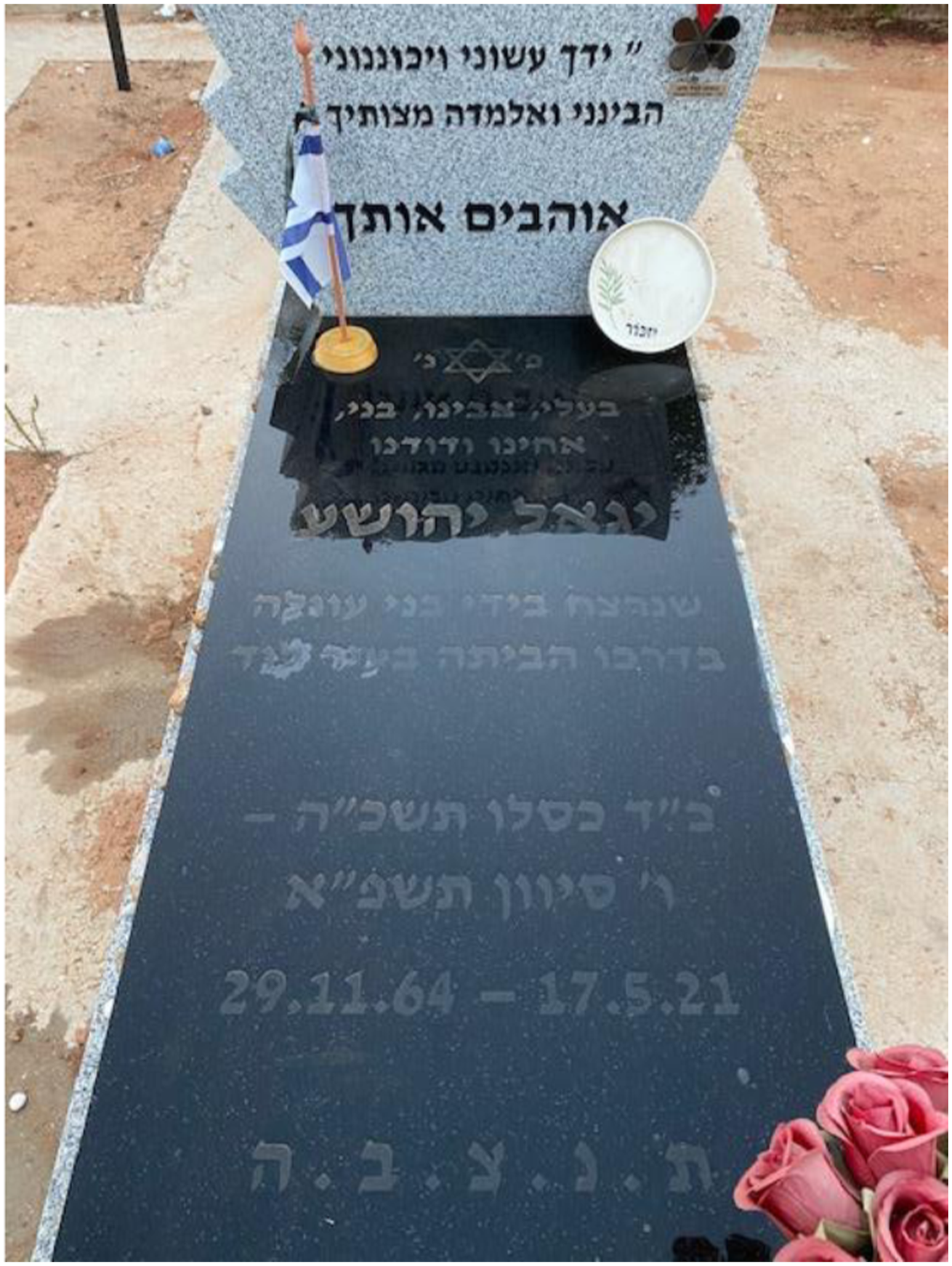
In Yigal’s case, the stated ideological meaning is that he was murdered for being an Israeli Jewish man by Palestinian terrorists. The tombstone also includes the symbol of the EDI association for organ donation, which emphasizes the narrative of the organ donations, including the kidney donation to the Palestinian woman, and commemorates them. Moreover, next to the symbol of the National Center for Organ Transplantation is a scriptural verse, Psalm 119:73: “Your hands have made me and fashioned me; Give me understanding, that I may learn Your commandments.” An interpretation of the verse is that the repair of a person’s limbs brings wisdom and a person’s organs—the brain, the heart, the vocal cords, and sight—allow him to acquire intelligence, wisdom, and sensitivity to learn God’s commandments and obey them 2 (Commentary of the Rabbi David Kimchi (RaDaK)).
Yigal’s brother shared a story of coexistence and recognition in loss that happened during the shiva: “… a Palestinian shepherd, a friend of mine, came with his flock to comfort us. He came with all the sheep to our mourning tent. It was surreal and touching.” In contrast to the few displays of coexistence that took place at the home of the Yehoshua family, at the home of the Kiwan family the Jewish recipients of the organ donations didn’t show up to comfort the family or contact them in other way, to thank them.
A few days after the transplantations took place, the family of Mahmoud Kiwan found themselves in the midst of a storm regarding the donation. Some members of Palestinian Arab society in Israel and abroad responded with severe reactions to the family’s statements regarding solidarity and a call for coexistence and the fact that they had saved the lives of patients identified with the occupying enemy (see Figure 2). These reactions included calling the family traitors and other harsh statements on social networks and in their city of residence. An example of one of the hostile reactions the Kiwan family received after the donations.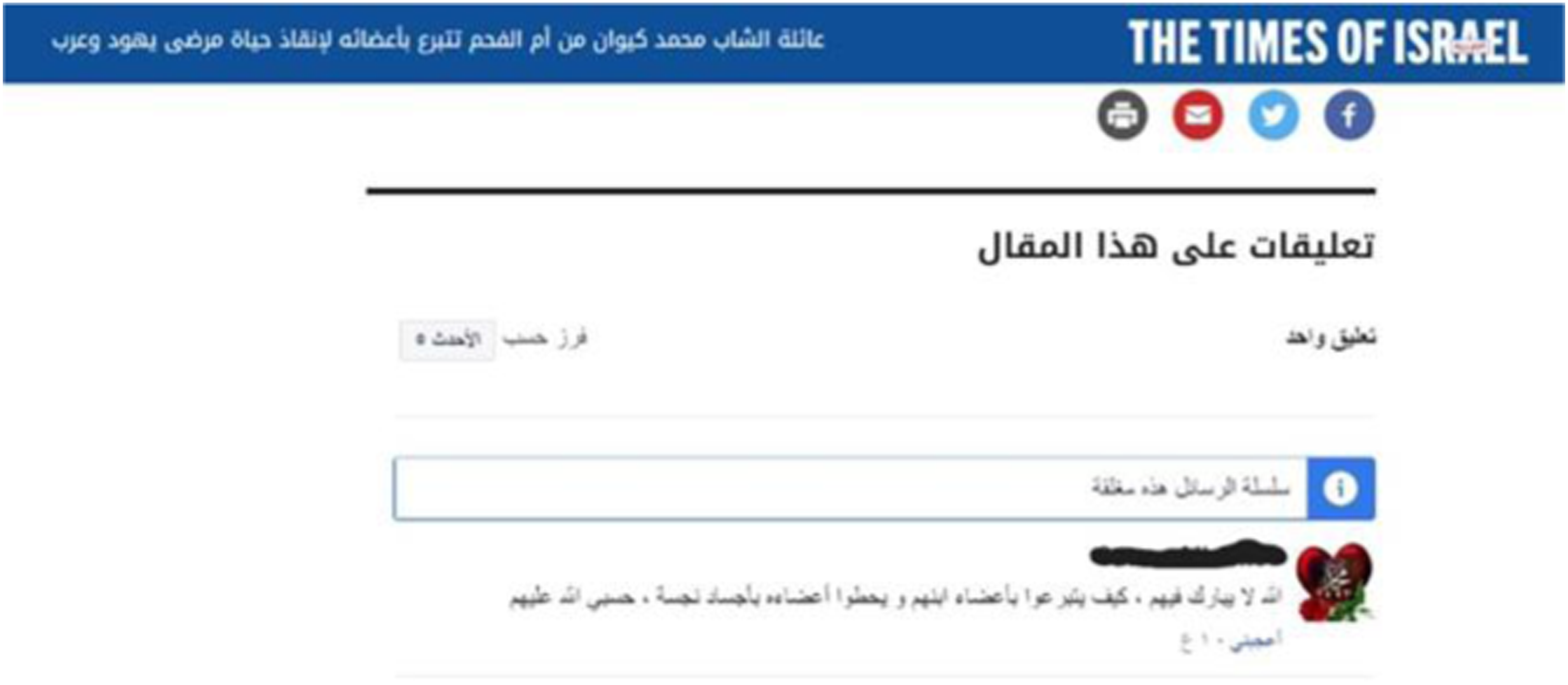
A few days after the donation, the family published Mahmoud’s photos with the caption “shahid” (in Arabic: شهيد martyr) (see Figure 3). In Islam, shahid is a title given to a deceased Muslim who died during the course of a religious act, during a war, or during any other form of struggle for religious beliefs. Palestinians inside and outside Israel use the term shahid for those killed by Israeli security forces. Such a decision can be understood as ideology meaning-making in loss and may have been the result of the harsh reactions the family received from the Arab public. Addressing Mahmoud as shahid may be understood as part of their disappointment and anger toward the Israeli Jewish recipients who ignored their donations and their anger toward the policeman who killed their son. By using the term, the family constructed political meanings for his death that took place during war, perhaps bringing comfort and constructing religious meaning for his death. Pictures of Mahmoud Kiwan.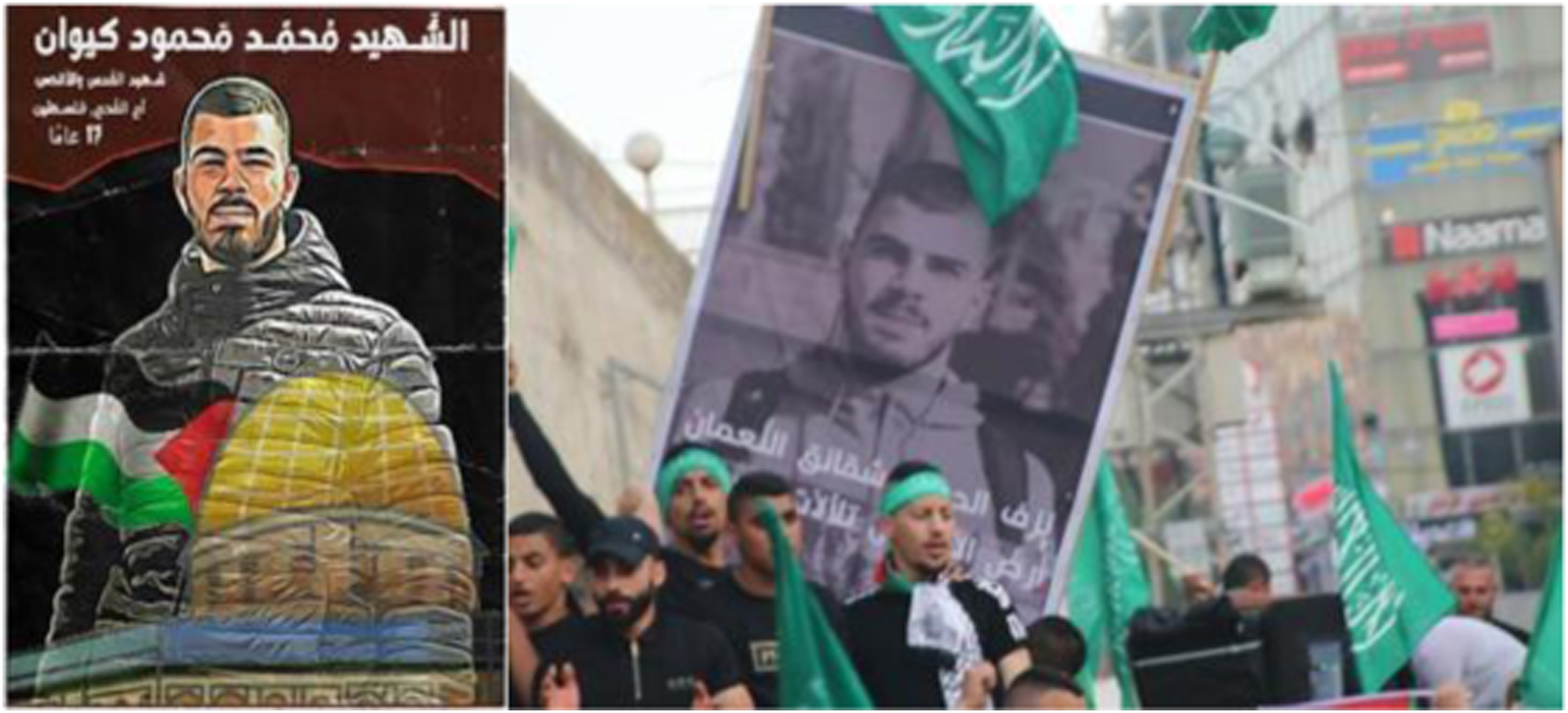
The Mufti of the city Umm Al-Fahm published a statement in the Arab press: Dear people, do not cause double pain to the family of the martyr Muhammad Mahmoud Kiwan ... The father and associates of the martyr Muhammad Kiwan contacted me regarding the campaign of defamation and slander that some people are conducting. This is because they donated the organs of their child the martyr, when the ones who benefit from this are themselves parts of Jewish society ... the reality in the country is that the donor does not know where the organ will end up, a Muslim may use it, a Christian may use it, a Jew may use it, or anyone else. This is because there is an order according to variable data that is not related to religion, and what happened to the martyr’s family ... the statement to completely prevent organ donation in our country out of fear or concern that the organ will reach the enemy could cause harm for Muslims who are on the waiting list. We have already heard of many cases in which Muslims in our country profited from organs, which may have been obtained from fighters. (Al-Zanara newspaper, May 25, 2021)
Findings suggest that the two families who had lost their loved ones during violent political conflict constructed political, ideological, and religious meanings for both the deaths of their loved ones and the organ donations that followed. However, while the meaning-making of the deaths was framed more in terms of “bounded solidarity,” as a death that is part of a political narrative of a specific group, the meaning-making of the donations was the opposite—expressed in donating a gift to whoever needs it, in the form of universal solidarity. It is reasonable to assume that the religious component, the call to save lives, both in Judaism and Islam, helped create meaning for their losses, as they were clearly able to save lives through organ donation.
Discussion
Solidarity is a polysemic concept. Solidarity is a boundary-drawing mechanism between “us” and “them” (Bayertz, 1999). In the present study, the dichotomy delineating distinct groups as “them” and “us” assumes multifaceted expressions, wherein the parameters of collective cohesion undergo dynamic shifts, both at a concrete and metaphorical level. The deaths of the two individuals took place in the context of definitive demarcations between “them” and “us,” in a situation where the perpetrators of each killing hail from adversarial and antagonistic political and ethnic factions. The conscious decision of the families to donate organs, with the awareness that they were likely to benefit individuals affiliated with the “other side,” can be viewed as a manifestation of universal solidarity.
The decision to engage in organ donation was explicated by the families, in their interviews with the researchers and in the media, in the context of an aspiration for coexistence and of religious doctrines that espouse the equality of all human beings, affirming their entitlement to life. This process entailed the transplantation of organs from donors representing distinct identities, which had hitherto been sustained within one body, into recipients with contrasting identities, having both practical and symbolic implications. Religious figures, the mufti and the rabbi, played a pivotal role in the families’ decisions. As esteemed religious authorities, they underscored the significance of universal solidarity, indicating the similarity between the shared tenets of Islam and Judaism, where the act of preserving any person’s life is considered a religious obligation, emphasizing the moral imperative of saving lives across these faith traditions. In the realm of hope and despair, universal solidarity inherently embodies the optimism for coexistence, the prospect of harmonious living together, both in practical and symbolic dimensions. This is exemplified by the phenomenon where a “Jewish kidney” can effectively operate within a Palestinian body, and conversely, a Palestinian heart can sustain life in a Jewish body. The decisions to donate organs and the religious support for them signify the potential for Jews and Palestinians to coexist harmoniously.
However, this hope was disrupted post-donation when Kiwan family, who did not receive recognition, gratitude, or acknowledgment for their universal act from the recipients of the donations, regressed into a state of solidarity characterized by more insular and distinct boundaries, reverting to the dichotomy of “us” versus “them.” Their decision to depict Mahmoud as a “martyr” is a compelling illustration of the shift toward bounded solidarity within a national religious context. His demise is portrayed not as a futile loss but rather as an integral part of a violent conflict rooted in religious differences. Paradoxically, the same religion that advocates the equality of all human beings and therefore the importance of saving any human life through organ donation can also be used to accentuate difference, underscoring that the death leading to the organ donations occurred within the context of a war that may be perceived as religious in nature.
In the scenarios described, there is a discernible flow between despair (the act of murder), hope (the act of organ donation), and subsequent disillusionment (the disappointment stemming from a lack of recognition or lack of manifestations of coexistence). These oscillations between hope and despair are closely intertwined with the manner in which the affected families construct varying interpretations of their loss and contributions.
The sociopolitical and ethical milieu within which a loss occurs significantly shapes the process of reconstructing meaning (Raskin & Debany, 2018). Furthermore, it is well established that organ donation serves as a meaningful response to loss, often providing solace to grieving families (Oreg, 2019, 2020; Oreg et al., 2023). Research suggests that political ideology becomes a pivotal avenue for the reconstruction of meaning following a loss in the context of political conflict, where individual narratives intersect with broader cultural, political, and religious contexts (Neimeyer et al., 2014). Evidently, both families in our study constructed ideological and political interpretations for their narratives of the deaths of their loved ones and the subsequent organ donations.
Although it may seem self-evident, the act of donating organs, particularly when the recipients are likely to belong to the opposing side in a protracted political conflict, demands a profound and intricate construction of ideological meaning. Both families faced the challenging task of reconciling their religious convictions with the immediate political turmoil and the overarching context of prolonged conflict, enduring occupation, and a constant atmosphere of fear. The religious positions advocated by religious authorities from both sides, namely, the mufti and the rabbi, assumed a pivotal role in shaping the overarching political and ideological narratives.
In contrast to Mahmoud’s family, who did not receive acknowledgment, the experience of Yigal’s family was marked by interactions that bolstered the development of a political ideology centered on hope. This was evident both during the period of “shiva” (the 7 days of mourning), when Palestinian mourners came to offer condolences and when a Palestinian shepherd arrived with his flock of sheep to console Yigal’s family. These events contributed to a tangible manifestation of coexistence. The encounters with the Palestinian kidney recipient and her family which occurred on two occasions, in which they were greeted warmly, provided further evidence of this hope for coexistence.
In contrast, Mahmoud’s family received no visits of consolation from Jews. Within their own community, they received approbation for their choice of organ donation and subsequently chose to refer to Mahmoud as a “martyr,” signifying an effort to construct a political and ideological interpretation of his death focused on a bounded solidarity within their community only.
In conclusion, organ donations occurring amidst ongoing political conflict between rival groups hold the potential to fortify the perception of universal solidarity and facilitate the construction of political and ideological meaning in the context of loss and subsequent donation. Nevertheless, for this meaning to become firmly rooted in the aspiration for reconciliation and coexistence, it is imperative to acknowledge the narratives of loss and the act of organ donation itself, both of which assume heightened significance during times of conflict. Religion and religious authorities play a pivotal role in delineating the boundaries of solidarity and shaping the political and ideological narrative surrounding death, particularly in the case of bereaved families who altruistically chose to donate their loved ones’ organs.
Limitations
There are several disadvantages to case study research. Among the limitations is the difficulty of generalizing findings from one case study to other settings. The current study tells the story of unique organ donations in a specific cultural and political context. Although the Israeli–Palestinian conflict is frequently violent and holds power relations built into it, the current study took place under extreme war conditions that may have further impacted the results. It is reasonable to assume that Palestinians and Israeli Jewish families would express slightly different feelings and construct different meanings for organ donations that cross national, cultural, and religious borders when there is not active warfare and when the organ donors have not been killed by brutal acts from the other side. Moreover, although the authors stated their positionality and tried to be aware of and reflective of their positions, it is still possible that the researchers’ personal opinions and biases influenced the research.
Epilogue
One month after Yigal Yehoshua was killed, the six Muslim killers were arrested and brought to justice. All of them were sentenced to long terms in an Israeli prison. On the other hand, despite photographs and documentation of the shooting of Muhammad Kiwan, for a year and a half the Jewish policeman who shot him was not arrested, and no investigation was opened into the matter. In our conversations with the family, they reiterated their expectation that the shooter would be brought to justice. A year and a half after Muhammad’s death, in October 2022, it was announced in the media that the investigation into the shooting had been closed due to the fact that it was not possible to identify the policeman who did the shooting. The Kiwan family received this news with pain and anger. At the beginning of the study, the members of the Kiwan family cooperated and were cordial and open. After learning from the media about the closure of the police investigation, we tried to recontact the family members. We wanted to share the research findings and to express our anger at the police decision. However, they refused to talk to us and hung up the phone.
Footnotes
Acknowledgments
We thank the Yehoshua and Kiwan families for opening their hearts and sharing their experiences with us. We are very sorry for their loss. We extend our gratitude to Garra Wojood and Noaz Cohen for their valuable contributions to this project. We thank Hagai Boas for his feedback on earlier versions of this manuscript, and to the reviewers and the editor for their constructive comments. This paper is dedicated in memory of Mahamoud Kiwan and Yigal Yehoshua, may their rest in peace.
Author Contribution
The study’s conception, theoretical framework development, and research setup were led by the first author. The data collection and analysis were a collaborative effort by both researchers, and they jointly authored the paper.
Declaration of Conflicting Interests
The author(s) declared no potential conflicts of interest with respect to the research, authorship, and/or publication of this article.
Funding
The author(s) received no financial support for the research, authorship, and/or publication of this article.
