







Abstract
Group level assessment (GLA) is a qualitative and participatory research-to-action methodology designed to engage a large group of relevant participants throughout the research process. As originally conceived, a single GLA session is led by a trained facilitator who guides the participants through seven structured steps: climate setting, generating, appreciating, reflecting, understanding, selecting, and action. The purpose of this manuscript is to describe the 25-year trajectory and uses, contributions as a liberating structure, and adaptations of GLA.
Keywords
Introduction
Group level assessment (GLA) is a qualitative and participatory research methodology intended for use with large groups (15–60) of diverse stakeholders. GLA is designed to engage relevant participants throughout the research process from generation of ideas, analysis, and prioritization to action. Twenty-five years ago, GLA was created as a client-centered needs assessment process that organization development consultants could use to assist groups in identifying needs and priorities (Vaughn & Lohmueller, 1998). As originally conceived, a single GLA session is led by a trained facilitator who guides the participants through seven structured steps: climate setting, generating, appreciating, reflecting, understanding, selecting, and action (Vaughn & DeJonckheere, 2019; Vaughn & Lohmueller, 2014). Figure 1 summarizes the steps of the original GLA methodology. Greater detail on the steps, prompt development, and process has been described elsewhere (Vaughn & DeJonckheere, 2019; Vaughn & Lohmueller, 2014). The purpose of this manuscript is to describe the trajectory of where and how GLA has been used, contributions as a liberatory structure, and adaptations of GLA as a methodological tool to be used within qualitative health research. Seven steps of group level assessment.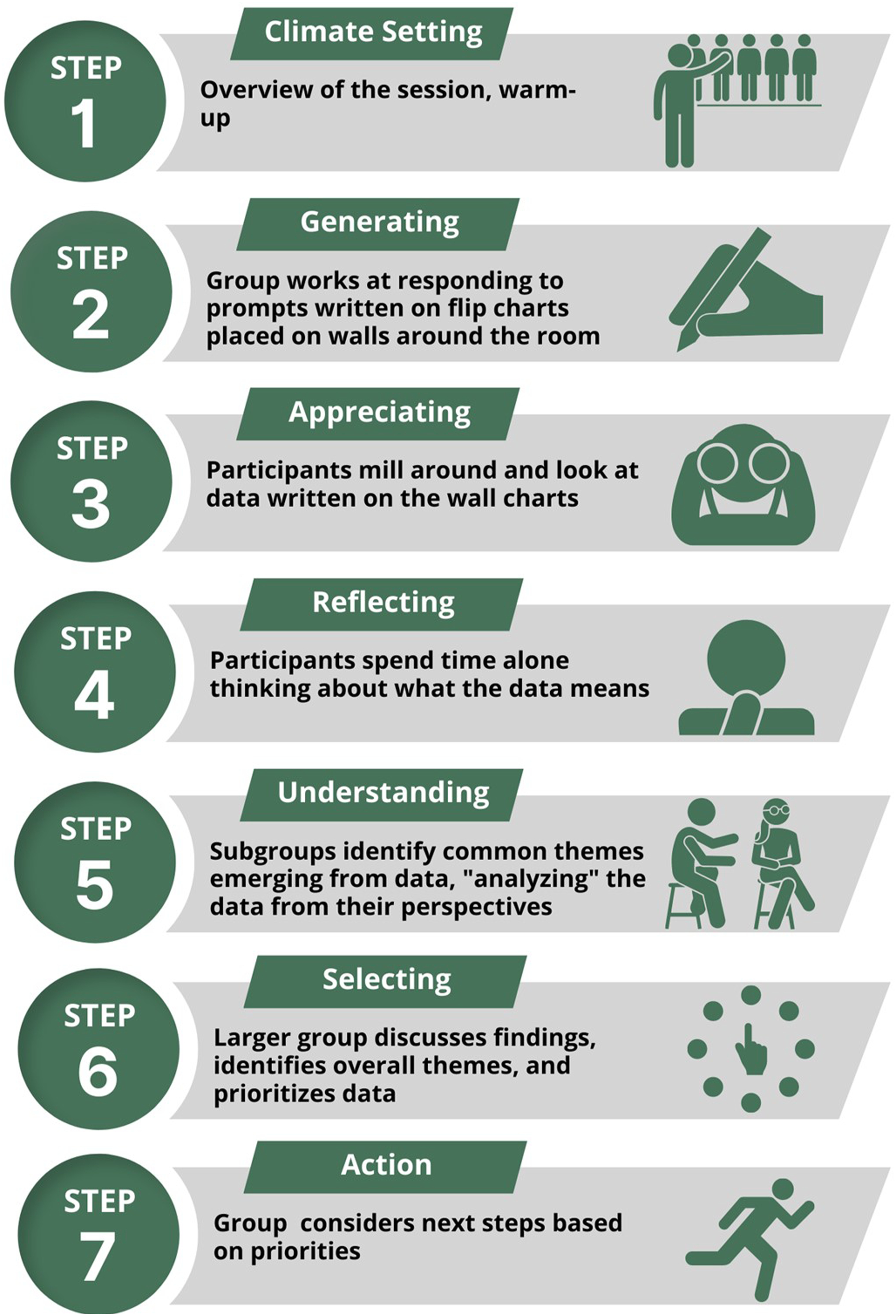
Since its origin, GLA has morphed from its original usage as an organization development tool into a research methodology that has been used widely in a variety of disciplines with many different types of groups and for different purposes including needs assessment, ideation, community engagement, evaluation, problem identification, intervention development, quality improvement, education, action planning, and priority setting. In an article organizing selected participatory research methods according to a variety of intended research and partnership goals, we categorized GLA within the “exploration and visioning domain” because of its applicability to different types of research development efforts (e.g., community dialogue, developing research questions, and exploring the meaning, causes, or solutions to specific problems) and its support of a wide range of participant involvement and representation across bounded groups and systems (Duea et al., 2022). For instance, GLA has been applied to engage participants and identify needs and barriers for various health-related issues such as African American fathers’ involvement in the pediatric medical home (Bignall et al., 2018), decision support needs for transgender and gender-diverse youth and families (Mazzola et al., 2023), caring for hospitalized limited English proficiency children (Choe et al., 2019), and use of continuous physiologic monitors for hospitalized pediatric patients (Schondelmeyer et al., 2019). Working with undergraduate women co-researchers, Guy et al. (2020) utilized GLA for action planning following a participatory action research project designed to elevate the status of and recognition of challenges for female students within STEM (Science, Technology, Engineering, and Mathematics) fields. Mehari and colleagues (2021) combined GLA with quantitative surveys for the evaluation of a police training workshop focused on de-escalation with trauma-exposed youth. Curriculum development and education examples that have incorporated GLA as the primary methodology include the incorporation of mindfulness practices within a college course (Vilvens et al., 2021), culturally specific leadership program for nurses (Nguyen-Truong et al., 2020), science education (Jacquez et al., 2020; Vaughn et al., 2020), and Jewish educational practices (Raider-Roth et al., 2019).
Across settings and purposes, several unique elements of GLA distinguish it from other qualitative research methods. GLA is intended for large groups of 15 to 60 diverse participants who represent different perspectives within a bounded “system” (e.g., community, department, clinic, and organizational subgroup) (Vaughn & DeJonckheere, 2019; Vaughn & Lohmueller, 2014). Although there are other excellent qualitative and participatory large group methods (e.g., World Café, Future Search Conference, and Delphi) (Brown & Isaacs, 2005; Duea et al., 2022; Janoff & Weisbord, 2006; Löhr et al., 2020; McPherson et al., 2018; RAND Corp, 2021; Weisbord & Janoff, 2010), GLA incorporates a participatory and community-engaged research process from start to finish due to the embedded steps of data collection, analysis, and action integrated into the seven steps (Vaughn & DeJonckheere, 2019; Vaughn & Lohmueller, 2014).
In contrast to other commonly used qualitative methods such as interviews and focus groups, GLA is by design a participatory research method that actively engages a large group of diverse participants in data collection, analysis, interpretation, prioritization, and action in real time, positioning the participants as the experts of their lives and communities (Vaughn & Jacquez, 2020). In this way, GLA is participant- and group-centered rather than being researcher-centric where the researcher drives the data collection and analysis process which can be disempowering, passive, and disengaging for participants. In contrast to many conventional research methods, GLA requires academic researchers to share power, co-learn, and engage equitably WITH (versus on or about) participants who generate, analyze, interpret, and prioritize data through the seven-step process.
Qualitative researchers might mistakenly think of GLA as a large focus group. However, GLA differs considerably from focus groups not only logistically (i.e., large size, participatory idea generation and data analysis, participant-centered, and heterogenous stakeholders) but epistemologically. Although both GLA and focus groups may share a constructionist epistemology in the sense of recognizing multiple realities and context dependency in the knowledge generation process (Maxwell, 2012), GLA is firmly rooted in the participatory and transformational epistemological camps (Díaz-Arévalo, 2022; Fine & Torre, 2019; Mertens, 2017; Peralta, 2017; Walker et al., 2022). GLA was designed to disrupt the status-quo, top-down research process with researchers driving the data collection and analysis and instead provide a democratic and liberating structure where those with a stake in the issue from all levels of the community or system drive the data generation, analysis, and prioritization to action. Knowledge in GLA is co-constructed, generated, analyzed, and prioritized by a large group of participant “insiders,” while in a traditional focus group, knowledge is extracted from a small relatively homogeneous group of participants responding to questions moderated by an “outsider” facilitator, and data analysis is conducted by the “outsider” researcher (Kendall et al., 2011) examining the content of the discussion and the interaction between respondents (Parker & Tritter, 2006). Because of the foregrounding of lived experiential knowledge of those who have a stake in the issue (participants, stakeholders, and community members) alongside academic/research expertise (Roura, 2021; Vaughn et al., 2018; Vaughn & Jacquez, 2020), GLA is an ideal methodological tool to be used both within the family of participatory research approaches—citizen science, community-based participatory research, participatory action research, patient and public involvement in research, community-engaged research, participatory health research, etc. (Vaughn & Jacquez, 2020)—and decolonizing, cultural approaches to research (e.g., PARcific Methodology—Rumsey et al., 2022; Indigenist Dadirri Methodology—West et al., 2012).
The GLA process is designed to be interactive which fosters engagement and generates energy with participants. However, GLA is most successful when led by a trained facilitator who understands group dynamics and can address challenging behavior in groups. Because GLA purposefully includes seven different steps, each with varied tasks and group sizes (individual, small, and large), the process can feel chaotic to some participants who find the varied activity and large group atmosphere stressful. However, by design, GLA supports heterogenous participants of different roles, status, personality, cognitive style, and power interacting together to generate and examine ideas. In other words, the seven steps of GLA serve as a “liberating structure” that not only holds a safe space for all participants to express thoughts and opinions freely but also promotes self-discovery via “stepping into another’s shoes” through various types of deliberate, facilitated interactions with participants different than oneself (e.g., during Step 2, Generating, large group simultaneously responding to prompts; dialogue in small mixed status/role groups in Step 5, Understanding) (see Table 1 for a summary of GLA sequence, cognitive tasks, and configurations). Based on complexity science, liberating structures can be defined as democratic, concrete tools that scaffold and organize participants in different group configurations, arrangements, and participatory steps (Kimball, 2012; Lipmanowicz et al., 2015; Torbert, 1978). Furthermore, liberating and democratic structures like GLA distribute power and influence more widely by engaging everyone, invite self-organization to flourish by letting go of over-control, expand and connect networks by breaking down silos, increase transparency and the rapid reciprocal flow of information, and build new sets of feedback loops via many new forms of interaction; and increase diversity by engaging more people and perspectives. (Lipmanowicz & McCandless, 2010, p. 10) Group Level Assessment Sequence, Cognitive Tasks, and Configurations.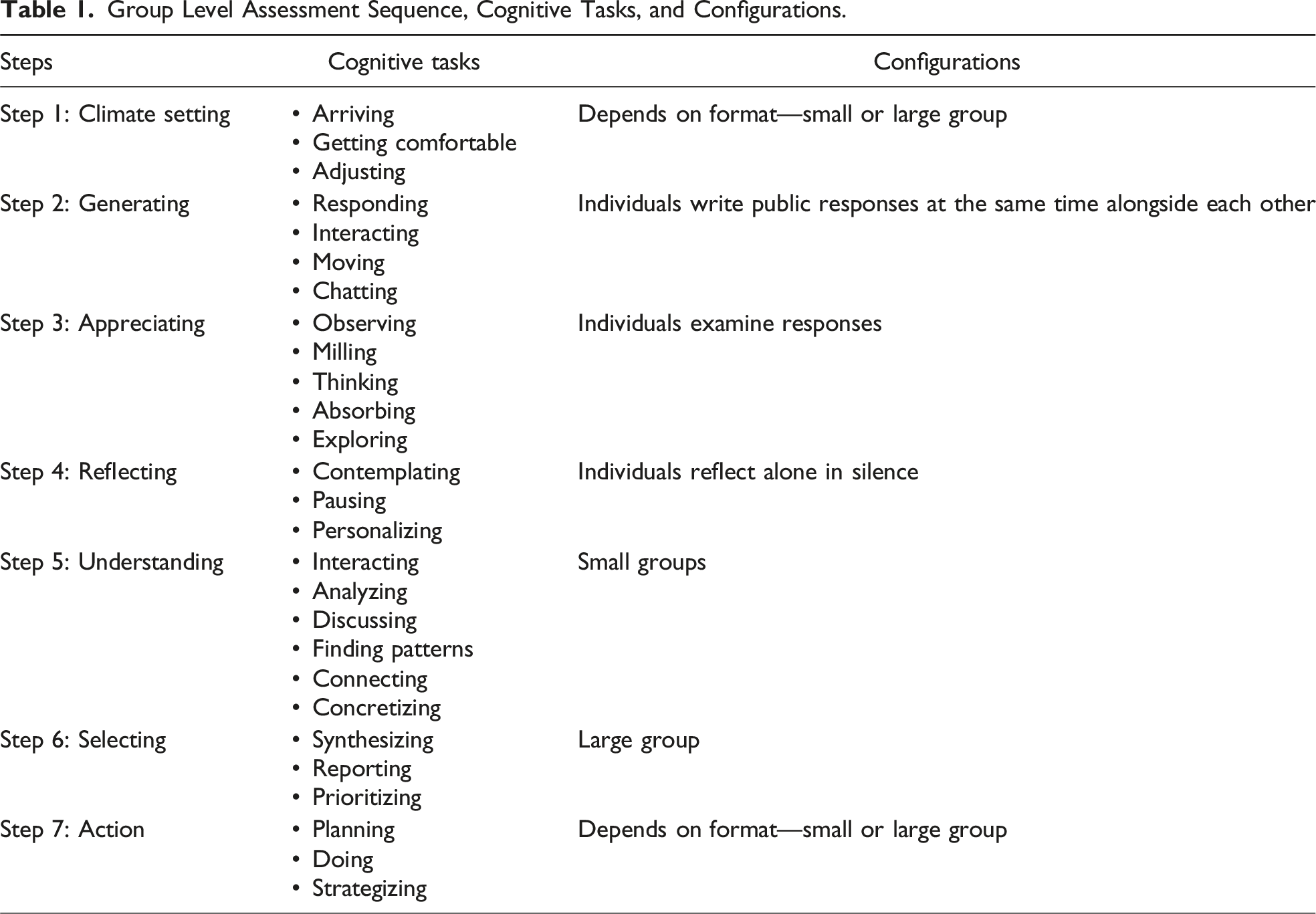
Across the seven steps, GLA promotes transparency and community/group engagement with the focus on “public data” versus private data that might be shared by an individual participant in a one-on-one interview for example (Vaughn & Lohmueller, 2014). This means that participants are unlikely to share an idea that only matters to them and if they do are likely to see that others either do not share their perspective or the participants are not ready to address the idea together as a community or group. The idea in GLA is not to dismiss or ignore important information from individual participants but rather to coalesce around the priority ideas that are collectively important across participants so that there is a greater likelihood of engagement and support of future action at a community/group level. In GLA Step 2, Generating, all participants are invited to respond simultaneously to open-ended prompts on flipcharts which allows individual responses to be shared publicly in real time. GLA Step 5, Understanding, within GLA is the collaborative data analysis step where participants in small groups identify common themes, analyzing data publicly and collectively from their perspectives. The summarizing of themes and prioritization in Step 6, Selecting, likewise occurs together as a large group with final themes and priorities clear for all to see.
GLA Adaptations and Modifications
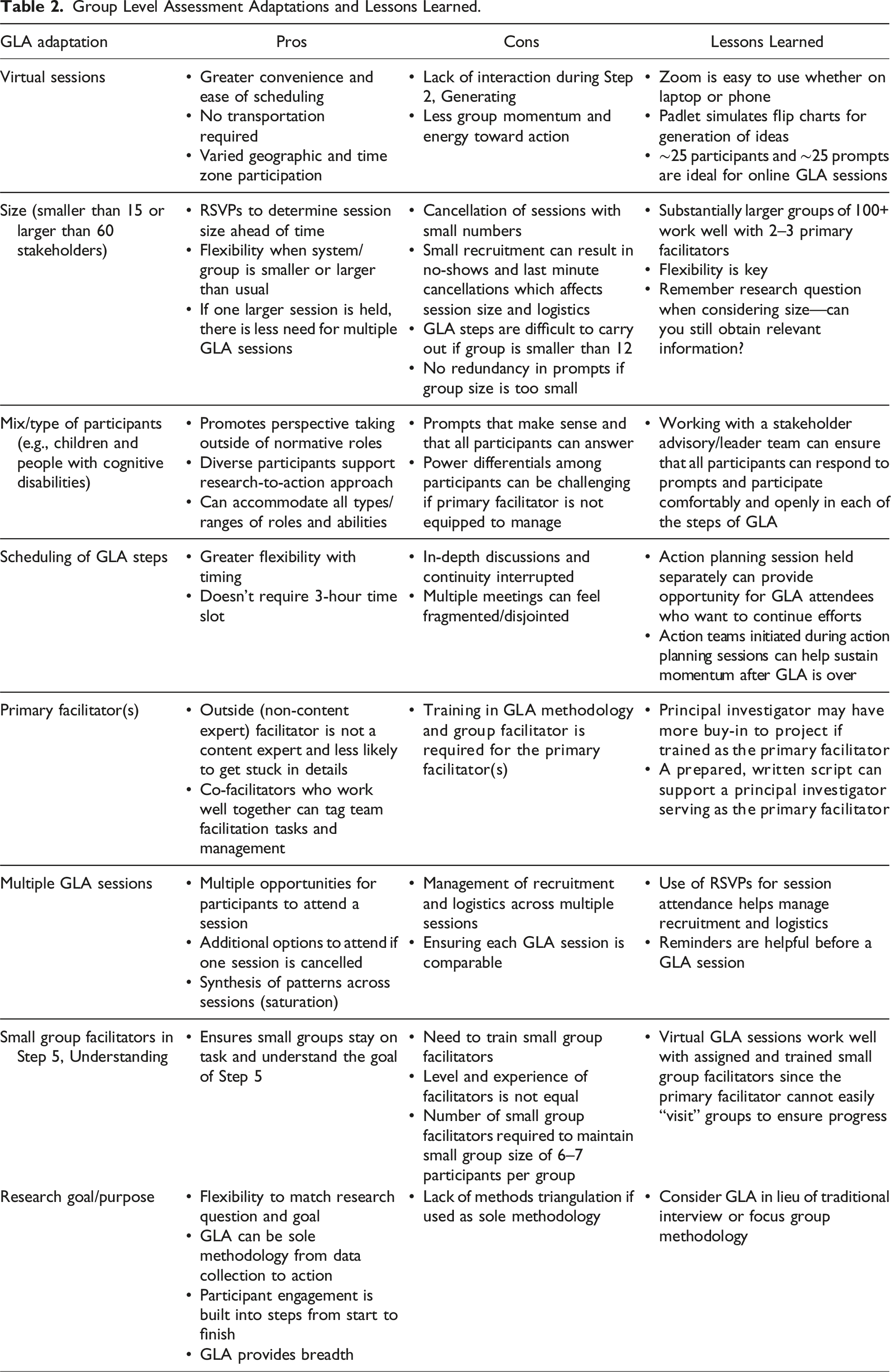
Group Level Assessment Adaptations and Lessons Learned.
Virtual Sessions
GLA was originally designed to be in person providing the opportunity to interact face to face. During the COVID-19 lockdown, GLA was adapted to the virtual environment. Zoom and Padlet work well to simulate the in-person steps of GLA (i.e., Padlet for Step 2, Generating; Zoom breakout rooms for the small group work in Step 5, Understanding). One research team conducted an online GLA to understand decision support needs of transgender and gender-diverse adolescents and their families (Mazzola et al., 2023). Dorhout (2023) provides a how-to for an online modification of GLA (mGLA) and lessons learned regarding technology and online “netiquette,” time constraints, and relational barriers.
Size
GLA is ideally suited for 15–60 people in one session. However, the group size can be adapted to smaller (less than 15) and larger (60+) with modifications to the steps and choice of a space appropriate for the number of attendees. An abbreviated, less in-depth GLA session can be conducted with 12 people by using fewer prompts and spending more time in the large group discussion in Step 6, Selecting. If the group size is less than 12 stakeholders, the steps and design of GLA cannot be maintained. Rather than cancelling a GLA session with less than 12 attendees, a traditional focus group or discussion group asking broad questions about the research content is recommended as a replacement. Alternatively, if the number of attendees is very small (five or less), cancelling the GLA session and inviting these participants to a future GLA session is suggested. Over-recruitment is ideal if there is concern that a single GLA session will be too small. If multiple GLA sessions are not an option (e.g., during a scheduled conference or workshop), larger GLA sessions (60+) can be supported with multiple primary facilitators, additional prompts, and separate large open spaces (or dividable spaces) that can accommodate the group size.
Mix/Type of Participants
Ideally, GLA engages a large group of diverse participants who represent all levels, roles, and statuses within a bounded system/group. Although the diversity means there will be power and status differentials among participants in each GLA session, the overall design and the seven-step liberating structure support the interactions. A trained primary facilitator and the structured format of the GLA steps minimize any disruptive group dynamics. GLA can easily include populations such as children, the elderly, diverse languages, deaf/hard of hearing, and participants with cognitive or developmental disabilities or low literacy through simplified prompts, helpers/advocates, translators, or interpreters who assist individual participants with Step 2, Generating, and inclusive, accessible settings that accommodate mobility and assistive devices, for example. In a GLA study conducted in a multicultural residential area where many residents did not speak the native language fluently and multiple languages were represented among participants, intercultural mediators/translators and a sign language interpreter attended GLA sessions (Magnusson et al., 2022). In an example of a GLA study that engaged elementary school children, researchers simplified the prompts and collaborated with college students who helped the younger children respond to prompts during Step 2, Generating, and facilitated small groups in Step 5, Understanding (Vaughn et al., 2011).
Scheduling and Session Time
GLA typically requires a minimum of 3 hours if all steps are completed in one session. However, Step 7, Action, can easily be held as a separate session following one or more GLA sessions. If an ongoing large group meets regularly (i.e., class), the seven steps could be split and conducted step by step for as many sessions as needed. In a GLA study about the foster care system in one county, the research team conducted a large GLA (Steps 1–6) with more than 60 foster care system stakeholders including foster youth to explore the barriers for foster youth transitioning to adulthood (Graham et al., 2015). GLA participants identified several specific challenges, and a separate action session was held where the challenges were summarized, and action teams formed for each of the identified challenges. The action teams continued to meet for years after the initial GLA.
Primary Facilitator(s)
All the steps of GLA can be conducted by a non-content expert primary facilitator or two co-facilitators who guide participants through the steps. The advantage of non-content expert facilitators is that they can maintain focus on the facilitation task and group dynamics versus becoming mired in the content. On the other hand, the principal investigator and/or a partnering member of the focal community can be trained as co-facilitators which may promote greater investment in the research process and contribute to increased engagement with the content and goal of the research.
Multiple GLA Sessions
GLA can be conducted as one “bounded” session with all steps and all participants or multiple sessions with different participants attending one of several sessions and results summarized across GLA sessions. Both options align with the GLA approach depending on the research question and whether breadth and synthesis of themes across sessions contribute to the ultimate research purpose. Multiple GLA sessions maximize flexibility for participants to choose which of several sessions best fit their schedule. For instance, in a needs assessment study about parents experiencing homelessness, researchers employed GLA using multiple sessions to understand the children’s service needs from the perspectives of families in shelter (Williams-Arya et al., 2021). To accommodate the widest range of parent schedules across three family homeless shelters, the researchers held five GLA sessions.
Small Group Facilitators for Step 5, Understanding
The original GLA was designed for small groups to self-facilitate in the identification and synthesis of themes for the small group’s assigned prompts in Step 5, Understanding. If the research team is large enough and/or there is concern about participants understanding the task in small groups (i.e., children), research assistants can be trained to facilitate small groups in Step 5. Small group facilitators will ensure that the group stays on task contributing to greater efficiency and functioning of the small group. In a virtual GLA, trained small group facilitators of the online breakout rooms for Step 5 do seem to enhance completion of the task as compared to self-facilitated small groups.
Research Goal/Purpose
GLA can serve as the sole methodology (i.e., data collection, data analysis, interpretation, and action) for a research project or in combination with other methods. See, for example, a mixed methods study by Jenkins and colleagues (2023) that used GLA in combination with concept mapping methodology to identify barriers and facilitators to effective interdisciplinary communication within internal medicine hospital teams.
Decisions about the number of sessions and number of total participants will depend on the research question and goal of the research. GLA can also be used for specific aspects of research such as needs/resource assessment, evaluation, prioritization, and intervention development. For instance, Raider-Roth et al. (2019) modified the traditional GLA to group level understanding (GLU) for the purpose of first understanding participants’ most pressing work–life needs and then creating a curriculum responsive to participants’ identified needs.
Summary/Conclusion
GLA is a large group qualitative and participatory alternative to other more commonly utilized research methods within qualitative health research. Since the origin of GLA 25 years ago, GLA has grown into an established, robust research methodology and spread across multiple disciplines and offers countless benefits for both researchers and communities/groups. Numerous GLA adaptations and modifications have been developed which further contribute to GLA’s versatility, flexibility, accessibility, and increasing popularity as a research methodology.
By design, GLA is participatory from start to finish, engaging participants as soon as a session begins or ideally before the session, during the planning, and prompt development. As a participatory research methodology, GLA is both a “thirdspace” and “holding space” for genuine and meaningful participation (Akkerman & Bakker, 2011; Cook, 2012; Hall, 2014; Hawley & Potter, 2022; Soja, 1996). GLA offers participants “the ability to speak up, to participate, to experience oneself and be experienced as a person with the right to express yourself and to have the expression valued by others” (Abma et al., 2019, p. 127). Recognizing participants as experts of their lives and communities, GLA promotes collective wisdom, responsibility, and action toward community/group-defined priorities. GLA recognizes the expertise of the community or group which encourages engagement and action based on the needs, assets, and priorities of the participants.
Group level assessment methodology is multi-faceted and versatile. GLA considers the “good, bad, and ugly” in the generation of data (Step 2 prompts) and is not only focused on deficits and problems. GLA can be used for a wide assortment of research purposes including needs assessment, program evaluation, project management, capacity building, and curriculum development. GLA can absorb multiple perspectives and voices simultaneously compared to researcher-centric methods that may minimize or limit participants’ voice unintentionally. In contrast to the private-ness and potentially cathartic and confessional association that may exist in research methods like one-on-one interviews or the challenging small group dynamics (e.g., dominating participant) that may occur in focus groups, the “public-ness” of GLA serves as a foundation from which participants can be equal contributors who prioritize, take ownership, and decide to act based on their own data and collective expertise.
As a liberating structure, GLA, in contrast to other qualitative research methods, provides a unique opportunity for participants to share ideas freely and openly within a supportive structure. The variation in the cognitive tasks (e.g., visual, written, discussing, and reflecting) and configurations (i.e., individual, small group, and large group) built into the steps of GLA supports all personalities and types of participants including those with low literacy, shyness, different statuses/power, and different educational levels that may present barriers in other research methods. Through its collaborative, generative, and discovery- and action-oriented structure, GLA “liberates energy, unleashes participants’ contributions, stimulates creativity, and reveals the group’s latent intelligence” (Lipmanowicz & McCandless, 2013, p. 21) while supporting candid exchanges and disrupting typical power dynamics (Roura, 2021). Bolstered by a solid 25 years of growth and maturity, GLA is an essential research methodology for the qualitative health research toolkit.
Footnotes
Declaration of Conflicting Interests
The author(s) declared no potential conflicts of interest with respect to the research, authorship, and/or publication of this article.
Funding
The author(s) received no financial support for the research, authorship, and/or publication of this article.
