







Abstract
This paper uses a small-stories positioning framework to analyse metaphors of the body and related claims of identity in Muslim women’s infertility blogs. I first conduct a directed qualitative content analysis to identify metaphorically used words and group them into a small set of metaphor families; I then apply Metaphor-Led Positioning Analysis to interpret how those metaphors position narrators, audiences, and institutions across small stories. I examine how narrators construct gendered selves in context – alternately contesting or adopting positions of victimhood – vis-à-vis hegemonic medical, social, and religious Discourses and key interlocutors (partners, families, clinicians, peers). Focusing on figurative language (e.g., the body as defective machine, battleground, empty container, rebellious agent, or season/journey), The article shows how metaphors mediate alignment with audiences, index affect, and enable stance shifts that both reproduce and resist pronatalist and medicalising ideologies. It argues that these cultural–rhetorical manifestations expose the workings of hegemony around femininity and the body in relation to reproductive ‘failure’, while also furnishing resources for re-authoring womanhood beyond gestation. Implications include faith-literate, lineage-sensitive communication in fertility care, and narrative-focused support for coping.
Keywords
Introduction
Infertility troubles identity in ways that are at once embodied, social, and moral. In strongly pronatalist settings where adult femininity is tightly yoked to maternity, difficulties conceiving or carrying a pregnancy are not merely clinical events but identity shocks (Inhorn, 1996, 2003; Inhorn & van Balen, 2002). Reproductive outcomes are publicly interrogated and morally evaluated; everyday talk about pregnancy, children, and kinship can become a conversational minefield for those without children (Inhorn, 1996). Across many Muslim communities – majority-world and diaspora – pronatalist expectations interlock with kinship obligations and religiously inflected moral orders regarding what counts as a ‘good’ wife, a patient believer, and a dutiful daughter-in-law (Inhorn, 2003; Inhorn & van Balen, 2002). In such contexts, women report scrutiny (‘Any news?’), unsolicited advice, pressures for silence to protect family honour or a husband’s masculinity, and, at times, explicit blame (Inhorn, 1996, 2003). Infertility thus becomes a problem of voice as much as biology: what can be said, to whom, and with what consequences for belonging.
Personal weblogs (blogs) have provided semi-public spaces where women narrate ‘trying to conceive’ (TTC) journeys under conditions of offline constraint. Blogs enable careful audience design, delayed disclosure, and stance management; they accumulate small updates over time, allowing identity to be crafted iteratively rather than declared once – a pattern squarely captured by a small-stories lens on identity (Bamberg & Georgakopoulou, 2008). Crucially, blogs leave a textual trace of micro-moves – hedges, intensifiers, lists, humour, hashtags, reported speech, and metaphors – through which narrators negotiate accountability and recruit allies.
This paper narrows the analytical lens to metaphors of the body. Figurative framings do more than decorate experience; they position tellers and audiences, distribute responsibility and entitlement, index affect, and make certain futures imaginable while closing others down (Charteris-Black, 2004; Semino, 2010; Semino et al., 2018). It argues that metaphor choice is not incidental style but a positioning device that helps infertile Muslim women navigate competing moral orders – biomedical, social, and religious – without forfeiting dignity or agency (Bamberg & Georgakopoulou, 2008; Kayı-Aydar, 2021). Reading metaphors through a small-stories perspective clarifies how identity is laminated across brief, situated tellings rather than housed inside people as stable traits (Butler, 1990).
Beyond blogs, infertility storytelling increasingly unfolds across visual platforms such as Instagram, where identity labels (‘warrior’, ‘traveller’) and multimodal posts scaffold belonging, normalise oscillations between grit and grief, and expose the tension between control and helplessness (van der Meij & Declercq, 2025). Systematic reviews of online peer-support communities indicate both benefits (reduced isolation, informational support) and risks (misinformation, emotional over-exposure), underscoring the importance of boundary-setting and platform-aware counselling (Lin & Shorey, 2023). This aligns with multimodal analyses of #TTC/in vitro fertilisation (IVF) discourse on Instagram, which show how identity tags and visual–text pairings organise patient authority and visibility online, while platform algorithms and dominant aesthetics normalise particular bodies and biomedical framings (Jarvis & Quinlan, 2022; Johnson et al., 2019). For Muslim women specifically, access, uptake, and counselling around assisted reproductive technologies (ARTs) continue to be shaped by intersecting cultural, religious, and structural barriers; recent syntheses call for faith-literate practice (Hammond & Hamidi, 2025).
To keep the analysis focused and auditable, this is a single-finding article: rather than reporting every pattern in the wider weblog corpus, it isolates one cross-cutting phenomenon (metaphors of the body) for sustained analysis. The study shows how five recurring metaphor families (machine, battleground, container/emptiness, rebellious agent/personification, and seasons/journey) are mobilised to resist or reproduce master Discourses (e.g., pronatalism and medicalisation) (Martin, 1987; Venkatesan & Murali, 2020). Its contribution is threefold: (1) specifying how figurative choices organise identity moment by moment in small stories; (2) offering a portable Metaphor-Led Positioning Analysis (MLPA) protocol; and (3) proposing practice implications for faith-literate, lineage-sensitive fertility communication (Inhorn & van Balen, 2002). This paper is a focused sub-study carved from the author’s larger weblog corpus project on infertile identities (Alhalwachi, 2021; Alhalwachi & McEntee-Atalianis, 2025).
Aim and Research Questions
This article examines how metaphors of the body function as positioning devices in public, English-language infertility blogs written by women who self-identify as Muslim. It asks (1) What metaphor families recur when narrators talk about the body and reproductive processes? (2) How do these metaphors position narrators, interlocutors, and audiences at Level 2 (interactional) and Level 3 (societal) across small stories? (3) What practice implications follow for metaphor-aware communication in fertility services?
Theoretical Framework: Small Stories, Positioning, and Metaphor
This study approaches identity as discursively accomplished rather than possessed (Butler, 1990). A small-stories perspective foregrounds brief, often fragmentary tellings – status updates, mini-rants, confessions, and list-like reports – that circulate on blogs and other digital platforms (Bamberg & Georgakopoulou, 2008). Such tellings may lack the completeness of canonical narratives, yet they are where stance is taken, audiences are recruited, and moral orders are invoked (Bamberg & Georgakopoulou, 2008).
Positioning theory operationalises these dynamics across layered levels. At Level 1 (storyworld), narrators assign roles to characters (e.g., the clinician as gatekeeper, the organ as recalcitrant, and the relative as intrusive advice-giver). At Level 2 (interactional), tellers align with imagined or real audiences (lurkers, commenters, and TTC peers), claiming epistemic and affective footing: to confide, instruct, rally, or joke (Kayı-Aydar, 2021). At Level 3 (societal), narrators locate themselves within or against master Discourses – biomedicine, pronatalism, and religion – that legitimate or constrain possible selves and actions (Bamberg, 2011; Bamberg & Georgakopoulou, 2008; Georgakopoulou, 2006; Inhorn, 2003; Kayı-Aydar, 2021). Blog writing is saturated with intertextual cues (hashtags, TTC acronyms, and clinic jargon) that make audience design and Level 2 work unusually overt; religious lexicon and pronatalist common sense keep Level 3 in view (Inhorn, 1996, 2003).
Foregrounding metaphor enriches this framework. Metaphors map source domains (machines, battles, containers, and journeys/seasons) onto embodied experience; as such, they are cognitive tools and social actions (Charteris-Black, 2004). In health discourse, figurative choices are not neutral: battle metaphors can legitimise effort and camaraderie yet risk implying that those who pause treatment are ‘quitters’ (Semino et al., 2018); machine metaphors can clarify mechanisms and legitimise intervention yet encourage a parts-logic that seeps into self-definition (Martin, 1987); container/void metaphors make absence speakable while potentially entrenching full/empty binaries of womanhood (Martin, 1987); personification can protect the global self by relocating blame to a part (Semino, 2010); and journey/season metaphors can open future-directed agency while sometimes smoothing over structural constraints (Semino et al., 2018; Venkatesan & Murali, 2020). Accordingly, treating metaphor as an analytic lens is not an add-on but a route into the often implicit premises that organise clinical reasoning and patient sense-making (Aita et al., 2003).
Recent work extends classic critiques of reproductive metaphors into contemporary care and pedagogy, showing how figurative repertoires shape expectations in ART and medical education (Delaunay & Gouveia, 2021; Liston et al., 2025). In parallel, meta-synthetic reviews of reproductive loss narratives map how people ‘story’ miscarriage, reinforcing that narrative devices – including metaphor – function as sense-making and identity work under uncertainty (Wallis et al., 2024). These insights complement corpus-based findings by demonstrating, in fertility-specific settings, how ‘machine/battle/journey’ framings organise roles, blame, and agency both at the bedside and in bedside-adjacent online spaces.
I therefore treat metaphors as positioning devices. Interactionally, they invite stance uptake by specific audiences – co-combatant (‘we fight’), co-expert (‘we track anti-Müllerian hormone (AMH) and protocols’), confidante (‘let me take off the mask here’), or mentee (‘here is what I learnt’). Societally, they license or resist moral accounts (Bamberg & Georgakopoulou, 2008; Kayı-Aydar, 2021). In reproductive contexts, feminist anthropology and cultural analysis show how mechanistic imagery naturalises hierarchical assumptions about female embodiment (Martin, 1987), while contemporary work in graphic medicine highlights negotiations of agency within technologised care (Venkatesan & Murali, 2020). A small-stories approach helps us see these negotiations in motion, as people oscillate across adjacent paragraphs – machine talk to secure legitimacy; battle talk to call out minimisation; container talk to protect energy; personification to vent; and journey talk to re-open horizons (Bamberg & Georgakopoulou, 2008; Semino et al., 2018).
Methods: Metaphor-Led Positioning Analysis (MLPA)
Design and Corpus (Sub-Study Within a Larger Project)
I conducted a qualitative analysis of public, English-language blogs authored by women who self-identify as Muslim and write about infertility and treatment. The corpus is blog-anchored (2016–2017) but sits within a multi-platform media ecology in which Facebook/Twitter was already established and Instagram was expanding rapidly. I focus analytically on public blogs because they provide durable, text-rich small stories suitable for positioning analysis and archiving, while contextualising findings with recent Instagram research in the Discussion section. This article is a focused sub-study carved from the author’s larger weblog corpus project, which comprised 10 blogs/bloggers and 411 archived posts (April 2016–January 2017) and examined the construction of infertile identities across small stories and discursive resources (Alhalwachi, 2021; Alhalwachi & McEntee-Atalianis, 2025). Here, I bracket findings on medical intervention and clinical persona work reported elsewhere and isolate one cross-cutting finding – metaphors of the body – for sustained analysis (Alhalwachi & McEntee-Atalianis, 2025). Within the corpus, posts and post-segments in which the body was clearly focal were targeted (e.g., menstruation, testing and results, consultations, treatment cycles, pregnancy testing, announcements, and losses). Three bloggers – pseudonyms Mona, Nora, and Suki – serve as exemplars because their timelines display sustained figurative labour, rich audience design, and clear positioning manoeuvres, allowing within-case trajectories and between-case contrasts. Methodologically, I follow QHR discussions of using unsolicited online narratives as qualitative data and consider their affordances relative to interviews (Seale et al., 2010).
Inclusion criteria were (a) first-person experiential narration related to the infertility journey; (b) explicit Muslim self-identification in the blog or profile; (c) public accessibility at time of capture; and (d) sufficient temporal depth to trace stance shifts. Exclusions were purely informational/reposted content without first-person stance and posts that were paywalled or private at capture. All texts were archived to a local research drive for stable analysis and version control.
Sampling/Case Selection
Three focal exemplars (Mona, Nora, and Suki) were selected through a two-stage, purposive process. First, I conducted a whole-corpus sweep of the 10 blogs (411 posts) to flag posts that (i) contained sustained, explicit body-talk (e.g., uterus/ovaries/womb) with candidate figurative language and (ii) sat at or near treatment milestones (diagnosis, IVF cycles, pregnancy loss, decision points). Candidate posts were logged in a sampling matrix (blogger, date, milestone, provisional metaphor family, and traceability risk). Second, I purposively selected three cases on the basis of (a) sustained figurative labour spanning at least two of the five metaphor families in a single post or across adjacent posts, (b) ethically quotable material suitable for anonymised reproduction, and (c) complementary trajectories/regions that reflect the corpus’s heterogeneity. A deviant case (Salam) was added to test the boundaries of the dominant container/emptiness repertoire. Within each selected case, I analysed those post-segments where metaphor tokens and positioning work co-occurred most densely, while retaining enough surrounding text to preserve interactional and biographical context.
Brief Case Summary
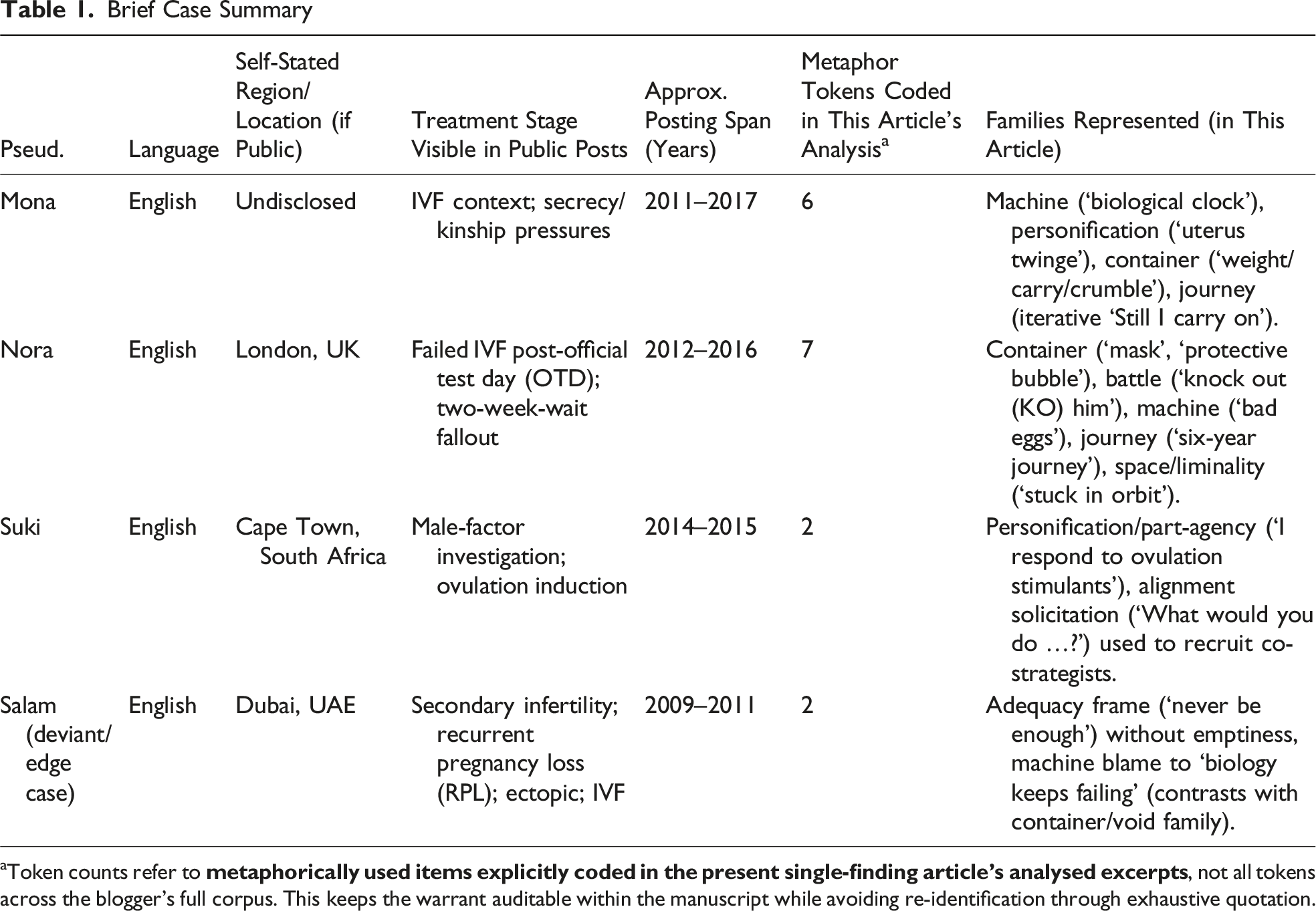
aToken counts refer to
Analytic Protocol (MLPA)
Where content analysis fits: I used a directed qualitative content analysis as the organising layer of MLPA: after unitising posts into small stories, we systematically coded metaphorically used words and phrases and assigned them to a small set of theoretically informed categories (the five metaphor families). This content-analytic layer produces an auditable codebook (definitions, inclusion/exclusion rules, and examples) and supports transparent case selection; it is descriptive and used for organisation rather than for statistical claims about prevalence (Hsieh & Shannon, 2005). The interpretive work then consists of positioning analysis (Levels 2 and 3) applied to the coded metaphor tokens in their local textual context.
The approach integrates small-stories/positioning analysis (Bamberg & Georgakopoulou, 2008; Kayı-Aydar, 2021) with critical metaphor analysis (Charteris-Black, 2004; Semino, 2010; Semino et al., 2018). Informed by Metaphor Identification Procedure (MIP)/Metaphor Identification Procedure Vrije Universiteit (MIPVU) (Pragglejaz Group, 2007; Steen et al., 2010), the approach was operationalised as a five-step MLPA: (1) (2) (3) (4) (5)
Metaphor Identification (Worked Example)
Token: • • • •
Metaphor spotting followed MIP/MIPVU-informed criteria as a sensitising check (Pragglejaz Group, 2007; Steen et al., 2010). In practice, for each candidate item, I (a) established its basic, more concrete meaning in general use; (b) established its contextual meaning in the blog segment; and (c) marked it as metaphorical where the contextual meaning could be understood via comparison with the basic meaning. I treated direct address to organs and part-agency grammar as metaphor/personification. I did not undertake full-corpus MIP/MIPVU annotation or report prevalence counts; the aim was interpretive transparency rather than frequency modelling.
Data were coded iteratively in a qualitative text editor. Early passes prioritised breadth (identifying candidate metaphor tokens and assigning them to families); later passes prioritised depth (writing positioning memos for each focal excerpt and checking deviant cases). By ‘manual fine combing’, I mean a final, line-by-line re-reading of the focal excerpts and their surrounding post context to (a) confirm that each coded item is metaphorical in context, (b) check that claims are warranted by the immediate co-text, and (c) ensure that any alternative plausible reading is either addressed or the claim is narrowed.
Researcher Positionality and Reflexivity
Research team and analytic accountability: The analysis and writing were conducted by a single researcher (the author). To strengthen analytic credibility, interpretations were tested through (a) a maintained audit trail (dated analytic memos linking each claim to specific textual warrants) and (b) peer debriefs with the author’s academic supervisory peers, who challenged readings and prompted clarification of alternative interpretations. These debriefs did not function as independent re-coding; rather, they supported reflexive checking and claim-scope decisions.
Peer debriefs within the author’s supervisory peer network encouraged explicit articulation of rival readings (i.e., alternative interpretations that could plausibly be supported by the text). Where rival readings remained viable, claims were narrowed, and the preferred interpretation was justified by pointing to specific lexical and interactional cues in the excerpt.
To guard against over-homogenisation, rival readings were logged and checked against textual warrants, and claims are scoped to public blogs written in English by authors who self-identify as Muslim. Here, ‘scoped’ means I do not treat these texts as representative of Muslim women as a whole, nor of infertility storytelling in other languages or in private/ephemeral online spaces; our claims are limited to what is observable in this particular genre and linguistic segment.
Rigour and Credibility
I pursued credibility through (a) negative-case analysis – documenting instances where a metaphor failed to perform its ‘usual’ identity work (e.g., battle talk used playfully rather than angrily); (b) within-/between-case comparison – checking whether patterns held across Mona, Nora, and Suki; and (c) thick contextualisation – retaining TTC acronyms, timing markers, and platform conventions that shape audience design (Bamberg & Georgakopoulou, 2008; Semino et al., 2018). Dependability and confirmability were supported by versioned analytic/reflexive memos (date-stamped entries with textual warrants, rival readings, and decisions) and a dated codebook (definitions, inclusion/exclusion rules, examples, and a change-log at each revision).
Ethics and Data Protection
Institutional ethical review/approval: The wider doctoral project from which this sub-study is drawn was treated as open-access public online data and therefore did not require formal ethical review/approval through the author’s institution’s ethics procedures. The present single-finding sub-study used the same publicly available corpus and followed the same ethics protocol adopted in the doctoral project as a passive analysis of already-existing, public blog posts; no interaction with bloggers or platforms occurred, and no consent was sought from bloggers or platforms.
All materials were publicly accessible at capture. To minimise harm and reduce traceability, I (a) use pseudonyms for all bloggers; (b) omit URLs and scrub incidental identifiers (locations, clinic names, unique post titles); and (c) quote verbatim only where necessary to support analytic claims, paraphrasing non-essential details when longer quotations could increase re-identification risk. This approach reflects the doctoral project’s emphasis on the persistence/traceability of online quotations and the need for harm-minimising anonymisation measures even where data are public.
Data were archived on an encrypted, access-controlled drive.
Codebook (Metaphor-Led Positioning Analysis – Families, Inclusion/Exclusion, Cues, Exemplar)
MACHINE (Body-as-Defective Machine)
Definition: Frames that construe the body as a system of parts that can fail, be timed, measured, or tuned.
Include if: part/quality/time metaphors are used to warrant action/legibility (e.g., ‘bad eggs’, ‘clock ticking’, and ‘out of whack’).
Exclude if: blame is assigned to a personified organ (→
Cues: numbers, protocols, timelines, parts lexicon; clinic acronyms (AMH, OTD).
Exemplar: ‘I fear I have
BATTLE (Body-as-Battleground)
Definition: Combat/warfare frames used to name injury, mobilise grit, or call out minimisation.
Include if: explicit fight/KO/warrior talk licenses critique or solidarity.
Exclude if: anger is primarily humorous vent aimed at an organ (→
Cues: fight, battle, KO, warrior, armour.
Exemplar: ‘I wanted to
CONTAINER/EMPTINESS (Body-as-Container/Void)
Definition: Emptiness/weight/mask frames that legitimise boundary-setting and selective withdrawal.
Include if: triage is justified or the ordinary is narrated as burdened labour.
Exclude if: the focus is future motion and waypoints (→
Cues: hollow, empty, mask, bubble, weight, carry, crumble; lists of mundane tasks.
Exemplar: ‘I’ve
PERSONIFICATION (Body-as-Rebellious Agent)
Definition: Organs/parts addressed or described as acting agents; blame externalised to a part.
Include if: apostrophe or part-agency grammar stabilises competence or humour.
Exclude if: parts are discussed as components/measures (→
Cues: direct address (‘WTF uterus?’), ‘my ovaries won’t cooperate’, ‘I respond to …’.
Exemplar: ‘Uterus, behave –
SEASONS/JOURNEY (Temporal Path/Waypoints)
Definition: Movement/seasonality frames that re-temporalise failure as process and legitimise rest.
Include if: pauses or alternatives (adoption, living well without children) are framed as waypoints.
Exclude if: static emptiness/weight without movement (→
Cues: path, chapter, waypoint, winter/spring, emerge, carry on.
Exemplar: ‘I’ll
Findings: Metaphor Families and Positioning Work
The analysis is organised around five recurrent metaphor families that recur across the dataset and are mobilised to do particular identity work: (A) body-as-defective machine; (B) body-as-battleground; (C) body-as-container/emptiness; (D) body-as-rebellious agent (personification); and (E) body-as-seasons/journey. In keeping with the study’s approach, Tokens were read through Level 2 (interactional) positioning – how tellers align with/hold off audiences – and Level 3 (societal) positioning – how tellers orient to master Discourses (biomedicine, pronatalism, religion). TTC jargon and punctuation in verbatim excerpts were retained; all blogger names are pseudonyms. I use community of practice (CofP) to describe the TTC/IF blogosphere – a networked, interactive arrangement among bloggers characterised by co-present levels of expertise, fluid movement from periphery to centre as novices become more expert, and authentic tasks/communication. Where helpful, I signpost to features that the wider project has already shown to be typical of this CofP’s repertoire (e.g., mitigation, rapport-building, and reader manoeuvring), so the analysis remains grounded in the community’s language practices.
Body-as-Defective Machine: Legibility, Legitimation, and the Seepage of Defect
Mechanistic framings permeate the dataset: ‘bad eggs’, ‘biological clock’, ‘hormones out of whack’, and ‘my womb doesn’t work properly’. Such tokens compress complex diagnostics into portable labels, making the body legible as a system of parts and timelines. Interactionally, machine talk indexes in-group fluency (OTD, IVF, AMH) and recruits a readership able to parse clinic-speak; societally, it ratifies a medicalised ontology of the body that legitimates grief and actionability while risking a slippage from part-defect to self-defect – a seepage the bloggers are alert to and actively manage. Since I bled before my OTD … On the outside I’m smiling
Here, ‘bad eggs’ functions as a community-recognisable warrant for sadness and temporary withdrawal (‘Forgive me’ works as an affiliation move), yet the line ‘I’m cursing myself’ signals seepage from defective-part talk to whole-self blame. Writers often manage this risk by shifting quickly, within the same post, into alternative framings (e.g., humour, personification, or journey language; see Section D). These shifts work like interactional repair: they help the blogger keep rapport with readers and keep speaking without being reduced to ‘broken’. At the same time, bloggers typically continue to treat clinic metrics and TTC acronyms as legitimate resources for deciding next steps; what they resist is the use of those metrics as moral judgements about the self. I turned 30 and my proverbial biological clock seems to be ticking ever louder. I can feel my uterus twinge … I literally ache in broodiness. (Mona)
Mona sutures mechanistic time (clock) to visceral pull (ache/twinge), licensing planned action while dignifying longing. Such pairings are prominent at diagnostic junctures and in two-week waits – moments where stabilising the body as a controllable system temporarily eases uncertainty and rebuts ‘just relax’ folk theories. In sum, machine metaphors work to secure legibility and peer-expert status, but require ongoing manoeuvring to prevent self-defining defect.
Body-as-Battleground: Anger as Epistemic Stance and Moral Claim
Combat imagery surfaces when women encounter minimisation, intrusive advice, or the grind of cumulative failure. The stance on offer is not indiscriminate rage but accountable testimony: anger names harm and demands recognition while preserving rapport through humour, pop-culture reference, and audience design – the very interactional craftsmanship the larger study has mapped (e.g., stance-taking plus mitigation as alignment resources). When he said we’d become dull from trying to conceive, I wanted to KO him like I was playing Street Fighter. (Nora)
The imagined KO is narrated rather than enacted. Level 2: it invites complicity without threatening the relational order; readers can ‘side’ safely and co-produce advice. Level 3: battle talk challenges gendered scripts of compliant patience and foregrounds the labour of endurance under institutional timetables. Notably, narrators resist entrapment in militancy: rallying is frequently sandwiched with self-care or stewardship (prayer, rest), refusing the fighter/quitter binary. This serial choreography – rage → humour, rally → rest – keeps identity mobile rather than over-moralised.
Body-as-Container/Emptiness: Grief, Masking, and Social Triage
Container/void metaphors crystallise absence, masking, and calculated withdrawal: ‘hollow’, ‘empty’, ‘stuck in orbit’, and ‘mask’. In this CofP, such framings recruit readers as confidantes/witnesses and justify triage (muting pregnancy feeds, declining events) as care for self and for relationships. Level 2: they are classic mitigation-and-affiliation moves – pre-empting sanction while keeping rapport lines open; Level 3: they surface tensions between secrecy, honour, and belonging in pronatalist ecologies, making the invisible labour of ‘being normal’ speakable and morally intelligible. I’ve worn a mask – faced the sadness alone while my husband went to work on a different continent for two weeks, attended work parties when I felt close to dead inside, dealt emotionally with my sister’s pregnancy and nodded as she showed me her pregnancy app … Forgive me … Right now I just can’t do it. Eventually I’ll emerge from the protective bubble and you’ll all have me back again. (Nora [pseud.])
Micro-read (Level 2/Level 3): Mask/bubble imagery performs triage: it licenses silence and selective withdrawal to conserve affective resources and protect ties. Level 2: ‘Forgive me’ is routine mitigation in this CofP – pre-empting censure while maintaining alignment. Level 3: the bubble reframes secrecy not as deceit but as care under pronatalist and kinship Discourses that over-expose women to unsolicited scrutiny; the metaphor renders ‘absence’ morally intelligible as protective labour rather than antisociality.
A second pattern is the ordinary made heavy, where lexis of weight/carry/crumble couples with a refrain that performs endurance: I’ve been quiet … secrecy leaves me feeling isolated … Still I carry on … I brush my teeth, I swim in the sea, I do the laundry, I clean the dishes, I go to work … I try to be normal. … the comfort of my mother seems taboo … I feel alone … I pray that the Almighty makes this weight easier to carry … I feel ready to crumble … Still I carry on … (Mona [pseud.])
Here, the list-format and iterative refrain enact continuity through the mundane. Level 2: the post recruits readers as witnesses/protectors who will ratify boundaries and accept reduced visibility without reading it as withdrawal from the relationship. Level 3: it makes visible the trade-off between secrecy (to shield nasab/masculinity) and the need for care, showing how bloggers manoeuvre competing obligations without repudiating piety or kinship. Across cases, container talk thus authorises stepping back (curating feeds, declining gatherings) as an ethic of preservation, not bitterness, and provides scripts that help sustain ties while limiting exposure.
Deviant Case (Secondary Infertility): Container Without ‘Emptiness’
I am the mother of the most amazing, beautiful funny, curious and very challenging little girl. I love the time I have with her and fear that I will never be enough … (Salam [pseud.])
Micro-read (Level 2/Level 3): Unlike the dominant container/emptiness repertoire, Salam’s small story foregrounds adequacy (‘never be enough’) rather than void. Level 2: The stance invites empathy without invoking hollow/empty lexis; the identity claim ‘I am the mother…’ pre-positions the teller as already inside the ‘mothers’ club’, which shifts the footing expectations of the audience (support is oriented to juggling and guilt-management, not to consoling absence). Level 3: The frame reconfigures pronatalist Discourses: the moral pressure is not to fill an empty container but to prove sufficiency as a mother under secondary-infertility conditions (competing duties, stalled expansion of family, kin expectations). This edge case shows that container work can be about over-fullness/strain rather than void – an important moderation to the family’s ‘usual’ identity job in this CofP.
Body-as-Rebellious Agent: Humour, Apostrophe, and Blame Externalisation
Personification is the corpus’s most playful resource: apostrophes to organs – ‘WTF uterus?’, ‘ovaries, do your job’ – reassign fault to a part and keep the narrator competent. Humour here is not frivolous: it is a calibrated rapport move that lowers face-threat and invites low-stakes alignment (likes, brief comments), a pattern the study has elsewhere described as ‘affective association’ work in this community. I want to share the conversation (or LACK thereof) … I maintain that we need to know what’s wrong so I can see whether I respond to ovulation stimulants … It feels like I’m doing this alone
Even without explicit apostrophe, the grammar of part-agency (‘I respond…’) quarantines failure to a subsystem and preserves the teller’s global competence. The closing question manoeuvres readers into co-strategists, diffusing the relational risk of confronting a reluctant partner. Across cases, personification co-occurs with planning talk (lists, next steps), signalling that lightness stabilises efficacy rather than trivialising distress.
Culturally, apostrophe offers a safe valve in faith-suffused spaces: exasperation is aired without sacrilege; dignity is preserved through stance and style. Risks (trivialisation, self-mockery) are managed by pairing humour with sober acknowledgement (‘today is hard’) or swift shifts into action (book tests; rest; curate feeds) – precisely the interactional manoeuvring the thesis documents (mitigation; reader design; appeals to shared knowledge).
Body-as-Seasons/Journey: Re-Temporalising Failure as Process
Journey/season framings open futures beyond pass/fail binaries. Writers imagine winters of waiting and hoped-for springs, or name ‘chapters’ and ‘waypoints’ that include pauses, adoption, donor debates, or living well without children. Crucially, journey talk legitimises rest and refusal as part of the route, not detours. Eventually I’ll emerge from the protective bubble and you’ll all have me back again. (Nora [pseud.])
Micro-read (Level 2/Level 3): ‘Emerge’ re-temporalises the bubble as a waypoint rather than an endpoint, converting a pause into part of the route. Level 2: The promise of return maintains audience alignment (‘you’ll have me back’), keeping relational doors open during low-visibility phases. Level 3: The movement schema (in → out) integrates sabr/tawakkul with deliberate pacing: rest is not failure but scheduled passage. The journey frame therefore keeps futures open beyond clinic pass/fail metrics while resisting over-moralised perseverance.
A recurrent pattern is oscillation rather than linearity: bloggers narrate forward motion through ordinary continuity (work, chores, prayer), mark setbacks as bends rather than dead-ends, and invite readers to travel alongside without presuming a guaranteed destination. When journey language is coupled with explicit waypoints (tests done, boundaries set, a cycle paused), it functions as a planning scaffold that protects agency and hope while allowing space for grief and reprieve.
Integrative Synthesis With Main Study
Across families, bloggers mix and switch metaphors to keep identity mobile under pressure. A typical sequence within a single post might run: machine → battle → container → journey, with each step repairing the last – legibility, then justified anger, then boundary-setting, then forward motion. Personification is a frequent side-step used to offload blame without rupturing communion. These are not ad-hoc oscillations: they are recognisable repertoires embedded in the CofP’s shared word-bank and ways of addressing readers (glossaries, TTC acronyms, inclusive ‘we’), which the larger project has shown to be central to belonging and authority online.
Overall, the metaphor families work with positioning resources already documented in the thesis/papers – mitigation, appeals to shared knowledge, explicit reader design, moral stance displays – to laminate claims to self that are accountable to both the audience and to capital-D Discourses. The effect is to resist entrapment in singular moral identities (‘broken’, ‘fighter’, ‘quitter’, ‘saintly patient’) and to keep pathways open for dignified participation in the CofP while navigating constraint across clinic, family, and faith.
Discussion
This study advances a metaphor-centred account of identity work in infertile Muslim women’s blogs. Using a small-stories positioning lens, we showed how figurative choices operate as tools for recruiting allies, allocating responsibility and navigating moral orders. Each family does recognisable identity work while affording distinct stances and actions. Below we draw out implications for theory and practice, organised to mirror the
A. Body-as-Defective Machine: Legibility With Seepage
Level 2: Mechanistic talk aligns tellers with a peer-expert audience and with clinics (protocols, schedules, acronyms). Level 3: It ratifies biomedical Discourses that legitimise grief and actionability – yet risks slippage from part-defect to self-defect. Clinically, limited mirroring of patients’ machine lexicon can validate experience; where welcome, introduce process/trajectory alternatives (‘phase’, ‘course’, ‘path’) to counter totalising defect (Semino et al., 2018). Signal that metrics describe a system state, not a person’s worth (Bamberg & Georgakopoulou, 2008; Martin, 1987; Semino, 2010; Venkatesan & Murali, 2020).
B. Body-as-Battleground: Anger as Accountable Testimony
Level 2: Combat imagery rallies co-readers while humour/pop-culture keeps affiliation intact. Level 3: It licences critique of minimisation and the compliant-wife script, rendering anger as testimony rather than disruption. In practice, treat anger as moral injury, not non-compliance; acknowledge it; and, where appropriate, route it into a consequence-bearing feedback/complaints pathway (document in the record; offer a formal feedback/complaints option; escalate patterns to clinical governance). Pair ‘fight’ talk with explicit permission for rest, so perseverance is not over-moralised (Butler, 1990; Inhorn, 1996; Semino et al., 2018).
Implications
Expressions of anger can be read as testimony to moral injury rather than as non-compliance; responses oriented to acknowledgement, careful documentation in the clinical record, and the transparent availability of formal feedback/complaints mechanisms are more likely to preserve alliance while enabling organisational learning (Butler, 1990; Inhorn, 1996; Semino et al., 2018). Framing pauses or strategic withdrawal as legitimate waypoints within a longer care trajectory likewise resists the over-moralisation of perseverance and helps align treatment pacing with patients’ values.
C. Body-as-Container/Emptiness: Masking, Grief, and Social Triage
Level 2: Container/void framings recruit readers as confidantes/witnesses and justify triage (muting feeds, declining events). Level 3: They surface tensions among secrecy, honour, and belonging in pronatalist ecologies. Clinicians can co-author protective scripts (‘I’m happy for you; I need to sit this one out’) and normalise energy budgeting as care for self and relationships. This language makes the invisible labour of ‘being normal’ speakable and morally intelligible (Inhorn, 2003; Martin, 1987).
D. Body-as-Rebellious Agent (Personification): Safety Valve and Competence
Level 2: Apostrophes (‘WTF uterus?’) invite low-stakes affiliation; humour lowers face-threat and sustains presence during thin weeks. Level 3: By relocating blame to a part, personification offers a culturally safe vent in faith-suffused contexts without sacrilege or fatalism. Where patients use it, light mirroring (‘this lining is being stubborn’) can affirm agency without infantilising; keep language adult and collaborative. The frequent pairing with lists/plans suggests personification stabilises efficacy (Semino, 2010).
E. Body-as-Seasons/Journey: Opening Futures; Legitimising Rest
Level 2: Journey/season frames often appear in advice-giver footing, converting suffering into usable guidance for peers. Level 3: They harmonise ‘sabr/tawakkul’ with pragmatic planning and keep social futures open beyond clinic pass/fail metrics. Use journey language to discuss options and trade-offs (including pauses, adoption, or flourishing without children) without implying that continuing treatment is the only virtuous route (Inhorn & van Balen, 2002; Semino et al., 2018).
Platform Shifts and Audience Design
Identity work now unfolds across Instagram and other visual platforms where identity tags (‘warrior’, ‘traveller’) and multimodality scaffold belonging and normalise oscillation between grit and grief. Prior Instagram studies underline that what gains visibility is not neutral: multimodal conventions and algorithmic curation privilege particular metaphors and subject positions – often white, heteronormative, clinic-centric – which then shape what patients feel licensed to say and how (Jarvis & Quinlan, 2022; Johnson et al., 2019). Elicit and reflect the metaphors patients bring from these spaces; boundary-setting and platform-aware counselling help manage over-exposure and misinformation (Lin & Shorey, 2023; van der Meij & Declercq, 2025).
Bioethically Literate Metaphor Work
Live Muslim bioethical debates – on revisiting the 14-day research limit, polygenic testing and selection (PGT-P), and emergent technologies (e.g., ectogenesis) – reshape the moral affordances of ‘machine/market’ and ‘journey/future’ framings. Name uncertainty, signpost authoritative guidance, and adopt a faith-literate, lineage-sensitive stance that respects ‘nasab’ while supporting informed choice (Chin et al., 2023, Muhsin et al. 2024; Ghaly & Abdelalim, 2024; Nuffield Council on Bioethics, 2025; see also AlJahsh, 2024b; Inhorn & van Balen, 2002).
Methodological Contribution
Combining small-stories positioning with critical metaphor analysis is portable to adjacent health contexts where bodies are problematised (endometriosis, menopause, recurrent pregnancy loss). As narrative ecologies shift beyond blogs, the figurative repertoire appears stable, while platform affordances (hashtags, reels) recalibrate audience design. Treating metaphors as analysable positioning devices enables evaluation of interventions (e.g., whether avoiding ‘failure’ in clinic letters reduces internalised defect) (Bamberg & Georgakopoulou, 2008; Lin & Shorey, 2023; Semino et al., 2018; van der Meij & Declercq, 2025). Portability is most plausible in adjacent reproductive and chronic-illness contexts that centre bodily contingency and in English-language, public online communities where iterative small stories accrue. Caution is warranted in languages with different figurative repertoires or genre conventions, in closed/ephemeral forums (private groups, WhatsApp, Stories) where audience design and traceability differ, and in settings where religious/kinship norms or clinic documentation practices materially constrain what can be said and how. To support translation into practice, Appendix B (‘Metaphor-aware communication tools for fertility services’) provides letter-phrasing guidance, a three-minute consultation checklist, staff reflection prompts, and simple audit indicators that operationalise these insights in routine care.
Limitations and Future Work
Public, English-language blogs and exemplar cases limit transferability; repertoires likely travel but uptake will vary across languages and platforms. Future work should examine Arabic, Urdu, Malay, Turkish, and French TTC networks; triangulate with interviews to probe intention and uptake; and co-design metaphor-aware communication to test effects on satisfaction and shame (Inhorn, 1996, 2003; Wallis et al., 2024). Finally, intersectional axes (class, migration status, racialised positioning in clinics) are not recoverable from public posts with sufficient reliability to analyse here; I caution against generalising beyond the sociodemographic profile likely over-represented in English-language TTC blogging.
Conclusion
Metaphors of the body are central to how infertile Muslim women manage identity under biomedical and moral pressure. Through a small-stories positioning lens, I showed how five figurative repertoires – machine, battleground, container/emptiness, personification, and seasons/journey – recruit allies, allocate responsibility, and keep social futures open beyond clinic success metrics. The same metaphors that secure legitimacy (machine) or authorise testimony (battle) can also risk self-defect or over-moralised perseverance; bloggers actively repair these risks by mixing frames (e.g., pivoting to personification or journey), pairing anger with humour, and legitimising boundaries through container talk. Practically, faith-literate, lineage-sensitive care can elicit, reflect, and – where invited – reframe metaphors in ways that dignify stance-work and decision-making. Methodologically, my MLPA is portable to adjacent reproductive and chronic-illness contexts and across platforms beyond blogs. Language is not an afterthought to care; it is one of its most actionable instruments.
Supplemental Material
Supplemental Material - ‘WTF Uterus?’ Metaphors of the Body as Positioning in Infertility Blogs by Muslim Women
Supplemental Material for ‘WTF Uterus?’ Metaphors of the Body as Positioning in Infertility Blogs by Muslim Women by Fatema S. Alhalwachi in Qualitative Health Research
Footnotes
Acknowledgements
I thank the women whose public writing made this research possible and colleagues who offered feedback on earlier versions of this work.

Ethical Considerations
This study did not require ethical board approval because it analysed publicly accessible online texts (blogs) and did not involve direct interaction with humans or animals. I followed harm-minimising practice: all bloggers are pseudonymised irrespective of handles; URLs and incidental identifiers are removed; and sensitive details are withheld where disclosure offers little analytic gain relative to privacy risk.
Author Contributions
Conceptualisation: Alhalwachi. Methodology: Alhalwachi. Data curation: Alhalwachi. Formal analysis: Alhalwachi. Writing – original draft: Alhalwachi. Writing – review and editing: Alhalwachi; McEntee-Atalianis. Supervision: McEntee-Atalianis. Project administration: Alhalwachi.
Funding
The author received no financial support for the research, authorship, and/or publication of this article.
Declaration of Conflicting Interests
The author declared no potential conflicts of interest with respect to the research, authorship, and/or publication of this article.
Supplemental Material
Supplemental material for this article is available online.
References
Supplementary Material
Please find the following supplemental material available below.
For Open Access articles published under a Creative Commons License, all supplemental material carries the same license as the article it is associated with.
For non-Open Access articles published, all supplemental material carries a non-exclusive license, and permission requests for re-use of supplemental material or any part of supplemental material shall be sent directly to the copyright owner as specified in the copyright notice associated with the article.
