







Abstract
Objectives:
Postherpetic neuropathy (PHN) is common, severe, and often refractory to treatment. We treated 10 patients with refractory PHN using Scrambler therapy, a neurocutaneous stimulation device that delivers “nonpain” information with surface electrodes.
Methods:
Scrambler therapy was given as 30-minute sessions daily for 10 days. Pain was recorded before and after treatment. Two centers.
Result:
The average pain score rapidly diminished from 7.64 ± 1.46 at baseline to 0.42 ± 0.89 at 1 month, a 95% reduction, with continued relief at 2 and 3 months. Patients achieved maximum pain relief with less than 5 treatments.
Discussion:
Scrambler therapy appears to have a promising effect on PHN, with prompt and continued relief and no side effects. Further research is warranted.
Keywords
Introduction
Postherpetic neuropathy (PHN) or post-shingles pain affects at least 10% to 25% of the patients with shingles 1 with increasing frequency by age. 2 To date, no therapy has been uniformly effective in either preventing or treating PHN. Therapies such as gabapentin, 3 tricyclic antidepressants, or pregabalin plus transcutaneous electrical nerve stimulation 4 reduce pain in about a third of patients but have side effects and require ongoing treatment.
Scrambler therapy uses superficial electrocardiogram ele-ctrodes to deliver simulated “nonpain” electrical impulse information given through the painful area using standard surface electrocardiogram gel electrodes. In the pilot trial, 5 11 patients with cancer with abdominal pain had pain reduced from 8.6 before the first treatment to <0.5 at the end of 10 sessions. Of the 226 patients with neuropathic pain including failed back surgery and brachial plexus neuropathy, 80% of the patients had over >50% pain relief, and only 10% had no response. 6 Scrambler therapy gave a 64% reduction in pain from chemotherapy-induced peripheral neuropathy (CIPN), 7 replicated at the Mayo Clinic with a 47% reduction in CIPN pain. 8 Ricci et al treated 47 patients with cancer pain, and pain decreased by 74%. 9 In a pilot randomized trial, 10 52 patients with chronic neuropathic pain (spinal cord stenosis, failed back syndrome, and PHN) were randomized to Scrambler therapy or treatment by the same expert group following standard pharmacology guidelines. 11 At 1 month, the Scrambler therapy group had a 91% decrease in pain to 0.7 points, and the standard therapy group had a 28% reduced pain score that was maintained. Other small series show a >50% reduction in refractory postherpetic pain 12 and cancer pain. 13 In a large series of patients with complicated pain, D’Amato and colleagues reported a significant reduction in pain scores across all the diagnostic groups. 14
We report here the results of 10 consecutive patients treated at 2 centers with Scrambler therapy, because the results have been consistent and dramatic.
Methods
We treated 10 patients with established PHN who enrolled on 2 clinical trials due to inadequate pain relief defined as a numeric rating scale pain score consistently over 5/10. The patients in Italy were treated with Scrambler therapy on the randomized trial, 10 and patients in Virginia were treated on an open access trial, MCC 13098. All patients gave written informed consent, and all studies were approved by the relevant ethics board.
Results
The mean age of the patient was 54 ± standard deviation of 13 years, 6 men and 4 women, with a mean duration of PHN for 15.6 months (range 2.5-48 months) without satisfactory relief despite conventional drugs. Each person was treated for 30 to 45 minutes as an outpatient for 10 working days.
As shown in Figure 1, the average pain score rapidly diminished from 7.64 ± 1.46 at baseline to 0.42 ± 0.89 at 1 month, a 95% reduction, with continued relief at 2 and 3 months. Patients achieved maximum pain relief with less than 5 treatments. Most patients were able to stop or reduce their pain medicines completely. Of the 10 patients, 5 had complete disappearance of pain that has continued. No side effects were observed as in other trials of Scrambler therapy.
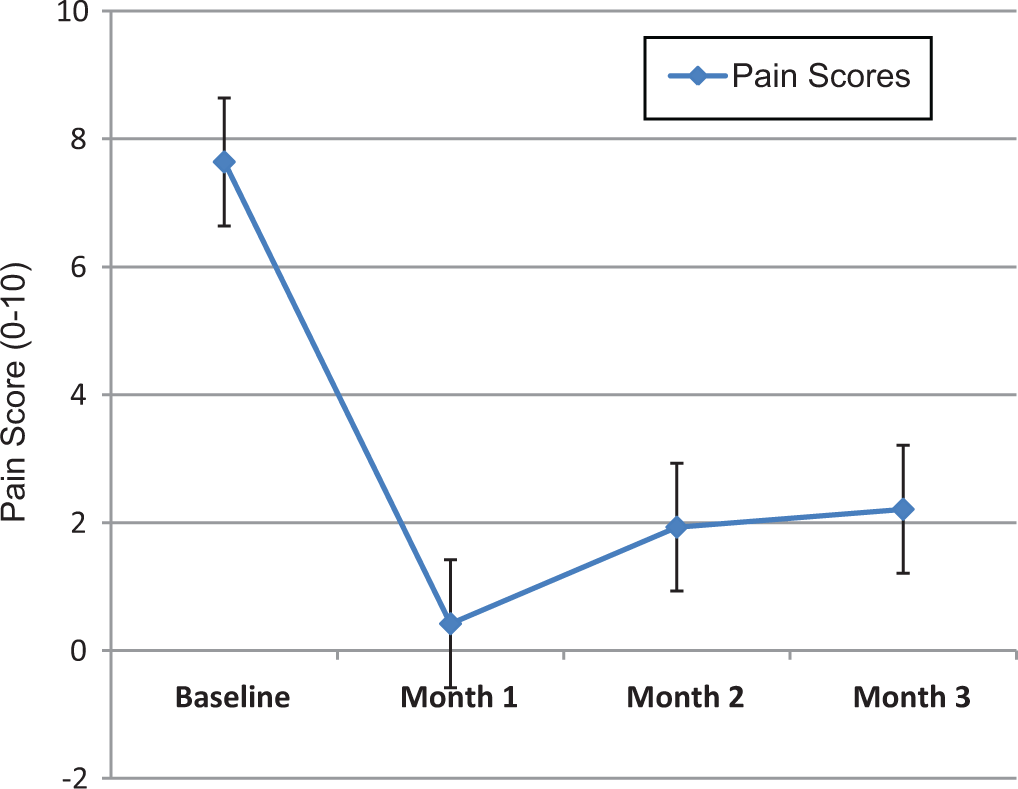
Effect of Scrambler therapy on postherpetic neuropathy pain.
Discussion
The results at 2 centers show dramatic, prompt, and continued PHN pain relief, with no side effects. The reduction in pain is more than twice that of any other reported noninvasive modality and happens within days, which is too soon for spontaneous resolution in patients with a median duration of PHN of 15 months. The reduction in pain is similar to the dramatic relief observed in PHN with spinal cord stimulation 15 (pain reduced from 9 to 1, with 23 of 28 patients reporting long-term relief). Scrambler therapy is noninvasive, inexpensive, and temporary. Scrambler therapy for PHN deserves further testing in randomized sham-controlled trials that are underway.
Footnotes
Declaration of Conflicting Interests
The authors declared the following potential conflicts of interest with respect to the research, authorship, and/or publication of this article: Dr Thomas J. Smith has no financial or other conflict of interest to disclose; Massey Cancer Center of Virginia Commonwealth University has been given 2 Calmare machines by Competitive Technologies, Inc, the distributor. Dr Giuseppe Marineo is the inventor of Scrambler Therapy, holds patent rights, and receives royalties from the sale of Calmare machines.
Funding
The authors disclosed receipt of the following financial support for the research, authorship, and/or publication of this article: Research Support from ACS Grant #PEP-10-174-01 (TS), R01CA116227-01 (TJS), and 2R01CA106370-05A1 (TJS) from the National Cancer Institute.