







Abstract
Background:
Although diagnosis disclosure to cancer patients has important roles in cancer care, it is not a routine practice in countries like Egypt. Respecting patients’ autonomy and responding to their preferences are among the factors that should guide the practice of cancer diagnosis disclosure.
Objectives:
To assess the preferences of Egyptian cancer patients regarding the disclosure of cancer diagnosis and to determine factors that may affect their preferences.
Methods:
The study included 295 patients aware of their cancer diagnosis from 3 cancer care facilities in Egypt. Patients were asked if they would have preferred to be informed of the diagnosis or not, whom they would have preferred to receive the diagnosis information from, and if they would have preferred to tell their families or not.
Results:
The vast majority (91%) of the included patients preferred to be informed about their diagnosis, 59% preferred to disclose the diagnosis to their families and 66% preferred to receive the diagnosis information from a physician. In univariate analysis, male gender, higher education level and employment were significantly associated with the preference for disclosure. None of the studied variables associated significantly with the preferences in multivariate analysis.
Conclusion:
The majority of Egyptian cancer patients in our study preferred to be informed about their diagnosis, which should be respected. The results may help in changing the diagnosis disclosure practice of health care professionals and refuting the misconception of family caregivers about cancer diagnosis disclosure in Egypt and countries with similar culture.
Introduction
Cancer diagnosis is frequently associated with anxiety and depression symptoms related to worries and uncertainties about the disease prognosis, disabilities, and progress.1,2 Family members of cancer patients may believe that diagnosis and prognosis disclosure would adversely affect the disease prognosis and increase the probabilities of stress, depression and loss of hope among their related patients.3-5 Consequently, they may ask healthcare professionals not to tell their related patients the truth, a scenario which is not uncommon in Egypt.
Truth disclosure helps patients to have less uncertainties and to make their choices about healthcare and future, while non-disclosure may lead to less medical support to the patient and less adherence to treatment.6,7
It has been previously reported that there is no relationship between diagnosis disclosure and mental health.8,9 However, cancer diagnosis disclosure is not a routine practice in many non-Western countries.10-14 This may be attributed to cultural differences in determining patients’ rights or the strong relationship between patients’ and their families. In such cultures, family members of cancer patients may be the recipients of cancer information and the decision makers on behalf of the patient.15,16 Even in Western countries where there are legalizations obliging healthcare professionals to inform patients about their condition, the problem regarding cancer information disclosure still exists as healthcare professionals may not provide enough information for the patients and their families.17-20
In Arab and Islamic cultures, not all patients are provided with the full information about their diagnosis. In a study performed in Turkey, 44% of the included patients did not know their diagnosis. 21 In a survey from Kuwait, 79% of 217 physicians stated that they would withhold the truth from the patient in response to his/her family request. 22 Another study from Jordan showed that although 91% of the participating physicians believe that they should inform patients of their conditions, only 48% of them were routinely practicing a shared decision-making approach. 23
Regarding patient preferences, many studies suggested that most of patients prefer to be told the truth about their diagnosis and prognosis.24,25 In an Indian study that included 250 cancer patients and 250 family caregivers, the disclosure preference was significantly higher in patients (81.2%) compared to caregivers (34.0%).4 Similarly, in Saudi Arabia the percentage of cancer patients who preferred diagnosis disclosure was also higher than that among family caregivers (82.6% vs 75.3%, respectively). 26
The patient-centered care model emphasizes on patient’s values, needs, and mutual decision making to improve the quality of care, costs, and patient satisfaction.27-29
Similar to many non-Western countries,10-14 cancer patients in Egypt are not routinely informed of their diagnosis. 3 Moreover, the preferences of Egyptian cancer patients regarding their diagnosis and prognosis disclosure are not known. In the present study, we aimed to assess diagnosis disclosure preferences among Egyptian cancer patients and to determine possible factors that may be contributing to their preferences.
Methods
This observational cross-sectional study was conducted in 3 cancer care facilities representing the 3 major geo-demographic regions inhabited by the majority of the population of Egypt. The Greater Cairo region was represented by Kasr Al-Ainy Center of Clinical Oncology and Nuclear Medicine—Kasr Al-Ainy School of Medicine—Cairo University in Cairo, the Nile Delta region by the Damietta Cancer Institute in Damietta and the Upper Egypt region by the Clinical Oncology Department—Faculty of Medicine—Beni-Suef University in Beni-Suef.
Participants
Adult (>18 years old) patients with confirmed diagnosis of cancer who are aware of their cancer diagnosis and able to understand and communicate in Arabic were included. A purposive convenience sampling method was used to select participants.
Patient’s awareness of cancer diagnosis was assessed by asking him/her to name the disease for which he/she is receiving treatment at the [corresponding cancer care facility]. Those who named their disease as cancer/malignant tumor were considered aware of diagnosis.
Data Collection
For eligible patients, the following data were collected: demographics (age, sex, city of residence, educational level, marital status and employment), primary cancer site, source of diagnosis information and family awareness of patients’ cancer diagnosis.
Participant’s cancer diagnosis disclosure preferences were assessed by asking him/her the following questions: “Regarding telling you the diagnosis of cancer, what would you have preferred?”, “Whom would you have preferred to tell you the diagnosis of cancer?” and “Regarding telling your family members about your diagnosis of cancer, what would you have preferred?”
Statistical Methods
Categorical variables were described as number and percentage, while continuous variables were described as mean and standard deviation. Independent-sample t-test was used to test the significance of difference in the mean age between 2 groups. Fisher’s exact test/Chi-square test was used to test the association between participants preference for cancer disclosure and the studied variables. Multivariable logistic regression analysis was performed to test the independent association between the preference for disclosure and variables that significantly associated with it in univariate analysis. A p-value <0.05 was considered significant. The Statistical Package for the Social Sciences (SPSS) version 22 (IBM Corporation, Armonk, NY, USA) was used.
Ethical Considerations
The study protocol was approved by the Research Committee of Kasr Al-Ainy Center of Clinical Oncology and Nuclear Medicine and an informed consent was obtained from participants. The data related to patients were coded and codes were stored in a safe place with access allowed to investigators and supervisors only.
Results
Three-hundred and 15 adult patients from the 3 study sites were aware of their cancer diagnosis and agreed to participate in the study. Twenty (6.4%) patients were excluded because of missing data.
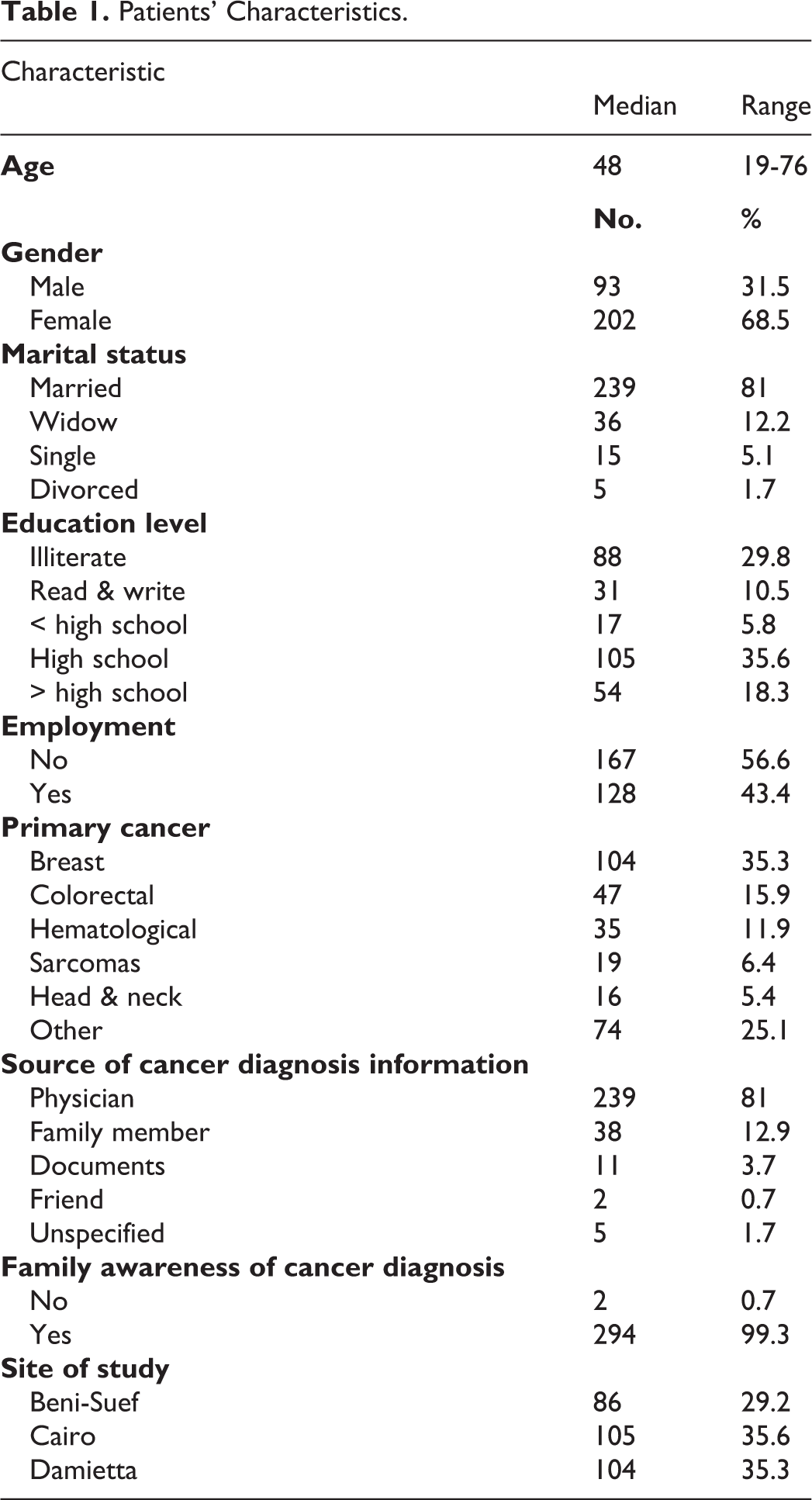
The median age of included patients was 48 years and most of them were females (68.5%) and married (81%). More than half were unemployed and 54% completed high school education or above. Breast cancer was the most common diagnosis (35.3%), followed by colorectal cancer (15.9%) and hematological malignancies (11.9%).
Most of the patients were informed of their diagnosis by a physician (81%). Family members were the second most common source of diagnosis information (12.9%). According to the participating patients, almost all of their families (99.3%) were aware of their cancer diagnosis. The characteristics of the 295 eligible patients are detailed in Table 1.
Patients’ Characteristics.
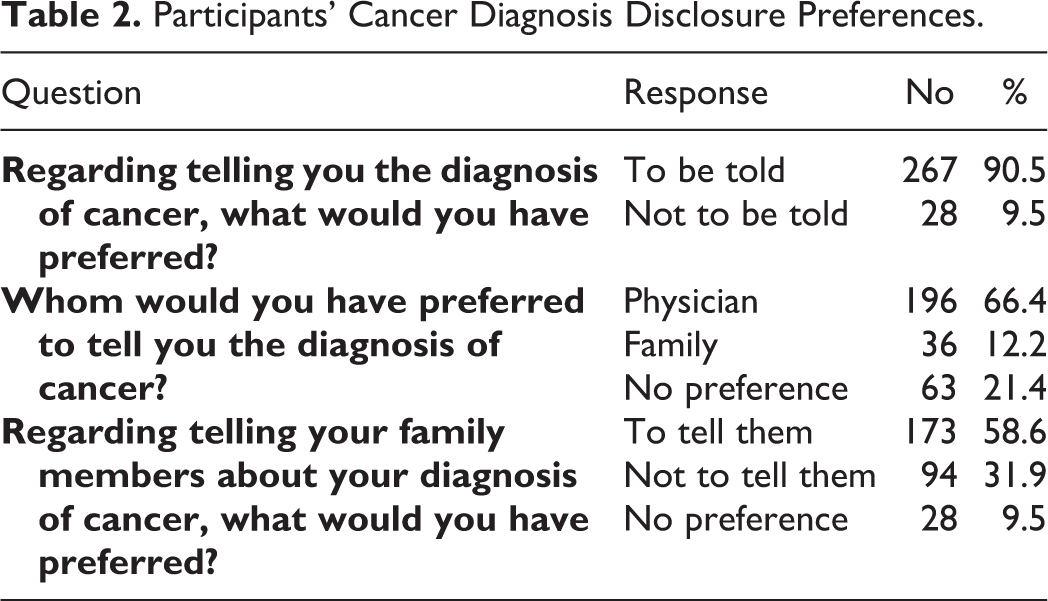
The vast majority (90.5%) of the included patients preferred to be told their cancer diagnosis, while a smaller percentage (58.6%) preferred to tell their families. Most (66.4%) of the patients preferred to be told by a physician and 12.2% by a family member (Table 2).
Participants’ Cancer Diagnosis Disclosure Preferences.
The univariate analysis showed a significantly higher prevalence of a preference for diagnosis disclosure in association with male gender, higher educational level, and employment (p = 0.011, 0.037 and 0.001; respectively). Although the prevalence of a preference for diagnosis disclosure was higher in Cairo (largely urban) than in Beni-Suef and Damietta (largely rural), the difference was not statistically significant. Marital status, primary malignancy diagnosis, and source of cancer diagnosis information had no impact on the preference as well (Table 3).
The Relationship Between Disclosure Preference of Cancer Patients and the Studied Variables.
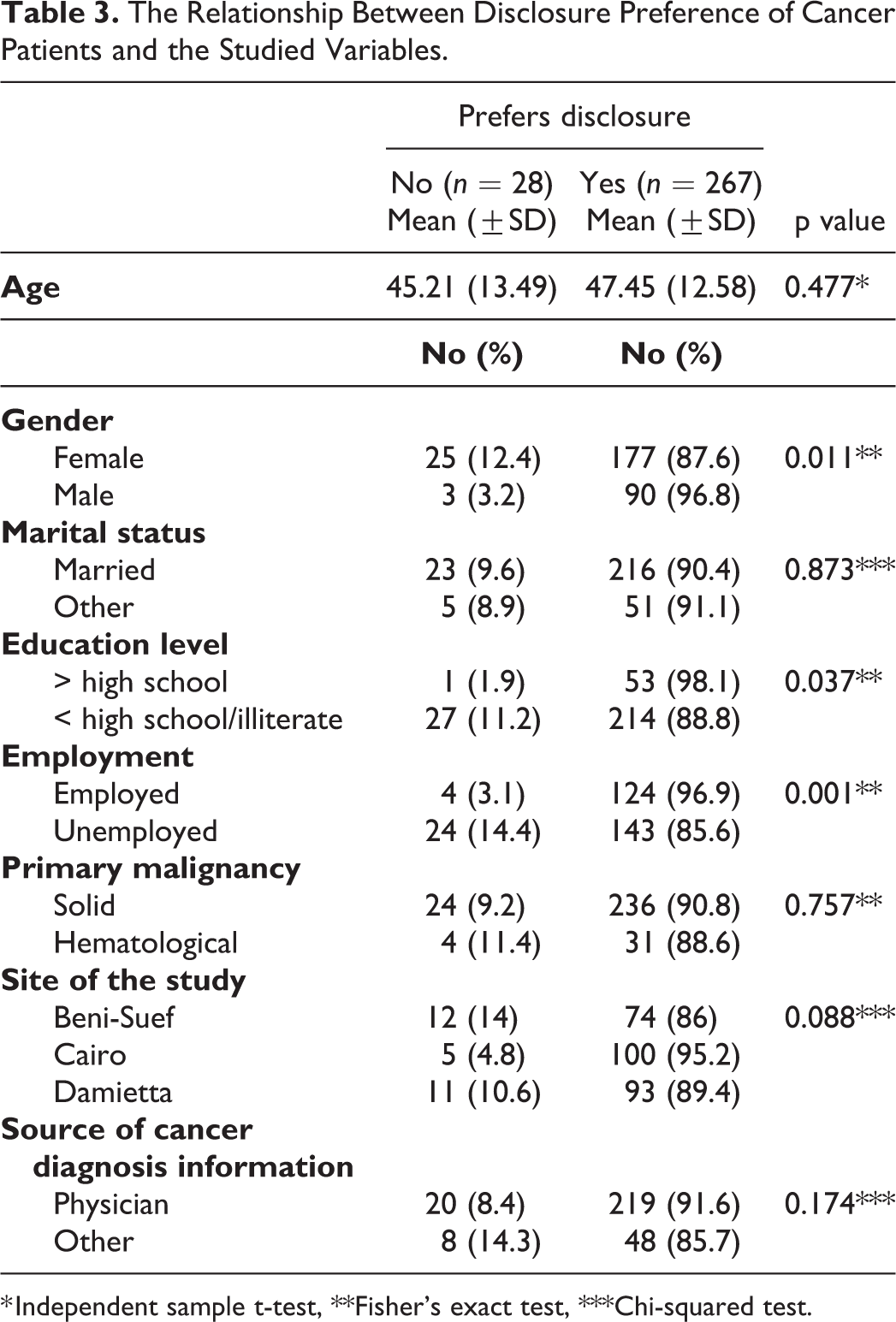
* Independent sample t-test, **Fisher’s exact test, ***Chi-squared test.
Logistic regression analysis showed no significant association between the preference and gender, educational level and employment (p = 0.776, 0.214, and 0.182; respectively).
Discussion
It is a moral commitment for healthcare providers to tell their patients the truth about their diagnosis.17,18 However, one of the most important dilemmas facing healthcare professionals in our region is communicating diagnosis, prognosis, and bad news to cancer patients. 30 Therefore, understanding patients’ preferences regarding the disclosure of diagnosis and prognosis may help in communicating with them the right way.
In this study which included 295 patients from 3 different cancer centers in Egypt, 90.5% of cancer patients preferred to be told about their diagnosis. This is consistent with many previous studies held in other countries and showed that most of cancer patients, ranging from 71.7% to 96%, preferred to be told about their diagnosis.4,24,31-33 In Rao et al study from India, 72% of the 172 included cancer patients preferred diagnosis disclosure. 24 Another study that was held in 8 hospitals in Korea showed that 71.7% of cancer patients and 43.6% of family members preferred informing the patients about their diagnosis. 33 In a cross-sectional study carried out in Lebanon, 82% of patients preferred to be informed of their diagnosis. 32
In the current study and in univariate analysis, male gender, higher education and employment were associated with higher preference for diagnosis disclosure. Some studies concluded that higher education was associated with a higher preference for knowing the diagnosis4,8; however, some other studies found that there is no significant relationship.31-33 Other factors including age, gender, and performance status showed different mixed results regarding their association with patients’ preference for disclosure.31,33 A metanalysis that included 24 studies showed that younger, female, and higher educated patients consistently showed much more preference for diagnosis disclosure and more information about their condition. Asian patients also showed more desire for telling their families than Western patients. 34 In the current study, multivariate analysis showed that none of the previous factors correlates significantly with patients’ preference for disclosure.
Yun et al study showed that most of the patients (78.3%) preferred the doctors to be in charge informing them of their diagnosis. 33 This is consistent with our study which showed that most of the included Egyptian patients preferred doctors to tell them about diagnosis.
The majority of patients included in the study done by Rao et al (90%) preferred telling their family members about diagnosis. 24 Although a majority of patients in the current study (58%) wanted to tell their family members about their diagnosis, their percentage was less than the results of Rao et al study. Even though the attitude of cancer patients toward diagnosis disclosure to their family members in Egypt is not well investigated, it may be attributed to patients’ feeling that cancer diagnosis may increase stress to their families and negatively affect their lives.
Although cancer diagnosis disclosure is a common practice in Western countries, non-disclosure is still present and common in Egypt and Middle Eastern countries because of the fear of negative effect of the word “cancer” on patients from families and community. 12 Therefore, the results of this study may help to change the misconception of medical professionals and family caregivers about disclosure of cancer diagnosis.
The present study has limitations. The cross-sectional study design did not allow tracking changes in patients’ preferences and their preference for prognosis disclosure was not addressed. In addition, the reasons behind patients’ preference for diagnosis disclosure were not explored. This may be attributed to their belief that knowing the diagnosis and prognosis may help them to plan their future and social life and take part in treatment decision. This needs exploration in future studies. Another limitation is the use of a non-probability purposive convenience sampling method to select the sample.
Conclusion
Most of Egyptian cancer patients prefer to be told about their diagnosis and to tell their families but to a lesser extent. Their preferred source of information is physicians. In order to deliver optimum patient-centered cancer care in Egypt, health care professionals are obliged to respect cancer patients’ autonomy and to communicate with them according to their preferences. The results of the current study may be helpful in changing the attitude toward cancer diagnosis disclosure and its practice in Egypt and in other countries where it is not a routine practice.
Footnotes
Authors’ Note
Conception: Samy A. Alsirafy; Design: Samy A. Alsirafy, Hadeer I. Abdel-Aziz, Hesham H. Abdel-Aal, Wessam A. El-Sherief, Dina E. Farag; Acquisition of data: Hadeer I. Abdel-Aziz, Ahmed Abdel-hafeez, Ahmad Hassan, Dina E. Farag; Analysis of data: Samy A. Alsirafy; Interpretation of data: Samy A. Alsirafy, Ahmed Abdel-hafeez; Drafting the manuscript: Ahmed Abdel-hafeez, Samy A. Alsirafy; Revising the manuscript: Hadeer I. Abdel-Aziz, Hesham H. Abdel-Aal, Wessam A. El-Sherief, Dina E. Farag, Ahmad Hassan; Final approval of the manuscript: All authors; Agreement to be accountable for all aspects of the work: All authors.
Declaration of Conflicting Interests
The authors declared no potential conflicts of interest with respect to the research, authorship, and/or publication of this article.
Funding
The authors received no financial support for the research, authorship, and/or publication of this article.
