







Abstract
Background
Positive and professional attitude of health professionals toward the palliative care issues of patients is crucial and challenging for fresh graduates. This study aimed to explore the perspectives of health science graduates about providing care for dying patients and their families.
Methods
In this cross-sectional study, graduates of the College of Health and Rehabilitation Sciences, Princess Nourah bint Abdulrahman University, Saudi Arabia (n = 113) have participated. The FATCOD -B scale was used to measure the attitude of health science graduates toward the care of patients and their families on a 5-point Likert scale. Data was collected through survey research forms.
Results
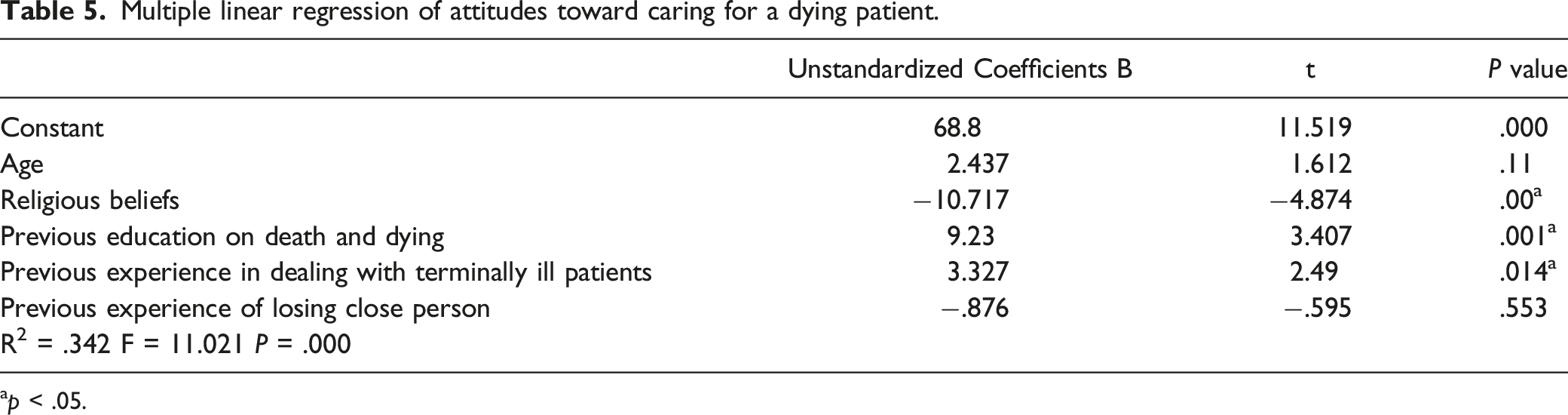
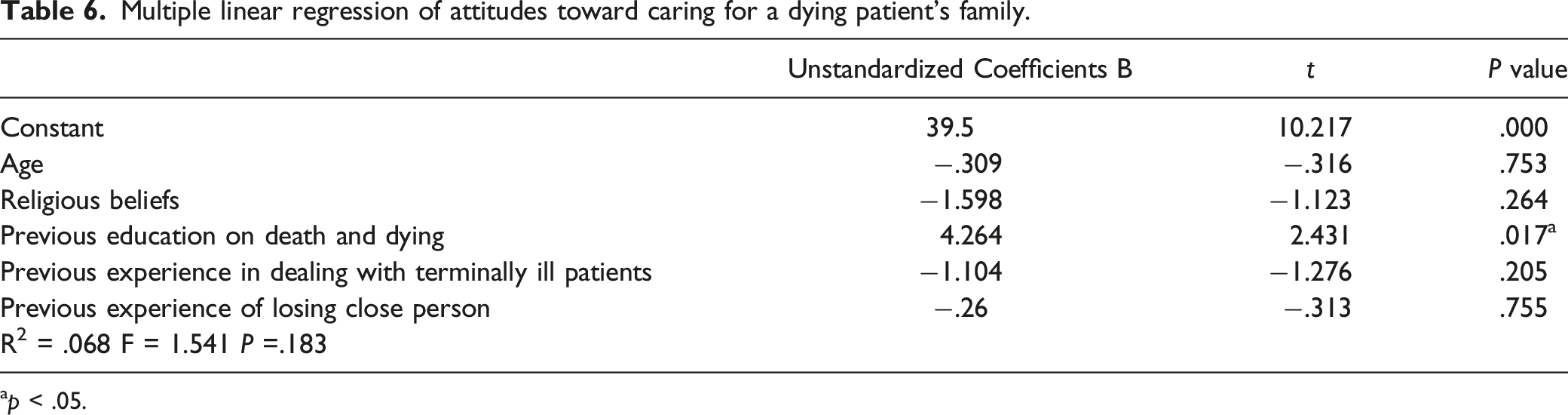
Significant associations of graduates’ attitude toward care of the dying patient with age, department, religious beliefs, education and experience (p = .05) were found. On the scale of caring for the dying patients’ families, religious beliefs and education (p = .05) were significant. Furthermore, multiple linear regression confirmed the predictive relationship of religious beliefs, education, and experience (R2 = .342, F = 11.021, p = .000) with graduates’ attitudes toward patient care. In comparison, education (R2 = .068, F = 1.541, p = .183) was the predictor of participants’ attitudes towards care of the patients’ families.
Conclusion
There is a dire need to focus on palliative care in the formal curriculum for all the health sciences disciplines. It is highly recommended to utilize case scenarios and simulation practice skills during the academic year to prepare students before the internship year. On-job counselling sessions can be helpful to increase the positive attitude of young Health graduates while working with dying patients and their families.
Keywords
Introduction
Providing care for critically ill and dying patients is an approach and a strategy in itself. Clinicians must deal not only with the patients themselves but also with their families and loved ones. Palliative care, end-of-life care or care of the dying, all terms have been used for the same meaning in literature alternatively. The World Health Organization (WHO) has defined palliative care (PC) as “an approach that improves the quality of life of patients (adults and children) and their families who are facing problems associated with a life-threatening illness. It prevents and relieves suffering through the early identification, correct assessment and treatment of pain and other physical, psychosocial, or spiritual.” 1 This definition encompasses many aspects other than the purely medical/clinical model of care, including patients’ needs and preferences and the alliance between patients and their families, who are all considered the object of the care. 2
It will be worth mentioning that providing healthcare in general and to those with a life-threatening illness, in particular, requires skillful clinicians with specific competencies who can adapt and take a holistic approach throughout the illness trajectory. 3 Besides skills and competencies, some sociodemographic factors, including age, experience, knowledge, beliefs, and positive attitude toward end-of-life care, were also to be contributing factors among health professionals.4-6
According to the WHO, worldwide, there are approximately 40 million people with a wide range of diseases who need palliative care each year. 1 This means providing care and consultation always requires a multidisciplinary team that could be able to address various aspects of health issues. In Saudi Arabia, the palliative care setup initiated during the 1990s based upon a holistic view, including interdisciplinary specialties, but is still not fully widespread. 7 Students of College of Health and Rehabilitation Sciences (CHRS) at the undergraduate level receive some information regarding palliative care, but most have not gone through any formal syllabus. Once Bachelor of Sciences (BS) students complete their four (4) years of coursework, they have to join one full year supervised internship at specialty related hospitals or centers to fulfil the requirement of degree as well as licensing. 8 Graduate students at the CHRS interact with palliative care patients as a part of a multidisciplinary team as occupational or physiotherapists, clinical psychologists, audiologists and radiologists. Health science graduate students from different disciplines, including Health Sciences, Communication Sciences, Radiological Sciences, and Rehabilitation Sciences, all come into direct contact with patients and their families, whether routinely or daily. This would raise the question of whether health science graduates are prepared to accept communication related to death and what their attitudes are toward providing care for end-of-life patients.
One of the studies reported a lack of education and experience among Iranian nurses toward death and caring for dying patients. 9 Similarly; a multicenter institutional study carried out in Ethiopia found that nurses’ knowledge of palliative care was inadequate. 10 Another study conducted among Korean medical students came to the precision that students considered knowledge and practice could prepare them for facing end-of-life care. 11 Similarly, a University level study from the United States also reported insufficient knowledge regarding palliative care. 12 Another recent study collected data from nursing students in Spain, Italy and the United Kingdom concluded that most students did not find themselves fully prepared for palliative care. 13 Yet, most of the literature exploring the attitude towards palliative care was found to be related to the nursing profession.9,10,13 The current study will help closely observe the attitude of health science, female students, toward end-of-life concepts.
A recent study conducted in Saudi Arabia aimed to explore the level of knowledge and the attitudes toward palliative care among the staff in King Saud Medical City (KSMC), Riyadh. In this study, reported poor knowledge and moderate attitudes were found among 323 staff nurses. 14 The author highlighted the need for palliative care education to be added to undergraduate curricula. This concurs with another study, which found that more than 50% of undergraduates from a pharmacy college did not know palliative care. 15 However, a better outcome was reported among nursing students compared with other disciplines, which was attributed to the fact that the nursing curriculum encompassed training and effective communication skills directed toward palliative care patients. Other studies have also indicated that structured educational programs, which integrate theoretical and practical training on palliative care, can improve students’ knowledge and attitudes toward end-of-life care.2,16-20
Therefore, the current study aims to measure the attitudes of female health science graduates and recent graduates about providing care for dying patients.
Materials and Methods
Study Design
This study has a descriptive, correlational, cross-sectional design.
Setting
This study was carried out between June and December 2020 among graduates who had already completed one semester and recent graduates at the College of Health and Rehabilitation Sciences (CHRS) of Princess Nourah bint Abdulrahman University (PNU). An online questionnaire survey was sent to the participants. A representative sample was calculated, whereas data was gathered through convenient sampling. PNU is a female-only institution that provides education on a large scale to female students. According to the official website of PNU, currently, twenty-seven thousand seven hundred and seventy (27 727) female students are enrolled. However, four thousand one hundred and twenty-five (4125) graduates from health colleges. CHRS alone has one thousand eight hundred and ninety-four (1894) graduates from thirteen (13) programs of Rehabilitation sciences, Health sciences, Radiological Sciences and Communication Sciences departments. 21 Therefore, it was a good opportunity to assess the perceptions, knowledge gap, practice and attitudes toward palliative care patients. CHRS provided the platform to approach the representative sample of variety of graduate students. 22 It further helped to evaluate the curricula and their effectiveness/gaps.
Participants
The study included a sample of 113 Saudi females from the population of CHRS graduates who had worked at the hospital for more than 6 months or who had recently graduated (less than 1 year ago). None of the participants had any formal training in palliative care.
Sample Size Calculation
The representative sample size was estimated as 178 female health sciences graduate participants calculated based on a total population of 330 graduates of 2 cohorts. The usual duration of internship placement is of 1 year. When one cohort enters the internship year, the senior one often is about to complete the internship. The prevalence factor in the current study was estimated as 50%, 23 the confidence level of 95% and a degree of error of .05. The actual sample size was 113, with a response rate of 63.5%.
Data Collection Methods
The data for analysis was collected using the Google Forms web application. 24 The online form consisted of 2 parts. The first part collected the respondents’ demographic data (age, graduation year, program, and training hospital). The second part of the survey was a standardized scale.
FATCOD Questionnaire
The second part of the survey contained the FATCOD questionnaire, Form B, a valid and reliable tool to measure attitudes about end-of-life care designed for nurses.25,26 The FATCOD-B questionnaire contains 30 items and uses a five-point Likert scale [strongly disagree, disagree, neutral, agree, and strongly agree]. Twenty questions deal with the participants’ attitudes toward the dying patient, and the other 10 questions are associated with attitudes toward the dying patient’s’ family. The instrument comprises an equal number of positively and negatively worded items, with reversed scores for the negative items. The total score ranges from 30 to 150; higher scores reflect more positive attitudes. 26 However, for the current study, FATCOD-B scale scoring was considered as having 2 sums of scores in each subdomain. Therefore, the scoring range of attitude toward caring for a dying patient was 20-100, and attitude toward caring for a dying patient’ss family was 10-50. Cronbach’s alpha for the collected responses to the FATCOD questionnaire was .734.
Procedure
This study was carried out between June and December 2020. After receiving ethical approval from the Institutional Review Board, PNU. The researchers requested the target populations’ contact information from the alumni unit at CHRS. Then a link to the self-administrated online form (including the consent form, demographic information and the FATCOD-B) was shared with the population via their emails by using undisclosed recipients’ method to protect participants' privacy. Informed consent was provided on the first page, which also described the aim and objectives of the study; the respondents proceeded to fill in the form when they had stated that they agreed to participate in the research study and filled in the consent form accordingly. The estimated time to fill in the questionnaire was about 8 to 10 minutes for each participant.
Ethical Considerations
The study proposal was approved (exemption) by the Institutional Review Board (IRB) at Princess Nourah bint Abdulrahman University (IRB Log Number 20-0207). Kind permission to use the FATCOD-B questionnaire was obtained from Mrs Katherine H. Murray Frommelt, who holds the copyright to the instrument. The study’s aim and protocol were fully explained to the participants, and electronic consent was obtained on the first page of the survey. The participants also were notified that their participation was voluntary, their confidentiality was assured, and they were also assured about the anonymity of their data and that it would only be used for the research.
Statistical Tests and Data Analysis
All statistical measures were performed using the Statistical Package for Social Science (SPSS) program version 23. The data was presented in the form of the number, percentage, median, and quartile range. Data normality was tested using the Kolmogorov Smirnov test, for which the P-value was .00. Mann-Whitney and Kruskal Wallis tests were used to compare the medians of the participants’ attitudes toward the dying patient and their families. A value of ≤.05 was considered statistically significant. Pearson correlation coefficients were used to test the correlation between attitude towards dying and death and some related factors, with a significance level p ≤ .05. Finally, a multiple linear regression analysis was carried out to analyze the predictors of attitude towards death and dying at a significance level of p ≤ .05.
Results
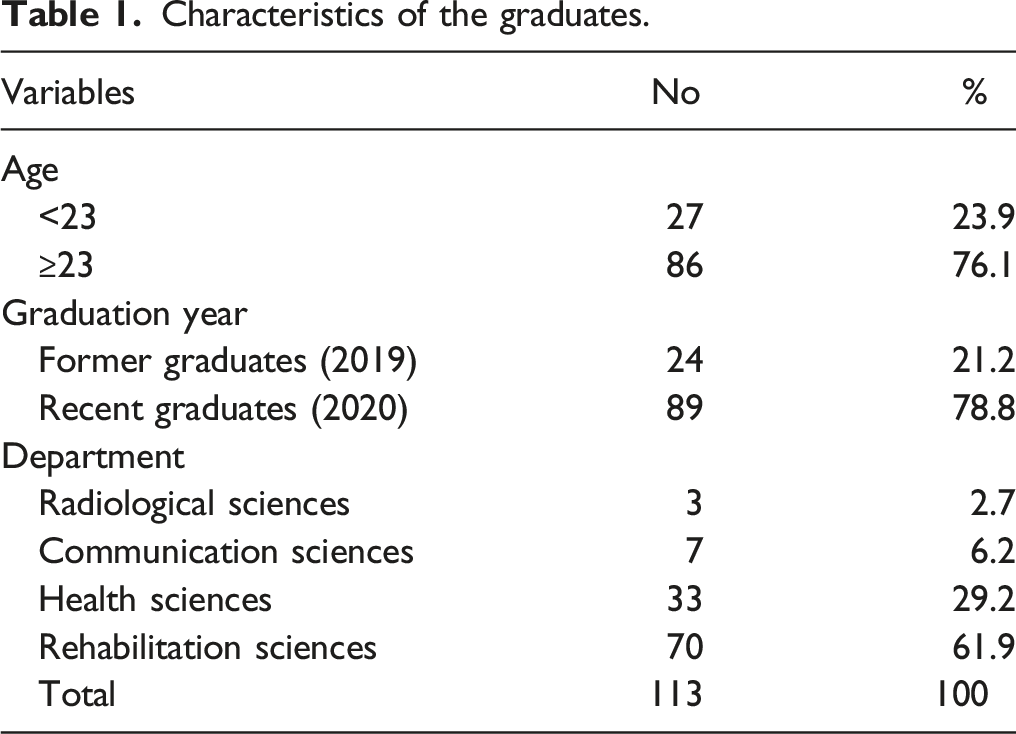
Characteristics of the graduates.
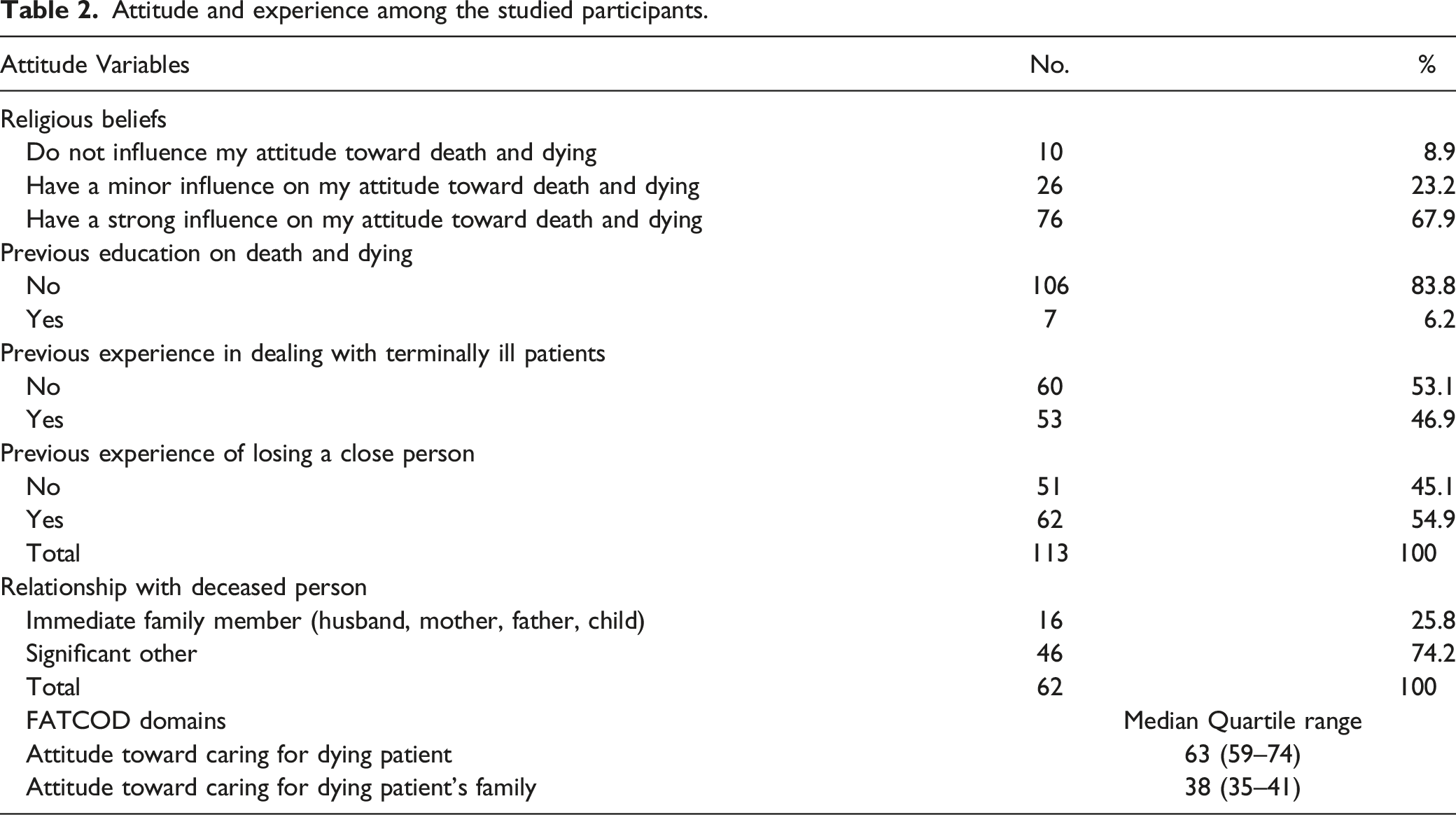
Attitude and experience among the studied participants.
Association between FATCOD domains and some related factors.
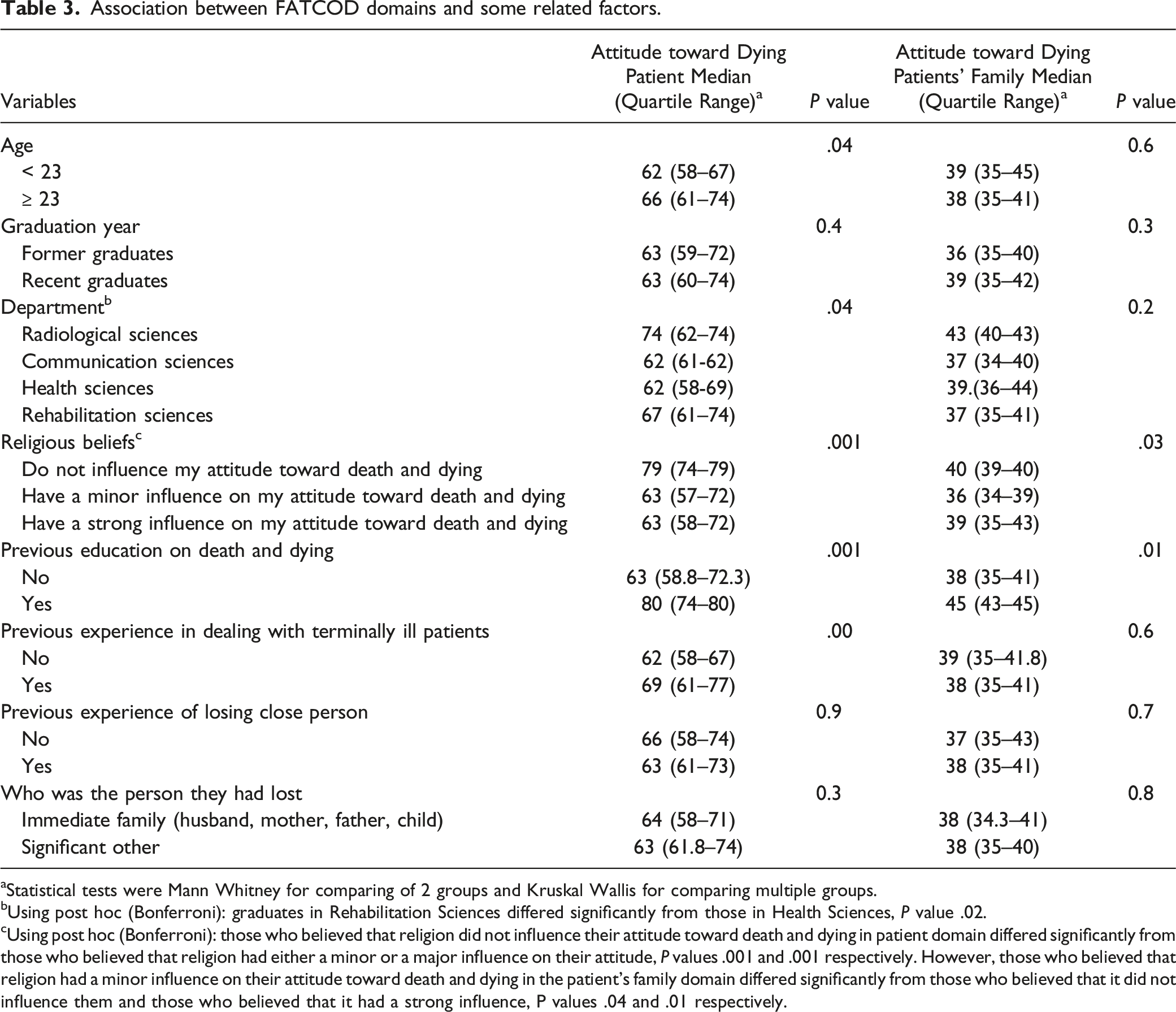
aStatistical tests were Mann Whitney for comparing of 2 groups and Kruskal Wallis for comparing multiple groups.
bUsing post hoc (Bonferroni): graduates in Rehabilitation Sciences differed significantly from those in Health Sciences, P value .02.
cUsing post hoc (Bonferroni): those who believed that religion did not influence their attitude toward death and dying in patient domain differed significantly from those who believed that religion had either a minor or a major influence on their attitude, P values .001 and .001 respectively. However, those who believed that religion had a minor influence on their attitude toward death and dying in the patient’s family domain differed significantly from those who believed that it did not influence them and those who believed that it had a strong influence, P values .04 and .01 respectively.
Correlation between FATCOD domains and some related factors.
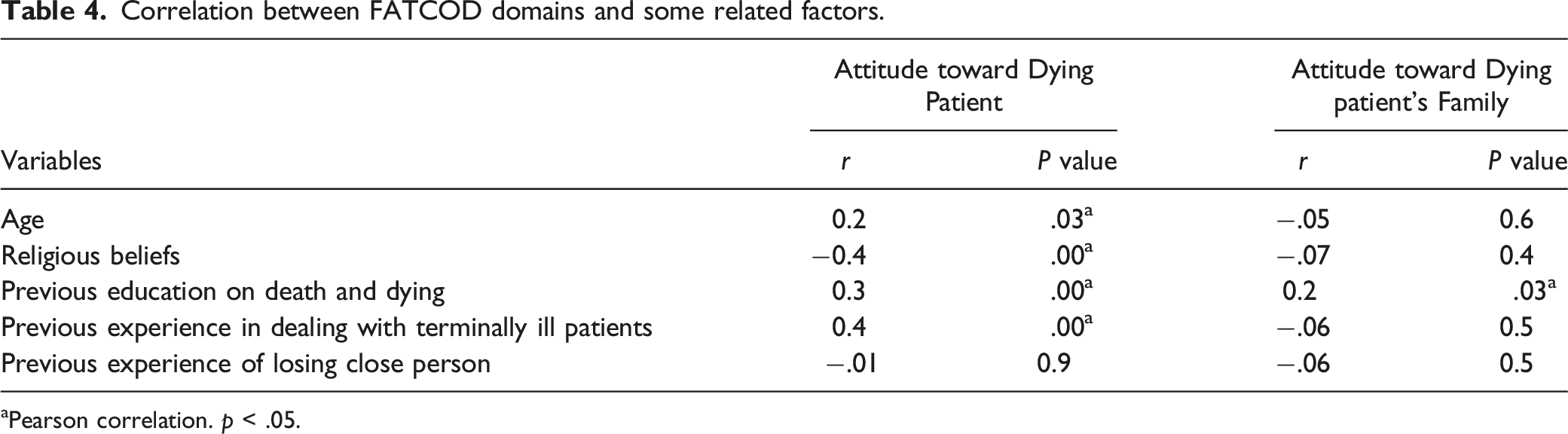
aPearson correlation. p < .05.
Multiple linear regression of attitudes toward caring for a dying patient.
ap < .05.
Multiple linear regression of attitudes toward caring for a dying patient’s family.
ap < .05.
Discussion
Health professionals are respected in society due to their professional values and care for patients’ biopsychosocial needs. This care task becomes more critical when palliative care for terminally ill patients and their family members. The literature reports a wide range of situations and extreme cases covered by the term palliative care. 1 There is immense pressure on recently graduated health professionals to respond to patients appropriately and be prepared to care for the needs of the patients’ family members.
This study was conducted to explore the attitudes of health science graduates already working at their placements from one semester and recent graduates toward patients in palliative care and their family members. The literature revealed numerous factors that contribute to better outcomes in palliative care, including knowledge, experience, maturity, attitude, openness, emotional sensitivity, sense of responsibility, and personal beliefs. 27 Therefore, it was hypothesized that “there would be correlations between attitudes towards caring for dying patients and their families and factors such as age, religious beliefs, previous education and experience of death and dying, and the experience of losing a close person.” Overall, the current study shows that the attitude of new graduates toward caring for dying patients can be predicted by their religious beliefs, previous education, and personal experiences of death and dying. Whereas attitude toward caring for dying patients’ families can be predicted by previous education. The findings confirm the previous studies.16,26,28,29 These findings are unique since previous research on responses to palliative care has been related mainly to the nursing profession. 28 However, there is a dearth of literature regarding other health professionals and graduates.
Here, we cannot ignore the essential aspect of knowledge and training for fresh graduates in preparing them to face these challenges. Previous studies found that health professionals suffered from a lack of knowledge regarding end-of-life patients.10,12-15 Most of these studies were conducted within the nursing profession, but the significance of this knowledge is undeniable in any career. If trainee health professionals can be equipped with education and experience in various situations; whether via case scenarios or simulation of palliative care; and possible ways to handle the situation, this might lead to more confidence, utilization of problem-solving skills and better outcomes to take professional responsibility toward patients’ care. Our results regarding previous education in the care of dying patients are consistent with those of an earlier study that found that undergraduate students of physiotherapy, nursing, medicine and pharmacy did not have adequate knowledge about palliative care. 16
When health professionals accumulate years of working experience, they develop more stable and mature attitudes, but these are often lacking in less experienced individuals. Therefore, to support new graduates, it is highly recommended that they should be offered a specialized training program before placement in palliative care units. When fresh graduates encounter actual patients, and they may lack confidence in their new role adaptation. As a result, palliative care exposure can significantly cause avoidance, disinterest, or even depression, anxiety and emotional exhaustion.18,30,31
Previous literature has also recommended that palliative care training improve medical students’ knowledge and attitudes.16,17,28,32 Our findings revealed that the average median score for graduates' attitudes toward a dying patient was neutral (63/100 × 5 = 3.15, Table 2). Still, their attitudes toward the patients’ family members were between neutral to positive (38/50 × 5 = 3.8, Table 2). This confirms the need for training regarding palliative care of patients, which could result in a more positive and skilled outcome. 32 Care of the dying person and providing a better quality of life is critical.
The literature review found that fresh medical graduates could easily suffer from emotional distress if they did not have prior training or support.30,31 However, appropriate training for health graduates can support them in maintaining their psychological wellbeing. 33 Our results revealed that respondents scored low (median = 2) on the items investigating their attitudes towards the patient, primarily related to the patient crying, expressing hopelessness, and talking about their impending death. It is particularly worth mentioning that recent graduates experienced some lack of competence in handling emotional turmoil or discussing death.
It will be worth mentioning the associations regarding two major variables of department and religious belief with the attitude of graduates toward patients’ care. Graduates in Rehabilitation Sciences had significantly different perspectives to those in the Health Sciences department. This variation of response needs to be studied further to promote a curriculum that can meet palliative care requirements for all graduates. Moreover, the respondents’ attitudes toward the patients’ family were found to be associated with religious beliefs and previous education about death and dying. It may be inferred that strong religious beliefs and prior experience may help health professionals to connect with family members and provide them with help and emotional support. As far as religious beliefs are concerned, results indicated that the group did not consider that their religious beliefs could influence death and dying and responded differently to those who considered a minor or major influence. These findings could be explained by the professional attitude of graduates and by previous studies. 29
This study has revealed various essential aspects related to graduates and recent graduates, associated factors, and their attitudes toward palliative care. However, a few limitations of this research could be addressed in the future. The sample size of the study could be increased, and male participants could be included. The current study included just 2 cohorts of graduates, however, more senior alumni working at various places, having more experience, could provide a better prospect of the attitude development toward the care of dying patients. The use of qualitative measures could help to reveal an issue that could not be accessed due to this study’s use of quantitative techniques; interview methods and focus groups could be utilized for this purpose.
Conclusion
The main objective of the current study was to explore the contributing factors to the attitude of health sciences graduate toward the care of dying patients and their families. Many research studies in this reference were reviewed and revealed significant indicators and gaps in knowledge that influence the attitude of young health practitioners. This study found significant associations between attitude toward the dying patient and age of the graduate student, relevant department, religious beliefs possessed, previous education, and previous experience in dealing with terminally ill patients. Furthermore, the predictive association was found with religious beliefs, prior education, and previous experience. Our study suggests a need to include special courses and precisely simulation-based courses to familiarize the students during the academic year. Therefore, it could help them develop a professional, humanistic and healthy attitude to deal with sensitive situations of caring for the dying patient and his family. Moreover, we also recommend introducing on job courses during placement that can be helpful in enhancing knowledge and reduce emotional distress. Therefore, it is one of the collective responsibilities of health institutions and hospitals to prepare fresh health sciences graduates for professional palliative care.
Footnotes
Declaration of conflicting interests
The author(s) declared no potential conflicts of interest with respect to the research, authorship, and/or publication of this article.
Funding
The author(s) disclosed receipt of the following financial support for the research, authorship, and/or publication of this article: This research was funded by Princess Nourah bint Abdulrahman University Researchers Supporting Project number (PNURSP2022R168), Princess Nourah bint Abdulrahman University, Riyadh, Saudi Arabia.
