







Abstract
Fundamental to medical education, gross anatomy first introduces medical students to human mortality, often provoking stress. Sense of purpose, a key aspect of well-being, may serve as a protective factor. We studied students’ sense of purpose during an anatomy course, examining its links to performance, spirituality, and belief in an afterlife. Fifty medical students who took a 7-week gross anatomy course in 2022 or 2023 completed the Life Engagement Test at the beginning, middle, and end of the course. We collected other data including demographics, religious/spiritual beliefs, and previous exposure to body donors. Practical and final examinations assessed course performance. Strong sense of purpose at the three measurement points was positively correlated with practical exam performance (r = 0.40, P = .004; r = 0.44, P = .003; r = 0.30, P = .047, respectively) but not National Board of Medical Examiners’ anatomy subject exam performance. Staunch believers and non-believers in an afterlife maintained a stable sense of purpose, while students uncertain about the afterlife experienced a decline from the beginning to the middle of the course and even more to the end (P = .046; P = .008, respectively). These students also had significantly lower practical examination performance as compared to other students (95% CI [−10.84, −0.52]). In conclusion, a strong sense of purpose predicts better performance in a 7-week anatomy course. Both believers and non-believers in an afterlife do well, but students wavering in their beliefs experience a declining sense of purpose and lower grades. Supporting these students when they confront human mortality, including in other contexts such as palliative care/hospice settings, may be beneficial.
Keywords
Introduction
The gross anatomy course represents an important landmark in a medical student’s professional development. Evidence shows medical students highly value the anatomy course as part of their medical education: they gain foundational medical knowledge, develop clinical skills, and improve teamwork. They learn to effectively manage their time and begin the process of professional identity formation.1-4 Both students and anatomists also view the course as highly clinically relevant, 5 and students report the course having an overall positive effect on personal growth. 6
The anatomy course is not just an introduction to the intense academic rigor of medical school, but also, for most students, it is their first exposure to deceased bodies.7,8 This profound and spiritual experience can evoke emotions ranging from gratitude to fear.9,10 Furthermore, confrontations with mortality can lead students to reflect on the meaning of life, death and the soul.11,12 While these experiences usually lead to positive outcomes such as the promotion of humanistic values, they can also contribute to stress and anxiety, especially at first exposure to a body donor.13-17 A previous study at the Mayo Clinic Alix School of Medicine, which uses a 7-week based anatomy course, found that students experienced a 46% increase in stress levels by the third week. 18 The authors also found a negative association between perceived stress and academic performance. 18
Given that some anatomy students experience increased stress leading to worse performance, it is worth exploring what protective factors exist, if any. A strong sense of life’s purpose may be one such factor. Sense of purpose, defined as “the extent to which [individuals feel] their lives [have] meaning, purpose and direction” is considered a core dimension of psychological well-being. 19
A strong sense of purpose has been associated with a variety of positive outcomes including improved functional status in older adults, 20 future financial prosperity, 21 and decreased risk of death.22,23 From a psychological standpoint, having a sense of purpose is associated with affective stability, 24 including a less pronounced increase in stress-induced negative affect, 25 and improved recovery after exposure to negative stimuli. 26 In academic settings, having a sense of purpose and meaning in life is associated with improved mental health 27 and better academic performance. 28
Several studies have also noted the benefits of purpose in students in medical and related professional schools. A recent study found that having a sense of purpose/duty to serve the population was associated with greater medical student participation in COVID-19 pandemic efforts. 29 Meaning in life has also been associated with reduced depression, improved quality of life, and life satisfaction among medical students30-32 and improved self-efficacy, social behavior and attitude toward care of the dying among nursing students.33,34
Despite the benefits of purpose across various life domains, no studies have examined the value of having a sense of purpose among medical students taking a gross anatomy class. Studying sense of purpose in this setting is useful for two reasons. First, as established above, having a sense of purpose correlates with improved academic performance generally. 28 Identifying whether this also translates specifically to the anatomy course setting would be of great value. Moreover, purpose represents a unique variable with potential for future intervention, as experimental studies prompting individuals to write about their sense of purpose have shown similar benefits to self-attested sense of purpose.35-37
Second, the anatomy course represents an opportunity for medical students to face their own mortality while becoming aware of the inevitability of death.17,38-40 Some evidence suggests that experimentally induced mortality awareness may decrease a sense of purpose and/or meaning in life among secular but not religious individuals.41,42 If the mortality awareness associated with the gross anatomy course is associated with reduced purpose, this could have implications for overall well-being which may extend to other contexts, such as palliative medicine and/or hospice care settings.
This study employs a conceptual framework grounded in principles of Seligman’s Theory of Well-Being 43 (namely, that sense of meaning or purpose is a component of well-being that allows for flourishing) and terror management theory 44 (namely, that a fear of death is related to one’s sense of purpose or meaning in life) to assess the relationship between sense of purpose and academic performance among medical students taking a 7-week gross anatomy course at the Mayo Clinic Alix School of Medicine. This study also examines whether sense of purpose changed during the course and if any sociodemographic or spiritual/religious characteristics moderated this change.
We utilized the conceptual framework as described above 45 and previous literature to hypothesize that: (1) sense of purpose would significantly and positively associate with academic performance and (2) sense of purpose would decline across the course among students identifying as secular but would remain stable among students identifying as religious or spiritual. We predicted this effect to be moderated by the amount of time that the student spent in the anatomy laboratory.
Methods
We invited medical students taking a 7-week, first-year gross anatomy course at the Mayo Clinic Alix School of Medicine in Rochester, Minnesota in 2022 or 2023 to participate in the study which involved three surveys total. The course schedule comprised 4 days of structured sessions per week. These structured sessions included 1 h each of gross anatomy targeted concept lectures, radiology instruction, cadaveric anatomy laboratory demonstration, and Audience Response System (ARS) sessions. One day per week was reserved for additional content such as hands-on ultrasound sessions, embryology review, or optional laboratory review. Afternoons were generally designated for self-directed learning. The total course duration was 140 h including 2 days of final examination. In 2022, gross anatomy lectures were delivered synchronously. In 2023, scheduled laboratory time was increased to 2 h per day, while gross anatomy transitioned to asynchronous, recorded lectures. Radiology remained synchronous in both years. All students had unrestricted access to the anatomy lab after hours.
A total of 113 students were eligible to participate across both academic years: 54 in 2022 and 59 in 2023. All students were invited to participate in the initial survey. We administered the first survey (survey 1) just before the course began and the second and third surveys (surveys 2 and 3, respectively) at the course’s mid-way point (week 3-4) and end (week 7). All three surveys assessed sense of purpose via the Life Engagement Test (LET), a 6 item survey developed and validated to assess the extent to which one has a sense of purpose in life. 46
The LET assesses whether participants believe they have enough purpose in their life, feel their activities are worthwhile, value what they do, and have many reasons for living. Some of the most widely used scales to assess purpose in life are derived from the Purpose in Life Scale in the Psychological Well-Being Scales. 47 Many of the studies described above use Purpose in Life-derived scales.20,21,23,25,26 Similar to the LET, the Purpose in Life scale assesses the extent to which participants value their activities and have a sense of purpose in life, but it also assesses the extent to which participants think about and have goals for their future, as well as the extent to which participants have a sense of direction. 47
We chose the LET for this study because it more efficiently measures purpose in life (6 items vs 9 items) and correlates strongly with The Purpose in Life Scale (r = 0.73). 46 Additionally, the LET has been employed among various sample populations including undergraduate students, community-based adult samples, and various patient-based populations, with Cronbach’s alpha ranging from 0.72 to 0.87 and test-retest reliability (after 4 months) ranging from 0.61 to 0.76. 46
In addition to the LET, the first survey asked students for additional information about demographic variables (e.g., age, gender, race/ethnicity), spiritual and religious beliefs, and previous life experiences. In the third survey, we also asked students how much time they had spent in the anatomy laboratory. Supplemental Digital Appendix 1 shows the full list of variables collected beyond the LET. We assessed course performance through both a graded lab practical exam and the nationally standardized national board of medical examiners (NBME) anatomy subject exam, with raw percentage scores between 0 and 100 in both.
The final practical examination was comprehensive, image-based, and aligned with course content delivered over the 7-week period. In addition to the practical final and NBME anatomy subject exams, students completed several formative practical assessments throughout the course, which were not graded but used to guide learning and provide feedback. Students also engaged in ARS-based formative quizzes during classroom sessions. These scores were not included in the course grade but were monitored by course faculty. Students who consistently underperformed were proactively contacted and offered academic support such as one-on-one tutoring.
We used unique identification codes to link student responses to grade data. Only course staff not involved as investigators had access to a spreadsheet linking the unique study identification code to participant name. The Mayo Clinic Institutional Research Board approved this study on August 31, 2022 (IRB number: 22-008442).
For data analysis, we calculated descriptive statistics for both categorical and numerical variables and used summary statistics to describe the data. We reported mean and standard deviations for continuous variables, and frequency and percentage for nominal variables. To assess any differences in continuous variables between years, we employed Quantile-Quantile plots to assess normality. Any variables not normally distributed were log-transformed to create a normal distribution. Following this, we used a Welch two sample t-test to determine if significant differences occurred in these variables between the two years. To further assess any differences in categorical variables between years, we employed Chi-Square tests or Fisher’s Exact Tests as appropriate.
To assess the correlation between sense of purpose and academic performance, we employed Pearson’s product-moment correlations for LET scores at the beginning, middle and end of the course and final examination grades. For this correlational analysis, we included all eligible participants (e.g., if a participant completed surveys 1 and 2 but not 3, we included them in the correlational analyses for surveys 1 and 2).
To address our second hypothesis, we used pair-wise comparisons using t-tests to assess changes in purpose throughout the course. Additionally, we employed linear mixed models with religious affiliation, belief in the afterlife and spirituality and their interaction with survey period as fixed effects and individual students as a random effect. For these analyses, we only included students who completed all three surveys.
We set significance for all tests at an alpha level of 0.05. We completed all analyses in R version 4.3.2 (Bell Laboratories, Murray Hill, New Jersey).
Results
Descriptive Statistics for Categorical Variables and Demographic Data (N = 50), 2022-2023
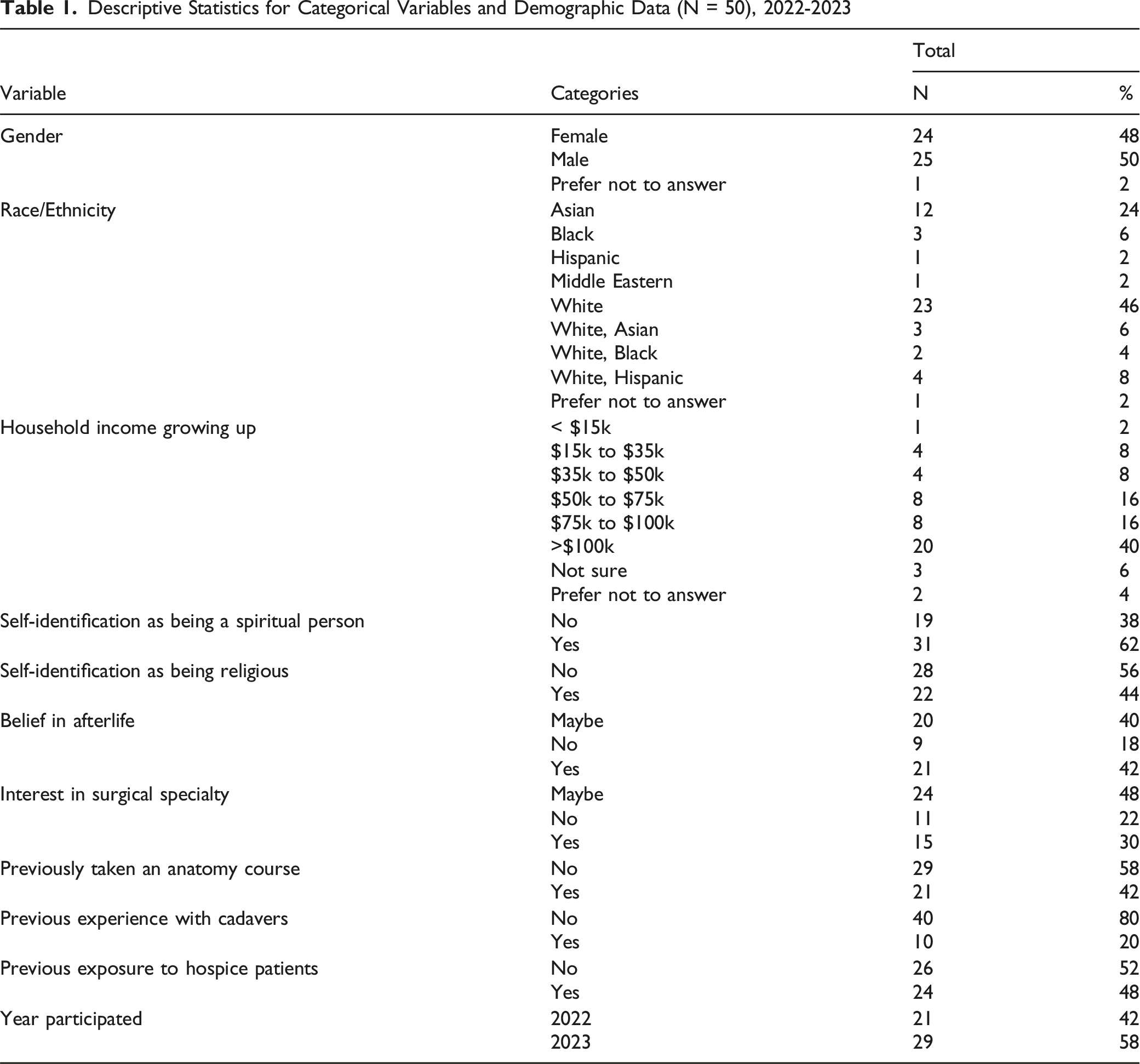
When assessing differences between the two academic years, all continuous variables were normally distributed, except for average time spent in the anatomy laboratory. After log-transforming this variable, Welch two sample t-tests determined that there were no significant differences between the two academic years on any of the continuous variables, except for days per week spent in the laboratory (3.06 in 2022 vs 4.04 in 2023, P = 0.03) (see Supplemental Digital Appendix 2 for detailed results). The observed increase in laboratory attendance among 2023 students may be attributed to both greater COVID-19 risks in 2022, as well as the shift to asynchronous lectures, which provided greater scheduling flexibility. These structural changes likely facilitated more frequent engagement with the anatomy laboratory, even though the overall time in minutes per week did not differ significantly between the two years. Chi-square tests and/or Fischer’s exact tests which assessed differences in the categorical variables between years found no statistically significant differences, apart from household income growing up (P = .03) (see Supplemental Digital Appendixes 3 and 4 for detailed results).
Statistics for Correlational Analysis Between Sense of Purpose and Academic Performance, 2022-2023 a
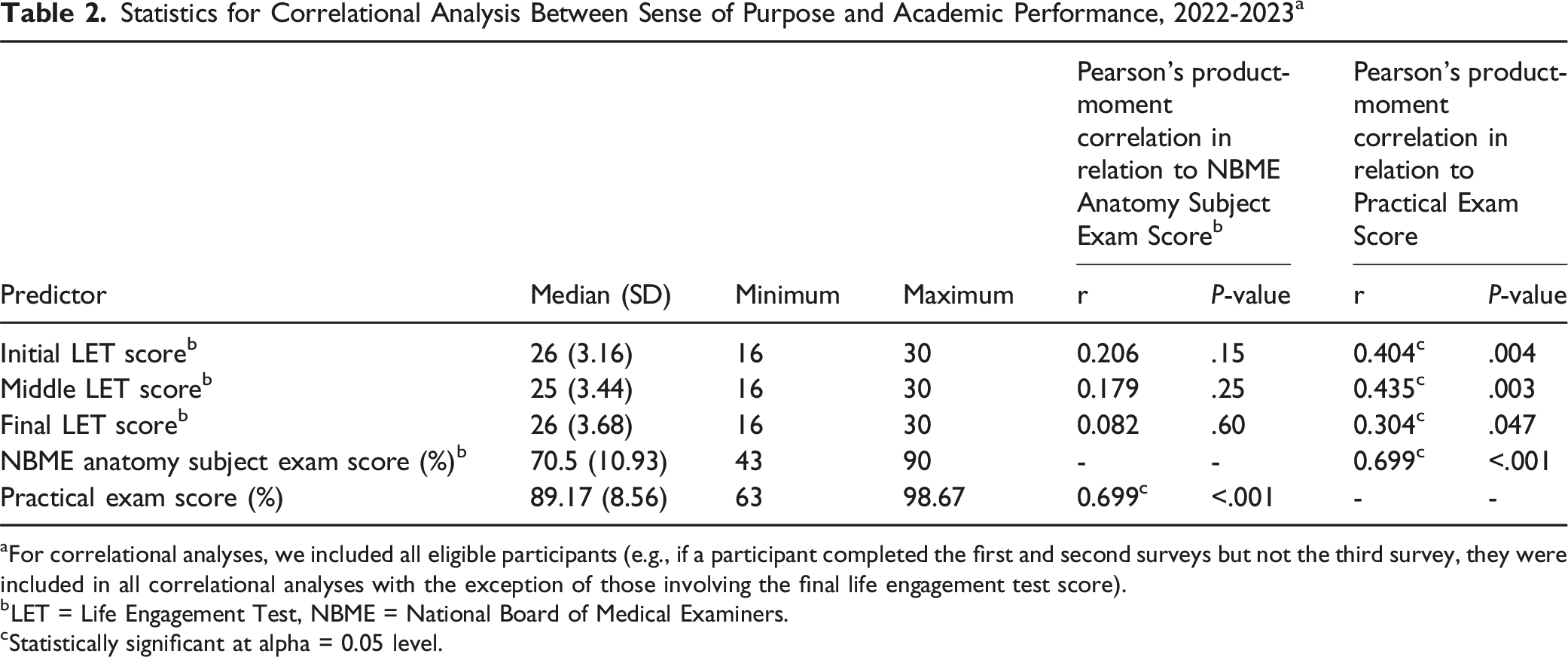
aFor correlational analyses, we included all eligible participants (e.g., if a participant completed the first and second surveys but not the third survey, they were included in all correlational analyses with the exception of those involving the final life engagement test score).
bLET = Life Engagement Test, NBME = National Board of Medical Examiners.
cStatistically significant at alpha = 0.05 level.
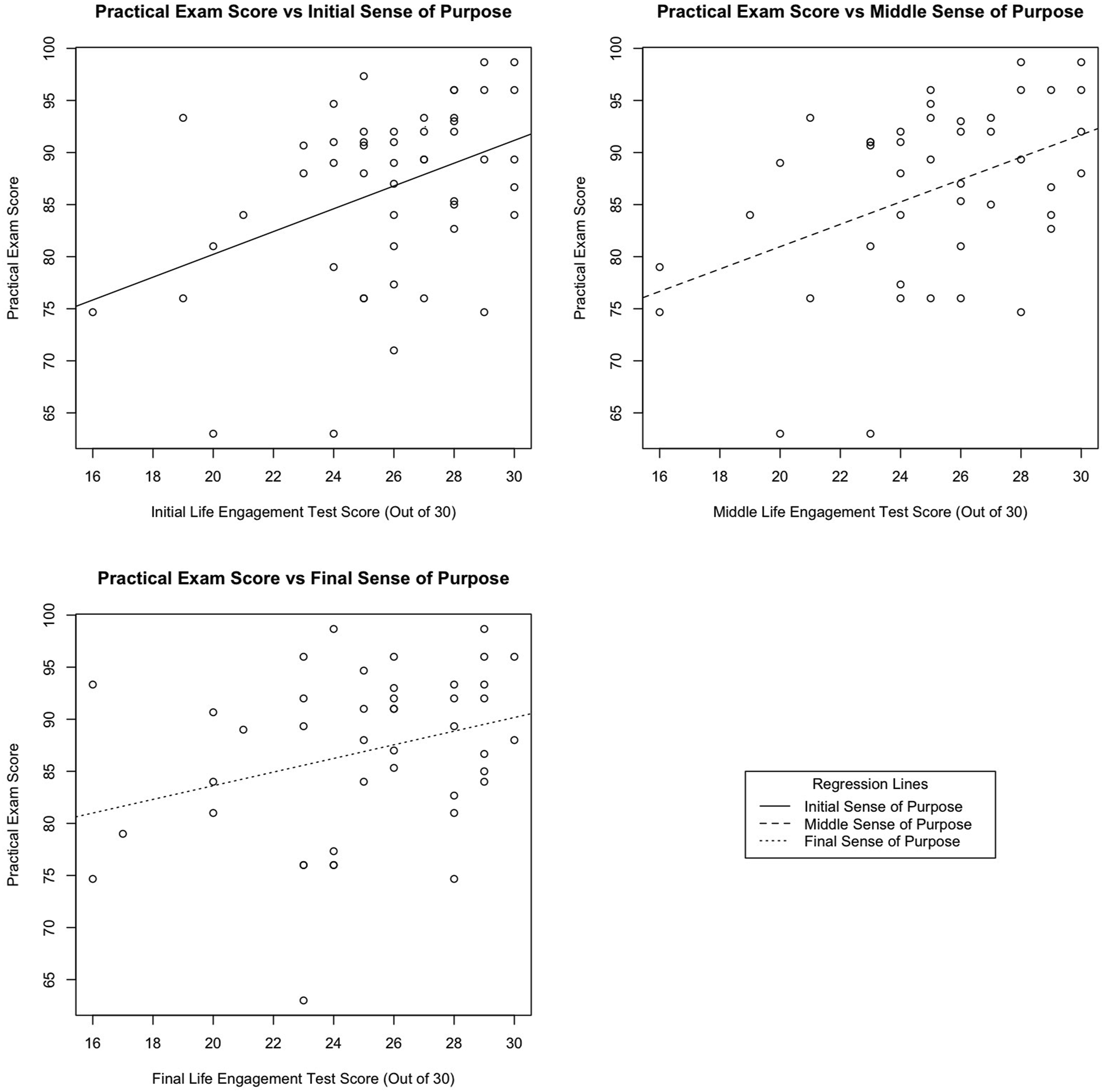
Correlations Between Sense of Purpose at the Beginning, Middle, and End of the Anatomy Course, as Measured by the Life Engagement Test, and Final Practical Exam Score, 2022-2023
Pair-wise Comparisons for Sense of Purpose Over Time (N = 43), 2022-2023
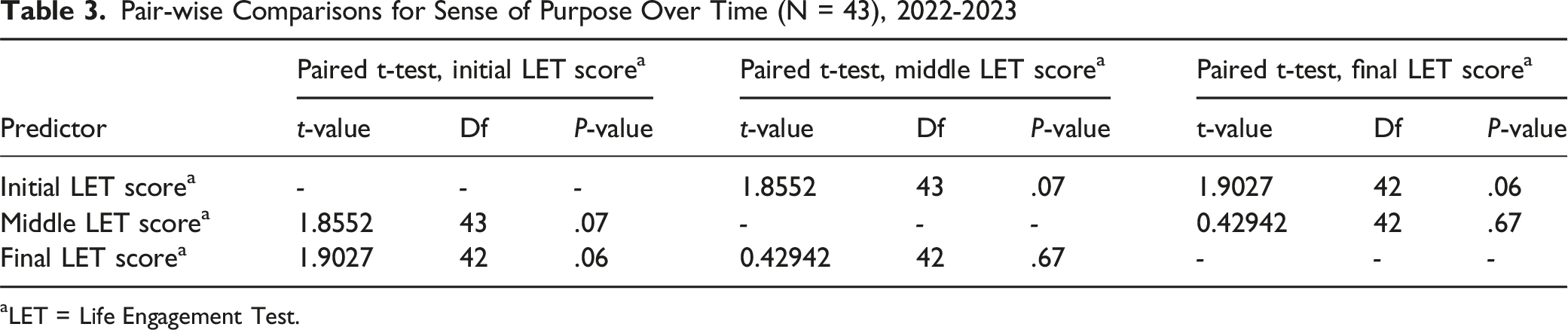
aLET = Life Engagement Test.
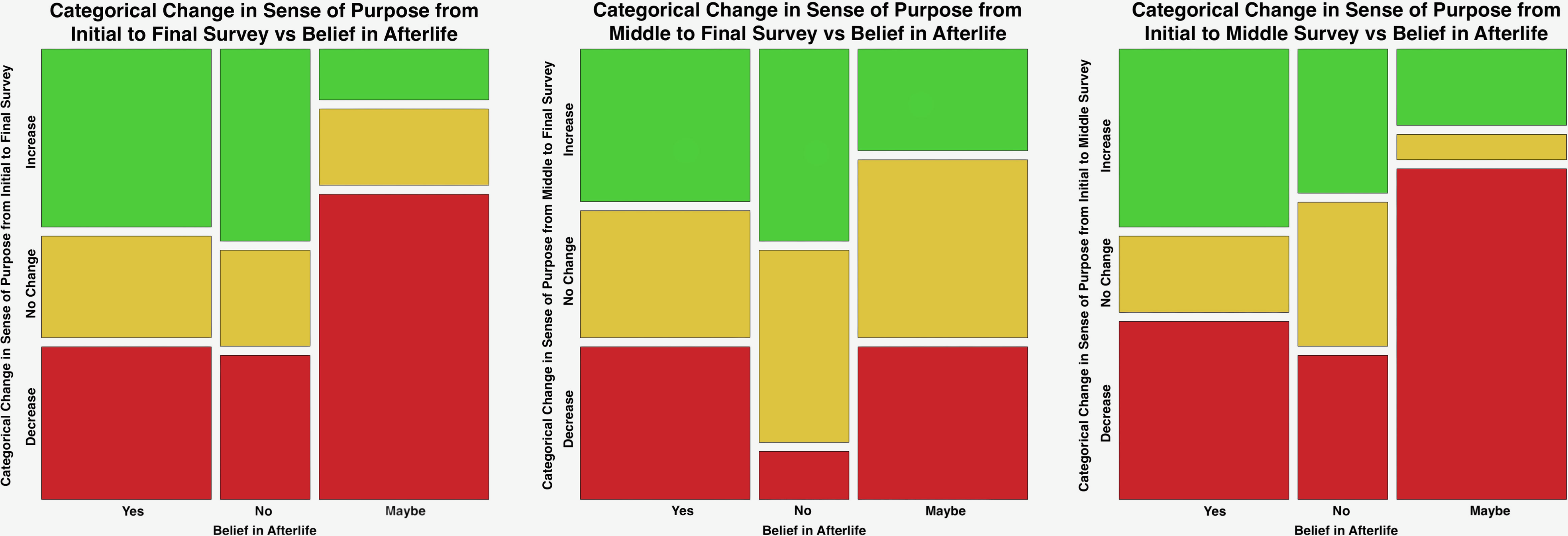
Mosaic Plots Showing Categorical Change in Sense of Purpose, as Measured by the Life Engagement Test, Across Time by Belief in the Afterlife, 2022-2023.
A post-hoc analysis demonstrated that, when compared to students either believing or disbelieving in an afterlife, students unsure of the existence of an afterlife performed significantly worse on the practical examination (95% CI: [−10.84, −0.52]) but not on the NBME anatomy subject examination.
Discussion
In this study of 50 first-year medical students taking a gross-anatomy course, a stronger sense of purpose, as measured by the Life Engagement Test (LET), significantly correlated with improved performance on a practical examination at the end of the course. This suggests that a student’s sense of purpose at varying time points can moderately predict their course performance. This finding is consistent with other studies which have demonstrated that those with higher sense of purpose and meaning in life perform better academically. 28 One potential explanation is that those students who have more meaning in their everyday tasks may engage more with course material, leading to improved academic performance. Alternatively, sense of purpose may represent a proxy for general well-being and flourishing.
Although sense of purpose at all three time points of the course was positively correlated with performance on an NBME subject exam, these correlations were non-significant. The discrepancy in significance between practical and NBME subject exam performance may be explained by increased variability in the NBME subject exam scores. Specifically, while the NBME subject examination is a nationally standardized exam, which could include content not directly taught in the anatomy course, the practical examination was developed by course faculty and was likely to be more relevant to taught content.
While sense of purpose did not significantly change across time, there were significant declines among those unsure of their belief in an afterlife, compared to those who either believed or disbelieved in an afterlife. Previous literature suggests that awareness of one’s own mortality may lead to decreased sense of meaning among non-religious individuals as compared to religious individuals.41,42 In contrast, our study found that it was not religion, but belief in an afterlife, that influenced purpose. As a result, students unsure of a belief in an afterlife had declines in their sense of purpose as they progressed through the course and were confronted with human mortality. Concerningly, these students also were noted to have significantly worse performance on the practical examination when compared to classmates more certain in their beliefs (either believing or disbelieving). Our findings suggest that those with uncertain beliefs about the afterlife may be vulnerable when confronted with cues that increase mortality awareness. In contrast, those confident in their beliefs (either believing or non-believing) may not be as influenced by such mortality cues.
In the US population, approximately 26% of individuals report being uncertain about their belief in the afterlife. 48 While understudied, the available evidence suggests similar rates of uncertainty among medical professionals. One study from Brazil found that among medical students, 18.7% did not have an opinion about the existence of an afterlife. 49 Another study found that among psychiatrists, 23.8% were undecided about life after death. 50 Given that a substantial portion of the US population and medical professionals are uncertain about the afterlife, our findings have important implications for other settings where individuals may be confronted with mortality, such as palliative care and hospice settings, among others.
Limitations and Strengths
Our study has limitations. The sample size was relatively small and consequently may be under-powered to detect some differences. Furthermore, it is possible that those who were lost to follow up in the second or third surveys had different sense of purpose changes throughout the course which were not captured by this study. For example, if students became overwhelmed and declined in their sense of purpose, they may have been less inclined to fill out the study surveys. Additionally, as our study used voluntary surveys, the possibility of non-response bias is an inherent limitation of the study format. Moreover, while the LET is widely used to measure sense of purpose, sense of purpose and meaning in life is an abstract concept which can be difficult to assess objectively.
Our study also did not examine other factors which could have mediated the relationship between sense of purpose and academic performance, such as stress levels or responses to negative stimuli. These are important factors that would benefit from further evaluation in future studies examining sense of purpose in mortality-salient contexts, such as the anatomy laboratory. Likewise, while this study focused on final course outcomes, future investigations could examine how sense of purpose correlates with formative assessments across the duration of the course. This would allow for a more nuanced understanding of how sense of purpose and meaning may influence academic engagement over time.
Despite its limitations, our study also has several strengths. By utilizing a longitudinal sample, sense of purpose at three separate timepoints could be correlated with course performance. Additionally, our sample had high retention, as 86% of participants who completed the first survey completed all study surveys. Finally, in addition to identifying purpose as a novel factor which may affect anatomy course performance, our study identifies a unique group of individuals (i.e., those uncertain about the existence of an afterlife) who may be particularly vulnerable when directly confronted with human mortality.
Conclusions
Among medical students taking a first-year gross anatomy course, a stronger sense of purpose was significantly associated with better course performance. Future studies should investigate this topic further and specifically assess whether interventions that increase purpose can improve academic outcomes. While sense of purpose was stable across time in the overall sample, students unsure of their belief in an afterlife suffered from a declining sense of meaning as the anatomy course progressed, which was accompanied by worse course performance. Further investigation of this finding is warranted to determine whether this group of students may benefit from additional support when confronted with human mortality, especially in other settings such as palliative care and hospice contexts.
Supplemental Material
Supplemental Material - Confronting Mortality in the Anatomy Laboratory: Effects on Medical Students’ Sense of Purpose
Supplemental Material for Confronting Mortality in the Anatomy Laboratory: Effects on Medical Students’ Sense of Purpose by Elizabeth K. Farkouh, Jayant A. Gupta, Ian M. Michel, Punnose K. Kattil, Wojciech Pawlina, J. Michael Bostwick in American Journal of Hospice and Palliative Medicine®
Footnotes
Acknowledgments
The authors wish to thank Dr. Anthony Burrow, Cornell University, for providing his expertise on sense of purpose in life, as well as Qurratulaine Jadran and Jonathan Torrens-Burton for their assistance in conducting this study. They would also like to thank Andrew Siefert and the Cornell Statistical Consulting Unit for their assistance in statistical analysis.

Ethical Approval
This study was conducted in compliance with the Declaration of Helsinki. The anonymity of participants to the research investigators was guaranteed, as only course staff not involved as investigators had access to a spreadsheet linking a research identification code to a participant name. All participating students provided informed consent to partake in the study. The Mayo Clinic Institutional Review Board and Education Research Committee approved this study on August 31, 2022 (IRB number: 22-008442).
Author Contributions
E.F., I.M., P.K., W.P. and J.B. conceived and designed the study. E.F., J.G. and I.M. contributed to data acquisition and analysis. The first draft of the manuscript was written by E.F. and J.G. All authors provided critical revisions of the manuscript and approved the final version to be published.
Funding
The authors disclosed receipt of the following financial support for the research, authorship, and/or publication of this article: The authors wish to thank the Mayo Clinic Department of Psychiatry and Psychology and The Kern National Network for Flourishing in Medicine for funding this study.
Declaration of Conflicting Interests
The authors declared no potential conflicts of interest with respect to the research, authorship, and/or publication of this article.
Previous Presentation
The authors presented preliminary findings from this study through a virtual poster presentation at The 2023 Kern National Network Conference held in Milwaukee, Wisconsin on September 21, 2023.
Supplemental Material
Supplemental material for this article is available online.
References
Supplementary Material
Please find the following supplemental material available below.
For Open Access articles published under a Creative Commons License, all supplemental material carries the same license as the article it is associated with.
For non-Open Access articles published, all supplemental material carries a non-exclusive license, and permission requests for re-use of supplemental material or any part of supplemental material shall be sent directly to the copyright owner as specified in the copyright notice associated with the article.
