







Abstract
This study examines how, in the realm of social media, Epinions Advisors voluntarily perform a role similar to that of a technical editor. Specifically, the study examines Advisors' use of politeness strategies at various levels of edit in order to motivate product reviewers to improve their work. The study categorizes Advisors' comments about 60 product reviews according to levels of edit in order to determine how Advisors address editing as they attempt to fulfill the concerns of technical editors: advocating for readers and mentoring writers. Updated reviews and Advisor–reviewer discussions suggest that Advisors motivated reviewers to edit.
Many of us are now familiar with Web sites that review products and services. We have read reviews of books and other products at Amazon.com or of cell phones and laptops at Newegg.com or CNET.com. We have read reviews of hotels on Tripadvisor.com and local restaurants at Yelp.com. In response to the proliferation of online consumer reviews of products and the potential effects these reviews have on consumer behavior, researchers have examined, for example, reviewer motivation to contribute (e.g., Hennig-Thurau, Gwinner, Walsh, & Gremler, 2004; Wasko & Faraj, 2005; Yoo & Gretzel, 2008), reviewer credibility (e.g., Cheung, Luo, Sia, & Chen, 2009; Mackiewicz, 2010b), and the impact of reviews on sales (e.g., Chevalier & Mayzlin, 2006; Hu, Liu, & Zhang, 2008). And several studies have examined the reviews in another popular site: Epinions.com (e.g., Liu et al., 2008; Pitsilus & Chia, 2010). Epinions is a popular review site that includes reviews of products ranging from aardvark toys to Zebra brand printers. Its goal is to gather and organize reviews of products and services so that users are better able to “make informed decisions” about potential purchases (Category Lead, n.d.). At Epinions, like at other review sites, a potential reviewer has only to provide an e-mail address in order to become a member, and members can rate products (on a rating system of 1 to 5 stars) and write reviews.
But what sort of feedback do product reviewers receive about the extent to which their reviews are useful? Most review sites offer limited feedback about review quality. For example, at Amazon, site users can answer the question, “Was this review helpful to you?” by clicking either yes or no. At Epinions, users rate reviews on an ordinal scale of very helpful, helpful, somewhat helpful, not helpful, or off topic. A rating on this scale—though more informative than an answer to a yes or no question—provides little in the way of substantive feedback that reviewers can use in editing and improving the helpfulness of their reviews. (Epinions reviewers can update their reviews as many times as they wish.)
To help Epinions members increase the usefulness of their reviews, Epinions created a special category of review raters called Advisors. Epinions charges Advisors with providing “constructive feedback via comments to reviewers on how to improve [review] content quality” (Rating Reviews, n.d.). For example, in the following excerpt, cntaur5, an Advisor in the electronics category, welcomes the reviewer subzero to Epinions and suggests that she should add more detail to her review: I wanted to take this opportunity and welcome you to the website. I think you get off to a good start, however I think a bit more could be shared on some of the Fuji FinePix S9000 Zoom Digital Camera’s functions and features.
Contributing to the literature on social media and on product reviews in particular, this study examines comments that are aimed at improving the quality of reviews rather than examining reviews themselves. It shows how Advisors take on a role quite similar to that of a technical editor. It examines how, working in the realm of social media, Advisors address reviewers' writing at various levels of edit (Van Buren & Buehler, 1980), using politeness to motivate reviewers to improve their work.
This study especially reveals how Advisors favor editing at a substantive level. Substantive (i.e., comprehensive, heavy, macro, developmental) editing involves critically examining both the rhetorical situation of a text and the text itself to determine the extent to which the text meets the needs of the discourse community. Such editing looks for omissions and lack of coherence across a text’s sections (Van Buren & Buehler, 1980, p. 30). Arguing for the importance of substantive editing, Grove (1994) explained that doing this work involves asking “whether the discussion is complete; whether there are technical discrepancies; and whether terms are defined clearly” (p. 171). Samson (1993) stated that a “macro-edit” examines “the content, organization, and logic of a document to see how well it addresses its subject, audience, and purpose” (p. 9). And Buehler (2003) suggested that a substantive edit requires a “rhetorical approach,” considering audience, writer, purpose, and house rules—elements that “will determine the form (within unavoidable constraints) as well as the content of the message” (p. 462). The following excerpt, Steelfan’s comment on a review of a stand mixer, illustrates how Advisors attempt to ensure “content quality” via their comments at the substantive level (Category Lead, n.d.). Steelfan asks the reviewer for additional content that readers will want: Your review does a nice job of telling us what you like about this mixer. Adding more information on features, specs, speeds and controls will greatly help readers to make a better buying decision. Please let me know if you need help on the site or if you decide to update. Thanks!!!
But as all editors know, changes at the substantive level demand consideration and consume time. Thus, when Advisors suggest substantive changes (and even when they suggest changes at other levels of edit), they run the risk of alienating reviewers, possibly driving them away from the site and potential review writing. The possibility of discouraging reviewers to such an extent that they abandon reviewing products altogether is a concern that technical editors working in professional relationships with technical writers and subject-matter experts (SMEs) do not face. Technical editors working in professional relationships have more in common with moderators of online discussion forums. Like online discussion moderators who induce certain forum-participant behaviors (e.g., using correct punctuation and capitalization or avoiding promotion of one’s own business) because they are able to block posts from uncooperative participants and to remove posts that fail to adhere to the rules of the forum, technical editors hold an institutional authority that allows them a substantial say in what constitutes appropriate, necessary, and quality content (Edwards, 2002). Of course, technical editors do not simply impose their will on SMEs and writers, mandating changes without a thought about building and sustaining good working relationships with them. Indeed, prior research on editing reveals how technical editors diplomatically convey the changes that they want to see enacted (Eaton, Brewer, Portewig, & Davidson, 2008; Mackiewicz & Riley, 2003). But institutional authority does matter. Another contribution of this study, then, is that it juxtaposes the concerns of a new type of editor—a volunteer without institutional authority who works on technical, evaluative texts written by other volunteers—and those of a professional technical editor who works with technical writers and SMEs.
To study how Advisors motivate reviewers to revise across levels of edit, I examine their use of politeness strategies to mitigate the blow of their suggestions and criticisms—speech acts that threaten a reviewer’s face (Brown & Levinson, 1987). Face relates to individuals' need to project their best self to others and to maintain this (best) self-image. Ury (1991) described the importance of face saving in negotiations: Face is much more than ego. It is shorthand for a person’s self-worth, his dignity, his sense of honor, his wish to act consistently with his principles and past judgments, and, of course, his desire to look good to others. (p. 101)
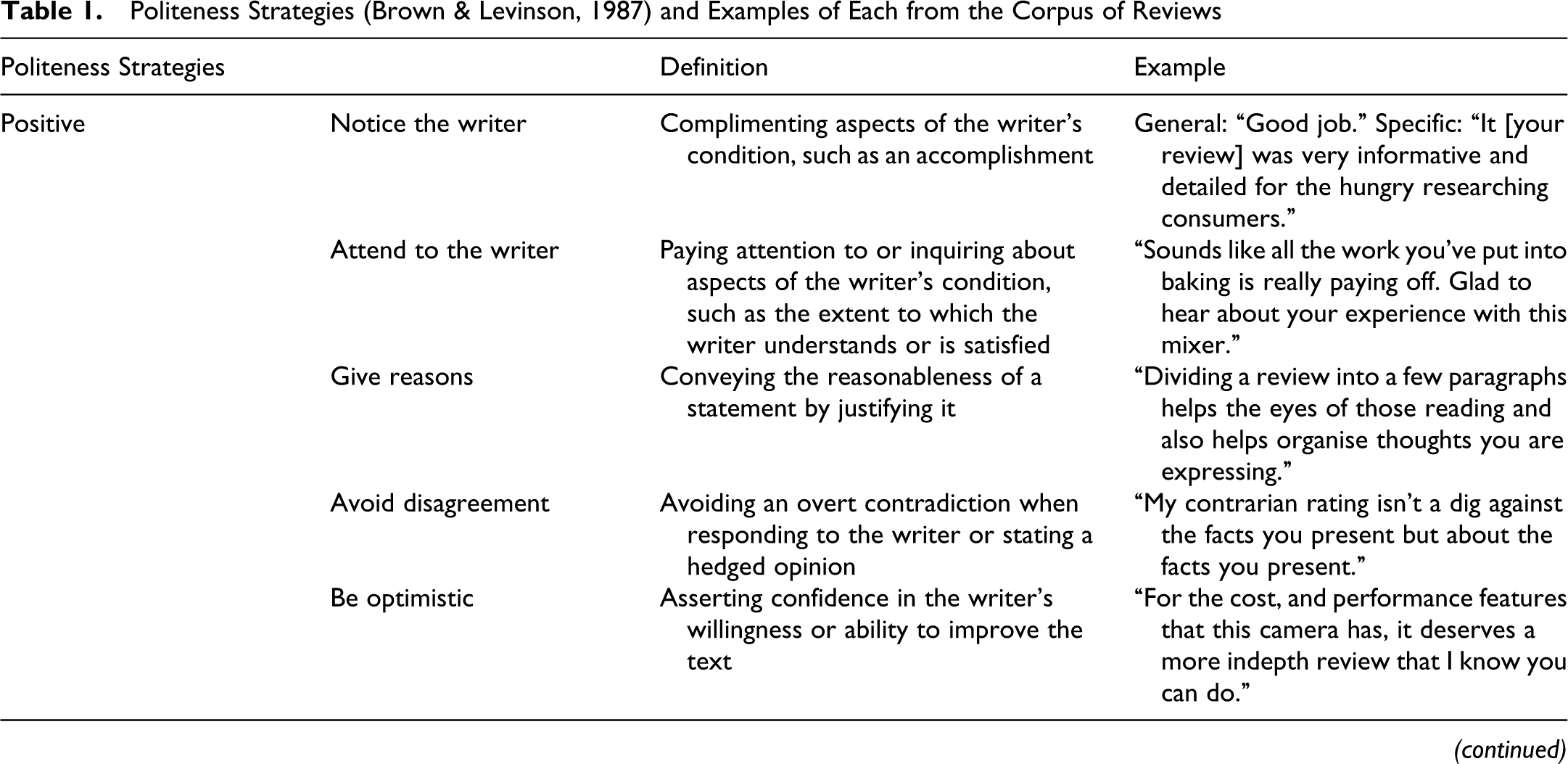
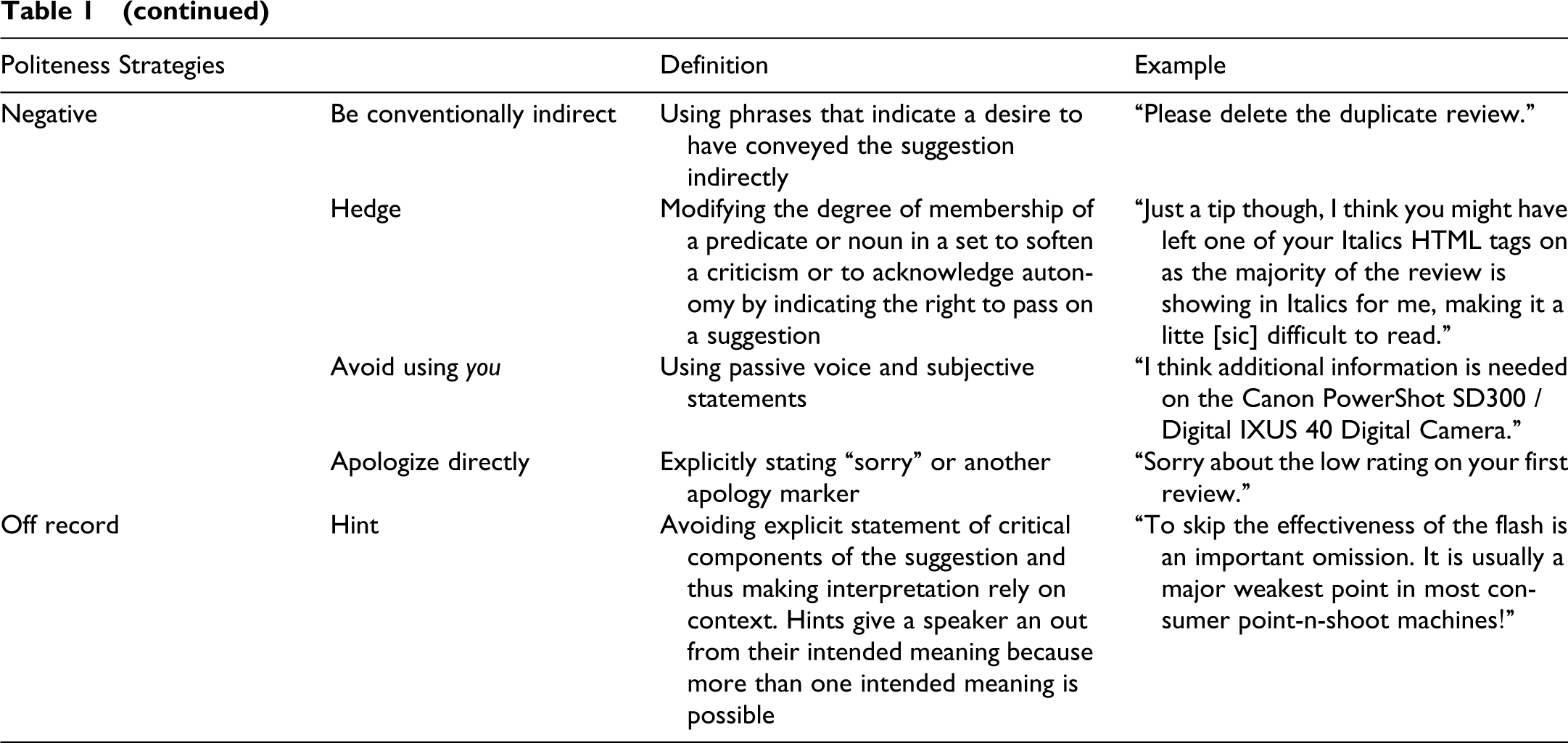
In the analysis that follows, I examine how Advisors consider reviewers' face needs when they use (a) positive politeness strategies, strategies that generate a sense of solidarity and rapport; (b) negative politeness strategies, strategies that demonstrate a willingness to accommodate reviewers' own decision making; and (c) off-record politeness strategies, strategies that convey ambiguous meaning, giving a speaker an out from any one meaning (see Table 1 ).
Politeness Strategies (Brown & Levinson, 1987) and Examples of Each from the Corpus of Reviews
Roles of Editors: Reader’s Advocate and Writer’s Mentor
Through politeness strategies, Advisors encourage reviewers to continue their efforts to improve the usefulness of their reviews, which, like the consumer products under review, are subject to ratings from Epinions members (on a very helpful to not helpful scale) and to written comments. By editing their reviews in a way that encourages and guides product reviewers, Advisors simultaneously and voluntarily carry out roles that are critical to the work of technical editors: those of reader’s advocate and writer’s mentor. As the reader’s advocate, technical editors ensure that documents are both comprehensive and useful (Rude, 2006, p. 31). The role of reader advocate, as Grove (1994) pointed out, is particularly important during substantive editing because it is at this level that the content’s and concept’s relevance to a particular audience are honed. In this advocate role, Advisors can help reviewers write and revise so that their reviews better meet readers' needs.
As the writer’s mentor, technical editors “teach, stroke, encourage, and possibly even defend” the writers whose work they edit (Tarutz, 1992, p. 42). Similarly, they can teach writers the “proper measure of loyalty and adherence to norms” (Becher, 1989, p. 25), thus enculturating them into the discourse community (Newton & Newton, 1998). Enculturating involves explaining the types of arguments and evidence that have value for the community (in this case, site users who stay current on the category-specific content even when they are not planning to purchase a particular product and those who happen upon the category-related community in order to get information for a specific purchase) and specifying what counts as “appropriate language, appropriate evidence, and appropriate reasoning” (Harrison & Stephen, 1995, p. 595). In this mentoring, Advisors can help reviewers to reshape their reviews so that the reviewers can better build and maintain their own reputations. As Lampel and Bhalla (2007) showed in their study of product reviewers' motivations for reviewing products, by helping reviewers build their reputations, Advisors simultaneously enhance their own reputations within their particular Epinions communities, a motivation additional to altruism—an often-noted motivation for contributing knowledge to an online community.
Method
To study Advisors' comments, I gathered a corpus of 60 reviews that had generated comments from Epinions Advisors. Most Epinions reviews do not generate comments from any Epinions members, let alone comments from Advisors. But reviews that receive Advisor comments can get more attention: Advisor recognition grants “a greater role in determining which reviews are seen by new visitors” (Category Lead, n.d.). Also, because users searching reviews within a particular category are likely to encounter an Advisor’s (high) profile, they are likely to find a list of the Advisor’s comments and, therefore, the reviews to which those comments are attached.
The 60 reviews focus on two types of technical products: digital cameras and stand mixers. I chose these two product categories for two main reasons. First, both categories generated numerous product reviews. Because these categories are active, they have generated site users who have category-specific recognitions, including the Advisor recognition. Searching from the most recent reviews (2010) to the older reviews (2002) through all product price ranges (starting with average-priced products), I looked for reviews that had received an Advisor’s comment until I had gathered 60 total reviews. These reviews generated 76 Advisor comments. (Some reviews received 2 or 3 comments from more than one Advisor, and some received two or three comments from one Advisor.) Then I separated the Advisor comments into two categories: (a) comments that discuss a way to change the review at some level of edit (e.g., substantive) and (b) those that do not discuss ways to edit the review. In regard to the first category, to determine the level of edit of a given comment, I relied on the appearance of terms associated with each level, such as the following: content, information, misspelled, capitalize, Epinions policy, Review Writing Guide, white space, paragraphs, and repetition. Then, a trained coder and I separately coded a set of Advisor comments for level of edit. We achieved 93% agreement—an acceptable percentage.
Of these 76 Advisor comments, 35 (46%) discuss editing. These 35 comments relate to 34 reviews. (One review received two Advisor comments about editing.) These editing-related comments constitute the bulk of the data examined in this study. Although this sample is small, it represents Advisors' editing advice to reviewers who wrote reviews about two important and popular products (digital cameras and stand mixers).
In regard to Advisor comments in the second category, 41 of the 76 comments (54%) do not discuss ways that the reviewer could edit the review. Given Advisors' charge to help reviewers generate reviews that are very helpful to Epinions users, this finding is somewhat surprising. But these comments serve several other purposes. For example, Advisors related their own experience with the product (e.g., “I use a D300 now and several Nikon FILM SLRs. Yes, I still shoot [and love film]”). Also, Advisors used comments to welcome new reviewers to the discourse community (e.g., “Just wanted to say welcome to the site”). I do not discuss such comments at length, except to say that Advisors often seemed to use non–editing-related comments in order to build solidarity (by highlighting commonalities between the Advisor and the reviewer) and rapport (by being inclusive and friendly with reviewers). Such positive politeness strategies are likely to increase the chance that the reviewers will continue to contribute content to the site. That is, such strategies are likely to motivate them to review other products as well. Indeed, as I discuss later, reviews receiving non–editing-related comments from Advisors were just as likely to be updated (i.e., edited) as were those reviews that received editing-related comments from Advisors.
In the following sections, I focus on comments that fall into the first category—comments that relate to editing—because these comments directly respond to the Advisors' charge to help reviewers generate useful reviews and reveal Advisors' dual roles of reader’s advocate and writer’s mentor.
Results: Levels of Edit
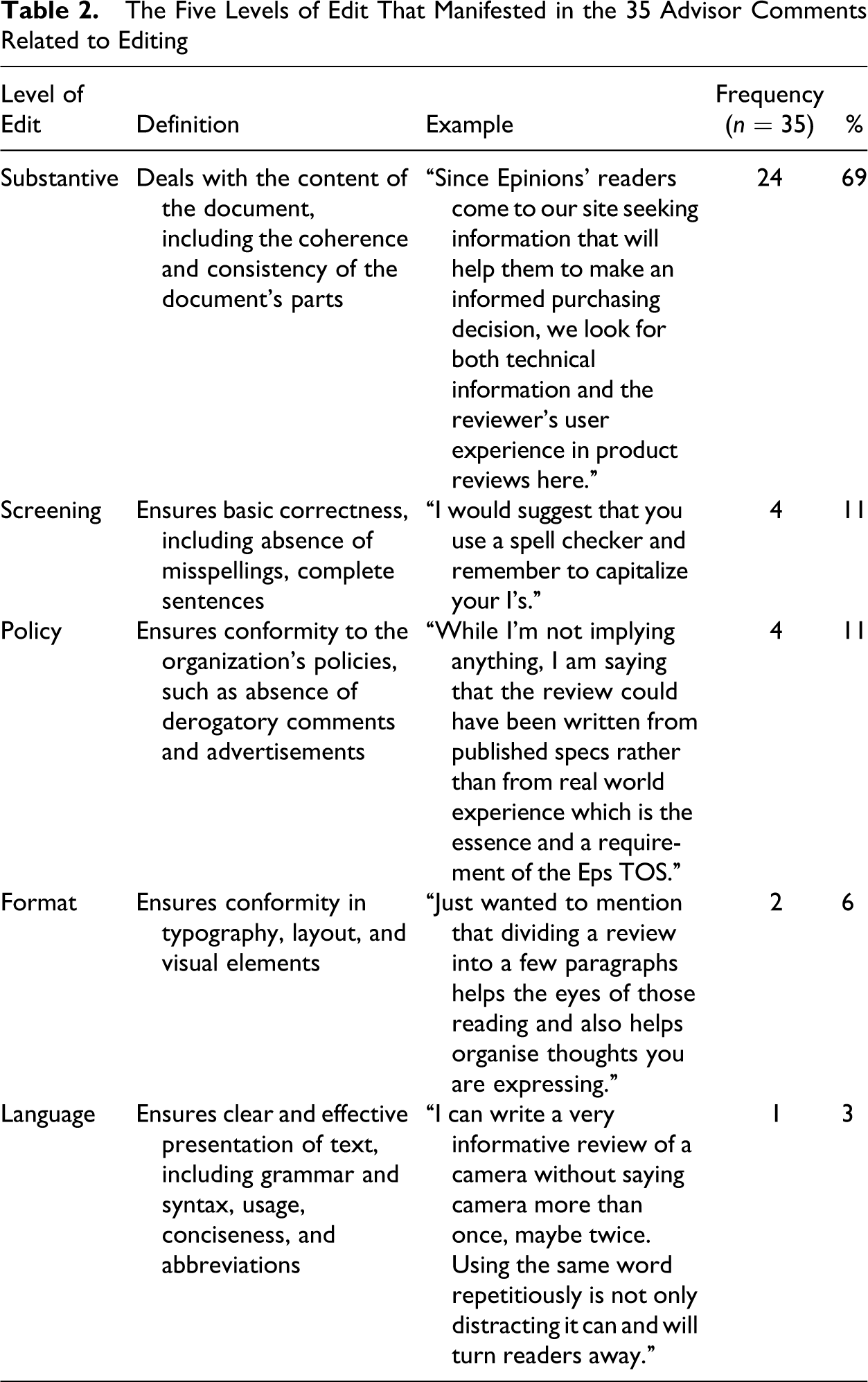
As I noted, of the 76 total comments from Advisors about the 60 reviews, 35 (46%) focus on how reviewers could edit their reviews to make them more helpful to readers. The 35 comments related to editing focus on five (out of nine) of Van Buren and Buehler’s (1980) levels of edit: substantive, screening, policy, format, and language (see Table 2 ).
The Five Levels of Edit That Manifested in the 35 Advisor Comments Related to Editing
Substantive Level of Edit
Of the 35 Advisor comments about editing, 24 focus on substantive editing (69%). When Advisors focused on editing, they focused primarily on how reviewers could substantively edit their reviews to better meet their audience’s needs and thereby turn, for example, a somewhat helpful review into a helpful or even a very helpful one. In addressing reviews at a substantive level of edit, Advisors used a variety of politeness strategies to motivate reviewers to edit for accuracy and for completeness.
Although Advisors spent most of their efforts at the substantive level in motivating reviewers to add to their reviews more detail and explanations of their own experiences with the product, they also took on the technical editor task of editing for accuracy. For example, after the Advisor sweeper asks the reviewer alethead to expand his review of a Pentax camera, he takes a moment to correct a statement in alethead’s review: I think this is a great start for a review.… Wish there was more “meat” to this review and, especially, more impressions of your experience with this camera. It’s what Epinions is all about. Just a nit but while the sensor hardware may be the same as Nikon’s (Sony’s 6.X DX sensor), the processing algorithm is not. The processing algorithm software is nearly as important [as] the sensor hardware. Also Pentax does not use Nikon’s metering system.
Like technical editors, Advisors such as sweeper consider ensuring accuracy to be a critical component of their mission. In fact, an Advisor’s concern for accuracy—a critical concern in meeting readers' needs and maintaining site credibility—is so critical that in some category communities (e.g., the community of Epinions members interested in digital cameras), face-saving, diplomatic politeness can be momentarily sidelined. Advisors' sense of urgency in correcting errors can override their concern for meeting the reviewer’s face needs. Politeness research shows that urgency decreases use of politeness (e.g., Manno, 1995). For instance, shouting, “Get out!” to a crowd of people in a burning building (and thus using an unmitigated command) is far more appropriate than shouting, “Get out!” to a crowd of people after noticing the first signs of water damage on an office building’s walls. Urgency excuses direct, unmitigated commands. When Advisors respond to (perceived) inaccuracies, a sense of urgency sometimes washes over them. Their impulse is to rid the site of the flaw (the urgent situation) as quickly as possible, thus lowering the potential negative effects on readers.
For example, Advisor colonialpara, critiquing review accuracy, directly and forcefully disagrees with solohan1’s review, particularly in the first three sentences in the body of his comment. Colonialpara’s disagreement in those three sentences constitutes a clear threat to solohan1’s face: I must disagree on one point. by colonialpara The build of this camera MOST CERTAINLY is NOT solid enough for a professional. It will NOT take the type of abuse and beating that pros put their cameras through. This is an entry level camera and nothing more. Nice job, though.
With his comment title (“I must disagree on one point”) and especially with the first line of his comment (“The build of this camera MOST CERTAINLY is NOT solid enough for a professional”), colonialpara shows that his concern for the reader’s welfare supersedes his concern for the reviewer’s face. Indeed, the first three sentences of the comment contradict solohan1 with certainty and force. Colonialpara shows certainty through his use of the superlative most paired with the force upgrader certainly. Also, colonialpara avoids using any mitigation at all, for example, a diminutive hedge phrase such as a little bit to soften his contrary opinion. This straightforward disagreement is quite striking, particularly given people’s tendency to try to agree with one another, if only to get along on a day-to-day basis. Sacks (1973) called this tendency the “rule of agreement” Brown and Levinson (1987) referred to it as the “preference for agreement” (p. 114). In this comment, colonialpara’s urgent concern for accuracy overrides this general conversational preference.
But even Advisors like colonialpara—those driven by a sense of urgency to identify an inaccuracy to a reviewer and thus get the error fixed—remember that they have a responsibility to encourage reviewers to improve their reviews and to review other products. Carrying out this responsibility involves meeting reviewers' face needs. In this case, colonialpara demonstrates concern for the reviewer’s face via the title that he attaches to his comment (“I must disagree on one point”). Although the title, like the first three sentences of the comment, reveals his sense of urgency, it does so in a more measured way. In the title, colonialpara uses what Austin (1975) called an “illocutionary force indicating device.” When he states “I must disagree,” he is explicitly stating the speech act (the verb disagree) that he is carrying out at that moment, leaving no room for ambiguity. But even in his role as reader advocate, attempting to rectify error to ensure the site users' best interests, colonialpara acknowledges the face needs of the reviewer by using a hedge phrase in the title: “on one point.” With this hedge, colonialpara limits the scope of his face threat and thus mitigates it. Even when dealing with inaccuracy, Advisors consider how their comments might affect reviewers' motivation to edit their reviews (and to review again).
More important to colonialpara’s motivation of the reviewer, however, is how he shifts gears after his disagreement; he ends his comment with a general compliment (“Nice job, though”). With this praise—what Brown and Levinson (1987) called noticing (in this case, noticing an accomplishment)—colonialpara conveys that the rest of the review as it stands is acceptable, that besides the “one point” he disputes, the review otherwise meets the standards of the electronics discourse community. The praise, then, boosts the reviewer’s face.
Colonialpara’s general praise suggests that compliments do not need to be specific to generate a good affective response from reviewers. Colonialpara’s general, formulaic praise demonstrates that he appreciates the reviewer’s work even though he has not taken the time to point to specific elements worthy of praise. As I found in an earlier study of compliments in interactions between technical writing students and writing tutors (Mackiewicz, 2006), most tutor compliments are formulaic (e.g., “Good job”), and therefore, unlike their specific counterparts (e.g., “Your use of personal experience in the first paragraphs provides a useful scenario”), they tend not to be instructive. But that study too found that formulaic compliments serve a purpose; such compliments motivated students to continue work on their papers by reinforcing the idea that they were already on the path to success. Colonialpara’s brief concluding compliment functions similarly.
Indeed, the reviewer’s responding comment to colonialpara reveals that colonialpara had successfully motivated the reviewer to edit his work to correct the inaccuracy: Yes, that’s a good point! I’m going to change that because obviously a $5000.00 body only camera such as the D2X would have more going for it than this entry-level camera.… Thanks for the comment. I’m glad you liked the review.
When editing at the substantive level, Epinions Advisors spend much of their effort motivating reviewers to fill in perceived omissions in content—omissions that decrease the review’s helpfulness for site users. They ask reviewers to supply more detail about particular topics, such as the situations in which the reviewer has used the product. In the example that follows, an Advisor, disartain, uses a variety of politeness strategies to encourage vikesgirl, a new reviewer, to describe the KitchenAid KV25G0X stand mixer in greater detail: Hi and welcome vikesgirl, Sounds like you got a great deal off ebay. I’m glad that you are enjoying the mixer. I was wondering and I am sure that consumers would like to know more details. Does it have special features? How many speeds? How many attachments does it have? Did it have the bowls with it? IF you want to change your review to add the extra information, look to the right of your review and in the orange box hit update. Make your changes and hit publish. IF you do this please email me I would love to read and rate it again. I wanted to thank you for the spaces between your paragraphs. Lots of people don’t format their reviews like you have and it makes them hard to read. Good luck
Like disartain, Advisor jps246 politely advocates for completeness. Commenting on jurafajt’s review of the Pentax camera, jps246 makes clear that completeness means a balance of detailed product description (similar to product specifications) and detailed explanation of the user’s experiences with the camera: I think you’re well on your way to a very helpful review—you just need to flesh out your review a bit. Consider that Epinions is used by consumers who are trying to compare and research products and your review may be the only one they see.… just flesh out each of your bolded topics with a bit more technical stuff and some more personal experience and I think you’re review would be much more helpful. If you decide to update, please email me (with the review URL) and I’d be happy to take another look.
Jps246 uses other strategies that motivate the task of editing for completeness. Namely, he gives reasons for his suggestion to add content, and in supplying the reasons, he frames the reviewer as someone worthy of his effort to articulate explanations for suggestions. In this case, jps246 points out that fleshing out the bolded topics will particularly help those readers who view just one online review of the product (the reviewer’s). Thus, this strategy motivates because it displays respect.
By supplying reasons, jps246 also mentors this reviewer. He familiarizes her with the category community’s preference for reviews that justify product evaluations with descriptions of the reviewer’s personal experience with the product. This Advisor’s comment accords with prior research on online reviews. In an earlier study (Mackiewicz, 2010a), I discussed how reviewers assert their expertise—one component of credibility—by asserting their experience with a product and by asserting that they have tested the product in a range of conditions. The Advisor jps246 helps this reviewer to recognize that relating personal experiences with products—not just delineating technical specifications—is what attracts readers to reviews and generates high ratings for those reviews.
In sum, this study revealed that when Advisors focused their comments on editing, they most often focused on editing at the substantive level, asking reviewers to do the same. In doing that, they enacted the advice of technical editing researchers who called attention to the importance of substantive editing in producing quality texts (e.g., Corbin, Moell, & Boyd, 2002; Grove, 1994). Specifically, in advocating for readers, Advisors asked reviewers for greater accuracy and completeness. In helping reviewers edit for accuracy and completeness, Advisors also mentored them in what counts as sound evidence within the community and thus toward achieving greater credibility. The changes they suggested meant extra work for reviewers, but those changes met and upheld the community’s expectations and, in the end, the quality of the site.
But Advisors may have made comments about substantive editing not just because of altruistic motivations (i.e., to carry out the technical editor roles of advocate and mentor); their motivations may have included maintaining and improving their own reputations within the category community—a point that Lampel and Bhalla (2007) made in their study of motivation for information giving in online communities. Like participants in Lampel and Bhalla’s study, colonialpara and disartain, in their editing for accuracy and in their identification of content omissions, showcase their own expertise in the subject matter—in these cases, electronics and home and garden products. That is, Advisors' motivations for writing comments about reviews may go beyond altruism to include reputation enhancement.
Screening Level of Edit
This study revealed that Advisors write comments that focus on ensuring that reviews meet the minimum standards of acceptability for discourse within the community. Use of correct spelling (e.g., their vs. there) and capitalization (particularly first words in sentences and the pronoun I) are two of these standards. Comments with this focus fall into Van Buren and Buehler’s (1980) screening level of edit. Of the 35 Advisor comments related to editing, 4 (11%) included this level of edit. For example, in her comment about hrawlins's review of a KitchenAid Professional 600 mixer, KMINER suggests that hrawlins pay attention to capitalization and spelling: I think the little “i”’s can be distracting from the good message and product information you are trying to get across. The site usually highlights misspelled words in the draft so that might help as well :)
In this advice, KMINER works as both reader’s advocate and writer’s mentor. As the reader’s advocate, KMINER attempts to move this reviewer away from casual, hurried writing that generates errors as well as nonstandard choices that may distract some readers, particularly readers for whom such errors and choices convey a lack of seriousness or, worse, a lack of credibility. As the writer’s advocate, KMINER’s advice guides hrawlins toward a review that can receive a better rating, raising it out of the somewhat helpful category, which contains reviews that “may have minor writing or presentation problems” and into the helpful category, which contains “well-presented” reviews (Rating Reviews, n.d.).
In motivating reviewers to perform a screening edit of their reviews, Advisors help reviewers meet the discourse community’s expectations of a helpful review, expectations that include use of standard written language. Thus, even at the screening level of edit, Advisors mentor reviewers by helping them show that they have made a sincere attempt to write readable and useful reviews (e.g., Hovland, Janis, & Kelley, 1953; Ohanian, 1990).
Policy Level of Edit
According to van Buren and Buehler (1980), a policy edit ensures that a publication contains all of the components that the publishing organization requires. At the Jet Propulsion Laboratory (JPL) where Van Buren and Buehler worked and produced their levels-of-edit document, a policy edit meant confirming that the table of contents and JPL logos conformed to standards. It also meant ensuring that certain content did not appear in a document, such as “derogatory or otherwise inappropriate judgmental comments … that would reflect adversely on private companies, government agencies, other investigators, or subdivisions within JPL” (p. 19).
At the policy level of edit, Advisors work to make sure that reviewers adhere to Epinions policies, such as those proscribing defamatory and vulgar language or duplicate reviews. Of the 35 Advisor comments, 4 (11%) focused on policy. Advisors use politeness to motivate reviewers to conform to policy. For example, rcjones edits at the policy level when he suggests, in regard to wlframe’s review of a KitchenAid Professional 600 mixer, that wlframe delete a review that she has posted in two Epinions categories, which is one posting too many: Hi, Duplicate reviews are frowned upon and against epinions policy. Please delete misplaced review.
In this comment, after greeting wlframe, rcjones gives reasons for his forthcoming request: “Duplicate reviews run counter to policy.” Rcjones uses politeness to motivate the reviewer, mitigating what would otherwise be a command (i.e., “delete misplaced review”) with please. The politeness marker please is particularly interesting in that it “irretrievably” marks a speech act as a request rather than a command; thus, Brown and Levinson (1987) called please a “force disambiguator” (p. 140). Please makes the intended force of the speech act clear and unambiguous. Advisors use this strategy (an example of conventional indirectness) as they often use devices to indicate illocutionary force (e.g., “I suggest that …”). In this case, it allows the Advisor to make clear that he is not issuing a command (“delete misplaced review”) and therefore mitigates the face threat and increases the likelihood that the mentoring can take hold.
The reviewer wlframe does indeed delete the duplicate review, and to reward this conforming behavior, rcjones praises the review—now posted to just one category: This is a good review and I’m sure it will be a help to consumers looking for information about the unit.
Format Level of Edit
Only 2 of the 35 Advisor comments (6%) focused on the format level of edit, showing concern with meeting readers' expectations for design-related readability. But in the Epinions discussion forum, review formatting and its impact on readers' experience is the topic of numerous discussion threads. For example, in that forum, shopaholic_man (2009) asserted that misspelled words are easier to read than is text that is formatted in all caps or that lacks white space between paragraphs: “I could actually read your sentence [with misspelled words] easier than reviews written in all caps. For that matter, I also have a great deal of difficulty reading reviews that are not separated into paragraphs.” However important formatting might be to Epinions members and to Advisors in particular, the results of this study indicate that Advisors did not encounter many reviews with egregious formatting problems, such as those related to typeface style (e.g., using all capital letters) or to use of white space (e.g., failure to use a line of white space between paragraphs).
Nevertheless, the format level of edit is a concern to some Advisors. Adopting a mentoring role and advocating for readers, Advisor henry_thoreau suggests to reviewer aluring2 that the formatting he is suggesting, skipping a line, both adheres to convention in the Epinions community and improves the text’s readability: If I may make one teensy suggestion: whenever you begin a new paragraph, skip a line. That’s the commonly accepted method (style). It looks tidier and makes it easier for the reader to follow your discussion (plus you’ll generally receive higher ratings, all other things being equal). ;-)
Language Level of Edit
Only 1 of the 35 (3%) Advisor comments focused on the language level of edit. This finding is at first glance surprising, given that this level of edit involves revising for clear and concise syntax and appropriate usage—common concerns for technical editors and those who evaluate and improve the writing of others. Advisors' staying away from commenting on reviewers' language errors—for example, problems with subject–verb agreement and parallel structure—may have stemmed from their not seeing the value of asking reviewers to correct common language-level problems, perhaps thinking that such matters have little effect on review helpfulness or reviewer credibility. Or perhaps the Advisors themselves did not identify such language issues or know how to articulate such problems. After all, Advisor recognition in Epinions stems from frequent, useful feedback to reviewers, which does not necessarily or even likely involve a focus on their grammar or word usage.
Such language problems in reviews certainly exist, though, and the one Advisor in this sample of Advisor comments who focused on language, walkerpkw, responded to park14’s review of a Canon PowerShot SD1200: Using the same word repetitiously is not only distracting it can and will turn readers away. You have some helpful information here and [I] suggest reading it aloud to someone to give you a better understanding and idea of what I mean. A particular college professor in English I once knew made this recommendation to me once, many years ago.
In sum, at all of these levels of edit, Advisors use politeness to motivate reviewers to improve their reviews by increasing their reviews' readability, correctness, and adherence to site standards. In doing so, Advisors advocate for Epinions readers. In motivating reviewers through various politeness strategies, including negative politeness hedges, positive politeness praise, and off-record politeness hints, Advisors also serve as reviewers' mentors, helping reviewers demonstrate sincere and honest attempts to be as helpful to readers as possible by showing them how to meet community expectations not only for the review content but also for the way that the content is conveyed. In helping reviewers across levels of edit, Advisors guided them toward credible identities within the community.
Results: Effect of Advisor Comments
Examining Advisors' comments—particularly the politeness strategies by which they motivate reviewers to edit their writing—is one thing, but showing that Advisors' comments have some effect on reviewers' behavior is another thing entirely. Two observations suggest that Advisors' comments did help shape reviewers' writing so that it better met the needs and expectations of Epinions users.
First, analysis of the date stamps on reviews shows that reviewers did update their reviews after receiving feedback from Advisors. Of the 35 reviews that received an Advisor comment related to editing, 14 (40%) were updated. To compare, I collected a random sample of 30 different reviews about stand mixers and digital cameras that received no Advisor comments. Of those 30 reviews, only 6 (20%) were updated. Clearly, examining a larger corpus of reviews and comments is necessary to determine whether this result would hold up, but this result is telling.
Second, 7 of the 35 (20%) review comments from Advisors received responding comments from the reviewers that specifically address their improvements to their reviews. For example, solohan1’s response to colonialpara’s substantive editing comment shows how reviewers commented on their own reviews in interacting with Advisors: “I’m going to change that … Thanks for the comment. I’m glad you liked the review.” Besides showing the motivating effect that an Advisor’s comment can have, solohan1’s response to colonialpara suggests the role that politeness can play in making criticism and suggestions less face threatening. Solohan1 not only promises to update the review but also thanks colonialpara for his “Nice job, though” compliment.
A somewhat surprising finding from this study is that the percentage of reviews that were updated after receiving an editing-related comment from an Advisor (40%) was the same as that of the reviews that were updated after receiving any type of Advisor comment; of the 60 reviews that received an Advisor comment—either editing-related or not—24 (40%) were updated. The time stamps of the updates suggest that Advisors' comments influenced reviewers. Of these 24 updated reviews, 15 (63%) were updated within 1 week after receiving a comment from an Advisor (25% of the 60 reviews receiving an Advisor comment). Indeed, 12 (50%) were updated the same day or the day after the comment was received (20% of the 60 reviews). For example, Advisor amyk49 commented on bluedot-79’s review on February 13, 2004, and bluedot-79 updated the review on February 14, 2004. These data suggest that Advisors' feedback played a role in reviewers' improving and updating their reviews but that their comments about editing were no more likely to generate an updated review than was, for example, a comment that welcomed the reviewer into the community or a comment that engaged the reviewer in a dialogue about the product (as opposed to a dialogue about the review).
Discussion
This study revealed that, in over half of their comments (41 of the 76, or 54%), Advisors, although charged with helping reviewers create better, more helpful reviews, focused their comments on welcoming reviewers and relating their personal experience with the product—not on suggestions for editing and improving reviews. Thus, this study shows that Advisors do other work besides that which is specifically assigned to them—motivating reviewers to edit. In using their comments for these other purposes, Advisors enrich a community of individuals with a common interest, such as photography or baking, and model friendly online behavior.
Unlike technical editors who work in formal relationships with technical writers and SMEs, Advisors cannot count on reviewers' returning to the discourse community in order to contribute again. Nor can they assume that a ready supply of reviewers is poised to volunteer. Using their comments for other purposes besides motivating reviewers to edit—particularly to connect to reviewers—therefore makes sense. Indeed, even though technical editors can rely on having a sustained relationship with the writers whose work they are editing, they might consider the ways in which non–editing-related comments such as those of the Advisors in this study can create a more welcoming, friendly, and collaborative environment in order to improve their own professional relationships with technical writers and SMEs.
In 35 of 76 comments (46%), Advisors focused on their primary responsibility: helping reviewers create more helpful reviews. But reviewing products is voluntary and largely unheralded work, so in their editing-related comments, Advisors used a variety of politeness strategies to encourage reviewers to carry out the changes that would make their reviews meet site users' needs and expectations. With politeness strategies, Advisors acknowledged reviewers' accomplishments and softened suggestions about ways to improve. Such strategies help motivate reviewers to take on the challenge of editing.
This study also revealed that when Advisors did concern themselves with editing, they most often focused on helping reviewers edit at the substantive level. With this focus, Advisors used a variety of politeness strategies (e.g., offering praise, minimizing the work involved in carrying out their suggestions) to motivate reviewers to carry out the kinds of changes that are likely to have a strong impact on a review’s usefulness. At this level, Advisors carried out the kind of important advocacy and mentoring work that technical communication scholars recognize in the work of technical editors (e.g., Corbin et al., 2002; Grove, 1994).
In textbooks and handbooks about editing, attention is often focused on the language and screening levels of edit, likely because these levels so clearly relate to copyediting and proofreading. Although editors' expertise at these levels certainly does play an important and obvious role in a document’s quality, their attention to the content and organization of the document (a task that often involves engaging with writers to envision and reenvision the document) is also important in creating and improving text quality. This study underscores the importance of the substantive level of edit in that it reveals how Advisors intuitively home in on substantive changes. They motivate reviewers to edit and update so that readers get what they want: specific information about products and, equally important, reviewers' descriptions and evaluations of their own experiences with those products. In doing this, Advisors also mentored reviewers by teaching them, as Harrison and Stephen (1995) put it, what the community considers “appropriate” evidence and reasoning (p. 595) and thus showing them how to construct a good reputation and eventually credibility (see Mackiewicz, 2010b).
In addition, in pointing out omissions and inaccuracies and thus displaying their expertise, Advisors likely also enhanced their own credibility. This observation underscores the idea that both altruism and reputation enhancement may motivate an individual to contribute time and effort to an online community. Advisors altruistically advocate for readers and mentor reviewers, but they also maintain and enhance their own reputations within the community through their (public) efforts.
In comments that fell outside the substantive level of edit, Advisors addressed policy, screening, formatting, and language concerns. They worked to make sure that reviews followed Epinions policy (making sure that reviews were not posted twice, for example, so readers would not have to wade through duplicated content). Advisors also ensured that reviews met a minimum level of correctness (via screening edits) and that they were easy to read (via format edits). But Advisors—whose reputation in the community develops from their ability to help reviewers create helpful reviews—were less concerned with (and possibly less able to identify problems related to) editing at these levels, particularly the language level.
Conclusion
This study contributes to the existing research on social media, specifically, to research on consumer reviews of products. But rather than focusing on the reviews themselves, the study analyzes comments that reviewers' receive about their reviews.
In particular, the study examines the concerns of Advisors in terms of levels of edit in relation to those of technical editors working in formal relationships with technical writers and SMEs. Advisors wield a special status (i.e., recognition), but, unlike technical editors, lack the institutional authority that puts real clout behind their suggestions and criticisms. Although technical editors attend to language, screening, and format levels of edit, among others, this study reveals that Advisors predominantly focused on the substantive level of edit that Grove (1994) and others called attention to in describing technical editors' work. This study also reveals some of the politeness strategies that Advisors used to motivate reviewers (somewhat successfully according to counts of updated reviews) to make changes that increase the helpfulness of the reviews. These politeness strategies included negative politeness hedges, positive politeness compliments, and, at times, off-record politeness hints.
Finally, this study shows how Advisors used politeness strategies to soften face-threatening speech acts. Such strategies seem to be particularly important when working with writers who are not obligated to edit their work or—in the case of Advisors—with reviewers who are not obligated to review again. Such strategies also seem critical when working in situations that demand that face threats such as criticisms be carried out in public. Technical editors may in fact encounter such situations when working with teams or in other collaborative efforts. Even in private, one-to-one communications with technical writers and SMEs, editors need to consider the ways in which they can politely deliver their advice (e.g., with negative politeness) and the extent to which they can motivate technical writers and SMEs with praise, empathy, and other politeness strategies.
Epinions Advisors are social media watchdogs who foster quality across levels of edit in the discourse of their online communities. Future research should explore not only which editing concerns Advisors prioritize and how they deliver their criticisms and suggestions but also what motivates them to carry out this volunteer work. A study using interviews with Advisors and a larger data set might reveal more about how these citizen editors broaden our conceptualization of technical editing.
Footnotes
The author declared no potential conflicts of interest with respect to the research, authorship, and/or publication of this article.
The author disclosed receipt of the following financial support for the research, authorship, and/or publication of this article: Author received a Semester Release from Teaching from Anna Gramberg, Dean of the College of Liberal Arts at Auburn University, and that leave allowed the author to research and write this article.