







Abstract
Scholars within the field of technical and professional communication (TPC) have called for situating the field in wider social, cultural, political, and global contexts. Despite a growing body of scholarship in this area, less attention has been focused on ways these issues are bound up in 21st-century global innovation and start-up ecosystems. This article addresses these issues by examining case studies of three high-tech initiatives in an emerging start-up ecosystem within the Occupied Palestinian Territory. In making this move, the research offers a theoretical and methodological framework for examining global innovation systems as they are constructed, enacted, maintained, extended, and transformed. Arguing for attention to the links between space and the politics of mobility, the author specifically examines the interplay of literacies, identities, technologies, mobilities, geographies, and practices.
Keywords
Scholars in technical and professional communication (TPC) have called for situating the field in wider social, cultural, political, and global contexts (Agboka, 2014; Ding & Savage, 2013; Scott & Longo, 2006; Scott et al., 2006; Savage & Agboka, 2015; Sun, 2020; Walton et al., 2019). Dovetailing with this turn is the need for attention to how these issues are bound up in a transnational economy driven by 21st-century global innovation and start-up ecosystems (Fraiberg, 2010, 2013, 2017; Sun, 2020). In this article, I extend this line of work through a case study of an emerging high-tech ecosystem in the Occupied Palestinian Territory (oPt). Despite or perhaps due to the current political situation, there is a move by the local population to reach a global marketplace that extends beyond the area’s deeply contested borders. Core to these efforts is the development of a start-up ecosystem comprising a growing list of venture capitalists, incubators, accelerators, coworking spaces, and meetups. Despite this emerging infrastructure, the industry is still seeking its first major exit or success story. The dream of start-up success is linked to a wider national narrative and the struggle for Palestinian statehood. That is, the effort to build a high-tech ecosystem is part and parcel of an effort to build a sovereign state. In the following study, I look more closely at this state of affairs and ways these issues are deeply entangled. More broadly, this project is an argument for a material, critical, and holistic approach for attending to translocal entrepreneurial mobilities, practices, literacies, and ecosystems.
Literature Review
This scholarship draws on and contributes to the literature in critical entrepreneurship studies (CES; Essers et al., 2017; Tedmanson et al., 2012). This strand of literature entails a shift from a traditionally myopic or atomistic focus on individual entrepreneurs. It further entails a shift away from a functionalist perspective that unquestioningly assumes entrepreneurship is a desirable economic practice, alternatively theorized as a “complex web of intertwined socio-economic and politically framed activities” (Tedmanson et al., 2012, p. 535). In a critique of the dominant paradigm for conceptualizing these activities (i.e., as traditionally aligned with neoliberal ideologies and flexible capitalism), CES argues for fuller attention to the dynamics of exclusion, exploitation, and oppression. These moves dovetail with TPC’s social justice turn (Walton et al., 2019) and its attendant focus on issues of power, privilege, and positionality. Central to these studies is a shift toward critical, cultural, and decolonial frameworks (Agboka, 2014; Ding & Savage, 2013; Haas, 2012; Savage & Agboka, 2015; Scott & Longo, 2006; Sun, 2020; Williams & Pimentel, 2014) that attend to literacy practices in business and industry, nongovernmental organizations, nonprofits, communities, and other digital and physical spaces. Yet despite a growing body of literature in this area, more limited attention has been given to the ways that these issues intersect with the innovation economy or global start-up ecosystems.
To fill this research gap, my study builds on an emergent body of TPC research in global innovation systems (Fraiberg, 2013, 2017; Sun, 2020) focused on how innovation and entrepreneurship are bound up in transnational circuits mediating “flows” of actors, ideas, media, capital, and culture across borders. This research further attends to the complex manner in which these wider flows or “scapes” are localized in specific contexts. More specifically, my study extends a related strand of research (Fraiberg, 2010, 2013, 2017) on the Israeli high-tech industry focused on the rapid development of the high-tech ecosystem and the complex manner in which wider cultural and historical forces shape and are shaped by everyday entrepreneurial practices. The growth of the high-tech industry as one of the top-ranked ecosystems with more start-ups per capita than any other country in the world has been linked to narrative encapsulated in the term “Start-Up Nation” (Senor & Singer, 2009). A model widely celebrated and studied in business schools around the world, the Start-Up Nation narrative is rooted in the notion that a culture of entrepreneurship is embedded in the country’s DNA. The underlying argument is that the key elements historically necessary to establish Israel as a country in 1948 were the same elements that helped to build a robust, world-class global ecosystem.
I complicate this narrative here through a fine-grained look at the ways that the pioneering narratives of the state intersect with modern settler colonial ones (Wolfe, 2006). To accomplish these aims, I squarely focus on how the physical construction of Israeli checkpoints throughout the oPt complicate this story. In a challenge to the principally celebratory depictions of Israel as a Start-Up Nation, I pose questions focused on who is included in this narrative, who is excluded or rendered invisible, and how this narrative is functioning in the construction of broader geographies of difference (Harvey, 1996). In making this move, I more specifically turn to how the industry is complexly linked to an emergent high-tech scene in the oPt with the two sides increasingly entangled. Central to this focus is an engagement with global complexity and the relational interplay of mobilities, identities, and literacies.
Background
This study focuses beyond the 1967 Green Line dividing Israel and the oPt. But first I will provide some historical context. The 1948 Arab–Israeli war is simultaneously characterized as the War of Independence by Israelis and as al-Nakba (the catastrophe) by Palestinians. During this period approximately 750,000 Arab inhabitants of Palestine in the formerly British-controlled area were expelled or fled from their homes and became refugees in the surrounding areas (Shavit, 2013). Following a victory in the 1967 war with the surrounding Arab states of Egypt, Jordan, and Syria, Israel gained control of the West Bank (of the Jordan River), East Jerusalem, and the Gaza Strip. These areas became referred to as the occupied territories with more than one million Palestinian inhabitants brought under direct Israeli control. Beginning in the 1970s, Israel began to build settlements (colonies) in the West Bank and Gaza while governing the area through a civil–military body, resulting in the outbreak of the first Intifada (Arabic for uprising) in 1987 and ensuing events leading up to the Oslo Accords in 1993. This set of agreements laid out a plan for the establishment of a Palestinian state with the status of key territorial and political matters to be negotiated in the 5-year interim.
Contributing to the fragmented nature of the landscape during this period, the West Bank was divided into three different areas: Area A, fully governed by the de facto government of the Palestinian Authority (PA); Area B, governed by the PA in relation to civil matters but with security handled jointly as part an Israeli–Palestinian arrangement; and Area C, under full Israeli control. With only 18% of the relatively narrow strips of land designated solely for the PA (Area A) and more than 60% of the land remaining under full Israeli sovereignty (Area C), the divisions created a series of isolated archipelagos that sharply limited Palestinians ability to travel beyond their villages and cities. Moreover, the continued building and expansion of settlements and outposts further hardened these divisions. With approximately 200,000 settlers in the West Bank by the turn of the century (and to date nearly a half million), these steadily rising numbers made the future of an independent Palestinian state increasingly untenable.
These tensions factored into the breakdown of peace talks and the outbreak of a second Intifada in 2002. As part of a cycle of eruptions and retaliatory measures, Israel clamped down through a complex apparatus of checkpoints, a separation fence, permits, a two-tiered road system, and other forms of surveillance and management. A continuation of a decades-long process, these mechanisms were part of a policy of containment that sharply limited Palestinian mobility and travel. The economic landscape was further fragmented by Israeli maintenance and control of Palestinian airspace, territorial waters, and ports; the net effect has been restricted and curtailed regional and international travel and trade (flow of imports and exports). Access to water, electricity, and internet and mobile services is also heavily regulated, with Palestinians only given 3G in 2017 even as the world is moving to 5G. Within this deeply contested space, the Palestinians are attempting to build a high-tech ecosystem aimed at markets typically beyond their highly restricted borders. To look more closely at this process, I pose the following questions: What are the social, cultural, historical, and political forces mediating the construction of an emergent Palestinian ecosystem? How do entrepreneurial actors navigate this dynamic, distributed, relational, and contested network? How is this process bound up in the actors’ positioning and production of identities, practices, literacies, and mobilities? How can an understanding of these issues inform theoretical and methodological frameworks in TPC?
Theoretical Framework
To study the formation of the Palestinian ecosystem and how actors navigate this contested network, I ground my analysis in an interdisciplinary framework that brings together spatial theory (Latour, 2005; Massey, 2005), mobility studies (Cresswell, 2010; Fraiberg, 2017; Nordquist, 2017), transnationalism (Wimmer & Glick Schiller, 2002), and sociocultural theory (P. Prior & Shipka, 2003). Core to this move is a shift from neutral understandings of space as a backdrop or stage against which activity takes place toward a conception of space as dynamic, sedimented with ideologies, and coconstituted as part of an ongoing struggle (Massey, 2005). Leander and Sheehy (2004) argued that the purpose of a spatial analysis is not to reduce space to a fixed map but instead to show how space is always changing and to question how, when, and into what. In my analysis, I look at the ways that this deeply contested process is unfolding in the context of the oPt.
More specifically, this scholarship shifts from a focus on activity systems to what is characterized as a “mobility system” (Fraiberg, 2017; Nordquist, 2017). Integrally related to the construction of space, this analytic optic foregrounds the politics of mobility (Cresswell, 2010; Fraiberg, 2017, Nordquist, 2017). Focused on the ways that actors move across space and time as they shape and are shaped by the social and geographic landscape, this framework foregrounds questions about who or what moves, when they move, how they move, and to what effect. These effects are particularly pronounced in the oPt, where the mobility of the local population has been sharply regulated. To understand how this struggle unfolds in the context of everyday literacy practices and globalizing entrepreneurial ecosystems, my analytic lens foregrounds what P. Prior and Shipka (2003) identified as “knotworking” (see also Engeström et al., 1999). This process entails the continual tying and untying of an array of texts, tools, tropes, histories, ideologies, actors, and objects distributed across near and far-flung contexts. Through this jointly coordinated activity, space is coconstituted as actors weave and are woven into wider social systems. This relational interplay mediates the positioning of the participants, coordination of activity, and social spaces through which signs, symbols, actors, and objects circulate. This framework thus serves as a lens for attending to the ways that social, cultural, and political structures are continually taken up, resisted, and transformed in the context of everyday practices on the ground.
In doing so, this framework is lastly grounded in a transnational lens (Wimmer & Glick Schiller, 2002) that breaks from container models of the nation–state and what has been characterized as methodological nationalism. This analytic optic conceptualizes global innovation and ecosystems as distributed across a transnational social field (Levitt & Schiller, 2004). Grounded in Bourdieu’s (1977) notion of field as a structured space of relationships that determines people’s position and movement within it according to the distribution of capital (economic, social, cultural), this field mediates the movement or “flow” of actors, ideologies, finances, and social and material objects across relational networks of activity. This orientation attends to not only how actors move in and across translocal spaces but also the changing nature of space itself (Ong, 1999).
In sum, this networked approach is grounded in a holistic perspective for examining global start-up ecosystems that attends to both their local or situated nature and the ways they are connected to near and distant spaces. In making this move, it foregrounds the forces that mediate mobilities—the rhythms, velocities, routes, turbulence, and sources of friction (Cresswell, 2010). Central to this frame is a historical–developmental view of actors, objects, and start-up ecosystems as they accumulate meanings and become stabilized-for-now structures mediating everyday activity.
Mobile Methodology
To collect and analyze my data, I employed a number of mobile methods for tracing transnational flows of people, imaginaries, and things in motion as they were translated or recontextualized across space and time. Specifically, I brought together various traditions of tracing chains of activity across people, languages, modes, and spaces (P. A. Prior & Hengst, 2010). This process attends to the complex manner in which objects and meanings are translated, rearticulated, and transformed as they migrate across contexts.
As part of a long-term project on the high-tech ecosystems in the region (IRB #15-697: 15-697), I collected data on people (start-up entrepreneurs, venture capitalists, policy makers) and things (policies, accelerators) on the move and in the making. During an on-site visit to Israel in 2017, I interviewed two high-tech industry leaders managing Arab–Israeli partnerships and initiatives. In addition, I interviewed four Palestinian citizens of Israel who were located in Tel Aviv and the northern Triangle region. And in 2019 and 2020, I interviewed 12 Palestinians in the oPt by phone and video conferencing (see Appendix for details); however, indexing my complex positioning, I also encountered some resistance in trying to enlist participants into my study due to political flare-ups making travel to the oPt problematic during my visits to the region. Further complicating my efforts to recruit participants was the fact that many Palestinian entrepreneurs engaged in tacit partnerships and collaborations with their Israeli high-tech counterparts. Some had concerns that going on record might identify them as complicit in normalizing or legitimizing the occupation. This cautiousness might have been intensified by my affiliation with the Michael and Elaine Serling Institute for Jewish Studies and Modern Israel at a U.S. university. These tensions were used to inform the analysis.
Mindful of these tensions, I progressed slowly while taking care not to release sensitive information. These issues contributed to my decision to draw on data for this study primarily from online artifacts available to the public (video interviews, websites, texts) and, in the final case, an interview that I conducted with a focal participant. Thus, while my broader data set informed the analysis, I selected three telling cases (Mitchell, 1984) based on their ability to richly foreground the links between virtual and physical spaces and ways these were bound up in wider social, cultural, and political contexts.
In each of the cases, I gathered an array of information (video interviews, websites, texts, articles, social media posts) to look at two related processes. First, I attended to the trajectories of high-tech entrepreneurs and projects, identifying key moments of development and change over time. Doing so is premised on the assumption that fully developed and stabilized social practices, identities, scripts, routines, and rituals are difficult to study because they are “so fast, fluent, dense and condensed that little is visible” (P. Prior, 2008, p. 3). Tracing the development of people and things offers glimpses into the mechanisms through which they become blackboxed or stabilized as various actors recruit and are recruited into wider semiotic systems. Second, as the flipside to this process, I identified disruptions and breakdowns (Latour, 2005) that can help to uncover the invisible infrastructures (Bjørn & Boulus-Rødje, 2018) in social and workplace practices.
This approach adopts mediated action (Wesrtsch, 1991) as the unit of analysis, serving to link situated practice to wider social fields. Central to this deeply dialogic process is the question, Who is carrying out the action? The answer is always at least two actors (Latour, 2005; Wertsch, 1991). Drawing on this analytic lens, I focused on questions of who or what was doing the acting (translating) and who or what was being acted on (translated). These moments of translation, or uptake, mediate literacies, identities, and mobilities.
In doing this work, I drew on a grounded theoretical (Charmaz, 2014) approach for coding the data in order to develop key categories and themes. With the information primarily in English and Arabic, I used two Arabic-speaking research assistants to assist with the analysis. This included a research assistant from Jordan and another based in Ramallah who aided with translations and cultural interpretations. Engaged in a reflexive process, I brought together a number of sensitizing concepts from two distinct areas. First, I turned to research (Bjørn & Boulus-Rødje, 2018) on the Palestinian high-tech industry and ways that entrepreneurs struggled with “infrastructural inaccessibility” or “critical infrastructures that are otherwise invisible and go unnoticed.” This research foregrounded how Palestinian tech entrepreneurship is characterized by “missing infrastructures related to mobility, legal frameworks, payment gateways, and mobile internet” (p. 1). Taking up these dimensions, I traced the trajectories of entrepreneurial actors, identifying key moments of friction or disruptions that resulted from these missing infrastructures. Second, I linked these institutional infrastructures to wider national ones by looking broadly at settler-colonial logics (Wolfe, 2006) of the occupation. A key concept directly and indirectly referenced by the participants, such logics served to explain and unmask wider social dynamics and practices. Bringing these areas together, I developed a framework with theoretical sensitivity and reach that focused on how narratives surrounding the development of the Palestinian ecosystem were deeply connected to the construction of an independent state.
Overview of the Palestinian Ecosystem
Central to this study is a conception of space as comprising heterogeneous streams of activity. Massey (2005) referred to these interwoven strands as “throwntogetherness”: forces, positions, ideologies, uncertainties, tensions, complexities, and ambiguities of economic social and political life. As part of an ongoing process, these messy, deeply knotted threads make up what she referred to as the “simultaneity of stories-so-far.” The focus on multiple and emergent stories in the oPt is particularly relevant in a region where contested narratives are deeply bound up in the construction of the social and physical landscape.
The high-tech ecosystem in the oPt is a complex, deeply distributed, emergent network of venture capital firms, incubators, accelerators, meetups, and start-ups. To estimate the size and scope, the World Bank (Mulas et al., 2018) assessed that the ecosystem comprised approximately 241 active start-ups. But the managing director of Ibtikar Fund contends there are probably closer to only 120 start-ups primarily in the early stage (Sune, 2020). The ecosystem includes a newly established Ministry of Entrepreneurship and Empowerment, a number of domestic venture capital firms, a recently opened $12 million Techno Park, approximately 20 accelerators and incubators (Mulas et al., 2018), an information technology (IT) association, and a growing number of coworking spaces, events, conferences, and networking activities.
One of the founders of the Palestinian Information Technology Association explained that the development of the ecosystem, which accounts for approximately 7% of the gross domestic product (Kassis, 2016), has generally risen and fallen with the political situation, as marked by a number of key milestones. One defining moment was the outbreak of the second Intifada in 2002. During this period, the economy collapsed as companies downsized and folded, with IT laborers forced to work out of their homes due to military incursions in the cities and streets. With few options for business within the oPt, this period was marked by attempts to tap into new markets by establishing footholds abroad in Dubai. But many business people, while sympathetic to the Palestinian plight, were reluctant to invest in Palestinian ventures largely because of the political instability and travel restrictions by Israeli authorities that prohibited residents coming directly from Arabic countries to enter the oPt.
The economic situation began to gradually recover in 2005, and it subsequently accelerated with the installation of Salam Fayyad as prime minister in 2008. An American-educated economist and former official of both the World Bank and the International Monetary Fund, the prime minister launched a period of neoliberal and market restructuring by building on policies first put into place during the Oslo agreement. This coincided with the announcement of the West Bank’s first planned city, Rawabi, that would include a high-tech hub intended to establish a cluster of innovation. This further coincided with Cisco Systems’ investment of $10 million in an effort to kickstart the Palestinian high-tech industry through funding outsourcing projects. These networks were further linked to the emergence of a number of other venture capital groups, accelerators, incubators, coworking spaces, and high-tech networking events. While the center of this activity converged in the unofficial capital of the West Bank, Ramallah, pockets of innovation were also distributed across Bethlehem, Nablus, Gaza, and East Jerusalem. To look more closely at this unevenly distributed and expanding network of entrepreneurial activity, I turn to three telling cases (Mitchell, 1984). Together they foreground the complex ways that social and geographic spaces are deeply entangled as the entrepreneurial ecosystem is constructed, “enacted, maintained, extended, and transformed” (Spinuzzi, 2008, p. 16).
Case 1: Doroob Technologies’ Effort to Put Palestine on the Map
Central to the Palestinian predicament is an effort to resist settler-colonial narratives and mechanisms of being socially and geographically erased from the map. To interrogate these issues, I turn to a company, Doroob Technologies, that is focused on developing a Geographic Information System (GIS) to navigate the oPt. The focus on mapping is particularly relevant in a region in which the geographic borders are deeply contested. The case foregrounds how maps, serving as a technology of power (Harley, 2009), not only reflect specific representations of the world but are also bound up in the production of those representations while serving as a proposition for how the landscape ought to be read (Barton & Barton, 1993). In doing this work, maps are conceptualized as inherently rhetorical (Barton & Barton, 1993; Kimball, 2006; Propen, 2007, 2012; Welhausen, 2015). This conception is a shift from maps as neutral or transparent reflections of reality toward an ideological orientation attendant to how they “inscribe stories about space, mobility, and bodies” (Eichberger, 2019, p. 10). As visual and material representations, maps have consequences on views of history, lived experiences, and societal discourse (Propen, 2012).
Bringing these issues front and center is a moment in 2016 during which the labels for the West Bank and Gaza briefly disappeared from Google Maps (replaced with the general term Israel). While the high-tech giant claimed the disappearance was the result of an unintended programming glitch, the incident generated widespread condemnation in the social media and Arab world. This protest was manifested in the #PalestineIsHere meme and a subsequent petition with more than 620,000 signatures for Google to relabel the area as Palestine. The underlying move was to call attention to the politics of legitimation: the use of maps as ideological tools to mediate, legitimate, and construct the spatial terrain. More specifically, the #PalestineIsHere movement called attention to Google as the largest source of digital geographic data in the world with the power “to shape and legitimize certain interpretations of the physical world and the politics that underpin it” (7amleh, 2018, p. 4).
This movement paralleled a human rights campaign by nongovernmental organizations (Rebuilding Alliance, n.d.) to force the search engine giant to include 236 Palestinian villages either misrepresented or missing. The campaign showed that Palestinian villages were only visible at a higher level of magnification whereas Israeli settlements were visible at a much lower resolution (7amleh, 2018). Complicit in settler-colonial logics, Rebuilding Alliance (n.d.) argued the following: This is a problem because mapping technologies help to shape the way the international community perceives the world. If Palestinian villages are not recognized as legitimate or permanent in mapping technologies, there is less likely to be international outcry when they are demolished or forcibly evacuated to make room for settlement expansion. (para. 5)
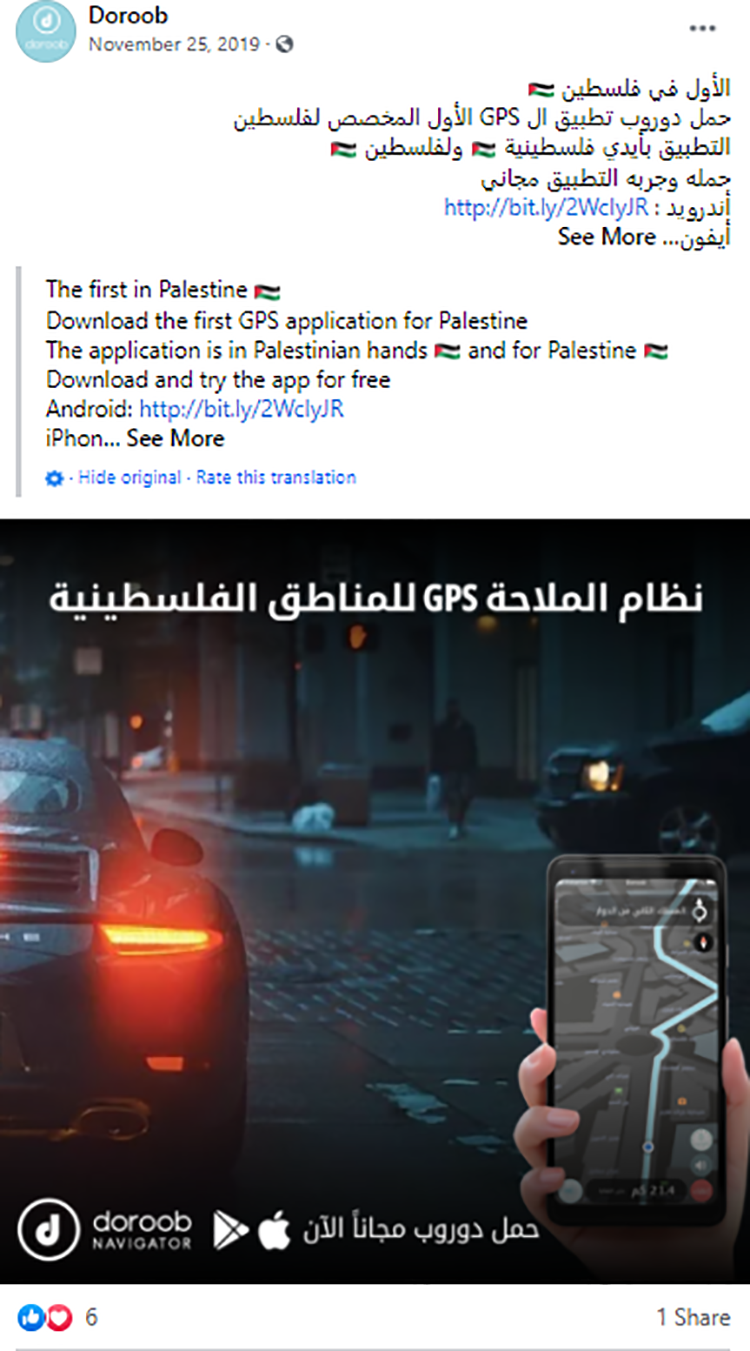
The release of Doroob Navigator was associated with national building and collective pride (Doroob, 2019).
Pointing to the complex manner in which digital and material spaces were inseparably intertwined in everyday practices—with driving itself as a site of “embodied, everyday politics” (Bishara, 2016)—was the story behind the idea for the local navigation app. Mohammad Abdulhaleem, the Doroob CEO, explained that a need became clear “after a drive with Google Maps between the West Bank and cities of Bethlehem and Ramallah left him lost in a remote valley” (Ayyub, 2019). Such comments were aligned with Mennecke and West (2001), who argued that “the practical use of GIS in many developing countries is frequently hampered by the lack of accurate and detailed spatial and demographic data, political considerations, and management issues” (p. 45). With many of these factors converging in the case of the oPt, the CEO’s story was a common tale of developing countries in which local routes and roads are inaccurate or missing. According to the CEO, the Palestinian people had long tried to make their voices heard: I was hard-pressed to make this application due to the fact that we have been asking Google to update its maps and understand the Palestinian situation [but with no results]. Therefore, I made the application because there was no reason to go and ask the biggest international companies to come and understand our situation and make something that relates to us while we ourselves can solve our own problems and the problems relating to the specific situation of Palestine. (Alaraby TV, 2019)
More centrally undergirding these rhetorical moves was a key cultural frame sumud (Johansson & Vinthagen, 2015; Nijmeh, 2018; Roy, 2016; Taraki, 2008). The concept is grounded in the notion that to remain on the land is a political statement and refusal to be passively or forcibly removed. The term surfaced repeatedly in accounts of the Palestinian innovation system as a signifier of Palestinian resilience or steadfastness. I wish to emphasize that such tropes and narratives are not imagined as static or essentializing but instead as dynamic and contested in an ongoing negotiation.
At the center of this negotiation was a complex road regime: a series of permits, tunnels, bridges, bypasses, restricted roads, roadblocks, closures, and checkpoints. Contributing to this geographic fragmentation of the landscape was a segregated, or “apartheid,” road system as part of the Israeli government’s policy of separation. This two-tiered structure permits only citizens of Israel to travel on certain routes in the West Bank and prohibits or restricts Palestinian travel. This road regime includes modern, state-of-the-art roads that enable Israelis to drive back and forth between the settlements and Israel without needing to pass or encounter Palestinian towns or villages. These designated roads are referred to by the IDF as “sterile” (B’tselem, 2004), indexing a set of settler-colonial ideologies linked to displacement and erasure. The alternative routes designated for Palestinians were more circuitous paths frequently on secondary roads in disrepair.
With the highly fragmented and disorienting nature of the road system, people risked straying into a prohibited road or area that could result in arrest, delays, detention, and confiscated automobiles. The consequences of accidentally winding up in a settlement was of particular concern for Palestinians, who are readily identified by their color-coded license plates or IDs and could be mistakenly classified as a threat. But as a user of Doroob Navigator explained, these distinctions remained unmarked by Google Maps: On many occasions, when one of my friends is with me [in the car], for example, ones who cannot enter [Israeli areas], who have Palestinian IDs, for example, they cannot enter settlements or Israeli areas. Other applications do not give you these [alternative] roads. (Alaraby TV, 2019)
In contrast, the Doroob Navigator tried to locate routes that were safe, open, and more direct for Palestinian users by using crowdsourcing to enable drivers to warn one another of threats or hazards. This process was part of a digital and cultural shift as the Palestinians had only recently been granted 3G and access to online navigation tools. The traditional method used by cab drivers was to share information when stationed at main junctions. The application’s development was complicated by the fact that Palestinians have a less developed postal system of addresses assigned to each business or residency. As Doroob’s CEO put it, “Here, if you want to order food, you have to describe the address, being the opposite from some place, following the traditional way” (Radio Ramallah, 2019). In a challenge to these cultural norms, the Doroob application was disrupting traditional models and, in doing so, transforming the wider social system.
As such, this case foregrounds how social, cultural, political, and geographic contexts were deeply bound up in the invention of and narratives surrounding the GIS system. Broadly, this navigation app might be understood as an effort to disrupt the matrix of control (Halper, 2000) curtailing Palestinian mobility. These disruptions were further layered onto the transformations of digital networks prompted by the introduction of 3G technology. Situated at these intersections were actors on the ground and in motion who were networking, or knotworking, as they dynamically wove and were woven into wider social and material spaces. This process mediated the construction of the digital infrastructure, high-tech ecosystem, and a state in the making.
Case 2: The City of Rawabi as a State in the Making
In the next case, I continue to look at the high-tech industry’s efforts to put Palestine on the map. Core to this focus is attention to not only how actors move social and geographic spaces but also the changing nature of space itself (Ong, 1999). Turning to the deeply contested nature of this activity, I attend to the “throwntogetherness” (Massey, 2005) of the deeply interlocking forces, positions, ideologies, uncertainties, tensions, complexities, and ambiguities that make up “the simultaneity of stories-so-far.”
In particular, to look at the messy convergence of these strands of activity, I focus on the first planned city in oPt of Rawabi (Arabic for hills). Located in the rolling hills of the West Bank, 17 kilometers from Ramallah, the city represents a new urban lifestyle and shifting Palestinian identity. Signifying these transformations is a modern architectural aesthetic: contemporary terraced apartments, an open amphitheater for 12,000 people, an upscale commercial center with designer brands (signifying a wider rebranding of Palestinian identity), and a high-tech innovation hub. The hub is intended to be a new center of Palestinian high-tech as part of a deliberate effort to develop a cluster or ecosystem of innovation (Lieber, 2018). Part of the smart cities model, the area is designed to attract a new creative class of talent to develop a start-up ecosystem and grow the industry. Indeed as the most ambitious and expensive private-development project in Palestinian history, the initiative itself might be considered a start-up venture.
The private venture was founded by real estate investor and entrepreneur Bashar Masri in partnership with the government of Qatar. In addition to financial backing from the Qatari government, the seed money to kickstart Rawabi came from Masri’s own real estate development company established in 1994 on the heels of the Oslo Accords. Originally from the historical economic hub of the region, Nablus, Masri grew up during the early years of the occupation. As a youth, he was imprisoned by Israeli authorities for the first time at age 14 after trying to flee from soldiers at a demonstration. Talking about a shift in perspective on resistance to the occupation, Masri reflects on how he went from throwing stones to building with them: As you grow you understand things better, and you learn things as you grow. Resisting the occupation always takes many forms. And some of them move parallel, some drop, some increase, and so on over time. I believe, since again we signed a peace agreement, all our resistance of the occupation should be peaceful means. Even when the occupation quells us, and shoots at us, and tear gases, etcetera. I believe at this stage, although I participated in rock throwing, we should not respond in that way. We should respond in passive ways. We need to become more sophisticated by using smart ways of battling the occupation. Building a city is in a way fighting the occupation. It is a more progressive way, it is the professional way, it is the human way, it is the modern way. (VPRO, 2102)
This notion of resilience and steadfastness is grounded for the local inhabitants in the deeply inscribed belief that the mere act of living on the land is a form of political resistance: against being dislocated, erased, and rendered invisible. Indeed the Rawabi project has achieved wide visibility through extensive coverage in the international media. The project is a counternarrative that is being woven into the fabric of the global imaginary. The high-profile entrepreneur noted that “we need to showcase to the whole world that we are about construction. We are not the stereotyped destruction. We are construction. We are builders. We deserve a state” (Masri quoted in Wang, 2016). Similar to that of Doroob Navigator, the Rawabi case was an effort to put Palestine on the social and geographic map in a challenge to settler-colonial logics.
The project bumped up against a number of infrastructural restrictions. Emplaced in Israel’s wider policy of containment, the construction process required getting permission from Israel at almost every stage (e.g., to build the city in a specific site, to construct a water pipeline, to build an access road). While the city is located within Palestinian controlled Area A, to reach Rawabi, people must pass through regions of the West Bank in area C, which is under full Israeli control. Such restrictions meant that the narrow access road was built only after 4 years of protracted struggle and bureaucratic wrangling (Wang, 2016). Further, the road could be shut down at any point by the Israeli authorities, with the added risk dampening demand from prospective homeowners and businesses (Lieber, 2018). Similar to the tensions and restrictions on mobility manifested in the road regime in the previous case, the precarity of the situation in Rawabi posed a financial threat and existential roadblock to the entire development project.
Central to this reimagined space is the vision of the 21st-century start-up economy. Circumventing the regime of mobility imposed by the occupation, the IT sector could bypass restrictions imposed on other sectors of the society where imports and exports of physical goods must first pass through Israeli ports of entry. Digital products were not subject to the same restrictions as physical products, having the potential to more freely travel beyond the area’s tightly controlled borders. With the possibility of “bypassing physical check points, metal detectors, roadblocks, and soldiers,” tech start-up investments in the IT sector hence offered more promise of developing “semi-economic independence and self-sufficiency” (Bjørn & Bourlus-Rødje, 2018, p. 9).
The executive director of the Rawabi foundation (Nassar, 2020) articulated how the city is positioning itself as a center of innovation in the Palestinian-controlled area and ultimately in the Middle East and North African region. Its mission in building a knowledge economy is to create an integrated economic cluster for fast-growing tech through a shared infrastructure, investment capital, training, and “expanded access to local and international ICT [information communication and technology] markets” (Rawabi, 2020). To support technology start-ups, this ecosystem includes a state of the art coworking space, high-speed fiber optic network, incubator, capital and financing, mentorship, lectures, competitions, hackathons, workshops, and high profile events such as Forbes Under 30. And a training institute with accredited programs sponsored by multinationals was being developed. In this fashion, the planned city was bound up in the creation of new networks, or knotworks, of activity as it forged connections to a global marketplace.
One of these connections was to ASAL Technologies (in which Masri is an investor), a leading outsourcing company specializing in hardware and software design in the Palestinian high-tech sector. Relocating to Rawabi, ASAL engaged in outsourcing for Israeli companies, including outsourcing 125 employees to the Israeli company Mellanox. Recently acquired by NVidia after a $6.8 billion takeover, Mellanox shared profits with its Palestinian engineers, who each earned roughly $40,000 dollars from the takeover (Ayyub & Cohen, 2019). In contrast to the oppositional stance that typically pervades Israeli–Palestinian relations, this high-tech relationship points to an alternative model of collaboration between the two populations. For Israelis, this model leverages Palestinian companies to solve the Israeli high-tech industry’s shortage of engineers. These Israeli firms profit from acquiring engineering talent at one-third of the salary of a local hire. Alternatively, for Palestinians, outsourcing is a way to reduce the high unemployment rate of college graduates and to develop experience and know-how (i.e., learn from Israel’s multibillion dollar start-up ecosystem).
The benefits of this interdependency are articulated in ASAL’s marketing materials. The ASAL Technologies (2020) webpage (see Figure 2) displays a picture of Rawabi City along with the English text “Rawabi Tech Hub is where companies come to shine.” Below this text is a tagline in Hebrew: “[The dream for all of us is here, come realize it with us.]” The code switching (or meshing) to Hebrew further signals how the company is aligning with the Israeli high-tech industry through a shared vision for both technology and peace. The uptake of English indexes a cosmopolitan, global identity that entails a shared vision of Israelis and Palestinians working closely together in pursuit of the middle class, Western dream. Underneath is a map of Israel and the oPt (see Figure 3) that indicates the distance from Tel Aviv, the center of Israel’s high-tech ecosystem, to Rawabi. The colorful text alongside the map—“Tel Aviv→Rawabi, same timezone, 60 Kilometers, 1 h away by Waze”—highlights the short distance in space and time between the two neighbors, making the travel appear effortless. A thinly dashed line marking the pathway across the 1948 territorial border offers little indication of any friction: e.g. military checkpoints, separation fences, restricted roads, or Israeli law that forbids its citizens to travel into Area A of the oPt, where Rawabi is located.
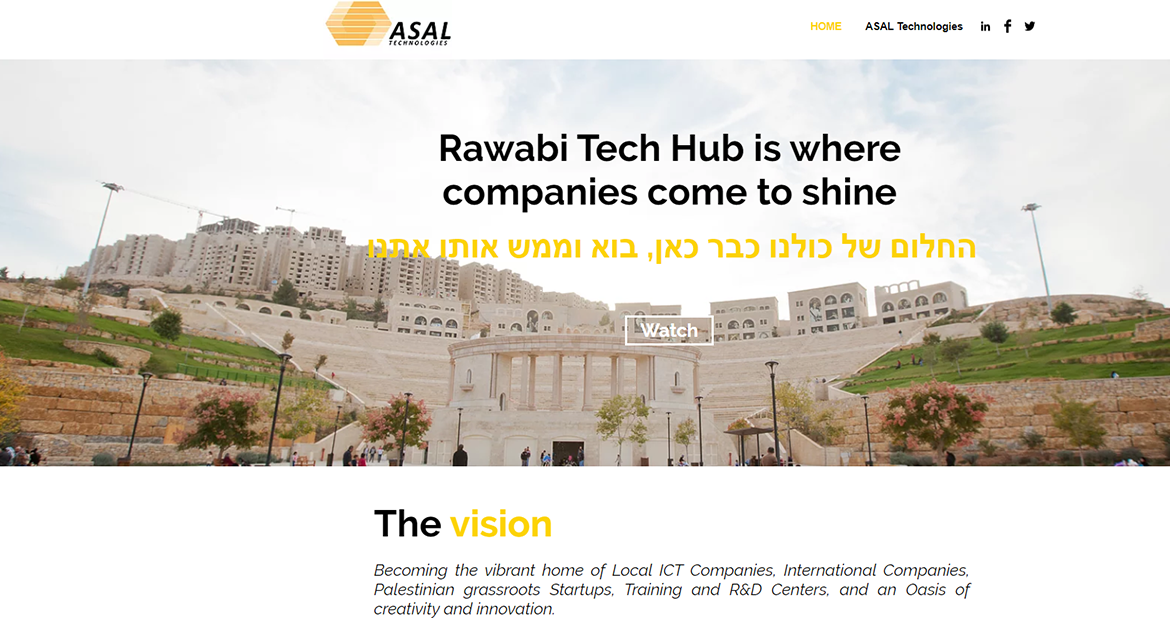
Rawabi Tech Hub as marketed to the Israeli start-up ecosystem on the ASAL (2020) webpage.
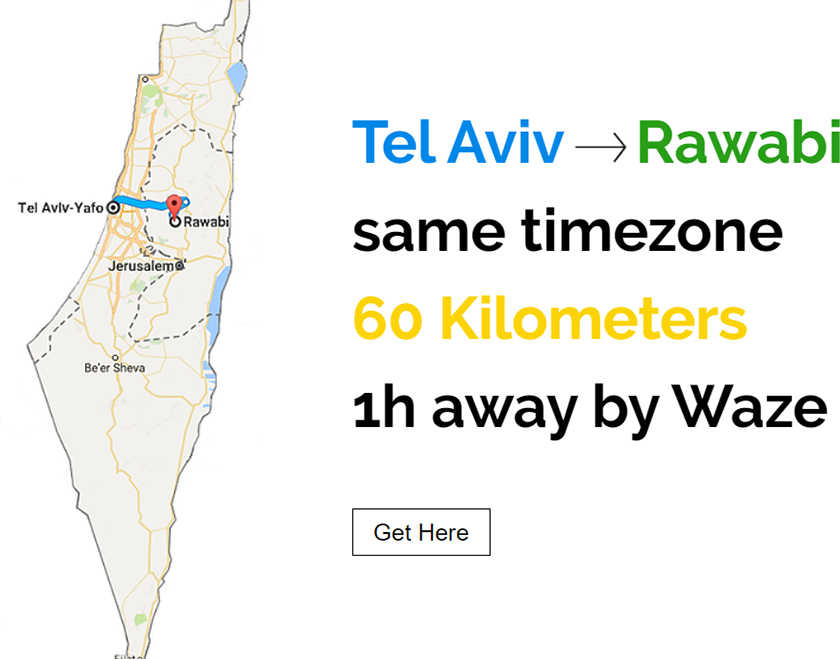
A Waze Navigation map on the ASAL (2020) webpage promoting the short travel time from Tel Aviv to Rawabi.
Central to this high-tech narrative is the reference to the Israeli navigation app Waze (similarly mentioned in the marketing video on the Droob Navigator). Purchased by Google for a sum of $1 billion and run by the Israeli founders, the navigation app has a default setting that would automatically select routes to avoid oPt areas A and B, warn users when entering those areas, and require users to disable it in order for the navigation system to operate. Prohibited from entering Palestinian controlled areas by Israeli law, users are warned to “avoid dangerous driving areas and the A, B territories, prohibited by law for entry by Israelis” (Stuart, 2016). Similar to the default in Google Maps, this application was designed from an Israeli perspective that marginalized the Palestinian towns and villages. But these issues remained invisible in ASAL’s marketing materials.
While these materials imagine Rawabi as a refuge from the realities of the occupation or a “way to ensure normalcy in times of conflict and strife” (Taraki, 2008, p. 12), groups such as the Boycott, Divestment, Sanctions (BDS) movement argued that it is a bubble for only a privileged social class willing to trade independence and self-determination for a bourgeois and capitalist lifestyle (Abunimah, 2012). As with other urbanizing areas such as Ramallah, the construction of this housing enclave for “a new globalized urban middle-class ethos and lifestyle” (Taraki, 2008, p. 13) elicited “bitterness and anger among ordinary people as a city prospering at the expense of the marginalized zones in a new spatial regime” (p. 12). In this fashion, Masri’s critics accused him of whitewashing the effects of colonization and of normalizing economic relations.
The BDS depicted the project as complicit in perpetuating the occupation and fostering Palestinian dependence on Israel. One oft-cited data point is that Masri has relied heavily on Israeli materials (e.g., 85% of the cement) and know-how (architectural plans from the Israeli settlement Modi’in) to build the city (Ross, 2019). This widespread reliance on Israeli resources is suggestive of the mechanisms through which the logic of settler colonialism is built into the environment. In response, Masri has argued that the occupation forces all Palestinians to buy from Israel, deal with Israeli companies, and use their materials. In this fashion, Masri, like other businessmen, is enmeshed in a system of structural dependency that forced him to rely on the colonial power.
At the center of these tensions are issues related to globalization, neoliberal reforms, and a new middle-class sensibility. As Taraki (2008) argued, Palestinian national identity is historically grounded in a culture of resistance informed by peasant values. This cultural trope has traditionally downplayed social disparities while publicly stigmatizing those flaunting wealth or privilege. This position is further manifested in reluctance to build or invest in homes, a tenet frequently shared by Palestinians who still reside in refugee camps. Their presupposition is that to build a permanent residence would be to abrogate the right of return and claim to homes from which they have been exiled. As Weizman (2007) suggested, “building a new house in the camp is sometimes seen as a betrayal of the national cause” (p. 228). This position stands in contrast to an alternative stance espoused by an emergent middle class who pursue personal fulfillment and a Western lifestyle as a means of “resilience and resistance at the same time” (Taraki, 2008, p. 17). This redefinition of resilience entails demonstrating that even in the face of occupation, the Palestinians will build their homes, economy, and fulfilling, productive lives. In this fashion, the cultural frame of resilience, or sumud, is taken up in multiple and conflicting ways. It is within these complex shifts that the development of the start-up ecosystem is complexly entangled.
In sum, the construction of Rawabi is bound up in the simultaneity of stories so far (Massey, 2005), linking multiple and competing threads of activity to the production of social spaces and relations. These plural geographies and messy circulations (Leander et al., 2010) shape and are shaped by “interlocking, intersecting, and interrelated” (Walton et al., p. 124) systems of power. These “knotty” strands of activity serve to uncover the mobilities, identities, and literacies mediating the emergent high-tech ecosystem.
Case 3: Navigating Transnational Social Fields at Exalt
Critically, while pockets of activity are distributed across East Jerusalem, Gaza, and the West Bank, the centerpoint of entrepreneurship and innovation is concentrated in the city of Ramallah. As the de facto capital of the West Bank, the city itself has grown alongside the industry for a confluence of factors: the city’s historical Christian roots (though it now has a Muslim majority) that made it initially more open to Western actors, the transfer of an urban middle class from the Israeli coastal towns of Jaffa and Haifa after the 1948 war, the Palestinian Authority’s selection of the city as its home, and an influx of donors and nongovernmental organizations that have helped fund the industry. The result has been an urban migration of young people and professionals from all over the West Bank. Travel restrictions and the cantonization of cities and villages due to the occupation have further resulted in the concentration of this upwardly mobile class. As Taraki (2008) explained, the highly restricted nature of travel within the territories has created discrete enclaves and paradoxically focused the gaze of this enclave city away from the Palestinian interior and toward the Arab world and beyond…. Indeed, this urban island at times appears better connected to the metropoles of the region—Amman, Cairo, Beirut, and…Dubai—than with other similarly enclaved Palestinian towns. (p. 7)
Critically, the transnational class at the forefront of these shifts frequently attended school abroad, developed proficiency in English, and gained professional experience at North American high-tech firms where they forged social networks. Many of these entrepreneurs and business moguls returned from the diaspora on a wave of optimism after the Oslo Accords in order to help build the economy and state. These actors brought with them social and political capital—including linguistic capital due to their mastery of English—that they would leverage to seed the industry. In this fashion, these actors might be understood as transnational entrepreneurs (Drori et al., 2009), drawing on resources across home and host cultures. Drawing on this analytic lens, I examine the ways that the construction of the ecosystem is bound up in a transnational social field shaping and shaped by everyday practices.
To do so, I turn to the case of Ramallah-based entrepreneur Tareq Maayah and his company, Exalt, one of the leading outsourcing companies. Born in Jerusalem, Maayah attended a well-respected Quaker school in Ramallah, traveled to the United States to receive his bachelor’s and master’s degree in electrical engineering, and found employment on the West Coast at an integrated chip design firm. Taking his experience, he decided to return home on the heels of the Oslo Accords “in the hope of establishing a Palestinian state at that time” (T. Maayah, personal communication, January 14, 2020). Caught up in the heady optimism of the moment, he explained that “there was a euphoria in terms of what the future would hold for us and I wanted to be part of the state in creation.” Although he did not have immediate career or business objectives at the time, his entrepreneurial disposition coupled with his professional and educational background led him to found a company. This initiated a 4-year joint venture as a Siemen’s research and development center. But in 2001, the second Intifada broke out and the high-tech bubble burst, with his company contracting from 50 to eight employees. As these rapid changes indicate, the high-tech scene was subject to the unpredictable, shifting political context.
In 2005 Maayah’s company gradually began to regroup. During this rebuilding effort, he bumped up against concerns about contracting with a Palestinian firm due to fears of instability and stories about the political situation: Because everybody had concerns. You know this is Palestine: why should I come to Palestine? Why should I work with you? What if something happens, how will you be able to service me? And all of that.
Maayah’s ambitions to expand his company were grounded in a “feeling of higher duty” to create as many high-value jobs as possible in order to build the economy and state. This firmly rooted conviction echoes those of entrepreneurs in the previous cases, with the building of the industry and Palestinian state deeply entangled. The oPt produces approximately 3,000 university-educated engineers, hardware and software developers, and technically skilled workers for the IT industry annually; however, the labor market can only employ a fraction of them (Rubin, 2018), resulting in a 34% unemployment rate for information communication technology graduates. Thus, engineers, computer scientists, and other skilled workers are frequently forced to turn abroad for employment opportunities, depleting talent in the oPt.
To tap into talent across the West Bank, Exalt opened satellite offices in Nablus and Bethlehem to be near major universities and, as Maayah put it, to be “as close as possible to where the talent is.” While Bethlehem is merely 30 kilometers away from the main office in Ramallah, the road system and checkpoints imposed by the occupation make commutes prohibitive, with unpredictable travel time ranging from 35 minutes to two hours. Echoing the entrepreneurs in the previous cases in which the occupation presented a roadblock to upward professional mobility, Maayah explained, “There is no predictability. So even if you would accept a checkpoint, at least you would want to know just how long it takes to plan your time, and even this is not possible.” This unpredictability disrupted the rhythms of everyday life. Drawing on “rhythmanalysis” (Lefebvre, 2013), Peteet (2017) argued that time is an artifact of power. In this respect, the delays at the checkpoints served as a public display of “state domination over the minutiae of everyday life” (p. 139). Through this state-sanctioned apparatus, Palestinians then were subjected to a temporal order that disrupted strategic planning and the ability to organize routine business activities. As a workaround, Maayah said, “mostly everything is done online, and actually this is the beauty of being in tech that this is actually more the norm than the exception. It is convenient, it works.” While employees tried to meet in person one or more times per week, the company avoided daily face-to-face gatherings to prevent workers from getting “drained down or…tired because of the transportation.”
When asked to compare the growth of the Palestinian high-tech sector to the Israeli one, Maayah asserted that Israel had key infrastructural elements in place, such as multinational firms. As an example, he suggested that Motorola established a presence in 1964 as a factor that helped shape the semiconductor industry. Such companies were foundational in transferring technological know-how to establish the groundwork for the country’s high-tech ecosystem. In contrast, the oPt lacks multinational companies in place to assist with providing access to cutting-edge technologies, knowledge transfer, and professional networks. In accounting for these differences, Maayah notably referenced the resilience of the Palestinians, who learn to work around constraints and limited access to resources.
With his company having resilience and a reputation for reliable, professional work, Maayah has formed solid working relationships with the Israeli start-up industry. Based on his successful track record, reputation, and age, he has gained VIP status as one of just a few 100 Palestinians granted a yearly permit to travel back and forth across the Green Line and fly out of Israel’s Ben Gurion International Airport. As a result, Maayah is more socially and geographically mobile than are most other Palestinians in the West Bank, whose identity card curtails travel and work. As a general rule, his engineers’ “security profile” (i.e., male, in his 20s or 30s, unmarried, no children) is prohibitive for moving across the Green Line to visit Israeli clients. Palestinians fitting into that profile typically need to receive approval for permits, a process that can be unpredictable and time-consuming.
Despite Maayah’s close working relationships with Israeli businesses, he is acutely aware of the power asymmetries. His outlook has been influenced by his time abroad, where he developed a bifocal perspective (Vertovec, 2010)—that is, he learned to see the world through the lens of both home and host cultures. Frequently adopting a comparative approach, Maayah often equates the Palestinians with marginalized populations in the United States, including African-Americans who are profiled by police: If you are a Palestinian at a checkpoint and you make a wrong move by accident, by mistake you move your hands in the wrong way or you wave your hands or something, then there is a big chance that you will get shot and this is in many ways similar to what we see, you know, with the African-American population in the United States.
Despite the sense that Israel is engaged in a settler-colonial project, Maayah does not view his professional relationships with Israelis as normalizing the occupation: You know Palestinians by hook or crook are forced to work with Israel…. Palestinians have always been working with Israelis in terms of using or buying Israeli goods and products. And [what] we are doing is in essence reversing the balance just a little bit to the benefit of the Palestinians…. We are the slaves in the plantation and no one can point a finger at us for doing whatever we do for our sustenance and our future viability, so we are good with everything we do; we are happy. And the important thing is that the services we are providing—we are providing to Israel, we are providing to the United States. You know some companies have clients in the Arab world, we have clients also in Europe. So we are trying to be global and sell our services all across the globe.
Although skeptical, Maayah hopes that reaching across the Green Line might one day result in a more peaceful coexistence: The good thing is all of us who are trying to reach out to each other across the Green Line or across the political boundaries, you know, do everything that we do in the hope that this all will one day, you know, be eliminated. Now are we optimistic? I am probably not, but we always remain hopeful that we are able to do something and change things, and, you know, it takes time and it takes a lot of struggle. And the only thing we pray for is that it will be as least painful to any of the sides, to both sides, as possible until…both sides realize that there has to be a just and long solution that is based on respect and human rights for both sides, or for everybody, I should say.
Conclusion
Collectively, this study suggests the need for a critical approach to rapidly globalizing entrepreneurial ecosystems. As part of the social justice turn in the field, it calls attention to the complex manner in which power, privilege, and positioning (Walton et al., 2019) mediate everyday entrepreneurial practices, identities, trajectories, and spaces. Unpacking these issues in the context of the emergent high-tech ecosystem in the oPt, the study foregrounds how “power geometries” (Massey, 1993) mediate social and geographic mobilities: who or what moves, when they move, how they move, and to what effect. These unequal encounters across difference (Tsing, 2005) are localized in particular historical moments and social spaces. Central to this spatial approach is the need to move beyond container models that adopt the institution as the unit of analysis toward a broader orientation focused on how institutional, national, regional, and global “flows” are deeply woven, or knotted, into everyday interactions, identities, and trajectories. It is through this dynamic and deeply contested process that actors weave and are woven into wider regimes of practice. Attending closely to these intersections, this study situates entrepreneurship and innovation in the “broader web of conditions, relations, and power dynamics of which technical communication is a part” (Scott et al., 2006, p. 11).
Tracing these messy circulations and plural geographies (Leander et al., 2010) sheds light on how nationality, ethnicity, and class mediate “invention, practice, delivery, engagement” (Jones et al., 2016, p. 215). It foregrounds how these contested processes privilege certain users over others and raises key questions about who is being accommodated, represented, and considered in technological innovations, as in the case of the GIS maps. More broadly, it calls attention to the complex manner in which “local knowledge systems, historical backgrounds, economic conditions, and other social and political and political factors” (p. 216) mediate the construction of identities, mobilities, and innovation systems in-the-making. The multilevel analysis (national, regional, organizational, individual) foregrounds how the construction of difference unfolds not only across cultures but also within them, as signaled by the class distinctions that drive “geographies of difference” (Harvey, 1996) in Palestinian society. It is within this deeply contested process that global innovation systems are being constructed, maintained, performed, extended, and transformed (Spinuzzi, 2008).
One limitation of this study is the need for more fine-grained analysis of intersections between the wider rhetorics of the Palestinian ecosystem and the local language and literacy practices on the ground. The study offers glimpses into the complex ways actors move across languages (Arabic, English, Hebrew) in reading, writing, speaking, and everyday design practices. Necessary for negotiating the constraints imposed by the infrastructure of the occupation is a web of legal documents, workplace genres, and other texts and textual practices in digital and nondigital spaces. Future directions for research would suggest more closely looking into how these processes mediate identities, geographies, and mobilities. Critical to understanding these issues is a focus on entrepreneurial actors as networkers, or knotworkers, continually tying and untying a range of texts, tools, and objects distributed across near and distant spaces. It is to these complex dynamics that we must turn in the study of transnational entrepreneurial ecosystems and 21st century globalization.
Footnotes
Appendix
Acknowledgment
I would like to thank Lee Tesdell for his assistance and feedback on this manuscript.
Declaration of Conflicting Interests
The author declared no potential conflicts of interest with respect to the research, authorship, and/or publication of this article.
Funding
The author received no financial support for the research, authorship, and/or publication of this article.