







Abstract
This article presents an ethnographic study on the user experience (UX) design of the photo- and video-editing apps of millennial and Generation Z participants from different cultural groups. The case study calls attention to the implications of rhetorical misrepresentations of reality that photo- and video-editing apps afford and encourages future large-scale studies on the negative psychological and behavioral impacts such apps can have on users’ psychology, behaviors, and well-being. The authors use frameworks in virtue ethics to argue that despite slight variations, photo and video app UX has ethical implications that can negatively impact young adult users. For example, the study suggests that the photo and video app features tend to subvert the traditional Chinese virtues of modesty, honesty, and the middle way and that hyperbolic and playful designs can cause addictive behaviors.
While researchers have studied the ideological and cultural underpinnings and implications of technologies for years (e.g., Baum, 1977; Doheny-Farina, 1992; Feenberg, 1991, 1991; Fleron, 1977; Gu, 2009; Leiss, 1977; Lynch & Kinsella, 2013; Veak, 2006), the rhetorical misrepresentations of reality by photo and video apps and the social impact of such misrepresentations have received relatively little critical attention from the field of technical and professional communication (TPC). Applying virtue ethics frameworks, we report our findings from a pilot study examining the social, and particularly the ethical, dimensions of the design of these popular photo- and video-editing apps: MeituPic, Pitu, BeautyCam, Camera360, B612, TikTok, Faceu, Snow, BeautyPlus, Facetune and Facetune 2, Instagram, Picsart, and Snapchat.
Photo and video apps developed over the last decade or so are skewing realistic representations of reality. Excluding Instagram, all the apps mentioned have built-in functions that allow users to tweak images or video clips to their desired effect, resulting, in most cases, in enhanced or improved body and facial features. The psychological benefits of enhanced looks have driven the subscription to these apps to millions and even hundreds of millions of users.
While such beautification functions might seem harmless, the cultural underpinnings and social impact of these photo and video apps are significant and can reshape and subvert the traditional virtue ethics of our particular cultures. To this end of understanding this reshaping and subverting force, we designed this study, selecting a group of users representing different cultures in order to gain their perspectives on these Photo- and video-editing apps and the degree to which the app designs are subverting our beauty and ethical standards. Although the study is limited by the sample size of the participant group, the interviews afford relatively in-depth data that shed light on the ethical dimensions of app design.
The Landscape of Contemporary Photo- and Video-Editing Apps
There are hundreds of photo- and video-editing apps available on the market today. Many of these apps, however, are professional tools that require a complex set of skills to navigate through their diverse array of editing functions. In addition, many of these apps are not available on the mobile platform. For this study, we selected the particular photo- and video-editing apps that are available on smartphones, are easy to learn and use, and have a large user base (i.e., 1 million or more users).
Most of these apps emerged on the mobile scene in the last decade or so (see Table 1). They have a similar set of editing tools, with some variations, that allow users to manipulate body features, such as hair and eye colors, skin tone, face shape, and body shape. They also allow users to tweak the background of the photo, from enhancing color shade to adding special elements to even replacing the entire background. As a result, users can edit an image of their face to resemble, for example, that of a movie star or alter an image of their physique to resemble that of a bodybuilder. Although the U.S. apps have fewer photoshopping features than their Asian counterparts have, users have reported new features on U.S. apps, such as Snapchat, that are much like those of their Asian counterparts (e.g., eye-enlarging and animal filters).
Photo- and Video-Editing App Data.
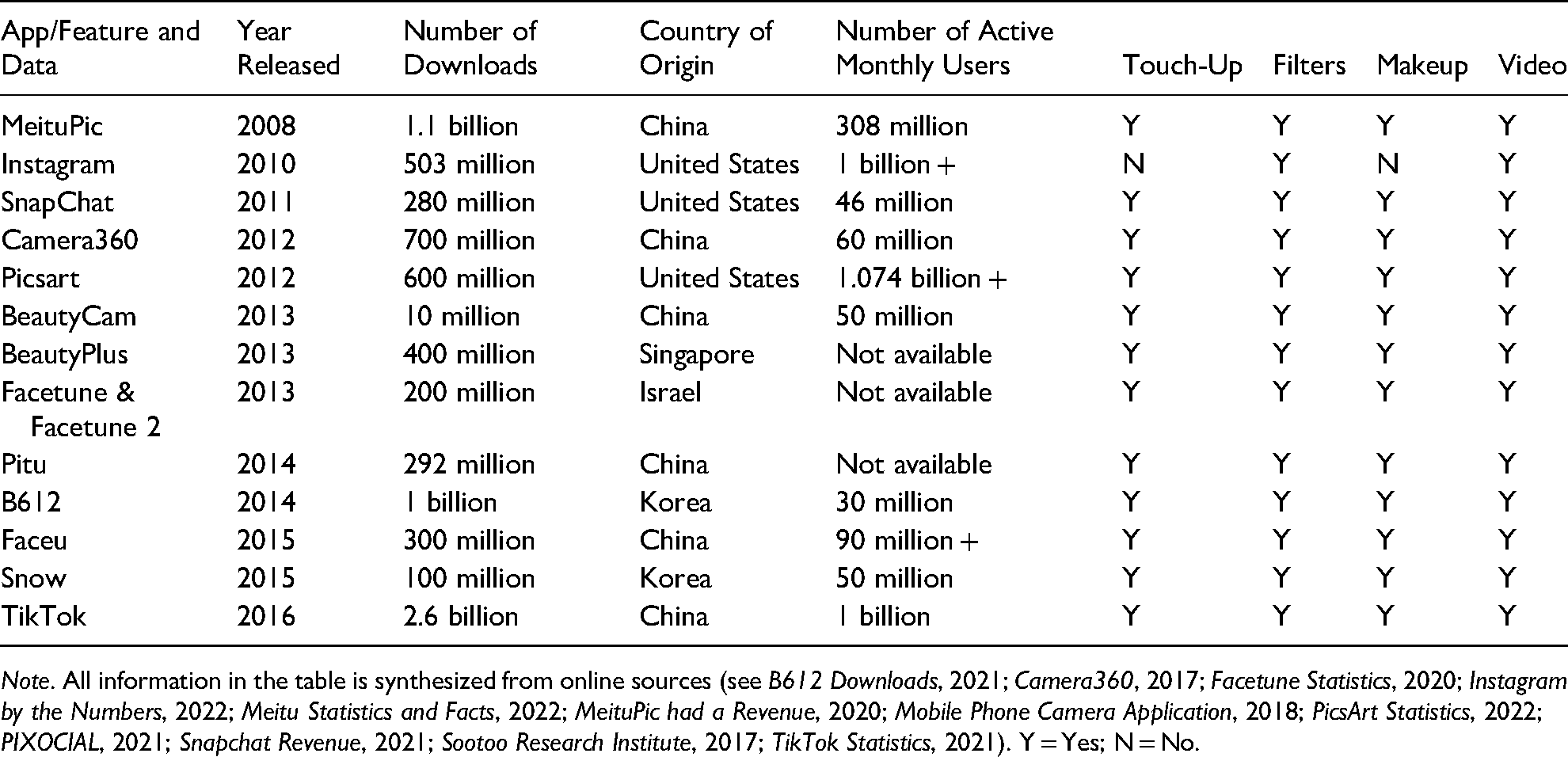
Note. All information in the table is synthesized from online sources (see B612 Downloads, 2021; Camera360, 2017; Facetune Statistics, 2020; Instagram by the Numbers, 2022; Meitu Statistics and Facts, 2022; MeituPic had a Revenue, 2020; Mobile Phone Camera Application, 2018; PicsArt Statistics, 2022; PIXOCIAL, 2021; Snapchat Revenue, 2021; Sootoo Research Institute, 2017; TikTok Statistics, 2021). Y = Yes; N = No.
Because of these appealing editing features and their ease of use, these popular apps have found their way to the smartphones of billions of users. The number of active monthly users for these apps ranges from 30 million (B612) to over 1 billion (TikTok and Instagram). For all the apps combined (not including the three apps for which these data are not available), the number of active monthly users is nearly 3.7 billion. Even if half of these users subscribe to more than one app, the number of monthly users is astoundingly significant and represents a great cultural force. The numbers of downloads and monthly users and the comprehensive features that these apps share are powerful evidence that such apps will exert far-reaching influence on their global users.
Ethical Implications and Ramifications
Photos and videos had long been believed to be skeuomorphic representations of reality, that is, until the emergence of the photo and video apps in recent years that threaten to subvert our conventional assumption of the realism of photos and videos. While developments in photography technology since the 1920s have made it easier to render candid representations of reality, the integrity of such representations in photos and videos is no longer intact with the advent of photoshopping applications and cameras with built-in filters or photoshopping features.
These advanced editing technologies have resulted in the overuse of editing functions to such an extent that a large number of users will not post any of their photos without editing them so that they appear, to themselves at least, to look substantively better. Unfortunately, this practice is leading to distorted beauty standards and skewed perspectives of what constitutes “a beautiful” or even “acceptable” appearance. Users seem to be constantly aware that any photos they post will be subject to scrutiny by the unrealistic beauty standards. Such misleading perceptions of beauty can lead to extreme and even tragic consequences. For example, at the beginning stage of this study, we were saddened by the news that an 18-year-old woman committed suicide after being anonymously cyberbullied because of her body shape (Teen Who Was Relentlessly Bullied, 2016). Thus, the use of social media and new media has been put into question: Recent studies have shown that the fitspiration and social comparison in general on Instagram can lead to self-objectification and mental health issues, especially for teens and young women (Fardouly et al., 2017; Teen Mental Health Deep Dive, 2021; Wells et al., 2021): Over 60% of teens think they are not attractive, around 90% of them want to hurt themselves, and, even more concerning, 90% want to kill themselves (89% of the U.S. participants and 90% of the U.K. participants; Teen Mental Health Deep Dive, 2021). In addition, 53% of teens have mental health issues due to their body images, and one in three teen girls blame Instagram for making their body image issues worse (Hard Life Moments, 2019). Considering the range of social media and new media available for our teens and young adult populations, we cannot help but question the beauty standards promoted and supported by these apps.
Unfortunately, no culture is immune to such skewed beauty perspectives because taking selfies and editing them are becoming increasingly popular activities in all cultures. To Yeung (2015), general partner of 500 Mobile Collective Microfund, there is no ethnic or racial discrepancy in loving to take selfies: “Chinese love taking selfies as much as we do in the US. I especially love its ‘make me taller’ feature [that is] perfect for me!” (n.p.) As photo posting on social media becomes ubiquitous across cultures, the skewed perceptions of beauty are infiltrating our traditional ethical perspectives. Therefore, as researchers, teachers, and designers, we are obligated to consider the implications of communication design and its social impact on the ethical choices we make. These implications warrant an examination of how the cultural and rhetorical factors have affected our ethical choices and how such choices in turn are reshaping our perceptions and behaviors.
In 2009, French politicians proposed a law requiring ads to make explicit statements on photoshopped models; Britain's liberal democrats also expressed their intention to ban photoshopping entirely in ads that target minors, indicating a critical stance toward “thinspiration” photo editing that would harm young girls (Stewart, 2009). Stewart argued that a warning in such images is equivalent to that of “smoking kills” and is far from enough due to the huge, negative impact of these photoshopped ads on women and minors. Then, in 2015, the French government passed a law that requires companies to state explicitly if models’ or entertainers’ pictures have been photoshopped or edited (Lubitz, 2015). While we applaud France for making such a significant ethical move, we lament that other countries have not also done so. This study brings to light users’ insights that might counteract the current state of laissez-faire on the issue of photo- and video-editing apps.
Building a Virtue Ethics Framework for App Design
Because our examination of the design, rationality, and impact of photo- and video-editing apps involves a whole array of social, ideological, and cultural factors and thus defies any single existing framework, we review the current literature on the following topics in a logical progression to try to arrive at an integrated framework that would ground our study in solid theoretical underpinnings:
Aristotelian, Confucian, and African virtue ethics in order to identify key differences that might underlie different cultural perspectives virtue ethics specifically applicable to photo and video editing ethical and ideological implications of the design of photo- and video-editing apps virtues violated in the design of photo- and video-editing apps virtues invoked in the design of photo- and video-editing apps race, gender, class, and cultural factors involved in the design and use of these apps
To understand why such apps have flourished and influenced young adult and teenage users’ beauty standards as well as their social and psychological behaviors, we looked at traditional Aristotelian ethics, which is making ostensible inroads into Sinosphere cultures; Confucian ethics, which still dominates Sinosphere cultures; and African ethics, which resembles the characteristics of both Confucian and Aristotelian ethics. We will briefly compare these three traditional ethics on the topics surrounding what constitutes a “good” person (particularly the importance of honesty and modesty) and whether human beings should be judged by their physical appearance. We designed this approach in order to identify and isolate a set of commonly accepted elements from the Confucian, Aristotelian, and African virtue ethics frameworks and use them to gauge our participants’ perceptions of how far the apps’ designs are deviating from and subverting our ethical standards.
Aristotelian Virtue Ethics
In Western virtue ethics, largely influenced by Aristotelian ethics, virtue refers to the character traits, such as honesty, modesty, kindness, patience, and self-control, that guide individuals to good and moral actions. Virtue ethics, according to Karimova et al. (2020), can be defined “as a doctrine of morally right virtues and their practices, and this doctrine is interdependent on influences of historically embedded traditions within specific cultures” (p. 256). Western virtue ethics largely originated in Aristotle's ethical framework, which “starts with a reflection on human life as a whole instead of on some moral acts and focuses on character and virtue instead of on principles and rules” (Yu, 2007, p. i). Concerning ethical behavior, Aristotle made a distinction between “actions in accordance of virtue” and “actions in possession of virtue,” with the former denoting actions in conformity with a virtue because the context dictates such a need even though the agent of action does not yet possess the virtue and the latter denoting actions resulting from the cultivation and possession of the virtue (Karimova et al., pp. 256–258).
Virtues are necessary in order for individuals within a community to achieve happiness and a good life, which, according to Aristotle, entails the attainment of both external and internal goods. External goods include such things as wealth, power, honor, health, beauty, and physical strength whereas internal goods are the goods of the soul and involve three faculties: two nonrational faculties—a nutritive, plant-like faculty (governing growth) and an appetitive faculty (governing desires)—and a rational faculty (governing reason). Aristotelian virtue ethics dictates that the nonrational faculties obey the rational faculty when consuming goods for the sake of happiness, or eudaemonism (Karimova et al., p. 259).
Confucian Virtue Ethics
To avoid overgeneralizing, we limit our discussion here to Confucius's ethical framework that mostly influenced East Asia and parts of South Asia or the Sinosphere in general. But other parts of Asia might have absorbed such ethics because of the power and geographical dynamics in Asia. Confucian virtue ethics has been interpreted in different ways concerning what and how many virtues it comprises. The ultimate representation of virtues is moral action. The Analects, one of the classics that influenced Sinosphere cultures most profoundly, dedicates a great amount of its content to the discussion of virtues and their corresponding actions. Ding (2007) found through a corpus analysis that Confucian rhetoric is virtue centered and focuses much more on exemplary conduct (xing) than on speeches (yan; p. 155). Indeed, conduct, or human beings’ actions, are so valued in Chinese ethics that there are many four-character idioms in the Chinese culture, such as “yan xing he yi” (actions should be consistent with words) and “zhi xing he yi” (actions should follow your conscience). The cardinal concept in Confucian ethics is the cultivation of the “gentleman-sage,”—a person who is ren (i.e., has the dispositions of gravity, reticence, modesty, tolerance, trustworthiness, diligence, generosity, and self-restraint)—who would observe the rites (p. 149).
Karimova et al. (2020) discussed three central aspects of Confucian virtues: ren, yi, and li (commonly translated as benevolence, righteousness, and propriety, respectively), each of which entails one or more virtues (p. 262). Sison et al. (2020) discussed five elements in Confucian virtue ethics that define what is moral (de): benevolence (ren), righteousness (yi), propriety (li), wisdom (zhi), and trustworthiness (xin; pp. 245–246). Dragga (1999) discussed six key virtues of Confucian ethics: goodness (ren), righteousness (yi), wisdom (zhi), faithfulness (xin), reverence (jing), and courage (yong; pp. 367–373). Rather than focusing on some selective key virtues of Confucian ethics, we thought it would better illuminate our discussion here to define the major virtues that are involved in photo and video editing. According to Confucian thought (Baidu Baike), Confucian ethics essentially consists of nine key virtues: ren (benevolence), yi (righteousness), li (propriety), zhi (wisdom), xin (trustworthiness), shu (kind heartedness), zhong (loyalty), xiao (filial piety), and ti (respect for elders; “Rujiasixiang,” 2022). Among these nine virtues, ren, yi, li, and xin are the virtues that are most involved with photo and video editing.
Ren, the most important virtue in Confucian ethics, can be translated as benevolence, kindness, or compassion and is associated with the following characteristics: “courtesy (gong), breadth (kuan), good faith (xin), diligence (min) and clemency (hui)” (Sison et al., 2020, p. 245). Photo or video editing can be a courtesy because of the collectivism in Confucian culture. For example, editing your photo or video is similar to applying makeup or dressing nicely out of respect for others when going out. But users might not realize the moral implications of their photo and video modifications.
Yi, commonly interpreted as righteousness, entails having “a sense of appropriateness, of the difference between right and wrong; sound judgment that leads to correct action” (Sison et al., p. 245). It means “consistently doing the right thing, choosing morality over profit or success, trying only to be as good a man or woman as possible without regard for fortune or reward in this or any other possible life” (Dragga, 1999, p. 369). Yi seems to be missing in users who are addicted to or used to photo or video editing. That is, our study suggests that such users (including some of our participants) might knowingly choose the “wrong” reasons for editing their selfies (e.g., to “win hearts” or to show courtesy).
Li, often translated as propriety, originally meant following rituals but later evolved to mean observing the social code and obeying the hierarchical order in society. Li also implies complying with each person's designated role in the social hierarchy and thus legitimizing a social order of inequality and the ruler's privilege to govern. It is commonly associated with ethical traits such as being courteous, considerate, and good mannered. Li can be shown in photo and video editing as users following the social code by editing their photos or videos and thus showing their courtesy and performing a social responsibility to others.
Xin, trustworthiness and integrity, is the tacit rule of social interactions. Confucius regards xin as one of the four subjects of learning (the others being language, action, and loyalty) and one of the five social norms (the others being respect, tolerance, diligence, and kindness) that should be taught to all students. He preaches “being true to one's words” and “earning others’ trust with integrity” (Song, 2013). Xin is missing when users edit their photos or videos to such an exaggerated extent that others might consider such users dishonest or untrustworthy.
The ultimate aim of Confucian virtue ethics, then, is to cultivate a harmonious society, which is guided by Confucian virtue ethics. Harmony requires following rituals and cultural codes while considering stakeholders on multiple levels, which in the use of photo- or video-editing apps can be seen as intersectional oppression (Walton et al., 2019, pp. 28–29) in various ways due to the apps’ oppressive features such as skin tone whitening, chest enlargement, eye enlargement, and height enhancement. Unknowingly, users follow each other's photo- or video-editing practices or behaviors as a sort of cultural ritual, maintaining a seeming harmony among them.
African Virtue Ethics
One virtue ethics framework that is particularly relevant to our discussion here is African virtue ethics. A direct English translation of “character” might be equivalent to African notions of morality or ethics. Most African languages do not have equivalent terms for “ethics” or “morality,” using words such as maemo (South Sotho, spoken widely in Lesotho and southern Zimbabwe), hunhu (Shona, spoken by majority populations in Zimbabwe), tsika (“ethics” or “morality,” in Shona), agwa (Igbo spoken in Eastern Nigeria), and iwa (Yoruba language) that are similar to the word “character” or “moral” and phrases such as nonomo mele si o (Ewe language) and Onni suban (Akan language) to refer to a person's character or lack of moral character. Similarly, in the Akan language, different words such as pa or papa mean “good,” and bone means “bad”; an honest, compassionate, generous person is someone who has suban, or good character, whereas someone who does not have suban is a dishonest, wicked, or cruel person. There are African sentences that define a wicked, selfish, cruel, ungenerous, or unsympathetic person as not even human, such as Onnye onipa (“He is not a person,” in Akan) and Ki i se eniyan (“He or she is not a person,” in Yoruba; “African Ethics,” 2010). This denial of personhood emphasizes the basic moral standards and expectations of African ethics.
African virtue ethics is also closely related to African people's strong religious beliefs. Some scholars have even argued that African virtue ethics is a religious morality (Danquah, 1944, p. 3; Opoku, 1978, p. 152; Sarpong, 1972, p. 41), meaning what is considered as good or evil is all in the eyes of a spiritual being, or God. Nevertheless, in African ethics, brotherhood, the common good, and a person's duties are also central notions. Similar to Confucian virtue ethics, with its collective, “family” notion, African virtue ethics requires a person to see humanity as one species with shared values, feelings, hopes, and desires. The common good in African virtue ethics refers to communitarian peace, happiness or human flourishing, justice, dignity, respect, freedom, equality, and so on among all human beings (“African Ethics,” 2010).
Differences and Similarities Between Aristotelian, Confucian, and African Virtue Ethics
Before we discuss our participants’ experiences using the editing features of photo- and video-editing apps, we need to compare Aristotelian and Confucian virtue ethics in order to explore our users’ behaviors cross-culturally. Although Aristotelian and Confucian ethics share similarities in their approach to virtues, they differ significantly in their conceptions of the family and the individual. On the notion of the family, there are two main differences between Aristotelian and Confucian ethics: First, although the family is also considered a “natural community” since it arises from an innate tendency in humans, in Confucian society its purpose is not limited to the satisfaction of daily needs or survival, going well beyond the confines of the household. The Confucian family is not enclosed within the Aristotelian economy. Secondly, the Confucian family serves as model or paradigm for the structuring and order of the political community and other groups and organizations (Low & Ang, 2013). All collectives are understood and patterned after the family in order for human beings to feel at home, thrive and flourish within them. The Confucian family overlaps or takes over the Aristotelian polity and presents itself, in its extended version—as a model for all collectives-, as the locus of flourishing (Norden, 2013). (Sison et al., 2020, p. 246)
Therefore, collectiveness is seen everywhere in Confucian societies and cultures, including in both personal and professional communication.
On the notion of the individual, Vallor (2016) argued that the Confucius notion is more concerned with the public dimension of self, that is, the self in relation to one's social or family obligations (in contrast to the autonomous individual in Aristotelian ethics) and that familial and political obligations should be in a state of harmony with Dao, a timeless ethical standard for societies (p. 38). In Aristotelian ethics, the highest state a human wants to achieve is happiness with others, which requires the dispositions of courage, honesty, patience, friendliness, justice, moderation, and practical wisdom (p. 36). As Vallor has argued, there is no tension in Confucian ethics between a person's philosophical well-being and the person's active political pursuit because to Confucius, all human happiness lies in political and family life (p. 39). Vallor further argued that the effective habits of self-appraisal that are supposed by moral self-cultivation can be easily distorted by new media (pp. 173–175). Self-appraisal is also of vital importance in Confucian ethics, which requires human beings to cultivate their morality via examining and reflecting on what they have done and said each day, encouraging individuals to “examine oneself three times a day.”
In Aristotelian ethics, the concept of kalon is especially relevant to our discussion. Kalon encompasses a range of virtues or dispositions such as “good,” “beautiful,” “noble,” “fine,” “admirable,” and “honorable” (Donohue, p. 26). There are three dimensions of kalon: It is an object of choice for the virtuous agent; in action, it is grounded in the ordered soul (i.e., the soul that enjoys internal harmony between its components); and according to Aristotle, it is God's contemplative activity (p. 28). Therefore, kalon is significant for Aristotelian ethics because it motivates human beings to exercise the virtues and obtain happiness. Kalon, as Aristotle's concept of beauty, focuses on the moral soul that contemplates and manifests beauty in virtuous behaviors, leading individuals toward greater harmonization of their own soul, which requires individuals to deny their passions when they run in excess. The Aristotelian kalon overlaps with the Confucian virtue ethics in that they both require individuals to contemplate their moral behaviors and seek harmony. Nevertheless, when giving up their own passions or desires for the social harmony or morality of their souls and behaviors, their focuses may be different: The Aristotelian kalon focuses more on what is seen as good in the eyes of God, emphasizing that each individual's behaviors are put in front of God's scrutiny, whereas Confucianism, which is more of an earthly philosophy, focuses more on how social orders are maintained and kept in harmony, requiring individuals to pay attention to the various social hierarchies and/or different levels of familial codes (families, organizations, communities, and even the nation as a family). Therefore, the Aristotelian individual, while needing to obey God's laws, is more of a free agent whereas the Confucian individual bears more burdens and faces more oppressions in many ways.
African virtue ethics is similar to Aristotelian ethics in that both view human behaviors as being judged in the eyes of God, who considers what is good to be pleasant. But like traditional Confucian virtue ethics, African virtue ethics is social, not individualistic, and emphasizes an individual's duties instead of rights, requiring each individual to care more about others’ interests, through compassion, solidarity, reciprocity, cooperation, interdependence, and social well-being, than their own needs, passions, or happiness. This contrasts with the moral systems of Western societies (“African Ethics,” 2010).
Virtue Ethics Standards That Apply to Photo and Video Editing
So in what way can Confucian, Aristotelian, and African virtue ethics inform us about photo and video editing and the design of photo- and video-editing apps? Are there specific standards derived from these virtue ethics to guide our beauty standards and beautification behavior? Evidence from Confucian, Aristotelian, and African virtue ethics suggests that there are applicable standards for physical appearance. While Confucius might not have formulated specific standards regarding a person's physical appearance, another Confucian scholar, Xunzi (2014), discussed why human beings should not be judged by their physical appearances. He gave specific examples of great, virtuous men in history who did not necessarily look handsome and compares them with notorious figures to support his argument that individuals’ physical appearance should not be the standard to determine their goodness or greatness. Xunzi argued that a learned person should not physiognomize people because people's outer form is less important than their heart and chosen course: So even though one's outer form is bad, it will pose no impediment to becoming a gentleman if one's heart and chosen course are good. Even if one's outer form is good, it will pose no impediment to becoming a petty man if one's heart and chosen course are bad…. How could the height, size, or beauty of a person's outer form be worth judging? … Yi Yin's appearance was such that his face had no beard or eyebrows. Yu hobbled about, and Tang leaned on one side. Yao and Shun were cross-eyed. Will you, my followers, judge their thoughts and intentions and compare their culture and learning? Or will you only differentiate the tall and the short, distinguish the beautiful and the ugly, and so deceive and snub one another? (pp. 32: 11–16; 33: 38–39, 41–52)
Thus, Confucian ethics values people's morality and deeds much more than their physical appearance. Not only is caring about others’ physical appearances considered imprudent; it is also condemned as being superficial because an individual's culture, learning, and special contribution to society are considered to be what makes a good person or, to put it in Confucian terms, a “gentleman-sage.”
In Aristotelian virtue ethics, a person’s appearance is called an “external good,” and “the man who is very ugly in appearance or ill-born or solitary and childless is not very likely to be happy” (Aristotle, 350 B.C.E., I:8). Thus, the religious background of Aristotelian virtue ethics might give the impression that good appearances are heavenly bestowed, which is a grace. In contrast, Xunzi (2014) considered the physical appearance as a less important aspect of an individual. Xunzi explicitly argued that those noble and moral men might have ill physical appearances and taught his students to respect each individual regardless of their physical appearances and focus more on their virtuous deeds and contributions to society.
In African virtue ethics, there seems to be no discussions on physical appearances, owing to the overwhelming emphasis on a person's moral character and responsibilities to the entire humanity. Nevertheless, the fact that this topic is missing does not demonstrate the lack of social justice in this regard; rather, it implies the opposite. That is, the fact that physical beauty is not even a topic in the African virtue ethics implies that physical appearance is unimportant compared with the various moral characters that are expected in a decent human being.
Ethical and Ideological Implications of the Design of Photo- and Video-Editing Apps
Examined under the frameworks of Aristotelian, Confucian, and African virtue ethics, the new media era avails photo- and video-editing apps with the opportunity, whether deliberately or inadvertently, to foster individuals’ habits of dishonesty, deceitfulness, conceit, and narcissism and beliefs in extreme beauty standards that lead to their having emotional stress, low self-esteem, and even suicidal tendencies. And there is strong evidence to suggest such ideological implications of these apps are not entirely innocent or unavoidable. As Vallor (2016) has argued, “all manner of distortions are possible” in our new social media era, and no reliable self-appraisal is offered by these new media platforms (p. 174). We agree with Vallor that the “mean” or balance between the new media's positive, self-fulfilling function and their negative, self-delusioning function (pp. 174–175) is hard to find and that we have to resist media habits that can make it even more difficult for individuals to cultivate qualities such as humility and honesty.
In TPC, the relationship between technologies and virtues has been discussed in order to promote virtuous practices in public spheres. Colton and Holmes (2018) emphasized the exigence for us to intervene in the various forms of ethical programs (p. 143), arguing that communities, networks, and other relations, as well as how traditional virtues can be adjusted to contemporary technological shifts, must be considered when we judge ethical behaviors as moral or immoral (p. 128). But Vallor (2016) is concerned about the dispositions that are specific to our new living context saturated with technologies (p. 32).
In addition, technologies themselves are never neutral entities devoid of ideological dispositions, and neither is technical communication (Walton et al., 2019, p. 29), which is especially apparent in the technology-transfer process. Transferring technology from the laboratory to the marketplace is very much a process of consensus building and thus knowledge construction—about what the technology is, what it means, and how it is going to impact users’ lives. Gu (2009) argued that this process of knowledge construction is contextual and that the promotion of democratic rules for technological innovation is vital in rhetoricizing and operationalizing technologies (pp. 100–101). Thus, we, as subjects, must be aware of the cultural and social contexts, as well as the inherent systematic issues, when inventing and using new technologies. We also must pay attention to the nondemocratic, virtue-violating consequences that technologies can create and impose on us.
Virtues Violated in the Design of Photo- and Video-Editing Apps
For instance, photo- and video-editing apps such as MeituPic have violated the Confucian, Aristotelian, and African virtue ethics of honesty, trustworthiness, modesty, and the middle way, or the containment of desires or passions that would harm the moral soul. Confucian virtue ethics requires trustworthiness, which entails honesty and sincerity. In this regard, individuals who use these photo- and video-editing apps to alter their physical appearance are being dishonest, insincere, and therefore untrustworthy. Moreover, those individuals are being insincere and untrustworthy when they post or share their photoshopped photos or videos because they are commiting an immoral act of cheating their viewers. The altered photos and videos, then, break the natural, harmonious relationships between reality and human beings, human beings and human beings, and human beings and society in order to appeal to the standardized or market-economy kind of beauty norms.
Like Aristotelian ethics that encourages a person's continuous self-appraisal (Vallor, 2016, p. 174), Confucian ethics encourages us to daily examine three aspects of our behavior: whether we have been faithful to those with whom we do business, whether we have been faithful in our communication with our friends, and whether we have mastered and practiced the instructions of our teachers (Confucius, 2016, Book 1, Chap. IV). The users of such photo- and video-editing apps communicate untrue visual messages about their appearances. Although some users are perhaps just being playful, other users, especially younger adults and teenagers, might be or become addicted to such kind of behavior. Thus, as Vallor argued, because a balance between the two types of behaviors is so hard to find, we need to avoid using such technologies before we can find that balance.
Further, promoting a dishonest, untrustworthy culture, such apps can foster immoral desires that are harmful to a person's pursuit of truth, or the Confucian Dao. Most of these apps enable users to share their end products to social media accounts, and many of the social media apps also have built-in editing and filtering features. In the Analects, Yen Yuan asked Confucius (2016) about what constitutes perfect virtue. Confucius said, “To Subdue one's self and return to propriety, is perfect virtue” (Book 12, Chap. I). Therefore, traditional Confucian ethics emphasizes self-regulation—from making sure that we are modest to suppressing our physical and material desires in order to follow conventions and social norms—which leads to societal, collective, and even metaphysical moral standards as opposed to the individualism advocated by Western culture, which seems to promote self-realization over filial piety. Aristotelian ethics also advocates modesty, but its advocacy of self-realization to achieve utmost individual happiness can make individuals more likely to abandon their morals in the name of self-fulfillment than they would be by following collective, societal standards that Confucian ethics advocates.
African virtue ethics that highlights a person's moral characters, including honesty and commitment to others and the entire humanity, and obedience to a spiritual being, might represent a bigger rejection of people's use of excessive photo and video editing for selfish purposes. Thus, dishonesty is considered a vice in all cultures, Confucian, Aristotelian, or African, and using photo- and video-editing apps to alter one's appearance demonstrates loss of control of one's desires, which goes against Confucian, Aristotelian, and African virtue ethics alike.
Virtues Invoked in the Design of Photo- and Video-Editing Apps
The question of whether there are any virtues in distorting one's physical appearance in photos, unfortunately, defies a straightforward yes or no answer. While using photo- and video-editing apps constitutes clear violations of certain aspects of Confucian, Aristotelian, and African virtue ethics alike, simply dismissing it as entirely unethical would be oversimplifying what is a complex social phenomenon and ignoring the social context behind it. Our data show that a majority of users are either Asian, have traveled in Asia, or are familiar with Asian cultures. We believe the following factors are at play in the Sinosphere cultures that are more familiar to the majority of these apps’ users.
Individualism
Although not new to Sinosphere cultures, individualism, as well as a survivor's mentality, is largely the trademark quality of Western culture. As De Mente has pointed out, “grievous economic and political conditions encourage a survivor's mentality, and immorality is often justified as necessary or appropriate because society itself is immoral” (qtd. in Dragga, 1999, p. 367). This aspiration to stand out in physical appearance seems increasingly justifiable, then, in this ever more competitive world in which we live. To many users, beautifying oneself in a photo is not unethical or immoral because it does not infringe on the benefits of others; rather, it is an effort to flourish their own life.
Conformity
While individualism has found its way into Sinosphere cultures, conformity to social norms is still a dominant guiding principle. Conforming to socially constructed standards of physical appearance is another driving factor behind photo editing. Ads, commercials, TV programs, films, and the Internet seem saturated with actors and actresses who are promoted as epitomes of physical beauty. The bombardment of such beauty images on almost all media platforms implies a strong endorsement of what constitute socially accepted beauty standards. To avoid feeling left out and to conform to such socially accepted beauty standards, users of photo- and video-editing apps might consider their behavior to be an act of contributing to social harmony, which can also be seen in Western virtue ethics. But individualism is more dominant in Western cultures whereas conformity is more dominant in Sinosphere cultures.
The equation of technology to wisdom and knowledge
The ability to use technologies is often a sign of wisdom, the wisdom to acquire new knowledge and learn new technical skills. Knowledge structures in both European-American and Sinosphere cultures are fundamentally changing, especially in third-world countries, which have seen fast-pace changes due to the global flow of technology. In addition, the conventional perspective that associates age with knowledge is being reversed due to these new technologies, especially the internet and mobile phone technologies.
Courtesy to others
Courtesy is featured in both Confucian and Aristotelian virtue ethics but is more obvious in the Sinosphere, where presenting oneself to others in a better and more pleasing image might be considered an act of kindness and propriety. In Korea and Japan, women who do not wear makeup when going out are considered to be showing their “nudity” to the public. In fact, women have protested this cultural norm in Korea (Kuhn, 2019). To many Sinosphere users of photo- and video-editing apps, then, improving their physical appearance is a courtesy and should be considered harmless because it does not encroach on anybody's rights, interests, or benefits.
While there are still differing perspectives on this new social phenomenon of edited beautification, rather than simply condemn it, we need to try to understand the complex social, ideological, and ethical factors surrounding it and find ways to address the communication designs of apps that support such behavior in order to regulate the behavior of users who could be easily victimized. The question is, How do we do so?
Race, Gender, and Class in New Media
McLuhan (1994) claimed that, like metaphors, media have the power to translate experience into new forms (p. 57), meaning that technologies and the information they provide are translations and extensions of our human consciousness. Our identities, selfhood, sense of gender, and concepts of race, gender, and class are all shaped by radio, television, the internet, and other products of media culture (Kellner, 2015, p. 7). With the advent of new media and other sophisticated technologies, our daily behaviors are quietly altered through new technical features and norms in social media and beyond. Vallor (2016) suggested that evaluating the relationship between technology, ethics, and human behaviors in the digital era requires frameworks in order to understand how technology influences our ethical habits and how they are formed, what ethical dispositions we have formed with the development of technologies at hand, and discussions of whether the behaviors that new technologies support are virtues or vices—discussions that are inseparable from discussions of morality or ethics itself (cited in Colton & Holmes, 2018, p. 21).
Confucian ethics, due to its historical factors, excluded women, but its “gentleman” virtues can be applied to all genders (in Chinese history and contemporary culture and subcultures, eunuchs and all genders have the right to strive for the gentleman virtue). But recent Chinese popular culture shows a trend toward cosmetic surgeries in women, representing an increased tendency to try to achieve an ideal of standardized beauty. Phrases, images, and videos reflecting gender-based beauty standards (e.g., “A4 waist,” “big long legs,” “wanghong [internet celebrity] face”) flood social media. “A4 waist” refers to a waist as thin as the width of an A4 paper. The phrase “big long legs” refers to legs that are super long, preferably those that are much longer than the upper part of the body, a standard that has been used to judge whether both women and men have a beautiful body shape. “Wanghong face” refers to the kind of facial appearance that celebrity women on social media tend to share: wide double eyelids, high nose bridge, V-shape face, and full lips. Some of the popular public figures who meet such beauty standards include Angela Baby and Yan Liu—both notably artificial beauties. Although the Asian chase of pale skin continues, due to the vast, diverse population in China, nonmainstream beauty standards such as tanned skin tone and six packs that conform to western ideals have become popular on social media as well. Youth and young adults follow these beauty standards in posting pictures of their own bodies. The availability of photo- and video-editing apps, together with the pervasive display of such unrealistic beauty standards on social media, only intensified their desire to change their own physical appearance.
In European-American cultures, Eurocentric beauty standards still prevail on mass media, social media, and new media although there have been some exciting changes such as the Dove real beauty campaign (2014) and a range of brands that feature plus-size models in their advertising. Multiple studies and reports have shown that the use of social media and photo-editing apps strongly correlates with both lower self-esteem and the tendency to request cosmetic surgeries (Chen et al., 2019; Lake, 2018). And a study from City University London (2021) shows that 90% of young women use a filter or edit their photos before posting them.
African beauty standards vary greatly from culture to culture due to the various racial groups. Generally, Africans appreciate women with curvy features, meat on their bones, wide hips, and an attractive face whereas they appreciate men with a fit and athletic body or a muscled physique (Tutu, 2021). But there has been a recent trend of young African users migrating from YouTube and Instagram to the Chinese Tik Tok, which has all the filters and photo- and video-editing features (Williams, 2020).
Thus, there seems to be a global convergence of beauty standards powered by the various social and new media platforms. To understand this process of global convergence between the digital and the physical worlds and between eastern and western virtue ethics, we apply an ethnographic research method due to its ability to study people, their groups, and cultures and to examine how media influence specific audiences by shaping their values and behaviors (Kellner, 2015, p. 8). As we discussed, a virtue ethics framework in technical communication aims to intervene unjust, exclusive, and other unethical practices. In this case, we use such a framework in our study of how women, younger generations, people of color, and those who have unfavorable body conditions according to their social norms have been oppressed by the use of photo- and video-editing apps. In new media composition, human beings are producers and consumers at the same time—the “prosumer” (Anderson, 2003)—signifying new territories of virtual and real-life identities. According to the “prosumer” logos, the experience of photo and video app users is shaped not only by their identities as producers but also by their identities as consumers when they habitually evaluate and digest others’ and their own visual, audio, and multimodal compositions. This fast-paced consumption (editing, posting, and receiving) process makes it harder for them to cultivate their morality, which will in turn profoundly define and change their dispositions and ethical standards toward class, ethnicity, race, and gender relations and their behavioral patterns.
Ever since Photoshop was developed in 1987 and its distribution license was sold to Adobe Systems in 1988, the world has witnessed a flourishing trend in photo and video editing led by the advertising industry, a trend that has become more and more ubiquitous in and beyond the entertainment industries across borders. So in this study, we ask, How should we research and use such technologies now and in the future, and how do such technologies impact users and our world from a virtue ethics perspective?
Research Questions and Methods
Responding to the call of Colton and Holmes (2018) for scholars and practitioners of technical communication, usability, and technology design to influence the virtues and vices that technologies help to produce in us (p. 45), we examine in this study users’ engagement in photo- and video-editing apps and the various behaviors these technologies cultivate and support. Specifically, we use a virtue ethics framework to explore the relationship between users’ social self-esteem and overall well-being and the ethical implications of their UX. We initially examined UX as presented in the apps’ reviews and ratings section but found that the data could not fully represent different cultural groups and the inclusive UX of users who were using the apps but had not reviewed them. Then, after receiving the approval of the institutional review board at a southeastern university (IRB approval 17085), we interviewed and observed participants from different cultural groups about their UX from and their attitudes toward particular photo and video apps in Eastern and Western cultures, especially the Chinese and Korean apps because they have many more photoshopping or editing features. Our overriding research question was this: What are the cultural and rhetorical underpinnings of the design and use of such photo- and video-editing apps? To answer this question, our study explores these underlying questions:
What are the major, trendy features of these photo and video apps? What photo and video app features do users prefer? What are the beauty standards or cultural norms for what is considered beautiful in different cultural and ethnic groups (e.g., Chinese, Chinese American, Asian, American, African American, LGBTQ, and other culture communities)? What are the individual and personal beauty standards within different communities? How do people's perceptions of one another relate to the extent to which they edit their selfies and pictures in general? What are the ethical dimensions of such applications and the kinds of ethical or unethical behaviors that they support? What is the social impact of our online identities and rhetorical representations that are constructed by using these niche techniques and features of photo and video apps or even cameras that have built-in photoshopping features?
Selection of Photo- and Video-Editing Apps
We used the following criteria to select the photo- and video-editing apps for our study:
The apps had to be mobile apps. Since most users today take photos and videos on their smartphones, being able to edit these photos and videos right on their phones is what attracts users to these apps in the first place. The apps had to be easy to use. Today's users are not interested in apps that require a steep learning curve. Only the skilled few will take the time to learn a professional editing app that requires an advanced skill set. In addition, an overly complicated app would be difficult to use on a mobile platform and more appropriate for desktop and laptop computers. The apps had to have a large user base. We set the threshold for the user population at 1 million because we believe a small user base would render the app less representative and thus the results less valid.
Selection of Users
Althought we are both part of the Confucian culture, we have lived in the United States a substantial number of years so we have a good understanding of both cultures, including their normative beauty standards. We have UX with both Asian and U.S. photo and video apps.
Our initial IRB approval allowed us to recruit a maximum of 150 participants, which was our goal, and we believed that such a participant group size would generate enough data to allow us to apply both qualitative and quantitative measures to interpret the data. We chose to interview different cultural groups in a large southeastern state university campus, which is a diverse, urban environment where students, staff, and faculty are daily exposed to different cultures. Participants voluntarily signed informed consent, and all interviews were carried out in our offices in this university campus.
Despite our limited recruiting time, 12 generation Z and millennials with dynamic cultural, ethnic, racial, and national backgrounds participated in this study. This sample size certainly would be too small for our full-scale ethnographic study. But we designed this initial stage of our research project as a pilot study, so our in-depth interviews with these 12 participants generated enough data for us to garner meaningful preliminary findings that would serve as a good starting ground for our larger project.
Our participants included female, male, and LGBTQ users, some of whom have been using the apps for a long time and some of whom were first exposed to the apps at the time of the interviews. Their ethnic backgrounds include Chinese American, African American, Mexican American, white Caucasian, Chinese, and Vietnamese. Of our 12 interviewees, 6 were international students or scholars at the time of the interview (1 student from Vietnam, 4 students from mainland China, and 1 scholar from mainland China), and 6 were American citizens (1 Mexican American veteran and university staff member; 2 white Caucasian Americans, including 1 female doctoral student and 1 male veteran and college student; and 1 Chinese American and 2 African American college students).
Interview and Observation Procedures
During a span of no more than 45 minutes, participants answered questions about their ethnic and cultural backgrounds, their age, how they define their identities, the beauty standards and social norms in their cultures and communities, their personal beauty standards, whether they use photo and video apps, the frequency of their app use, the apps and features they prefer, differences and similarities between the features of Asian and U.S. apps, the kinds of pictures and videos they look at on their social media and how they evaluate them, their opinions of friends and other users who use photo apps that can edit their appearance, how these apps have changed their digital life versus their life offline, whether they think such features are entertaining and should be encouraged, what they think they should do about these photo and video apps, and their individual reflections on such apps after talking about their UX stories. We also observed the participants and allowed them 10 to 15 minutes to edit a selfie or photo on their phones. None of the participants allowed us to video record their sessions, so we audio recorded the interviews and took notes during our observations. Our interview protocol is included in the Appendix.
Findings and Discussions
We will first discuss, from a UX perspective, the design and features of one of the most popular photo and video apps, Meitu. Then we report and synthesize the individual responses from each participant. Finally, we analyze and elaborate on these responses and their implications.
Meitu, the Most Popular Chinese or Asian Photo and Video App
Touch-up features such as those that lighten skin tones, slim face and body shapes, lengthen legs, clean skin, enlarge eyes or double eyelids, automatically apply makeup, and so on are only generalized features of the photo and video apps that are popular with users. In addition, new live broadcasting apps, such as Tik Tok (both Chinese and English platforms), have emerged that have intelligent, built-in photoshopping features so that users do not have to spend time editing their physical appearances. Mclntyre (2016) named 16 of Asia's top photo apps to take on Instagram. Of these, five are Chinese apps that enable users to chat online and send each other virtual gifts (e.g., symbolic roses, airplanes, and other types of gifts that represent different cash values), facilitated by an online transaction system, so that popular users (e.g., social media influencers) can actually earn their living by broadcasting a variety of aspects in their life.
MeituPic—or Meitu, in short—is the most popular photo and video app shown on the Chinese public social network Weibo (the Chinese version of Twitter). With 308 million active monthly users, Meitu is arguably the “world's most popular photo editing app.” In its “brief introduction” section, “the official website of Meitu” claims to provide “the following services: teaching you photoshopping techniques; making you happy; ensuring your satisfaction…. We have good content each day; please follow our updates!” To the right of this commercial visual are two bubble banners that say “30% of your looks depend on hereditary genes, but 70% of them rely on photoshopping,” and “Meitu gives you whatever God owes you” (our translation; Meitu, Inc., n.d.). The logic behind this claim and the accompanying banners seems to be to encourage photoshopping techniques that enhance one's physical appearance and provide an affirmative, uplifting message that users will have ultimate satisfaction after they edit their pictures. The image of a fair lady on Meitu's home page causes us to assume that the target audience of this app is primarily female users.
Compared with their Western counterparts (e.g., SnapChat), Chinese photo and video apps that are popular in Asia and globally offer more sophisticated, detailed features to their users and therefore have a greater impact on users’ behaviors. We find it concerning though that such features might become a global phenomenon due to the many contemporary beauty standards that are shared globally. Although such apps can bring users instant gratification, they can incur ethical consequences that app designers and TPC educators need to consider.
UX Data From Participants
The age of the photograph, the age of the full gamut of self-critical attitudes…so the photograph really transcends the pictorial by capturing the inner gestures and postures of both body and mind, yielding the new worlds of endocrinology and psychopathology. (McLuhan, 1994, pp. 196–197, 202)
To capture “the inner gestures and postures of both body and mind” that McLuhan has described, we used UX research methods. Based on our research questions, we chose the following methods:
Concept testing—a researcher shares an approximation of a product or service that captures the key essence, the value proposition, of a new concept or product in order to determine if it meets the needs of the target audience. Interviews—a researcher meets with participants one-on-one to discuss in depth what the participant thinks about the topic in question. Desirability studies—participants are offered different visual design alternatives and asked to select from a closed list of attributes that correspond with each alternative. Attitudinal and behavioral—participants’ attitudes toward the photo and video apps and toward frequent users and their actual behaviors regarding these apps (e.g., what they post, whether and to what extent they edit their photos) Qualitative—analysis of participants’ attitudes and behaviors based on our observations of them using the photo apps Contextual—whether and how participants are using the photo apps (i.e., natural or near-natural use, scripted use, no use) Hybrid of these parameters
According to Rohrer (2014), UX research methods can be categorized into a three-dimensional framework: attitudinal or behavioral, qualitative or quantitative, and contextual (2014). In terms of these three dimensions, this study explores the following parameters:
Because in Confucian ethics, a gentleman (junzi) should always be able to enact the “middle way” in any given moral situation (Vallor, 2016, p.39) and because Aristotelian ethics supports humility, we tried to determine whether our participants and their friends still practice traditional ethical standards when they use these apps and communicate with their friends on social media. In addition, we wanted to see if the participants follow the ethical advice from Confucian scholar Xunzi (2014) and the Chinese idiom Ren bu ke mao xiang (One cannot be judged from one's appearance); that is, it is not ethical to judge people from their appearances.
Data Analysis
Because of the diversity of our participants, we decided to analyze the demographics, user groups and levels, users’ ethical awareness, and how users’ behaviors converge and diverge within the focus groups. When analyzing participants’ awareness of virtue ethics, we focused on major violations of three virtue ethics: middle way, inner beauty, and honesty.
User Demographics
Of the 12 participants in this pilot study, 5 are from mainland China, 1 is from Vietnam, and the other 6 are American citizens from 4 different ethnic groups—2 Caucasians, 1 Chinese American, 1 Mexican American, and 2 African Americans. A majority of the 12 participants either are of Asian ethnic or cultural background or have experience living in China, Singapore, or Vietnam. Only one participant identified as being gender fluid. We feel our study is diverse and serves well as a case study on the ethnographic UX of photo and video apps (see Table 2 for more demographic information about the participants).
Participant Demographics.
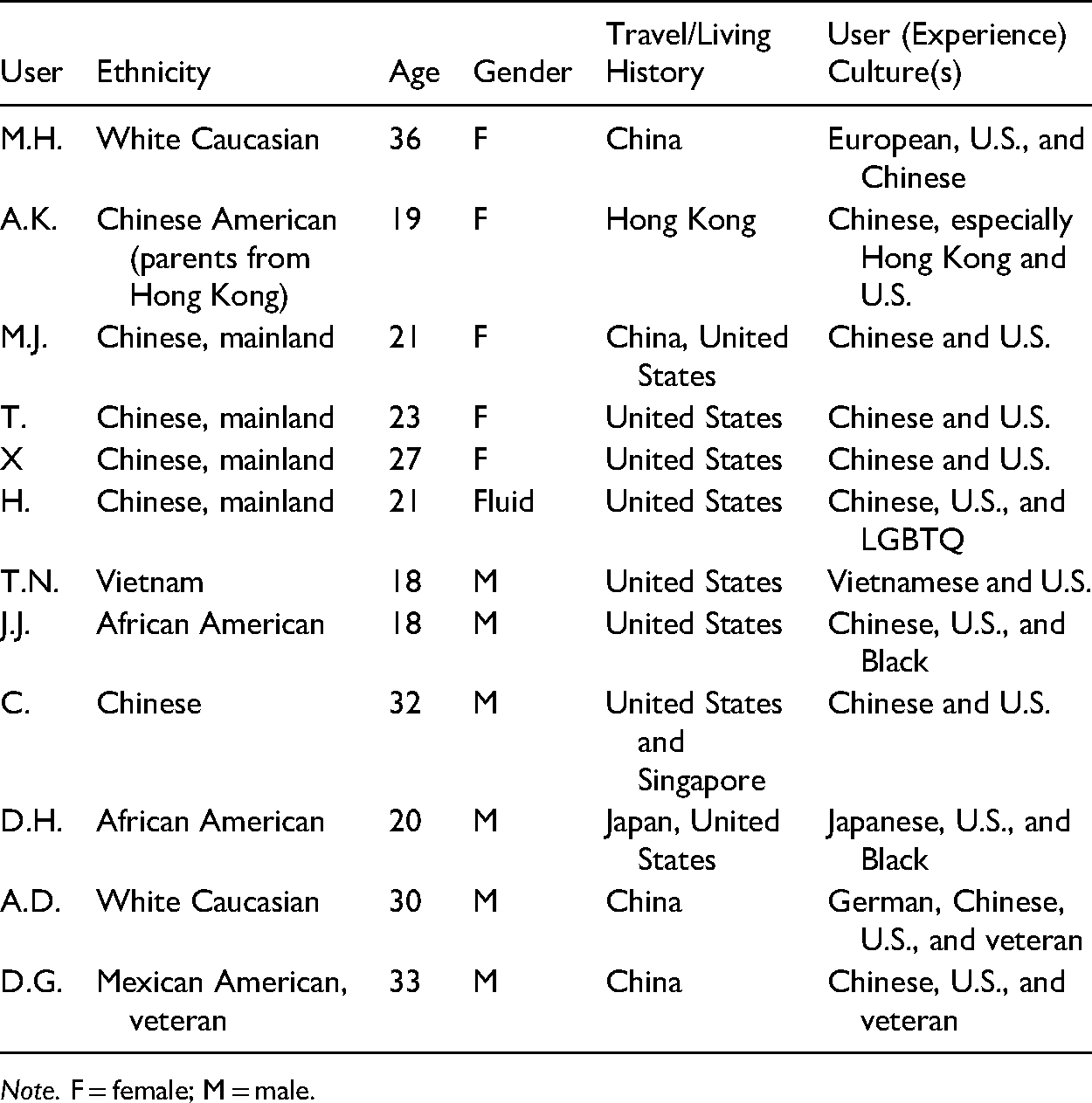
Note. F = female; M = male.
A majority of the participants (8 out of 12) use different apps frequently. Our participants represent diverse global cultures and subcultures. Our study is based on the assumption that users of these photo- and video-editing apps operate, largely subconsciously, under the influence of the virtue ethics frameworks that they have been exposed to during their cultural upbringing although we recognize that some, especially Western users, might operate out of utilitarian motives. In either case, we believe that the dominant virtue ethics of users’ particular culture might have prevailing influence in most use contexts, with contextual exigencies influencing their particular decisions in any given case of use.
User Groups and User Levels
We have categorized our participants into three groups: defenders, observers, and critics (see Table 3). Defenders are participants who love using such apps and defend the use of the apps. Observers are participants who are aware of the photo and video apps from watching others use the app or seeing others posts on social media but do not use the apps themselves. Critics are users who find the apps problematic or harmful.
Participants, Groups, Levels, and Apps Used.
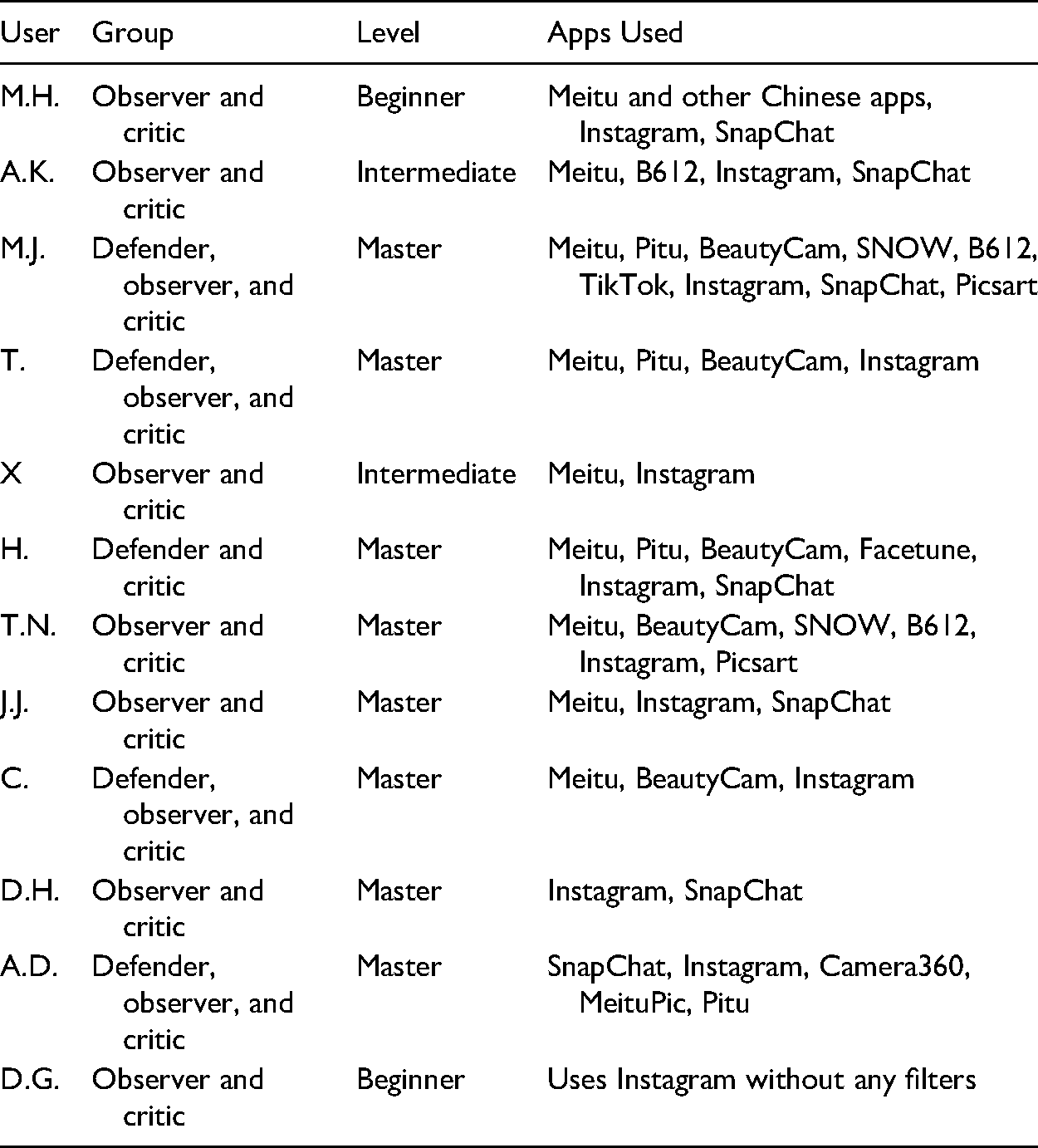
We also categorized our participants into three categories (beginner, intermediate, and master) according to their familiarity with or mastery of photo and video apps that they use. Beginners are those who have just started using such apps or rarely use the advanced features of them. Intermediate users have mastered some major features of the photo and video apps that they use. Master users have a great command of the apps’ features, can use multiple apps at the same time, and share edited photos frequently on social media.
Of the 12 participants, 8 are considered masters of the photo and video apps that they use. They either grew up using such apps or have developed their skills gradually. Only 2 participants are beginner users, and 2 are intermediate users. A majority of the master users belong to Generation Z, so we need to explore the implications for users from the millennial generation in a future study. Judging from our demographic data, however, we can say that both Generation Z and millennials are aware of the photo and video apps and might even have a good command of them but that millennials tend not to treat the apps as a daily necessity, especially some of the advanced features. Although this is only a pilot study with a small sample size, it does tell us that a majority of Generation Z and even younger generations of app users have mastery levels of these photo and video apps, which might be of interest to parents and educators alike, as well as the app designers or developers who might be parents themselves.
It looks contradictory that some users are both defenders and critics. For example, M.J. self-identified as a firm observer and defender at the initial stage of her photo- and video-editing journey. She enjoyed the compliments from her online community because she is great at touching up her photos, but she struggled with the criticism against her, including being blocked by friends due to her overediting behaviors. She then changed her path and decided not to be addicted to these apps after seeing the failure of a plastic surgery of one of her best friends. Her UX is a good example of the long learning curve that a young woman went through in using new technologies.
A key finding is that all of the participants identified themselves as critics. We think that some of them, at least some of the Asian participants who are masters of the apps, might have been pretending that they did not like certain app features but are actually addicted to the apps. Or perhaps they are only critical of certain features that they cannot completely control, such as the extent to which they can make their skins white or chins thinner.
We think that the Confucian virtue ethics of practicing the middle way, valuing inner beauty, and being an honest and trustworthy person provide an important framework for users and app designers alike for considering the harmful aspects of photo and video app features. But according to our interviews, users, especially Generation Z users, are not aware of the negative impacts of the features for making themselves seem more attractive because they think that everyone likes beautiful things, so trying to look more beautiful is only human nature. Only 6 participants considered extreme photo editing a dishonest behavior, and other participants either did not mention it or considered it to be nonapplicable. Despite being aware of the dishonesty in distorting their appearance by using these photo- and video-editing apps, most users found themselves using the features nonetheless and did not value inner beauty more than physical appearance. Table 4 lists participants’ opinions and awareness of their own practices and values.
Participants’ Opinions and Awareness of Their Own Practices and Values.
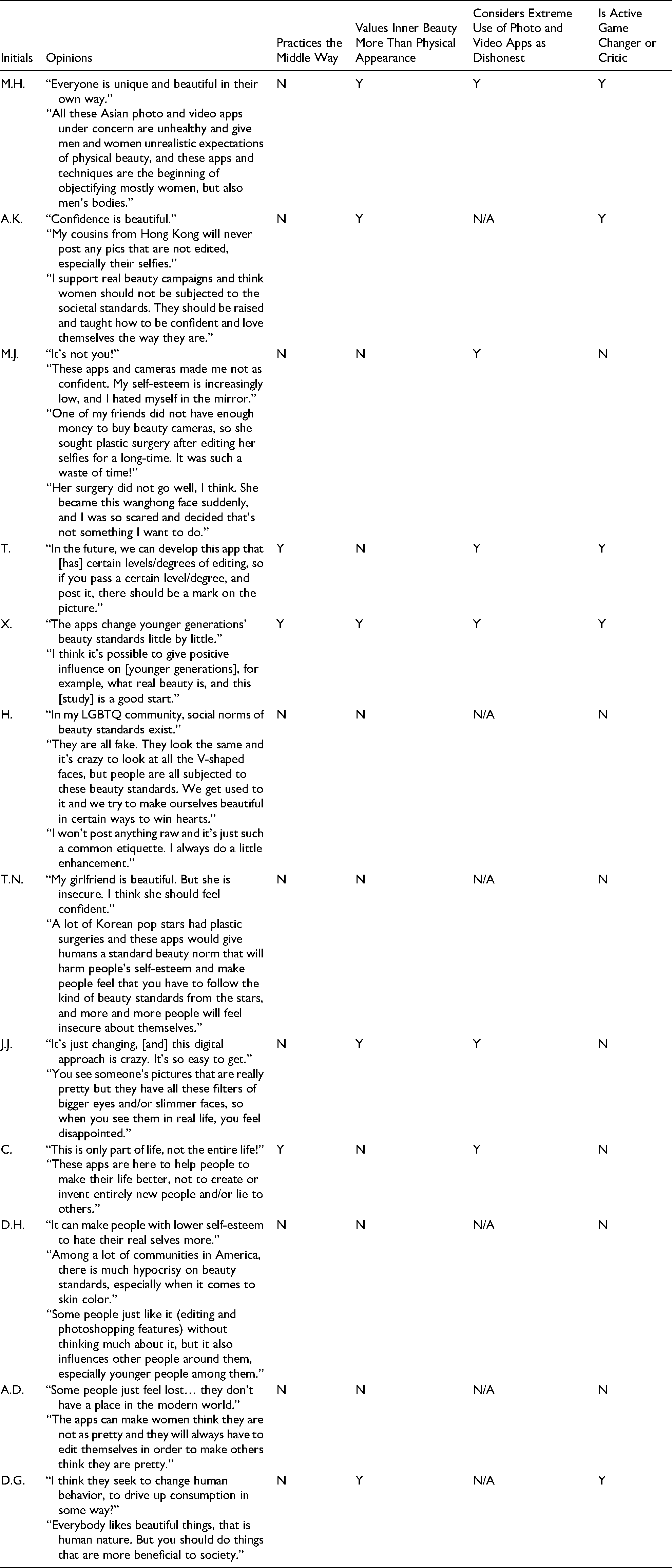
M.H., for example, is definitely against the use of such photo- and video-editing apps because she thinks individuals should recognize their own beauty and unique physical features. She criticizes the apps and thinks it is only an Asian phenomenon to objectify primarily female users. She also thinks that the photo- and video-editing technology gives users unrealistic expectations of their own and others’ physical appearances. Therefore, she does not need to think about the middle way when using such technology because she thinks that the use of these apps can be a dishonest portrait of the users and that the objectification of human beings is a denial of each individual's inner beauty. Our data also showed that she had not even used Instagram or any selfie apps because she abhors them. In fact, she used some of the apps for the very first time during our interview and observation session (see Table 3). Hence, she fights against such social and cultural trends by not using the technology herself, which shows how critical she is of these apps.
Compared to M.H., H. represents the other end of the spectrum. H. always edits photos and never posts anything raw—which to H. is just a common etiquette. H. also explained that some users edit their photos and videos in order “to win hearts,” which is a good example of individuals prioritizing their personal desires over their ethical expectations, such as honesty and modesty.
J.J., one of our African American participants, is more concerned with practical issues that might occur because of the use of photo- and video-editing apps—that users who have overedited their selfies, photos, or videos will not even be recognized by others or that seeing someone you have never seen in person will be disappointing after seeing that person's overedited, unrealistic photos on social media.
And D.G. thinks that such apps serve to “drive up consumption” and “change human behavior.” He also mentioned that it is natural to enjoy beauty but that everyone needs to do good things for society.
Of the 12 participants, 5 can be considered as active game changers or critics because of their critical stance toward the apps and their opinions or agendas that value the healthy development of society and people more than the apps’ superficial, self-aggrandizing functions. While a majority of the participants (8) say that they are aware of the negative influence that the apps’ editing features can have, 3 participants also mentioned the societal pressure on women regarding beauty standards, and 1 of these 3 participants directly mentioned how these photo and video apps can reinforce cultural norms that objectify female and male bodies. Most users feel that the degree to which users edit their photos is the crucial factor as to whether others will accept such behaviors and whether others will consider such behaviors dishonest. One user (an international student from Vietnam) mentioned the struggles his ex-girlfriend had editing her selfies and how her self-esteem became lower as she continuously compared herself to Korean pop stars. We need to further question whether these behaviors are based on the users’ sensitivity or insensitivity to virtue ethics or simply their utilitarian weighing of costs and benefits and whether users have weighed their costs and benefits and still decided to use (or not to use) the touch-up features to a desirable extent.
The degree to which photos and videos are edited is hard to measure, and only users themselves can decide the extent to which their retouching is appropriate. We agree with some of our participants that the editing process will be considered ethical only if the beautified selfies and photos are recognizable. Overedited selfies and photos do not represent truth or reality, and the audience will likely find the overediting behaviors as dishonest. Our participants’ reflections led us to think about the “mean” that Vallor (2016) mentioned and the middle way in Chinese virtue ethics. To what extent can users photoshop and still be considered moral? Most of our participants think it is hard for users to control the degree to which they use the apps, but the participants do not think addictive behaviors are healthy. For instance, H. thought that “as long as you don't change your features too much that others cannot even recognize you,” it is fine to play with apps like Meitu. And C. and A.D. think that the app can be entertaining and help build up some users’ self-esteem but that it is crucial for users to keep the photo editing to a natural degree so that they do not become addicted, depressed, and self-hating.
Detailed User Observation Form
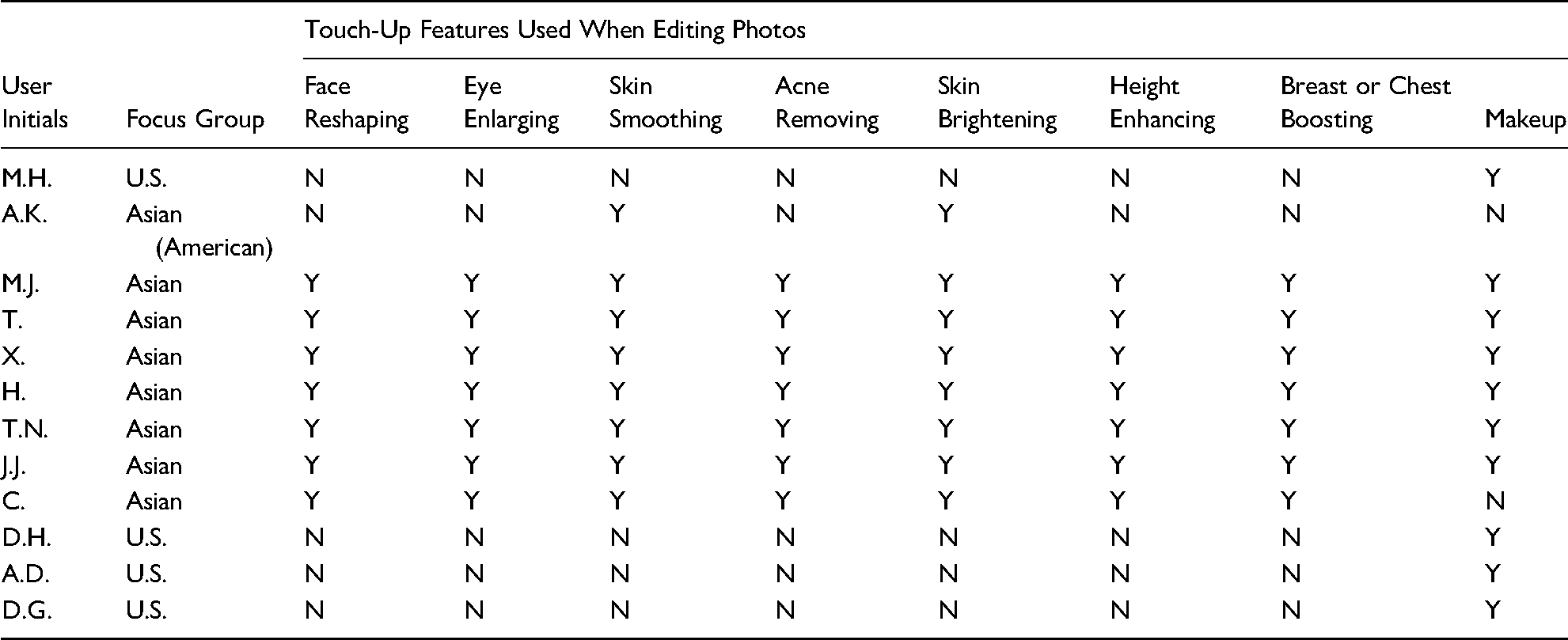
To gain an in-depth understanding of the cultural norms for beauty standards and the use behaviors of the photo and video apps that we were interested in—and most important, those that our participants mentioned—we observed participants’ user behaviors when editing selfies and other photos on their phones. None of our participants agreed to be video recorded, so we took notes in order to record their user behaviors. We invited the participants to show us how they use photo and video apps for at least 10 to 15 min right after their interview. Some of them took more time than others did for the observation. We asked them to explore MeituPic, Instagram, and other photo and editing apps of their choice. We chose MeituPic and Instagram because they are the most popular ones according to our users and according to data from research and other online sources (see Frommer, 2015), and our participants were invited to choose at least one app that they were interested in or most familiar with other than MeituPic and Instagram. The features that we were most interested in investigating are those that can change one's appearance substantially or completely. These features include those that slim the face, enlarge eyes, erase wrinkles, remove acnes, brighten skin tone, smooth skin texture, enhance height, boost breasts or chests (in females and males), and apply makeup.
Our observation data show that the majority of users in the Asian-culture focus group favor the touch-up features when editing photos whereas the U.S.-culture focus group tends to use nonediting features only but are intrigued by and show interest in using the editing or touch-up features of the Asian apps (see Table 2). But we noticed that there was no difference between groups in their use of the makeup features. Our only Asian American participant, however, showed completely different user behavior from that of all the Asian participants. Her UX is more similar to that of all our other U.S. participants (see Table 5).
User Behaviors of U.S.-Culture Versus Asian-Culture Focus Groups.
One participant, D.G., noticed the consumer culture that is driving the app designs, saying, “I think maybe they seek to change human behavior, to drive up consumption in some way?” D.G.'s comment illustrates the Aristotelian emphasis on consuming goods for the sake of happiness. We believe that most users do not realize some of the real purposes (e.g., to sell advertising) behind such apps due to their young age and possibly the nature of new media and social media, as Vallor mentioned (2016). The gradual use of these seemingly harmless apps can have a negative impact on users in the long run, if not sooner.
Limitations and Future Research
As a pilot study, this project has its obvious limitations. The participant sample size is small. As we mentioned, for the full-scale ethnographic study we envision, our target number of participants is 150. The group of 12 participants in this study, while comprising varied ethnic and cultural backgrounds, does not cover the range of ethnicities and cultures needed for our full-scale study. For the larger project, we will need a more diverse group of participants to ensure a fair representation of cultures. Aware of this limitation, then, we focused more on the depth of responses in this project. Another limitation is the relatively small number of photo- and video-editing apps that we included. Although this pilot study featured some prominent and popular photo and video apps that are designed in China, Singapore, Korea, Israel, and the United States, we were unable to include similar apps from other countries or cultures due to space and sample constraints. A more inclusive selection of apps will be necessary for the full ethnographic study. While our interpretations of Confucian, Aristotelian, and African virtue ethics might have been limited by our positionalities, we have found interesting alignments from our interview and observation data that support our arguments.
Despite these limitations, we believe that our findings are revealing and shed light on directions for future research, especially on the ethical dimensions of technology design and its impact on users’ real-life psychology and behaviors. As Jhally argued, in consumer culture, it is difficult to locate origins of people's most cherished values and assumptions because everything seems so natural and therefore so normalized that what we used to value as fundamental happiness (control of one's life, self-esteem, happy family life, loving relations, tension-free leisure time, and good friendships) is weighted only by their market value (cited in Dines & Humez, 2015, pp. 246–248).
Our study suggests that no matter what our ethnical backgrounds are, the beauty standards of our culture create class, gender, and racial issues that invade our judgments and ethical behavior. No matter which culture the participants are from, they all agree it is understandable to edit photos, especially selfies, to a certain degree due to the human nature of pursuing perfection. But based on our participants’ own UX, users should make a conscious effort to maintain their perspective toward such apps so that they will not lose their identity—physical or psychological—or self-esteem and create other social issues. In other words, their culture's beauty standards are instilled in their behavior whether users know it or not.
The interviews revealed that there are overwhelmingly oppressive beauty standards in every culture for the 12 participants represented. Women, men, and LGBTQ participants all implied or complained that they have to follow the social norms in their society, which objectify their bodies, and those who do not want to follow these trends find it hard to persuade those who are addicted to the photo and video apps. We find it concerning that Meitu, which came out in 2008, is rated as appropriate for ages 4 and up on the App Store, which states that this app “contains no objectionable material.” We suggest that stakeholders of such apps and communication designers should conduct both large-scale UX research and, more important, in-depth design analysis to update this age rating.
As technical communication scholars, we urge all involved parties to help identify technical ways to prevent minors and young adults, as well as those who are vulnerable or easily oppressed, from developing addictive, harmful behaviors as a result of unethical communication designs. In future research, we intend to conduct large-scale, behavioral UX surveys and observations to find more data-driven answers to this problem.
Conclusion
Technologies can create realities that are not always what their designers intended. As users, we allow, consciously and subconsciously, deterministic qualities of technologies to dictate our rhetorical representations of realities when we leave behind our critical stances and succumb to social norms that prescribe various standards, such as beauty standards. When we look at what the regular use of photo- and video-editing apps can sometimes lead to for vulnerable users—lower self-esteem, self-resentment, and depression to needless plastic surgery and even suicide—we see that how we use such technology can affect the basic values we hold as one humanity. How, then, should we operationalize new and emerging technologies so that they will not erode our minds and misdirect our behaviors? Will the technologies we have already invented continue to shape us in ways that we cannot seem to control? How can we manage the degree to which we use such apps and who uses them? These are questions we need to address with a sense of urgency.
As we enjoy the globalized, free dissemination of information from social media and new media, we see a need to reconsider and intervene in the way that photo- and video-editing apps convey local, global, and transcultural beauty standards that impair young adults’ and future generations’ use of sound moral judgment in their digital practices—practices that can have a wider impact on their behaviors in the physical world. Our study gives us cause for concern about this wider impact, especially if the failure to exercise virtue ethics in photo and video editing propagates to a ubiquitous disregard for virtue ethics in other technology-related activities and behaviors.
The majority of our participants thought that as long as users can maintain a certain degree of restraint and judiciousness in photo editing, they will be fine. Unfortunately, Vallor’s (2016) “mean,” which is equivalent to the Chinese “middle way,” is almost impossible to measure and hard to define as younger users become addicted to the features daily. We argue that such features are harmful and problematic to users who cannot maintain a balanced use of the apps and call for photo- and video-app designers and society in general to be alarmed at the negative psychological and behavioral impact that the apps can have on young generations. These apps’ convergence of transcultural beauty standards can be oppressive and even fatal to vulnerable populations from generation Z, millennials, and even later generations.
Therefore, we call for communication designers, scholars, TPC practitioners, and other stakeholders to take actions that guard against beauty standards prescribed by local and global norms. We argue that people should be judged not by their superficial physical standards but rather by their inner beauty or moral behavior. We urge educators, parents, and professionals in TPC to pay attention to UX-related social and global issues and identify ways to better understand how technologies can affect rhetorical misrepresentations of realities in our fight against the commercialized trend of objectifying human bodies. We also encourage design, research, and pedagogical frameworks that are based on virtue ethics in order to address these issues in workplaces, classrooms, and global public spheres.
Footnotes
Appendix
Declaration of Conflicting Interests
The authors declared no potential conflicts of interest with respect to the research, authorship, and/or publication of this article.
Funding
The authors received no financial support for the research, authorship, and/or publication of this article.