






Abstract

This week (July 14–21, 2024), many people in the United States and across the planet endured some of the hottest days on record (Freedman, 2024). According to various sources, this heat wave directly results from “climate change.” Headlines make the effects clear: “Miami Is Entering a State of Unreality” (Ariza, 2024) and “Greece Shuts Acropolis During Hottest Parts of the Day as Southern Europe Swelters in a Heat Wave” (Becatoras & Nedeljkovic, 2024). Other articles feature citizens’ reactions: “‘Villagers Scared to Death’ by New Mexico Fires” (Yousif, 2024) and “‘Like an Apocalypse': Fires Threaten New Mexico Village” (Bonner, 2024).
Yet despite empirical and testimonial evidence, the fact of climate change remains a question that many claim is not answered. Political leaders deny it (Frazin, 2024), and corporations push to slow or stop action to combat it (Elbin, 2023). As a result, our world faces an existential threat that data and facts seem insufficient to resolve. When deductive logic and the “rational-world paradigm” (Fisher, 1984, pp. 4–6) are inadequate to generate consistent action and change in behavior and policy, we need other means and methods that are more closely aligned to storytelling or narrative rationality (Fisher, 1987). Thus, Technical Communication for Environmental Action, edited by Sean Williams, comes at an auspicious moment. This book offers potential strategies and approaches that we can use, as technical communicators, practitioners, and citizens, to respond to environmental problems such as climate change—which are, at their root, also rhetorical problems. From the outset, Williams outlines the project as one that “explores the actual practice of technical communicators participating in community projects, government processes, nonprofit programs, and international work that shapes environmental action” (p. 1).
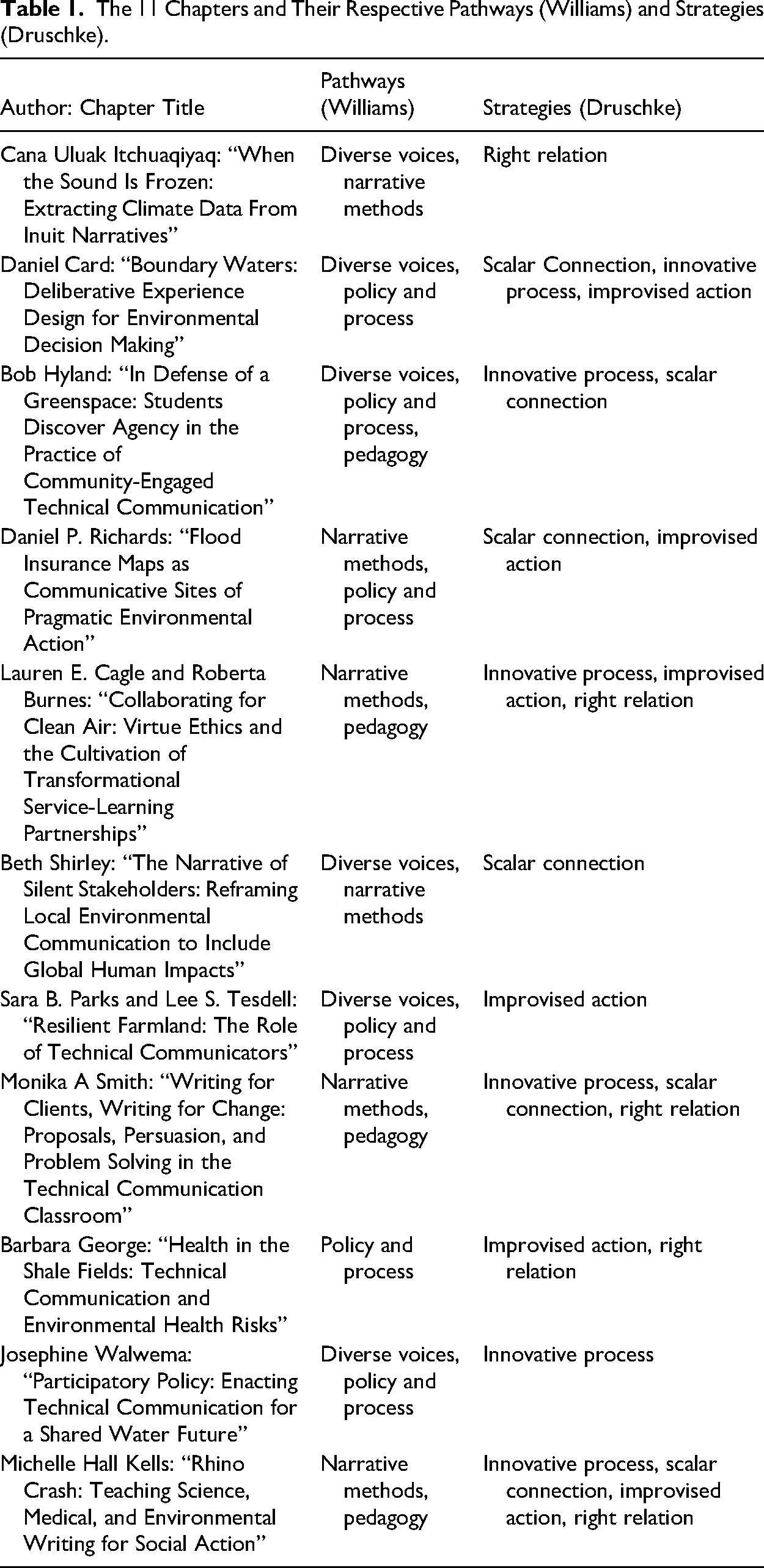
The book begins with Williams's 18-page introduction, followed by 11 chapters, and concludes with a thoughtful epilogue by Caroline Gottschalk Druschke. Both Williams and Druschke share summaries of each article. They also offer heuristics that break down various means and methods that the chapter authors use to effect what Williams calls “pragmatic and democratic action” (p. 1). Williams uses four pathways to structure the book for readers: “Diverse Voices, Narrative Methods, Policy and Process, and Pedagogy” (p. x). Druschke documents the authors’ pedagogical and research-based strategies: “innovative process, scalar connection, improvised action, and right relation” (p. 297). Table 1 lists the 11 chapters and their respective pathways (Williams) and strategies (Druschke).
The 11 Chapters and Their Respective Pathways (Williams) and Strategies (Druschke).
The first chapter, by Cana Uluak Itchuaqiyaq, is a beautiful example of an approach that might reach people who, for many reasons, may not fully trust science or government. Her “story about stories” (p. 19) describes essential “context-based knowledges” (p. 20) that demonstrate how local knowledge is both observable and considered more reliable (p. 24). Her narrative method is what Fisher (1984) would call a “mode, not a paradigm, of communication” (p. 2). As such, it takes advantage of “history, culture, biography, and character” (p. 3), validates “embodied knowledge,” and is theoretical and pedagogical.
Although they take different approaches to involving their students in projects to serve their communities, Bob Hyland, Lauren E. Cagle and Roberta Burnes, Monika A. Smith, and Michelle Hall Kells all focus on valuing their partners and respecting their partners’ voices and knowledge. I learned the value of that approach over 20 years ago (Dubinsky, 2002), which played an essential role in my later work: helping my students and students across the university enact a form of the land-grant mission (Dubinsky, 2010). In each of these articles, the authors transform “clients” into partners by enabling those partners to share their knowledge and experiences and treating them with respect, not charity.
Hyland focuses on research to help students achieve “a greater appreciation of the ecosystem's value and the ecological restoration measure needed” (p. 80). His “science/issue brief” emphasizes essential details about the work and highlights the critical policy issues. Smith highlights how “partnering with campus units . . . can ease the challenge of liaising with external clients” and using “communication genres to “make a difference’” helped student see the short- and long-term value of this kind of work (pp. 212–213), particularly when it is “place-based,” a strategy she acknowledges borrowing from Ross et al. (2019).
Cagle and Burnes enact ethical and transformational partnerships with their students and partners to create knowledge that is, not unlike that discussed by Itchuaqiyaq, “coproduced.” Again, this is a well-known strategy in community engagement, focusing on change, not charity, and built on mutual respect (Bringle & Hatcher, 1996; Cushman, 1996; Kahne & Westheimer, 1996). It is also one that has deep historical and rhetorical roots (Brizee, 2015; Dubinsky, 2002), And because the two authors propose a strategy clothed in “closeness, equity, and integrity” (p. 131), they demonstrate a viable pathway to action that may lead to change.
Hall Kells's chapter outlines how she enacts what its title espouses: teaching for social action. She opens with a quote from Wendell Berry, one of the environmental field's most prominent activists (and rhetoricians, I would argue). This quote helps Hall Kells explain her strategy to create, in her classroom, a “responsible relationship to the world” by addressing the challenge she uses as an opening frame—“the resistance to reason”—which she calls “a failure of imagination” (p. 267). She also relies on stories, primarily about a partnership with Dr. Deblanc, a resident veterinarian, on a project to rescue rhinos in South Africa. This story describes “identification” (p. 274), an essential element that Fisher (1984) has highlighted. Hall Kells does not diminish “scientific knowledge”; instead, like Itchuaqiyaq, she opens avenues to “complementary data sources” (p. 35) by helping students “engage environmental action with a more holistic vision that aligned traditional Indigenous ecological wisdom with Western systems of knowledge making” (p. 275). I recommend that readers focus on how she uses “appreciative inquiry” and her 10 Ps (pp. 278–279).
The value of process, a key frame in both Williams's introduction and Druschke's epilogue, is also essential in our discipline because it is linked to techne. Each chapter offers a view into the processes that the authors relied on. Like many authors in this volume, Card delineates a need for “user advocacy . . . [and] social and environmental justice frameworks” (p. 39). Drawing on a wide range of scholars in our field and his experience working with the Minnesota Department of Natural Resources, he highlights the notion of “wicked problems” that require place-based knowledge and bringing “stakeholders to the table” in order to “foster equitable decision making” (p. 40). The importance of having these individuals participate must not be underestimated.
Beth Shirley and Josephine Walwema, who work beyond the borders of the United States, provide additional perspectives on this kind of work. Shirley focuses on questions about “the responsibility of technical communicators to advocate for . . . disenfranchised communities” (p. 147) and respecting “stakeholder engagement.” Walwema focuses on answering which “technical communication strategies frame policies . . . [to] bring about a secure . . . future” (p. 247), which is essential. Her environmental issue is how the City of Cape Town copes with water. Her article offers insights into building trust and public participation (pp. 248–249), and her argument that “communicating technical communication is not simply a matter of translation” (p. 260) is central to any community-based or participatory-framed work that those in our field may undertake.
Walwema is not alone in thinking about the future and the current dangers. Daniel P. Richards, Barbara George, and Sara B. Parks and Lee S. Tesdell also offer valuable advice about intersections of policy and the need for action to resolve current and future problems. Richards's case study of a genre that few study—flood insurance maps—relies on the importance of plain language and user experience to address future crises (i.e., floods). His work exemplifies ways that we, as technical communicators, can impact issues ranging from zoning to risk literacy. By relying on rhetorical approaches, he argues for “initiating dialogue” to help communities build resilience (p. 117).
George's focus is “environmental health risks” (p. 219). Like Richards, she studies issues linked to risk and crises. Teachers and practitioners could emulate her heuristic (“a series of questions based on stasis”). She advocates for a proactive stance to help citizens rather than waiting until “more harm occurs to human bodies” (p. 242).
Finally, Parks and Tesdell focus on “teaching practitioners to read better and navigate context” (p. 170). Their case also highlights the value of place-based work that builds on the strengths of a community rather than “adopt[ing] . . . deficit model attitudes” (p. 173). This strategy has long been a part of urban work by community-based scholars (Kretzmann & McKnight, 1996) and is very much in line with our field's focus on usability.
To conclude, this book offers valuable examples, models, tools, and the underpinning theory to do the work that our field is well-situated to do and the work that our world needs. As Smith suggests, we can write for change (p. 211) and teach our students to do so. To prepare for this work, we need to “listen to the whispers of the grass” (Pungowiyi, 2001, qtd. in Itchuaqiyaq, 2023, p. 35). Strategies in the book that can help us do so include
listening to voices, particularly the voices of the community members involved respecting local knowledge and practices focusing on making connections and using those connections to increase the impact of research remembering that we are a pedagogical discipline that values a frame of “how” and is neither afraid nor unwilling to adopt a mantle of “service” (Dubinsky, 2004)
The teachers and practitioners in this book offer valuable, learned wisdom that we, as technical communicators, can use in the classrooms and communities in which we work and live. That wisdom is informed by the stories they tell, the theories they call on for framing the work, and, most important, the knowledge they have gleaned from those with whom they work.