






Abstract
Within technical and professional communication research, limited attention has been given to the experiences of disabled employees in the workplace. This article presents findings from a study of complaints filed by the Equal Employment Opportunity Commission in 2023 under federal disability law. The authors use a thematic analysis of the initial complaints to surface the “stories of clash” between organizational practices and individual experiences of disability. They found that interactions between organizational actors and organizational disability policies and practices impact how individuals experience disability in the workplace. The study thus offers insights for cultivating an accessibility mindset to promote inclusive practices.
Technical and professional communication (TPC) scholars have long recognized the importance of integrating the perspectives of disabled people into organizational decision-making. For example, within TPC workplace research, scholars have consistently reminded researchers to fully consider the experience of disability in ways that value disabled people's embodied knowledge as situated expertise (Acharya, 2022; Bennett, 2023; Melonçon, 2017; Oswal, 2018; Oswal & Palmer, 2022; Melonçon & Ranade, 2021; Zdenek, 2018). But TPC workplace research has given limited attention to the day-to-day experiences of disabled employees in relation to accessibility and inclusion. This limited attention to disabled employees’ voices and experiences falls short of the disability community's call for “nothing about us without us” (Bennett & Hannah, 2021b; Bennett & Hannah, 2022; Charlton, 1998; Oswal & Palmer, 2022), which demands their involvement in all stages of corporate work on access and inclusion.
Our study examines 47 complaints filed in 23 federal courts by the Equal Employment Opportunity Commission (EEOC) in 2023 on behalf of disabled job applicants and employees in workplace disability discrimination lawsuits. Two of us are TPC scholars who are trained attorneys, and one of us is an undergraduate prelaw student with work experience in legal settings, so we have a good understanding of the mechanics of the legal system and discourse community. We center the lived experiences of a wide range of disabled people, drawing on their “stories of clash”—accounts of how workplace practices, rather than disability itself, create barriers to access and inclusion. Because TPC researchers often lack access to internal policy documents or employees who are experiencing discriminatory circumstances at work, the fact summaries in the lawsuit filings provide TPC scholars and practitioners (TPCers) unique access to workplace interactions that they can draw from to develop an understanding of the relationship between internal organizational practices, the law, and the experience of workplace discrimination.
Thus, two exigencies drive this study: (a) illuminating what TPCers can learn from EEOC filings about the experience of disabled workers and (b) helping the field develop a better understanding of how disability sits in the workplace. As such, this study sheds light on the organizational–legal context of TPC access and inclusion work by focusing on the experiences of people with disabilities. Ultimately, we wanted not only to highlight the perspectives of disabled employees but also to shed light on how corporate policies extinguish these employees’ expectations under disability law in contexts in which organizational practices and individual experiences of disability clash. To do so, we center our findings on the experiences that disabled employees and job applicants have presented in their complaints. This focus positions us to offer the discipline new ways to think about what it might mean to write workplace policies with a mindset that attends to the experiences of disabled people. Through discussing the study's findings and their pedagogical implications, we aim to equip readers, from scholars to practitioners and managers, with knowledge and practices in order to cultivate the habits of thought that will enable them to attend to and integrate disabled people's perspectives into organizational practices.
Before proceeding, we want to clarify our language choices around disability in this writing. We recognize that disability is complex and that the preferences for disability-first or people-first language of people who experience disability vary (Ladau, 2021; Shakespeare, 2018; Shew, 2023). Because the EEOC cases represent a wide cross-section of disabled people, we mix both disability-first and people-first language in our writing.
Literature Review
For over three decades, scholars have acknowledged the value of narratives in TPC research (Blyler, 1996; Edwards & Walwema, 2022; Gonzales et al., 2021; Jones, 2016; Jones, 2020; Jones & Walton, 2018; Marsen, 2014; Small, 2017; Vealey & Gerding, 2021). Narratives represent knowledge from individuals’ experiences and contribute to knowledge building (Baniya & Chen, 2021; Carlson & Caretta, 2021; Moore et al., 2021). Within TPC scholarship, narratives are recognized for making sense of experiences, including workplace experiences (Jones, 2020; Marsen, 2014; Small, 2017), and communicating complex phenomena (Vealey & Gerding, 2021); promoting intercultural skills (Gonzales et al., 2021); understanding and managing organizational crises (Marsen, 2014); and pursuing social justice (Edwards & Walwema, 2022; Jones & Walton, 2018; Vealey & Gerding, 2021). Further, as Edwards and Walwema (2022) put it, “because narrative inquiry goes after untold, often marginalized stories, it has the ability to uncover voices that have been silenced or that are not a part of the dominant narrative” (p. 256). And counternarratives, particularly from multiple perspectives, can challenge discriminatory or unjust systems (Baniya & Chen, 2021; Jones, 2016; Mangum, 2021; Rea, 2021). Thus, stories are a powerful tool in social justice work because they aid in both recognizing and revealing injustices (Moore et al., 2021; Walton et al., 2019). We organize this literature review around how and to what extent researchers attend to the experiences of disabled people by including disabled people's stories in their work.
Stories From Secondary Research
Some scholars have captured disabled people’s stories from secondary sources (e.g., newspapers, reports, or court opinions) even though the stories are not the central focus of their scholarship. For example, photos expressing how people with different visual disabilities experience websites (Ray & Ray, 1998) and brief news accounts of disabled users’ experiences with assistive technologies (Carter & Markel, 2001) have been used to demonstrate the challenges of website accessibility. Published at the turn of this century, this scholarship highlights quickly evolving technologies and an unsettled legal and regulatory landscape that placed new design requirements on TPC practitioners’ work. Similarly, researchers have captured case-law snippets of disabled users’ experiences with various issues regarding website inaccessibility (Palmer & Palmer, 2018) in order to highlight the legal and ethical landscape of website accessibility. Even though these snippets are filtered multiple times through differing stakeholder perspectives, they capture key aspects of disabled people's stories from the court reporter's recording of the disabled person's initial account, to the lawyer's interpretation of that account, and to the judge's evaluation of these presented accounts in light of the law. Unfortunately, though, the original account, or story, is diluted in this process by the rhetorical features of legal argument that dampen the story's distinct and situated character.
Stories in TPC Practice
Beyond capturing stories in secondary research, some TPC scholars have focused on the stories of disabled people in TPC practices. For example, these scholars have shown how video testimonials can help to teach novice web developers how to create accessible websites for people with visual disabilities (Youngblood, 2013) and to train faculty in accessible classroom practices for students with dyslexia (Phelps, 2021). When examining usability practices, Hutter and Lawrence (2018) integrated vignettes from deaf users’ experiences with testing an app in order to illustrate concerns with prototype development and current protocols for user testing. The researchers debriefed the users after they tested the app, gaining insight into how the users encounter biases, cultural appropriation, and paternalism in product design and user testing. This study, then, draws attention to how deaf users deploy their embodied expertise to navigate accessibility challenges and calls for codesign with the deaf users. Such a move toward codesign is widely recognized as a way to center marginalized voices (Acharya, 2022; Agboka, 2013; Jones, 2016; Oswal, 2019; Oswal & Palmer, 2022) and integrate users’ experiences in accessible design practices.
Stories in the Workplace
Scholars also have used stories to illuminate the importance of workplace culture on disabled employees’ experiences. For example, Konrad (2018) gathered powerful narratives by interviewing visually disabled employees and their associates (e.g., colleagues, family, and friends) to explore how normative ideas about work create access barriers in the workplace. This work revealed commonplaces, such as when work happens and how job tasks are performed, that employers wielded to enforce normative standards and parameters that constrain the rhetorical possibilities for disabled workers’ self-advocacy (p. 138). And Oswal and Palmer (2024) interviewed university accessibility practitioners—including disabled practitioners—and their stories indicated that, despite much of the accessibility work being driven by compliance concerns, an accessibility culture was present and growing in some higher education institutions. But this growth was not widespread across higher education because some of the disabled accessibility practitioners said that they still faced accessibility barriers in the workplace (p. 22).
Considering this workplace culture issue, as well as the role of stories in revealing and challenging the injustices identified in this literature review, we have situated and designed our study to examine disabled employees’ and job applicants’ stories of workplace disability discrimination as reflected in their EEOC complaints.
Methods
Our approach was informed by researchers who have advanced frameworks to include the perspectives of disabled people in workplace contexts. Namely, we draw from Oswal's (2019) and Willers's (2024) work with a framework for accessible user experience that forwards participatory design and accounts for embodied expertise. We also consider Bennett and Hannah's (2022) ethical decision-making framework that is grounded in disability studies and justice principles. These scholars offer useful analytical frameworks for approaching the stories of clash in the statement of claims (the description of the facts or incidents giving rise to or forming the basis of the lawsuit) that elaborate on disabled employees’ struggles to prove competency, conform with traditional professionalism standards, and seek to obtain reasonable accommodations in the face of discriminatory employer actions. Ultimately, through these stories, we learn how claimants often must prove employability in ways that are not required of their nondisabled peers.
To examine employee experiences of disability discrimination in the workplace, we conducted a textual analysis of the statement of claims in the disability discrimination lawsuits filed by the EEOC in 2023. We used an iterative, qualitative coding process and thematic analysis to analyze this data (Saldaña, 2021; Tracy, 2013). We will now discuss the details of our data collection and analysis.
Data Collection
We searched the Nexus Uni database for complaints filed by the EEOC for disability discrimination in 2023. A complaint is the document filed by a plaintiff to initiate a lawsuit in the United States. This complaint notifies the court and the defendant of the basis (i.e., key facts and legal grounds) on which the plaintiff is bringing the lawsuit. In one instance, the complaint was unavailable in Nexus Uni, so we accessed it through the Public Access to Court Electronic Records (PACER) system, which provides public access to federal court records. All the complaints were brought under federal law only. In total, we examined the complaints in all 47 cases, focusing on the statement of claims to understand the current landscape of workplace disability discrimination and how it impacts employees’ and job applicants’ experiences. The complaints were filed in federal courts in 23 different states and involved 41 different employers (see Appendix A for the list of complaints).
Even though statements of claims are written by lawyers to shore up the legal claims of the case, their fact summaries often include direct testimony of the disabled claimants, which include both employees and job applicants. This testimony contains accounts of multiple encounters and contact points between people, norms, policies, and environments (workplace culture), thus reflecting in situ moments across disability types and workplaces. Collectively, the cases represent a type of topography of the experience of being disabled in the workplace. As such, these cases filed by the EEOC (n.d.), the federal agency charged with “enforcing federal laws that make it illegal to discriminate against a job applicant or an employee because of … disability” (para. 1), tell the stories of clash between organizational practices and disabled people's experiences. Through those stories, we witness the conditions that give rise to the claimants’ experience of discrimination. It is these conditions that TPCers must attend to in their written documents (e.g., corporate policies and procedures) and in the practices that instantiate these policies.
Data Analysis
Our analysis centers the experience of the employees and applicants, focusing on the rhetorical aspects of their stories rather than lawyers’ efforts to establish the required elements of the legal claims: that is, the elements demonstrating that claimants are qualified for and could perform the job with reasonable accommodation (or without accommodation) and that the employers acted discriminatorily or unfavorably against them because of their past or current disability or association with a person who has a disability. Although lawyers mediate claimants’ stories in order to comply with legal standards of argument and satisfy the court that the legal elements of the claim have been met and that a cause of action exists, they do not co-opt these stories but rather emphasize the points of the story that carry the legal weight to prove the case in court.
To understand the claimants’ workplace experiences, we focused on the facts represented in the statement of claims (sometimes labeled as statements of facts, allegations, or facts common to all claims), located between the administrative procedures section (conditions that must be met before the EEOC can file suit) and the prayer for relief section, which specifies the remedies that the plaintiff seeks in court. Appendix B contains an annotated excerpt of a statement of claims. But we do recognize that slippage occurs in the claimants’ stories: Details of the claim (or story) leak from or to other sections of the complaint, such as the “Nature of the Action” or “Statement of the Case“ (sections that, when included, provide a summary or overview of the lawsuit, e.g., the type of claim, key facts, and legal basis for the claim). As such, although we hewed closely to the statement of claims, we reviewed the complaints in their entirety, including other sections that captured the claimants’ story, in our analysis.
We analyzed the complaints in three stages: emergent coding, collaborative coding, and theming the data.
Stage 1: Emergent Coding
In our first pass of the documents, we separately read the corpus of complaints and noted our observations, engaging in what Braun and Clarke (2006) deemed as phase one of thematic analysis, familiarizing ourselves with the data (p. 87). During this stage, we noted both the legal and the rhetorical significance of the moves (e.g., language used and anecdotes conveyed) made in the complaints. We then met, shared our observations, and identified codes for the recurring aspects that emerged in the data regarding complainants’ experiences with disability in the workplace. Developing this list of emergent codes corresponds with Braun and Clarke's phase two, generating initial codes (p. 88). Through that discussion and coding process, we agreed on 10 emergent categories of initial codes. Table 1 presents these 10 coding categories and their corresponding definitions. It is from these coding categories that our analytical themes emerged to describe the landscape of the complainants’ experiences with disability discrimination in the workplace as depicted in the EEOC lawsuits.
The 10 Coding Categories and Their Definitions.
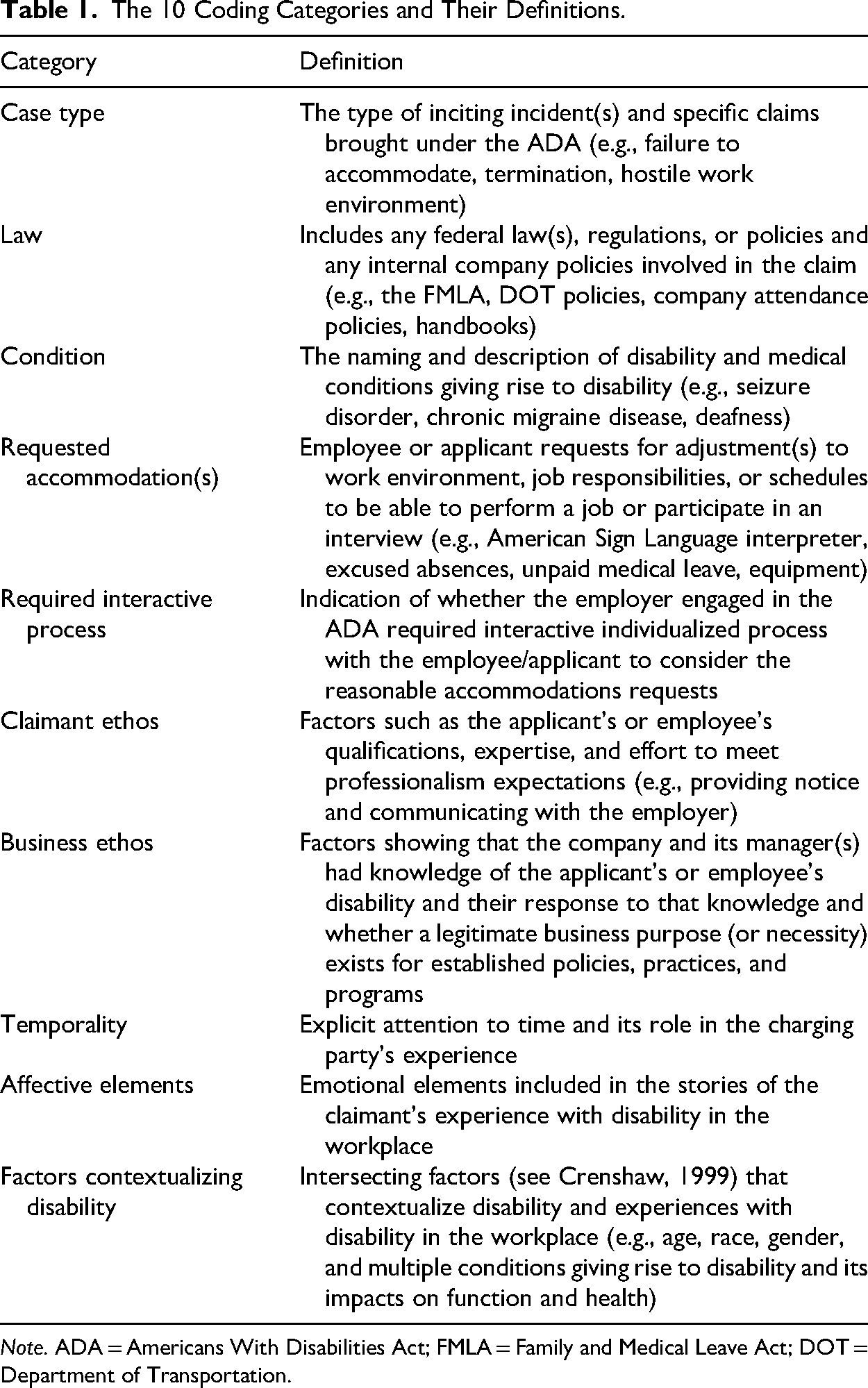
Note. ADA = Americans With Disabilities Act; FMLA = Family and Medical Leave Act; DOT = Department of Transportation.
Stage 2: Collaborative Coding
We then collaboratively coded each text for the categories identified in Stage 1. Our unit of analysis was a statement (ranging from a few words to a few sentences) that involved or referenced disability. In our coding, we observed that the 10 codes represented either descriptive or interpretive elements. The descriptive elements, represented by the first five coding categories listed in Table 1, largely include aspects of establishing the legal claim and were relatively easy to identify and code. The interpretive elements, represented by the last five categories listed in Table 1, were less straightforward and include persuasive aspects of the stories that play a role in contextualizing the discrimination experienced in the workplace.
As we collaboratively coded, we encountered a challenge in identifying a primary phenomenon in instances where codes overlapped. For example, in moves concerning ethos, claimants’ statements that characterized and undermined the employer's ethos often bolstered the claimant's ethos, and vice versa. This simultaneity made it difficult to separate statements into claimant and business ethos. Through discussion, we resolved these tensions by focusing on the actor in the coded statement (i.e., actions taken by the employee or applicant were coded as claimant ethos, and those taken by the employer were coded as employer ethos).
Also at this stage, we encountered an analytical difficulty that arose from the legal requirements to establish claims. For example, drawing on our legal training, we understood that in initiating a lawsuit, the claimant must merely provide sufficient facts to establish a plausible claim ( Bell Atlantic Corp. v. Twombly, 2007 ). That is, the claimant's priority in the statement of claims is to meet the legal threshold rather than to provide a full accounting of details that led to the lawsuit. Thus, readers do not get the full story there of the claimant's experience in the workplace as a cohesive narrative. To negotiate this limitation, we read other sections of the complaint that contained story elements (e.g., the “Nature of the Case” or “General Allegations” section) in order to get a sense of the fuller story.
Finally, in Stage 2, we refined our definitions and understanding of the codes we generated in Stage 1, ensuring coding consistency, and began discussing potential themes present in the data—proposing how different codes combine to communicate significant aspects of the lived experience of disability in the workplace. This stage, then, loosely correlates with Braun and Clarke's (2006) phase three, searching for themes, in that we began “thinking about the relationships between codes, between themes, and between different levels of themes” (p. 89). When we had compiled all our coded extracts of data for each coding category, refined our code definitions, and had a list of potential themes, we began Stage 3.
Stage 3: Theming the Data
Attending closely to where individual experiences of disability clashed with workplace practices that limit access and inclusion, we discussed the themes that emerged in our coding categories. In this stage, we examined the concepts coded and compared their distinctions and commonalities (Saldaña, 2021) to refine the list of potential themes from Stage 2. Our process involved a blend of Braun and Clarke's (2006) phase four, reviewing themes, and phase five, defining and naming themes. We focused on whether the themes captured the range and variation of significant factors impacting employees’ and job applicants’ experiences with disability discrimination in the workplace as described in the claims. Within and across the claims, what stood out is that these disability experiences in the workplace were multilayered and multidimensional. Our themes needed to account for this complexity. Specifically, while the claims all contain legal boilerplate language (standard language typically present across legal claims of such discrimination, e.g., “was qualified for and could perform the job with or without reasonable accommodations”), the rhetorical force of the claimants’ stories displayed a range of factors that overlap and give shape to the experience of workplace disability discrimination.
When reading the legal filings, we were also interested in how TPCers could think beyond this legal rights-based discourse toward justice-oriented work (Bennett & Hannah, 2022). Through our analysis of these stories of clash, we found five themes impacting claimants’ experiences of disability in the workplace that have implications for TPCers: layered law, battle of ethos, multiplicity, temporality, and pathos.
Findings
Overall, the complaints in the corpus cover a range of discriminatory incidents that employees and job applicants experienced in the workplace. Table 2 offers a thumbnail overview of the types of incidents that form the basis of the complaints, broken down by case type and law beyond the Americans With Disabilities Act (ADA), including corporate policies and federal regulations. Some cases involved more than one type of discriminatory action or law (broadly construed as statutory law, implementing regulations and corporate policies). As Table 2 shows, failure to accommodate was the most prevalent type of complaint, followed by discharge or termination, due to disability. Additionally, nearly one third of the cases involved corporate policies. Together, these cases suggest that there is room to improve corporate policies and the practices involved in implementing workplace accommodations, both of which TPCers are well-positioned to address.
Overview of the Number of Complaints According to Case Type and the Law (Beyond the ADA) or Policies Involved.
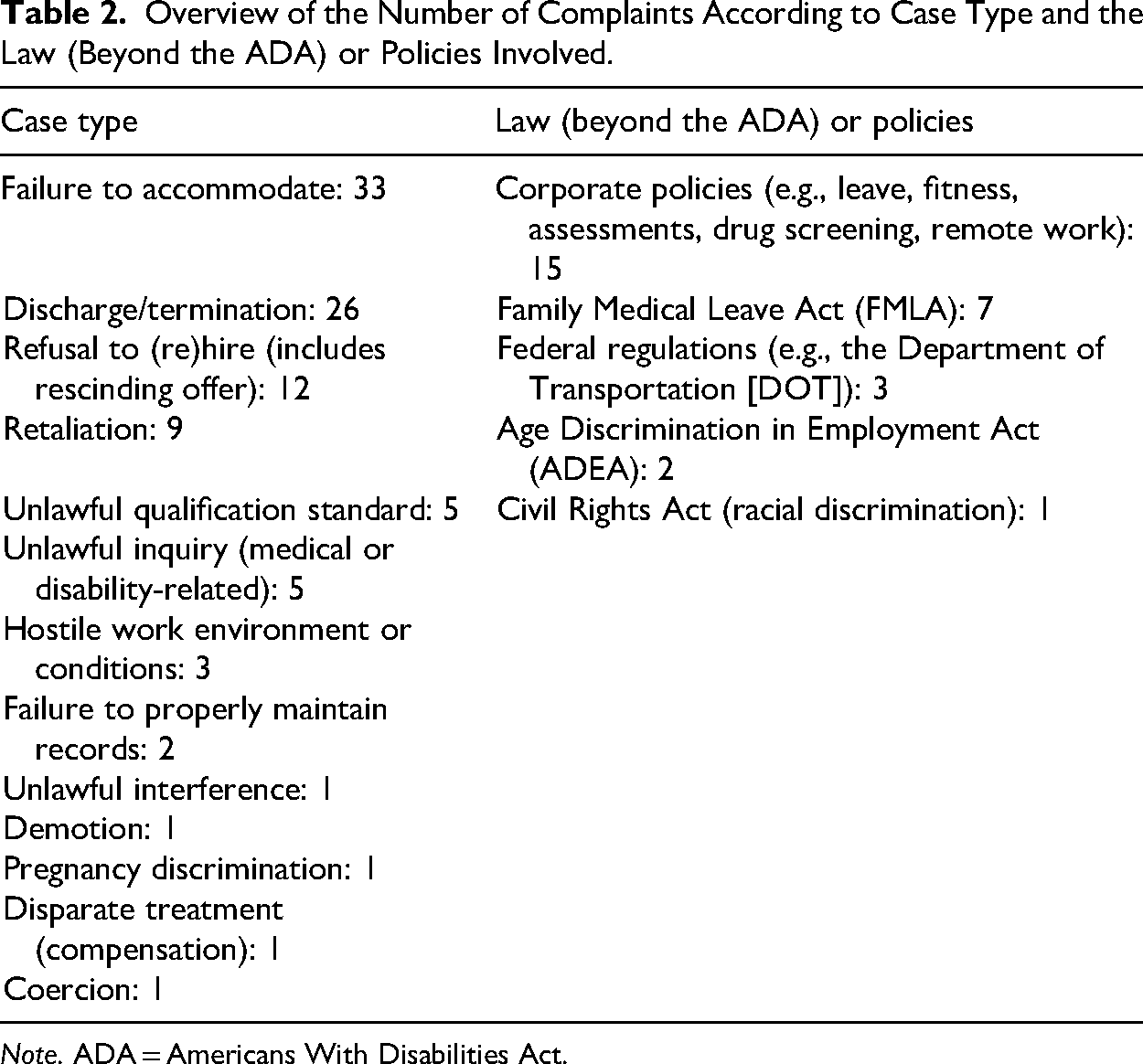
Note. ADA = Americans With Disabilities Act.
As we moved into theming the data, our coding categories (see Table 1) informed the final themes. For example, the interplay between the categories of case type, law, requested accommodations, and required interactive process resulted in the theme “layered law” whereas the dynamics captured in the categories of claimant ethos and business ethos resulted in the theme “battle of ethos.” The theme “multiplicity” captures the categories of condition and factors contextualizing disability. Finally, the categories of temporality and affective elements resulted in the themes “temporality” and “pathos,” respectively.
As we examined the complaints, we witnessed layered stories within and across the cases and documented the unfolding of the personal, legal, organizational, and relational aspects of disability discrimination. This unfolding allowed us to attend to individualized expressions of disability in the context of workplace disability discrimination. Here, we present our findings from the stories of clash between employers’ practices and disabled people's experiences with such discrimination. We organize these findings around the five themes that emerged in Stage 3 of our data analysis:
Layered law: the interaction between the ADA, other federal laws and regulations, and corporate policies Battle of ethos: the push-and-pull between the ethos of the charging party (employee or applicant) and the ethos of the employer that centers around the responsibility for inciting incidents that led to disability discrimination claims Multiplicity: the multiple dimensions that impact the way disability is named, described, and constructed in the workplace Temporality: the ways that time appears as part of the experience of disability in the workplace Pathos: the story elements within the experience of disability in the workplace that evoke emotions
Layered Law: The Conflict of Workplace Policies and Procedures With Formal Law
We define layered law as employer policies and practices established in anticipation of enacting the ADA and other federal laws and regulations, such as the Family and Medical Leave Act (FMLA), in ways that create accessibility barriers for disabled employees and job applicants. In every case we examined, the ADA is present as red-letter law—that is, the legal and regulatory framework under which disability discrimination claims are brought. But in over half the cases, the law was not limited to the ADA; instead, the law often showed up through interactions between the ADA and other federal laws and regulations as well as the corporate policies and practices that employers crafted in anticipation of the law. The layering of these workplace policies and practices over federal disability and employment laws confounded employees’ expectations that their right to equal employment opportunities would be protected under federal disability laws.
These stories of clash between the ADA and corporate practices appeared in many cases. For example, in EEOC v. Didlake, Inc. (2023), there is a clash between the layering of the company's inflexible medical leave policy; its 100-percent-healed policy, which requires a fitness for duty certification; and those policies’ interactions with ADA requirements. In this case, corporate values and practices appear in the two corporate policies that work together to essentially push people who are not protected by the FMLA out the door. Specifically, employees without FMLA leave who experienced a health event, such as a hospitalization or recurrence of cancer, were terminated and denied reemployment unless they could produce a fitness for duty certificate without restrictions. For instance, the statement of claims notes, “Defendant terminated Naomi Frye because she required a month of leave after being briefly hospitalized for a psychiatric disorder but was not FMLA eligible. Pursuant to its 100-percent healed policy, Defendant refused to rehire her because, according to her former supervisor, her condition was ongoing” (p. 5). The company enforced its 100-percent-healed policy despite the ADA providing reasonable accommodations, such as unpaid leave, to qualified individuals with disabilities. In this case, then, the simultaneous failures of legal compliance and organizational policy amplify the frustration and disappointment that employees experience from not being accorded their legal rights.
In many cases, we observed how employers’ everyday practices are structured in a way that creates tension between the law and organizational practices. One such example, EEOC v. Gregg Orr Auto (2023), involved a long-time employee, Dykes, who took FMLA leave for cancer surgery. In this statement of claims, layered law takes center stage, demonstrating how the interplay of the ADA, the Age Discrimination in Employment Act (ADEA), the FMLA, and the company's policy of maintaining a self-insurance plan plays a significant role in Dykes's experience of discrimination. Here, the company's self-insurance policy influenced its practice of pushing out employees who were older or experienced high medical costs, such as employees with disabilities. Having observed this practice, Dykes “rushed back to work” following surgery in order to avoid getting pushed out. Still, after receiving his medical claims, the company replaced him with a younger employee. Even though the employee was granted FMLA for his leave and the ADEA and the ADA should have protected him from being terminated because of his age and need for ongoing treatment, respectively, the company sacrificed his job to save medical costs. Thus, after following organizational protocols to protect his job, Dykes experienced the upending of a reasonable expectation of job protection. Ultimately, the employer's twin concerns regarding age and long-term medical costs overrode the employee's compliance with federal law and organizational policy, thereby dissolving his legal protections.
Across the cases, even for those in which the law paved the way for employment opportunities, corporate policies frequently denied reasonable accommodation to disabled workers or job offers to qualified applicants with disabilities. For example, in EEOC v. Trico Transportation Services, Inc (2023), an employer rescinded a conditional offer of employment after learning of the applicant's record of disability. Specifically, the employer required applicants to complete a medical history questionnaire that induced applicants to disclose past conditions, even if they no longer had the condition. As a result of the applicant disclosing a condition he had been treated for (back pain), the employer claimed he was “high risk,” perceiving the applicant as having a disability, and withdrew the job offer even though he had no medical restrictions, passed the Department of Transportation (DOT) physical, and could perform the job. Here, the company's policy requiring applicants to complete a medical history form that solicited a wide array of past and present medical information (85 different conditions), including “those he no longer suffered” (p. 5), was problematic. Such forced disclosure through an overly broad form led the company to view the applicant as having a “forever disability,” deeming him unemployable despite the ADA's supposed legal protections. For employees and job applicants, being perceived as disabled and unemployable, even when they can perform the job, can become a persistent barrier to earning a livelihood and gravely impact their work experience, adding rhetorical force to resulting discrimination claims.
Battle of Ethos: The Struggle of Disabled Employees to Establish Credibility
The battle of ethos in the claimants’ stories comprises rhetorical moves that shape perceptions of parties’ credibility. We define battle of ethos as the struggle of disabled employees to both establish their credibility as a qualified employee and demonstrate flaws in their employer's character. Within the claims, we observe two primary ethos moves: (a) a focus on the claimant and (b) a focus on the employer. Often, as we have described, story elements that bolster the claimant's ethos also serve to undermine the employer's ethos. Within the claimants’ stories, this push-and-pull between the ethos of the claimant and the ethos of the employer illustrates the claimants’ understanding of professionalism standards and employer expectations.
Specifically, when the ethos move focuses on the charging party, or the claimant, it often provides a perfunctory sense of the claimant's ability to meet professionalization standards or adhere to workplace norms. That is, many complaints contain boilerplate language indicating that the employee or applicant was “able to perform all of the essential functions of the job” whereas others specify particular qualifications, work experience, performance reviews, or promotions that indicate their fitness for the job. For example, in EEOC v. Chesapeake Montessori Foundation, Inc (2023), a mother working in a Montessori school did not get her teaching contract renewed despite her long track record of employment because the school's principal questioned her ability to commit to the job during COVID due to her daughter's disability. To demonstrate her commitment to the job, the claimant threads a description of her immersion in the Montessori community with that of her long teaching history, master's degree, and Montessori credentials. Here, the claimant not only centers her ethos in her past professional experiences and training but also undermines the credibility of the employer, which would hire a less qualified teacher. Thus, the aggregate of the claimant's professional experience surpasses the normative qualification standards conveyed by the legal boilerplate language that typically stands in for the actual workplace-specific facts.
In some cases, claimants’ ethos showed up in the descriptions of their resilience and tenacity in notifying the employer of their specific needs for accommodations and proposing specific accommodations that would allow them to do their job. For example, in EEOC v. Otis Worldwide Corporation (2023), an employee with autism spectrum disorder and ADHD requested an accommodation of reassignment to a role or environment with fewer competing auditory inputs. After he provides all the required documentation and repeatedly requests a meeting through the company's specified channels, the employer actively avoids the interactive process for making the reasonable accommodations required under the law. The employer's ethos, then, is seriously put into question by the employee's persistent, good faith efforts to comply with legal requirements that are thwarted by the employer's resistance to the legal accommodations process. As such, this complaint exemplifies how workplace practices can outright reject claimants’ efforts to meet workplace standards via requests for reasonable accommodations.
Repeatedly across the cases, we observed qualifications standards not tied to job or business necessity that operated to discriminate against disabled people in the workplace. This issue often appears in business policies that categorically bar people with specific disabilities, such as color blindness or hearing loss, from jobs they are qualified to perform. For example, in EEOC v. United Parcel Service (2023), job applicants who were deaf or hard of hearing had been denied employment opportunities after having received a hearing exemption by obtaining the requisite DOT medical card proving that they met the physical conditions to hold the job. The employer refused to hire the workers based on its written policy against hiring any person with a DOT hearing exemption as a driver of a DOT-regulated vehicle. Here, the employee experience is one of invisibility—the policy is unable to perceive the employee as having met the qualifications for employment. Like in the earlier case with boilerplate language, the claimants’ stories undermine the credibility of the employer, which administers an arbitrary policy that adds qualification standards unnecessary to perform the job, erecting barriers that these employees cannot overcome.
When the battle of ethos focuses on company actions, employer ethos is undermined by actions such as disparate treatment, inconsistent policy application, and reliance on corporate policy to avoid approving reasonable accommodations. For example, in EEOC v. Zoe Center for Pediatric & Adolescent Health, LLC (2023), the chief operating officer (COO) both misapplied and hid behind the company's absence policy to avoid providing accommodations to an employee with anxiety and PTSD. In that case, the employee's requested accommodation of partial remote work was reasonable for this employer—they had an established practice of remote work when it suited the company (e.g., when inclement weather closed the office and employees were sick), and they offered remote access to some employees. But the COO misapplied the company's absence policy and terminated the employee who had correctly followed company procedures even after the human resources manager advised the COO that his actions may be in violation of the ADA. Here, the employee's experience with navigating a whack-a-mole policy landscape created by the inconsistent, disparate application of corporate policies ultimately resulted in her losing her job. This case, like others in the corpus, shows how employees’ workplace experiences can be used to undermine employer ethos as a means of persuasion in making their case for employment discrimination.
As in the previous example, several cases involved the C-suite (senior executives and corporate leadership) in the claims of workplace discrimination. C-suite involvement amplifies the battle of ethos because of the power and scope of influence inherent in those positions, both of which are instrumental in shaping corporate culture. Thus, actions originating in the C-suite are likely to be viewed as representative of the company as a whole and not as easily dismissed as those of a rogue shift supervisor. One such example, EEOC v. Walmart, Inc (2023), stated that the corporate office threatened local store management for excusing absences due to seizures as an accommodation, which led local managers to deny accommodations, saying, “if we treat you this way, we have to treat everyone this way” (p. 8). This quote from a manager demonstrates a misunderstanding of the very definition of ADA accommodations because such accommodations are exceptions to the baseline job or work environment. The corporate office's lack of legal literacy (Hannah, 2011) here ignores the employee's disclosure of a need for absences due to ongoing seizures. In doing so, the corporate office effectively penalizes the employee by removing her accommodations for her disability. Further, by misunderstanding ADA law, the employer undermined its own ethos. Ultimately, that misunderstanding nullified the employee's expectation that her employer would comply with the law, leaving her struggling to secure the basic legal rights afforded to her by the ADA.
Multiplicity: The Complex Construction and Unfolding of Disability in the Workplace
Disability does not just “show up” in a person—it is produced in interactions (Shakespeare, 2016). In this study, we use the concept of multiplicity (i.e., the varied and complex ways in which disability unfolds in the workplace) to account for the story aspects in the claims that illustrate the multiple ways that workplace interactions influence the construction of disability in the workplace. These aspects of disabled employees’ stories serve to educate readers about how, beyond any physical, cognitive, psychological, or medical issues, social experiences at work play a large role in the experience of disability.
Because of the prevalence of the medical understanding of it (Shew, 2023), disability is often conceived or categorized via a checklist logic that reduces it to a set of simplified dimensions or properties that can be addressed by a specified list of actions (Bennett & Hannah, 2021a; Oswal & Melonçon, 2017). But the experiences expressed in these cases expose the limitations of this logic. Namely, employees expressed how organizational practices, such as paperwork (written texts) and processes (oral meetings), frequently intensified their disability experience beyond its checklist designation. For example, in EEOC v. Res-Care, Inc (2023), the complainant narrates numerous medical conditions and events (e.g., asthma, heart problems, high-risk pregnancy, and being airlifted to the hospital) and how her experience was exacerbated by the organizational culture through both policies and discourse practices.
Specifically, shortly after the employer learns that the employee in this case is pregnant, supervisors call her into a “disciplinary counseling session” to “set future expectations.” The cultural practice of labeling an initial meeting about the employee's pregnancy as a disciplinary counseling session illustrates how corporate actors can act in a disabling manner through casting the disabled employee as a problem. In setting this negative tone, which escalates as the employee experiences pregnancy-related health conditions and events, the supervisors aggravated the employee's disability experience. Further, failing to properly apply company leave policies and refusing to consider accommodations, such as unpaid leave under the ADA, those supervisors pressure the employee to return to work early from medical leave and ultimately discipline her. Thus, corporate culture sometimes promotes myriad intertwined disabling practices that compound the challenges that the workplace environment poses to disabled employees, thereby escalating the employee's experience of disability, both physically and emotionally, in new ways.
Temporality: The Ways Employers Weaponize Time
We define temporality here as the employers’ use of time as a weapon to exert pressure on disabled employees at particularly precarious moments. Although time generally appears to establish legal claims, it also plays a role in employees’ experiences by degrading their workplace performance. We use the concept of temporality to capture this rhetorical effect.
In one example, EEOC v. Pete's Car Smart, Inc (2023), time is conveyed both quantitatively and qualitatively to signal the pressure points in interactions between employees and employers: The day following the [heart] surgery, Defendant's Owner and President Bill “Pete” Vaughn called Charging Party's daughter and told her that Charging Party needed to retire.… Leading up to the time of her surgery, Vaughn made discriminatory remarks about Hudson's age including comments about the color of her hair and that she had “old-timer's disease.” Vaughn also made discriminatory remarks about Hudson's disability including comments about the pace at which she walked or stood up from her chair.… On March 22, 2021—six days before her medical leave was scheduled to end—Vaughn told Hudson she needed to retire, or she would be terminated. Vaughn informed her that he did not think she could do her job any longer given her age and heart condition. (pp. 4–5)
In this example, the story leads with a quantitative reference to time (e.g., “the day following the surgery”) and then contextualizes the experience with qualitative references to time (e.g., the company owner making references to why it is time for the employee to retire). The company owner increasingly pressures the employee to retire at high-stress times—leading up to the claimant's surgery, immediately following surgery, and less than a week before the end of her medical leave. Through simultaneously deploying quantitative and qualitative assessments of time, the employer crafts an intimidating environment in which the employee is disfavored and pressured to leave. Thus, the description of these critical junctures in which the employer's disparaging comments in aggregate serve to undermine the claimant's value and force her out adds rhetorical energy to her claim.
Pathos: The Evocative Impacts of Employers’ Actions on Employees’ Experiences
We define pathos here as the affective components of the stories in the claims that illustrate the gravity of the employer's actions or inaction on the employee's disability experience. Although pathos showed up less frequently in these cases, when it was present, it had strong rhetorical power. Pathos appeared in the claimants’ stories in one of four ways: (a) how the claimant is positioned (e.g., “Aggrieved Individual”); (b) detailed accounts of the claimant's experience of pain, illness, or treatment; (c) slurs or insulting language about the claimant's disability; and (d) emotional descriptors interspersed within a generally neutral account.
Some complaints contained a combination of the various affective elements. For example, a passage from EEOC v. R & G Endeavors, Inc (2023) stated, “Both managers and co-workers have frequently shouted at the Aggrieved Individual, belittled him in front of co-workers, and used and tolerated the use of slurs such as ‘retarded’” (p. 3). This example contains affective components in referring to the claimant as an “Aggrieved Individual,” “the use of slurs such as ‘retarded,’” and details of his treatment at work, which was witnessed by his job coach. Such experiences illustrate how organizational actors create toxic work environments through words, behavior, and inaction that impact the claimant's day-to-day work experience. Here, the ongoing disrespect signaled by insulting language and a lack of empathy toward the employee's pain and hardship paints a grim picture of employee alienation. This alienation gives rise to emotional distress, which can spill over into the disabled employee's life beyond the workplace.
In some cases, the claims capture the employee's unmediated voice by incorporating evidence of the employee's prior communications, elevating the claimant's appeal to pathos. For example, EEOC v. 299 Madison Ave (2023) highlights quotes from a hotel front desk employee's text messages with her supervisors after being denied an accommodation of a chair or stool at the front desk because the company policy required front desk workers to stand. One relevant passage in the claim states that Perez continued to work as a front desk agent at Library Hotel between January 2023 and March 2023 without a reasonable accommodation by enduring significant pain during nearly every shift, performing self-massage and physical therapy exercises whenever possible, and missing work when the pain from Perez's impairments became unbearable. On March 13, 2023, Perez sent supervisor Soukiassian a text message stating: “unfortunately this job is slowly wrecking my body and I’m not doing very well health-wise … I do hope to be back tomorrow, but I can’t even stand up straight right now, much less for 8 h.” (p. 6)
In this story, the language powerfully shows how being denied accommodations impacts the employee. Phrasing such as “enduring significant pain,” “pain … became unbearable,” and “slowly wrecking [her] body” conveys the gravity of the employer's denial of reasonable accommodations on the employee's health and well-being. Further, the claim captures the actual voice of the employee, helping readers to empathize with the employee's experience. Again, we see how the effects of discrimination spread well beyond the employee's work life—despite her best efforts to self-advocate for her needs and manage her symptoms, she is left worse off by the supervisor's refusal to act, resulting in a downward spiral of physical symptoms that negatively affect every facet of her daily life.
Discussion
This study has pedagogical implications that can further equitable and just practices for greater accessibility and inclusion in the workplace by equipping TPCers to meet the goal of writing with (and not just for) people with disabilities. We must consider what these diverse stories relating disability experiences in workplace contexts mean for how TPCers can promote an accessibility mindset when composing workplace policies. By an accessibility mindset, we mean a conscious habit of thought that attends to the kinds of experiences that were ignored in the cases we reviewed. Specifically, this habit of thought surveys the various junctures where organizational documents, practices, and people interact to create critical “misfits” (Garland-Thompson, 2011) that erect barriers to disabled employees’ full participation in the workplace. It is in these junctures where TPCers can learn from employees’ lived experiences and advocate with them for more inclusive practices that not only promote disability rights by removing barriers to full participation in the workplace but go beyond mere compliance toward greater concerns of justice.
We will now discuss what the study's findings reveal about the experience of disability in the workplace and how developing an accessibility mindset aids TPCers in promoting more accessible and socially just workplace practices. Scholars have recently noted the impact of workplace culture on disabled employees and users of various forms of communication, products, and services (Konrad, 2018; Oswal & Palmer, 2024). Accessibility culture has been defined as “an organization-wide awareness of the barriers preventing disabled users from participating in available activities, services, and opportunities at par with their nondisabled counterparts” (Oswal & Palmer, 2024, p. 19). Such a culture roots out accessibility barriers from all aspects of the organization, including its policies and practices. TPCers who cultivate an accessibility mindset and actively enact socially just practices within their workplaces (Colton & Holmes, 2018) could aid in transforming their workplace culture.
Thus, to help students develop an accessibility mindset, TPC instructors can incorporate some of the complaints we studied into their curriculum in three ways: by developing inclusive leadership to bolster organizational ethos, building legal literacy to eliminate clashes in layered law, and creating organizational training that accounts for the unfolding of the disability experience. We highlight each of these ways by indicating how, based on our findings, disability sits in the workplace; discussing the study's implications for practitioners and managers in the workplace; and addressing how TPC instructors can incorporate some of the resources presented here to train the next generation of practitioners.
Develop Inclusive Leadership to Bolster Organizational Ethos
In our study, we witnessed some failures of leadership by ignoring ADA requirements and failing to correctly apply their own internal policies. One example was when threats by Walmart's corporate office to local store managers for excusing an employee's absences for seizures caused them to remove existing accommodations ( EEOC v. Walmart, Inc, 2023 ). Such leadership failures signal a need for organizations, especially at the management and executive levels, to strengthen and expand their approach to accessibility in the workplace. In many instances, qualified employees not only followed their company's accommodations processes; they also showed employers how to reasonably accommodate their needs, such as by requesting partial remote-work schedules (see, e.g., EEOC v. Zoe Center for Pediatric & Adolescent Health, LLC, 2023), yet their requests were denied. Such blatant disregard of disabled employees’ accessibility needs—and worse, circumvention of the accommodation process to terminate employees who could perform the job with reasonable accommodations—undermined organizational ethos. That is, these leaders perpetually hold out accommodations as a promise they have no intention of keeping. When those in authority erect employment barriers for disabled workers, they snuff out opportunities to deliberate and thoughtfully make a more accessible and inclusive workplace. As rhetoric and communication scholars, we are interested in opportunities for creating the habit of thought that is central to cultivating an accessibility mindset in organizational leaders.
A good place to start is to consider examples of workplaces that model inclusive leadership. One example is Microsoft, which has pursued inclusive leadership by creating the position of chief accessibility officer (Wilson, 2018). Although some scholars have criticized Microsoft for promoting technocapitalist, ableist narratives in its commercials (Tucker, 2017) and soft-pedaling accessibility as optional in some of its developer texts (Horton, 2021), others have commended Microsoft for being a company committed to inclusivity (Melonçon & Ranade, 2021). Another example is J.P. Morgan, which—despite having some publicly facing documents that exhibit problematic textual tensions between the company's organizational goals and its goals for accessibility and inclusion (Bennett & Hannah, 2021a)—has been recognized for receiving high marks on the Disability Equity Index and having an Office of Disability Inclusion that is led by a disabled employee.
Other work in the field emphasizes the significance of including disabled leadership in workplace decision-making in order to achieve justice ends (Bennett & Hannah, 2022), yet our study suggests that workplaces fall short in doing so. To close this gap, TPCers and managers in the workplace could not only advocate for inclusive leadership but also focus on disabled employees’ experiences in conversations that critically assess the collaborative design of workplace policies, practices, and environments (Bennett & Hannah, 2021a; Hutter & Lawrence, 2018). Inclusive leadership that centers disabled employees’ workplace experiences exemplifies an accessibility mindset and helps ensure that internal policies promote access and inclusion, especially in hiring, retention, and advancement policies.
Because an accessibility mindset turns on mindfulness, TPC instructors can cultivate an accessibility mindset in the next generation of workers through activities that reflect on disabled workers’ perspectives and organizations’ leadership practices. To guide this reflection, instructors might begin by assigning students two readings: Bennett and Hannah's (2022) ethical decision-making framework, which integrates disability justice principles into the field's disability studies work, and Oswal and Palmer's (2024) accessibility culture discussion. After those readings, students could read complaints that show the impact of managers or executives that ignore the accommodations process. For example, an employee diagnosed with ADHD and autism spectrum disorder completed his company's accommodation request form asking for reassignment “to a role or environment with fewer competing auditory inputs, vocal or otherwise” (EEOC v. Otis Worldwide Corporation, 2023, complaint p. 4). But both his supervisor and the human resources department dodged his repeated attempts to engage in the accommodations process, kept him on unpaid leave, and refused to move him to open positions that would accommodate his disability.
Reading such complaints directs students’ attention to the consequences that follow from a lack of inclusive leadership. Students could then write reading reflections and engage in classroom discussions about different paths that leadership could have taken before, during, and after the event in question. Namely, they could reflect on leadership's role in encouraging activities and decision-making that foster conditions for an accessibility culture to take shape. Then they could extend that reflection to leadership's potential in situ responses to support that culture. And finally, they could reflect on adjustments to workplace policies and practices that leadership can make to cultivate an accessibility culture over time. Through these temporally connected learning activities, students can model the kinds of thoughtful deliberations that are characteristic of the habit of thought that underlies an accessibility mindset.
Build Legal Literacy to Eliminate Clashes in Layered Law
In the complaints, we observed that employees with disabilities repeatedly ran up against internal policies, as written or applied through practices, that clashed with disability laws and negatively impacted them professionally and personally. These clashes ultimately suppressed their opportunities to fully participate in the workplace despite having the requisite skill and qualifications to perform the job. Such clashes resulted, for example, from internal policies refusing to hire deaf or hard-of-hearing applicants even though they had obtained a DOT medical card and exemption indicating that they could perform the job ( EEOC v. United Parcel Service, 2023 ); requiring job applicants to complete forms that disclose past medical conditions, resulting in a rescinded job offer ( EEOC v. Trico Transportation Services, Inc, 2023 ); and enforcing inflexible medical leave and 100-percent-healed policies that make no provision for ADA accommodations (EEOC v. Didlake, Inc., 2023). These examples demonstrate the employers’ fundamental misunderstanding of how ADA law relates to organizational policy. That is, employers in these examples prioritize their policies over the accommodations required by the ADA. Although companies are free to develop policies in ways they deem fit, those policies must be written in a way that recognizes their secondary status to formal law, such as the ADA. TPCers with legal literacy informed by an accessibility mindset can help organizations to negotiate this difficult work of establishing clear policies and practices that accord with the law and advance principles of justice.
Previous scholarship underscores the need for TPCers to develop basic legal literacy (Agboka, 2020; Bennett & Hannah, 2021a; Hannah, 2011; Hannah et al., 2021; Palmer & Palmer, 2018; Taylor, 1996). Moreover, TPCers are well-positioned to promote an understanding of key disability law concepts in the workplace (Palmer & Palmer, 2018). Legal literacy that is informed by an accessibility mindset can be supported organizationally. Namely, in employee training practices, organizations can draw on publicly available resources, including the complaints listed in Appendix C, and the information on disability discrimination maintained on the EEOC website, such as the webpages devoted to disability discrimination and employment decisions (https://www.eeoc.gov/disability-discrimination-and-employment-decisions) and disability-related resources (https://www.eeoc.gov/eeoc-disability-related-resources). By familiarizing themselves with these resources, organizational actors can better understand the legal landscape in which their organizational policies and practices operate.
TPC instructors can incorporate instruction that models this kind of training in their classrooms. For example, as a first step, TPC instructors can nurture legal literacy with an accessibility mindset by having students read texts by Charlton (1998, see Chapter 1) and Mingus (2011) that together describe the complexity of the “nothing about us without us” ethos. With that ethos in mind, instructors could then ask students to read some of the publicly available EEOC disability resources listed in Appendix C as well as Palmer and Palmer's (2018) discussion of the legal context of website accessibility. By reading these texts, students can develop insight into the complex legal and regulatory framework in which a company's policies are situated. Instructors can then guide students, armed with this insight, through a complaint and model how to identify layered law and the negative impacts that corporate practices and policies can have on disabled employees. As an example, in the annotated complaint in Appendix B, Paragraph 13 describes the company's “inflexible medical leave policy” whereas Paragraphs 14 and 15 explain the effects of that policy in practice, with paragraphs 15 (a) and (b) stating the impacts of those policies on two specific employees. Although only excerpts of the complaint are included in this annotated sample, students should read the complaint in its entirety because story elements may be found outside of the statement of claims.
Following this instruction, instructors can assess students’ understanding of layered law by having them annotate a complaint, describe how they see layered law at play, and comment on any potential accessibility and inclusion issues that may arise from applying the company policy. Based on this work, students can then recommend ways that the organization can revise its policies to ensure that the rights afforded by the ADA are recognized in a socially just manner (Bennett & Hannah, 2022). Ultimately, fusing an accessibility mindset with disability justice principles will go far in ensuring that the next generation of TPC practitioners carry an accessibility mindset into the workplace where they can help develop more inclusive policies and practices.
Create Organizational Training That Accounts for the Unfolding of the Disability Experience
In addition to the importance of building legal literacy and developing inclusive leadership, the EEOC cases show the diverse, complex ways that disability unfolds in the workplace, underscoring that TPC researchers and practitioners need to attend to the different ways that disability unfolds over time. Specifically, this complexity accounts for the clashes observed around pathos, temporality, and multiplicity, which are difficult to pin down in isolation because they often operate together. One way to view this unfolding is through the various dimensions (e.g., physical, emotional, economic, and relational) of disabled employees’ experiences that are impacted.
For example, in EEOC v. Singley Construction Company, Inc (2023), as an employee's kidney disease progressively worsened over time, she requested accommodations that would allow her to continue full-time employment. The employer not only denied the request, cutting the employee's work hours, but also notified the employee that the company planned to hire her replacement, whom she was expected to train. After receiving notice that the employee filed a charge of disability discrimination with the EEOC, the employer retaliated by terminating her employment. This case demonstrates the unfolding of the disability process in the workplace, showing how the employee's disability progressed, how the employer's response to the progression exacerbates the employee's experience of disability in the workplace, and how that response has a grave impact on the economic dimension of the employee's experience. Not only did the denial of accommodations directly impact the employee's livelihood; it also impacted the emotional dimension of the employee's experience, adding insult to injury by notifying her that she was expected to train her replacement. Egregious examples like this are peppered throughout the corpus, yet the unfolding of the disability experience is not uniformly present—in some cases, the physical dimension leads whereas in other cases, the relational, emotional, or economic dimensions lead.
In the workplace, TPCers can create information products, such as training materials (Rice-Bailey, 2016), that account for this complexity of disabled employees’ experiences. To account for the unfolding of such experiences in an organization's information products, we join and extend previous scholarship that advocates incorporating testimony from people with disabilities into training (Phelps, 2021; Youngblood, 2013). This training can incorporate testimony from disabled people with a variety of workplace experiences in order to gain a greater awareness of the complexities and nuances of these experiences.
To develop training around testimony that describes how the disability experience unfolds in the workplace, students first need to understand how to account for this unfolding. In the classroom, TPC instructors can follow an approach like the one we have suggested for teaching students to identify layered law by having students annotate the unfolding of disability in workplace interactions. One example is EEOC v. Len Stoler, Inc (2023), in which a service advisor of two years sustained a traumatic brain injury in a motorcycle accident. In this case, Paragraph 17 articulates the physical injuries sustained in the accident and its impact on the employee's motor skills and self-care, Paragraph 18 describes the therapies she undertook, and Paragraphs 24–28, 32–34, and 39–41 describe a series of the employer's and a coworker's actions and their impacts on the employee. Some of those actions and impacts on the employee's experience included clearing out her desk with no notice the day the employer learned she emerged from her coma (temporality), demoting her to a position in which she earned less than half her previous salary (multiplicity, emphasizing the financial dimension of her experience), denying her an on-site parking spot (multiplicity, emphasizing the health and physical dimensions), and being mocked and threatened by a coworker (pathos and multiplicity, emphasizing the emotional and safety dimensions).
Using such a complaint, students then can rhetorically analyze the workplace interactions and their impact on the employee's experience in the scenario and propose ideas for inclusive training based on their analysis and research. These ideas could be embedded into a range of projects in the existing curriculum, such as the layered law memo, a policy proposal, or training instructions. Appendix C provides a list of complaints that can be used to examine the specific concepts (battle of ethos, layered law, multiplicity, temporality, and pathos) we discussed here. Regardless of the project or complaint that is selected, the activities should be centered on achieving an accessibility mindset, which learns from disabled employees’ experiences and explores how to make workplace policies and practices more inclusive.
Conclusion
This study contributes to the discipline's knowledge of disabled employees’ and job applicants’ day-to-day experiences of disability in the presence of workplace policies, practices, and interactions that create employment barriers and can gravely impact their lives. Specifically, by examining complaints from employees and job applicants with a diversity of disabilities involving a wide array of employers, we address calls in the field to attend to such lived experiences in socially just ways (e.g., Acharya, 2022; Bennett, 2023; Melonçon, 2017; Melonçon & Ranade, 2021; Oswal, 2018; Oswal & Palmer, 2022; Zdenek, 2018). In doing so, we add to the discipline's work in centering stories from marginalized populations to reveal and challenge injustices in order to achieve greater social justice (e.g., Baniya & Chen, 2021; Edwards & Walwema, 2022; Jones, 2016; Jones & Walton, 2018).
Across the cases in this study, we found that a poor organizational ethos, evidenced by a lack of inclusive leadership, the layering of corporate policies and practices that clash with disability laws, and workplace interactions characterized by elements of multiplicity, temporality, and pathos, contributed to the complexity of disabled employees’ experiences in the workplace. Together, these findings show how employers’ policies and practices extinguish disabled employees’ expectations of equal participation in the workplace and underscore the importance that workplace culture plays in disabled employees’ experiences (Konrad, 2018; Oswal & Palmer, 2024). To engage with these experiences, readers can apply the pedagogical recommendations that we offered to develop an accessibility mindset. This mindset can help readers transform environments in which organizational disability policies and practices nullify disabled people's rights into environments in which those rights are upheld.
Further studies could expand the field's understanding of the experience of disability in the workplace. Those studies could include interviews of employees and job applicants with diverse disabilities in a variety of workplace contexts. To develop further insights, studies might engage with community organizations focused on employment and disability. Additionally, future research might examine disabled employees’ experiences beyond U.S. contexts.
Footnotes
Authors’ Note
Heidi Willers and Mark A. Hannah designed the study and gathered and analyzed the data. All authors made significant contributions to the data interpretations, the drafting of the article, and critical revisions for the manuscript's intellectual content.
Acknowledgments
For their research assistance in accessing the EEOC filings, we would like to thank Joe Buencker, Associate Librarian, Humanities Division, and Tara Mospan, Associate Director and Head of Research Services, Ross-Blakley Law Library at the Sandra Day O’Connor College of Law, Arizona State University.

Ethical Considerations
As publicly available textual data was used for this study, no Institutional Review Board approval was required.
Funding
The authors received no financial support for the research, authorship, and/or publication of this article.
Declaration of Conflicting Interests
The authors declared no potential conflicts of interest with respect to the research, authorship, and/or publication of this article.
Data Availability
Complaints were obtained from Nexus Uni. Federal court filings can also be obtained through the U.S. Court PACER system. The references section contains citations to the cases discussed in the manuscript.
Author Biographies
Appendix A
Legal Cases Filed by the EEOC in 2023 for Disability Discrimination
We reviewed the statement of claims in the complaints filed in the following cases, which are listed in alphabetic order of the defendant (employer).
EEOC v. 299 Madison Ave LLC, Complaint, No. 1:23-cv-08306 (S.D.N.Y. Sept. 20, 2023)
EEOC v. A&A Appliance, Inc., Complaint, No. 1:23-cv-02456 (D. Colo. Sept. 21, 2023)
EEOC v. Alliance Ground International, LLC, Complaint, No. 1:23-cv-14302 (N.D. Ill. Sept. 29, 2023)
EEOC v. Alternate Solutions Health Network, L.L.C., Complaint, No. 2:23-cv-13043-PDB-EAS (E.D. Mich. Nov. 30, 2023)
EEOC v. Bennett Enterprises, Inc., Complaint, No. 1:23-cv-01758 (N.D. Ohio Sept. 8, 2023)
EEOC v. Chesapeake Montessori Foundation, Inc., Complaint, No. 1:23-cv-02544-MJM (D. Md. Sept. 19, 2023)
EEOC v. Covius Services, LLC, Complaint, No. 2:23-cv-00186 (E.D. Wash. June 29, 2023)
EEOC v. Didlake, Inc., Complaint, No. 8:23-cv-02618-AAQ (D. Md. Sept. 26, 2023)
EEOC v. Digital Arbitrage, Inc., Complaint, No. 1:23-cv-11856 (D. Mass. Aug. 14, 2023)
EEOC v. DTG Las Vegas LLC, Complaint, No. 2:23-cv-00510 (D. Nev. Apr. 6, 2023)
EEOC v. Elaine's Pet Resorts, LP, Complaint, No. 1:23-at-00845 (E.D. Cal. Sept. 29, 2023)
EEOC v. Employment and Training Centers, Inc., Complaint, No. 4:23-cv-03201 (S.D. Tex. Aug. 30, 2023)
EEOC v. GMRI, Inc., Complaint, No. 2:23-cv-01448-NR (W.D. Pa. Aug. 14, 2023)
EEOC v. Gregg Orr Auto Collection, Inc., Complaint, No. 5:23-cv-00097 (E.D. Tex. Sept. 25, 2023)
EEOC v. Innovative Services NW, Complaint, No. 2:23-cv-00295 (W.D. Wash. Mar. 2, 2023)
EEOC v. Len Stoler, Inc., Complaint, No. 1:23-cv-02487-ADC (D. Md. Sept. 13, 2023)
EEOC v. Lori's Gifts, Inc., Complaint, No. 2:23-cv-03175-EAS-CMV (S.D. Ohio Sept. 28, 2023)
EEOC v. Mead Johnson & Company, Complaint, No. 1:23-cv-00454 (W.D. Mich. May 3, 2023)
EEOC v. Munster Medical Research Foundation, Inc., Complaint, No. 2:23-cv-00201 (N.D. Ill. June 20, 2023)
EEOC v. National Telecommuting Institute, Inc., Complaint, No. 5:23-cv-01210 (W.D. Tex. Sept. 27, 2023)
EEOC v. Otis Worldwide Corporation, Complaint, No. 1:23-cv-10612-DJC (D. Mass. Mar. 21, 2023)
EEOC v. Papa Johns Pizza, Complaint, No. 3:23-cv-00030-TES (M.D. Ga. Mar. 14, 2023)
EEOC v. Pete's Car Smart Inc., Complaint, No. 2:23-cv-00092-Z (N.D. Tex. May 31, 2023)
EEOC v. The Phoenix Center Inc., Complaint, No. 1:23-cv-592-JPH (S.D. Ohio Sept. 19, 2023)
EEOC v. R & G Endeavors, Inc., Complaint, No. 0:23-cv-01506 (D. Minn. May 23, 2023)
EEOC v. Red Barchetta LLC, Complaint, No. 2:23-cv-00008-TSK (N.D. W. Va. May 23, 2023)
EEOC v. Res-Care, Inc., Complaint, No. 1:23-cv-00856 (D.N.M. Sept. 29, 2023)
EEOC v. Singley Construction Company, Inc., Complaint, No. 2:23-cv-00106-KS-MTP (S.D. Miss. July 31, 2023)
EEOC v. Tech Mahindra (Americas) Inc., Complaint, No. 6:23-cv-06397 (W.D.N.Y. July 14, 2023)
EEOC v. Tenet Healthcare Corporation, Complaint, No. 2:23-cv-00630-ACA (N.D. Ala. May 18, 2023)
EEOC v. Total Systems Services, LLC, Complaint, No. 1:23-cv-01311-WMR-JSA (N.D. Ga. Mar. 28, 2023)
EEOC v. Trico Transportation Services, Inc., Complaint, No. 2:23-cv-01298 (W.D. La. Sept. 19, 2023)
EEOC v. Union Pacific Railroad, Complaint, No. 23-cv-03030 (D. Minn. Sept. 29, 2023)
EEOC v. United Labor Agency, Complaint, No. 23-cv-00283-DAR (N.D. Ohio Feb. 14, 2023)
EEOC v. United Parcel Service, Complaint, No. 1:23-cv-14021 (N.D. Ill. Sept. 22, 2023)
EEOC v. Verizon Maryland, LLC, Complaint, No. 8:23-cv-02428-AAQ (D. Md. Sept. 6, 2023)
EEOC v. Voyant Beauty, LLC, Complaint, No. 1:23-cv-14023 (N.D. Ill. Sept. 22, 2023)
EEOC v. Walmart, Inc., Complaint, No. 2:23-cv-02395 (D. Kan. Sept. 8, 2023)
EEOC v. Walmart, Inc., Complaint, No. 3:23-cv-08118-GMS (D. Ariz. June 28, 2023)
EEOC v. Walmart, Inc., Complaint, No. 5:23-cv-05149-TLB (W.D. Ark. Sept. 11, 2023)
EEOC v. Wal-Mart Stores East, LP, Complaint, No. 1:23-cv-06902 (E.D.N.Y. Sept. 18, 2023)
EEOC v. Wal-Mart Stores East, LP, Complaint, No. 3:23-cv-00181 (W.D.N.C. Mar. 27, 2023)
EEOC v. Wal-Mart Stores East, LP, Complaint, No. 5:23-cv-00160-D (E.D.N.C. Mar. 30, 2023)
EEOC v. Wal-Mart Stores East, LP, Complaint, No. 5:23-cv-00218-FL (E.D.N.C. Apr. 24, 2023)
EEOC v. Weis Markets, Inc., Complaint, No. 1:23-cv-01767-YK (M.D. Pa Oct. 25, 2023)
EEOC v. William Beaumont Hospital, Complaint, No. 4:23-cv-11560-FKB-CI (E.D. Mich. June 28, 2023)
EEOC v. Zoe Center for Pediatric & Adolescent Health, LLC, Complaint, No. 4:23-cv-00167-CDL (M.D. Ga. Sept. 26, 2023)
Appendix B
An Annotated Excerpt of a Statement of Claims (EEOC v. Didlake, Inc., 2023).
Appendix C
Suggestions for Publicly Available Complaints to Incorporate Into TPC Curriculum and the Themes They Exemplify.