







Abstract
Background:
As change management in schools is considered a matter of great importance, a deeper understanding and analysis of the organizational behavior of employees is a prerequisite for effectively managing educational institutions that strive for high quality in competitiveness. Therefore, this work pays great attention to the organizational citizenship behavior of teachers, which is viewed through the prism of personality traits, well-being, and job insecurity.
Objective:
The aim of this research was to examine whether there are differences in the personality traits, work orientations, subjective well-being and perceived employment uncertainty between the teachers with pronounced OCB and those with low level of OCB. Also, potential predictive value of this variables and OCB of teacher was tested.
Methods:
The research sample consisted of 982 teachers employed in primary schools. A canonical discriminant analysis was applied to determine whether it would be possible to distinguish between teachers who are characterized by pronounced organizational citizenship behavior and those who do not, based on a set of variables that consist of personality traits, organizational orientation, well-being, employment uncertainty, income satisfaction, duration of employment and education level.
Results:
Results show that teachers with high scores of OCB (Altruism, Courtesy, Civic virtue, Sportsmanship behavior, Conscientiousness) are characterized by highly pronounced traits (Honesty, Conscientiousness, Agreeableness) followed by an orientation toward advancing in the hierarchy of an organization, and thus a higher level of subjective well-being.
Conclusions:
It's clear that teachers’ responsibility, commitment and inventiveness to their roles could be crucial factors for realization of educational values and goals. Bearing in mind that teachers are the basis of overall functioning of human resources in school and that they are more flexible and creative than technological and structural school's resources, they could be seen as main resource for raising the level of school organization effectiveness and productivity and the quality of education in general.
Keywords
Introduction
Considering the progressive changes dictated by contemporary advancements in science, technology, and engineering, it is natural and expected that the pace and pattern of living undergo exponential modification. Individuals find themselves immersed in a chain of continuous learning, intertwined with the demands for accumulating new knowledge, equipping themselves with new skills and abilities to respond to current and uncertain changes, and to confront the challenges of today. The concept of organizational behavior, due to its versatility and focus on work performance in the modern world, acquires numerous meanings and connotations. Like other terms that are difficult to define through a single universal definition, this term creates significant ambivalences and leaves many researchers and scientists uncertain about its meaning and relevance, both in general and in how to approach changing situations at micro, macro, and meso levels. In personal life, changes are undoubtedly present on a daily basis and refer to activities that individuals undertake to facilitate or improve their functioning. However, everyday changes also affect organizations, and their frequency in the workplace is somewhat expected. Changes within the organization can be defined as alterations in structure, technology, people, or behavior within an organization. More often than not, organizational behavior shows positive aspects of change, or constructive effects, and their acceptance varies from person to person based on their behavioral patterns, environmental and cultural characteristics, the duration of change, and the management style of change. This is especially true for educational environments, or school environments, as complex and dynamic settings where various forms of relationships and interactions coexist simultaneously.
Schools are increasingly faced with ever growing demands, like enhanced diversity in the classroom, higher expectations regarding pupil achievements, and new psychological insights concerning pedagogy and learning that require educational changes. 1 When a demand for radical changes is placed in front of a school, regardless of the relationships involved, the essence is not to avoid them but to effectively and productively handle the available tools for their adequate implementation. Organizational changes in the school environment, whether they relate to the structure, strategies, policies, procedures, technology, or school culture, can be progressive and transform the way the school operates, or successive, organized in phases but with dynamic changes in the way key components and actors of the school organization function. In any case, regardless of the type of change, it inherently requires abandoning old work patterns and adapting to new ways of working. As change management in schools is considered a matter of great importance, a deeper understanding and analysis of the organizational behavior of employees is a prerequisite for effectively managing educational institutions that strive for high quality in competitiveness. Therefore, this work pays great attention to the Organizational Citizenship Behavior of teachers (abrevated: OCB), which is viewed through the prism of personality traits, well-being, and job insecurity.
OCB is an important area of scientific research and undeniably necessary for organizational success. Although the enormous importance of OCB has been highlighted in many works, it has been often linked to large corporations (public and private) and their functioning. OCB in the educational sector has received little space in the works, and therefore researchers of teachers’ OCB, personal characteristics and its contribution to educational productivity. Over time, in progressive educational systems throughout developed countries, the importance of the OCB of those who directly participate in the implementation of teaching was recognized, and the concept of OCB of teachers began to come to the fore, which was finally proven through professional and scientific literature, through different theoretical and research perspectives. On the territory of Serbia, unfortunately, it would be said that such efforts do not exist or are not a priority of research interest. Nevertheless, the OCB of teachers exists and takes place despite the absence of its clear and precise definition and study.
OCB was described as an idea which makes comprehensible the behavioral reason for employee natural behavior related to their work performance. Researchers point out that it refers to a worker's voluntary behavior shown to increase the viability and boost an organization effectiveness. 2 Therefore, the major advantage of OCB is that it has a favorable impact on both the individual's and the group's work productivity leading to improved organizational outcomes. Teachers’ organizational citizenship behavior (OCB) is the teacher behavior that is discretionary, not directly or explicitly recognized by the formal reward system. The factors found to be determining Teachers’ OCB are different, hinging on country-culture specific nature. 3
Under the conditions of the current extensive changes and demands for school transformations, the main guidelines for school leaders are the personal vision of the school as an organization, its goals, and potential achievements. These demands make the schools’ success more and more dependent on teachers’ willingness to go above and beyond the call of duty in order to attain their schools’ goals and objectives. 4 The psychological resources of teachers are increasingly important as the nature of teaching changes with increasing pressure from policymakers, politicians, and communities. 5 Human resources and their potentials are becoming the main factor of competitiveness and organizational performance, and they have to be addressed with great attention and interest. 6 The commitment of employees that goes above and beyond the formal specifications prescribed by their jobs was the focus of study of numerous authors.7,8 Moreover, because formal job and task-descriptions can never cover the entire array of behaviors that are needed to successfully respond to continuously changing demands, schools depend on teachers’ willingness, when needed, to take the extra effort and show initiative. Therefore, behaviors that go beyond in-role duties have become a crucial factor in schools’ effectiveness. 9
What is meant by OCB is an individual's behavior, discrete in its nature, not incorporated in the formal reward system set up by the organization, and which, ultimately, contributes to the more successful functioning of the organization.8,10 What it actually includes is the behavior of those members of an organization who are ready to do significantly more compared to what the formal nature of their work requires, as well as achieve results which are far above those expected. According to Podsakoff and associates, OCB even enables the maximizing of organizational performances. 11 Among certain contemporary theoreticians working in the field of organizational behavior (for example: Wagner, Rush), there is a predominant attitude that OCB has a cumulative positive effect on the functioning of an entire organization, 12 as well as on the strengthening of its competitive position. The essence is that the OCB of the members of an organization could have considerable financial, non-financial, short-term, and long-term positive effects, which contribute to the growth of organizational efficiency and effectiveness. 13 Author Organ differentiates between five different dimensions of OCB which could be manifested among employees in organizations: Altruism, Conscientiousness, Sportsmanship behavior, Courtesy, and Civic virtue.8,10
Research which focuses on the importance of personality traits in the field of organizational psychology improves the existing theories and understanding of behavior and performances in the workplace. Actually, studies suggest that personality traits are included in and could explain twice as many variances than was previously believed regarding the evaluation of overall work success. 14 Knowledge and understanding of the variables of personality traits, as well as their effects on work success, drastically increased in importance among the professional public, as was the case a couple of decades ago. Obviously, there are numerous data and analyses which support the justifiability of using and measuring personality traits in the area of organizational psychology and adult education. 15 When discussing the school environment, although various approaches can be identified in defining effective teaching in the literature, the most dominant one explains it in terms of the personal characteristics of teachers, supported by research results conducted at different levels of education. The results indicate that the effectiveness of teaching cannot actually be separated from its key factor, namely the teacher.
The HEXACO model of basic personality structure 15 was created during extended studies of the dominant “Big five” model. 16 It was determined that, in addition to the five established personality traits (extraversion, neuroticism, openness, agreeableness, and conscientiousness), it would be necessary to include a sixth personality trait in the model. This sixth personality trait has been confirmed and is known as “honesty/humility”; thus, the HEXACO model consists of Honesty, Emotionality, Extraversion, Agreeableness, Conscientiousness, and Openness. 17 There is extensive data and analysis supporting the validity of using and measuring personality traits in organizational psychology.15,18 A large number of studies have addressed the importance of personality traits in explaining organizational behavior, whether it concerns organizational commitment, attitudes towards one's job and workplace, and similar aspects.19–21 The application of the HEXACO inventory and the five- to six-factor models among teachers has become a standard and powerful investigative tool in recent years. 22 By using various personality inventories, such as those based on the Big Five theory as well as Six-factor inventories (e.g., HEXACO model), it has been confirmed that each of the factors has some influence on employees’ attitudes towards work, behavior at work, and job performance.23,24 In recent years, a few studies have examined the relations between HEXACO domains and OCB, generally supporting expectations within our study.25,26
An organization not only affects the behavior of its members, it also affects the formation of their permanent attitudes, values, and interests. There are already several analyses of the impact of an organization on its employees. The most famous is Presthus’ analysis of personality types in an average organization. 27 At the top of the organizational pyramid are those who want to advance in the hierarchy. The second group consists of the majority of non-engaged “indifferents” for whom their occupation is just a means of achieving goals outside of work. The third group is the minority, consisting of ambivalent persons. They neither give up their demands for progress, nor accept a disciplined role in order to achieve those goals. The definition of these three types is very schematized, but helps to better understand the relations between the organization and the people in it. Recent research by McCroskey, Richmond, Johnson and Smith 27 has provided validation for the existence of the three distinct organizational personality types advanced by Presthus. The results of this work were consistent with the earlier work reported by Pruden. 28 Some studies similar to ours investigate the relationships between OCB, Presthus's organizational personality types, and other organizational variables.22,29 This scheme could also be viewed from the perspective of organizational behavior in the educational environment, focusing on the relationship between the principal and teachers, or through the lens of transformational and transactional leadership behaviors. In other words, speaking of school principals, as stated Jovanović and Ćirić 30 transformational behavior is an important factor that relates to the teacher acceptance, better performance and increased job satisfactionat school. Precisely, on organizational level this principals behavioral style increases job satisfaction, creates positive school climate, enhances performance at school, involves in problem solving and decision making, develops quality at all levels, increases school members’ commitment, capacity and engagement in meeting goals and improves teachers’ acceptance, motivation, commitment and professional growth. While the transformational behavior is characterized by charisma and shared vision, as well as stimulating others towards conducting exceptional work, the essence of transactional behavior lies in the exchange of “giving and taking”, meaning that relationships in the organization are established through exchanges such as reward systems for achieving specific goals. Guided by the essence of transactional leadership in organizations, which provides followers with rewards for reaching set goals, the author points out that it motivates individuals only at a basic level but does not promote development beyond the set goal or enhance individual growth. 31 Thus, there is a frequent tendency to overlook or even lack acknowledgment of the contributions of individuals who achieve results beyond expectations, and minimal stimulation for surpassing the initial goal. Logically, in an educational environment, this can result in teacher demotivation because without praise and recognition, even verbally expressed, there is no striving for higher achievements. This is undoubtedly a significant loss for the educational institution. Numerous authors emphasize that leaders of this style of behavior and leadership are solely focused on systems of beneficiary and reward, often failing to recognize or change their approach even when they realize that employees cannot reach the set goals. In this regard, Gibert and Kelloway argue that transactional leadership in educational institutions encompasses a wide range of director behaviors, from laissez-faire, meaning barely any reactivity in a given situation, to active and passive management by exception, meaning reacting only to negative behaviors or behavioral patterns deserving criticism, in order to provide contingent rewards and punishments. 32
For a great number of employees, changes in the professional sphere of life during the past three decades have caused and strengthened feelings of uncertainty and concern about the nature and future of their very jobs. A significant portion of the literature suggests that perceived employment uncertainty could have significant consequences for the attitudes of employees towards their organization, 33 and general psychological well-being,34,35 but also for the way in which employees perceive their organization. 36 Today, there are numerous employees who must accept that they are doing jobs far beneath their professional qualification, or that they are faced with increased uncertainty when it comes to finding a new job on the job market. 28 The way in which employees perceive the consequences of social change can act as a kind of stressor. Individuals who perceive and assess the sphere of their life which relates to work and professional engagement as having undergone some form of deterioration, and who, accordingly, conclude that their work conditions have decreased, experience a lower level of general psychological well-being. 34 Research in this field indicates that perceiving a threat and danger to the nature and existence of a job can have negative consequences, similar to job loss itself.34–38 All this is in accordance with the essential assumption of research done in the field of psychology of stress, which is that the anticipation of stressful events represents an equally important and strong, maybe even stronger source of anxiety than the real, actual event. 39 Research results of Karakus and associates 5 imply that teachers with high level of self-efficacy feel more competent to handle stressful situations at work and consequently are less likely to experience burnout and depression. Burnout in the school environment has its own specifics. First of all, they arise from the nature of the job, the teacher's personality and psychosocial climate of the school environment. During their educational work, teachers permanently establish various communication links and relationships with other persons, including: students, colleagues, other school staff, parents of students, etc. During these communications, they manifest various roles, but above all they remain what they are - human beings with all their positive human and professional qualities, but also flaws. In doing so, they engage different aspects of their personality. Such work often brings them into situations of increased responsibility, emotional strain and stress. Speaking of the burnout syndrome, two possible directions can be distinguished in the school environment. The first direction is the one in which the emphasis is on the controlling behavior of school principals in relation to the work of teachers, which can cause burnout, a low level of job satisfaction, and less persistence and dedication of teachers. Another direction is the one that suggests that the processes by which principals motivate their teachers with rewards and promises through simultaneous recognition and showing respect for the work put in, can have a positive effect on teacher motivation and prevent burnout. Such phenomena were pointed out by Eyal and Roth 40 observing the behavior styles of school principals in relation to teachers. Although job insecurity has always been an important psychosocial risk factor in developed societies, technological, economic and political changes have increased its perception in recent times. 41,42 The teaching profession has several specific characteristics such as, the prevailing diversity in the classroom, constant changes to the curriculum, and the lack of social recognition for their work, which all lead to a vulnerability in the prevalence of job insecurity and the consequences of itself.42–44
During their professional career, numerous teachers go through periods when, after a series of stresses, they reevaluate themselves and do some kind of professional “accounting”. They come to a situation where they doubt in their professional capabilities and competence. The solution to the dilemma - whether to stay in the teaching profession or to leave it, is sometimes found in the search for another, less stressful job and occupation. Some teachers leave the school environment and get employed in another workplace that, in their opinion, is less distressing and uncomfortable. In Republic of Serbia, the vagueness of social norms, behavioral rules, forms of communication, practically the entire work sphere, provide the individual with a feeling of insecurity. All of this leads to a feeling of job instability, or precaseration. It should be added to this that investments in the education sector in Serbia are minimal. Unfavorable demographic situations, increasing living cost, the collapsed social and material status of the teaching profession, and the frequent practice of hiring teachers on a basis of fixed-term contracts, these are all factors that, regardless of the love for the teaching job and motivation, affect the feeling of uncertainty. It should be noted the starting salaries of teachers are low, below the national average, even though teachers represent the most educated sector in the country. There is no stable, consistent, good payment system in Serbia. Earnings grow very slowly and very little over the years and depend only on the years of service, i.e., it is not possible for quality teachers who work hard and take responsibility in the school to progress adequately and earn more.
The demand for investing in human capital and education as factors of national growth is extremely legitimate, especially given Adam Schmidt's economic theory that states that a nation's wealth will be dependent on the acquired talents of its citizens, their education, experience, relevant skills, and health. It makes sense that teachers are highlighted as the foundation of both society and education. The belief that the educational system is only as good as its teachers is becoming more and more common, which lends credence for this. To put it another way, teachers are crucial for ensuring that everyone has access to a high-quality education since they are seen to be vital individuals in forming the beliefs and values of future generations. Although choosing a career in education has always been a matter of national interest and significance, there has unfortunately been a recent decline in high school students’ interest in majoring in education on the territory of the Republic of Serbia. In addition to scholars and academics, society as a whole, especially educational policy makers and the state itself, are concerned about the lack of interest in enrolling in institutions that educate teachers and professors. The slow growth of Serbia as a developing nation, which is lagging behind developed nations, does not appear to be the cause of this issue; rather, it appears that the lack of investment in the education sector, which has other issues and problems like the abandonment of the teaching profession or the demotivation of young people to pursue or maintain it in light of the profession's obviously low status, is to blame.
Societal contest in which this empirical research take place, within developing and transitional country like Serbia cultural sphere could represent vital segment for understanding professional/work relations and need to be unavoidable variable in sociopsychological explorations.45,46 Especially in educational system of an country - because south-east corner of Europe is a mix of cultures, customs and languages, and each country in this region, like Serbia, is rich with its distinctive heritage. Starting with the 1970s, economic recessions, industrial restructuring, technological “advancements” and the increasingly more intense competition have all dramatically affected and altered the very nature of work and employment conditions, not only in Southern Europe and Balkans but all over the world. The world economy is experiencing a severe economic downturn, with potentially dire economic and social consequences which induce strong impact to developing countries in transition like Serbia and her nearest neighbors countries with similar cultural contexts. Until recently, in educational institutions and work organizations, there were values where material compensation was received relatively independently of the actual amount of work done, and job security was more certain. The reality is that stricter demands are being formed regarding the relationship between work performed and compensation, the necessity of accepting harsher working conditions, and accepting jobs that do not provide a sense of fulfillment. 47 These changes have become more pronounced in recent years, following economic instability caused by the pandemic and political shifts, not only in the Euro-Asian region but also worldwide.
Beginning in the second half of 2008, a growing number of countries experienced sharp declines in output which quickly translated into sharp reductions in employment and hours worked, and, in some cases, unprecedented increases in unemployment.33,48,49 Organizations in most global industrial countries have been forced to restructure, let go of their current employees, and to “streamline their workforce”. A significant part of the existing literature suggests that perceptions of employment insecurity can also have key consequences for the actions and attitudes of employees towards the organization,34,39 their general psychological well-being, 34 but also the way in which employees perceive their own organization.36,39,50
Contemporary theoretical approaches are directed towards the “open systems” – they strive to accept the significance of external factors in relation to a work organization. Therefore, socio-ecological models place the focus of their interest both on individual's behavior and environmental determinants. 51 Socio-ecological approach represent an theroetical frame, or constelation of theoretical principles that lead to fluent explanation of dynamic interelations of personal and contextual factors. 52 Due to the fact that very few researches took into account both dispositional (e.g., personality traits) and contextual variables (e.g., employment uncertanity) at the same time during the scientific analysis – implying they primarily present an organization as an open-ecological system – this study in a comprehensive way, using the integrative approach, tries to achieve the prediction of the criteria related to organizational commitment of employees based on a set of predictors – personality traits, organizational orientation, subjective well-being and perceived employment insecurity.
Subjective well-being is not a phenomenon which is only significant at the level of an individual; furthermore, it is a fact that happiness and life satisfaction, in addition to economic and social indicators, represent some of the most important indicators of the quality of life in a society.53,54 The concept of “well-being” refers to optimum psychological functioning and experience. 55 To achieve psychological well-being, it is necessary for an individual to be included in the realization of their own “personal project” and set goals, both in the field of work and professional engagement, but also in other spheres of life. 53 Studies show that individuals who characterize their professions and workplaces as having a high level of efficiency, control, and significance, and along with that a low level of stressors, exhibit higher levels of psychological well-being. 56 Also, the realtionship between organizational socialization (abbrevated: OS) and organizational behavior in educational setting can be added to this because it has been proven that high levels of OS supports OCB in primary and secondary school teachers. 57 The conclusion is that there is broad theoretical support for the association between the characteristics of a teachers profession, their professional engagement, and a subjective evaluation of general psychological well-being.
Research methodology
Research aim and research questions
The aim of this study was to examine whether there are statistically significant differences in the personality traits, orientations toward work organization, subjective well-being and perceived employment uncertainty between the teachers characterized by pronounced OCBs and the teachers with low level of those kind of behaviors. In accordance with this, it was investigated whether it is possible to differentiate between teachers characterized by a pronounced OCB and those who exhibited weaker forms of this type of behavior at work based on a set of variables that make up the personality traits of the HEXACO model, organizational orientation (focused on hierarchy, ambivalent, and indifferent), subjective well-being, perceived employment uncertainty, income satisfaction, duration of employment and level of formal education. Also, it was verified what is the potential predictive value of personality traits, organizational orientations, perceived employment uncertainty, subjective well-being, income satisfaction, duration of employment and educational level toward OCBs of teaching staff.
Sample / participants / group
The research sample consisted of 982 respondents – teachers from primary schools in Serbia. The research sample was determined by using purposive sampling technique. The advantages of purposive sampling are the opportunity to create justification to generalize from the sample - considering that it is a specific category of employees in question, namely a specific profession -teachers. As for their gender, 49.6% were male and 50.4% were female. All research procedures with respondents were conducted in the first and second quarter of 2023. in public primary schools in Serbia. The school year in Serbia lasts from September to June of the following calendar year, so it is necessary to administer measurement instruments during the months when employed teachers are present in the school setting (in our research, this was from January to June). It is possible that teachers who are more responsible towards their professional obligations and toward the work organization were more likely to participate in the research - self-selection bias; or that teachers who were overwhelmed with work responsibilities (high workload) more frequently avoided participating in the research - nonresponse bias (it should be noted that although these biases are possible, they are unlikely).
Instrument and procedures
The OCB of teachers was measured using the OCB Questionnaire which has the following subscales, that is, it measures the following aspects of organizational identification: Altruism, Courtesy, Civic virtue, Sportsmanship behavior, and Conscientiousness. The instrument used to determine personality traits was the HEXACO-PI-R model 16 which consists of 60 items in total. The dimensions represented were as follows: Honesty, Emotionality, Extraversion, Agreeableness, Conscientiousness, and Openness. To measure the intensity of organizational orientation, an organizational orientation questionnaire was used. 59 General psychological well-being was measured using the Concise Scale of Subjective Well-being. 60 To measure perceived employment uncertainty, a questionnaire was designed for the purposes of this study, one based on a scale for measuring perceived requirements related to the work context, and thus perceived risk of job loss or change of workplace. 33 The complete questionnaire created by these authors consists of a great number of smaller scales; however, in our study we only used the scale whose items directly refer to perceived employment uncertainly (perceived risk of job loss, perceived lack of workplaces and opportunities for employment), as well as perceived decrease in work conditions (more frequent overtime, working the night shift), a lack of time for hobbies and leisure activities, and thus a more intensified need for financial support from family or friends.
The reliability of the instruments used has been proven through the research process: the value of Cronbach's alpha for the questionnaire used to measure OCB is .763; the reliability of the HEXACO-PI-R questionnaire obtained in this study by calculating Cronbach's alpha is 0.757, and the dimensions represented were as follows: Honesty (α= 0.68), Emotionality (α= 0.70), Extraversion (α= 0.65), Agreeableness (α= 0.63), Conscientiousness (α= 0.73), and Openness (α= 0.75); the reliability for the questionnaire used to measure subjective well-being is .875; for the questionnaire used to measure employment uncertainty it is .681; Cronbach's alpha for the questionnaires used to measure organizational orientation ranges from .874 for the questionnaire used to measures the expression of ambivalent orientation to .798 for the questionnaire used to measure indifferent organizational orientation; Cronbach's alpha for the questionnaire used to measure orientation towards advancement in the hierarchy of the organization is .820. From these findings, it can be concluded that all the questionnaires used have satisfactory reliability. Pallant 61 states Alpha Cronbach's value above 0.6 is considered high reliability and acceptable index. 62 Whereas, the value of Alpha Cronbach is less than 0.6 considered low. All procedures are done in accord with the ethical standards of the Research Ethics Committee of the Faculty of Philosophy of the University of Niš in which the experiments were done and also in accord with the Declaration of Helsinki of 1964 and its later amendments/ comparable ethical standards.
Data analysis
All statistical analyses were calculated in the SPSS 20.0 (SPSS Inc, Chicago, Illinois) statistical program. The results are presented as frequencies, percentages, and mean values. The ANOVA (F-test or Analysis of Variance) was used to compare the groups of respondents. The core motivation for applying this analysis is that ANOVA divides variance into different sources, helps identify significant differences, and uncovers meaningful relationships between variables. Its versatility and ability to handle various factors make it an essential tool in many fields that use statistics, including the social sciences and organizational practices. ANOVA allows to test the differences between group means, which can help to answer research questions and inform decision-making. ANOVA has greater statistical power than other methods of hypothesis testing, which means that it is more likely to detect significant differences between groups.61,62 Discriminant analyses were used to distinguish between different groups of respondents based on their level of organizational identification, commitment, and organizational orientations. In our study, we chose discriminant analysis primarily because it provides various benefits and enables the examination of whether significant differences exist among groups in terms of the predictor variable(s). It also evaluates the accuracy of classification. 63 To verify the potential predictive value of the predictor variables on the OCBs of teaching staff, regression analysis was conducted. Regression analysis is a powerful statistical tool widely used across various scientific disciplines to understand relationships between variables and make predictions. 64 All p-values that were 0.05 or less were considered significant.
Research results
The canonical discriminant analysis was applied to evaluate whether it is possible to differentiate between teachers characterized by a pronounced OCB and those who exhibited weaker forms of this type of behavior at work, and based on a set of variables that make up the personality traits of the HEXACO model: organizational orientation (focused on hierarchy, ambivalent, and indifferent), subjective well-being, perceived employment uncertainty, income satisfaction, duration of employment, and level of formal education (Table 1). Before those analysis correlation analysis was conducted, so it's important to have in mind that all correlations are low intensity (r < 0.3), which in a strong way ensure that there are no indications for multicollinearity in further predictions. 65 Moreover, specific test for multicolinearity was conducted, and results showed that specific indicators for multicollinearity were also at tolerable levels 66 – Tolerance score for every predictor was over 0.20 and VIF (Variance Inflation Factor) below 10.
Chi-square and functions at group centroids of the canonical discriminant functions.
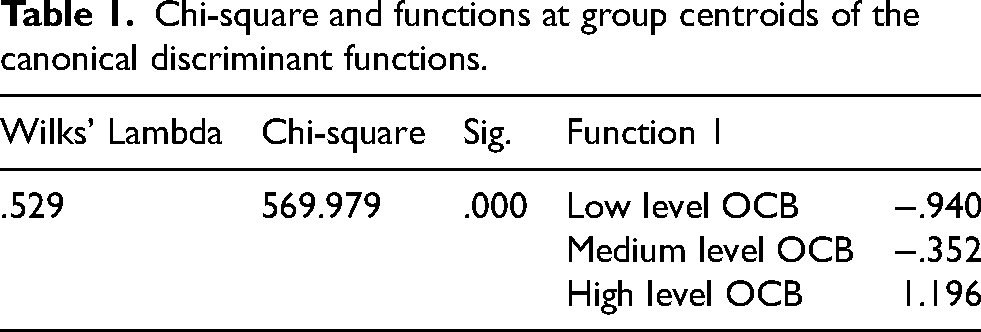
The values of the group centroids (average discriminant scores for each of the groups) range from - 0.940 among employees with less pronounced OCB to 1.196 among employees with more pronounced OCB. The discriminant function was performed for eighteen factors, Wilks ‘Lambda = 0.529, Chi-square = 569.979, p < 0.01.
The results showed that teachers with pronounced OCB compared to those with less pronounced forms of OCB have statistically significantly more pronounced personality traits of Honesty, Conscientiousness, and Agreeableness (Table 2). In addition, teachers characterized by more pronounced OCB are to a greater extent oriented towards advancement in the organization hierarchy; on the other hand, indifferent and ambivalent orientation towards the organization is more pronounced among employees with less pronounced OCB.
Means and the structure matrix of the canonical discriminant functions.
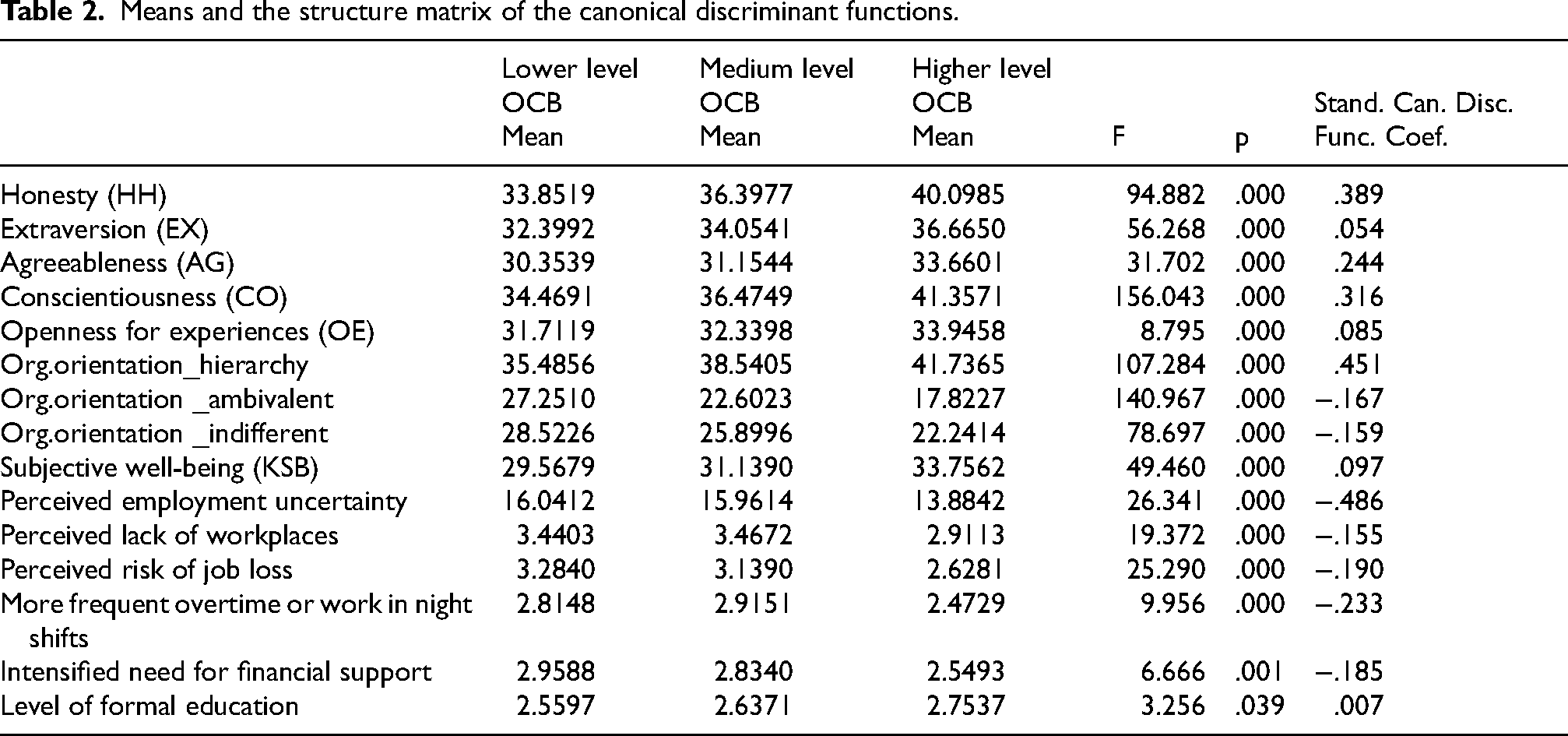
Teachers with less pronounced OCB compared to those with more pronounced OCB are more prone to perceive social circumstances as threatening for their employment certainty/duration of employment (such as increased risk of job loss or perceived lack of workplaces in their current profession). Therefore, it is not an unexpected finding that subjective well-being is somewhat higher among teachers with more pronounced OCB.
The duration of employment of the respondents did not prove to be significant for distinguishing between those with more or less pronounced OCB, even though a higher level of formal education and thus more pronounced income satisfaction are traits of teachers with highly pronounced OCB.
A canonical discriminant analysis was also calculated in relation to certain aspects of OCB, that is, its subscale. Respondents with high scores on the OCB subscales such as Altruism, Courtesy, Civic virtue, Sportsmanship behavior, and Conscientiousness are characterized by highly pronounced personality traits of Honesty, Conscientiousness, and Agreeableness, a pronounced focus on advancement in the organizational hierarchy, and a higher level of subjective well-being; on the other hand, employees with less pronounced OCB are to a greater extent concerned with employment uncertainty, and thus job loss or the lack of potential workplaces on the job market. Teachers with weaker Courtesy, Civic virtue, Sportsmanship behavior, and Conscientiousness aspects of OCB are to a greater extent ambivalent or even indifferently oriented towards their organization.
Given that a significant number of predictor variables are included in the study, the extent to which it is possible to predict OCB was evaluated based on a set of predictor variables consisting of personality traits according to the HEXACO model: organizational orientations, perceived employment uncertainty, subjective well-being, income satisfaction, duration of employment, and level of formal education.
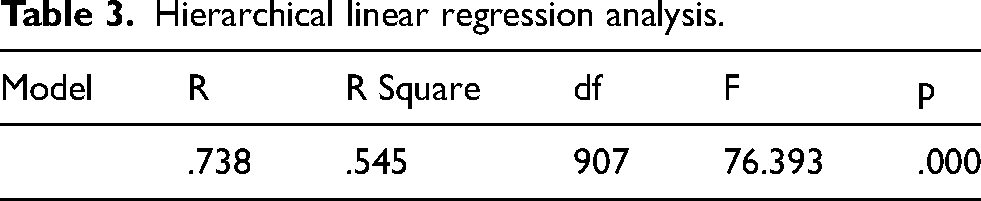
The prediction model was shown to be statistically significant (Table 3). The percentage of explained variability of the criterion variable – OCB accounts for 54.5% of the variability of the criteria. A significant partial contribution to the explanation of the variability of the criterion variable of OCB is made by Honesty (t = 9.816, p < 0.01), Agreeableness (t = 2.510, p < 0.05), Conscientiousness (t = 4.628, p < 0.01), and Openness to experiences (t = 3.984, p < 0.01), organizational orientation toward advancing in the hierarchy (t = 10.423, p < 0.01), ambivalent organizational orientation (t = −7.431, p < 0.01), and duration of employment (t = 4.464, p < 0.01). Beta coefficients are negative only for ambivalent organizational orientation which indicates that the expression of this variable is inversely proportional to the expression of OCB. On the other hand, a higher degree of Honesty, Agreeableness, Conscientiousness, Openness to experiences, organizational orientation toward advancing in the hierarchy and duration of employment lead to more pronounced OCB (positive beta coefficients).
Hierarchical linear regression analysis.
Discussion
OCB, or as the founding father of this concept Dennis Organ defined it, the “good soldier syndrome”, is equated with the desire of employees to voluntarily assist others at work, and thus manifest excellence in the workplace with no expectations and no possibility of receiving any reward or commendation from their employer or superiors.8,10,67 In contemporary society and the actual market economy, all work organizations including schools are constantly and more intensely under pressure from various crises (financial collapses of the market, adjusting to pandemics caused by biological agents, etc.). Therefore, possessing human resources which in addition to performing their regular work roles also have “some sort of gift” to realize roles which are not financially supported or recognized, can be a key factor in the survival, development, and expansion of schools which are aware of this phenomenon, and which are ready to select future teaching personnel and train specific individuals with pronounced OCB.
The core idea behind this study is to present the opportunity to define those traits based on which it is, to a certain extent, possible to make a distinction between teachers who are characterized by pronounced OCB and other collegues. The study analyzed the extent to which certain personality traits, organizational orientations, perceived employment uncertainty, and perceived subjective well-being can help distinguish individuals with pronounced OCB from other teachers.
The results have indicated that teachers who are more prone to manifest OCB are characterized by traits such as Honesty, Conscientiousness, and Agreeableness. Furthermore, precisely those teachers characterized by a tendency towards OCB to a lesser extent perceive the conditions in which they live and work as precarious for job certainty and career advancement. In these current times the increasingly frequent crises and “turbulences” in the socio-economic sphere are stronger than ever, as is the fear of job loss, concern over pay cuts, and the inability to advance in one's career38,68,69 which exponentially increase the significance of such findings. Subjective well-being is more pronounced among teachers who are characterized by OCB, which is confirmed by the results of previous similar studies carried out on this topic.70–73 When the organizational orientation of teachers are in question, it turns out that the indifferent and ambivalent orientation are usual for employees with less pronounced OCB, and that organizational orientation focused on advancement in the hierarchy is a trait of employees with pronounced OCB. Finally, it is worth pointing out that OCB is more pronounced among teachers with higher income, which is not a rare finding in the literature, such as Alkahtani, 74 and that OCB is more pronounced among employees with a higher level of education. The analyses which focused on individual aspects of OCB (Altruism, Courtesy, Civic virtue, Sportsmanship behavior, and Conscientiousness) provided absolutely congruent results to those obtained for the overall OCB score. We must bear in mind that the societal context characteristic of the Southeastern corner of Europe, consisting of a synthesis of diverse cultures, customs, and languages, may play a vital role in defining the relationships between OCB and other variables explored in the research. However, in the last two decades, organizational changes, economic crises, and increasingly stressful work environments are no longer endemic to certain countries but have become global phenomena, 33 forming a standard aspect of life for the modern employees, especially in the educational and scientific sectors. Educational institutions share similarities with other organizations, as the demand for organizational effectiveness is generally increasing in a globalizing world, a phenomenon that has become a worldwide standard. 75 Various studies across the globe22,76–78 emphasize the predictive influence of individual factors on OCB, as well as the relationship with well-being 77 in the teaching profession.
The findings obtained by the canonical discriminant analysis are almost completely corroborated by the results of the regression model of prediction of the extent of OCB based on a set of predictor variables consisting of personality traits according to the HEXACO model: organizational orientations, perceived employment uncertainty, subjective well-being, income satisfaction, duration of employment, and level of formal education. The prediction model proved to be significant and explains approximately 54.5% of the criterion – OCB.
The findings of our research must be considered within the broader context of several decades of devaluation of the teaching profession. Teachers’ salaries in Republic of Serbia are generally low compared to other professions, leading to challenges in attracting and retaining talent in this profession. This, in turn, results in widespread dissatisfaction, with many teachers reporting job insecurity - particularly those on temporary contracts. Furthermore, class sizes are often large, and resources in many schools are limited, negatively impacting the teaching environment.
In addition to their teaching responsibilities, teachers frequently take on additional duties, such as administrative tasks, which further complicates their daily activities. While teaching is still regarded as a respectable profession, societal attitudes toward educators fluctuate based on economic conditions. As a result, teachers frequently demand better working conditions and higher wages, reflecting broader social dynamics. Currently, educational workers in Serbia are protesting to improve working conditions, the status of teachers, and respect for the their profession.
Due to insufficient government investment in the education system, interest and motivation to pursue teaching careers are declining among younger generations from year to year. There is a growing concern that in some teaching areas, a shortage of teachers could significantly affect the quality of education.
Classroom diversity in Serbia reflects a mix of cultural, ethnic, and linguistic backgrounds, shaped by the country's societal history and regional differences. Although this diversity offers significant benefits, it also presents challenges, such as language barriers, cultural misunderstandings, disparities in educational quality, unpreparedness of teachers, social segregation, the reinforcement of prejudices and discrimination, and difficulties in evaluating student performance. Addressing these challenges requires concerted efforts from educators, policymakers, and communities to foster a more inclusive and supportive environment for all students.
Potential limitations of this study important for the audience to consider when interpreting the findings include the cross-sectional design of our study, which captures data at a single point in time. This design limits the ability to infer causality or observe changes over time, which can be a significant limitation in understanding the dynamics of work-related issues. We also highlight the contextual limitations of our study, based on conducting research in specific settings—namely, the educational system of a particular country and a geographically dynamic area. Exceptional importance of this study could be represented throught the significance of this research lies in the fact that it does not replicate other studies from the international area, but instead examines the relationship between key elements of organizational productivity—OCB and the personal characteristics within the sample of teachers, However, this can also be seen as a limitation, as there are no comparable studies in the regions surrounding Serbia on this topic. Nevertheless, this study and its findings can serve as a strong basis for replicating the research with a sample of secondary school teachers and university professors.
Conclusions and implications
It seems that certain fundamental questions regarding educational system reform and improvement of educational practice have been gaining popularity lately. They relate to: (1) ways of creating a “professional community” aimed at achieving optimum performance in school organizations; (2) creating a conductive educational environment in which teachers, as providers of educational services, demonstrate the willingness and desire to contribute to successful changes through their personal qualities and traits; (3) undertaking specific activities to influence the effectiveness and enhance the professionalism of teaching and teachers; (4) bridging the gap between the challenges of academic standards and responsibilities and what is happening in educational institutions and what is necessary for them to achieve competitiveness in the knowledge market; and (5) timely informing of state and national education reform policies about the real situation within educational institutions and learning communities, as well as the possibilities for successful implementation of planned reforms. Answers to such questions largely lie in OCB because school organizations, by their very nature, cannot survive solely within the framework of formally stated teacher job descriptions, but rather within the framework of a whole range of behaviors necessary to achieve goals. Indeed, OCB is not some illusion but is becoming an increasingly visible requirement in education. It is important to bear in mind that it can significantly contribute to the improvement of educational well-being and performance at various levels (school level, educational group, society) and does not imply that managers, least of all teachers as leaders in the near future, become victims of yet another externally imposed demand, but rather the main resource for improving the efficiency and effectiveness of the school by contributing to the transformation of resources, innovation, and adaptability. It is indisputable that at the core of the modern perspective of OCB in school settings lies change and capacity building. More specifically, the contemporary approach highlights transformation that results in affirmative and constructive changes in educational organizations, groups, interpersonal relationships, and environments. Teachers have unlimited opportunities to intervene in all areas of school activity and functioning because they bring their entire personality into work, and this profession is one of the few where there is no clear boundary between private and professional dedication. A teacher never settles for their own successes but seeks them in the successes of their work organization. The teaching profession is imbued with one's entire personality and carried out with a lot of emotion, love, humanity, and selflessness.
Since the sphere of the work environment is a complex continuum, in order to understand, explain, and comprehend it is necessary to take into consideration a broad spectrum of variables, in addition to the personality traits of teachers and their organizational orientation, such as subjective well-being, perceived job uncertainty, the educational and economic-material status of the respondents. Traits of key importance for distinguishing between employees with high and low OCB include Honesty, Conscientiousness, and Agreeableness. Still, it must not be lost sight of an important factor – that the ways in which an individual views the group and organization they belong to could have significant effects on work outcome, and are frequently even more important than those measured through individual attributes. Therefore, it is not surprising that organizational orientation focused on advancement in the hierarchy of the organization “goes hand in hand” with OCB. Considering intensifying competitiveness in the majority of occupational spheres and frequent socio-economic turbulences as in the past but also in the forthcoming period it's clear that teachers’ responsibility, commitment and inventivity to their roles – represented through OCBs - could be crucial factors for success of educational values and goals. Bearing in mind that teachers are the basis of overall functioning of human resources in school and that they are more flexible and creative than technological and structural school's resources, they could be seen as main source for raising the level of school organization effectiveness and productivity and the quality of education in general. Especially, in the setting of extremely frequent changes, turbulent and unstable social surrounding. Thus, it becomes clear that studies focused on shedding light on OCB and variables which are associated with it reflect real needs, both of the scientific and of the wider public. It is precisely these studies and understandings that should further be developed, since what emerged from them are findings that may represent a key factor for the survival, sustainable development, and strengthening of educational organization which is in constant interaction with the broader social context in which, among other things, there is an insistence on the innovation, adjustment, and endurance of human resources.
Based on the analysis of the current state in educational institutions in the Republic of Serbia, it could be concluded that the quality of teachers’ OCB is not only a challenge but also a demand of the modern era and differs from standard organizational behavior. If OCB were understood as a creative category and organizational behavior as unacceptance of the status quo and formally prescribed requirements, it could be said that in this time and within Serbian institutions, more OCB is needed, especially considering the turbulence and variability of the environment. In educational institutions in Serbia, in order to raise their level of effectiveness and productivity and the quality of education in general, it is necessary to refocus on researching OCB in this sector, which would likely result in raising awareness of its importance and spreading a culture of discretionary behavior aimed at all those directly or indirectly involved in educational work, exceeding existing expectations and benefiting both the teacher's role and the school as a whole.
Footnotes
Acknowledgements
We would like to thank all teachers for participation, help and support in conducting research.

Ethical approval
This study was conducted after evaluation and approval from the Research Ethics Committee of the Faculty of Philosophy (approval: RECFPUNI24/01) and Research Ethics Committee of the Department of Psychology (approval: 5-2024) established at the Faculty of Philosophy, University of Niš.
Informed consent
Informed consent has been obtained from all participants.
Funding
The author(s) disclosed receipt of the following financial support for the research, authorship, and/or publication of this article: This research was supported by the Ministry of Science, Technological Development and Innovation of the Republic of Serbia (Contract No. 451-03-66/2024-03). Prepared within the project Affirmation of pedagogical theory and practice in contemporary society, as well as the project Popularization of science and scientific publications in the field of psychology and social policy, which are carried out at the Faculty of Philosophy of the University of Niš (No. 336/1-6-01).
Declaration of conflicting interests
The authors declared no potential conflicts of interest with respect to the research, authorship, and/or publication of this article.