







Abstract
Background
This study addresses the gap in evidence-based interventions for work stress, burnout, and coping strategies among sports coaches, which are critical for their psychological health and performance.
Objective
This study aimed to evaluate the novel application of a mindfulness training program to alleviate stress, burnout, and enhance coping strategies among sports coaches.
Methods
Sixty-one coaches were randomly assigned to an experimental (n = 30) and control group (n = 31). The experimental group completed a four-week, twice-weekly 90-min mindfulness training. Assessments included the five facets mindfulness questionnaire (FFMQ) and measures of job pressure, burnout, and coping strategies, with analyses of correlations and linear regressions between mindfulness and these factors.
Results
The FFMQ correlated negatively with various stressors (R ranging from −0.331 to −0.943, p < 0.001) and burnout indicators (R = −0.414 to −0.480, p < 0.001). Job pressure predicted mindfulness levels (β = −0.973), with a predictive model: Y = 206.275–0.973 * job pressure. The experimental group's FFMQ scores rose by 13.9% at week four (p = 0.003), with reductions in job pressure, external competition, and negative coping (7.4%, 20.3%, and 18.1% respectively, p < 0.05). They also outperformed the control group in FFMQ scores and stress measures at week four (p < 0.05).
Conclusion
A four-week mindfulness program significantly enhances mindfulness, reduces job stress, burnout, and negative coping among sports coaches, underscoring its potential as an evidence-based intervention for improving work performance and mental health.
Keywords
Introduction
Sports coaches are instrumental to athlete performance, with their psychological well-being and job performance shaping training and competition outcomes.1,2 Work-related stress profoundly affects psychological health and job effectiveness.3,4 Despite the crucial role that sports coaches occupy in sports, the job pressure they endure often does not receive adequate attention.5,6 Particularly in the high-stress, high-competition environment of competitive sports, the job pressure faced by coaches is especially pronounced.7,8 Burnout, resulting from job pressure, not only affects coaches’ job satisfaction and quality of life but also impacts their engagement and satisfaction, thereby negatively affecting the training outcomes of athletes and the team atmosphere. This phenomenon has been widely confirmed in the research fields of psychology and occupational health.9,10
In Sichuan Province, China, the issue of job pressure among sports coaches is particularly salient. Our previous research has revealed that job pressure is a significant factor leading to job burnout among coaches in this region, with organizational support and negative coping strategies mediating the relationship between job pressure and burnout. 11 These findings underscore the importance of alleviating job pressure in sports coaches, enhancing coping strategies, and improving the sense of organizational support to potentially reduce job burnout. 11 Unfortunately, our previous research did not propose effective intervention methods for improving the job pressure and occupational burnout of coaches. Current research tends to focus on the causes and influencing factors of job pressure and burnout,12–14 with relatively less exploration of how to effectively intervene and alleviate these issues.
Mindfulness training mitigates job pressure,15,16 bolsters coping skills,17,18 and enhances psychological resilience.19,20 By fostering a comprehensive awareness and acceptance of current experiences, mindfulness training helps to diminish automatic reactions and emotional distress, thereby improving psychological health.21,22 In the field of competitive sports, mindfulness training has garnered widespread attention and research as an intervention to enhance psychological health and performance. However, the majority of studies have concentrated on elite athlete populations, exploring how mindfulness training can help improve their focus,23,24 emotional regulation capabilities,22,25 and competitive performance.26,27 In contrast, there is relatively less research on mindfulness training for sports coaches. A study involving twenty Division I coaches who underwent the Mindfulness Training for Coaches reported reduced anxiety, increased emotional stability, and improved well-being. 28 Another study with 46 coaches over 28 days found that daily increases in mindfulness were linked to better recovery, suggesting that mindfulness training could be a promising intervention to enhance coaches’ daily recovery and prevent burnout. 29 A six-week mindfulness training program has been shown to elevate stress and burnout among sports coaches. 30 However, the aforementioned studies did not elucidate the relationship between mindfulness training and occupational stress or coping strategies. As guides and educators in the athletic training process, the psychological quality and stress-coping abilities of sports coaches also have an undeniable impact on the development of athletes and the performance of the team. 31
Although mindfulness training has been extensively studied for enhancing athlete performance and well-being, its impact on sports coaches has not been adequately explored, especially in the high-pressure, high-competition environment of competitive sports. This study addresses this research gap by focusing on the specific and under-researched group of sports coaches and applying mindfulness training within a cultural context, an area less frequently covered in previous studies. The novelty of our research lies in not only examining the effects of mindfulness training on individual psychological measurements but also proposing a new approach to managing and preventing job burnout among competitive sports coaches, offering a fresh perspective for cross-cultural research. Research hypotheses:
Materials and methods
Participants
This study was conducted during a training session for sports coaches organized by the Sichuan Provincial Sports Bureau (April-May 2024), and was approved by the Ethics Committee of Sichuan Sports College (202312). Building on our previous research involving a similar participant group, 11 we recruited sports coaches who were interested in participating in this study. The inclusion criteria were as follows: sports coaches aged 30 to 60, who passed a health questionnaire and physical examination, were willing to participate and able to complete the entire experimental process, adhered to the Declaration of Helsinki, and signed an informed consent form. Exclusion criteria included the presence of psychological disorders such as depression and the use of medications that could affect mood.
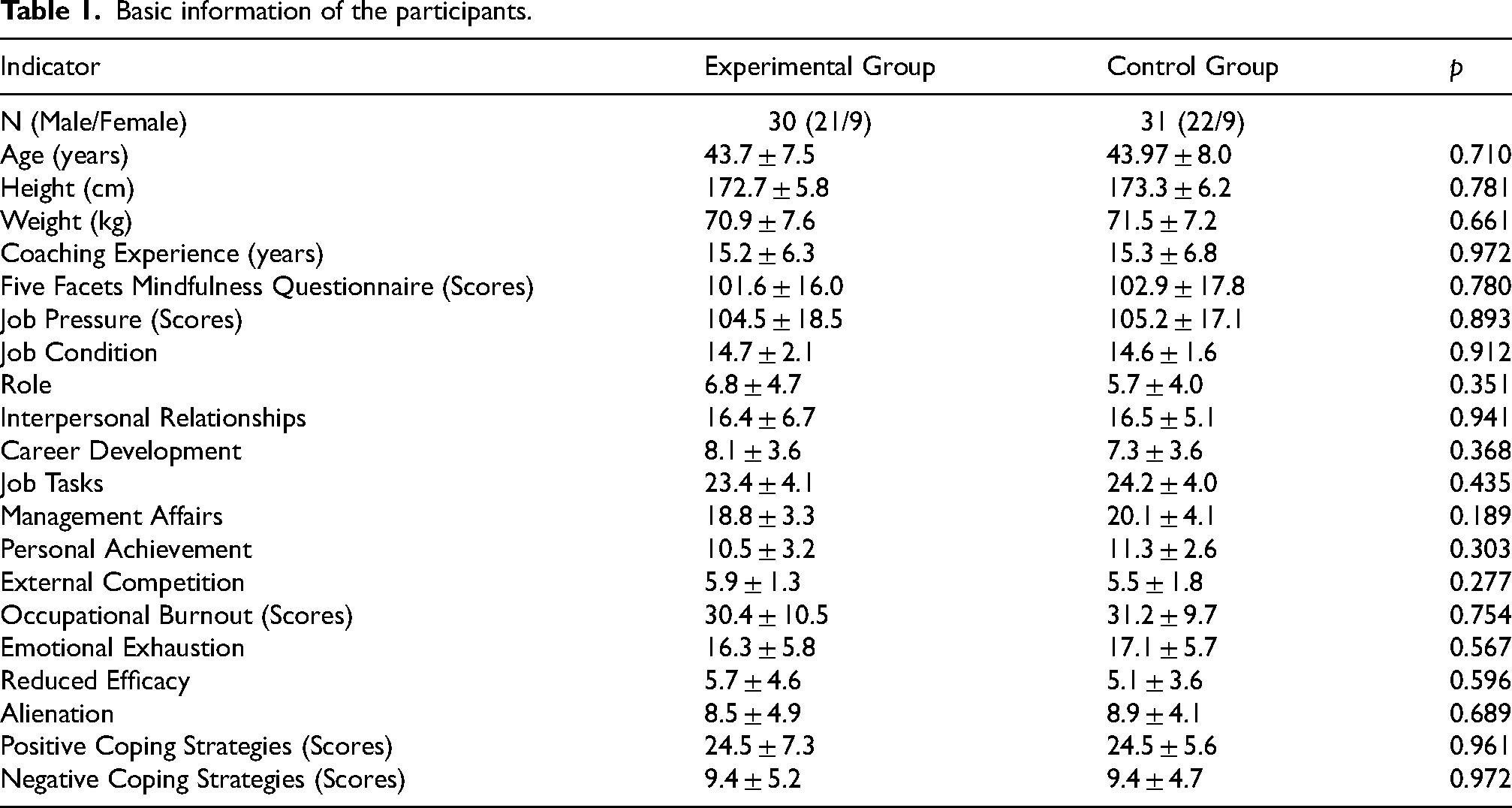
Referring to previous research on sports coaches,28,29,30 and considering a 2 (number of measurements) by 2 (number of groups) experimental design with an effect size of 0.3, a significance level of 0.05, a statistical power of 0.8, and accounting for approximately 5% sample loss, a minimum of 60 participants was calculated to be necessary. Initially, sixty-two participants were recruited. To ensure the randomness and fairness of the allocation process, we utilized a computer-generated list of random numbers to assign participants. Through this method, participants were randomly assigned to either the experimental group (31 participants) or the control group (31 participants). One participant left due to personal reasons in the second week, resulting in a 1.6% sample loss, and ultimately 61 participants completed the entire process. Basic information of the participants in both groups is presented in Table 1. There were no statistically significant differences in baseline data between the groups (p > 0.05), indicating homogeneity of the samples at the start of the experiment, providing a reliable basis for subsequent comparative analysis.
Basic information of the participants.
Intervention methods
The intervention in this study is a four-week mindfulness training program designed to enhance sports coaches’ ability to cope with job pressure, reduce occupational burnout, and improve their coping strategies. The program consists of two 90-min guided sessions per week, led by an experienced mindfulness trainer. The training includes a variety of mindfulness exercises such as body scans, mindful walking, and mindful breathing, as well as guidance on how to apply these practices in daily life and work. The evaluation of the intervention's effectiveness includes pre- and post-tests with the Five Facets Mindfulness Questionnaire (FFMQ) and other relevant psychological assessment tools.
Before the experiment began, the procedures of the study were thoroughly explained to the participants, and the principles of privacy protection were emphasized to ensure that each participant could voluntarily participate based on a full understanding of the content and purpose of the research. Participants in the experimental group underwent a four-week mindfulness training program, with two 90-min sessions per week, totaling eight sessions. The control group maintained their original lifestyle and routine without receiving any form of psychological or physical intervention.
The mindfulness training was guided by an experienced mindfulness trainer (with over ten years of intervention experience). Training sessions were scheduled on Tuesday and Friday evenings to facilitate participation during the intensive training period. At the beginning of each session, participants were encouraged to share their experiences from the previous week's practices and discuss any confusion or problems encountered during the practices. The trainer emphasized the importance of the practices in each session and provided timely feedback and guidance on issues encountered by the participants. The study employed a culturally adapted mindfulness-acceptance-insight- commitment model for Chinese sports coaches, encompassing preparation, practice, decentering, acceptance, values, engagement, and integrated practice to enhance mindfulness. 32
Questionnaire testing
To accurately measure the mindfulness levels, job pressure, job burnout, and coping strategies of sports coaches, this survey employed questionnaires tailored for the Chinese population. The job pressure, job burnout, and coping strategy questionnaires have been proven to have high reliability and validity in our previous research. 11 Identical questionnaires were administered at baseline (one day before the first mindfulness training) and after the 4-week intervention.
Five Facets Mindfulness Questionnaire: The Chinese version of the Five Facets Mindfulness Questionnaire (FFMQ), revised by Deng et al., 33 was used to measure the mindfulness levels of sports coaches. It consists of 39 items, rated on a 5-point scale from “not at all” to “very much,” scored from 1 to 5 (items marked with R for reverse scoring, scored from 5 to 1). It includes: observation (1, 6, 11, 15, 20, 26, 31, 36), description (2, 7, 12R, 16R, 22R, 27, 32, 37), aware actions (5R, 8R, 13R, 18R, 23R, 28R, 34R, 38R), non-judgmental inner experience (3R, 10R, 14R, 17R, 25R, 30R, 35R, 39R), and non-reactivity (4, 9, 19, 21, 24, 29, 33). Higher scores indicate higher levels of mindfulness among sports coaches. The Cronbach's α coefficients for each subscale and the total scale for the Chinese population are 0.439—0.843. 33
Job pressure Questionnaire: Based on the Occupational Stress Indicator designed by Cooper (1988), 34 a job pressure questionnaire suitable for sports coaches in China was revised, 35 consisting of 41 items, rated on a 5-point scale from “completely disagree” to “completely agree,” scored from 0 to 4. It includes eight dimensions: job condition (1–4), role (5–9), interpersonal relationships (10–17), career development (18–20), job tasks (21–27), management affairs (28–34), personal achievement (35–39), and external competition (40–41). Higher scores indicate greater perceived job pressure. The Cronbach's α coefficient for this questionnaire among sports coaches in China is 0.868, with a composite reliability of 0.870. 34
Burnout Questionnaire: Based on Maslach's questionnaire, 36 a Chinese version of the burnout questionnaire, revised by Guo (2017), 37 consists of 15 items, rated on a 7-point scale. It includes three dimensions: emotional exhaustion (1–5), reduced efficacy (6–11), and depersonalization (12–15). Scores for emotional exhaustion and depersonalization range from 0 to 6, while scores for reduced efficacy range from 6 to 0, with higher scores indicating higher levels of burnout. The Cronbach's α coefficient for this questionnaire among sports coaches in China is 0.892, with a composite reliability of 0.881. 38
Coping Strategy Scale: A simplified coping strategy scale for the Chinese population, 11 consisting of 20 items, rated on a 4-point scale from “never” to “often,” scored from 0 to 3. It includes two dimensions: positive coping (1–12) and negative coping (13–20). Higher scores on the positive coping dimension indicate more frequent use of positive coping strategies, while higher scores on the negative coping dimension indicate more frequent use of negative coping strategies. The Cronbach's α coefficient for this scale among sports coaches in China is 0.901, with a composite reliability of 0.866. 35
Reliability and validity testing of questionnaires
Cronbach's α was used to test the reliability of all valid questionnaires from the two measurements, with α ≥ 0.70 indicating high reliability, 0.35 ≤ α < 0.70 indicating acceptable reliability, and α < 0.35 indicating low reliability. 39 The reliability tests yielded α values of 0.761 and 0.779, indicating high reliability in the two questionnaire administrations.
Statistical analysis
SPSS 20 was used for statistical analysis of all participant measurement data. First, Spearman's analysis was conducted to examine the correlations between FFMQ and job pressure, job burnout, and coping strategies in the 122 measurements from all participants (baseline and week four). A linear regression model was established with FFMQ scores as the dependent variable and other factors as independent variables to predict the relationship between participants’ mindfulness levels and job pressure, job burnout, and coping strategies. Second, a two-way analysis of variance (ANOVA) was used to analyze the interaction effects of group (2) and time (2). If there was an interaction effect, we analyzed whether there were separate effects of time or group; if there was no interaction effect, we analyzed whether there were main effects of group or time.40,41 The significance level was set at α=0.05.
Results
Correlations and linear regression between FFMQ and other factors
The results section begins by presenting the correlations between the Five Facets Mindfulness Questionnaire (FFMQ) scores and the key variables of job pressure, job burnout, and coping strategies as shown in Table 2. Notably, the FFMQ demonstrated a robust negative correlation with job pressure (R = −0.943, p < 0.001), indicating that as mindfulness increases, perceived job pressure significantly decreases. Similarly, significant negative correlations were observed with burnout indicators, with the strongest association found for emotional exhaustion (R = −0.470) and depersonalization (R = −0.414), both p < 0.001. These results underscore the potential of mindfulness to mitigate the adverse effects of job pressure and burnout among sports coaches. A linear regression model was established with FFMQ scores as the dependent variable and other factors as independent variables, demonstrating a linear relationship between FFMQ scores and job pressure (F(1, 119) = 970.76, R² = 0.890, β = −0.973, 95% CI: −1.035 to −0.911, p < 0.001). The regression equation for predicting the FFMQ scores of sports coaches is: Y = 206.275–0.973 * job pressure. These findings directly support our research objective, which is to assess the impact of mindfulness training on sports coaches’ work stress, job burnout, and coping strategies. In particular, the strong negative correlation between the FFMQ and work stress (R = −0.943) and the regression model (β = −0.973) suggest that mindfulness training may effectively reduce the work stress of coaches, a key factor in improving their psychological health and job performance.
The correlation between the five facets mindfulness questionnaire, job pressure, occupational burnout, and coping strategies. (N = 122).

Intragroup and intergroup comparison results
The results of the intragroup and intergroup comparisons are shown in Figure 1. A two-way ANOVA was conducted to examine the interaction effects of group (2) and time (2). An interaction effect was found for FFMQ (F = 4.438) and external competition (F = 4.460), indicating that group and time had an interactive effect (p < 0.05). No interaction effects were found for other indicators (p > 0.05). Further analysis yielded the following results:
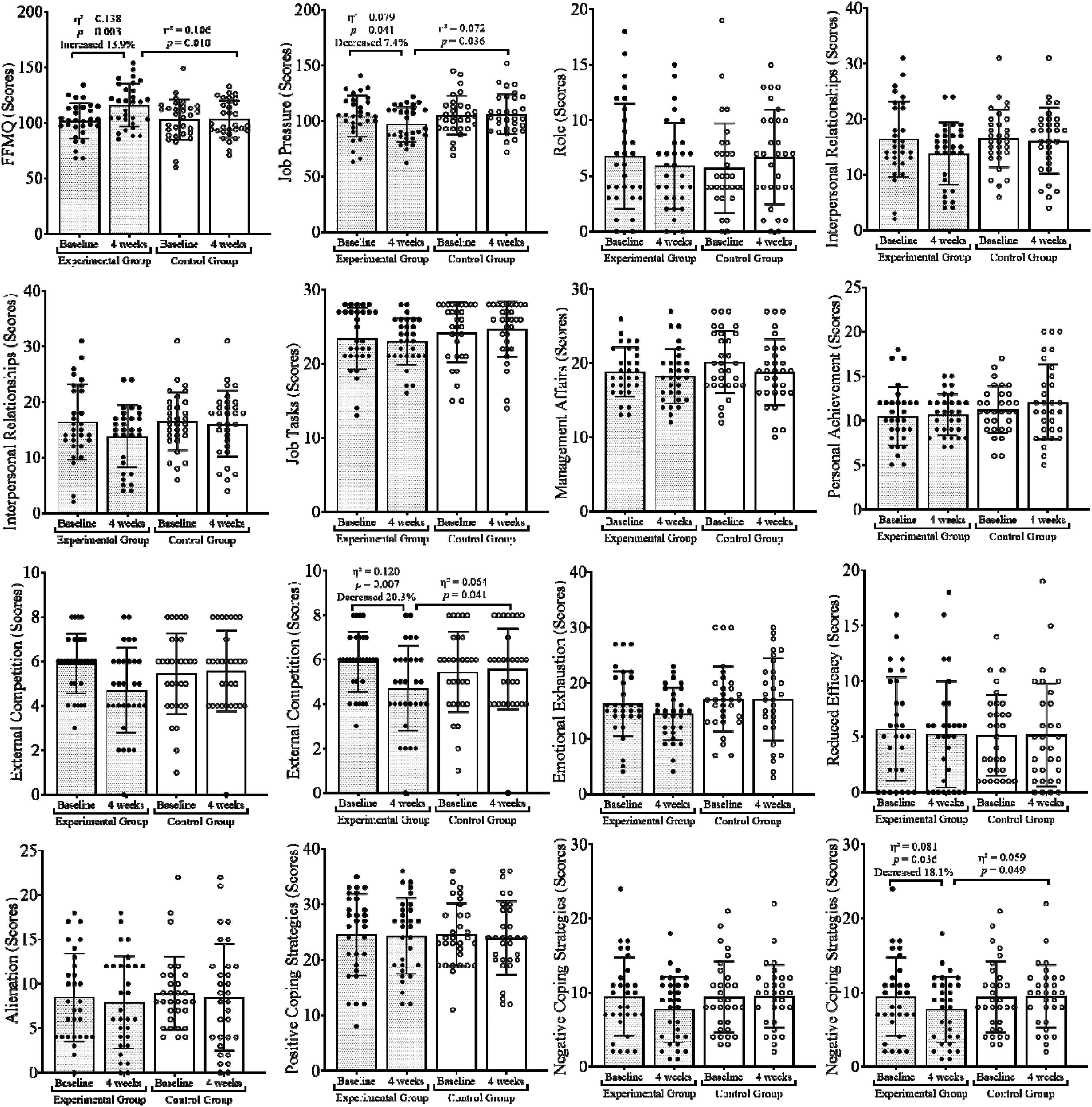
Data changes in the experimental group and the control group
Within-group comparison at week four versus baseline: The experimental group showed a 13.9% increase in FFMQ scores (η² = 0.138, p = 0.003). Job pressure scores decreased by 7.4% (η² = 0.079, p = 0.041), and external competition scores decreased by 20.3% (η² = 0.120, p = 0.007). Negative coping decreased by 18.1% (η² = 0.081, p = 0.036). Other indicators showed a decreasing trend but were not statistically significant (p > 0.05).
The control group showed no statistically significant differences in any indicators (p > 0.05). Intergroup comparison at week four: The experimental group had significantly higher FFMQ scores than the control group (η² = 0.106, p = 0.010), and significantly lower scores in job pressure (η² = 0.072, p = 0.036), external competition (η² = 0.064, p = 0.041), and negative coping (η² = 0.059, p = 0.049). Other indicators showed a decreasing trend but were not statistically significant (p > 0.05). The significant increase (13.9%) in FFMQ scores for the experimental group, along with the reduction in work stress, external competition, and negative coping, not only confirms the effectiveness of mindfulness training but also provides new evidence for psychological interventions for sports coaches.
Discussion
This study aimed to evaluate the impact of a four-week mindfulness training program on job pressure, job burnout, and coping strategies among sports coaches. The results, which reveal significant negative correlations between mindfulness levels and key job-related stress factors, align with and extend previous research28,29,30 by highlighting the specific benefits of mindfulness training in the context of sports coaching. The findings reveal a significant negative correlation between mindfulness levels and job pressure (R = −0.943), job burnout (R = −0.480), and negative coping behaviors (R = −0.331). These correlations suggest that mindfulness may be linked to lower levels of these negative factors. Additionally, the regression analysis indicates that job pressure is correlated with mindfulness levels (β = −0.973), which could imply a trend toward lower mindfulness with increased job pressure.
Partial support for hypothesis H2 indicates that our four-week mindfulness training program not only influences individual psychological measures but also offers a novel approach to stress management and burnout prevention in competitive sports coaching, a perspective that has been understudied in cross-cultural contexts. The experimental group's increase in FFMQ scores post-training is associated with an improvement in mindfulness, which may be linked to better awareness and acceptance of current experiences. The observed decrease in job pressure could be related to the mindfulness training, potentially aiding in the management of work-related stress. Furthermore, the training's association with reduced job burnout and negative coping strategies suggests that it may contribute to the development of more adaptive coping mechanisms.
In the field of competitive sports, the main subjects of mindfulness training have been elite athletes.23–27 Few studies have reported on the relationship between mindfulness training on sports coaches. For instance, regular mindfulness training has been shown to reduce anxiety and increase well-being in sports coaches. 28 Four weeks of mindfulness training can promote psychological recovery and prevent burnout in sports coaches. 29 Six weeks mindfulness training program has been shown to reduce stress and job burnout in sports coaches. 30 These studies28,29,30 are consistent with this study. It is worth noting that compared to previous studies,28,29,30 this study was conducted in Sichuan Province, China, and considered the cultural background, which may affect the acceptance and effectiveness of mindfulness training, providing a new perspective for cross-cultural research. We found that mindfulness training can reduce negative coping strategies among sports coaches in China, and reducing negative coping strategies can further alleviate job pressure and job burnout. 11 Mindfulness training improves the coaches’ comprehensive awareness and acceptance of current experiences, reducing automatic reactions and emotional distress, thereby reducing job pressure and job burnout. Moreover, mindfulness training may also enhance self-regulation capabilities and improve negative coping strategies, further expanding on previous research.28,29,30
The association between regular mindfulness training on sports coaches may be related to several factors. First, mindfulness training has been proven to enhance participants’ psychological resilience19,20 and emotional regulation capabilities,17,18 which may be key factors in reducing job pressure and job burnout. Second, mindfulness training strengthens participants’ awareness and understanding of their emotional states,21,22 enabling them to face stressful situations more calmly, which may contribute to mitigating the intensity of negative emotions and enhancing the ability to regulate emotions. Additionally, mindfulness training promotes a shift from relying on negative coping strategies to positive coping strategies, such as problem-solving and seeking support, which helps to manage and alleviate job pressure more effectively.
This study confirms the benefits of mindfulness training in enhancing the psychological well-being and stress management of sports coaches. It suggests that sports organizations should integrate such training into their development programs to improve the resilience and performance of coaches. Cultural adaptation of these programs is crucial for maximizing benefits, highlighting the need for policymakers to include mental health support for coaches in sports budgets. Despite challenges in engagement and cultural adaptation, the intervention provided key insights into enhancing coaches’ well-being, emphasizing the need for cultural sensitivity in mindfulness practices. Mindfulness training shows promise in improving psychological health across different cultural contexts.
This study has limitations. The single Randomized Controlled Trial design limits our ability to infer causality, and our findings are preliminary, necessitating further validation with larger samples and diverse methods. Selection bias may have occurred due to voluntary participation, suggesting a need for broader recruitment and random sampling in future studies. The small sample size restricts generalizability, and the study overlooked individual differences, work environments, trainer experience, and training quality. The brief training period might not have altered deeply ingrained coping strategies or job pressure perceptions. Future research should expand sample sizes, investigate long-term mindfulness training effects, and consider individual and environmental factors for a comprehensive understanding of its psychological impact on coaches.
Conclusion
This study demonstrated that a four-week mindfulness training program effectively enhances mindfulness levels and reduces job pressure, burnout, and negative coping strategies among sports coaches, directly addressing our research objective. The significant improvements in psychological health and the downward trend in emotional exhaustion and depersonalization support the utility of mindfulness training as an intervention to improve work performance and mental well-being in this population.
Footnotes
Acknowledgements
Thanks to the participants who participated in this study.
Ethical approval
This study was approved by the Ethics Committee of the Sichuan Sports College (202312).
Informed consent
This study involving humans were approved by the study was conducted according to the guidelines of the Declaration of Helsinki. All the participants have signed an informed consent form in all participants.
Author contributions
QQT and LC: designing this study, writing initial draft and revision, revising language and content, supervision, project administration, and funding acquisition. QQT: making figure and table. LC: rechecking the manuscript and putting forward suggestions for amendment. All authors contributed to the article and approved the submitted version.
Funding
The authors disclosed receipt of the following financial support for the research, authorship, and/or publication of this article: This work was supported by the The Central Guidance for Local Science and Technology Development Fund Projects, (grant number 2024ZYD0001).
Declaration of conflicting interests
The authors declared no potential conflicts of interest with respect to the research, authorship, and/or publication of this article.
Data availability statement
The raw data supporting the conclusions of this article will be made available by the authors, without undue reservation.