







Abstract
Background
Nursing is considered a hard job and the stressors associated with this work can have negative effects on life satisfaction, quality of life and mental health.
Objectives
The study aimed to develop a potential predictive model to identify the main factors influencing nurses’ mental health, focusing on personal characteristics, working conditions, quality of life, and life satisfaction.
Methods
This cross-sectional study was focused on a sample of nurses at university hospital center in Sfax-Tunisia. Validated self-reporting instruments were used: Satisfaction With Life Scale (SWLS), World Health Organization Quality Of Life – BREF (WHOQOL-BREF) and General Health Questionnaire (GHQ 28). Statistical software R was used to perform the statistical analyses.
Results
The survey included 199 nurses. The average GHQ-28 score was 27.3 ± 12.4. The predictive model identified the following significant predictors of psychological distress: female gender (β = 0.54, p < 0.001), presence of a chronic disease (β = 0.56, p < 0.001), bad financial status (β = 0.54, p < 0.001), and life satisfaction score (β = −0.6, p < 0.001), collectively explaining 40% of the variance in the total GHQ 28 score.
Conclusion
These findings indicate that interventions promoting the mental health of nurses could be implemented by improving modifiable predictors such as physical health and life satisfaction.
Introduction
The stress factors associated with lifestyle and professional activities can lead to psychological instability and interfere with the effective performance of professional tasks. 1 Healthcare workers are particularly vulnerable to continuous stress, which can result in cognitive, psychological, and physical problems.2,3 Specifically, nurses play a crucial role in protecting and ensuring public health and their mental health is closely linked to the quality of the nursing care they provide. However, nursing is associated with elevated levels of stress, 4 poor quality of life, 5 and burnout syndrome, 6 primarily due to extended working hours and job-related frustration. 7
Existing research has extensively explored the factors contributing to burnout and psychological distress among nurses, emphasizing working conditions and individual characteristics.8,9 However, psychological well-being is increasingly recognized as a complex and multidimensional concept, encompassing cognitive and affective components that influence mental states and perceptions. 10 Some authors have suggested that personality traits, including affective temperaments, interact with life satisfaction and job satisfaction, particularly in health professions.10,11 Despite this recognition, most of the existing studies have focused on isolated variables without examining the combined effects of personal, professional, and social factors. This gap is particularly significant, as interactions between these dimensions play a crucial role in nurses’ mental health.12,13 Studies have shown that mental health profiles are strongly correlated with nurses’ life satisfaction and professional quality of life.14,15 Similarly, personal factors such as health status, economic stability, and overall quality of life also emerge as key determinants of psychological well-being.16,17
Given the lack of comprehensive predictive models that integrate these interrelated dimensions to identify the determinants of mental health outcomes among nurses, addressing this gap is essential for developing targeted psycho-educational strategies to mitigate work-related stress, improve mental health, and reduce the risk of job dissatisfaction.18,19
Thus, the current study had been conducted to evaluate the psychological well-being of nurses in a hospital-based context and to propose an example of a potential predictive model that identifies the key determinants of mental health. The study specifically focuses on personal and professional variables, quality of life and life satisfaction among nursing staff members. By integrating these dimensions, this research seeks to provide an example of a predictive model of nurses’ psychological well-being and guide future interventions to support their mental health.
Methods
Study design and procedure
This observational study was carried out with nurses at the University Hospital Center in Sfax, Tunisia, from July 2022 to December 2022. Nurses were invited to complete a self-administered questionnaire. This study adhered to the ethical standards set forth by the Declaration of Helsinki. Participants’ confidentiality was ensured throughout the data collection and analysis process. All participants were informed of the study's objectives, their right to confidentiality, and anonymity, and they provided their informed consent before participating in the study.
Participants
The present study concerns nurses working at the university hospital center in Sfax-Tunisia. The eligibility criteria included nurses actively engaged in direct patient care with a permanent employment contract. Exclusion criteria encompassed nurses with a history of psychiatric disorders and those who chose not to participate in the survey. Additionally, incomplete questionnaires were excluded from the data analysis.
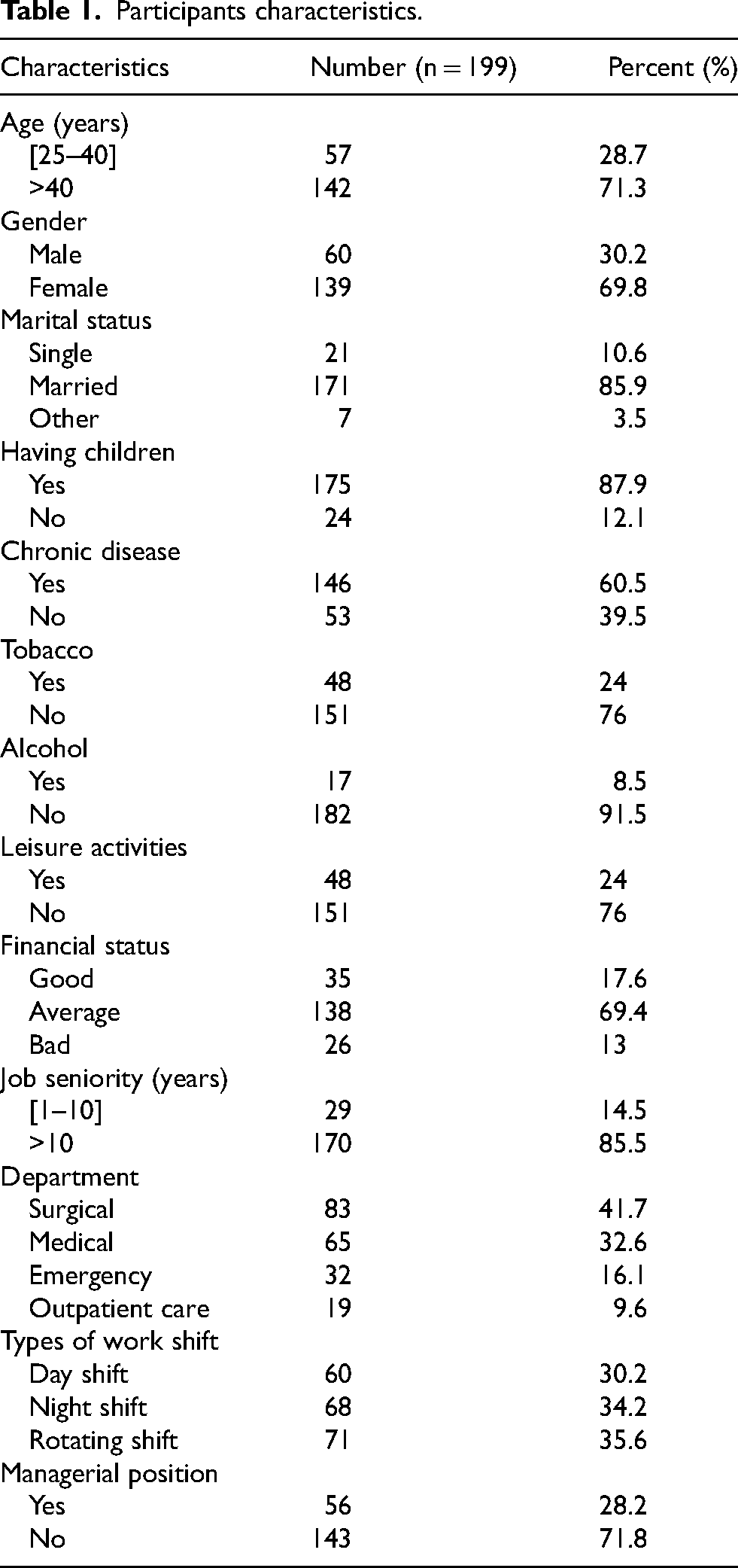
Among the nurses included in the study, the average age was 46.5 ± 8.7 years. The largest group (71.3%) comprised nurses over the age of 40. The majority of participants (69.8%) were female, and 85.9% were married. Additionally, 146 respondents (60.5%) reported having one or more chronic conditions. Regarding occupational factors, 85.5% of participants had more than 10 years of job experience. The majority (41.7%) worked in surgical departments, and 35.6% were involved in rotating shift work (Table 1).
Participants characteristics.
Variables and data measurements
Data collection was conducted using a structured, self-administered questionnaire. All the scales employed in this study have been widely validated and extensively utilized in both international and Tunisian research,14,20–22 demonstrating strong reliability and validity in healthcare settings, particularly among nursing professionals. To ensure linguistic and cultural relevance, the instruments were administered in their validated French versions.
Personal and occupational information to identify participants’ characteristics The Satisfaction with Life Scale (SWLS):
23
This 5-item self-report questionnaire assesses overall life satisfaction. Participants respond using a 7-point Likert scale, where 1 represents “strongly disagree” and 7 represents “strongly agree.” The total SWLS score is derived by summing the responses to the five items, with higher scores indicating greater life satisfaction. The World Health Organization Quality of Life-BREF (WHOQOL-BREF):
24
Developed from the comprehensive WHOQOL-100, this instrument comprises 26 items. It includes one item from each of the 24 facets of the WHOQOL-100, along with two additional items on overall quality of life and general health. Responses are rated on a 5-point scale assessing intensity, capacity, frequency, and evaluation. The WHOQOL-BREF evaluates four domains: physical health, psychological health, social relationships, and environmental health. Scores are presented on a scale from 0 to 100. The General Health Questionnaire (GHQ-28)
25
is used to identify individuals whose mental health has deteriorated. It includes 28 items divided into four areas: somatic symptoms, anxiety and insomnia, social dysfunction, and depression. Each item is scored from 0 to 3, with total scores ranging from 0 to 84. Higher scores indicate greater psychological distress.
Statistical analysis
Statistical analyses were performed using R software, version 4.0.1. 26 Internal consistency assessment was performed separately for the three scales and each dimension by calculating Cronbach's alpha. A Cronbach's alpha of ≥0.7 indicates that the scale has good to excellent reliability. 27
The Gaussian distribution of the quantitative variables was evaluated using the Shapiro-Wilk test.
Transformations were applied to specific variables to enhance the symmetry of their distributions, making them more close to Gaussian distribution. Indeed, a square root transformation was performed to improve the distribution of the dependent variable (GH28 total score).
Quantitative variables are reported with mean ± standard deviation (SD), while categorical variables are expressed as percentages. Means between two groups were compared using the Student's t-test, and the chi-square test was used for categorical variables. A p-value of less than 0.05 was considered statistically significant.
We performed a multivariate analysis with the GHQ-28 score as the dependent variable, employing multiple linear regression with a backward selection method to evaluate the significance of predictor variables (p < 0.005 in univariate analysis). The final model was chosen based on the lowest Akaike Information Criterion (AIC) and was validated through the following steps:
A posteriori analysis of the residuals: ensuring they follow a normal distribution, exhibit homogeneous variance (homoscedasticity), and are independent. Identification of outliers by measuring the Cook's distance, with a value greater than 1 indicating an outlier. Detection of multicollinearity problems using the variance inflation factor (VIF). VIF values greater than 5 indicate the presence of multicollinearity.
Results
Of the 350 distributed questionnaires, 250 were returned, resulting in a response rate of 71.4%. After excluding 51 questionnaires due to incomplete responses or missing data, 199 questionnaires (56.8%) were included in the analysis.
Mental health status, life satisfaction and quality of life
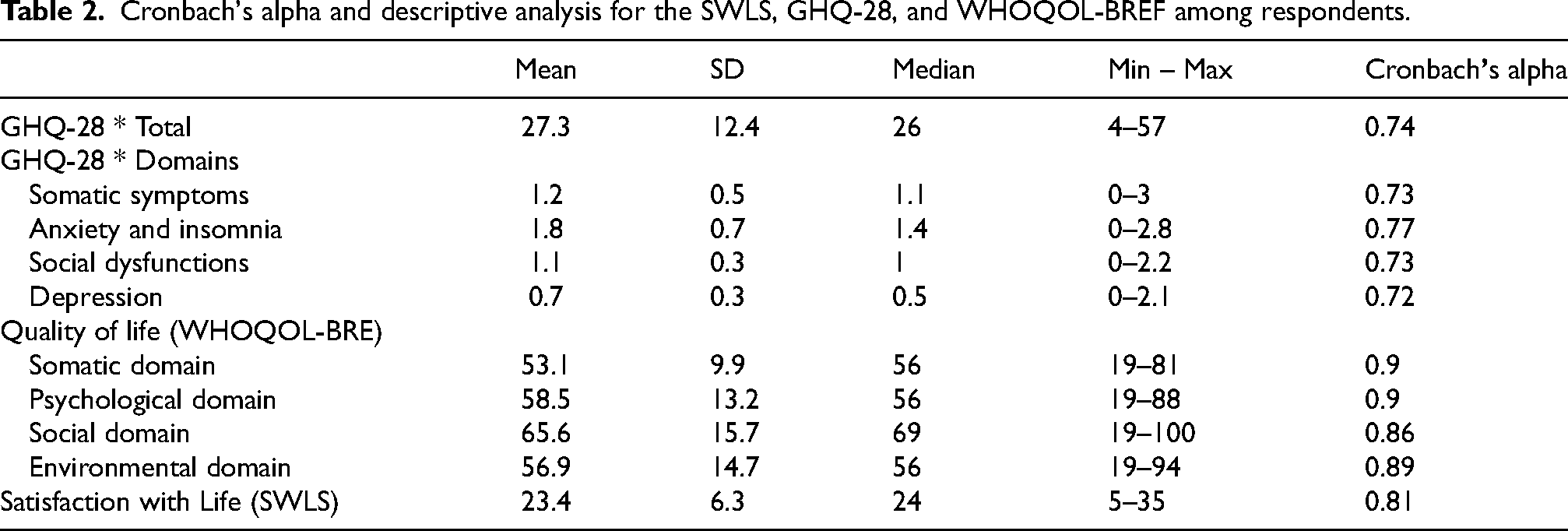
Internal consistency and descriptive statistics of the questionnaires are provided in Table 2. Cronbach's alpha values demonstrated good internal consistency (≥ 0.7).
Cronbach's alpha and descriptive analysis for the SWLS, GHQ-28, and WHOQOL-BREF among respondents.
Factors affecting mental health status (GHQ-28)
Mental health status and personal and occupational factors
Sociodemographic variables that showed a significant correlation with GHQ-28 scores were age >40 (p = 0.000), female gender (p = 0.005), having children (p = 0.011), chronic disease (p = 0.000) and bad financial status (p = 0.000).
For the study of occupational variables, nurses working in emergency department (p = 0.000) and having rotating shift (p = 0.000) showed a higher GHQ-28 mean score. The detailed data are shown in Table 3.
Determinant factors of mental health score.
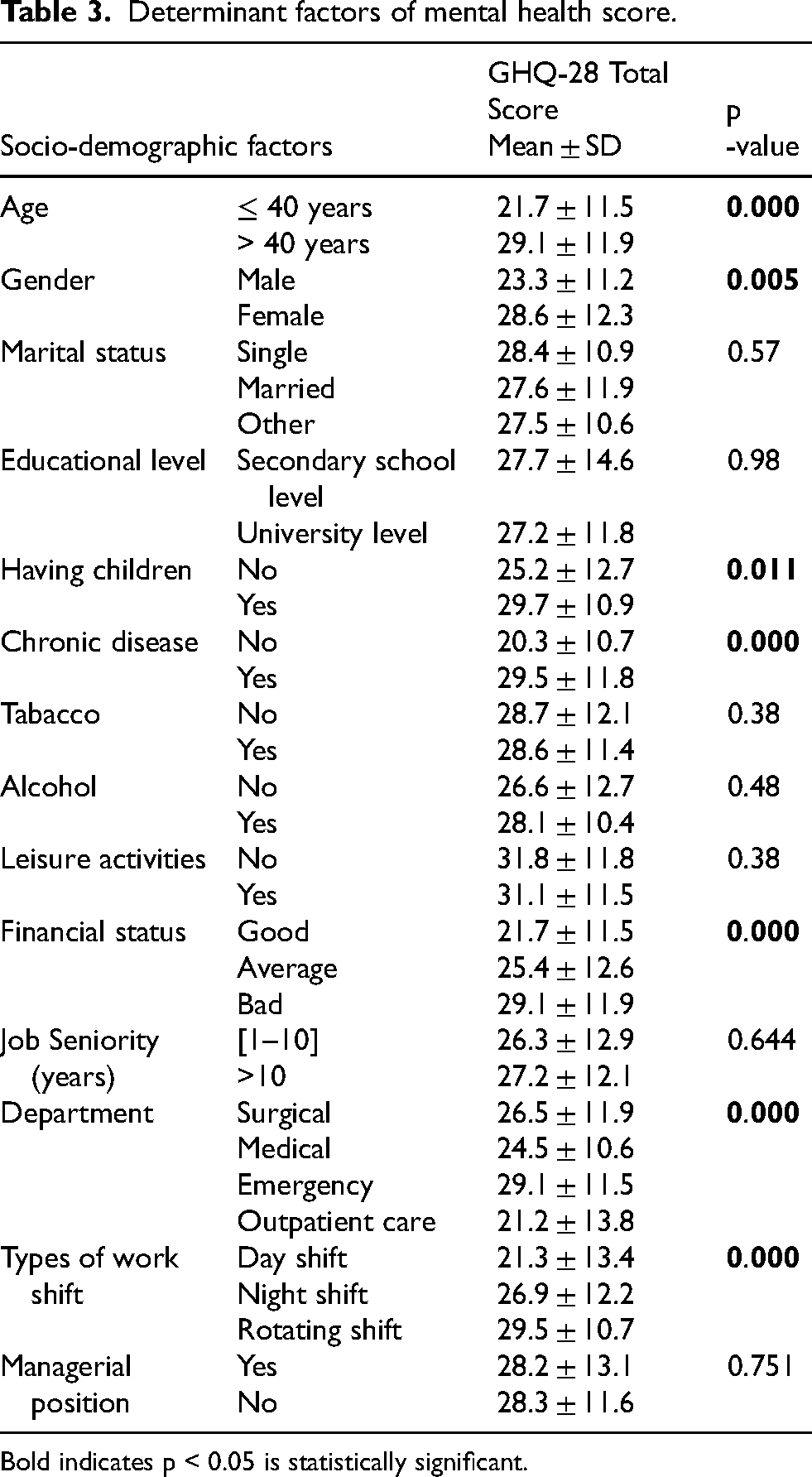
Bold indicates p < 0.05 is statistically significant.
Correlations between mental health status, satisfaction with life and quality of life
Correlations between life satisfaction, quality of life, and GHQ-28 scores were examined. GHQ-28 score was negatively correlated with life satisfaction (SWLS) (r = −0.48, p = 0.000). The GHQ-28 score was inversely correlated with all four domains of quality of life as measured by the WHOQOL-BREF: physical health (r = −0.36, p = 0.000), psychological health (r = −0.41, p = 0.000), social relationships (r = −0.51, p = 0.000), and environmental health (r = −0.54, p = 0.000).
Statistical model building
The independent variables included in the model were gender, age, having children, chronic disease, financial status, department, types of work shift, satisfaction with life score and quality of life's domains scores.
The statistical model was selected based on the lower Akaike Information Criterion (AIC = 553) with R2 = 0.4. The results revealed that female gender (β = 0.54, p = 0.001), having chronic disease (β = 0.56, p = 0.001), bad financial status (β = 0.54, p = 0.001) and satisfaction with life score (SWLS) (β = −0.6, p = 0.001) were retained in our statistical model, explaining 40% of the variance of GHQ28 total score. Regarding the validity of our model and the reliability of the predictions, posteriori analysis of the residuals showed that they follow a normal distribution, have the same variance (homoscedasticity) and are independents. No influential observations were found (Cook's distance <1), and the variance inflation factor (VIF < 5) does not indicate a multicollinearity problem (Figure 1).
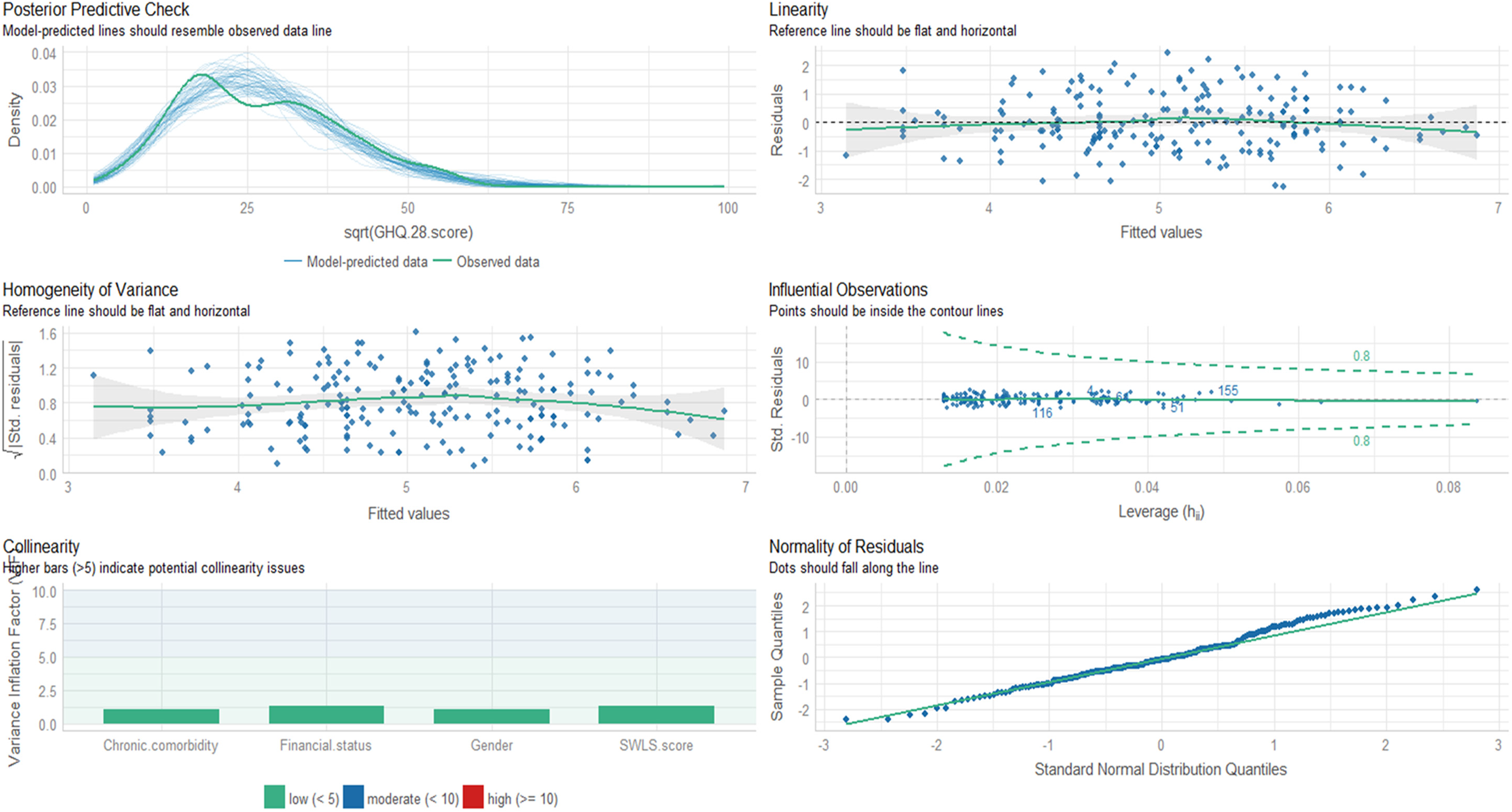
Validity of the model and reliability of the predictions.
Discussion
The study aimed to evaluate the psychological well-being of nurses in a hospital-based context and to propose an example of a potential predictive model that identifies the key determinants of mental health. The study specifically focuses on personal and professional variables, quality of life and life satisfaction among nursing staff members.
In the present study, psychological distress among nurses was evident, as indicated by elevated GHQ-28 scores (mean score >23). Some research have reported moderate levels of distress, while others point to higher levels.28–30 This variability can be attributed to the multifactorial aspect of mental health among nursing staff members. Environmental factors such as occupational stress and organizational support, and individual coping mechanisms, contribute to these variations.10,31 As this suggests, future research should aim to explore the underlying causes of distress in different contexts and develop appropriate psycho-educational approaches to promote mental health within healthcare workers.
In addition, in our study, the four dimensions of mental health present distinct profiles. The somatic symptoms and anxiety subscales had the highest scores. Several studies also highlight the importance of somatic symptoms and anxiety among hospital nurses.32–34 These findings underline the need to develop interventions targeting specific dimensions of nurses’ mental health.
On the other hand, the findings of the present study focus attention on several key predictors of mental health among nurses, including gender, the presence of chronic diseases, financial status, and life satisfaction. In terms of gender, a systematic review by Otten et al. 35 points out that gender is an important determinant of stress responses. This gender-specific response is determined by biological,36,37 psychological38,39 and social40,41 factors, and could lead to different health outcomes for women and men. These findings underline the crucial need for gender-sensitive mental health interventions. 42
Similarly, the study identified chronic illness as a significant factor associated with mental health disorders. Recently, numerous studies have shown that there is a bidirectional interation between chronic diseases and mental health problems.43–46 Therefore, the chronic disease may influence mental health and may lead to serious psychological disorders. 46 This finding points to the importance of implementing targeted support programs for nurses with chronic illnesses, including health behavior and workstation adjustments to preserve their mental health.
Economic stability also emerged as an essential determinant of mental health. In fact, financial distress significantly affects mental health, leading to increased rates of anxiety, stress, and depression among nurses.47,48 Therefore, improving nurses’ financial stability could be a key to enhancing their overall well-being.
Life satisfaction is also a significant factor in mental health in our study. Numerous studies have shown that it plays a crucial role in nurses’ mental well-being.20,49,50 The results suggest an inverse correlation between life satisfaction and mental health problems among nurses.14,22,50,51 These findings underline the need for targeted interventions to improve life satisfaction, which would positively affect mental health.
The association between quality of life and mental health did not stay significant in the final statistical model. Some studies also reported a lack of significant correlation.52,53 This interaction appears to be complex and influenced by other factors such as fatigue and safety climate.52,54 These results underline the need for targeted interventions to combat fatigue and provide appropriate ergonomic measures to improve nurses’ quality of life and general well-being.
In summary, the study highlights the multifactorial dimension of nurses’ mental health, influenced by personal, professional and social factors, with a particular impact for life satisfaction. Preventive measures, such as gender-appropriate support, promoting healthy behaviors, managing chronic illnesses, improving financial stability and promoting life satisfaction, represent essential levers for strengthening nurses’ psychological well-being.
Limitations and future research
This study goes beyond existing research by presenting an example of a potential predictive model that integrates a multidimensional perspective, offering innovative insights into the interaction of personal, professional, and social factors and their impact on nurses’ mental health. Although these results focus on hospital nurses, they could also relate to other healthcare professionals. However, a limitation of the study is the small sample size, which raises questions about the generalizability of the findings. Thus, we propose extending this research to all regions of Tunisia through a multicenter study.
Conclusion
Gender, financial situation, having chronic diseases and life satisfaction were identified as predictive factors of mental health status among nurses. The results of the present study suggest that improving physical health, financial stability, and life satisfaction could enhance the mental health status of this professional category.
Footnotes
Acknowledgements
The authors sincerely thank all the nurses who participated in this study for their time and valuable contributions.

Ethical considerations
Not applicable. This study did not require formal ethical approval as it did not involve any medical interventions, and participation was entirely voluntary and anonymous.
Funding
The authors received no financial support for the research, authorship, and/or publication of this article.
Declaration of conflicting interests
The authors declared no potential conflicts of interest with respect to the research, authorship, and/or publication of this article.
Informed consent
All participants were informed about the study's objectives, their right to confidentiality and anonymity, and they provided their informed consent before participation.