







Abstract
Background
Young doctors are struggling with extreme workplace stress due to inadequate working conditions, high patient load and low salaries in a faltering health care system of Pakistan. These conditions necessitate a focus on psychological resilience factors such as hardiness and positive reinterpretation coping. This study investigates how optimism affects workplace stress through hardiness and positive reinterpretation coping using a serial mediation model. Understanding these psychological dynamics is vital for improving the well-being of doctors in under developed health care system.
Objective
The objective of the study is to explore the serial mediating role of hardiness and positive reinterpretation coping in the association between optimism and workplace stress among young doctors of Pakistan.
Method
Purposive sampling was used to select 200 young house job doctors from public hospitals of Lahore, Pakistan. Self-report questionnaires like Life Orientation Test-Revised, Personal Views Survey (3rd Edition), Coping Orientation to Problem Experienced and Work place stress scale were used to assess the optimism, hardiness, positive reinterpretation, and work place stress of the participants. All the ethical considerations were taken into account while collecting data and reporting findings. Data was analyzed using SPSS and AMOS.
Results
Findings of Pearson Product Moment Correlation indicated that optimism is positively related with hardiness (r = .32, p < .001) and positive reinterpretation (r = .35, p < .001), and negatively associated with work place stress. Additionally, hardiness was positively linked with positive reinterpretation (r = .46, p < .001). Furthermore, findings also suggest significant negative association of optimism (r = −.24, p < .001), hardiness (r = −.51, p < .001), and positive reinterpretation (r = −.41, p < .001) with work place stress. Findings of SEM suggested that CFI, GFI, TLI, NFI, SRMR, and RMSEA values indicated the model fitness. The serial mediating role of hardiness and positive reinterpretation in the association of optimism and work place stress was also significant as the indirect effect was (b = −.07, p = <.01)
Conclusion
The present research emphasized the sequential interaction of optimism, hardiness, positive reinterpretation and work place stress that advances our knowledge to understand stress management. These findings can be useful in counseling and training of house-job doctors working in unprivileged circumstances.
Introduction
Young doctors in Pakistan and similar developing contexts often work under challenging conditions that contribute to chronic workplace stress. Resource shortages, low pay, and excessive workloads in public hospitals have led to high stress levels among junior doctors. 1 In extreme cases, these conditions have even prompted collective actions like strikes to protest untenable working environments.1,2 Such evidence accentuates that young doctors frequently operate in stressful settings that can jeopardize their well-being and performance on the job.1–3
Workplace stress refers to job-related factors and events that negatively affect an employee's health and well-being. These unfavorable work conditions at workplace cause a decline in physical, mental and social health of an employee. 3 In healthcare professions, doctors and nurses face numerous stressors, including emotional exhaustion from patient care, exposure to suffering and death, understaffing, and administrative pressures. These stressors can have detrimental effects: chronic work-related stress has been connected to negative consequences such as burnout, health issues, absenteeism, and decreased productivity. 3 On the contrary, research studies revealed that certain personal characteristics like optimism and hardiness, along with useful coping mechanisms, might mitigate the effects of stress in high-pressure professions.4,5 These results imply that personal traits like resilience and coping mechanisms also influence how stressful a person feels at work, in addition to external work pressures. 3
Optimism is one of the major preventive factors of stress at workplace. Dispositional optimism is a general expectancy of favorable outcomes and it has been linked with better stress coping and mental health. Optimism may lead people to perceive stressful situations as a challenge and try to adopt problem-focused coping style, while pessimism distal an individual to perceive the situations as threatening and negative and most probably use avoidance coping style.6–9 Recent literature also substantiates the suggestion that optimism is related to better perceived stress and enhanced actual psychological health. 6 For instance, a meta-analytic review conducted by Gallagher et al., suggested that positive expectancies like hope and optimism, reduces stress-related psychopathology. 10 Whereas optimistic appraisal helps in reducing stress because it enhances the belief in one's capability to deal with stress, a pessimistic appraisal increases stress. 9 Stress is a product of person-environment interaction; hence, while optimists are likely to be subjected to the same pressure at the workplace as the pessimists, the former will not be as affected as the latter. 6 Conversely, optimism has also been a predictor of lower stress levels, hardiness and the tendency to use positive coping approach in the form of positive interpretation. 11 This means that optimism- which is a characteristic of young doctors – might mean that they have the psychological resources (hardiness and constructive coping) to safely practice in a stressful organizational environment.
Hardiness referred to as mental toughness or psychological resilience, protects people against the negative consequences of stress at work. Hardiness is typically characterized by a committed, control-oriented, and challenge-seeking approach to life's difficulties (the “3 Cs”).12–14 Kobasa was the first to study hardiness as one of the stress resilience characteristics and further research evidences confirmed it as protective.1,14 People with high levels of hardiness typically view stressful events as chances for personal development and react to hardship in a way that is adaptive, which results in decreased levels of stress in similar circumstances.3,13 For instance, the study on emergency department nurses indicated that nurses with greater dispositional hardiness reported significantly less psychological impact from a violent workplace event.15,16 High and low hardiness has also been proved to have a significant impact on well-being, and job satisfaction; where high hardiness is indicated by positive psychosocial functioning and low hardiness by negative emotions, anxiety, burnout and other related stress.3,17 Moreover, other characteristics associated with the hardiness include the ability to use positive coping strategies; workers with higher levels of hardiness are likely to picture the stressful events in a positive manner rather than having a feeling of hopelessness.13,15,18
Effective coping strategies represent another crucial factor in managing job stress. Coping is the process of using cognitive and behavioral techniques to handle stressors, and it can range from maladaptive responses (e.g., denial, substance use) to adaptive ones (e.g., problem-solving and seeking support). Positive reinterpretation, which is also referred to as positive reframing is an adaptive coping mechanism specifically relevant to stressful professions. This means one intentionally focuses on the positive aspect in any given negative circumstance. Cheshire et al. demonstrated that parents who used positive reinterpretation to cope with a child's chronic illness reported lower psychological distress. 5 The usage of stress-coping mechanisms by professionals is heavily influenced by personality traits and positive coping. Professional life, particularly for health professionals, can be stressful. Medical professionals find workplace stress difficult to deal with while others regard it as a challenge to overcome.10,17 Workplace stress can be mitigated by employing effective coping mechanisms.16,18 Professionals can overcome their stress levels by focusing on the good parts of a challenging scenario and finding positive meaning in stressful situations. Professionals tend to use positive reinterpretation as an adaptive coping mechanism to deal with stress.
Based on the above literature, the present study aims at exploring the sequential relationship between optimism, hardiness, positive reinterpretation coping and workplace stress in young doctors. Optimism may predispose individuals to be hardier and to utilize positive reinterpretation, which in turn could lessen their experience of stress in demanding work environments. Building on prior research that hinted at these relationships,7,10,17 this study aims to empirically establish whether optimism is indeed linked to lower workplace stress through the serial mediating effects of hardiness and positive reinterpretation. In other words, we investigate if higher optimism leads to greater hardiness, which then promotes positive reinterpretation coping, ultimately reducing perceived stress in young doctors.
Method
Participants
A sample of 200 young house-job doctors (118 males and 82 females) working in five major public teaching hospitals of Lahore city that represents the health care system of Pakistan was chosen through purposive sampling technique. The selection of sample that are likely to be information-rich in relation to the research's goal is part of the purposive sampling technique. 19 As the researcher uses the pre-established inclusion criteria to choose a sample of house-job doctors that is why purposive sampling technique was the most appropriate. 20
The nature of the sample restricted the sample size. Young doctors are appointed for a year in hospitals for their in -house training. Young doctors overburdened as they work in day and night shifts so it is not feasible to collect data from a larger sample. Besides, the objectives, sampling strategy, homogeneous population, ethics, and available budget all influence the sample size for a present study. 21 The statistical analysis revealed that data was normally distributed which further clarifies the representation of the sample.
The inclusion criteria were to have Bachelor of Medicine and Bachelor of Surgery (M.B.B.S) degree and practicing as house officer in the Government teaching hospital. In public teaching hospitals, house-jobs lasted for 12 months. Divorced or separated marital status were excluded from the sample because with these marital statuses, house-job doctors may experience increased workplace stress.
Measures
The following measures were used for data collection without any changes or adaptations and permissions were collected from the respective authors of the questionnaires.
Personal views survey, third edition (PVS-III)
The PVS-III is a patented tool that assesses an individual's dispositional resilience. 22 This tool was used to assess the hardiness level of the participants. The PVS-III is an 18-item self-reporting test. Each item contains four optional replies that are rated from 0 to 3, with 0 (not at all), 1 (somewhat true), 2 (true), and 3 (very true). The Cronbach alpha value of PVS-III was .72 suggesting satisfactory reliability of the scale.
Professional life stress scale (PLSS)
Fontana (1989) established the PLSS to evaluate the degree to which professional life events are stressful to an employee. 23 This scale was used to assess the workplace stress of the participants. The PLSS is a self-reporting instrument with 24 items. The items have a variety of response options. As a result, 24 recommends alternative scoring schemes based on the number of optional responses offered to the respondent in order to estimate the respondent's work place stress. The estimated Cronbach Alpha value for the current sample was found to be statistically significant (=0.69).
Life orientation test-revised (LOT-R)
The LOT-R, a proprietary tool that evaluates an individual's dispositional positive expectancies, 25 was used to gauge the participants’ level of optimism. The LOT-R is a ten-item self-report questionnaire. Each item has five possible responses 0 (severely disagree), 1 (disagree), 2 (neutral), 3 (agree), and 4 (strongly agree). Three negatively phrased items have to reverse score. As a result, the researcher reverse-scored these items according to the authors’ instructions. 25 Furthermore, there are four filler items that are not scored at all. The respondent can receive a total score ranging from 0 to 18. The higher the respondent's LOT-R score, the more optimistic he or she is. The reliability coefficient for the current sample was computed as = .71, indicating that the scale has acceptable internal consistency.
Positive reinterpretation and growth (PRG)
The participants’ positive interpretation was assessed using the Coping Orientation to Problems Experienced (COPE) subscale of Positive Reinterpretation and Growth (28). The scale is made up of four items, each of which is graded on a four-point scale. 1 (I don't usually do this), 2 (I usually do this a bit), 3 (I usually do this a medium amount), and 4 (I usually do this a lot) (I usually do this a lot) The Cronbach alpha was .78, indicating that the scale was reliable in the given sample.
Procedure
A total of 311 house-job doctors from five teaching public hospitals in Lahore were approached by the researcher. Only 200 of the 311 house-job doctors provided a written informed agreement to participate in this study and finished their assigned project. The response rate was 76 percent, which is quite acceptable given the busy schedules of house-job doctors, the length of surveys, and the unusually hot weather in Lahore city at the time of data collection. Permission to gather data from house-job doctors was sought from the appropriate hospital authorities. Five public teaching hospitals in Lahore were contacted. The nature and objective of the current study were explained to the participants. Prior to the administration of the questionnaire booklet, each participant was given a consent form to fill out so that they may give their written consent to participate in this study. Rapport was built by promising the participants that their personal information would be kept private, allowing them to give their real responses without fear or constraint.
Results
The correlation between optimism, toughness, positive reinterpretation, and work place stress was investigated using Pearson product moment correlation.
Table 1 shows that there is a significant positive relationship between optimism and hardiness (r = .32, p < .001), optimism and positive reinterpretation (r = .35, p < .001), hardiness and positive reinterpretation (r = .46, p < .001). Furthermore, Table 1 also suggests significant negative association of optimism (r = −.24, p < .001), hardiness (r = −.51, p < .001), and positive reinterpretation (r = −.41, p < .001) with work place stress.
Inter-correlations among optimism, hardiness, positive reinterpretation, and work place stress in health care professionals (n = 200).
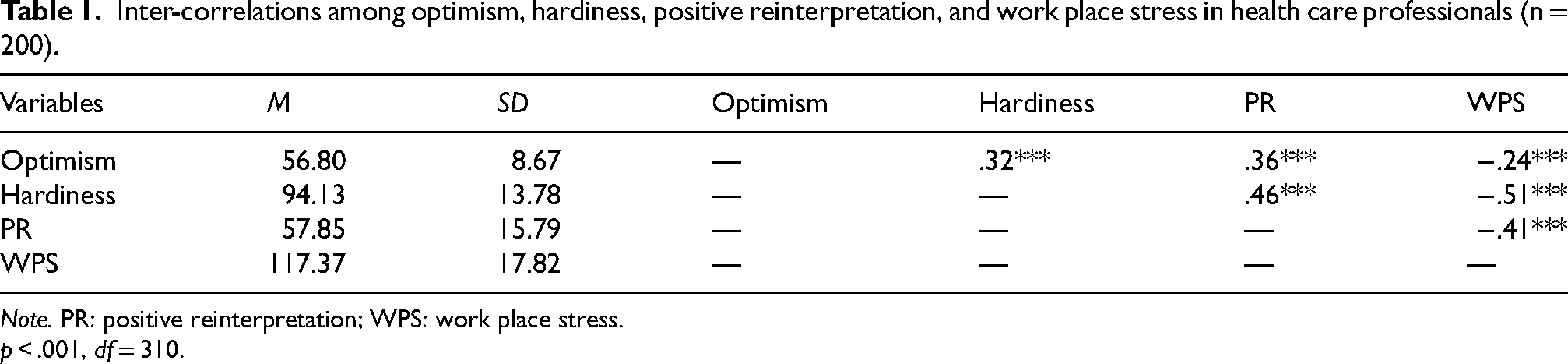
Note. PR: positive reinterpretation; WPS: work place stress.
p < .001, df = 310.
Structure equation modeling (SEM)
Correlation analysis revealed that optimism, hardiness, positive reinterpretation, and work place stress are all linked. By using structure equation modelling (SEM) and analysis of moment structure (AMOS) version 24.0, the serial mediating function of hardiness and positive reinterpretation in the association of optimism and work place stress was investigated. (see Figure 1).
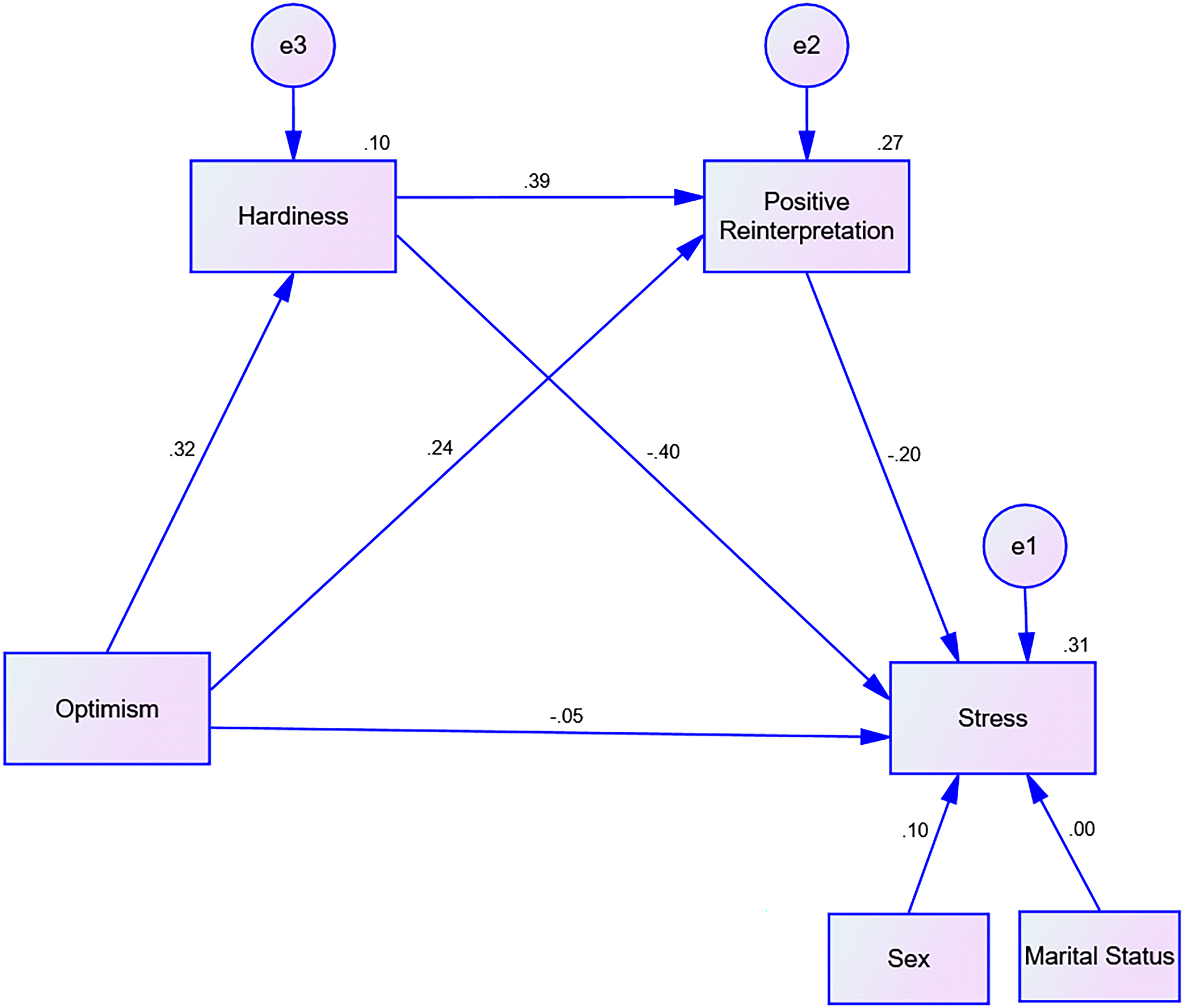
Results of a Complex multivariate model for standardized regression coefficients estimates of direct and indirect effects for optimism, hardiness, positive reinterpretation, and work place stress were examined after the model fit indices had been calculated.
The fit indices for optimism, hardiness, positive reinterpretation, and work place stress are shown in Table 2. According to, 26 SRMR and RMSEA values should be.08 or lower, and CFI, GFI, TLI, NFI, SRMR, and RMSEA values should be.90 or larger. Table 2 shows that all fit indices CFI, GFI, TLI, NFI, SRMR, and RMSEA meet the conventional criteria of model fit. In the context of SEM analysis, effect size can be inferred from model fit indices, helping to gauge the strength and practical significance of the relationships modeled. Below given is an interpretation of the effect sizes associated with each of reported fit indices:
Fit indices for optimism, hardiness, positive reinterpretation, and work place stress (n = 200).
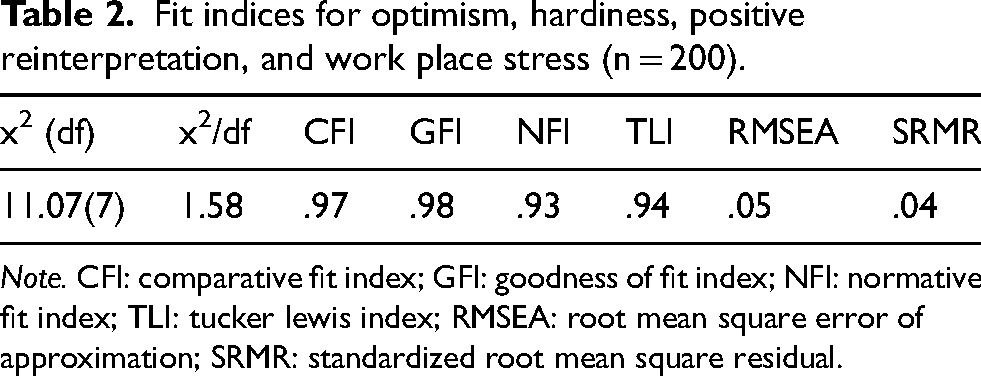
Note. CFI: comparative fit index; GFI: goodness of fit index; NFI: normative fit index; TLI: tucker lewis index; RMSEA: root mean square error of approximation; SRMR: standardized root mean square residual.
The model's chi-square value is 11.07, here, is not significant, it suggests that the model adequately fits the data, implying a small effect size in terms of unexplained variance whereas, Chi-Square to Degrees of Freedom Ratio of 1.58 indicates a good fit, suggesting a small effect size in terms of the model's complexity relative to its explanatory power. Ratios below 2.0 are generally considered acceptable, reflecting a minimal burden of complexity for the amount of explained variance.27,28 A CFI value of 0.97 indicates a strong effect size, suggesting that the model accounts for a significant proportion of variance in the data compared to a null model. This high value suggests that the relationships modeled are robust and meaningful. Likewise, Goodness of Fit Index (GFI) of 0.98 reflects an excellent fit, indicating a large effect size. This suggests that the model explains a substantial amount of the variance in the observed data, reinforcing the significance of the relationships within the model. A Normative Fit Index (NFI) of 0.93 indicates a good fit with a moderate to large effect size. It shows that the model explains a considerable amount of variance compared to a baseline model, supporting the importance of the theoretical framework used. Similarly, A TLI of 0.94 signifies a strong fit and indicates a large effect size. This value suggests that the model efficiently captures the relationships among variables without unnecessary complexity, signaling effective theoretical constructs.
An RMSEA of 0.05 indicates a good fit with a small effect size regarding model misfit. This low value suggests that the model closely approximates the population covariance structure, highlighting the relevance of the relationships modeled. An SRMR of 0.04 indicates a strong fit with a small effect size, reflecting minimal discrepancy between observed and predicted correlations. This suggests that the model captures the relationships effectively, indicating that the constructs are well-represented in the data.
Overall, the model fit indices in SEM analysis suggest a strong effect size across various dimensions of model fit. High values for CFI, GFI, NFI, and TLI, combined with low RMSEA and SRMR, indicate that model explains a significant amount of variance in the data and effectively captures the underlying relationships. This comprehensive assessment supports the robustness and practical significance of the research findings.
Table 3 shows that optimism has a direct effect on hardiness and positive reinterpretation. Furthermore, the findings revealed that hardiness has strong direct effects on positive reinterpretation and work place stress. Furthermore, the findings revealed that positive reinterpretation has a large direct effect on work place stress.
Standardized estimates of direct effects for optimism, hardiness, positive reinterpretation, and work place stress (n = 200).
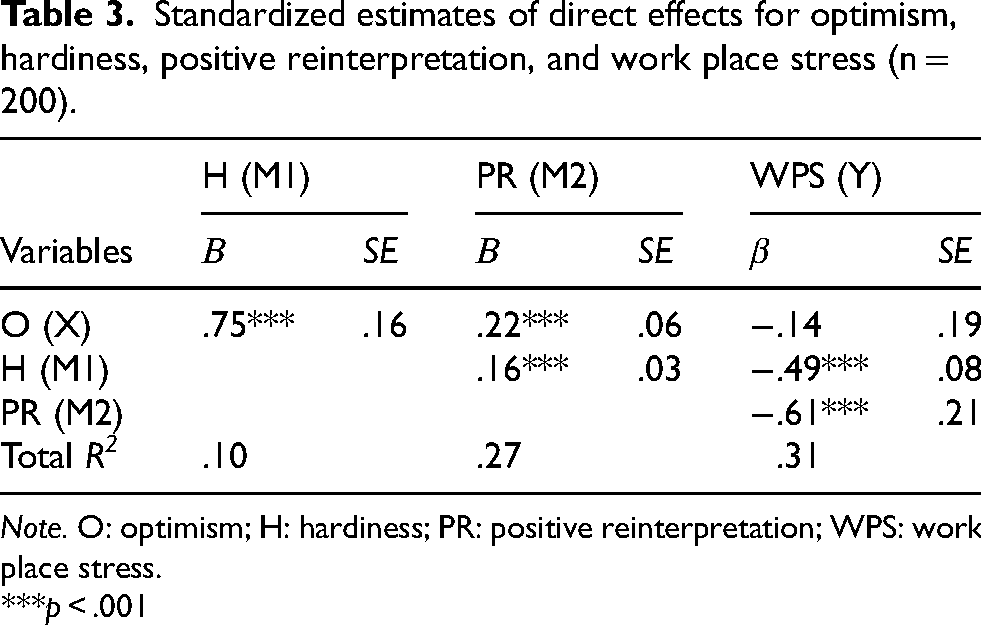
Note. O: optimism; H: hardiness; PR: positive reinterpretation; WPS: work place stress.
***p < .001
Table 4 depicts that when considering the mediating indirect effect of optimism on work place stress, single mediation of hardiness and work place stress, and serial multiple mediation of hardiness and positive reinterpretation were statistically significant. Hence, confirming the serial mediating role of hardiness and positive reinterpretation in the association of optimism and work place stress.
Standardized estimates of indirect effects through hardiness and positive reinterpretation between optimism and work place stress (n = 200).
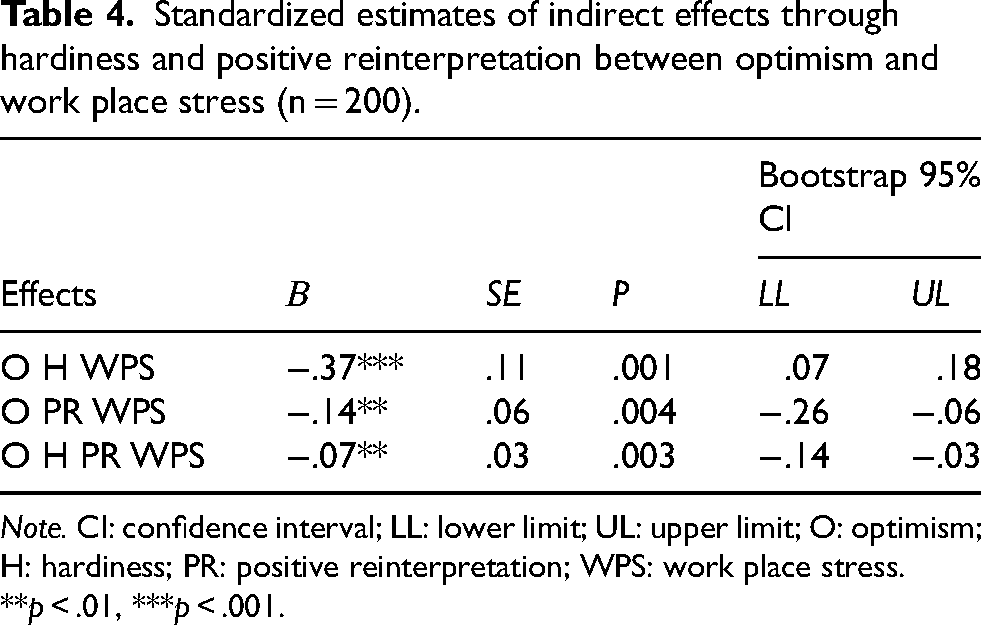
Note. CI: confidence interval; LL: lower limit; UL: upper limit; O: optimism; H: hardiness; PR: positive reinterpretation; WPS: work place stress.
**p < .01, ***p < .001.
Discussion
At workplace, house job doctors have to experience several challenges, hazards and stressors. 29 It is very important to investigate how young doctors are perceiving and coping with stressful situation. The current study explored the association of optimisim, hardiness and positive reinterpretation with workplace stress amog house job doctors of government hospitals of Pakistan.
Findings indicated significant negative association of optimism and professional stress. There is ample evidence indicating the negative relationship of optimism with negative emotions such as anger, anxiety, depression, and distress and a positive relationship with well-being, happiness, self-esteem, and life satisfaction.30,31 Likewise, optimism is inversely related to the presence or development of stress, in this way optimism provides mental strength in the face of stressful circumstances.
Additionally, findings also depicted the significant positive association of optimism with hardiness. Optimism is a behavioral strategy that makes people happier, more successful, and healthier. It plays a role as a bridge in different health areas by increasing positive expectations. These findings are also supported by previous empirical and theoretical literature depicting that higher level of optimism is significantly associated with higher level of hardiness.7,11,13
Furthermore, findings also demonstrated that optimism is significantly positively associated with positive reinterpretation. These results are also in line with previous empirical literature demonstrating that the doctors with the higher level of dispositional optimism significantly more often cope with stress trough positive reinterpretation during the stressful circumstances. 7 Being optimistic may assist house job doctors to develop a positive outlook towards life and acquire productive and healthy coping skills like positive reinterpretation.
Likewise, findings demonstrated the significant predictive association of hardiness with work place stress. Hardiness is a personality variable that can explain individual differences in stress vulnerability. 32 Individuals with high hardiness personalities have behaviors that make them stronger in facing work and other activities they enjoy and turn negative stressors into challenges, which means they become positive things. 15 Previous empirical literature also supported the current results indicating that having higher level of hardiness is significantly associated with lover level of stress.
Additionally, results also depicted that higher level of hardiness is significantly associated with positive reinterpretation. When exposed to stress, people who are high in hardiness tend to rely on problem-focused coping approaches like positive reinterpretation.7,13 When faced with a problem, they look for ways to solve it. This has been described as transformational coping, because it entails transforming the situation from something that is stressful and potentially damaging, into something that is positive and manageable through action.
Similarly, the findings of this study revealed a negative link between positive reinterpretation and workplace stress. It is critical to consider how a person perceives a stressful circumstance and how he is positively preparing himself to deal with it by employing positive and progressive interpretation. 18 These findings are also in line with prior research, which has shown that practicing healthy and adaptive coping techniques can help people cope with stress. 5
Finally in line with previous literature, results indicated the serial mediating role of hardiness and positive reinterpretation in the association of optimism and work place stress in house job doctors. 10 Optimism provides mental strength and enables individuals to take the stressful situation as a challenge through positive interpretation of the stressful circumstances. In this way their stress level decreases. 16 Hence, it can be concluded that stress is not associated with a single factor but it's interplay of several factors that ensure the well-being of an individual during stressful situations. The current study highlighted that optimism, hardiness, and healthy coping strategies like positive reinterpretation jointly enable house job doctors to overcome their stress level. 15
Cultural context in Pakistan
It is pivotal to interpret the findings of the current research in the perspective of collectivist culture and health organizations of Pakistan. Young doctors employed in public health facilities in Pakistan work under congested conditions, with densely schedules work and fewer resources, resulting to very high stress levels among doctors.2,33 For instance, one of the local studies found that nearly half of the house officers were reporting high-stress levels, the major suffered stressors being night calls, extremely overwhelming workload, time constraint, lone working, and managing uncertainty in diagnosis. 33 The hierarchical nature of the medical system and societal expectations (such as deference to senior physicians and the pressure to “prove” oneself during training) may further exacerbate stress in this group. Despite these challenges, cultural norms in Pakistan strongly emphasize endurance and resilience. Many early-career doctors view enduring hardship as part of professional growth, which may encourage a hardy mindset—treating difficulties as challenges to overcome rather than as insurmountable problems. This ethos could help explain why traits like hardiness and optimism are particularly salient for stress reduction in our Pakistani sample.
Cultural values may have an impact on the doctor's attitude to deal with stress. Pakistan is collectivist country; people turn to family and friends and faith in times of adversity. It is also in the teachings of Islam to help and sooth people in their illness. 18 Studies indicate that Pakistanis tend to use constructive coping methods—such as discussing problems with others, rationally analyzing the situation, and engaging in religious practices—rather than seeking formal psychological help. 18 In the medical context, many young physicians draw upon religious beliefs (e.g., viewing hardships as a test from God or an opportunity for spiritual growth) and a strong sense of duty to find meaning in stressful experiences. Qualitative evidence, for instance, found that Pakistani doctors commonly coped through self-motivation, pragmatic thinking, pride in their profession, and religiosity. 34 Such culturally rooted coping strategies align closely with positive reinterpretation, as they involve reframing difficulties in a more positive or hopeful light. At the same time, there is stigma attached to admitting stress or mental health struggles in the medical community. 35 As a result, young doctors may feel compelled to “cope on their own” instead of seeking counseling, reinforcing internal strategies like positive reinterpretation and maintaining optimism. The concept of mental toughness (closely related to hardiness) is increasingly recognized as vital for Pakistani doctors, reflecting an expectation that they endure stress with resilience. 33 These cultural factors likely amplify the relationships observed in our study—a culturally reinforced optimistic outlook and hardy attitude become crucial for junior doctors to survive and thrive in a high-stress work environment where external supports are limited. In essence, the Pakistani context may intensify the need for personal resources, making their protective effects on stress even more pronounced for young doctors.
Limitations and future recommendations
This study has several limitations. First, all the variables were collected through questionnaires which can be subjected to response bias; thus, could be influenced by common method variance. To tackle this, future research should employ different measures to decrease the probability of single-source bias. Second, such design restricts causal conclusions, and thus, it is advised to use a longitudinal approach to address the issues of directionality. 30 Third, the sample was restricted to house-job doctors from public hospitals in a single city, limiting generalizability. It is recommended to researchers to include diverse, representative samples from multiple regions and hospital settings to improve external validity. 31 Lastly, other substantial factors such as work support system, organizational environment, emotional intelligence, or additional coping strategies were beyond this study's scope but should be assessed in future research for a more comprehensive model.
Overall, this study extends the understanding of stress management by highlighting the serial interplay of optimism, hardiness, and positive reinterpretation coping. These insights suggest practical interventions (e.g., resilience-building workshops or cognitive-behavioral stress management programs) to empower young doctors, ultimately improving their well-being and professional performance.
Footnotes
Ethical considerations
University of the Punjab, No. (D/541/A.Psy) has approved this study.
Author contributions
Dr Yousaf Jamal is the first author. This is the work from his PhD study. He write the Introduction, Literature review and Method. Dr Faiqa Yaseen is the corresponding author and has analyzed the data and participated in the overall write up and revisions of the manuscript. Dr Mohammad Khalid write the discussion and also contributes substantially in refining the draft.
Funding
The authors received no financial support for the research, authorship, and/or publication of this article.
Declaration of conflicting interests
The authors declared no potential conflicts of interest with respect to the research, authorship, and/or publication of this article.
Informed consent
All the participants provided informed consent for their data to be included in the study