






Abstract
Background
Nursing practice demands a high level of manual dexterity and hand grip strength for tasks such as medication administration, patient handling, and operating medical equipment. Burnout and self-efficacy are common psychological factors among nursing students that may potentially influence the development or expression of these physical skills. However, the nature of this relationship is not well understood.
Objective
To investigate the relationship between levels of self-efficacy and burnout, with hand grip strength and hand dexterity, in nursing students at King Saud University.
Methods
A cross-sectional study was conducted with 57 nursing students average age was 21.98 ± 1.70 years. Maslach Burnout Inventory-Student Survey and General Self-Efficacy Scale were used. Hand dexterity was evaluated using Purdue Pegboard Test and hand grip strength was assessed using a dynamometer. Correlation analysis was used to determine the associations between the variables.
Results
No significant correlations between overall burnout or its emotional exhaustion and cynicism sub-scores, and hand function (p > .05). However, professional efficacy showed a significant positive correlation with Purdue Pegboard Assembly (rs = .29, p = .03) and Purdue Pegboard Both Hands scores (rs = .32, p = .01). General self-efficacy also correlated positively with Purdue Pegboard Assembly (rs = .34, p = .009), but no other significant correlations were observed.
Conclusions
These results may have implications for student support and interventions aimed at enhancing self-efficacy, potentially optimizing the development of skills critical for future nursing practice.
Introduction
Nursing students face a demanding academic and clinical environment, requiring a complex interplay of cognitive, emotional, and physical skills. 1 This multifaceted training can significantly impact their well-being, potentially leading to burnout and influencing their perceived self-efficacy. 2
Self-efficacy, the belief in one's ability to succeed in specific situations, 3 For university students, fostering self-efficacy is essential as it enhances their confidence, improves academic performance, and strengthens their ability to cope with stress. 4 It enables them to face difficult courses, overcome obstacles, and maintain a positive outlook on their future. Student self-efficacy is associated with improved stress management skills, thereby reducing the negative effects of stress. 5 Conversely, academic burnout, is a psychological condition caused by prolonged and unmanaged academic stress.6–8 It characterized by emotional exhaustion, depersonalization, and reduced personal accomplishment, can severely hinder academic performance and future professional development. 9 A study by Aryankhesal et al. (2019) demonstrated that emotional exhaustion, a key component of burnout, adversely affects students’ concentration and information processing abilities. 10 This leads to decreased academic performance, as students find it hard to engage with the material and clinical tasks effectively. Burnout is associated with chronic stress, which may have a negative effect on physical fatigue and muscle tension which can affect motor function and dexterity.11–14 This can manifest as increased stiffness, pain, and reduced fine motor control. 15 Additionally, Burnout may impacts mental health, causing issues like anxiety and impaired cognitive function.16,17 Therefore, preventing it is crucial for protecting students’ psychological well-being and ensuring they succeed academically and professionally.
Hand function is essential for nursing students, as many clinical tasks, such as drawing blood, giving injections, and performing assessments, rely heavily on manual dexterity and grip strength. Polat et al. (2023) emphasized the importance of hand function for nursing students’ success in clinical practice. 18 Any problems in hand function can significantly hinder a student's ability to perform critical nursing duties and, consequently, affect their academic success.
Beyond the psychological aspects, the practical demands of nursing necessitate physical competence, particularly in tasks requiring hand grip strength and dexterity. These physical attributes are essential for performing various clinical procedures, administering treatments, and ensuring patient safety. However, the potential relationships between self-efficacy and burnout with hand grip strength and dexterity in nursing students remain largely unexplored.
This study aims to investigate the relationship between levels of self-efficacy and burnout, with hand grip strength and hand dexterity, in nursing students at King Saud University. By examining these interconnected factors, we seek to provide a comprehensive understanding of the challenges faced by nursing students and identify potential areas for intervention and support.
High self-efficacy may promote physical skills like grip strength and dexterity by boosting motivation and reducing performance anxiety, leading to more effective practice and improved physical performance. In contrast, burnout creates a negative feedback loop: its associated exhaustion and lack of motivation cause a decline in practice, while chronic stress leads to muscle tension and fatigue, directly impairing physical strength and dexterity. Thus, we hypothesize that higher levels of self-efficacy will correlate with lower levels of burnout and better hand grip strength and dexterity. Additionally, we hypothesize that higher levels of burnout will correlate with poorer hand grip strength and dexterity. Understanding these relationships is crucial for developing targeted strategies to enhance student well-being, improve academic and clinical performance, and ultimately contribute to the development of competent and resilient future nurses.
Methodology
Study design and setting
A cross-sectional observational study was conducted at King Saud University, Riyadh, Saudi Arabia, between September and November 2024. Participants were recruited through email invitations sent to senior nursing students at King Saud University, and by utilizing social media platforms.
Participants and study size
Participants were nursing students in their last two years of study, excluding those with a recent history of hand injuries, musculoskeletal disorders impacting hand function, chronic pain conditions affecting upper extremities, and recent surgeries. Based on a power analysis conducted with G*Power 3.1.9.7, a minimum of 58 participants was required to achieve sufficient statistical power (0.9) to detect a medium effect size (0.4) at a significance level of 0.05.
Data collection instruments and outcome measures
Demographic characteristics
Maslach Burnout Inventory-Student Survey
The Maslach Burnout Inventory-Student Survey (MBI-SS) is a widely used instrument designed to assess burnout specifically within student populations. It's an adaptation of the original Maslach Burnout Inventory (MBI), which was developed for professionals. The MBI-SS measures burnout across three dimensions: Exhaustion (EX): Feelings of being emotionally drained and depleted by academic demands (5 questions), Cynicism (CY): A detached and negative attitude towards studies and academic life (4 questions) and Professional Efficacy (PE): Feelings of competence and achievement in academic work (6 questions). All items are scored on a 7-point frequency rating scale ranging from 0 (never) to 6 (always). According to previous studies, high levels of emotional exhaustion are indicated by scores above 14, high cynicism by scores above 6, and low efficacy by scores below 23.19–21
Burnout was indicated by high scores for cynicism and emotional exhaustion, but low scores for academic efficacy (the scores of PE items were reverse for the total Burnout scores). The MBI-SS has demonstrated acceptable validity, with a range from 0.30 to 0.47 for the subscales. 22
General Self-Efficacy Scale
The General Self-Efficacy Scale (GSE) is a widely used psychometric tool designed to assess an individual's perceived ability to cope with a broad range of life's challenges. GSE is a self-report 10-item questionnaire. Responses are typically recorded on a 4-point Likert scale (Not at all true = 1, hardly true = 2, moderately true = 3, and Exactly true = 4). Higher scores indicate higher perceived general self-efficacy. It is a valid scale ranging from 0.49 to 0.65. 23
Purdue Pegboard Test
The Purdue Pegboard Test (PPT) (Model 32020A; Lafayette Instrument, Lafayette, IN) is a standardized assessment tool used to measure manual dexterity and fine motor coordination. 24 The test involves placing small pegs into holes on a pegboard, as well as assembling pegs, collars, and washers. The test consists of several subtests, including: Assembly, both hands, and dominant hand. Scoring is based on the number of pegs placed or parts assembled within a specific time limit (60 s for assembly test and 30 s for each other tests). Higher number indicate good manual dexterity and coordination. The PPT has demonstrated good validity and test-retest reliability.25–27
Grip strength measurement
A hand dynamometer (Baseline 12-0241 LITE Hydraulic Hand Dynamometer ®, Warwick, RI, USA) is a device designed to measure isometric grip strength, which is the maximum force a person can generate with their hand muscles. They quantify the force exerted by the hand and forearm muscles when gripping the device. Hand dynamometers have shown good reliability and validity in numerous studies.28,29
Procedure
Data was collected in a single session. Manual dexterity was assessed using the Purdue Pegboard Test, which included right-hand, left-hand, both-hands, and assembly tasks. Participant scores were recorded. Finally, hand grip strength was measured, with participants performing the test using their dominant hand.
Data analysis
IBM SPSS Statistics (Version 29. Armonk, NY) was used for the analysis. Shapiro-Wilk test indicated that the data was not normally distributed. Descriptive analysis presented as mean and first and third quartile (1st, 3rd quartile). Spearman's rank correlation test (rs) was used to analyse the relationships between hand function measurements (hand grip strength and hand dexterity) and burnout components (exhaustion, cynicism, and self-efficacy) as the data was not normally distributed based on shapiro-willk test. rs value below 0.20 indicates little to no statistical significance, a value between 0.20 and 0.40 indicates a fair relationship, a value between 0.40 and 0.60 indicates a moderate relationship, a value between 0.6 and 0.8 indicates a strong relationship, and a value greater than 0.80 indicates a very strong relationship. 30
Results
Sixty female nursing students from King Saud University were initially recruited. However, due to incomplete data, the final analysis included 57 participants. The participants’ average age was 21.98 ± 1.70 years. All of the participants had a right-hand preference. Table 1 represents participants’ characteristics and outcome measure scores.
Participants’ characteristics and outcome measure scores.
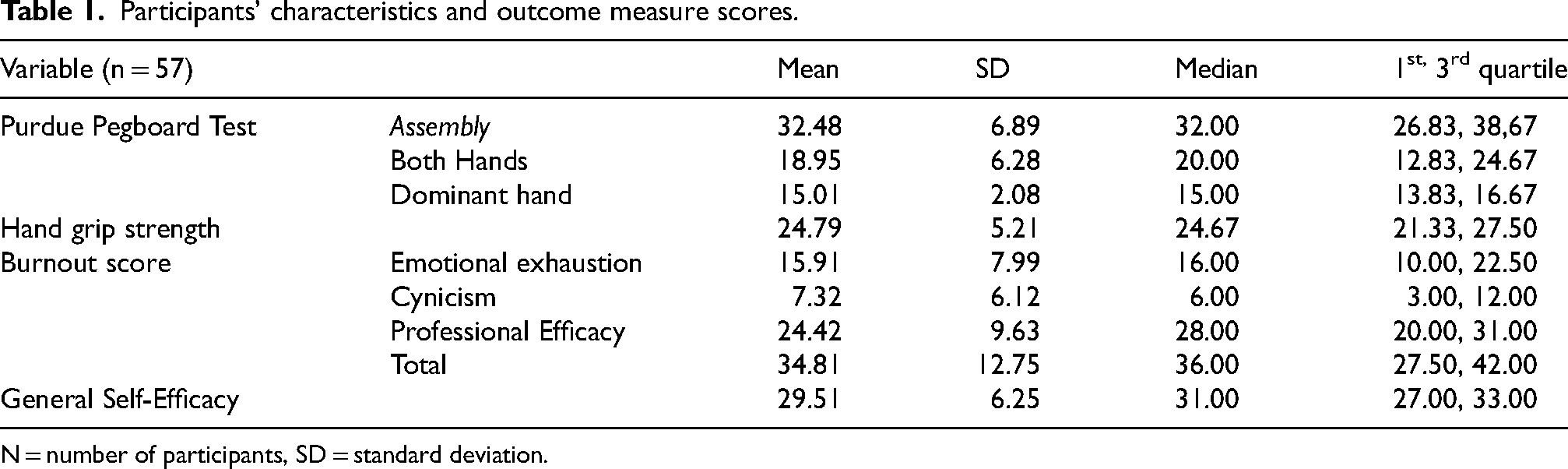
N = number of participants, SD = standard deviation.
Burnout, Self-Efficacy, and correlation with Hand Function
Out of 57 participants, 37 (64.9%) reported high levels of emotional exhaustion, for cynicism, 25 participants (43.9%) reported high levels, and regarding professional efficacy, 15 participants (26.3%) reported low levels.
No significant correlations were found between the total burnout score and any of the hand function measures (p > .05). Regarding the sub scores, no significant correlations were found between emotional exhaustion and any of the hand function measures (p > .05). Similarly, cynicism showed no significant correlations with any hand function measures (p > .05). A significant fair positive correlation was observed between professional efficacy and Purdue Pegboard Assembly (rs = .29, p = .03). A significant fair positive correlation was observed between professional efficacy and Purdue Pegboard Both Hands (rs = .32, p = .01) and no significant correlations were found between professional efficacy and Grip Strength or Dominant Hand performance. A significant fair positive correlation was found between general self-efficacy and Purdue Pegboard Assembly (rs = .34, p = .009). No other correlations were found to be significant. Higher professional efficacy and higher general self-efficacy were associated with better performance on the Purdue Pegboard Assembly test. Higher professional efficacy was also associated with better performance on the Purdue Pegboard Both Hands test table 2.
Correlation of burnout and general self-efficacy, with hand function.
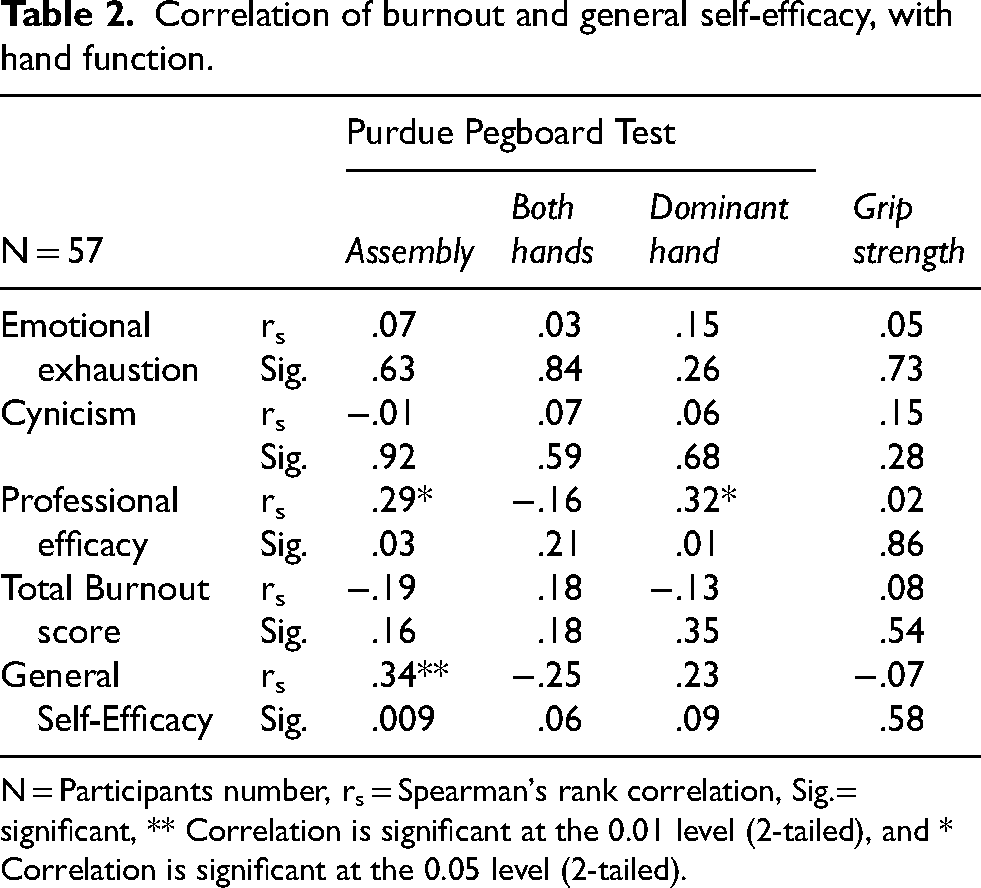
N = Participants number, rs = Spearman's rank correlation, Sig.= significant, ** Correlation is significant at the 0.01 level (2-tailed), and * Correlation is significant at the 0.05 level (2-tailed).
Discussion
The current study investigated the relationship between burnout levels, self-efficacy, and measures of hand function (grip strength and dexterity) in a cohort of 57 female nursing students at King Saud University.
Notably, a substantial proportion of the participants reported high levels of emotional exhaustion (64.9%) and cynicism (43.9%), while a smaller percentage reported low levels of professional efficacy (26.3%), highlighting the potential for burnout within this student population. Previous studies have consistently reported significant levels of burnout among nursing students.31,32 Moafa et al.'s 2024 study indicated a different burnout profile, with 30% of their participants experiencing high emotional exhaustion, a notably higher 59% reporting high depersonalization (cynicism), and a substantial 66% exhibiting low personal accomplishment (professional efficacy). 32 Altharman et al. (2023) reported that 65% of nursing students and interns experienced a high level of burnout 42% experienced emotional exhaustion, 54% reported depersonalization, and a substantial 77% indicated low personal achievement. 31 According to a systematic review and meta-analysis, 23 studies reported that the prevalence of academic burnout in nursing students was 35% (range: 24% to 47%). Across these studies, 40% of participants showed high emotional exhaustion, 23% showed high depersonalization, and 30% reported low personal accomplishment. 33 The causes of academic burnout and stress, as cited in the previous studies, were related to the demanding nature of their academic programs and clinical placements.33,34
This study's main results indicated no notable relationships between overall burnout, its dimensions of emotional exhaustion and cynicism, and the evaluated measures of hand functions. This implies that nursing students’ feelings of being emotionally drained and detached due to burnout were not clearly linked to their measured hand dexterity or grip strength. This finding contrasts with some prior research that has suggested a potential link between psychological stress and physical performance. Ulupinar and Meler (2024), found a noticeable reduction in hand dexterity in emergency service nurses following their shifts, as demonstrated by their performance on the Nine-Hole Peg Test. 35 While physical demands were the primary factor, the high-pressure atmosphere of emergency care likely contributed to general exhaustion, potentially affecting their physical capabilities. Another study conducted Savci et.al. (2024) found a significant negative correlation between perceived stress and hand grip strength (p < .001), and pinpointed perceived stress as a probable influence on hand grip strength, in addition to factors like age, gender, height, and Body Mass Index Savci, Akinci. 36 The researchers noted that ongoing stress can result in long-term elevated cortisol levels, potentially leading to a reduction in muscle mass and consequently, weaker grip strength, This happens through two primary mechanisms: promoting the breakdown of muscle proteins and inhibiting the synthesis of new muscle proteins. 37 Even in other healthcare professionals, Badrasawi et al. (2024), demonstrated a significant association between stress scores and emotional exhaustion and personal accomplishment burnout subscales (p ≤ 0.001 for both) in a sample of dentists Badrasawi, Nazzal. 38
An important distinction is that the studies by Ulupinar and Meler 35 and Savci, Akinci 36 included practicing nurses in their sample; similarly, Badrasawi, Nazzal 38 investigated practicing dentists. In contrast, nursing students in the current study may not yet be exposed to the sustained occupational stressors of professional practice that may cumulatively influence motor performance. Therefore, the discrepancies between the findings of this study and those of other research might stem from several factors, including variations in the populations studied, the restriction to only female participants, and the use of different methods for measuring outcomes. Furthermore, the relatively small number of participants in this study compared to others could also contribute to the differing results.
While overall burnout showed no association with hand functions, the current study identified significant positive correlations between professional efficacy and two sub-measures of the Purdue Pegboard Test: Assembly and Both Hands performance. Additionally, a significant positive correlation was found between general self-efficacy and the Purdue Pegboard Assembly Test. This indicates that nursing students who reported a higher sense of competence and accomplishment in their professional roles tended to demonstrate better fine motor dexterity and coordination involving both hands. Likewise, those who perceived themselves as generally capable of managing life's challenges also performed better on the task requiring fine motor dexterity. These findings align with the broader concept of self-efficacy studies and clinical performance,39–41 and are also consistent with perspectives from occupational science, which underscore that self-efficacy and occupational competence reciprocally influence performance.42,43
This correlation can be further explained by the notion that self-efficacy fosters a positive feedback loop for hand dexterity and grip strength. Believing in one's ability to improve motivates focused and persistent practice, resulting in tangible gains in these skills. These improvements then further enhance self-confidence and belief in one's potential, encouraging continued effort and progress in a self-reinforcing cycle. This finding has implications for nursing academic programs, which should consider embedding targeted dexterity training into the curriculum to promote students’ sense of professional efficacy and serve as a proactive measure against academic stress. These implications align with a recent review by Reaves et al. (2024), which emphasizes the significance of psychomotor skills in nursing education and identifies effective strategies in teaching, such as structured rehearsal, simulation, and feedback. These methods help nursing students gain the confidence and competence required for safe and effective clinical practice, as students require skills such as providing injections, wound dressing, and handling delicate medical instruments. 44 Moreover, the study's findings suggest that addressing burnout and self-efficacy in education could result in interventions to enhance students’ grip strength and dexterity. This is because professional self-efficacy is closely linked to dexterity. Therefore, boosting students’ confidence in their professional skills—through approaches such as targeted dexterity training—may lead to noticeable improvements in their physical abilities.
The study's use of validated instruments and direct relevance to nursing practice are its main strengths. The specific positive correlation found between professional efficacy and dexterity provides actionable insights for future interventions in nursing education. The study's primary limitations include a small sample size, which may have limited the power to detect significant correlations. Furthermore, as a cross-sectional study, it cannot determine causality, so it's unclear whether self-efficacy influences dexterity or vice versa. The findings are also limited by the fact that only female students were included, making the results difficult to generalize to the broader nursing student population.
Conclusion
This study identified a significant association between professional and general self-efficacy and specific measures of fine motor dexterity (Purdue Pegboard Assembly and Both Hands scores) in female nursing students at King Saud University. This suggests that a strong sense of competence and self-belief may contribute to better performance in tasks requiring these skills. Conversely, neither overall burnout scores nor their dimensions (emotional exhaustion and cynicism) showed significant correlations with hand function. Future research could explore these relationships longitudinally and investigate potential mediating factors, such as stress management strategies or specific training interventions, to further understand the interplay between psychological well-being, motor performance, and occupational competence in nursing students as they progress through their education and into professional practice. It would be beneficial to include measures of participants’ prior physical activity and psychological well-being in future studies in order to control for the effect of these factors.
Footnotes
Acknowledgements
We would like to thank the nursing students who participated in this study.
Informed consent
All participants were fully informed about the study's objectives and procedures, and written informed consent was obtained after they had the chance to ask any questions. Participants then completed an online questionnaire collecting demographic information, burnout levels, and self-efficacy data. Throughout the study, participant privacy and data confidentiality were strictly maintained.
Ethical consideration
The study received ethical approval from the Institutional Review Board of King Saud University, College of Medicine (KSU-HE-24-788). All participants were fully informed about the study's objectives and procedures, and written informed consent was obtained after they had the chance to ask any questions. Participants then completed an online questionnaire collecting demographic information, burnout levels, and self-efficacy data. Throughout the study, participant privacy and data confidentiality were strictly maintained.
Authors contributions
Maha F. Algabbani, Rawaf Abduljabbar, Raneem Babtain, Razan Alharthi, Shahad Alfaddaghi, Hessah M. Bin Zuair, and Shahad Y. Alshehri were primarily responsible for the study's conceptualization, data collection, initial data analysis and writing the first draft. Maha F. Algabbani, Samiha M.I. Abdelkader and Rehab F.M. Gawad, Saad A. Alhammad, Muneera M. Almurdi, Nabila Tounsi, and Afaf A. M. Shaheen provided significant contributions to the methodological design, and offered critical insights during the data analysis and interpretation phase, and finalizing the manuscript.
Funding
The authors received no financial support for the research, authorship, and/or publication of this article.
Declaration of conflicting interests
The author(s) declared no potential conflicts of interest with respect to the research, authorship, and/or publication of this article.
Data availability statement
The data supporting the findings of this study are available upon reasonable request from the corresponding author. The data are not publicly available because they contain information that could compromise the privacy of the research participants.