







Abstract
Background
Italy's Legislative Decree 81/2008 includes work-related stress and organisational factors in its definition of prevention. For young workers in unstable jobs, the gap between legal principles and daily experience may be wide.
Objective
To compare how young workers in Italy and Japan perceive physical and mental safety, stress, and economic risk, and to ask what the patterns suggest about where prevention struggles.
Methods
Mixed-method dataset of 206 young workers (92 Italy, 114 Japan). Descriptive statistics and qualitative responses.
Results
Physical safety is high in both countries (88.8%), but mental safety is lower (74.4%). Stress affects 64.6%, rising to 77.2% in Italy against 54.4% in Japan. Main stressors are ordinary: responsibility, pace, heavy hours. In Italy, half report high precariousness risk; in Japan, one sixth. Stress does not decline with experience.
Conclusions
Young workers often feel physically safe but carry heavy psychosocial loads. The Italian framework already targets these dimensions, but the gap between principle and practice remains. Different risk bundles—precariousness in Italy, time intensity in Japan—require prevention to look beyond physical hazards.
Introduction
Work is often where young people first learn what risk means in concrete terms. Not only the obvious risk of physical injury, but also the quieter risks that settle into everyday life: exhaustion, anxiety about making mistakes, fear of losing the job, and the sense of being replaceable. These risks are not just private feelings. They are shaped by schedules, contracts, supervision, workplace hierarchies, and by the broader labour market. In other words, they are social facts, even when they show up as individual strain.
In Italy, the legal framework is clear in principle: the protection of health and safety at work is meant to include the worker`s full psychophysical integrity, and prevention is supposed to begin early through information, training, and shared responsibility. 1 The difficult question is not whether these principles exist, but how they meet the lived reality of young workers especially at the beginning of a work trajectory, when knowledge is limited, bargaining power is low, and many jobs are temporary or semi-formal. The early phase matters because it is where norms are learned: what is considered normal overtime, what can be refused, whether speaking up is realistic, and what kind of discomfort must be silently absorbed.
This article tests that meeting point between principles and experience through a comparative analysis of young workers in Italy and Japan. The comparison is not used to rank countries morally, but to sharpen the sociological interpretation of risk. What looks acceptable in one context may appear intolerable in another; what feels safe on paper may still carry an everyday cost. In occupational health research, psychosocial risk is often linked to how work is organised: high demands combined with low control, limited voice, and uneven reciprocity between effort and reward can generate sustained strain and, over time, harm.2,3 This is particularly relevant for young workers, who frequently enter workplaces from a structurally weaker position and may internalise organisational pressures as personal failure.
The empirical puzzle that motivates the analysis is simple. On one side, many respondents report feeling physically safe at work, and a substantial majority also report a relatively high level of mental safety. On the other side, a large share describe work as highly stressful, and the stress is not explained mainly by rare dramatic events, but by ordinary organisational features: responsibility, fast pace, heavy shifts, and anxiety about doing the job well. In Italy, this is compounded by concerns about precariousness and economic decline, which can make prevention feel like a luxury something to care about later, when survival is secured. The result is a familiar contemporary tension: formal safety and subjective strain coexist, and young workers are often asked to carry that contradiction alone.
The study has three research questions. First, what is the level of perceived physical and mental safety among young workers, and how does it vary by country and by early-career position? Second, which risks are most salient illness risk, precariousness, impoverishment and how are they linked to reported stress and its causes? Third, what do these patterns suggest about gaps between the preventive ambitions of D.Lgs. 81/2008 and what young workers actually experience in the first years of work, when training, voice, and enforcement should matter most?
To answer these questions, the article combines quantitative contingency tables on safety, perceived risks, stress and surveillance with qualitative accounts that describe how time pressure, workload, and informal practices are experienced in daily work. The goal is not to treat qualitative evidence as decoration, but to use it to clarify what the numbers can only hint at: how safety is interpreted, how stress is normalised, and where legal principles meet organisational routines. By keeping the focus on early career stages, the paper aims to contribute to sociological debates on psychosocial risk as a product of labour-market insecurity and organisational control, rather than as an individual weakness or a purely clinical issue.
Theoretical framework
This section connects two things that are often kept separate: the legal language of prevention, and the everyday experience of work. I will stay close to the text of the Italian framework and to a small set of well known work stress models. I will not treat any of them as proof on their own. They are only lenses that help us read what young workers report, and to do it with some care.
The Italian framework: prevention as a shared and organised practice
Italy`s Legislative Decree 81/2008 is built around a simple idea: safety is not only a matter of reacting to accidents, but of preventing harm before it happens. Article 15 lists general measures of protection that go well beyond devices and technical compliance. It includes the assessment of all risks, the planning of prevention, and importantly for this paper attention to how work is organised, not only to physical exposures. It also includes information and training, as well as participation and consultation of workers and their representatives.
This matters for our topic because the decree does not frame prevention as something that belongs only to experts. It explicitly treats training and participation as part of ordinary prevention practice, not as optional additions. In plain terms: prevention is supposed to be planned, taught, and discussed, not just imposed or assumed.
Article 20 adds the worker side of the picture. It states that workers must take care of their own health and safety and that of others, in line with their training, instructions, and the means provided by the employer. It also includes very concrete duties such as following instructions, using equipment correctly, and reporting hazards and deficiencies. This detail is important because it shows the implicit logic of the system: workers can be expected to act responsibly only if they are actually put in a position to do so through training, clear procedures, and realistic channels for signalling problems.
A key point for this paper is that the legal framework explicitly extends the idea of risk to include psychosocial dimensions. Article 28 states that risk assessment must cover all risks for safety and health, including those linked to work related stress, and it refers to the European agreement of 8 October 2004 for its content. In other words, the decree does not treat stress as something purely personal or external to safety. It treats it as something that can, at least in principle, be assessed and prevented as part of organisational responsibility.
The European agreement described stress in a broad but practical way: a state accompanied by physical, psychological, or social complaints, arising when people feel they cannot bridge the gap between demands and what is expected of them. I find this definition useful because it avoids moralising. It does not say that stress is a weakness. It frames it as a mismatch that can emerge from how work is arranged and demanded.
Emerging risks as ordinary organisational pressures
When people talk about emerging risks today, they often mean things that are not new in an absolute sense, but that have become more central in many jobs: work intensification, long or irregular hours, high responsibility without real autonomy, constant evaluation, and pressure to perform. These pressures matter because they can affect health even when the workplace is physically safe. The legal language of Article 15 already anticipates this by including prevention planning that takes into account the influence of factors of the environment and the organisation of work.
To keep the theory grounded, I rely on two classic approaches that are widely used in occupational sociology and occupational health, and that speak directly to the kinds of stressors measured in the results.
The first is the demand-control approach. In simple terms, high demands become more harmful when workers have little control and little say over how work is done. The original formulation is associated with Karasek and Theorell. 2 I am not claiming that this model explains all stress. But it gives a clear way to interpret why heavy schedules, fast pace, and high responsibility can weigh more when people feel they have limited room to negotiate tasks, timing, or standards.
The second is the effort-reward imbalance model. Here the focus is on reciprocity: when people invest high effort and receive low reward (including low pay, low recognition, insecurity, and blocked prospects), strain becomes more likely. This is the core idea in Siegrist's work. 3 Again, this is not a mechanical law. But it is a careful way to connect economic insecurity such as the perceived risk of precariousness or impoverishment to stress, without reducing stress to individual fragility.
The demand-control model has not only been used to measure strain; it has also been tested as a guide for reorganising work. Karasek reviewed nineteen international case studies where workplaces deliberately tried to reduce stress by increasing worker control while maintaining or adjusting demands. 4 The results were not uniform, but the pattern was consistent: interventions that gave workers more room to influence how and when tasks were done tended to reduce strain, even when demands stayed high. This matters for the present study because it shifts the question from whether work is stressful to whether it can be made less so through changes in how it is organised. The logic is already present in the Italian framework, but the data here suggest that for many young workers, the gap between demands and control remains wide.
A related line of research follows workers over time to see how stress and motivation evolve. Hyvönen and colleagues tracked young Finnish managers over two years and found that changes in the psychosocial work environment predicted changes in personal work goals. 5 When effort-reward imbalance increased, workers shifted toward goals focused on leaving the job; when it decreased, they shifted toward goals related to competence and contribution. This adds a dynamic element to the static picture in this dataset. If precariousness and impoverishment are perceived as stable risks, as they are in Italy, the likely effect is not just higher stress but a gradual reorientation away from the job. Over time, young workers may stop expecting recognition or development and start planning exit. That is not a problem the law can fix directly, but it is a problem the law was designed to notice: Article 15 includes training and participation, and Article 28 includes stress, precisely because work organisation is supposed to be part of what prevention looks at.
These two lenses also align with the legal architecture of prevention. Article 15 puts training, organisation, and participation at the centre of prevention; Article 28 includes work related stress inside the risk assessment duty. So the theoretical point is modest: if psychosocial strain is shaped by demands, control, reciprocity, and organisational design, then prevention cannot be limited to equipment and physical hazards. It must also look at how work is paced, scheduled, evaluated, and discussed.
Recent work (as the one of Hyvönen) has tested these classical models on young populations with results that align with what this study finds. This matters for the present analysis because it suggests that reward, and particularly the prospect of career opportunities, is not a stable background condition but something that shapes how young workers orient themselves to work over time. When reward is low, the impulse is to leave; when it is present, the impulse is to invest. In the Italian case, where perceived precariousness and impoverishment are high, this mechanism may help explain why stress does not fade with experience: if reward remains blocked, the orientation shifts but the strain may persist.
Vulnerability in early career: why time in the job matters without overclaiming
The decree itself does not single out young workers as a sociological category, but it does mention that risk assessment must consider differences connected to age and to the specific contractual form through which work is performed. This matters because early career workers are often concentrated in short contracts, probationary situations, or roles with limited bargaining power. That does not automatically mean they are more stressed, but it is a reasonable hypothesis to test carefully, not to assume.
For this paper, low seniority is used as a cautious proxy for early work experience. The reason is practical: it is the variable available in the dataset, and it is also directly relevant to prevention logic. A worker with less than one or two years of experience may still be learning basic routines, still trying to understand what is acceptable to question, and still building the confidence to report problems. This is exactly where training and participation central in Article 15 should matter most.
At the same time, it is important not to romanticise or simplify. Seniority is not the same as age; and even within the same seniority band, experiences can differ widely by sector, contract, and workplace culture. So in the analysis that follows, any early-career vulnerability will be treated as a pattern to observe, not as a conclusion to declare in advance. This is also why there is the use of qualitative material alongside the tables: not to generalise more, but to understand better what the categories may hide.
Why a comparative lens (Italy-Japan) is useful, but limited
The comparison with Japan is not meant to imply that one system is better. It is used to see how similar experiences can take different forms depending on labour-market structure, workplace norms, and expectations around endurance and voice. Here too, theory is only a guide. The legal anchor is Italian, but the sociological question is broader: how do young workers interpret safety when physical protection feels high, but organisational pressure remains strong? The European agreement`s definition stress as a gap between demands and perceived capacity to meet them helps keep that question grounded and non moralistic across contexts.
The choice to compare Italy and Japan is not self-evident, and requires an explanation that goes beyond the generic usefulness of international comparison. The two countries share, in different ways, features that make them theoretically interesting for this kind of inquiry: both have mature economies with segmented labour markets, both have undergone reforms that made entry into work more flexible, and in both the tension between formal protection and substantive insecurity has become a recurring public issue. But the similarities end there, and it is precisely the distance that makes the comparison useful. Italy has an explicit and detailed regulatory framework built around participation and training, while Japan lacks an equally formalised equivalent and tends to rely more on company practices and a work culture that normalises the sacrifice of time and recovery. In the Italian case, young workers’ vulnerability runs mainly through contractual precariousness and economic uncertainty; in Japan, through time intensity and the difficulty of bounding work. Comparing two different logics makes it easier to see what, in the data, depends on work organisation and what instead reflects settled social expectations. The point is not to establish which country manages risk better, but to use the gap between them to make visible mechanisms that, in a single context, risk seeming natural or inevitable. The comparison, in this sense, does not prove: it questions. It helps ask why in Italy concern for physical safety coexists with such a widespread sense of impoverishment, or why in Japan fatigue is more often described as a matter of hours than of uncertainty. These are questions that, without the contrast, would probably not emerge with the same clarity.
In short, the theoretical framework does not try to predict the results. It sets up a careful way to read them. D.Lgs. 81/2008 gives the normative promise: prevention, training, participation, and attention to psychosocial health. The stress models remind us that work organisation and reciprocity can matter as much as physical conditions. The comparative lens helps us avoid taking any single national context as normal by default, while still respecting that our legal discussion is grounded in the Italian framework.
Methodology
The wider research design this article draws from
The analysis presented here comes from a broader comparative study carried out in Italy and Japan, built from the start as a mixed-method project. The core instrument was a structured questionnaire.
The questionnaire consisted of 50 items organised into four sections. It was originally designed in Italian and subsequently translated into English and Japanese. The Japanese translation was produced in collaboration with academic staff at Toyo University, including contributions from Prof. Kitagawa, Cabell, Liu, who ensured linguistic accuracy and cultural appropriateness. A pre test was conducted in both countries, leading to targeted revisions of items that proved ambiguous or culturally mismatched.
Although a formal back translation protocol was not adopted, the multi-step translation and revision process supported a solid degree of conceptual equivalence. Some limits to full equivalence remain intrinsic to the comparative design. Terms such as precariousness or grey work resonate differently across contexts; certain labour-market phenomena such as arubaito, lifetime employment, or company based unions lack direct Italian equivalents; and questions regarding strikes or union participation required careful phrasing in Japan.
Because of these structural asymmetries, the analysis avoids fine grained metric equivalence claims and instead adopts two precautions:
Within country percentages are used for all comparisons, and Interpretation focuses on patterns rather than absolute values.
Qualitative responses were also used to clarify semantic or normative differences underlying similar survey categories, particularly concerning stress, work intensity, and economic insecurity.
This article is therefore not a new data collection. It is a focused re-analysis of a subset of that broader research, centred on safety and psychosocial risk in early work experiences, and on how the Italian legal framework 1 can be read against these empirical patterns.
The study draws on a total of 206 voluntary (Table 1), unpaid respondents, divided between Italy (n = 92) and Japan (n = 114). The recruitment strategy relied on non-probabilistic sampling, combining convenience and snowball procedures consistent with the exploratory goals of the research. In Italy, participants were reached through personal networks, university contacts, and circulation on social media. In Japan, recruitment occurred through acquaintances, face to face contact in public spaces (including university areas and libraries), and expansion via local academic networks.
Summary of sample composition.
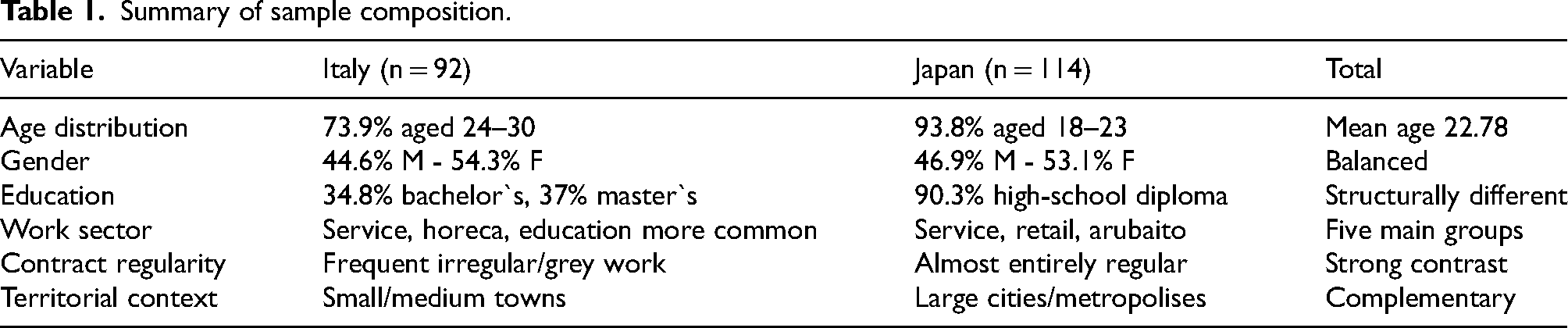
The age distribution reflects different transition to work trajectories across countries. The overall mean age is 22.78 years, with the Japanese group concentrated almost entirely in the 18–23 range (93.8%), whereas the Italian sample shows a higher presence of young adults aged 24–30 (73.9%).
The gender composition is balanced in both settings:
Italy: 44.6% men, 54.3% women; Japan: 46.9% men, 53.1% women.
Clear educational differences emerge between the two national samples. In Japan, 90.3% of respondents hold a high school diploma, consistent with an early entry into the labour market. In Italy, the educational profile is much higher: 34.8% hold a bachelor`s degree and 37% a master`s degree.
Territorial background also differs: Italian respondents tend to come from small or medium sized towns, whereas Japanese respondents predominantly live in metropolises or large cities.
Work trajectories are heterogeneous. Across the whole sample, 38.5% work in common operational roles (service, retail, horeca), 19.5% in teaching/educational roles, 18.5% as employees or managers, 14.1% as skilled workers, and 9.3% as self employed.
Contractual forms reflect structural national differences. In Italy, respondents report a mix of regular, fixed term, on call, internship, and self employment arrangements, with a noteworthy presence of irregular or grey work. In Japan, part time work (arubaito) is widespread but almost always regularised and formally declared.
This paper narrows the broader research to a specific question: how young workers perceive physical and mental safety, illness risk, job-related stress, and socio-economic risk (precariousness and impoverishment), and how these perceptions differ between Italy and Japan and across early-career positions. The aim is descriptive and interpretive. The article do not claim causal inference. The dataset is not designed for causal identification, and the analysis is presented accordingly, as patterns that can inform discussion rather than settle it.
To keep the paper methodologically clean, the article uses only variables that are clearly present in the dataset and already structured in the available contingency tables. When Ns differ across items (for example because of missing responses on particular questions), it is reported the valid N for each analysis rather than forcing a single denominator.
Sample and structure
The quantitative analyses rely on frequency tables and cross-tabulations produced for the following key variables:
perceived physical safety at work (4-point scale from very low to very much, valid N = 205) perceived mental safety at work (same 4-point scale, valid N = 203) perceived risk of contracting illnesses at work (valid N = 205) perceived job stress (Quanto ritiene il suo lavoro stressante?, valid N = 206) and main stated cause of stress (valid N = 131) perceived risk of precariousness (valid N = 205) and risk of impoverishment (valid N = 204)
For each of these outcomes, I used the breakdowns already available by:
country (Italy vs Japan) education (up to high school vs degree) where available job level/role where available work seniority (Da quanto tempo lavora? in four classes) where available
Because the intent of the paper is comparative and early-career focused, the country breakdown and the seniority breakdown are treated as central, while the others are used as contextual checks rather than as the main narrative.
Quantitatively, the paper uses a simple strategy on purpose:
Describe distributions for each key indicator (physical safety, mental safety, illness risk, stress, precariousness risk, impoverishment risk). Compare countries using within-country percentages in the cross-tabs (to avoid confusion between raw counts and different group sizes). Explore gradients by seniority, treating seniority as a plausible proxy for entry phase.
There are no multivariate models in this paper. The reason is not that modelling is wrong, but that with a non-probabilistic sample and several variables with different valid Ns, regression would risk creating a false sense of precision.
Alongside the closed-ended items, the research collected open-ended responses where respondents describe work experiences in their own words. The qualitative material used in this paper is drawn from those open-ended responses, not from separate ethnographic observation or follow-up interviews.,
The qualitative analysis is not used to prove the quantitative results. It is used for three more modest tasks:
to clarify what respondents may mean when they say they feel safe or stressed to show concrete mechanisms behind stressors that are otherwise abstract in survey categories (for example, heavy shifts or responsibility) to document, with careful wording, situations that appear relevant to psychosocial risk: excessive hours, unstable schedules, informal work, limited voice, and experiences described as harassment or persistent pressure,
The article uses purposive selection guided by the quantitative categories. In practice, I looked for accounts that speak directly to the themes measured in the tables: long shifts, demanding schedules, pressure, role overload, difficulty combining work and study, and situations where speaking up is difficult.
Selection is balanced across Italy and Japan to avoid building the narrative on only one context. The unit of reference is the numbered interview, which is reported in the text whenever a qualitative excerpt is used.
When an excerpt is originally not in English, it is translated into English for publication. The translation is kept as close as possible to the original meaning. The goal is not stylistic elegance, but fidelity.
A key limitation is straightforward: the dataset does not contain a variable that directly measures alternanza scuola-lavoro or comparable forms of structured school-to-work placement. For this reason, the article does not make claims about alternanza itself.
What the dataset does include is work seniority in four classes (less than one year, 1–2 years, 2–4 years, more than four years). In this paper, we use low seniority specifically the first two categories as a transparent proxy for early entry into work. This is a pragmatic choice, and we treat it carefully:
What the proxy captures: a period in which a worker is more likely to be new in the job, still learning routines, and often less able to negotiate tasks and schedules. What the proxy does not capture: whether the job is linked to school, whether it is a formal placement, the quality of training received, or the institutional features of alternanza.
In other words, we use seniority to speak about early career in a broad sense, not about school-based programmes. This distinction will be stated explicitly in the paper to avoid overreach.
Two final points matter for methodological credibility.
First, this is a cross-national survey with translation. Even with careful translation and testing, perfect equivalence between contexts cannot be assumed. The analysis therefore stays close to the observed distributions and avoids fine-grained claims that would require stronger measurement invariance testing.
Second, the sample is not probabilistic. This means results should be read as evidence about patterns within this dataset, not as population estimates for all young people in either country. This is not a weakness to hide. It is a boundary condition that we state clearly, and it shapes the modest tone of the conclusions.
Several methodological boundaries shape the interpretation of the findings. First, the non-probabilistic sampling limits generalisability and may reflect unknown selection biases. Second, cross-national comparability is constrained by cultural and linguistic differences that cannot be fully removed, even after careful translation and pre-testing. Third, the translation process, while rigorous, cannot guarantee perfect equivalence for all concepts, especially those with different social meanings in Italy and Japan. Fourth, the dataset does not include direct indicators of school-to-work transitions, so no claims can be made about formal entry pathways. Finally, these limitations mean that the results describe patterns within this sample only and cannot establish causality.
Results and discussion
The choice to rely on descriptive statistics and qualitative material is consistent with how other researchers have approached similar questions with non-probabilistic samples. Crozier and Cassell, 6 studying temporary workers in the UK, argued that pluralistic methods are particularly suited to capturing the process-oriented nature of stress, especially when working with populations whose experience is shaped by transient and unstable conditions. 7 Their use of audio diaries to track how stress unfolds over time is different from what is done here, but the underlying claim is the same: when the aim is to understand how people make sense of difficult work situations, qualitative depth and careful description are not weaknesses but necessary tools. The risk of overgeneralising is real, and it is stated clearly; but the risk of missing what the numbers only hint at is equally real, and that is what the qualitative material tries to address.
Perceived physical and mental safety at work
Physical safety is reported as high in both countries, with a clear concentration on the top categories. In the full valid sample for this item (n = 205), 67 respondents selected much and 115 selected very much. Taken together, this is 182 out of 205, or 88.8% reporting high physical safety. The remaining categories are small: 21 low (10.2%) and 2 very low (1.0%).
The distribution differs by country in a specific way: the top category (very much) is more common in Japan. In Italy (n = 91), very much accounts for 42 responses (46.2%), while in Japan (n = 114) it accounts for 73 responses (64.0%).
Mental safety is also mostly positive, but less uniformly so than physical safety. For mental safety, the valid sample is n = 203 (Table 2). In total, 94 respondents selected much and 57 selected very much, for 151 out of 203, or 74.4% reporting high mental safety. The lower categories are more visible here than for physical safety: 46 low (22.7%) and 6 very low (3.0%).
Key cross variable patterns.

The same pattern appears across countries, but the gap is smaller than for physical safety. In Italy (n = 91), very much is 21 responses (23.1%); in Japan (n = 112), it is 36 responses (32.1%).
A careful interpretation is needed. These items capture perceived safety, not objective risk exposure, enforcement quality, or formal compliance. The high scores should therefore be read as a strong sense among respondents that the workplace is not experienced as physically dangerous and, for many, is also psychologically manageable. At the same time, the lower ceiling for mental safety (74.4% vs 88.8%) suggests that psychological comfort is harder to guarantee than physical safety, even in settings that feel physically secure.
From the standpoint of the Italian safety framework, this distinction matters. The legal definition of risk assessment includes risks connected to work-related stress and other factors tied to age and contractual conditions, explicitly treating psychosocial health as part of health and safety, not as a separate issue. The results do not allow a direct conclusion about compliance, but they do justify treating mental safety as a distinct dimension rather than assuming it follows automatically from physical protection.
Perceived risks: illness, precariousness, and impoverishment
Perceived illness risk is generally low, with a minority reporting high risk. For the illness-risk item (valid n = 205), 102 respondents selected very low (49.8%) and 46 selected low (22.4%). Together, this is 72.2% in the low-risk categories. On the other side, 43 selected much (21.0%) and 14 selected very much (6.8%). This means 27.8% report high illness risk.
Country differences exist, but they do not reverse the overall picture. In Italy, much is 25 out of 91 (27.5%) and very much is 6 out of 91 (6.6%). In Japan, much is 18 out of 114 (15.8%) and very much is 8 out of 114 (7.0%). The share reporting much is higher in Italy, while very much is similar across countries.
A cautious reading is appropriate here as well. Illness risk can refer to very different exposures depending on sector, job tasks, and personal health conditions, none of which are fully reconstructed in a single variable. What can be said with confidence is simply that illness risk is not the dominant concern for most respondents, whereas a substantial minority experiences it as salient.
Perceived precariousness shows the sharpest cross-national contrast among the risk indicators. For the precariousness-risk item (valid n = 205), Italy and Japan differ strongly. In Italy (n = 91), much is 28 (30.8%) and very much is 17 (18.7%), for a combined 49.5% reporting high precariousness risk. In Japan (n = 114), much is 13 (11.4%) and very much is 5 (4.4%), for a combined 15.8%. It suggests that, within this dataset, precariousness is experienced as a central risk for many respondents in Italy, while it is a less common concern in Japan at least in the high-intensity categories.
A sociological note can be made without overreaching: precariousness is not only an economic condition but also a psychosocial stressor, because it changes how demands are experienced and how much room exists to refuse, negotiate, or report problems. This aligns with classic work-stress theory that treats insecurity and blocked rewards as part of health-relevant work environments, rather than as external background noise. The results here do not demonstrate the mechanism directly, but they make the mechanism plausible enough to examine in the next steps of the analysis, alongside stress outcomes. In Italy, where precariousness is high, stress levels are also higher, suggesting a possible association.
Perceived impoverishment risk is also higher in Italy, though slightly less polarized than precariousness. For the impoverishment-risk item (valid n = 204), Italy (n = 90) shows 37 much (41.1%) and 8 very much (8.9%), totalling 50.0% in the high categories. Japan (n = 114) shows 14 much (12.3%) and 7 very much (6.1%), totalling 18.4%. This suggests that in Italy economic vulnerability is felt not only as a risk of unstable employment but also as a risk of downward economic movement. In Japan, the risk is present, but far less common in the high categories.
This matters for the logic of prevention. The Italian legal framework places strong emphasis on training, participation, and the ongoing improvement of safety systems. However, when economic insecurity is experienced as acute, it can reasonably be expected that the threshold for speaking up becomes higher, and that training and participation are harder to turn into real practice especially for workers in early or unstable positions. This point cannot be proven with these descriptive tables alone, and it should not be treated as a conclusion. It is better framed as a hypothesis that the later results especially stress levels, stressors, and the qualitative accounts can support or challenge.
Stress and its main drivers: time, pace, responsibility, and exposure to others
The picture changes when the focus moves from feeling safe to feeling stressed.
On the stress item (valid n = 206), 113 respondents described work as much stressful and 20 as very much stressful. This means 133 out of 206, or 64.6%, reported high stress. The remaining answers were 51 a little and 22 very little, so about one third stayed in the low-stress range.
The country breakdown is worth reading slowly, because it is not what stereotypes might suggest. In Italy (n = 92), 60 reported work as much stressful and 11 as very much stressful: 71 out of 92, or 77.2%, in the high-stress categories. In Japan (n = 114), 53 reported much and 9 very much: 62 out of 114, or 54.4%. So, within this dataset, high stress is common in both settings, but it is markedly more frequent in Italy.
This does not mean that Japanese workplaces are easy or that Italian workplaces are always harsh. The data do not allow that kind of claim. What the numbers do suggest is simply that stress is widespread, and that its intensity is not reducible to a single national narrative.
To understand what stress means here, the most useful next step is the question on the main reason for feeling stressed (valid n = 131). The distribution does not point to one single dominant cause; instead, it shows a cluster of ordinary organisational pressures.
Across the whole valid sample (n = 131), the most common single reason was responsibility (26; 19.8%). Close to that were work pace (21; 16.0%) and heavy hours/shifts (20; 15.3%). Two other reasons appear frequently: contact with the public (18; 13.7%) and anxiety or fear of not doing the job well (18; 13.7%). The remaining categories such as intense mental activity (10; 7.6%), presence of the boss/superiors (12; 9.2%), and intense physical activity (4; 3.1%) are present but less central.
Two points stand out, and they matter sociologically.
First, the core stressors are not rare events. They are about time and organisation: pace, shifts, and responsibility. It also speaks directly to the preventive logic of the Italian framework, which treats work organisation as part of what prevention should address, and explicitly includes work-related stress in risk assessment.,
Second, the country differences in stress drivers are suggestive, even if they should be treated with humility because this is a main reason question and respondents could select only one option. In Italy (n = 70), work pace is more often the primary reason (14; 20.0%) than in Japan (7; 11.5%). Italy also shows a higher share choosing responsibility (17; 24.3%) than Japan (9; 14.8%). Japan, by contrast, shows a higher share choosing heavy hours/shifts as the main driver (14; 23.0%) compared to Italy (6; 8.6%).
This combination is coherent with a simple reading: in both countries stress is strongly linked to how time and demands are managed, but the centre of gravity looks a bit different. In Italy, stress appears more often tied to pressure to deliver and to carry responsibility; in Japan, stress appears more often tied to the weight of schedules and shift intensity. This is not a claim about national character. It is a cautious description of how respondents, in these two samples, chose to name the main source of strain.
Finally, it is worth noticing what is not at the top. Directly citing the presence of the boss or superiors is not the most common main reason (12; 9.2%). This does not mean hierarchy is irrelevant. It may simply mean that hierarchy is experienced through concrete organisational outcomes deadlines, pace, responsibility, and schedules rather than as a standalone category. In plain terms: pressure can be felt as time pressure and performance pressure, even when it is socially produced by supervision and organisational control.
The finding that heavy hours and shifts are named as the main stressor more often in Japan than in Italy resonates with comparative work on precarious employment. Trappmann and colleagues, studying young workers in England and Germany, found that precariousness is often framed as inevitable, something that cannot realistically be challenged. 8 In their analysis, workers developed what they call legitimising frames: ways of seeing insecurity as normal, as a stage, or even as a driver of entrepreneurial attitudes. This is useful for thinking about the Italian case. If precariousness is experienced as widespread and stable, it may become part of the background, something to adapt to rather than resist. Stress then attaches not to insecurity itself but to what insecurity makes harder to refuse: pace, responsibility, and the constant pressure to perform. In Japan, where precariousness is less central in the data, the stress attaches more directly to the immediate demand: the hours, the shifts, the schedule. The difference is not about which country has it worse. It is about how different risk bundles produce different stress profiles, and how those profiles might call for different preventive responses.
Early job experience and vulnerability
The dataset does not contain a variable that directly captures school-to-work placements or alternanza. For this reason, the entry phase into work is read through a transparent proxy: low seniority, defined as less than 1 year and 1–2 years of work experience. This is not treated as a perfect measure of first job, and it is not used to make claims about specific programmes. It is simply the best available way to focus on the early period of work experience in a consistent and comparable way.
For physical safety, high ratings are common across all seniority groups. In the less than 1 year group (n = 45), 29 respondents selected very much safe and 10 much safe, meaning 39/45 (86.7%) in the high-safety range. In the 1–2 years group (n = 56), 34 reported very much and 15 much, for 49/56 (87.5%). In the 2–4 years group (n = 68), 36 very much and 30 much correspond to 66/68 (97.1%). In the more than 4 years group (n = 36), 16 very much and 12 much correspond to 28/36 (77.8%).
These differences should not be overinterpreted. The sample sizes vary, and the pattern is not a clean linear gradient. Still, it is notable that even in the entry phase, perceived physical safety remains high, which is consistent with the broader picture of generally positive physical safety perceptions.
Mental safety shows a more mixed pattern. In the less than 1 year group (n = 45), 13 respondents selected very much safe and 16 much safe, so 29/45 (64.4%) are in the high categories. In the 1–2 years group (n = 56), 15 very much and 29 much produce 44/56 (78.6%). In the 2–4 years group (n = 66), 22 very much and 31 much produce 53/66 (80.3%). In the more than 4 years group (n = 36), 7 very much and 18 much produce 25/36 (69.4%).
Again, there is no simple story of the longer the experience, the safer it feels. But the early phase does stand out for having the lowest proportion of high mental safety (64.4% in the first year). This is consistent with the basic idea that the entry period can be psychologically delicate, even when physical safety does not feel threatened. The legal framework matters here because it explicitly expects prevention to include training, information, and participation elements that are especially consequential when someone is new and still learning what is normal and what can be questioned.
When moving from safety to stress, the seniority breakdown looks surprisingly stable. The share reporting work as much or very much stressful stays close to the overall level in each seniority group: 30/46 (65.2%) in less than 1 year, 39/56 (69.6%) in 1–2 years, 39/68 (57.3%) in 2–4 years, and 25/36 (69.4%) in more than 4 years. This suggests that stress is not just an entry shock that fades quickly. In these data it appears as a fairly persistent feature across experience levels, with some variation but no clear downward trend.
Low seniority also matters for how stress is named. In the less than 1 year group (n = 28 for this item), the most common main reason is responsibility (7; 25.0%), followed by pace (4; 14.3%), anxiety about doing the job well (4; 14.3%), and heavy hours/shifts (3; 10.7%). In the 1–2 years group (n = 39), pace (8; 20.5%) and heavy hours/shifts (7; 17.9%) become more visible, while responsibility drops (5; 12.8%). This should not be read as a strong causal pattern, but it does fit a common-sense interpretation: early work experience often combines learning responsibility with adapting to schedules and rhythm.
Finally, the socio-economic risk indicators show that the entry phase is not the only sensitive zone. For precariousness, the share reporting high risk (much or very much) rises from 9/45 (20.0%) in less than 1 year to 16/56 (28.5%) in 1–2 years, 22/68 (32.3%) in 2–4 years, and 16/36 (44.4%) in more than 4 years. For impoverishment, the more than 4 years group also shows a higher share in the high-risk categories (16/36 = 44.5%) than the earlier groups (13/45 = 28.8%; 18/56 = 32.1%; 19/67 = 28.4%). This may reflect that longer exposure to labour-market realities changes how economic vulnerability is felt. But it would be unwise to go further than that without additional information on sectors, wages, and contracts.
The overall methodological point is modest: low seniority is a useful lens for the entry phase, but vulnerability does not appear only at entry. Some pressures especially economic ones may become sharper over time, not weaker.
The connection between precariousness and health is not merely economic; it works through stress pathways that have been theorised and tested in longitudinal research. Scott-Marshall and Tompa, using nationally representative Canadian data, found that precarious employment experiences defined by instability, lack of protection, and social vulnerability were significantly associated with adverse mental health outcomes over time. 9 Their framework treats precariousness not as background context but as a structured exposure that affects health through chronic strain, reduced control, and limited access to the resources that make work manageable. This fits the Italian pattern in the data: high perceived precariousness and high stress travel together, and they do so in ways that are consistent with a causal story, even if this dataset cannot test it directly.
Qualitative cases: how psychosocial risk becomes everyday practice
The qualitative material helps translate survey categories like heavy shifts, pace, or responsibility into concrete situations. These excerpts do not represent entire countries. They illustrate mechanisms that also make sense of the quantitative patterns, especially around time pressure, under-reporting, limited voice, and the gap between formal arrangements and actual practice.
Several Italian accounts describe work that extends far beyond what is legally or contractually expected. One respondent reports working as a waitress with thirteen hours a day in a seasonal context. (Interview 58) Another describes a first job as a seasonal waitress where the contract was fictitious and working hours were illegal, including a period with no days off across weeks. (Interview 30)
Other accounts focus less on long hours and more on mismatch and informality. One respondent reports a pattern described as part-time on paper but full-time in reality, combined with low hourly pay and some work paid informally. (Interview 22) These experiences speak directly to a practical point: when formal arrangements and real work diverge, prevention becomes harder because training, risk assessment, and reporting procedures tend to follow the formal description of the job rather than the lived workload. This is exactly the type of gap that a prevention system struggles to correct unless it is paired with effective monitoring and safe reporting channels.
A different but related issue appears in accounts describing workplace hostility and the difficulty of reporting it. One respondent explicitly mentions mobbing and the impossibility of proving it in a way that would support a formal complaint. (Interview 25) This is not used here to claim prevalence. It is used to show how psychosocial risk can be experienced as something that is real but hard to formalise, which can discourage reporting and leave the burden on the individual.
In the Japanese material, the most striking cases are about schedules that compress rest to a minimum. One respondent describes working until 5:00 a.m. and then having classes at 9:00 a.m. the next morning. (Interview 302) The same interview also describes covering for a full-time worker, working six days in a row and three nights in a row, described as incredibly hard. (Interview 302).
Another respondent describes task overload in a very concrete way: a superior demanded completion of a long list of chores in fifteen minutes, a time judged impossible, producing stress and a sense of being set up to fail. (Interview 241).
These accounts matter because they help explain why a setting can feel physically safe while still producing high strain. The strain does not necessarily come from hazards in the narrow sense; it comes from fatigue, compressed recovery time, and organisational expectations that are difficult to meet. This is precisely the kind of risk that the legal language of work-related stress is meant to include: stress arising when demands and expectations exceed what feels manageable.
Bringing the two sides together without forcing symmetry
The qualitative evidence is not used to argue that Italy and Japan have the same problem. The mechanisms look different. The Italian excerpts more often point to contractual ambiguity, informality, and the economic vulnerability around work, which fits the very high levels of perceived precariousness and impoverishment risk in the Italian quantitative tables. The Japanese excerpts, in contrast, put the spotlight on schedule intensity and overload, which fits the quantitative finding that heavy hours/shifts are more often selected as the main cause of stress in Japan than in Italy.
The shared point, stated carefully, is that psychosocial risk often lives in ordinary practices how time is allocated, what is counted as normal effort, and whether voice is realistically possible for those in weaker positions. That shared point is not a moral conclusion. It is simply a way of connecting the legal promise of prevention and participation to the concrete situations described in the data.
The results show a combination that is easy to miss if safety is treated as a single thing: physical safety is rated very high, mental safety is also mostly positive, yet high stress is common and often linked to time, pace, and responsibility. A cautious sociological reading is that perceived safety may capture the absence of immediate physical danger and a basic sense of order, while stress captures the daily organisation of effort: how much must be done, how fast, for how long, and with how much room to adjust. This separation is exactly what classic models of psychosocial risk insist on. In the demand-control approach, stress is not primarily about dramatic hazards; it emerges when demands are high and the worker has limited control or limited voice over how those demands are met. 2 That framework fits the way the main stressors appear in the data heavy hours/shifts, fast pace, responsibility, and fear of not doing the job well because all of them can intensify when control is low or when tasks are rigidly scheduled. Importantly, the Italian legal framework is compatible with this distinction. Article 28 requires that risk assessment covers work-related stress, linking it to the European agreement that defines stress as a mismatch between demands and perceived capacity to meet them. The point is not that the data measure compliance, because they do not. The point is simpler: the law already anticipates that a workplace can be safe in a narrow physical sense and still be problematic in a psychosocial sense, because organisation of work is part of risk.
The comparative pattern in the data is also sociologically meaningful, as long as it is handled with care. In Italy, reported stress is higher, and the perceived risks of precariousness and impoverishment are dramatically higher than in Japan. In Japan, the top-end ratings of physical (and to a lesser extent mental) safety are somewhat more frequent, yet qualitative accounts still describe severe schedule compression and overload. One way to connect these observations without forcing conclusions is to treat them as different risk bundles. In the effort-reward imbalance model, insecurity and low reward (including low prospects and instability) are not background conditions; they are part of the stress-producing environment because they weaken reciprocity and make high effort feel harder to refuse or renegotiate. 3 This provides a cautious bridge to the Italian pattern: high perceived economic risk can plausibly make stress more persistent because it raises the cost of saying no, reporting problems, or leaving. In Japan, the stressor profile looks slightly different: heavy hours and shifts stand out more strongly as a named main cause of stress, and the qualitative cases show how time discipline can erode recovery even when the workplace is experienced as safe in other respects. This does not justify a cultural explanation on its own. It simply suggests that psychosocial risk can be produced through more than one pathway through labour-market insecurity in one context, and through intense time demands in another while still falling under the same broad preventive logic that Article 28 and the 2004 European agreement place inside the health-and-safety domain.
A broader point about cross-national comparison in psychosocial risk is worth making explicit. Jain and colleagues, reviewing occupational health services across twelve industrialised countries including Italy and Japan, found substantial variation in how psychosocial risk is addressed at the policy level. 10 Italy, with its detailed framework under D.Lgs. 81/2008, is positioned differently from Japan, where the approach relies more on company-level practices and lacks the same degree of formalisation. This does not mean one system is better; both have gaps, and the data here show them. But it does mean that comparisons need to be read with attention to institutional context. When a young worker in Italy reports high precariousness, the reference point is a system that promises participation and protection but may not deliver it. When a young worker in Japan reports schedule intensity, the reference point is a system where long hours are normalised and formal channels for challenging them are weaker. The two experiences are not directly comparable as quantities, but comparing them helps see what each system takes for granted and what it leaves unaddressed.
Conclusions
This article set out to read young peoplès early work experiences through a specific lens: the preventive logic of Italy`s Legislative Decree 81/2008, and in particular its attention to training, participation, and psychosocial health. The aim was not to measure compliance with the law because the dataset cannot do that but to ask a simpler question: what do the reported patterns of safety, stress, and perceived risk suggest about where prevention may hold and where it may still struggle, especially at the beginning of a work trajectory?
A first result is that perceived physical safety is very high in this dataset. Across the valid sample (n = 205), 88.8% report high physical safety, and the top category is more frequent in Japan than in Italy (64.0% vs 46.2%). Perceived mental safety is also mostly positive, but less uniformly so, again with a modestly higher top-category share in Japan (32.1% vs 23.1%). This gap between physical and mental safety is important because the Italian framework explicitly includes work-related stress within risk assessment and treats the organisation of work as part of prevention, not as an afterthought.
When respondents are asked to name the main reason for stress (n = 131), the dominant cluster is organisational rather than exceptional: responsibility (19.8%), work pace (16.0%), heavy hours/shifts (15.3%), contact with the public (13.7%), and anxiety about doing the job well (13.7%). In country terms, heavy hours/shifts are selected as the main driver more often in Japan (23.0%) than in Italy (8.6%), while work pace and responsibility appear more often as the main driver in Italy.
A third result is about socio-economic risk, and here the cross-national contrast is strong. In Italy, nearly half of respondents report high risk of precariousness (49.5%, n = 91), compared to 15.8% in Japan (n = 114). The same pattern appears for impoverishment risk: 50.0% in Italy (n = 90) versus 18.4% in Japan (n = 114). These are perceptions, not objective labour-market indicators, but they still matter sociologically because insecurity can shape how work demands are experienced and how easy it is to speak up or negotiate. This is one reason why classic models treat insecurity and low reward as part of the stress-producing environment rather than as background context. 3
Because the dataset does not include a direct measure of school-to-work placements, early entry into work was approached through work seniority as a transparent proxy. That choice is limited but still informative. The less than one year group shows the lowest share of high mental safety (64.4%, n = 45), while physical safety stays high even in the entry phase (86.7% high physical safety in the same group). Stress, however, does not appear to be a pure entry shock: high stress remains common across seniority groups, without a clear monotonic decline with experience. This supports a cautious conclusion: early career is a sensitive phase for psychological comfort, but stress is not confined to the first months and may reflect more durable organisational pressures.
This connects directly to the legal emphasis on training, information, and participation in prevention (art. 15), and on the worker`s role in signalling hazards in line with training and instructions (art. 20). The data cannot show whether training was delivered or whether reporting channels were safe and effective. Still, the pattern high physical safety coexisting with lower mental safety and high stress fits the idea that prevention needs to address work organisation and psychosocial risk, not only physical hazards.
The qualitative cases do not prove prevalence, and they should not be treated as representative. Their value is more modest: they make the survey categories concrete. In Italy, some accounts describe very long shifts and grey arrangements (for example, 13-h days in seasonal service work, a fictitious contract with illegal hours, or part-time on paper but full-time in practice). (Interviews 58, 30, 22) Another account describes mobbing as real but difficult to document and report. (Interview 25) In Japan, accounts describe extreme compression of rest (working until 5:00 a.m. and having class at 9:00 a.m., or covering for a full-time worker across multiple consecutive days and nights) and unrealistic task demands. (Interviews 302, 241)
Placed next to the quantitative results, these cases suggest a plausible bridge: safety can be experienced as high in a basic sense while organisational practices still generate fatigue and strain. This is consistent with a simple reading of the European definition of work-related stress as a gap between demands and the felt capacity to meet them.
The findings do not allow a direct claim that the Italian framework is not applied. What they do allow is a set of evidence-informed priorities that align with what the framework already asks for.
Treat psychosocial risk as part of ordinary prevention. The legal text already includes work-related stress within risk assessment (art. 28). The data show that high stress is common and that its main drivers are organisational (pace, shifts, responsibility). A practical implication is that risk assessment and prevention planning should make room for these everyday drivers, not only for physical hazards. Focus on the entry phase with concrete support, not only formal training. The first-year group shows the lowest level of high mental safety in the seniority breakdown, and stress is already common early. This fits the preventive logic of training and participation (art. 15) and the worker duty to act in accordance with training and instructions (art. 20). In plain terms: early-career workers may need training plus real supervision and safe voice channels, not training alone. Take economic insecurity seriously as a psychosocial issue. The perceived risks of precariousness and impoverishment are much higher in Italy than Japan. The effort-reward imbalance model is relevant here because it frames insecurity and low reward as part of stress-producing conditions.
3
Even if the dataset cannot test the mechanism directly, the combination of high stress and high economic risk makes it reasonable to treat insecurity as a factor that can complicate prevention by raising the perceived cost of speaking up.
If the goal is to move from description to implication, two recent studies offer useful directions. One is the work by Schelvis and colleagues on emotional exhaustion in young workers, which used necessary condition analysis to test which psychosocial adversities are truly unavoidable for strain to appear. 11 Their finding is that no single factor is sufficient, but some combinations make exhaustion almost certain. This points to a preventive logic that is already present in the Italian framework: risk assessment should look at how factors combine, not at isolated hazards. The other is Méndez-Rivero and colleagues’ work on precarious employment and mental health in Sweden, which found that psychosocial risk factors partially mediate the relationship between precariousness and poor mental health. 12 In plain terms: precariousness harms not only directly, through economic uncertainty, but also indirectly, by making work more demanding and less controllable. This fits the pattern in the Italian data, where high precariousness and high stress travel together, and it suggests that prevention cannot treat economic insecurity as external to occupational health. It has to be part of the picture.
In this article, the Italian Legislative Decree 81/2008 is used only as an interpretive lens, not as something the study can empirically evaluate. The dataset does not include direct measures of training delivery, participation practices, or risk-assessment procedures, and therefore no conclusions can be drawn about compliance or implementation. The legal framework helps guide the reading of the results, but it cannot be treated as evidence of causal effects or institutional performance.
Several limits should remain explicit. Firstly, the sample is not probabilistic, so results should be read as patterns within this dataset, not as population estimates. Secondly, different variables have different valid Ns, and comparisons should respect those denominators. Another limit is that entry into work is approximated through seniority bands, not through a direct alternanza measure. Lastly, cross-national comparison involves translation and contextual differences; equivalence should not be assumed perfectly.
A realistic next step would be to extend the design with measures that the current dataset does not include: a direct alternanza or placement indicator, clearer measures of contractual hours versus actual hours, and more structured indicators of training content, reporting channels, and perceived retaliation risk. If the goal is to connect prevention principles to measurable practice, these additions would make it possible to test more precisely where the system works well and where it fails silently.
Taken as a whole, the evidence points to a simple conclusion that does not require dramatic language: young workers in both contexts often feel physically safe, but many still carry a heavy psychosocial load. The gap between being safe and being well is exactly where prevention, training, and participation are supposed to operate especially at the start of a work trajectory, when voice is fragile and norms are still being learned.
Footnotes
Ethical approval
The research was made by the author, that works for the University of Bologna. The University of Bologna does not require ethical approval.
Informed consent
verbal informed consent was given by each of the participants of the studies before starting their interviews.
Funding
The author received no financial support for the research, authorship, and/or publication of this article.
Declaration of conflicting interests
The author declared no potential conflicts of interest with respect to the research, authorship, and/or publication of this article.
AI was used in order to refine English,not the first language of the author
The used AI is Microsoft Copilot. It was used also in order to create the abstract.
